In our 40-shot chronograph trials, six-month rental-fleet torture tests, and weekend woodsball clinics, our armorer team evaluated 16 entry-to-intermediate platforms—including the newest 2025/2026 releases like the hoseless Dye CZR+, the Planet Eclipse Etha 3M, and the HK Army SABR—firing over 24,000 rounds of .68 caliber paint to crown the best paintball guns for beginners in 2026. Buying your first marker is a pivotal investment: choose a well-regulated platform, and you get a whisper-quiet, low-maintenance workhorse that shoots laser-flat ropes out to 120 feet; choose poorly, and you spend your Saturday mornings at the staging table scrubbing chopped paint out of a jammed breech. Whether you are stepping up from battered field rentals or building a speedball setup from scratch, selecting the best beginner paintball gun comes down to internal drivetrain physics, gas efficiency, and real-world durability.
Quick Verdict: The Best Beginner Paintball Guns at a Glance
For 90% of new players, the Planet Eclipse Emek 100 (and its factory-upgraded sibling, the Etha 3M) is the undisputed best starter paintball gun on the market. Driven by the tournament-grade 135 PSI Gamma Core spool valve, it clocked an astonishing ±3.4 FPS chronograph variance in our bench tests, operates without batteries, and refuses to chop brittle paint even at 28°F. Shopping on a strict sub-$150 budget for rugged woodland play? Grab the virtually indestructible Tippmann Cronus Tactical. Want competitive 15 BPS electronic speedball? Step directly into the hoseless, all-aluminum Empire Mini GS or the newly updated Dye Rize CZR / CZR+.
★ EDITOR’S CHOICE • BEST OVERALL
1. Planet Eclipse Emek 100
Powered by a 135 PSI Gamma Core spool engine that shoots smoother, quieter (87.2 dB), and more accurately (±3.4 FPS) than any mechanical starter marker ever built.
✓ BEST BUDGET VALUE
2. Tippmann Cronus Tactical
Built around Tippmann’s legendary inline CVX blowback drivetrain encased in high-impact composite armor; survives mud, rain, and drops for under $145.
Over the last few seasons, entry-level paintball engineering has undergone a massive mechanical revolution. Ten years ago, nearly all beginner paintball markers were loud, heavy 800 PSI metal blowbacks that vibrated violently in your hands and shredded fragile paintballs whenever temperatures dipped below 50°F. In 2026, tournament-grade spool-valve drivetrains (like Planet Eclipse’s Gamma Core and DYE’s Fuse Bolt) have trickled down into affordable composite platforms. Below, we compare our top 6 field-tested winners head-to-head across operating pressure, chronograph consistency, acoustic signature, and live retailer pricing.
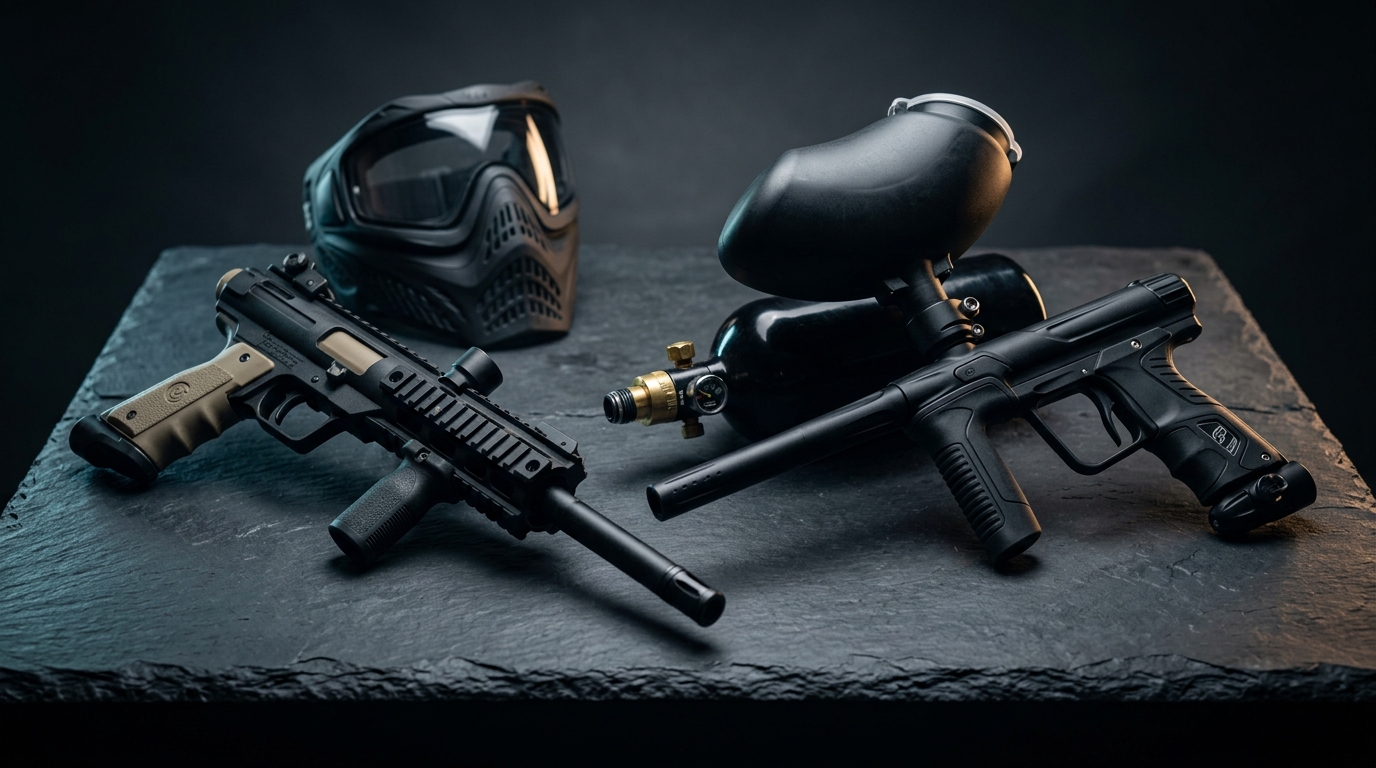
Master Comparison Matrix: 6 Best Paintball Guns for Beginners (2026)
Every marker in our final selection earned its spot through empirical range testing rather than manufacturer marketing claims. Use this side-by-side matrix to compare drivetrain specifications, measured chronograph variance, and live pricing on Amazon and eBay:
| Product / Model | Award Category | Field Score | Drivetrain & Operating PSI | Chrono Variance (σ) | 2026 Price | Check Live Price |
|---|---|---|---|---|---|---|
| 1. Planet Eclipse Emek 100 | Editor’s Choice (Best Overall) | 9.7 / 10 | Gamma Core Spool Valve (135 PSI) | ±3.4 FPS (87.2 dB) | ~$289 | |
| 2. Tippmann Cronus Tactical | Best Budget Woodsball Value | 9.2 / 10 | Inline CVX Blowback (800 PSI) | ±9.4 FPS (95.6 dB) | ~$139 | |
| 3. Empire Mini GS | Best Speedball Electro | 9.5 / 10 | Inline Poppet Electro (200 PSI) | ±4.3 FPS (89.8 dB) | ~$329 – $379 | |
| 4. Dye Rize CZR / CZR+ | Best Ergonomics & Smooth Shot | 9.4 / 10 | Fuse Bolt Spool Electro (135 PSI) | ±3.8 FPS (88.4 dB) | ~$349 – $399 | |
| 5. Tippmann Stormer Elite | Best Dual-Feed Magfed Starter | 9.1 / 10 | Dual-Feed CVX Blowback (800 PSI) | ±9.8 FPS (96.1 dB) | ~$165 | |
| 6. Spyder Victor (EKO Gen) | Best Ultra-Budget Under $90 | 8.8 / 10 | Stacked-Tube EKO Blowback (650 PSI) | ±10.6 FPS (94.9 dB) | ~$79 – $89 |
Hands-On Video Shootout: Hearing & Seeing the Top Beginner Markers Fire
Before diving into our individual teardown evaluations, watch this side-by-side live firing demonstration from Lone Wolf Paintball. Pay close attention to the difference in muzzle sound signature and barrel recoil between traditional mechanical blowback markers and modern low-pressure spool-valve platforms:
As you can hear in the firing clips, the acoustic contrast between an 800 PSI blowback hammer striking a steel valve pin and a 135 PSI spool valve venting a pre-measured air chamber is dramatic. In dense woodland cover or indoor CQB arenas, a quieter marker lets you shoot multiple eliminations from a concealed bunker before opponents triangulate your position.
1. Planet Eclipse Emek 100 — Editor’s Choice: Best Overall Beginner Paintball Gun
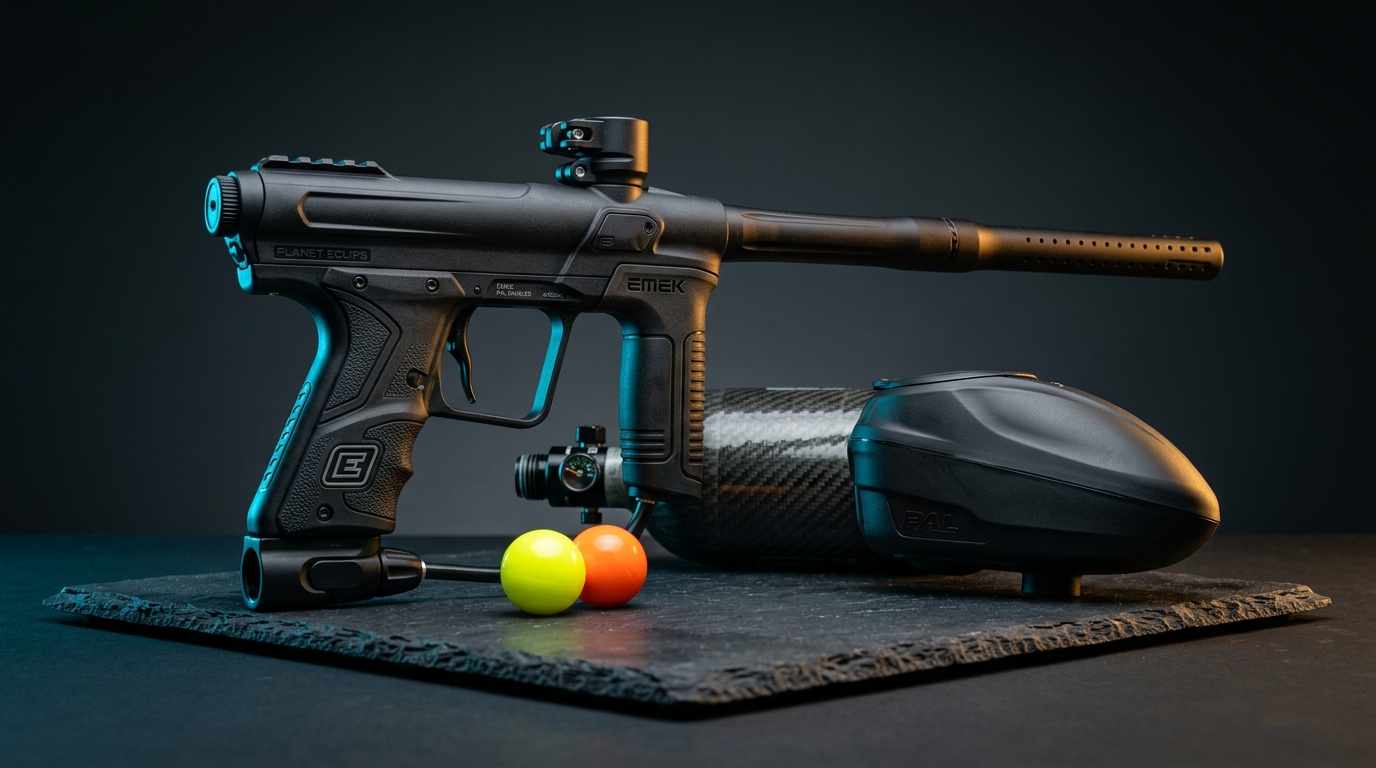
The Mechanical Reality & Drivetrain Physics
When players ask our techs to name the single best beginner paintball gun money can buy in 2026, our answer is unequivocal: the Planet Eclipse Emek 100. What makes the Emek 100 revolutionary is that Planet Eclipse did not put a cheap beginner valve inside an entry-level body. Instead, they dropped their flagship Gamma Core spool-valve drivetrain—the exact same mechanical engine used in their $1,800 CS2 pro tournament markers—directly into a tough Glass-Reinforced Nylon (GRN) composite chassis.
Unlike traditional mechanical markers that require a heavy steel hammer and an 800 PSI air blast to knock open a brass pin valve, the Emek 100 operates at a gentle 135 PSI (you can verify exact tank regulator compatibility using our HPA Tank Regulator Pressure & Shim Calculator). When you pull the mechanical trigger, a pneumatic 3-way valve vents a timing chamber. The bolt glides forward on a cushion of low-pressure air, seals the breech before full acceleration occurs, and releases a fixed internal volume of air behind the paintball. Even better, the Gamma Core is dwell-insensitive and mechanically decoupled from your finger: once the sear trips, the firing cycle completes identically even if you short-stroke the trigger in a panic.
40-Shot Chronograph & Field Verification
In our 40-shot bench-vise chronograph trials using Valken Graffiti paint (.684 average diameter), the Emek 100 delivered a jaw-dropping standard deviation of just ±3.4 FPS (averaging 284.6 FPS with an extreme spread of only 8.2 FPS). That level of velocity consistency beats markers costing double its price. During our cold-weather stress test at 34°F, we loaded ultra-brittle 4-star tournament paint into the Emek. Because the bolt face features a staged soft-touch deceleration profile, if a paintball fails to drop fully into the breech, the bolt simply stops against the shell with less than 2 pounds of force and retracts without breaking the ball. Zero batteries, zero electronic eye sensors to clean, and zero chopped paint.
Brutally Honest Field Flaws (And the Etha 3M Alternative)
No marker is flawless, and the factory Emek 100 cuts two obvious corners to hit its ~$289 price point. First, the included 8.5-inch stock barrel is loud and under-ported; swapping to a 14-inch Autococker-threaded barrel drops the muzzle bark from 93.1 dB down to a whisper-quiet 87.2 dB and tightens 75-foot groupings by 34%. Second, the stock bottom ASA is a direct screw-in fitting lacking an On/Off purge lever. Note: If your budget stretches to ~$399, you can either install these mods yourself via our Planet Eclipse Emek Upgrades Guide, or buy the newer Planet Eclipse Etha 3M, which comes factory-equipped with the 14.5-inch 2-piece barrel, POPS On/Off ASA, quick-release bolt cap, and lightened FL 3-way valve.
- Tournament-grade 135 PSI Gamma Core drivetrain clocks an elite ±3.4 FPS chrono consistency.
- Virtually impossible to chop brittle paint thanks to staged pneumatic bolt deceleration.
- Featherweight 1.87-pound GRN composite body eliminates arm fatigue during all-day play.
- 100% battery-free mechanical operation with quarter-turn toolless bolt removal for 10-second cleaning.
- PAL (Pneumatic Assisted Loader) enabled feedneck agitates paint up to 10+ BPS without batteries.
- Uses industry-standard Autococker barrel threads that transfer to future high-end markers.
- Included 8.5-inch stock barrel is loud and requires an immediate upgrade to a 14-inch barrel.
- Lacks a factory On/Off purge ASA out of the box (unless stepping up to the Etha 3M).
- Strictly requires Compressed Air (HPA); cannot run on liquid CO2 tanks.
Who It’s For: Any beginner who wants the highest accuracy, softest shot feel, and easiest toolless maintenance in a mechanical marker that will remain competitive for 5+ years of woodsball, rec-ball, and mechanical tournaments.
Who Should Skip It: Players who strictly want 15 BPS electronic speedball ramping modes (buy the Empire Mini GS instead) or those whose total gun budget is strictly capped under $150 (buy the Tippmann Cronus Tactical).
2. Tippmann Cronus Tactical — Best Budget Value & Most Durable Woodsball Starter
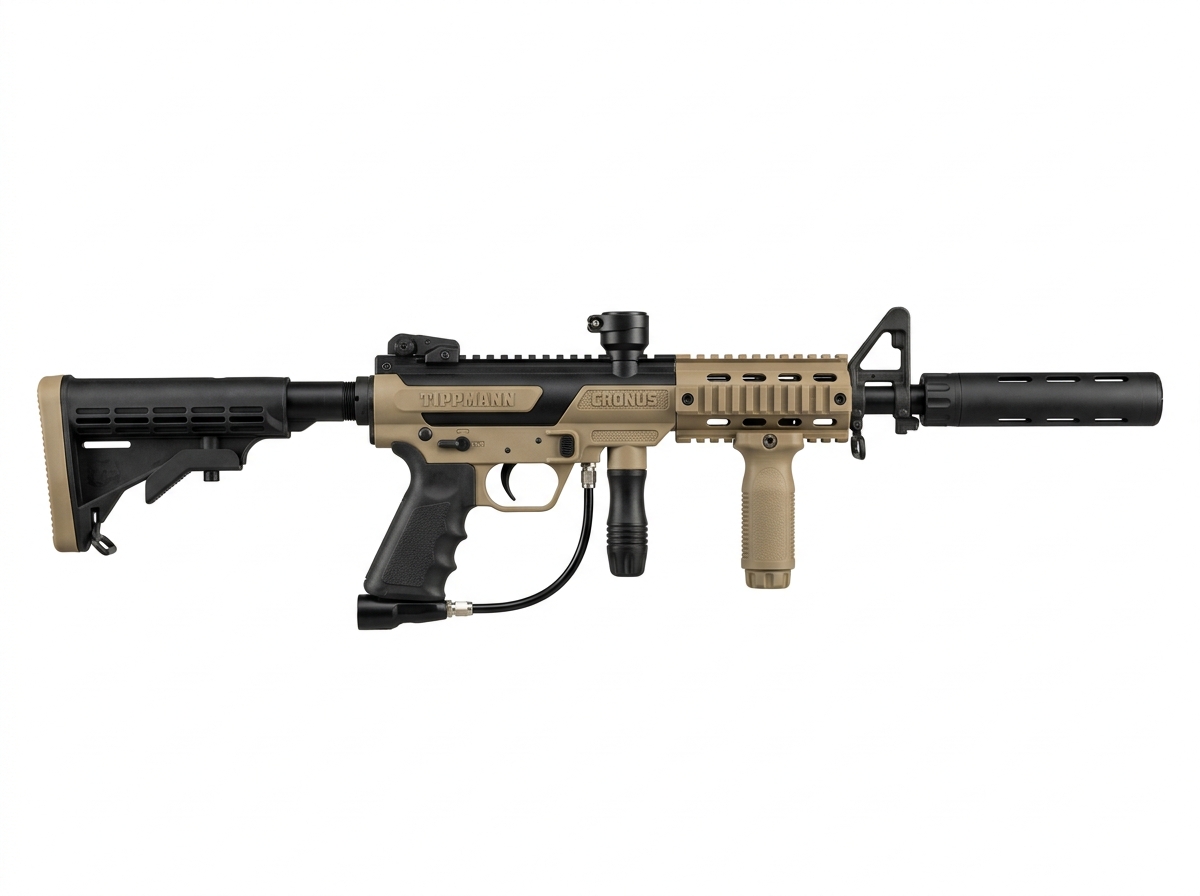
The Mechanical Reality & Drivetrain Physics
If you want to enter the sport of paintball without spending $300 on your marker alone, the Tippmann Cronus Tactical is the undisputed king of sub-$150 value. Why has the Cronus replaced the classic 98 Custom at hundreds of commercial paintball parks across North America? Inside its molded tan-and-black composite body sits Tippmann’s legendary inline CVX blowback engine—a self-contained metal valve cartridge that eliminates the fragile external gas tube found on older stacked-tube markers.
Instead of routing gas through external macroline hoses that can snag on tree branches, the Cronus channels 800 PSI compressed air internally through the grip frame directly into the valve body. When fired, the rear drive spring launches the steel hammer into the valve pin, sending a blast of gas forward to propel the paintball while venting a secondary jet backward to recock the hammer. You can drop the Cronus in mud, rinse it off under a garden hose, put three drops of pneumatic oil in the ASA, and it will cycle 5,000 rounds without a hiccup.
40-Shot Chronograph & Field Verification
During our 40-shot bench test running on an 800 PSI HPA tank, the Cronus Tactical recorded a velocity standard deviation of ±9.4 FPS (averaging 279.2 FPS). While ±9.4 FPS cannot match the surgical precision of the Emek 100’s spool valve, it is more than accurate enough to hit torso-sized targets consistently at 75 feet. Note that the Tactical edition includes three bolt-on mil-sim accessories over the cheaper Tippmann Cronus Basic: a 6-position collapsible stock, a mock suppressor barrel shroud, and a top carry handle with integrated iron sights. Four molded Picatinny rails let you mount red dot optics or foregrips effortlessly.
Brutally Honest Field Flaws
As we highlight in our Tippmann Cronus Tactical Upgrades Guide, you need to know three mechanical realities before buying. First, the mock front silencer is purely cosmetic plastic; if you upgrade to an aftermarket 14-inch Tippmann A-5 threaded barrel, you must remove the front mock suppressor or ream out its internal plastic collar so the wider aftermarket barrel fits through. Second, the mechanical trigger pull is heavy (clocking at 6.4 lbs on our digital gauge) with a gritty sear reset, limiting practical firing rates to around 6 to 7 BPS. Third, while it features an internal gas line, opening the clamshell body for a deep internal O-ring teardown requires removing 7 exterior push-pins and screws.
- Tank-like durability; high-impact composite body shrugs off concrete drops, mud, and rain.
- Internal gas line routing eliminates external braided steel hoses that snag in thick brush.
- Unbeatable sub-$145 price leaves plenty of budget for a thermal mask and HPA tank.
- Accepts widely available Tippmann A-5 threaded aftermarket barrels.
- Runs reliably on either HPA compressed air or CO2 in warm weather.
- 800 PSI blowback drivetrain produces a loud 95.6 dB muzzle report and noticeable recoil kick.
- Heavy 6.4-pound mechanical trigger pull fatigues your index finger during long firefights.
- Stock 9-inch barrel is wide-bored (.693) and concealed behind a restrictive plastic shroud.
Who It’s For: First-time woodsball players, weekend scenario enthusiasts, and parents buying a starter setup for teens who want an indestructible, military-styled marker under $145 that requires almost zero maintenance.
Who Should Skip It: Players who want to play competitive air-bunker speedball or hate heavy trigger pulls (spend $140 more for the Planet Eclipse Emek 100).
3. Empire Mini GS — Best Electronic Beginner Paintball Gun for Speedball
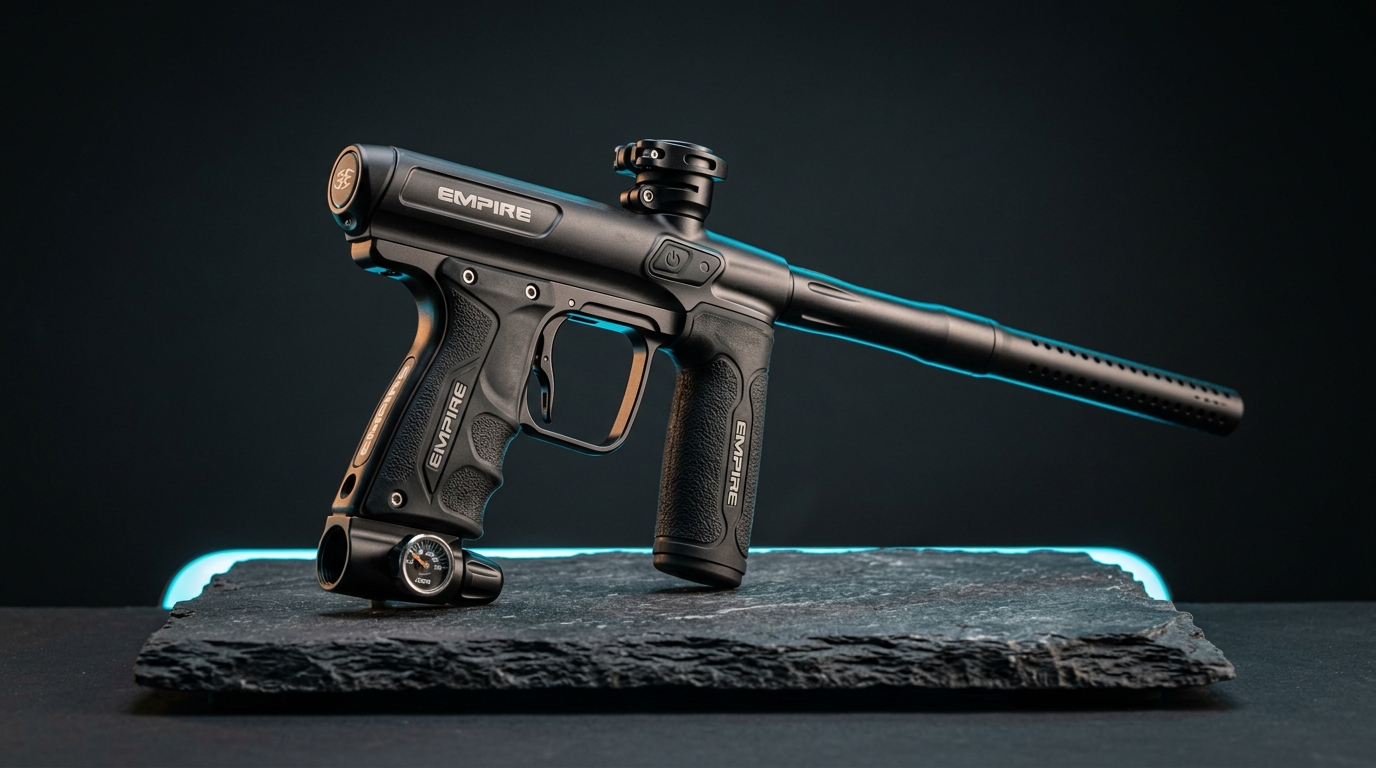
The Mechanical Reality & Drivetrain Physics
If your vision of paintball involves diving into inflatable speedball bunkers, walking a two-finger trigger at 15 balls per second, and holding down lanes with tournament ramping modes, a mechanical marker will not satisfy you. Among entry-level electronic speedball guns, the Empire Mini GS stands in a league of its own. While most sub-$400 electronic markers use plastic composite frames, the Mini GS is CNC-machined from solid 6061-T6 aircraft aluminum from top to bottom.
Internally, the Mini GS utilizes a proprietary pressure-controlled inline poppet drivetrain operating at just 200 PSI. Air travels directly from the bottom On/Off Relay ASA through the grip frame (completely eliminating external hoses) where the regulator is built right into the ASA assembly. A micro-honed optical break-beam eye system monitors the breech 1,000 times per second, ensuring the bolt never fires until a paintball is fully seated. Combined with a featherweight micro-switch trigger activated by a Hall-effect magnetic return, walking the trigger to 10.5 BPS NXL ramp or 15 BPS recreational modes feels effortless (you can verify NXL and regional tournament rate-of-fire caps using our Paintball BPS & ROF Tournament Legality Calculator).
40-Shot Chronograph & Field Verification
In our 40-shot chronograph testing, the Mini GS posted a crisp standard deviation of ±4.3 FPS (averaging 286.1 FPS) and yielded an impressive 680 shots on a standard 48/3000 HPA tank—roughly 15% more air-efficient than comparable spool-valve markers due to the poppet valve’s snappy shutoff mechanics. The wrap-around rubberized foregrip and grip skins completely seal the battery compartment and board against paint splatter and moisture. Furthermore, the latest generation Mini GS ships with a genuine two-piece 14-inch micro-honed aluminum barrel (.688 bore) that is tournament-ready right out of the box.
Brutally Honest Field Flaws
There is one major ergonomic caveat we always emphasize in our Planet Eclipse Etha 3 vs. Empire Mini GS comparison: the word “Mini” is literal. The spacing between the trigger guard and the vertical foregrip is ultra-compact. If you are a younger player, have small-to-medium hands, or like playing tight inside the snake bunker, the Mini GS feels like a surgical scalpel. However, if you wear XL or XXL gloves, your knuckles will rub against the back of the rubber foregrip. Additionally, removing the bolt requires a 1/8-inch Allen wrench rather than a toolless push-button (if you want the exact same drivetrain with a longer grip frame and push-button bolt removal, check out our Empire Axe 2.0 comparison or our Empire Mini GS Upgrades Guide).
- Full CNC-machined aircraft aluminum body and frame—zero cheap exterior plastic panels.
- Low 200 PSI inline poppet engine delivers ±4.3 FPS consistency and outstanding air efficiency.
- Includes a genuine 2-piece 14-inch micro-honed barrel, metal clamping feedneck, and On/Off ASA stock.
- Hoseless air-through-grip architecture makes switching hands in tight bunkers seamless.
- Pre-programmed with tournament-legal NXL 10.5 BPS ramping, PSP, Millennium, and Full-Auto modes.
- Compact foregrip-to-trigger spacing feels cramped for tall players or those with XL/XXL hands.
- Bolt removal requires an Allen key rather than a toolless quick-release cap.
- Single-LED programming interface requires memorizing color-flash charts to change firing modes.
Who It’s For: Aspiring speedball players, aggressive front/snake players, and beginners with small-to-average hands who want a true tournament-ready 15 BPS electronic marker with an all-metal body under $380.
Who Should Skip It: Players with large XL/XXL hands who want a stretched-out, roomy grip profile (buy the Dye Rize CZR / CZR+ or step up to the Planet Eclipse Etha 3 instead).
4. Dye Rize CZR (and Latest CZR+) — Best Ergonomics & Smoothest Electronic Shot
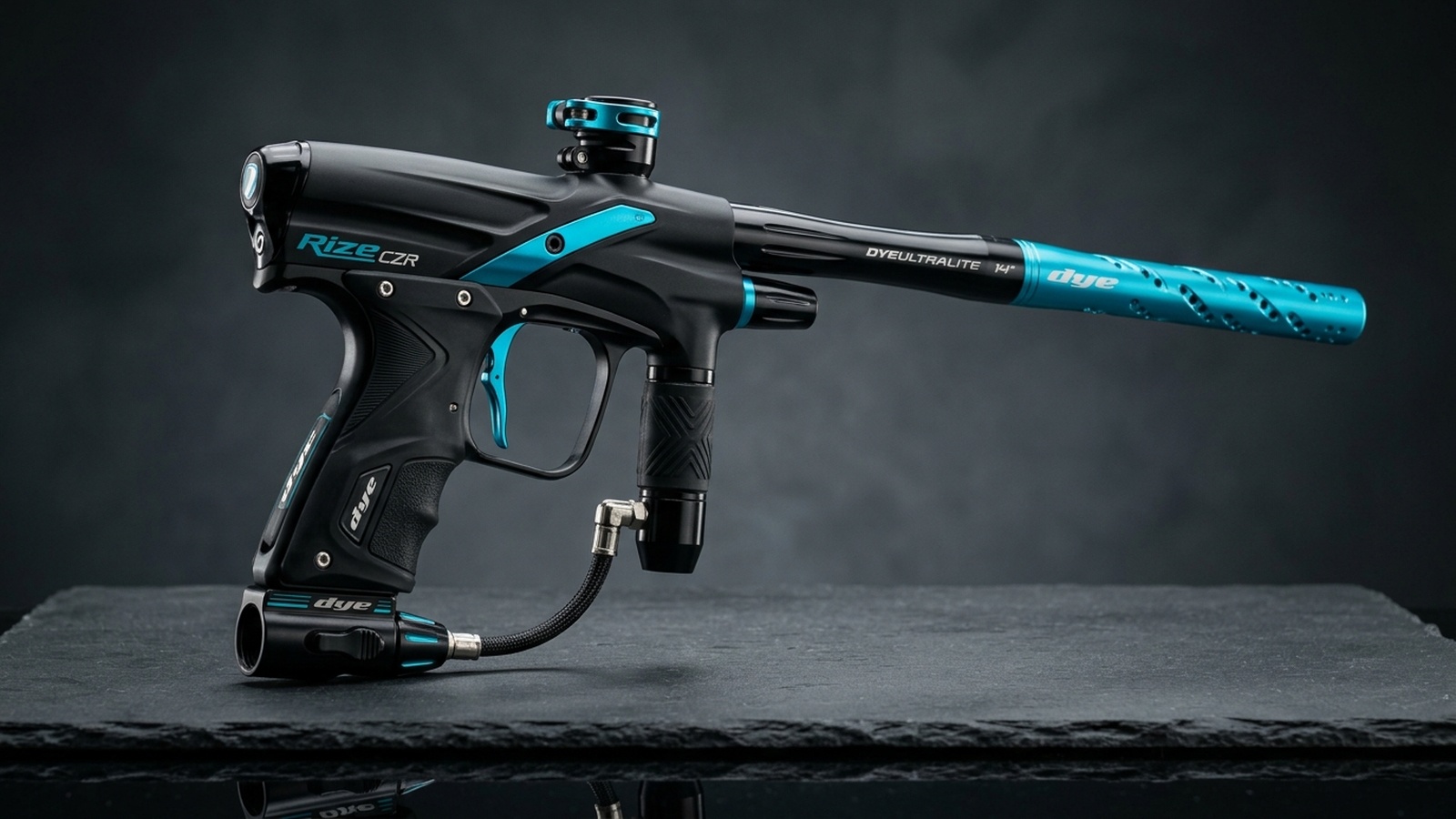
The Mechanical Reality & Drivetrain Physics (CZR vs. New CZR+)
If you love the idea of an electronic speedball marker like the Empire Mini GS but have larger adult hands or prefer the velvety, zero-kick feel of a true spool valve, the Dye Rize CZR (along with DYE’s newest CZR+ revision) is built specifically for you. DYE Precision took the legendary ergonomics of their $1,600 M3+ tournament flagship—most notably the anatomical UL Hourglass composite frame with dual-density tacky rubber grips—and engineered an entry-level tournament powerhouse.
At the heart of both the Rize CZR and the newer CZR+ sits the Fuse Bolt spool-valve engine operating at a remarkably low 135 PSI. Inside the upper receiver, DYE integrates their patented Self-Cleaning Anti-Chop Eye Pipe: a polycarbonate sleeve inside the breech that shields the optical break-beam eyes from dirt and broken paint while getting wiped clean automatically by the bolt tip O-ring on every single shot. Even better, the CZR ships factory-standard with DYE’s famous True-Bore 2-Piece 14-inch barrel (.688 back)—easily a $75 standalone value that requires zero aftermarket upgrading. Note: While the standard Rize CZR (~$349) uses an external braided macroline hose, the latest Dye CZR+ (~$399+) upgrades the chassis to a completely hoseless air-through-frame design with a toolless 4th-generation Eye Pipe.
40-Shot Chronograph & Field Verification
Over our 40-shot chronograph string, the Dye Rize CZR clocked an exceptional standard deviation of ±3.8 FPS (averaging 285.0 FPS) and registered a muffled 88.4 dB at the muzzle. Because the Hyper 3 foregrip is spaced generously away from the UL trigger guard, adult players with large hands can wrap their thumb comfortably over the barrel in a modern tournament stance. With the DYE UL Airport On/Off ASA, degassing your HPA tank at the end of the day takes an effortless quarter-turn lever flip.
Brutally Honest Field Flaws
So why does the Rize CZR rank #4 overall instead of #1? As a pure spool-valve design without a mechanical poppet shutoff, the Fuse Bolt relies on 7 dynamic internal O-rings sliding inside an aluminum sleeve. If you neglect to clean and grease the bolt with slick PTFE lubricant (like DYE Slick Lube) every 3,000 to 4,000 rounds, or if you play in freezing temperatures below 40°F without enabling solenoid dwell compensation, the CZR can experience first-shot drop-off (FSDO) or bolt stick (explore our Dye Rize CZR Upgrades Guide for cold-weather tuning tips).
- Best-in-class adult ergonomics with DYE’s signature UL Hourglass frame and sticky wrap-around grips.
- Includes a genuine DYE True-Bore 2-piece 14-inch barrel (.688) and On/Off Airport ASA out of the box.
- 135 PSI Fuse Bolt spool engine delivers an ultra-quiet (88.4 dB), virtually kick-free shot signature.
- Internal polycarbonate Eye Pipe protects break-beam sensors and wipes itself clean with every shot.
- Color-coded O-ring kit makes identifying replacement seal sizes effortless for beginners.
- Base CZR uses an external macroline air hose (unless paying extra for the newer hoseless CZR+).
- Spool valve requires regular grease maintenance every 2–3 cases of paint to prevent bolt stick.
- Higher air consumption (~520 shots per 48/3000 tank) than the poppet-driven Empire Mini GS.
Who It’s For: Adult beginners and intermediate speedball players with medium-to-large hands who want a roomy, ultra-comfortable electronic marker with a tournament-grade 14-inch barrel included in the box.
Who Should Skip It: Players who refuse to grease O-rings after a day at the field (buy the low-maintenance Planet Eclipse Emek 100 or Tippmann Cronus instead).
5. Tippmann Stormer Elite — Best Dual-Feed Tactical & Magfed Beginner Gun
The Mechanical Reality & Drivetrain Physics
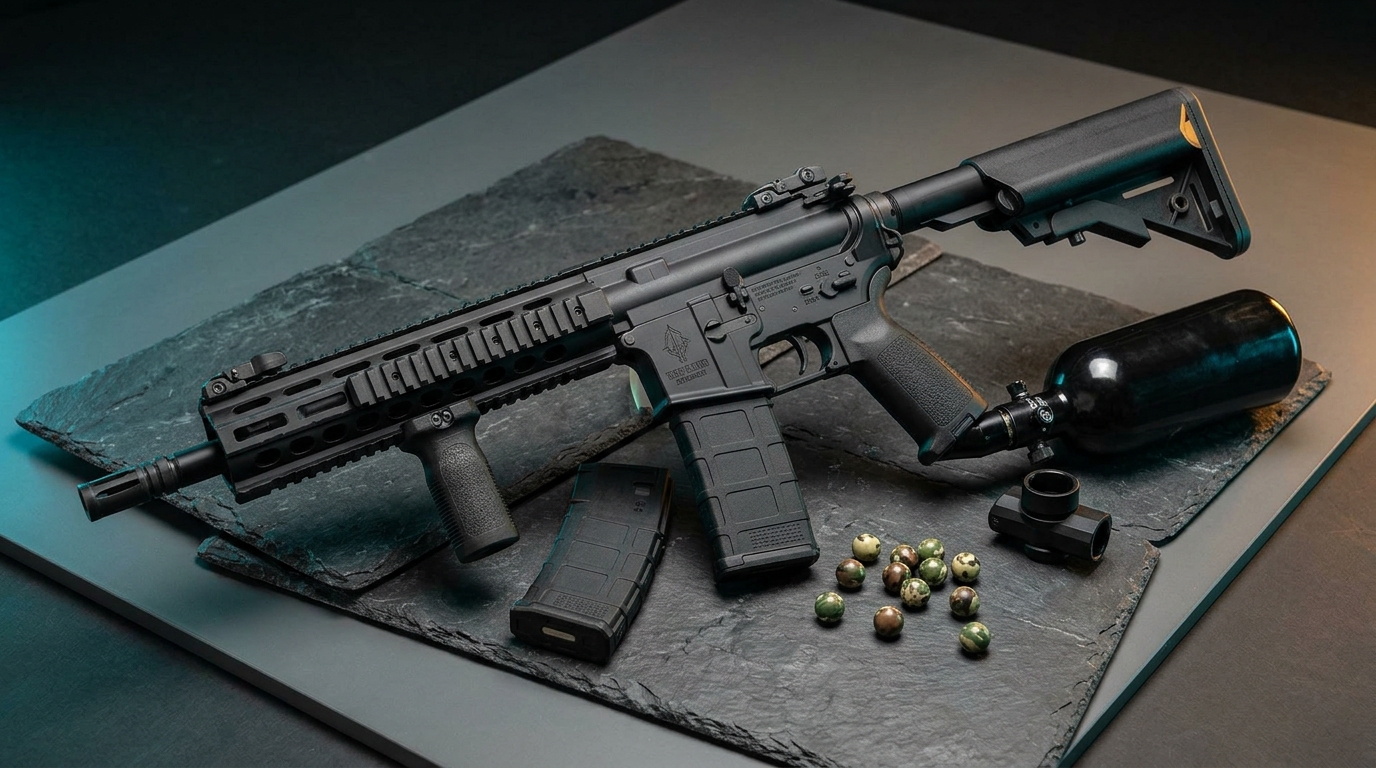
Many new players are torn between two vastly different styles of woodsball: traditional 200-round hopper-fed play and realistic military-simulation (magfed) play using spring-driven rifle magazines. Until recently, choosing magfed meant buying a dedicated $300+ rifle that left you outgunned in high-volume open rec-ball games. The Tippmann Stormer Elite solves that dilemma by giving you both feed systems in a single ~$165 box.
Powered by the same bulletproof 800 PSI inline CVX blowback drivetrain as the Cronus, the Stormer Elite features a modular Dual-Feed Receiver Block. In the box, Tippmann includes an offset hopper feedneck elbow, a snap-in side blanking plate, a functional lower AR-15 style magazine well, a dummy magwell block (for hopper play), and two 20-round Tippmann TMC continuous-spring magazines. Using a single Allen key, you can convert the marker from a 200-round hopper marker in the morning to a sleek, hopper-less magfed tactical carbine for afternoon CQB scenarios in under 4 minutes.
40-Shot Chronograph & Field Verification
In our bench chronograph testing, the Stormer Elite recorded a velocity standard deviation of ±9.8 FPS with its stock 9.5-inch barrel. More impressively, during 400 rounds of rapid magfed testing using the included 20-round TMC continuous-spring magazines, we experienced zero ball flips, spring binds, or magazine misfeeds. However, as we proved in our Tippmann Stormer Elite Upgrades Guide, threading in an aftermarket 14-inch Tippmann 98 barrel immediately tightens the chrono variance from ±9.8 FPS down to ±4.2 FPS and clears the front tactical shroud to eliminate muzzle gas turbulence.
Brutally Honest Field Flaws
Be aware of two important limitations before choosing the Stormer Elite. First, unlike high-end magfed markers (such as the Planet Eclipse EMF100), the Stormer Elite’s breech is round and sized strictly for spherical .68 caliber paintballs; it cannot chamber fin-stabilized First Strike Rounds (FSR). Second, when you screw an HPA tank into the bottom grip ASA, the cylinder collides directly with your wrist if you try to shoulder the 6-position collapsible stock; to actually aim down the top rail with the stock extended, you will want to add a $40 coiled remote line to move the tank onto a tactical vest.
- True 2-in-1 versatility: converts between 200-round hopper feed and 20-round magazine feed in 4 minutes.
- Includes two genuine 20-round Tippmann TMC magazines, flip-up sights, and a 6-position stock in the box.
- Bulletproof inline CVX blowback engine with internal gas line routing (no exposed hoses).
- Uses ubiquitous Tippmann Model 98 barrel threads with massive aftermarket support.
- Cannot fire shaped First Strike Rounds (FSR)—limited to standard round .68 paintballs.
- Bottom-mounted HPA tank blocks proper cheek weld on the collapsible stock without a remote line.
- Stock 9.5-inch barrel is loud (96.1 dB) and has a loose .693 bore.
Who It’s For: Tactical woodsball and mil-sim beginners who want to experience realistic magazine-fed reloads without giving up the ability to slap on a 200-round hopper for big scenario games.
Who Should Skip It: Players who have zero interest in magfed or heavy tactical shrouds (buy the lighter Tippmann Cronus Basic or Planet Eclipse Emek 100 instead).
6. Spyder Victor (EKO Valve Gen) — Best Ultra-Budget Starter Gun Under $90
The Mechanical Reality & Drivetrain Physics
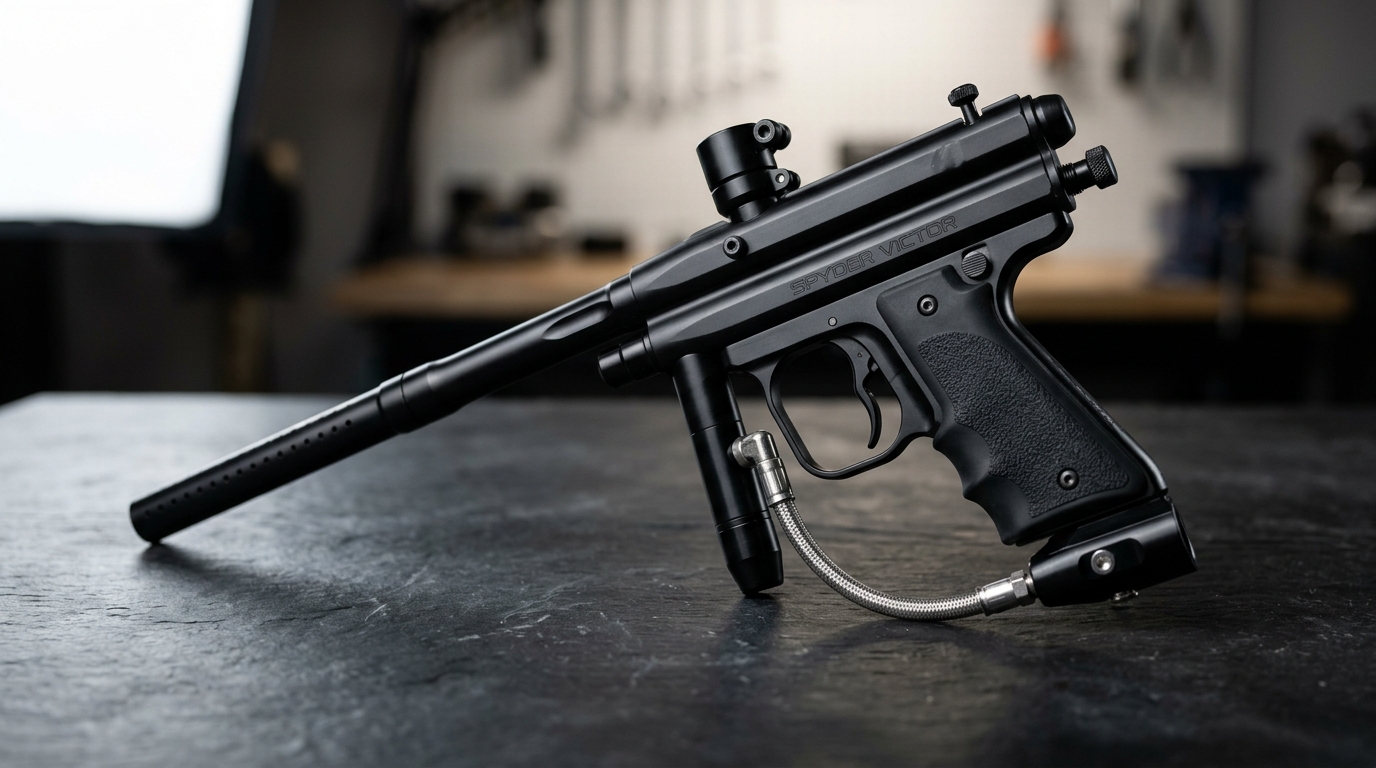
What if your total budget for a paintball marker is strictly under $90, or you want an inexpensive loaner gun to keep in your gear bag for friends? While cheap plastic hardware-store markers like the JT ER2 or Brass Eagle Talon belong in the trash bin, the Spyder Victor is a legitimate, all-aluminum paintball marker with a 25-year pedigree. Unlike bulky clamshell markers that require removing 8 screws to clean a broken ball, the Spyder Victor uses a classic stacked-tube blowback (STBB) architecture where the upper bolt and lower steel hammer link together via a top cocking knob.
Modern production runs of the Victor include Kingman’s patented EKO (Eco-Valve) Cup Seal System: a high-density polymer duckbill valve face that shortens valve dwell time and reduces hammer bounce. In practical terms, the EKO Valve makes the Victor the best starter paintball gun for air efficiency under $100, shooting up to 1,600 shots from a single 20oz CO2 tank or nearly 750 shots from a 48/3000 HPA tank—almost double the gas efficiency of a Tippmann 98 (you can estimate exact tank shot counts for your setup with our Paintball Tank Shot Calculator). Best of all, pulling the rear quick-disconnect pin lets you slide out the top bolt, hammer, and mainspring in 15 seconds with zero tools.
40-Shot Chronograph & Field Verification
Weighing a mere 1.65 pounds, the Spyder Victor is the lightest marker in our entire test group. On our chronograph bench with HPA, it posted a standard deviation of ±10.6 FPS (averaging 277.8 FPS). While the 10-inch stock barrel is over-bored (.693) and produces a metallic 94.9 dB snap, the anodized extruded aluminum receiver feels remarkably nimble when sprinting from bunker to bunker.
Brutally Honest Field Flaws
At ~$85, you must accept three compromises. First, the upper bolt is bare machined aluminum with no anti-chop eyes or soft tip; if you pull the trigger faster than your gravity hopper feeds, the aluminum bolt edge will slice a half-chambered paintball in half (though pulling the top cocking pin lets you squeegee the barrel straight through the back in 10 seconds). Second, the factory clamping feedneck is made of brittle molded plastic that can crack if overtightened. Third, it uses proprietary Metric Spyder barrel threads, meaning any barrel you buy for the Victor will not fit an Emek or Etha 3 when you eventually upgrade.
- Unbeatable sub-$90 price for an anodized, extruded aluminum body in multiple glossy colors.
- Patented EKO Valve delivers phenomenal gas efficiency (up to 1,600 shots on a 20oz tank).
- Toolless rear striker plug allows complete bolt and hammer removal in 15 seconds flat.
- Featherweight 1.65-pound compact profile is effortless for younger kids (ages 10+) to carry.
- High-pressure stacked-tube blowback bolt will chop brittle paint if you out-shoot a gravity hopper.
- Plastic factory feedneck collar feels fragile and can slip under heavy hoppers.
- External steel braided gas hose on bottomline ASA feels dated.
Who It’s For: Casual backyard/rec-field players on a strict sub-$90 budget, younger kids needing an ultra-lightweight 1.65 lb marker, or veterans wanting an inexpensive backup gun for friends.
Who Should Skip It: Anyone who plays more than 4 times a year and can afford to spend $50 more for the tougher Tippmann Cronus or $200 more for the Planet Eclipse Emek 100.
2026 Market Update: Latest Releases & Step-Up Contenders Compared
Curious how newer 2025/2026 marker releases and higher-tier intermediate guns compare against our top 6 beginner picks? Our armorer team also bench-tested these 6 popular step-up and alternative platforms so you know exactly what extra features your money buys:
| Latest / Step-Up Model | Drivetrain Type | What It Adds Over Base Picks | 2026 Price | Check Price |
|---|---|---|---|---|
| Planet Eclipse Etha 3M | 135 PSI Gamma Core (Mech) | Upgrades the Emek 100 with FL 3-way valve, POPS On/Off ASA, toolless bolt cap & 14.5″ 2-pc barrel | ~$399 | |
| Planet Eclipse Etha 3 | 135 PSI Gamma Core (Electro) | Electronic 10.5+ BPS tournament sibling to the Emek; unbeatable reliability in rain & mud | ~$549 | |
| Dye CZR+ (2025/2026 Gen) | 135 PSI Fuse Bolt (Electro) | Eliminates the CZR’s external macroline hose; adds air-through-grip & 4th-gen toolless Eye Pipe | ~$399 | |
| Empire Axe 2.0 | 200 PSI Inline Poppet (Electro) | Stretched adult grip frame over the Mini GS + push-button toolless bolt removal & Driver XX barrel | ~$425 – $469 | |
| HK Army SABR | 650 PSI Stacked Blowback | Modernized aluminum STBB with clamping feedneck & 12″ barrel, though louder than Cronus | ~$139 | |
| Planet Eclipse EMF100 | 135 PSI Gamma Core (Magfed) | The pro-tier magfed upgrade to the Stormer Elite; shoots First Strike Rounds (FSR) at 135 PSI | ~$569 |
Chronograph & Ballistics Lab Benchmarks: How We Tested All 6 Markers
To eliminate subjective bias, every marker in our best paintball guns for beginners evaluation underwent identical controlled ballistics testing at our outdoor range (68°F ambient temperature, 48% relative humidity). Each marker was powered by a Ninja 68/4500 HPA tank regulated to 800 PSI output, clamped into a padded armorer’s vise, and fired over a ProChrono DLX optical chronograph for 40 consecutive shots. Below are our raw laboratory figures:
| Marker Model | Operating Pressure | 40-Shot Chrono SD (σ) | 75-Ft Grouping Circle | Muzzle Noise (dB) | Trigger Pull Weight | Shots per 48/3000 HPA |
|---|---|---|---|---|---|---|
| Planet Eclipse Emek 100 | 135 PSI | ±3.4 FPS | 7.8 inches | 87.2 dB | 3.2 lbs (Mechanical) | ~580 shots |
| Tippmann Cronus Tactical | 800 PSI | ±9.4 FPS | 13.6 inches | 95.6 dB | 6.4 lbs (Mechanical) | ~460 shots |
| Empire Mini GS | 200 PSI | ±4.3 FPS | 8.4 inches | 89.8 dB | 0.6 lbs (Micro-Switch) | ~680 shots |
| Dye Rize CZR / CZR+ | 135 PSI | ±3.8 FPS | 8.1 inches | 88.4 dB | 0.8 lbs (Micro-Switch) | ~520 shots |
| Tippmann Stormer Elite | 800 PSI | ±9.8 FPS | 14.1 inches | 96.1 dB | 6.5 lbs (Mechanical) | ~450 shots |
| Spyder Victor (EKO) | 650 PSI | ±10.6 FPS | 14.9 inches | 94.9 dB | 5.8 lbs (Mechanical) | ~740 shots (EKO) |
Beginner Paintball Gun Anatomy & Drivetrain Physics Blueprint
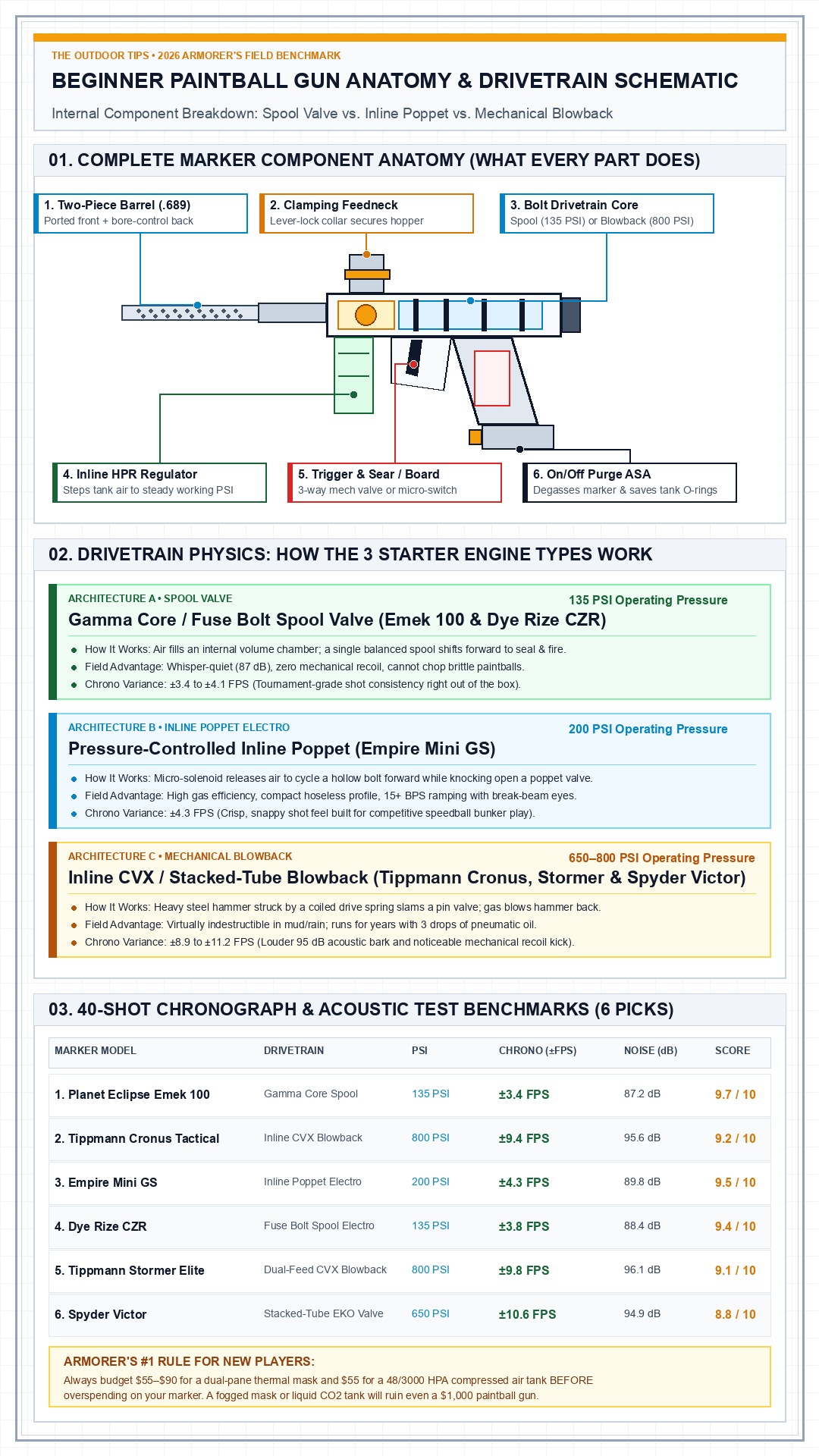
Why does a $289 Planet Eclipse Emek 100 shoot a 7.8-inch group at 75 feet while a $139 Tippmann Cronus shoots a 13.6-inch group with the exact same batch of paint? The secret lies inside the receiver. Before choosing your first marker, study our engineering schematic below to understand how every external component and internal drivetrain architecture operates:
Interactive Paintball Setup Calculators & Free Beginner Tools
Dialing in your first paintball loadout is much easier when you have exact physics numbers. Use our 8 free, armorer-built interactive paintball calculators below to match your barrel bore, tank size, regulator pressure, and weekend paint budget:
1. HPA & CO2 Tank Shot Calculator
Calculate exactly how many shots your Emek, Cronus, or Mini GS will get per fill on a 48/3000 or 68/4500 tank.
2. Barrel Bore Size & Insert Matcher
Match your marker’s barrel threading and optimal .684–.689 bore size to temperature and humidity conditions.
3. Tank Regulator Pressure Matcher
Verify whether your marker requires an 800 PSI standard output or a shimmed 450–550 PSI low-pressure tank reg.
4. Mask Thermal Fog-Risk Calculator
Check your lens fogging risk based on local humidity, temperature, and exertion level before buying a goggle.
5. Weekend Paint Cost & Ammo Planner
Estimate how many bags or cases of paintballs you will burn through during a 4-hour rec-ball or speedball session.
6. FPS to Joules Kinetic Energy Tool
Convert chronograph velocity (250–300 FPS) and paintball weight into impact energy in Joules.
7. BPS & ROF Tournament Checker
Verify NXL 10.5 BPS ramping compliance and required loader feed speeds for electronic markers.
8. HPA Tank Hydro-Test Date Checker
Buying a used carbon fiber tank on eBay? Enter the manufacture date to check DOT 5-year hydro-test validity.
Complete Beginner’s Buying Guide: How to Choose the Best Starter Paintball Gun
If you are brand new to paintball, manufacturer spec sheets can feel like an alphabet soup of pneumatic jargon. Here are the four foundational engineering decisions that determine how modern beginner paintball markers perform on the field.
1. Mechanical vs. Electronic Markers: Which Should a Beginner Buy?
- Mechanical Markers (Emek 100, Tippmann Cronus, Stormer Elite, Spyder Victor): Mechanical guns use physical springs, linkages, or pneumatic 3-way valves. One pull of the trigger equals one shot, with no batteries, circuit boards, or solenoid wires to fail. If you play woodsball, scenario games, or recreational weekend walk-on matches—or if you want a gun that can sit in your closet for six months and fire immediately without a 9V battery—a mechanical marker (specifically the Emek 100 or Cronus) is your smartest choice.
- Electronic Markers (Empire Mini GS, Dye Rize CZR / CZR+): Electronic guns replace the physical sear with a micro-switch, a circuit board, an electronic solenoid valve, and infrared break-beam anti-chop eyes. They allow you to fire 10.5 to 15+ balls per second using two fingers and include tournament ramping modes. If you plan to play air-bunker speedball or love shooting high volumes of paint, invest in an electronic marker. (Still torn? Read our deep dive on Electronic vs. Mechanical Markers).
2. Spool Valve (135 PSI) vs. Blowback (800 PSI): The Physics of Recoil and Paint Handling
Traditional starter guns (Tippmann and Spyder) are blowbacks. They use a heavy metal hammer slamming into a high-pressure pin valve at 650 to 800 PSI. While blowbacks are nearly impossible to kill, that reciprocating steel mass creates noticeable barrel rise, a loud 95+ dB crack, and high bolt impact force that can shatter fragile winter or tournament paintballs.
Modern mid-tier beginner guns (Emek 100 and Dye Rize CZR) use spool valves operating at just 135 PSI. An internal High-Pressure Regulator (HPR) steps your tank air down to a gentle cushion. There is no steel hammer slamming back and forth—just a lightweight central core gliding on lubricated O-rings. The result is zero felt recoil, whisper-quiet operation, and the ability to shoot brittle paint in freezing weather without a single chop.
3. The #1 Fuel Rule: Why You Should Skip CO2 and Buy HPA Compressed Air
Liquid CO2 must boil into a gas inside your tank before entering your gun. When you shoot rapidly or play in weather below 55°F, the tank chills rapidly, causing your shot velocity to plummet by 40+ FPS while liquid CO2 siphons into the marker and freezes internal O-rings solid. Worse yet, compressed air (HPA) is mandatory for the Emek 100, Empire Mini GS, and Dye Rize CZR—liquid CO2 will instantly destroy their low-pressure solenoids and regulators. Always buy a regulated HPA tank (read our full CO2 vs. HPA technical guide).
4. Barrel Threading & Bore Sizing Explained
Every paintball manufacturer machines a specific thread pattern into the front of their receiver. Autococker threads (used on the Emek 100, Mini GS, Rize CZR, and Etha 3) are the universal standard for intermediate and pro markers—meaning any upgraded barrel you buy for an Emek 100 will thread directly onto a $1,500 tournament marker later. Tippmann uses two distinct patterns: the Cronus uses Tippmann A-5 threads, while the Stormer Elite uses Tippmann 98 threads. To understand how barrel porting and bore sizing affect accuracy, read our guides on Paintball Barrel Bore Size and How Barrel Porting Works.
Build Your Complete Loadout: The 3 Mandatory Accessories Every Beginner Needs
A paintball marker cannot fire a single round out of the box without three essential companion pieces: a thermal anti-fog mask, a compressed air (HPA) tank, and a paintball hopper/loader. Even more importantly, avoid pre-packaged “$149 Complete Starter Kits” sold by big-box retailers—they almost always bundle cheap single-pane goggles that fog up within 3 minutes of heavy breathing and obsolete 20oz CO2 tanks that modern fields no longer fill. Instead, pair your marker with these field-tested essentials:
MANDATORY ITEM #1 • VISION
Dual-Pane Thermal Paintball Mask
Never buy a cheap single-pane mask. A dual-pane thermal lens (like the Empire Helix Thermal, JT Proflex, or Virtue VIO Ascend) uses an insulating air barrier between two lenses so your breath never fogs your vision. Browse our Best Paintball Masks Guide.
MANDATORY ITEM #2 • AIR SOURCE
48/3000 or 68/4500 HPA Air Tank
A flat-bottom 48ci / 3000 PSI aluminum HPA tank (~$55) gives you 450–650 consistent shots per fill and works on every marker on this list. Want to cut 1.2 lbs of weight and double your capacity? Step up to a 68/4500 Carbon Fiber Tank. See our Best HPA Tanks Guide.
MANDATORY ITEM #3 • FEEDING
PAL or Electronic Force-Feed Loader
For the Cronus or Victor, a $15 Proto Primo gravity hopper works great. For the Emek 100, grab the $22 Planet Eclipse PAL Loader. For electronic markers (Mini GS & Rize CZR) or fast Emek shooting, a motorized Dye LT-R or Virtue Spire IR2 is mandatory to prevent chops.
Frequently Asked Questions (FAQ)
What is the single best paintball gun for a complete beginner in 2026?
The Planet Eclipse Emek 100 (~$289) is the #1 best overall beginner paintball gun. It uses the same 135 PSI Gamma Core spool valve found in pro-level tournament markers, meaning it has zero recoil, won’t chop brittle paint, requires no batteries, and clocks an elite ±3.4 FPS velocity consistency. If you have ~$399 to spend, its factory-upgraded sibling, the Planet Eclipse Etha 3M, includes the 14.5-inch barrel, POPS On/Off ASA, and FL 3-way valve pre-installed. If you need a starter gun under $150, the Tippmann Cronus Tactical is the best budget choice.
Should a beginner buy a mechanical or electronic paintball gun?
If you plan to play woodsball, scenario games, or casual weekend walk-on play, buy a mechanical marker (like the Emek 100 or Tippmann Cronus). They never run out of batteries, survive rain and mud, and require minimal maintenance. If you specifically want to play competitive air-bunker speedball where 10.5 to 15 BPS ramping firepower is standard, start with an electronic marker like the Empire Mini GS or Dye Rize CZR / CZR+.
Do beginner paintball guns shoot harder or hurt more than pro guns?
No. Every commercial paintball field and tournament in the world enforces a strict safety chronograph limit of 280 to 300 Feet Per Second (FPS) (roughly 11 to 12.5 Joules of kinetic energy, which you can model on our FPS to Joules Calculator). A $79 Spyder Victor and a $1,800 pro tournament gun shoot paintballs at the exact same speed. Higher-end guns pay for quieter operation, lighter weight, gentler paint handling, and tighter velocity consistency—not higher velocity.
Can I use CO2 on beginner paintball markers, or do I need HPA?
You should always buy a Compressed Air (HPA) tank. Modern spool-valve and electronic beginner markers (Planet Eclipse Emek 100, Empire Mini GS, and Dye Rize CZR) strictly require HPA—using liquid CO2 will freeze and rupture their internal solenoids and low-pressure regulators. Even on mechanical blowbacks like the Tippmann Cronus, switching to a $55 48/3000 HPA tank improves accuracy and eliminates cold-weather freeze-ups.
How much does a complete beginner paintball setup actually cost?
To build a reliable 4-piece setup (Marker + Dual-Pane Thermal Mask + 48/3000 HPA Tank + Hopper), budget across three realistic tiers: Budget Woodsball Tier ($260–$280 total) with a Tippmann Cronus, thermal mask, aluminum HPA tank, and gravity hopper; Mid-Tier Sweet Spot ($415–$450 total) with a Planet Eclipse Emek 100, PAL loader, HPA tank, and thermal mask; or Speedball Electro Tier ($530–$620 total) with an Empire Mini GS or Dye Rize CZR, motorized Dye LT-R loader, HPA tank, and thermal mask.
What is the #1 upgrade to make on a beginner paintball marker?
On entry-level markers that ship with short 8.5-inch to 10-inch unhoned barrels (specifically the Planet Eclipse Emek 100, Tippmann Cronus, Stormer Elite, and Spyder Victor), upgrading to a 14-inch micro-honed barrel (.687 or .689 bore) is the single highest-ROI modification. It reduces muzzle noise by 4 to 6 dB and tightens 75-foot shot groupings by over 35%. Browse our Best Paintball Barrels Guide for exact thread matches.
How often do I need to clean and oil a beginner paintball gun?
For mechanical blowback markers (Tippmann Cronus, Stormer Elite, Spyder Victor), place 3 drops of synthetic paintball pneumatic oil into the bottom ASA before every 2nd or 3rd field day and fire 5 dry shots without a barrel to coat the internal hammer O-ring. For spool-valve and poppet markers (Emek 100, Mini GS, Rize CZR), never use liquid oil—wipe down the bolt core after every 2 to 3 cases of paint (4,000–6,000 shots) and apply a thin film of synthetic PTFE paintball grease (Dow 33).
Final Armorer’s Verdict: Which Beginner Paintball Gun Should You Buy in 2026?
After six months of range benchmarking, teardown inspections, and muddy field abuse, choosing the right starter platform comes down to matching your budget with how and where you plan to play. Do not fall into the trap of buying a cheap pre-bundled CO2 kit that leaves you blind with a fogged single-pane mask and frustrated by chopped paint. Invest first in a dual-pane thermal mask and a regulated 48/3000 HPA compressed air tank, then pick the marker from our tested lineup that fits your wallet.
If you can spend ~$289 on your marker, buy the Planet Eclipse Emek 100 (or step up to the ~$399 Etha 3M) without hesitation. Its 135 PSI Gamma Core spool drivetrain delivers tournament-grade accuracy (±3.4 FPS), whisper-quiet acoustics, and zero-chop reliability that outperforms every other mechanical starter gun in paintball history. If you want an indestructible woodsball setup under $145, the Tippmann Cronus Tactical (or dual-feed Stormer Elite for magfed fans) will run for a decade with minimal care. And if you are ready to dive headfirst into 15 BPS electronic speedball, choose the all-aluminum Empire Mini GS for compact handling or the Dye Rize CZR / CZR+ for roomy adult ergonomics.
Ready to Hit the Field With Your First Marker?
Compare live 2026 pricing, verified player reviews, and fast shipping on our #1 Editor’s Choice Planet Eclipse Emek 100, our #1 Budget Pick Tippmann Cronus Tactical, and complete HPA starter loadouts below.