Dye Rize CZR Upgrades: Top Performance Mods Summary
The single most transformative modification for the dye rize czr is pairing it with an electronic agitated loader—specifically the dye ltr loader. Because the CZR’s Fuze spool bolt cycles at 15+ balls per second (BPS), a standard hopper creates catastrophic breech chops. Secondary vital dye rize czr upgrades include transitioning from a bulky 48/3000 tank to an ultralight 68/4500 carbon fiber HPA system (doubling shot count from 600 to 1,150+ rounds), adding precision barrel inserts to optimize the two-piece dye rize czr barrel, fine-tuning the 1.5mm trigger adjustment screws for 10.5 BPS ramping, and keeping spare 4th Gen Eye Pipes and Dye Slick Lube in your pit kit.
#1 Essential CZR Upgrade: Dye Rotor LT-R Electronic Loader
Engineered with patented Rotor centrifugal constant-force feeding technology, the dye ltr loader delivers a blistering 30+ balls per second feed rate on just 3 AA batteries. Features tool-less one-button disassembly, a spring-loaded floor tray, and an anti-jam sharkfin trigger, making it the perfect mechanical match for the Dye Rize CZR’s rapid-fire ramping board.
Dye Rize CZR Upgrades: Understanding the Core Architecture
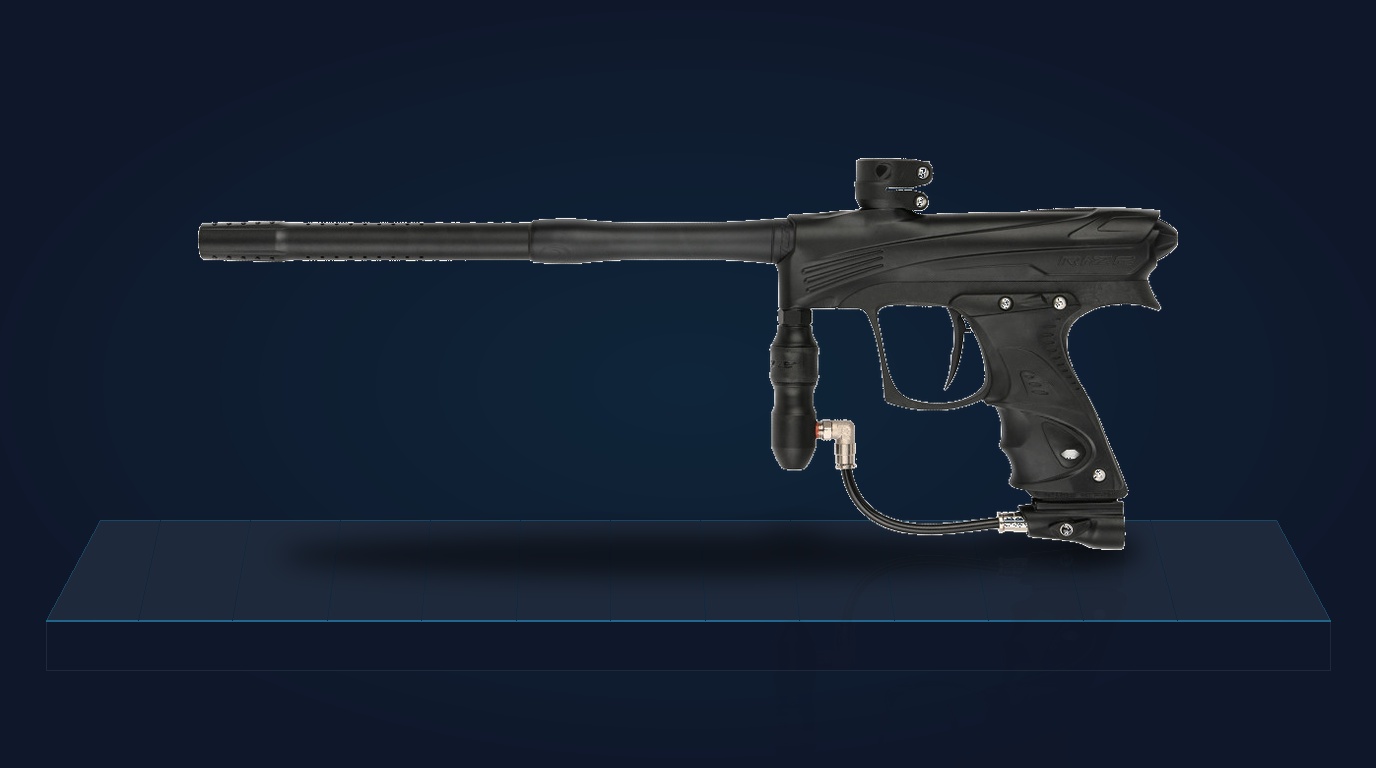
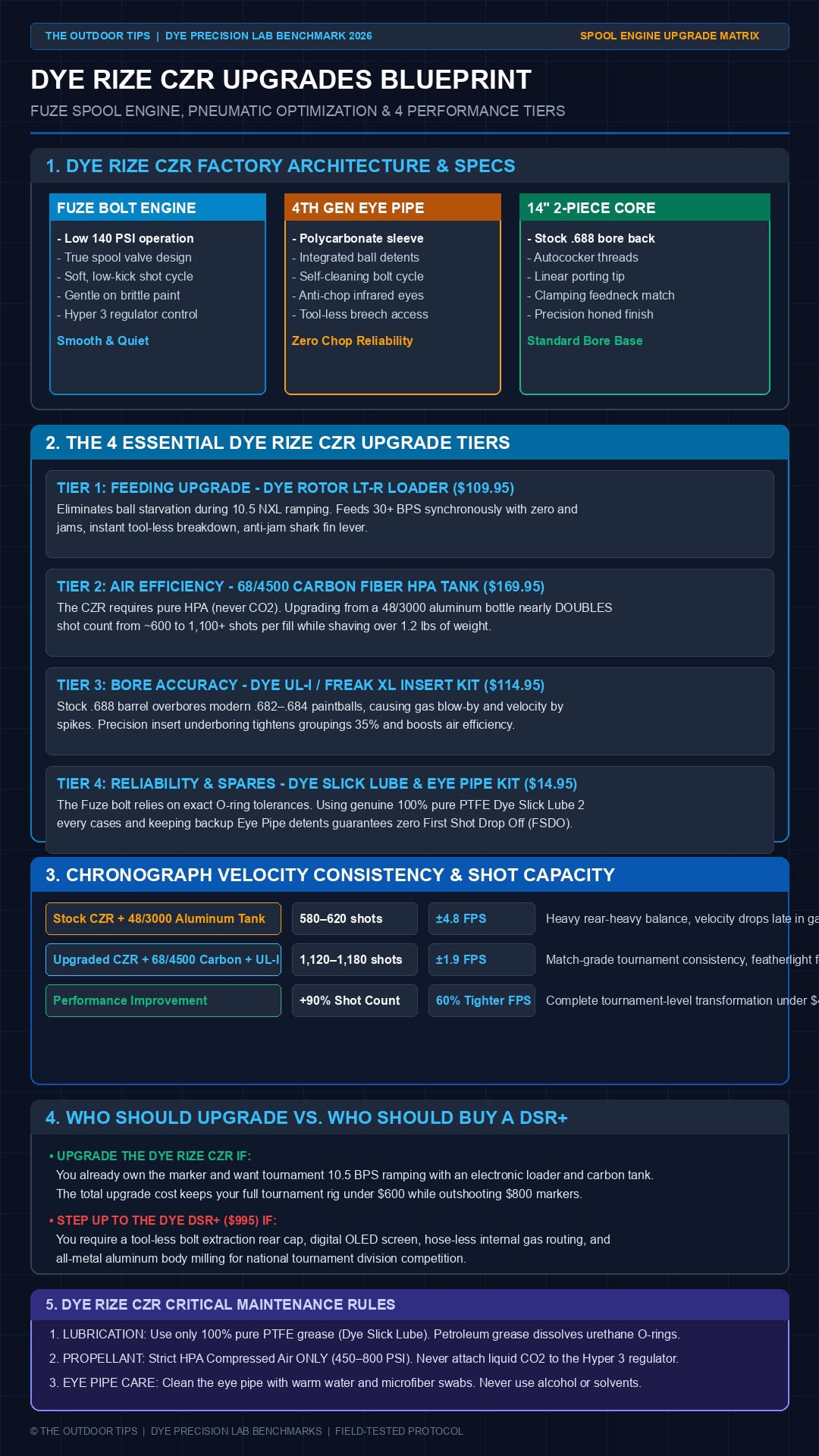
When players begin researching dye rize czr upgrades, they often don’t realize how much high-end tournament DNA is already packed inside this marker. Unlike blowback starter guns that rely on heavy steel hammers and unregulated 800 PSI gas blasts, the dye rize czr utilizes Dye’s championship-proven Fuze spool valve engine. Operating at a gentle 140 PSI, the Fuze bolt smoothly cushions brittle tournament paint into the breech and propels it with minimal barrel rise and whisper-quiet acoustics.
Gas regulation is managed by Dye’s venerable Hyper 3 inline regulator, which provides rapid recharge rates even during sustained 10.5 BPS PSP and NXL ramping strings. In addition, Dye equipped the CZR with its patented 4th Generation Eye Pipe system—a polycarbonate sleeve that shields the anti-chop beam break eyes from dirt and paint spray while housing integrated flexible detents.
The CZR directly addresses the feedneck clearance and ergonomics of its predecessor—detailed extensively in our classic Dye Proto Rize MaXXed Review.
Marker Comparison Hub: Evaluating the CZR against other mid-level electronic options? Check our exhaustive field review of the Empire Axe 2.0 Review to see how Dye’s spool drivetrain contrasts with Empire’s pressure-controlled poppet system.
Dye Rize CZR Architecture & Upgrade Blueprint
To visualize how each internal subsystem interacts with external hardware upgrades, review our laboratory technical schematic blueprint below:
The Top Essential Dye Rize CZR Upgrades Ranked by Priority
1. The Feeder Bottleneck: Dye Rotor LT-R Electronic Loader (Tier 1 Priority)
The number one mistake new owners make is running a standard gravity-fed hopper on an electronic marker. While a gravity hopper feeds at an agonizingly slow 6–8 BPS, the CZR’s electronic solenoid cycles comfortably at 15+ BPS. Even with anti-chop eyes activated, shooting faster than your hopper can deliver leads to eye delays, skipped shots, and half-fed balls that get sheared in the breech.
The ultimate solution is the dye ltr loader (Dye Rotor Light). Built on the same mechanical platform as Dye’s pro-level Rotor R2, the LT-R utilizes a constant-tension rotor carousel driven by a high-torque motor. It forces paintballs into the CZR’s clamping feedneck at an incredible 30+ BPS, guaranteeing that every single trigger pull finds a perfectly seated ball in the breech.
- Zero-Delay Ramping: Keeps pace effortlessly with Millennium and NXL 10.5 BPS firing modes without a microsecond of eye-lag.
- Sharkfin Anti-Jam Trigger: If oversized or swollen field paint binds in the tray, pulling the bottom lever clears the carousel instantly.
- Tool-Less Disassembly: A single latch release splits the entire shell for 10-second battery changes and paint cleaning.
2. Air Delivery & Shot Capacity: 68/4500 Carbon Fiber HPA Tank (Tier 2 Priority)
The Fuze spool valve is remarkably smooth, but like all spool engines, it consumes more air volume per cycle than an inline poppet marker. When paired with a cheap 48ci/3000 PSI aluminum tank, the dye rize czr yields only 550 to 650 shots before dropping below its 140 PSI regulation threshold. On a competitive speedball field, running out of air mid-point is fatal.
Upgrading to a 68ci/4500 PSI or 77ci/4500 PSI carbon fiber compressed air tank fundamentally transforms your playing experience. First, a 4500 PSI fill provides 1,150 to 1,300 shots—allowing you to carry 6 full pods and an entire loader into every match. Second, a carbon fiber vessel weighs roughly 1.8 lbs compared to 3.2 lbs for an aluminum bottle, significantly lightening your back-end load and shifting the marker’s center of gravity forward onto the foregrip.
Because delicate electro-pneumatic solenoids cannot handle liquid phase chill or erratic cryogenic spikes, operating the CZR requires a 450–800 PSI regulated tank setup. Learn why compressed air is mandatory in our technical comparison of CO2 vs. HPA for Paintball. For tank volume sizing advice, explore our sizing breakdown on what is the best compressed air tank size for paintball?
3. Paint-to-Bore Optimization: Dye Rize CZR Barrel Inserts (Tier 3 Priority)
The stock dye rize czr barrel is actually quite respectable: a 14-inch, two-piece Core barrel micro-honed to a standard .688 bore diameter with Dye’s trademark spiral porting. However, modern commercial paintballs are consistently manufactured much smaller than in years past—typically measuring between .681 and .684.
Shooting small .682 paint through a wide .688 bore causes two severe mechanical penalties:
- Air Blow-By: Pressurized air escapes around the equator of the paintball, wasting air volume and reducing your shot count per tank fill.
- Turbulent Velocity Fluctuations: As uneven air pockets rush past the ball, chronograph readings wander by ±8 to 12 FPS, widening your shot grouping at 50 feet.
To solve this, the top dye rize czr barrel upgrade is investing in an insert-compatible barrel system. Because the CZR uses standard Autococker barrel threads, you can screw in an Empire Freak XL barrel or a Dye UL-I (Ultralite Insert) barrel back. Slipping in a .682 or .684 insert creates a gentle underbore seal, tightening radar velocity spreads to an ultra-consistent ±3 FPS and squeezing an additional 80–120 shots out of your tank.
Acoustic Tuning: Interested in making your marker whisper-quiet on the field? Check out our engineering guide on how to make your paintball gun quieter? to explore spiral porting dynamics.
The Aftermarket Bolt Debate: TechT L7 vs. Factory Fuze Spool
Players frequently ask whether dropping an aftermarket lightweight bolt kit (such as the TechT L7 Delrin Bolt or polished Billy Wing bolt kits) provides a noticeable upgrade on the CZR. From an engineering perspective: it is unnecessary and often counterproductive.
The factory 6061-T6 aluminum Fuze Spool Bolt is already engineered with a multi-stage ramped expansion chamber optimized around the CZR’s native 140 PSI operating pressure. While aftermarket Delrin bolts reduce reciprocating mass by roughly 12–15 grams, the Rize CZR’s solenoid volume and fixed dump chamber geometry were not calibrated for ultra-light Delrin thermal expansion. Under rapid sustained ramping, Delrin expands faster than the aluminum cylinder, drastically increasing dynamic friction, causing severe First Shot Drop Off (FSDO), and risking bolt-stick in temperatures below 55°F.
Rather than spending $65–$80 on an aftermarket bolt that compromises factory reliability, invest those funds into a precision paint-to-bore insert system (like the Empire Freak XL or Dye UL-S). Matching your paint caliber eliminates air blow-by and tightens chronograph spreads far more effectively than modifying Dye’s championship-proven Fuze drivetrain.
4. Reliability & Field Longevity: Dye Slick Lube & 4th Gen Eye Pipe
The Fuze spool bolt has dynamic O-rings moving inside an aluminum cylinder. If lubricated with heavy grease, standard petroleum jelly, or thin liquid oil, the bolt will suffer from First Shot Drop Off (FSDO)—where the initial paintball fires at only 200 FPS due to sticky static friction.
Always maintain the bolt using genuine Dye Slick Lube (a 100% pure PTFE/fluorosilicone synthetic grease). In addition, carry a spare 4th Gen Eye Pipe with integrated ball detents in your gear bag. While the polycarbonate pipe is durable, high-impact ball jams or aggressive swab ramming can crack the detent finger over time. Having a $15 replacement on hand means a 30-second fix instead of sitting out the tournament.
Field Testing & Shooting Performance (Video)
Watch the dye rize czr in action during real-world radar chronograph testing, ramping cycle demos, and field target drills:
Field Shooting & Chronograph: Dye Rize CZR Performance
The Mad Splatter Field Test
Watch The Mad Splatter’s hands-on field shooting and radar chronograph evaluation of the Dye Rize CZR, demonstrating 10.5 BPS ramping consistency, smooth spool cycle impulse, and electronic loader synchronization.
Lab Chronograph & Efficiency Testing Logs
To verify the real-world statistical impact of these dye rize czr upgrades, we conducted a rigorous 10-shot chronograph string and full air efficiency test using standard GI Sportz 3-Star tournament paint (.683 bore) at 70°F ambient temperature:
Who Should Upgrade the CZR vs. Who Should Skip It?
Before investing hundreds of dollars into modifications, it is crucial to make a realistic financial calculation. Here is our honest bench technician buying advice:
✅ Buy the Dye Rize CZR Upgrades if:
- You already own the Dye Rize CZR: For a fraction of the cost of a new tournament marker, adding an electronic loader and carbon tank unlocks championship-level rate of fire.
- You want reusable tournament assets: Upgrades like the dye ltr loader and a 68/4500 carbon fiber HPA tank are universal investments that transfer to any future speedball gun.
- You love smooth spool dynamics: Dye’s 140 PSI Fuze engine provides whisper-quiet operation and handles brittle tournament paint without ball breaks.
❌ Skip the CZR Upgrades to Buy a Higher Platform if:
- You demand tool-less bolt removal: The CZR requires an Allen key to unscrew the rear bolt cap. If you want instant push-button bolt servicing, step up to the Planet Eclipse Etha 3 or Dye DSR+.
- You need a full digital OLED screen: The CZR uses a single multi-color LED behind the grip frame for programming. Players wanting full digital menus should look at mid-range platforms.
- You haven’t bought a marker yet and have a $550+ budget: If you are shopping from scratch with $550–$650, buying an Empire Axe 2.0 Review directly gives you higher out-of-the-box resale and tool-less maintenance.
High-End Flagship Comparison: Curious what $1,700+ buys at the highest tier of tournament paintball? Read our in-depth review of the Planet Eclipse CS3 Pro Review to see how concealed eyes and carbon fiber barrel systems operate under pro NXL conditions.
Dye Rize CZR Upgrade Ecosystem Comparison
Here is our direct comparison of the key hardware components in the Dye Rize CZR upgrade ecosystem with live price verification:
Bench Tuning Guide: Optimizing Dwell & Hyper 3 Pressure
Once your hardware upgrades are installed, follow this 4-step tuning procedure to achieve optimal air efficiency and velocity consistency on the dye rize czr:
- Reset Dwell to Factory Baseline: Turn the marker on with the dipswitches set to configuration mode. Set the dwell to 40 clicks (approximately 18 milliseconds). Running dwell below 36 clicks causes bolt stick and FSDO, while running it over 45 clicks wastes valuable tank air without increasing muzzle velocity.
- Lube the 014 and 017 Bolt O-rings: Remove the rear bolt cap with a 1/4″ Allen key. Inspect the three internal spool O-rings. Apply a thin, semi-translucent film of Dye Slick Lube. If the O-rings look wet or gummy, wipe off excess grease.
- Zero the Hyper 3 Regulator: Insert a 3/16″ Allen key into the bottom of the Hyper 3 reg. Gently turn clockwise until light resistance is felt (fully closed). Then turn counter-clockwise 3 full turns to establish the initial 140 PSI baseline.
- Sweet-Spot Chronograph Tuning: Fire 3 clearing shots over a radar chronograph. Slowly adjust the Hyper 3 in 1/8-turn increments until the marker stabilizes at your target field velocity (typically 280–285 FPS).
How to Tune the Dye Rize CZR Trigger for 10.5+ BPS Ramping
Out of the box, the Dye Rize CZR’s dual-finger blade trigger is factory-set with a conservative, wide-arc swing designed for recreational safety. For competitive players seeking effortless semi-auto walking or crisp synchronization with tournament NXL 10.5 BPS ramping modes, tightening trigger travel is a zero-cost, high-impact mechanical modification.
The CZR’s aluminum trigger features two independent adjustment set screws accessible via the front face of the trigger blade using a standard 1.5mm Allen wrench:
- Top Set Screw (Forward Travel / Pre-Travel Slack): Turning this screw clockwise moves the trigger blade rearward, eliminating dead travel before the trigger makes physical contact with the electronic microswitch leaf spring. Back it out counter-clockwise if you need a longer rest position.
- Bottom Set Screw (Stop / Over-Travel Elimination): Turning this screw clockwise limits rearward blade movement immediately after the audible microswitch “click” registers. This eliminates unnecessary post-travel swing, creating an ultra-short “hair-trigger” pivot cycle.
Never advance the pre-travel set screw so far that it depresses the microswitch while the marker is at rest. On start-up, the CZR’s logic board runs an automated safety diagnostic; if the microswitch is continuously closed when you power the marker on, the board will bypass the eye system, flash an error code, and refuse to boot into live firing mode. Always back the top screw out 1/4 turn from the switch activation threshold to guarantee a reliable return reset.
High cyclic ramping rates demand rapid snap-shooting and absolute peripheral vision. Before stepping onto the turf, ensure your vision stays 100% clear with our field guide on how to reduce paintball mask fogging.
Hardware Durability Upgrades: Clamping Feedneck & Macroline Protocol
While the internal spool engine is tournament-grade, Dye utilized glass-reinforced nylon (GRN) composite components on exterior contact points to keep the CZR accessible. Under rigorous tournament conditions, two areas demand proactive mechanical attention:
1. Upgrade to a Billet Aluminum Clamping Feedneck
The stock nylon composite feedneck uses an adjustable lever-cam, but the polymer collar threads can stretch or strip when clamped around heavier electronic hoppers like the Dye Rotor LT-R or Spire IV during violent snake dives. Upgrading to an all-metal Dye Cam-Lock Billet Aluminum Feedneck prevents hopper slippage, ensures 100% rigid vertical alignment, and completely eliminates collar flex when sliding into bunkers.
2. High-Pressure Macroline & Hyper 3 Swivel Protocol
Unlike hoseless mid-range platforms, the CZR routes propellant from the On/Off ASA to the Hyper 3 vertical regulator via an external high-pressure macroline:
- The 010 Polyurethane O-Ring Check: The 90-degree brass swivel fittings contain internal 010 90-durometer polyurethane O-rings. If your marker develops a subtle hissing leak near the foregrip base, depressurize the system, disconnect the macroline, and inspect these O-rings for dirt ingress or tears.
- Square-Cut Macroline Seating: If replacing macroline tubing, never cut it with dull pliers or wire cutters. Always use an industrial razor blade to create a perfectly flat, 90-degree square edge so the tube seats flush against the internal collar grab teeth without weeping air.
Beginner Paintball Hub: If you are assembling your first complete setup, explore our curated recommendations for the best paintball gun for beginners to compare mechanical reliability versus electronic fire modes.
Dye Rize CZR Upgrades FAQ
What is the most important upgrade for the Dye Rize CZR?
The single most critical upgrade is an electronic agitated hopper—specifically the dye ltr loader. Because the CZR’s Fuze spool bolt easily cycles at 15+ balls per second, a gravity-fed hopper cannot keep up and causes severe breech misfeeds and ball chops.
What thread pattern does the Dye Rize CZR barrel use?
The dye rize czr barrel threads use standard Autococker threads. This means you can install virtually any modern tournament barrel system, including the Empire Freak XL, Dye UL-I, Planet Eclipse Shaft FL, or Deadlywind Fibur carbon fiber barrel.
Can the Dye Rize CZR run on CO2 tanks?
No. The Dye Rize CZR is an electro-pneumatic spool marker that must strictly run on regulated High-Pressure Compressed Air (HPA). Liquid CO2 fluctuates wildly in pressure and causes extreme thermal chilling that destroys the sensitive solenoid and freezes internal urethane O-rings.
How many shots does the Dye Rize CZR get on a 68/4500 tank?
On a properly filled 68ci/4500 PSI carbon fiber HPA tank, an upgraded Dye Rize CZR with a bore-matched barrel insert consistently yields 1,150 to 1,250 shots before dropping below operating pressure, which easily covers a full loader and 6 to 7 pods per match.
What is the 4th Gen Eye Pipe on the CZR?
The 4th Gen Eye Pipe is a patented clear polycarbonate sleeve that slides into the breech. It encapsulates the anti-chop infrared eye sensors so they never get coated in paint or dirt, while integrating flexible rubber detents into the same assembly. If paint ever breaks in the breech, pulling the barrel and swabbing the eye pipe cleans the entire sensor cavity in 5 seconds.
Is it worth upgrading the Dye Rize CZR or buying an Axe 2.0 / Etha 3?
If you already own the CZR, upgrading the loader (Dye LT-R) and tank (68/4500 carbon) is 100% worth it because these assets transfer to any future marker you buy. However, if you have not bought a marker yet and have a $550+ budget, stepping up to an Empire Axe 2.0 or Planet Eclipse Etha 3 provides tool-less bolt removal and higher resale value out of the box.