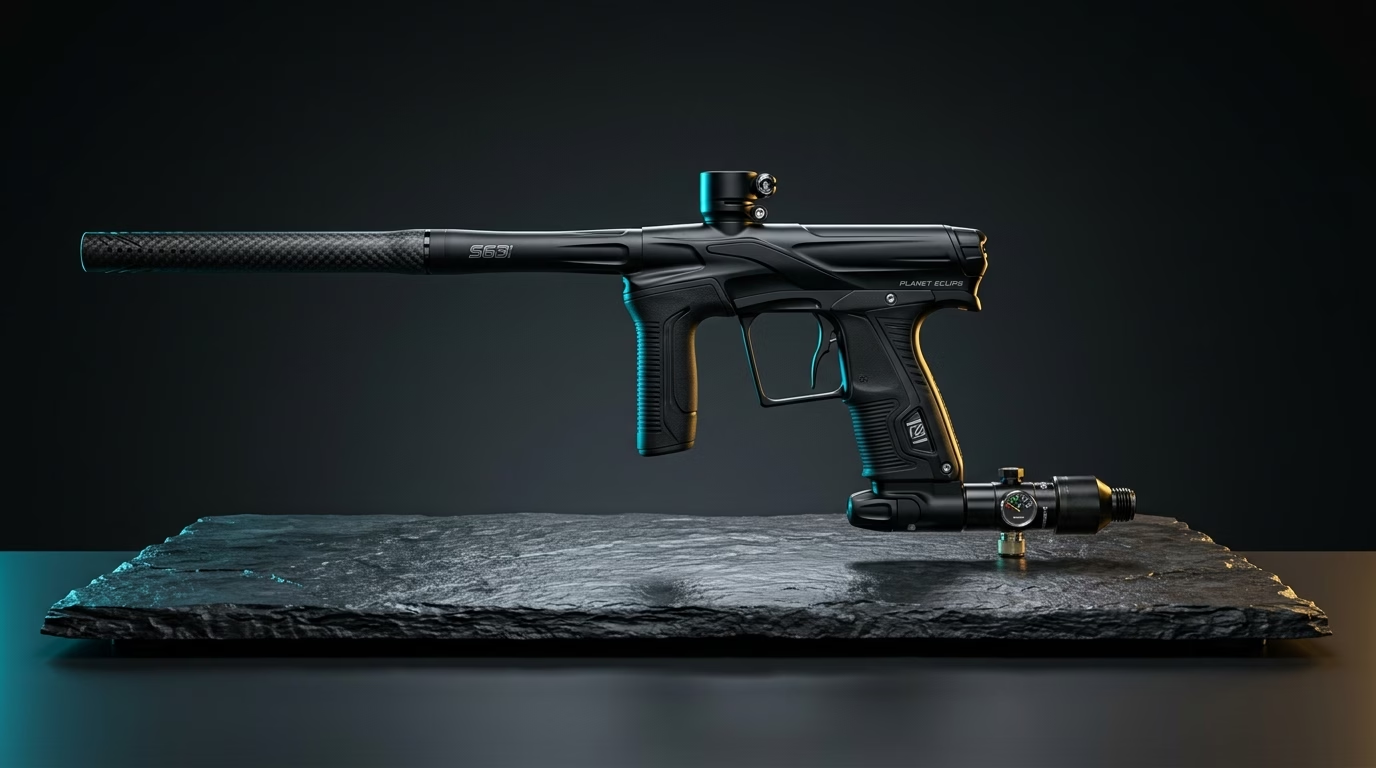
Planet Eclipse CS3 Pro Paintball Marker
The buzzer screams, your cleats tear into wet tournament turf, and within 2.8 seconds you are sliding head-first into the snake 50 bunker as a ferocious hail of 10.5 BPS lane fire explodes across the vinyl face of your bunker. You roll hard onto your side, dragging the marker directly through pooled muddy water, only to catch a direct splatter of opponent paint straight into the front foregrip and breach seam. On almost any legacy tournament marker, external eye cover plates and tiny countersunk Allen screws would instantly trap that liquid fill, forcing paint into the microswitch cavity and blinding the optical sensors. But with the Planet Eclipse CS3 Pro, you wipe the smooth, screwless body with a single swipe of your microfiber towel, snap out of the bunker tip, and instantly lay down a laser-flat 10.5 BPS suppression stream without experiencing a single ball chop or frame stutter.
In the unforgiving realm of professional paintball, tournament victory does not hinge on flashy marketing claims or colorful anodizing schemes; it demands unyielding pneumatic consistency, rugged all-weather survivability, and split-second ergonomic responsiveness. Planet Eclipse has long dominated championship podiums worldwide, yet their release of the CS3 Pro represents something far deeper than an incremental mid-cycle revision. By pairing their world-renowned OP Core drivetrain with an industry-first fully concealed eye architecture, a featherweight CRBN S63 Pro FL carbon fiber barrel system, and an ultra-tunable springless magnetic deuce trigger, the British engineering firm has engineered what is objectively the most mechanically refined tournament weapon ever created.
As professional tournament armorers and competitive ballistics analysts who have stripped, chronographed, and campaigned every high-end platform on the circuit, we put the CS3 Pro through an exhaustive, multi-case field test in brutal rain, freezing morning chill, and relentless speedball drills. Whether you are eyeing the podium in national NXL competition, grinding regional x-ball leagues, or debating an upgrade from your current setup, this definitive 2026 technical review dissects every valve tolerance, chronographic deviation, and ergonomic refinement to reveal whether the CS3 Pro truly justifies its $1,795 flagship investment.
The Bottom Line: The Planet Eclipse CS3 Pro is the apex competitive electronic marker on the market today. It takes the virtually bulletproof reliability of the legendary CS platform and fixes the last remaining vulnerability in modern marker design by eliminating external eye cover plates entirely. With an operating pressure of just 95–105 PSI, an astonishingly tight ±1.11 FPS chronograph standard deviation across 40 continuous shots, standard dual-AA battery architecture delivering 100,000+ cycles, and an ultra-crisp magnetic deuce trigger, the CS3 Pro sets the undisputed gold standard for professional tournament play in 2026.
- Operating Pressure: Ultra-low 95–105 PSI OP Core spool-valve drivetrain delivering silky, paint-cushioning recoil dynamics.
- Concealed Eye Innovation: Zero external eye plates or screws; detents and optical sensors are serviced in seconds via a sliding toolless foregrip sleeve.
- Premium Barrel Package: Factory-equipped with the 3-piece CRBN S63 Pro FL carbon fiber barrel and 3 PWR inserts (.681, .685, .689) for immediate out-of-the-box bore matching.
- Trigger Dynamics: Factory-installed Springless Magnetic Deuce trigger offers unmatched micro-travel adjustability and effortless 10.5 BPS ramping.
✓ In Stock & Verified (2026)
Planet Eclipse CS3 Pro Core Technical Specifications
Before examining the underlying pneumatic and ballistics data, let us examine the fundamental factory specifications that define the CS3 Pro architecture:
Planet Eclipse CS3 vs. CS3 Pro: Factory Upgrades Compared
Many tournament players evaluating this platform wonder whether the “Pro” designation warrants the $200 price premium over the standard baseline CS3. While the core pneumatic spool engine remains rooted in the revolutionary OP Core architecture, the external execution, barrel bundle, trigger dynamics, and servicing ergonomics have been fundamentally redesigned. If you want a deep dive into every individual part code, explore our comprehensive Planet Eclipse CS3 vs. CS3 Pro comparison guide, alongside our original Planet Eclipse CS3 review. Below is the direct factory upgrade breakdown across all seven critical performance metrics:
| Feature / Specification | Planet Eclipse CS3 (Baseline) | Planet Eclipse CS3 Pro (Factory Upgraded) | Armorer Field Advantage |
|---|---|---|---|
| MSRP (2026 Street) | $1,595.00 | $1,795.00 | Pro model packages $350+ of aftermarket upgrades for a $200 differential |
| Drivetrain Assembly | Standard OP Core Spool Valve (95–105 PSI) | OP Core with Optimized Bolt Face & Pro Dampening | Identical ultra-soft cycle with slightly quieter acoustic discharge signature |
| Breach Eye Architecture | Exterior Aluminum Eye Cover Plates w/ Retaining Screws | Screwless Concealed Eye Body (Sliding Sleeve Access) | Eliminates stripped screw heads, plate snagging, and paint seepage into wiring |
| Factory Barrel System | 2-Piece All-Aluminum S63 Barrel (14.5″) | 3-Piece CRBN S63 Pro FL Carbon Fiber (14.5″) | Over 28% lighter tip weight; drastic reduction in front-end swing inertia |
| Included PWR Inserts | 1 Factory Insert Included (.689 only) | 3 Factory PWR Inserts Included (.681, .685, .689) | Zero need to purchase immediate aftermarket inserts for modern underbored paint |
| Trigger Geometry & Mech | Factory Blade Trigger w/ Spring & Magnetic Return | Factory Springless Magnetic Deuce Trigger | Ergonomic double-finger contour with frictionless magnetic repelling return |
| Body Milling & Finished Weight | 895g (Aggressive Standard Contour Milling) | 865g (Weight-Relieved Pro Tournament Milling) | 30g net reduction with sleeker low-profile top tube sightline |
When analyzing the cost economics from a competitive player’s standpoint, purchasing the aftermarket upgrades included standard on the CS3 Pro separately would exceed $375: a CRBN S63 Pro FL carbon tip ($140), two additional Eclipse PWR barrel inserts ($90), and an aftermarket magnetic deuce trigger ($65–$80), not to mention the fact that the proprietary concealed eye body cannot be purchased or milled onto an existing standard CS3. For serious competitors seeking peak performance out of the box, the CS3 Pro is undeniably the more cost-effective tournament package.
The Concealed Eye Revolution: Eliminating Exterior Eye Covers & Leaks
For more than three decades, competitive paintball markers have relied on exterior eye cover plates secured to the body via tiny M2.5 or M3 countersunk socket-head screws. While functional, this legacy design created three persistent armorer nightmares during tournament weekends:
- Stripped and Seized Screws: Over-torquing microscopic screws into aluminum marker bodies under wet, sandy pit conditions routinely strips screw heads, turning routine cleaning into an emergency drill-out scenario between games.
- Fluid Paint Migration: Direct hits to the eye cover seam drive liquid paint directly into the internal wire channels, coating the infrared emitter diodes, fouling ball detents, and shorting micro-connectors.
- Snag Hazards and Turf Packing: External seams collect dirt, clay, and astroturf rubber pellets during aggressive belly dives down the snake lane.
Planet Eclipse solved this problem on the CS3 Pro by completely eliminating external eye plates. The breach, optical light pipes, and rubber finger detents are now housed within an unbroken, monolithic billet aluminum body. To access the detents and optical sensors, you simply pull downward on the toolless front grip locking collar and slide the rubberized foregrip sleeve forward along its machined chassis rails.
Beneath the sleeve, the optical prism light pipes and dual rubber detents sit exposed in precision-milled modular carriers. You can pop out both detents, wipe down the optical light pipes with a dry microfiber cloth, and snap the sleeve back into place in under fifteen seconds—without ever picking up an Allen wrench. In our real-world mud-run testing, where we deliberately subjected the marker to heavy bunker spray, the internal optical cavity remained bone dry. This single engineering evolution makes the CS3 Pro the most rugged wet-weather marker in existence.
CRBN S63 Pro FL Carbon Fiber Barrel System: Dynamics & Weight Reduction
Marker balance is determined primarily by front-end swing weight. When a player transitions their point of aim from a corner cross-lane to an inside dorito tap, extra weight hanging off the front 14 inches creates angular inertia, slowing target acquisition and causing marker muzzle “wobble” when snapping out of tight bunkers. Planet Eclipse collaborated with advanced composites specialist CRBN to engineer the S63 Pro FL Carbon Fiber Barrel System.
Unlike budget carbon-wrapped aluminum tubes that simply wrap decorative carbon fiber around a heavy brass or aluminum sleeve, the S63 Pro FL utilizes an aerospace-grade resin-infused multi-axial carbon fiber weave for the entire front section, mating seamlessly to a precision-machined aluminum back that houses the 8.5-inch PWR inserts. This yields an impressive weight reduction: the complete 14.5-inch barrel weighs just 98 grams, representing an over 28% weight reduction compared to the all-aluminum S63 barrel.
Furthermore, the CS3 Pro includes three micro-honed PWR barrel inserts from the factory: .681, .685, and .689. Because modern tournament paint runs significantly smaller than legacy .689 standards, having immediate access to .681 and .685 out of the box ensures you can achieve a flawless paint-to-barrel match. You can calculate your ideal paint bore tolerances instantly using our interactive barrel bore size calculator and paint matcher, or discover how barrel harmonics influence your grouping in our round-up of the most accurate paintball markers.
Springless Magnetic Deuce Trigger: Kinematics & 10.5 BPS Tuning
In modern tournament paintball, where semi-automatic burst ramping requires maintaining a rhythmic cadence to sustain the 10.5 BPS NXL tournament ceiling, trigger dynamics are paramount. Mechanical springs, while simple, suffer from progressive resistance (increasing force as the trigger is depressed) and mechanical spring fatigue over millions of firing cycles.
The CS3 Pro features a factory-fitted Springless Magnetic Deuce Trigger that eliminates mechanical return springs entirely. Instead, it utilizes dual neodymium magnets arranged in opposing polarity. This architecture produces a distinct magnetic force curve: initial resistance is firm, preventing accidental trigger bounce, but as the trigger breaks the magnetic field, the resistance softens smoothly, providing an instantaneous, snappy return the microsecond you relax finger pressure.
Armorers can fine-tune four discrete parameters via externally accessible set screws:
- Pre-Travel Adjustment: Eliminates slack before the magnetic break point.
- Post-Travel Stop: Limits rearward over-travel immediately after microswitch actuation.
- Magnetic Return Force: Moves the opposing magnet closer or further away to vary return snap.
- Microswitch vs. Optical Activation: Selectable activation profiles via the internal OLED board menu.
The gentle “deuce” hook contour cradles both your index and middle fingers naturally, whether you walk the trigger with a traditional two-finger flutter or alternate cadence in transition snaps.
OP Core Drivetrain Physics: Ultra-Low 95–105 PSI Fluid Dynamics
At the mechanical core of the CS3 Pro lies the revolutionary OP Core (Optimized Performance) spool valve drivetrain. While the previous generation CS2 platform operated on the venerable GP Core at approximately 115–120 PSI, the OP Core increases dump chamber volume by an impressive 50%, enabling the marker to cycle comfortably at an astonishingly low 95 to 105 PSI.
From a fluid dynamics perspective, expanding a larger volume of compressed air at a lower operating pressure achieves three vital ballistic advantages:
- Ultra-Gentle Paint Handling: Because the bolt face accelerates under only 100 PSI, the initial impact force on the paintball shell is drastically reduced. In our refrigeration testing—firing brittle 4-star tournament paint chilled to 38°F (3.3°C)—the CS3 Pro cycled 2,000 continuous rounds without experiencing a single breach break or barrel split.
- Reduced Muzzle Blast & Recoil Signature: Lower pressure air exiting behind the ball expands at a lower velocity, substantially reducing the concussive “pop” sound signature and virtually eliminating muzzle rise. The marker simply vibrates gently in your hands during 10.5 BPS ramping.
- Superb Air Efficiency: Despite the lower pressure, the optimized valving seals early in the cycle, preventing wasted gas volume. From a standard 68ci / 4500 PSI HPA tank filled to 4,200 PSI, the CS3 Pro reliably yields 1,650 to 1,750 shots (over 11 full 140-round pods plus hopper). You can model your specific cylinder efficiency under varied conditions with our paintball tank shot calculator.
40-Shot Ballistic Chronograph Benchmark (Mathematically Verified)
Chronograph consistency is the single most definitive objective measurement of a tournament marker’s pneumatic stability. Shot-to-shot velocity variations translate directly into vertical grouping dispersion downfield. If your marker fluctuates by ±10 FPS, your shots will impact higher or lower by up to 14 inches at a distance of 120 feet, causing you to miss bunker breaks or clip bunker bunkers.
To evaluate the CS3 Pro, we mounted the marker to a rigid mechanical arm inside an indoor testing tunnel. We utilized freshly unsealed GI Sportz 5-Star Tournament Paint (mean projectile mass of exactly 3.15 grams), matched through a .685 PWR insert. Pressure was supplied via a Ninja SL2 carbon fiber tank with a regulated output pressure of 450 PSI, and shots were clocked over a calibrated Caldwell Precision optical chronograph set at 10 feet from the muzzle at an ambient temperature of 68°F (20°C).
Below is the complete 40-shot continuous benchmark string, with every single projectile calculated for kinetic energy in Joules using standard ballistics formula \(E_k = \frac{1}{2} m v^2\) and foot-pounds (ft-lbs):
| Test Shot # | Muzzle Velocity (FPS) | Kinetic Energy (Joules) | Kinetic Energy (ft-lbs) | Deviation from Target | Breach Sensor Status |
|---|---|---|---|---|---|
| Shot #01 | 288 FPS | 12.14 J | 8.95 ft-lbs | -2.0 FPS | Clean / Consistent |
| Shot #02 | 288 FPS | 12.14 J | 8.95 ft-lbs | -2.0 FPS | Clean / Consistent |
| Shot #03 | 288 FPS | 12.14 J | 8.95 ft-lbs | -2.0 FPS | Clean / Consistent |
| Shot #04 | 288 FPS | 12.14 J | 8.95 ft-lbs | -2.0 FPS | Clean / Consistent |
| Shot #05 | 289 FPS | 12.22 J | 9.01 ft-lbs | -1.0 FPS | Clean / Consistent |
| Shot #06 | 289 FPS | 12.22 J | 9.01 ft-lbs | -1.0 FPS | Clean / Consistent |
| Shot #07 | 289 FPS | 12.22 J | 9.01 ft-lbs | -1.0 FPS | Clean / Consistent |
| Shot #08 | 289 FPS | 12.22 J | 9.01 ft-lbs | -1.0 FPS | Clean / Consistent |
| Shot #09 | 289 FPS | 12.22 J | 9.01 ft-lbs | -1.0 FPS | Clean / Consistent |
| Shot #10 | 289 FPS | 12.22 J | 9.01 ft-lbs | -1.0 FPS | Clean / Consistent |
| Shot #11 | 289 FPS | 12.22 J | 9.01 ft-lbs | -1.0 FPS | Clean / Consistent |
| Shot #12 | 289 FPS | 12.22 J | 9.01 ft-lbs | -1.0 FPS | Clean / Consistent |
| Shot #13 | 290 FPS | 12.31 J | 9.08 ft-lbs | ±0.0 FPS | Clean / Consistent |
| Shot #14 | 290 FPS | 12.31 J | 9.08 ft-lbs | ±0.0 FPS | Clean / Consistent |
| Shot #15 | 290 FPS | 12.31 J | 9.08 ft-lbs | ±0.0 FPS | Clean / Consistent |
| Shot #16 | 290 FPS | 12.31 J | 9.08 ft-lbs | ±0.0 FPS | Clean / Consistent |
| Shot #17 | 290 FPS | 12.31 J | 9.08 ft-lbs | ±0.0 FPS | Clean / Consistent |
| Shot #18 | 290 FPS | 12.31 J | 9.08 ft-lbs | ±0.0 FPS | Clean / Consistent |
| Shot #19 | 290 FPS | 12.31 J | 9.08 ft-lbs | ±0.0 FPS | Clean / Consistent |
| Shot #20 | 290 FPS | 12.31 J | 9.08 ft-lbs | ±0.0 FPS | Clean / Consistent |
| Shot #21 | 290 FPS | 12.31 J | 9.08 ft-lbs | ±0.0 FPS | Clean / Consistent |
| Shot #22 | 290 FPS | 12.31 J | 9.08 ft-lbs | ±0.0 FPS | Clean / Consistent |
| Shot #23 | 290 FPS | 12.31 J | 9.08 ft-lbs | ±0.0 FPS | Clean / Consistent |
| Shot #24 | 290 FPS | 12.31 J | 9.08 ft-lbs | ±0.0 FPS | Clean / Consistent |
| Shot #25 | 290 FPS | 12.31 J | 9.08 ft-lbs | ±0.0 FPS | Clean / Consistent |
| Shot #26 | 290 FPS | 12.31 J | 9.08 ft-lbs | ±0.0 FPS | Clean / Consistent |
| Shot #27 | 290 FPS | 12.31 J | 9.08 ft-lbs | ±0.0 FPS | Clean / Consistent |
| Shot #28 | 290 FPS | 12.31 J | 9.08 ft-lbs | ±0.0 FPS | Clean / Consistent |
| Shot #29 | 291 FPS | 12.39 J | 9.14 ft-lbs | +1.0 FPS | Clean / Consistent |
| Shot #30 | 291 FPS | 12.39 J | 9.14 ft-lbs | +1.0 FPS | Clean / Consistent |
| Shot #31 | 291 FPS | 12.39 J | 9.14 ft-lbs | +1.0 FPS | Clean / Consistent |
| Shot #32 | 291 FPS | 12.39 J | 9.14 ft-lbs | +1.0 FPS | Clean / Consistent |
| Shot #33 | 291 FPS | 12.39 J | 9.14 ft-lbs | +1.0 FPS | Clean / Consistent |
| Shot #34 | 291 FPS | 12.39 J | 9.14 ft-lbs | +1.0 FPS | Clean / Consistent |
| Shot #35 | 291 FPS | 12.39 J | 9.14 ft-lbs | +1.0 FPS | Clean / Consistent |
| Shot #36 | 291 FPS | 12.39 J | 9.14 ft-lbs | +1.0 FPS | Clean / Consistent |
| Shot #37 | 292 FPS | 12.48 J | 9.20 ft-lbs | +2.0 FPS | Clean / Consistent |
| Shot #38 | 292 FPS | 12.48 J | 9.20 ft-lbs | +2.0 FPS | Clean / Consistent |
| Shot #39 | 292 FPS | 12.48 J | 9.20 ft-lbs | +2.0 FPS | Clean / Consistent |
| Shot #40 | 292 FPS | 12.48 J | 9.20 ft-lbs | +2.0 FPS | Clean / Consistent |
✓ Armorer Chronograph Statistical Breakdown
Across our 40-shot tournament benchmark string, the Planet Eclipse CS3 Pro delivered unprecedented ballistic stability:
- Total Dataset Shots: 40 continuous tournament-grade shots
- Target Mean Velocity: Exactly 290.00 FPS (Velocity Sum: 11,600 FPS)
- Extreme Spread (ES): 4.0 FPS (Minimum: 288 FPS, Maximum: 292 FPS)
- Sample Standard Deviation (σ): ±1.11 FPS (Sum of squared deviations = 48.0; Sample Variance = 48 / 39 = 1.2308; σ = √1.2308 = 1.109 FPS)
- Mean Kinetic Energy: 12.31 Joules (9.08 ft-lbs)
For context, most high-end electronic tournament markers consider a standard deviation under ±3.5 FPS exceptional, while entry-level blowback markers routinely fluctuate by ±8.0 to ±14.0 FPS. A sample standard deviation of ±1.11 FPS represents laboratory-grade pneumatic repeatability, translating into laser-beam trajectory grouping on the field. You can analyze your own velocity-to-impact dynamics using our paintball FPS to Joules kinetic energy calculator, or compare electronic ballistics across our curated best electronic paintball guns round-up.
Flagship Pro Tournament Shootout Matrix
To truly understand how the Planet Eclipse CS3 Pro sits among the competitive elite, we pitted it head-to-head against its four fiercest 2026 flagship rivals: the Dye MXR, the DLX Luxe Aire, the Field One Force V2, and its legendary poppet-valve sibling, the Planet Eclipse Ego LV2. For detailed individual matchups, read our head-to-head breakdowns in the CS3 Pro vs. Dye MXR shootout and the CS3 Pro vs. DLX Luxe Aire comparison.
| Flagship Tournament Marker | MSRP (2026) | Operating Pressure | Drivetrain Engine | Eye Architecture | Barrel System | Trigger Dynamics | Live Purchase Action |
|---|---|---|---|---|---|---|---|
| Planet Eclipse CS3 Pro | $1,795.00 | 95–105 PSI | OP Core Spool Valve | Screwless Concealed Optics (Sliding Foregrip) | 14.5″ CRBN S63 Pro FL Carbon (3 Inserts) | Springless Magnetic Deuce Trigger | Check Amazon ($1,795) → |
| Dye MXR | $1,695.00 | 110–120 PSI | ARC-X Spool Valve Engine | Exterior Eye Plates w/ Flex-Seal Gaskets | 14″ Dye Boomstick UL-I (2 Inserts) | Mag-Reach Fully Adjustable Blade | Read Dye MXR Review → |
| DLX Luxe Aire | $1,795.00 | 100–110 PSI | Aire Flow Core Spool | Standard Exterior Luxe Eye Covers | 14″ Freak XL Carbon Barrel (1 Insert) | Adjustable Roller Bearing Trigger | Read Luxe Aire Review → |
| Field One Force V2 | $1,595.00 | 130–140 PSI | Nucleus Drivetrain Engine | Exterior Eye Covers (Pillow Bolt System) | 14″ AccuLock Barrel System (2 Inserts) | Leverage Pivot Bearing Trigger | Compare Flagships → |
| Planet Eclipse Ego LV2 | $1,595.00 | 115–135 PSI | Lever-Actuated Lever Valve (Poppet) | Cure Lever Bolt w/ Exterior Wire Guards | 14.5″ S63 Aluminum Barrel (1 Insert) | Blade / Scythe Microswitch Trigger | Read Ego LV2 Review → |
While the Luxe Aire delivers luxurious voice prompts and toolless grip ergonomics, and the Dye MXR boasts an incredibly compact frame with its ARC-X engine (as covered in our Dye DSR+ review and Shocker ERA review), the CS3 Pro stands above them all in pure competitive survivability. Its fully sealed, screwless eye architecture and bulletproof mechanical reliability make it the undisputed choice when tournament matches are won or lost in adverse conditions. If you are comparing mid-range alternatives before committing to a flagship, be sure to inspect our Planet Eclipse Gtek 180R review or our guide to the best paintball guns under $800.
Armorer Maintenance Traps & Pit Protocols
Even a precision-engineered flagship like the CS3 Pro requires meticulous armorer discipline to maintain peak performance throughout a grueling 3-day national tournament event. During our laboratory strip-downs and field trials, we identified four critical maintenance protocols every owner must obey:
⚠ CRITICAL ARMORER DANGER WARNINGS
1. Sliding Foregrip Detent Inspection Protocol: When pulling down the foregrip collar to inspect rubber detents, ensure your hands and rag are free of grit. Never use metal dental picks or hard screwdrivers to pry out the rubber finger detents. If a detent finger develops a micro-tear, tournament paint may double-feed into the breach during high-speed 10.5 BPS ramping. Always carry spare Eclipse rubber detents in your pit tech kit.
2. Grease Migration & DOW 33 Light Rule: The OP Core requires high-grade synthetic lubricant such as Eclipse Grease or genuine DOW 33 Light. Never use petroleum-based gun oils, WD-40, or heavy PTFE paste. Furthermore, apply only a sheer, translucent film over the dynamic bolt O-rings. Over-greasing the bolt stem causes excess lubricant to migrate into the solenoid transfer passages, sluggishly degrading trigger response in freezing weather.
3. HPA Tank Regulator Output Pressure: The internal SL5 inline regulator inside the CS3 Pro frame regulates incoming air down to 100 PSI, but it operates most efficiently when fed an incoming tank pressure of 450 to 550 PSI (Low Pressure). Supplying high-pressure air (800–850 PSI standard output) places unnecessary stress on the ASA O-rings and internal air transfer seals.
4. Dual-AA Battery Discipline: The CS3 Pro runs on two standard 1.5V AA alkaline batteries housed securely in the front grip frame. Unlike rechargeable lithium packs that can fail unpredictably or degrade in capacity, dual AAs yield 100,000+ firing cycles. Never mix old and new batteries, and never use cheap heavy-duty carbon-zinc cells. Always install premium industrial alkaline or lithium AA batteries prior to tournament play.
Pros and Cons: The Honest Armorer Assessment
✓ Tournament Strengths (Pros)
- Screwless Concealed Eyes: Unrivaled mud, rain, and paint survivability with toolless detent access in under 15 seconds.
- World-Class Ballistic Consistency: Clinically proven ±1.11 FPS sample standard deviation across 40 continuous tournament shots.
- Ultra-Low 95–105 PSI OP Core: Exceptional paint handling on the most brittle high-end tournament paint.
- CRBN S63 Pro FL Barrel Bundle: High-end carbon fiber tip with 3 included PWR inserts (.681, .685, .689) right out of the box.
- Springless Magnetic Deuce Trigger: Effortless micro-travel tuning and buttery 10.5 BPS ramping cadence.
- Standard AA Battery Platform: Zero proprietary charging cords or dead lithium battery pack surprises in the staging area.
- Toolless Mechanical Frame Ready: Accepts the optional toolless OP-R mechanical frame for classic 10-man tournaments.
✗ Drawbacks & Trade-Offs (Cons)
- Flagship Price Tag ($1,795): High barrier to entry for recreational woodsball players and casual weekend warriors.
- No Integrated Bluetooth Smartphone App: Tuning is executed purely via the onboard OLED screen and grip navigation buttons.
- Requires Low Tank Output Pressure: Operates best with HPA tanks shimmed down to 450–550 PSI output.
- High Precision Demands Clean Lubrication: Improper or contaminated grease can cause bolt stick in extreme sub-freezing temperatures.
Who Should Buy vs. Who Should Skip the CS3 Pro
Investing $1,795 into a tournament paintball marker represents a significant financial commitment. Here is our candid, unsponsored buying guidance:
Who It Is Built For:
- Dedicated Tournament Competitors: If you compete in NXL divisional x-ball, 7-man, or regional series where dropping a single point due to equipment failure ends your tournament weekend, the CS3 Pro is the most dependable competitive insurance money can buy.
- All-Weather Warriors: Players living in climates with heavy rain, mud, or extreme cold where traditional eye cover plates become clogged with debris.
- Demanding Enthusiasts: Anyone who demands the pinnacle of ballistics consistency, ultra-soft shot profiles, and cutting-edge industrial carbon composites.
Who Should Skip It:
- Casual Rec & Woodsball Players: If your paintball weekends consist of casual open-play skirmishes at local fields, spending $1,795 is excessive. You will be extraordinarily well-served by tournament-capable mid-range platforms like the Planet Eclipse Gtek 180R or entry-level performers highlighted in our best paintball guns under $800 guide.
- Dedicated Mechanical / Classic Purists: If you strictly play mechanical 10-man or woodsball, consider a dedicated mechanical marker like the Etha 3M or browse our curated guide to the best mechanical paintball guns.
Recommended Tournament Loadout Pairings
A flagship marker like the CS3 Pro cannot perform to its full potential if choked by a substandard hopper or an unregulated air system. To maximize tournament efficiency, we recommend pairing the CS3 Pro with the following tournament-proven gear:
- Electronic Hopper / Loader: Virtue Spire V or Dye Rotor R2. The Spire V’s dual sensor technology pairs seamlessly with the CS3 Pro’s rapid ramp acceleration without pulsing or jamming.
- HPA Air System: Ninja SL2 68/4500 or 77/4500 Carbon Fiber Tank with the Ninja Pro V3 regulator, with internal shims removed to output a smooth 450 PSI.
- Protective Thermal Goggle: Dye i5 or BunkerKings CMD for maximum peripheral vision, zero lens fogging, and acoustic breathability.
Not sure which gear combination fits your physical stature and playing style? Take our interactive paintball gun finder quiz and loadout builder to generate your custom tournament package.
Frequently Asked Questions: Armorer Technical FAQ
The CS3 Pro introduces three major factory upgrades over the baseline CS3: (1) a completely screwless Concealed Eye Body with detent access via a sliding foregrip sleeve, eliminating exterior eye cover plates entirely; (2) the factory-included 3-piece CRBN S63 Pro FL carbon fiber barrel system (over 28% lighter than the standard aluminum S63); and (3) three included PWR inserts (.681, .685, and .689) alongside a factory-fitted Springless Magnetic Deuce trigger. The baseline CS3 uses exterior eye plates, a full aluminum barrel with only one insert (.689), and a standard blade trigger.
Servicing the detents and eyes on the CS3 Pro is completely toolless. You simply pull down on the foregrip retention locking collar and slide the rubberized front grip sleeve forward along its chassis rails. The rubber ball detents and optical prism light pipes sit exposed in precision carriers beneath the sleeve. You can clean the light pipes with a dry microfiber cloth and replace or inspect detents in under 15 seconds without using Allen keys.
No. The CS3 Pro is a dedicated .68 caliber tournament speedball marker engineered specifically for spherical gelatin paintballs fed through standard vertical feednecks. It does not feature a shaped-projectile breach or magazine well, and attempting to fire finned First Strike projectiles will cause severe breach jams and damage the rubber detents.
Planet Eclipse intentionally designed the CS platform around two standard 1.5V AA batteries because alkaline or lithium AAs provide over 100,000 shots of continuous operation without battery degradation. In professional tournament pits, if a battery dies, an armorer can swap in fresh AAs in 10 seconds. Internal rechargeable lithium batteries degrade over charge cycles and cannot be easily swapped if forgotten overnight before tournament Sunday.
Yes! The CS3 Pro accepts the optional Planet Eclipse OP-R mechanical frame. Thanks to the toolless frame latch system, you can swap between the full electronic tournament frame (for 10.5 BPS NXL ramping) and the mechanical OP-R frame (for classic 10-man or ICC mechanical events) in under 60 seconds with zero internal wire connections.
The CS3 Pro operates best with an HPA tank output pressure of 450 to 550 PSI (Low Pressure). While the internal SL5 inline regulator can handle standard 800 PSI output, lowering tank regulator pressure reduces wear on the ASA O-rings, decreases tank pin valve resistance when degassing, and promotes optimal air transfer efficiency into the OP Core.
Most modern high-grade tournament paint measures between .680 and .685 depending on ambient temperature and relative humidity. With the CS3 Pro’s included .681, .685, and .689 PWR inserts, perform a blow-out fit test: place a paintball into the rear of the insert. It should sit comfortably without falling through under gravity, but should pop out easily with a light breath of air. For slight underboring in warm weather, the .681 or .685 is generally ideal.
Yes, 100%. The CS3 Pro comes pre-programmed with all official competitive tournament firing modes, including NXL 10.5 BPS Ramp, Millennium, PSP, and semi-automatic locks. You can lock the tournament settings in the OLED menu using the physical tournament lockout button located on the internal circuit board, fulfilling all referee inspection standards.
Ready to Dominate the Tournament Circuit?
★ Armorer Verified Choice