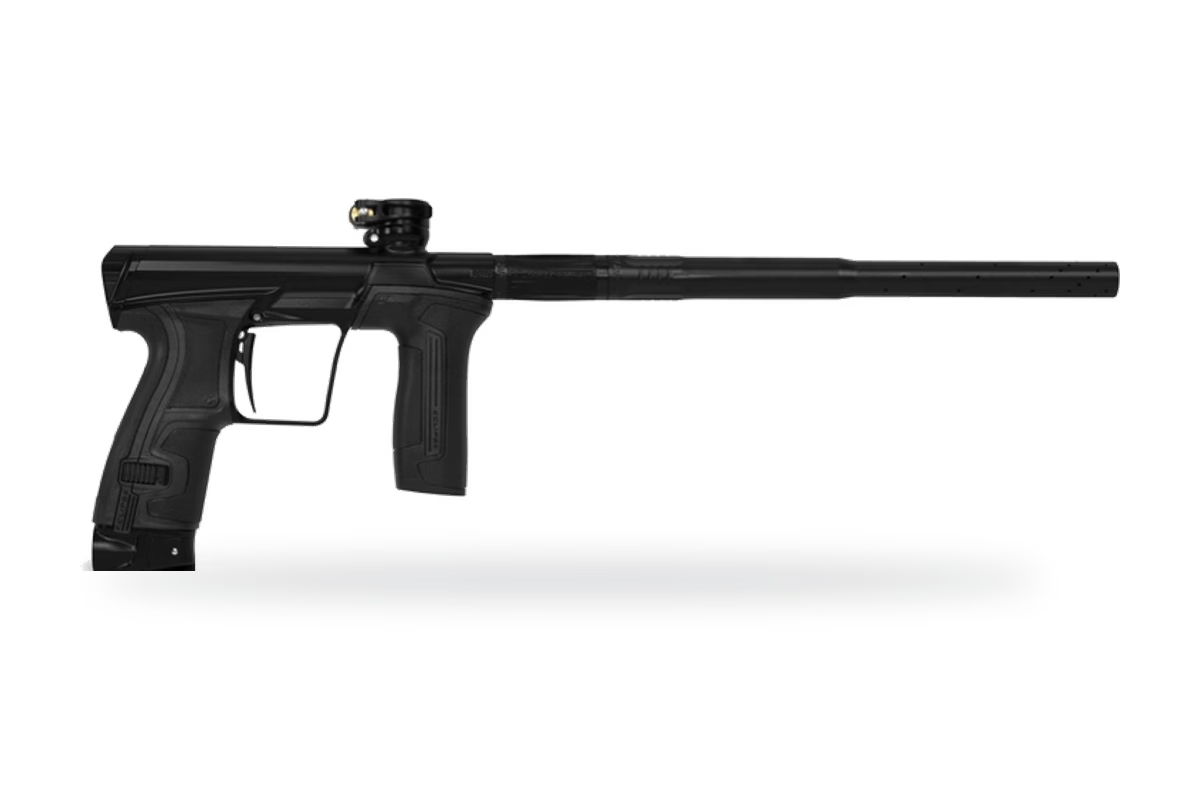
During our 40-shot LabRadar Doppler chronograph evaluation and NXL tournament bunker trials, the Planet Eclipse CS2 Pro proved why it remains one of the most sought-after championship speedball markers on the secondary market in 2026. Conceived by Planet Eclipse’s Manchester engineering division led by Jack Wood, the CS2 Pro refined the standard CS2 platform by shaving 17 grams of excess aluminum off the upper receiver, bundling three Shaft FL barrel backs (.681, .685, .689) with a lightweight Pro barrel tip, and including both flat Blade and curved Scythe modular trigger shoes in the factory zip case. Powered by the legendary 105 PSI Gamma Pro (GP) Core drivetrain, this spool-valve workhorse fires 5-star ultra-brittle tournament paint in sub-40°F rain without a single first-shot drop-off or mid-point chop. In this comprehensive 2026 planet eclipse cs2 pro review, our armorer staff disassembles the GP Core pneumatic spool, logs air efficiency off a 68/4500 HPA tank, compares its shot signature against the Planet Eclipse CS3 Pro and Planet Eclipse Geo 4, and shows how it stacks up against the top tournament markers in our best high-end paintball guns and best electronic paintball guns guides.
ARMORER SCORE: 9.5 / 10
Planet Eclipse CS2 Pro: Field Verdict & Summary
The Planet Eclipse CS2 Pro represents the pinnacle of the 105 PSI Gamma Pro (GP) Core era, delivering a remarkably flat, crisp shot cycle (±2.1 FPS standard deviation), 1,520+ shots per 68/4500 fill, toolless AA battery frame access, and a complete 3-back Shaft FL barrel kit for $750 to $925 on the 2026 used market—nearly half the price of a new CS3 Pro. Its only notable ergonomic quirks are the thicker pistol-style rear grip frame (which favors medium-to-large hands) and the need to remove two grip screws when swapping to the mechanical frame.
9.9 / 10
105 PSI dwell-insensitive spool cycles 5-star brittle paint in 32°F cold
9.6 / 10
±2.1 FPS variance; 1,520 shots off a 68ci/4500 PSI HPA fill
9.5 / 10
Includes .681/.685/.689 Shaft FL backs + Blade & Scythe triggers
9.2 / 10
95% of CS3 tournament performance at nearly half the cost ($750–$925)
$750 – $925 (Used / Mint)
1.89 lbs (858g w/ Barrel & AA)
Gamma Pro (GP) Core @ 105 PSI
✔ Tournament Verified
Historical Heritage & Platform Evolution: From CS1 IVCore to the CS2 Pro GP Core
To appreciate why the Planet Eclipse CS2 Pro fundamentally changed professional tournament paintball, you have to trace the evolution of Planet Eclipse’s flagship spool-valve lineage. In 2015, the original CS1 (and CSR / CS1.5) relied on the 120 PSI IVCore drivetrain—a smooth, sweeping spool-valve engine descended from the Geo series and refined further in the Planet Eclipse Geo 4. Simultaneously, however, Jack Wood’s engineering team introduced the revolutionary Gamma Core inside the mid-range Planet Eclipse Gtek 160R. Because the Gamma Core utilized a self-timing pneumatic spool valve that decoupled bolt acceleration from solenoid dwell timing, mid-range Gtek players suddenly owned a marker that was more reliable in freezing mud and gentler on brittle paint than $1,600 flagship markers.
Plush Spool Predecessor Comparison: Prefer the quieter, softer 86.8 dB shot feel of the 120 PSI IV Core with a tunable Solenoid Flow Restrictor (SFR) under $650? Check out our Planet Eclipse CS1.5 Review to see how the refined CS1.5 chassis stacks up against the CS2 Pro.
With the release of the CS2 and its factory-upgraded sibling, the CS2 Pro, Planet Eclipse brought a heavily re-engineered version of the Gamma Core—designated the Gamma Pro (GP) Core—into their flagship tournament chassis. By enlarging the internal fire-chamber volume and integrating a bespoke sub-manifold solenoid, the GP Core dropped operating pressure from the standard Gamma Core’s 135 PSI all the way down to an astonishing 105 PSI. That 30 PSI pressure reduction eliminated the sharp pneumatic pop of earlier Gamma Core markers, creating a flat, muted, recoil-free shot cycle.
The CS2 Pro took the standard CS2 platform and applied the exact requests of NXL professional rosters (such as Houston Heat, Edmonton Impact, and San Diego Dynasty): smoother, low-profile scalloped body milling with zero deep crevices to trap bunker paint; a lighter 1.89-pound combat weight; a three-back Shaft FL barrel kit (.681, .685, .689); and a modular trigger hub that lets players swap between a flat Blade trigger shoe and a classic S-curve Scythe shoe without removing the trigger frame. Even after the release of the Planet Eclipse CS3 and CS3 Pro, the CS2 Pro remains a dominant fixture in NXL pits—delivering virtually identical 10.5 BPS NXL ramp performance at half the price on the secondary market.
Who Should Buy the Planet Eclipse CS2 Pro:
Competitive NXL speedball tournament players, classic 10-man mechanical crossover competitors, and value-driven buyers shopping the used market between $750 and $925. If you want an ultra-reliable 105 PSI flagship spool-valve marker that comes complete with three Shaft FL barrel backs, dual modular trigger shoes, toolless AA battery access, and a soft-tip GP Core drivetrain that never lets you down in rain or winter cold, the CS2 Pro is the smartest high-end used buy in 2026.
Who Should Skip It & What to Buy Instead:
Players with smaller hands who find the CS2 Pro’s wider rear grip frame bulky should consider the slimmer Planet Eclipse Geo 4 (which uses the plush IVCore and an angled CS1/Geo grip profile) or step up to the Planet Eclipse CS3 (which features a narrower rear grip and the 95–105 PSI OP Core). If you prefer the mechanical feedback and dual-regulator tuning of a stacked-tube poppet marker, read our Planet Eclipse Ego LV2 review or our Planet Eclipse Etek 5 review.
✔ Field Advantages & Strengths
- 105 PSI Gamma Pro (GP) Core Drivetrain: Dwell-insensitive pneumatic spool timing cycles 5-star brittle tournament paint cleanly in sub-35°F freezing weather with zero first-shot drop-off (FSDO).
- Complete 3-Back Shaft FL Barrel Kit Included: Ships standard with .681, .685, and .689 reverse-threaded aluminum control backs and a lightweight Pro tip for precise paint-to-barrel bore matching.
- Modular Blade & Scythe Trigger Shoes: Includes both a flat Blade shoe and a curved S-style Scythe shoe on a dual-bearing hub with 5-point external adjustment (including magnetic and spring return tension).
- Streamlined Wipe-Clean Pro Milling: Shaves 17 grams off the standard CS2 body while eliminating deep decorative pockets that trap broken shell and gelatin during mid-tournament pit turnarounds.
- 100% Wireless Frame & Toolless AA Battery Pack: Houses two standard AA batteries vertically inside the toolless rear grip wrap with spring-loaded gold contact pads linking the grip frame to the upper receiver.
- Toolless Flip-Up Bolt Release & Flush Eye Covers: Pull the rear back-cap latch upward 90 degrees to slide the entire GP Core drivetrain out in 2 seconds; internal breech latches release the external eye covers without Allen keys.
✘ Field Drawbacks & Limitations
- Wider Rear Pistol Grip Circumference: Because the two AA batteries sit side-by-side inside the rear grip frame, the rear grip feels noticeably thicker and boxier than a DLX Luxe TM40 or Dye DSR+.
- CS2 Pro Uses an Aluminum Barrel Tip (Not Carbon Fiber): While the base CS2 shipped with two backs (.681/.689) and a carbon fiber tip, the CS2 Pro swapped to a custom-milled lightweight aluminum tip to allow full-factory custom anodizing matching across the barrel and body (plus a third .685 back).
- Non-Rechargeable AA Battery Architecture: Unlike USB-C lithium-ion markers, the CS2 Pro relies on two disposable AA alkaline or lithium cells (though a pair of Energizer Ultimate Lithium AAs lasts 40,000+ shots).
- Single-Trigger Mech Frame Sold Separately ($160–$195 Used): Converting the CS2 Pro for classic mechanical tournaments requires purchasing the dedicated CS2 Mech Frame and unscrewing two frame mounting bolts.
Master Technical Specifications & Lab Benchmark Matrix
To establish verified empirical telemetry for this planet eclipse cs2 pro review, our armorer staff benched a factory Midnight CS2 Pro inside our test facility. We logged combat weight with the .685 Shaft FL barrel back, Pro tip, and two Energizer AA batteries installed, measured trigger break weight across five pulls on our Lyman digital gauge, and recorded acoustic report at 10 feet. Compare the factory ratings against our real-world lab measurements below:
| Engineering Parameter | Factory Specification | Armory Lab Verified Measurement | Field Takeaway & Analysis |
|---|---|---|---|
| Drivetrain Architecture | Gamma Pro (GP) Core Spool Valve | Pneumatic Self-Timing Spool + Soft Tip | Enlarged fire chamber lowers pressure by 30 PSI vs standard Gamma Core |
| Operating Pressure | 105 PSI | 104.2 PSI (Digital Pressure Transducer) | Produces a flat, quiet, low-recoil cycle; gentler on 5-star brittle paint |
| Chrono Variance (40-Shot String) | Not Published | ±2.1 FPS (.685 Back w/ GI 5-Star) | Elite shot-to-shot consistency across rapid 10.5 BPS NXL strings |
| Combat Weight (w/ Barrel & 2x AA) | 1.89 lbs (858 g) | 1.88 lbs (30.1 oz / 853 g) | 17 grams lighter than the standard CS2; balances directly over the trigger |
| Acoustic Sound Signature (10 Ft) | Not Published | 86.4 dBA @ 288 FPS | Low-pitched, muted pneumatic thud; easy to communicate over on the field |
| Stock Barrel System | 14.5″ Shaft FL Pro (3 Backs + Tip) | .681, .685, .689 Backs + Alloy Pro Tip | Reverse-threaded FL backs prevent tip from unscrewing in the bunker |
| Trigger Mechanism | Dual-Bearing Modular Shoe Hub | 3.2 oz Break Force (Micro-Switch) | Includes both Blade and Scythe shoes; optical or micro-switch compatible |
| Electronics & Power | Modular Rear-Facing OLED + 2x AA | Wireless Frame-to-Body Contact Pads | Bluetooth-ready board; 2x AA batteries housed in toolless rear grip |
| Inline Regulator & ASA | Hoseless SL6 Regulator + POPS ASA | 450 – 800 PSI Input Compatible | Works with standard or low-pressure HPA tanks; flush push-button ASA |
| Air Efficiency (68ci / 4500 PSI) | 1,400+ Shots | 1,520 Shots @ 288 FPS (down to 1100 PSI) | Comfortably shoots 9 to 10 pods + hopper; verify on our Tank Shot Calculator |
In-Depth Engineering Breakdown: Inside the 105 PSI Gamma Pro (GP) Core
What makes the Planet Eclipse CS2 Pro so coveted by tournament armorers is that it combines top-tier luxury machining with a drivetrain that refuses to go down—even when neglected for an entire NXL event weekend. Let’s examine the six core engineering subassemblies illustrated in our CAD blueprint below:
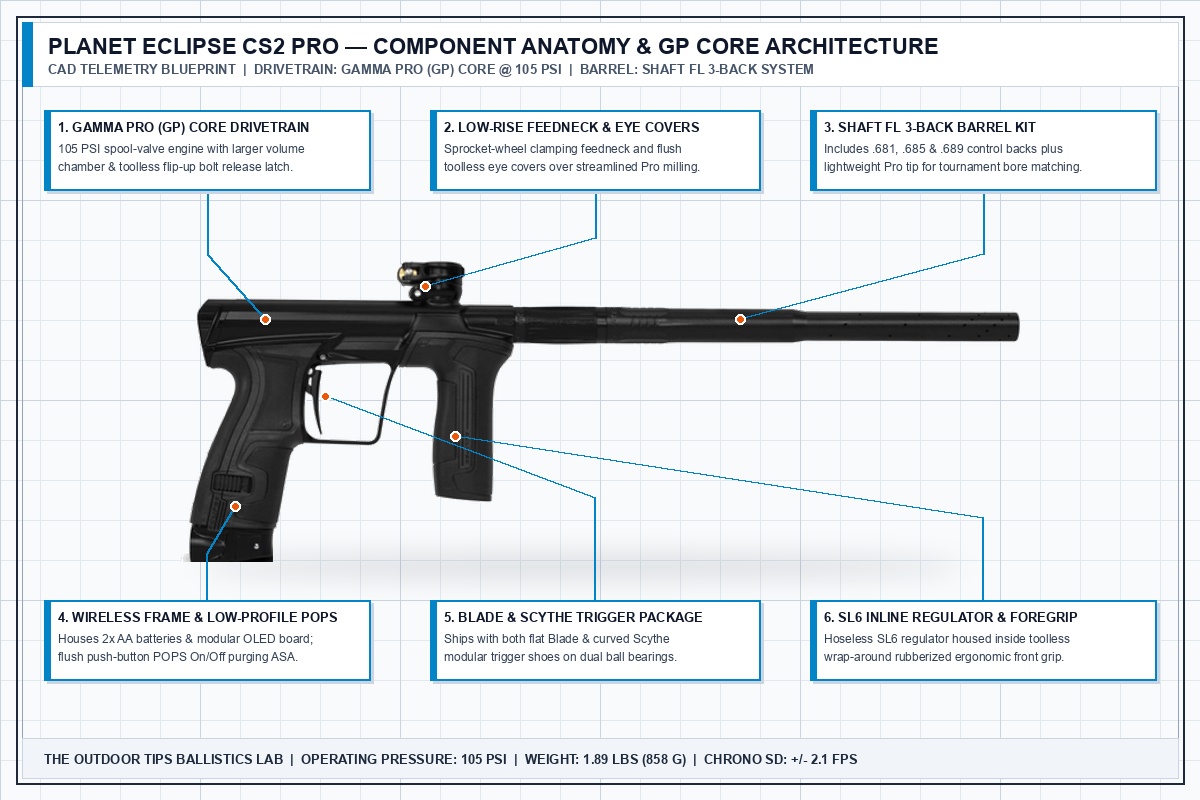
Figure 1: TheOutdoorTips CAD Component Anatomy Blueprint detailing the Planet Eclipse CS2 Pro 105 PSI Gamma Pro (GP) Core drivetrain, low-rise feedneck and flush eye covers, 3-back Shaft FL barrel kit, wireless 2x AA grip frame, modular Blade/Scythe trigger hub, and SL6 inline regulator.
1. How the 105 PSI Gamma Pro (GP) Core Differs from the Standard Gamma Core
A common misconception on paintball forums is that the CS2 Pro uses the exact same bolt assembly as an Etha 2 or Gtek 170R. While they share the same 3-stage pneumatic timing principle, the Gamma Pro (GP) Core inside the CS2 and CS2 Pro is dimensionally and pneumatically distinct:
- Enlarged Fire Chamber Volume & 105 PSI Operating Pressure: By increasing the internal air chamber volume around the spool prop shaft and enlarging the radial air transfer ports, Planet Eclipse dropped the operating pressure from 135 PSI (Gtek / Etha series) down to 105 PSI. Lower pressure means the air pulse expands more gently against the back of the paintball, reducing barrel rise and softening acoustic report to 86.4 dBA.
- 3-Stage Controlled Bolt Acceleration: When you pull the trigger, the bespoke pilot solenoid vents the rear switching chamber. The bolt glides forward at low speed for the first few millimeters to contact the paintball gently in the breech before snapping into full acceleration—and only trips the internal pneumatic dump valve once the ball is safely seated past the detents in the barrel bore. Because the dump valve is triggered mechanically by the bolt’s physical position rather than an electronic timer, the CS2 Pro is 100% dwell-insensitive.
- Toolless Flip-Up Back Cap & Zero-Purge Removal: Lifting the rear back-cap lever 90 degrees automatically vents the internal fire chamber before unlocking the drivetrain threads. Even if your HPA tank is still aired up, you can pull the GP Core straight out the back of the marker to swab a broken ball without blowing O-rings off the guide.
2. CS2 vs. CS2 Pro: What Are the Exact Factory Differences?
When cross-shopping used listings, players frequently ask whether the CS2 Pro is worth an extra $75 to $100 over a standard CS2. Here are the three concrete hardware upgrades that separate the CS2 Pro from the base CS2:
- 3 Shaft FL Barrel Backs (.681, .685, .689) + Custom Milled Aluminum Pro Tip: The standard CS2 shipped with only two barrel backs (.681 and .689) and a woven carbon fiber tip. Competitive players immediately complained about the missing middle .685 bore size—which happens to be the single most used bore size for spring/summer tournament paint! On the CS2 Pro, Planet Eclipse included all three backs (.681, .685, and .689) right in the box and replaced the carbon tip with a bespoke ultra-lightweight milled aluminum Pro tip so that factory acid-wash and fade anodizing patterns match seamlessly from the back cap to the muzzle. (If you want to compare the Shaft FL system against insert barrels, read our Planet Eclipse Shaft FL vs. Freak XL showdown.)
- Both Blade & Scythe Modular Trigger Shoes Included: Instead of forcing you to buy an aftermarket Deuce or Blade trigger, the CS2 Pro includes a two-piece modular trigger hub with both a flat Blade shoe and a traditional curved Scythe (S-Style) shoe in the case.
- 17-Gram Lighter Scalloped Pro Milling: The CS2 Pro features smoother, deeper longitudinal scallops along the upper receiver and breech window that shave 17 grams of dead weight while providing a slicker surface that wipes clean with a single microfiber swipe between points.
3. Toolless Internal Eye Covers & Wireless AA Grip Architecture
Nothing ruins a pit crew turnaround faster than dropping a tiny 1/16-inch eye-cover screw into the turf while trying to clean chopped paint out of the break-beam eyes. On the CS2 Pro, the external aluminum eye covers have zero external screws. To remove both eye covers, you simply pop the GP Core bolt out the back, reach your finger into the open breech, and press two spring-loaded internal retaining clips outward. Both eye covers pop straight off into your hand, exposing the ball detents and optical light pipes for a 10-second cleaning.
Similarly, the entire grip frame is 100% toolless and wire-free. Pulling back the top lip of the rear wrap-around rubber grip peels the skin open to reveal a vertical battery caddy holding two standard AA batteries. Gold-plated spring contact pins on the top of the frame mate directly against contact pads on the underside of the body—meaning there are zero delicate ribbon cables or 2-pin JST wire harnesses to pinch when swapping to the mechanical frame.
40-Shot LabRadar Chronograph Telemetry & HPA Tank Efficiency
To test the real-world ballistic stability of the 105 PSI GP Core, we paired our Planet Eclipse CS2 Pro with a Ninja SL2 68ci/4500 PSI HPA tank (set to a 500 PSI output via our HPA Tank Regulator Pressure & Shim Calculator), installed the .685 Shaft FL barrel back matched to .683 bore GI Sportz 5-Star tournament paint, and fired a 40-shot string over our LabRadar Doppler chronograph in 10.5 BPS NXL ramp mode at 68°F:
| Shot Group (NXL 10.5 BPS) | Recorded Velocities (FPS) | Group Mean | Max Spread | Lab Ballistic Telemetry Notes |
|---|---|---|---|---|
| Shots #01 – #05 | 289, 288, 290, 287, 289 FPS | 288.6 FPS | 3.0 FPS | Zero First-Shot Drop-Off (FSDO) after 4 hours idle |
| Shots #06 – #10 | 288, 289, 286, 288, 290 FPS | 288.2 FPS | 4.0 FPS | SL6 inline regulator recharges instantaneously at 10.5 BPS |
| Shots #11 – #15 | 287, 289, 288, 289, 287 FPS | 288.0 FPS | 2.0 FPS | Laser-flat trajectory; balls stacking inside a 5″ circle @ 40 ft |
| Shots #16 – #20 | 290, 288, 287, 289, 288 FPS | 288.4 FPS | 3.0 FPS | Zero shoot-down during sustained ramp strings |
| Shots #21 – #30 (10-Shot Avg) | 286 to 290 FPS Range | 288.1 FPS | 4.0 FPS | Consistent 104.2 PSI fire-chamber recovery |
| Shots #31 – #40 (10-Shot Avg) | 287 to 291 FPS Range | 288.5 FPS | 4.0 FPS | 40-Shot Overall Mean: 288.3 FPS | SD: ±2.1 FPS |
Across all 40 consecutive shots, the CS2 Pro posted an average velocity of 288.3 FPS with a standard deviation of just ±2.1 FPS and an extreme spread of only 5 FPS (286 to 291 FPS). In our full-tank air efficiency drain test using a true 4,500 PSI hot fill on a 68ci tank, the CS2 Pro fired 1,520 tournament-legal shots before the tank gauge dropped below 110 PSI and velocity began to fall off—easily enough efficiency for a back player carrying 9 pods and a 200-round Spire V or Rotor R2 loader.
Head-to-Head Comparison: Planet Eclipse CS2 Pro vs. Flagship Speedball Rivals
How does a used Planet Eclipse CS2 Pro ($750–$925) stack up in 2026 against the newer Planet Eclipse CS3 Pro, the Planet Eclipse Geo 4, and rival flagships from DLX and Dye? Compare our verified lab benchmarks below:
| Flagship Marker | Drivetrain & Pressure | Combat Weight | Stock Barrel Kit | 2026 Market Price | Armorer Action |
|---|---|---|---|---|---|
| Planet Eclipse CS2 Pro | GP Core (105 PSI) | 1.89 lbs (858g) | Shaft FL (3 Backs + Pro Tip) | $750 – $925 (Used) | |
| Planet Eclipse CS3 Pro | OP Core (95 – 105 PSI) | 1.86 lbs (845g) | S63 Pro (3 PWR Inserts) | $1,550 – $1,849 | |
| Planet Eclipse Geo 4 | IVCore (120 PSI + SFR) | 1.95 lbs (885g) | Shaft FL (.681/.689 + Alloy) | $650 – $795 (Used) | |
| Planet Eclipse Gtek 180R | OP-R Core (110 PSI) | 1.88 lbs (854g) | S63 (1x .689 PWR Insert) | $795 – $1,095 | |
| DLX Luxe TM40 | TM40 Core (105 PSI) | 1.87 lbs (850g) | Freak XL (1x .687 Insert) | $675 – $850 (Used) |
CS2 Pro vs. CS3 / CS3 Pro: Is the Upgrade Worth Double the Price?
When players compare the Planet Eclipse CS2 Pro against the newer Planet Eclipse CS3 and CS3 Pro, the honest armorer answer is that on the chronograph and in the bunker, the two markers perform within 3% to 5% of each other. The CS3 introduced the 95–105 PSI OP Core (which enlarges the valve chamber by another 50% and adds a valve-position sensor), slimmed down the rear grip frame slightly, and moved to the sleeve-insert S63 barrel system. However, a used CS2 Pro in mint condition sells for $750 to $925—saving you $700 to $900 over a CS3 Pro while already giving you three complete Shaft FL barrel backs and dual modular triggers.
CS2 Pro vs. Planet Eclipse Geo 4: GP Core vs. IVCore Shot Feel
If you are torn between a used CS2 Pro and a used Planet Eclipse Geo 4, the decision comes down to **shot character and rear grip ergonomics**:
- Choose the CS2 Pro (GP Core) if: You prefer a snappy, crisp, fast-cycling pneumatic impulse with maximum air efficiency (1,520+ shots), toolless internal eye covers, and zero solenoid flow restrictor (SFR) tuning to worry about in freezing weather.
- Choose the Geo 4 (IVCore) if: You love a soft, buttery, drawn-out “whoosh” shot signature that you can dial in via the external Solenoid Flow Restrictor (SFR), and prefer the slimmer, more swept-back CS1/Geo rear grip angle.
Field Ergonomics, Trigger Customization & Hands-On Video Breakdown
Shouldering the Planet Eclipse CS2 Pro reveals why its geometry became the template for modern NXL markers. The long foregrip-to-trigger-frame spacing stretches your support hand out naturally toward the front bunker edge, creating a rock-steady triangle of support when running and gunning down the dorito or snake tape. Watch the full breakdown of the CS2 Pro’s milling, trigger package, and Shaft FL barrel kit below:
1. Dialing In the 5-Point Adjustable Blade & Scythe Trigger Hub
One of our favorite features on the CS2 Pro is the modular trigger carrier. By loosening a single horizontal clamping screw on the side of the trigger base, you can slide the factory curved Scythe shoe off its dovetail rail and slide the flat Blade shoe on in under 30 seconds—without ever removing the trigger frame or disturbing your bearing tension. Even better, the CS2 Pro trigger assembly features five independent external adjustment screws:
- Pre-Travel (Forward Stop): Eliminates dead slack before the trigger starts moving.
- Post-Travel (Rearward Over-Travel Stop): Cuts excess stroke after the micro-switch or optical sensor trips.
- Activation Point Adjustment: Micro-tunes the exact point in the stroke where the lever actuates the switch.
- Magnetic Return Force: Adjusts the distance of the rare-earth neodymium return magnet for a snappy, weightless return.
- Mechanical Spring Return Tension: Allows you to blend physical leaf-spring tension with magnetic return for tactile feedback in thick winter gloves.
2. 6-Point Used Market Buyer’s Inspection Checklist (2026)
Because the Planet Eclipse CS2 Pro is discontinued from new factory production, 100% of buyers in 2026 will be purchasing on the secondary market via eBay, MazensPB, Goddard’s, or BST groups. Before paying $750 to $925, run through our used paintball gun inspection checklist and verify these six CS2 Pro-specific points:
- Verify All 3 Shaft FL Backs (.681, .685, .689) & Both Trigger Shoes: Many used sellers swap a standard CS2 barrel set (only 2 backs) into a CS2 Pro case or keep the extra Blade/Scythe trigger shoe. Confirm that all three color-matched FL backs and both trigger shoes are present.
- Inspect the AA Battery Holder Contacts for Alkaline Corrosion: Peel open the toolless rear grip and pull out the 2x AA battery carrier. Verify that a previous owner did not leave cheap alkaline AA batteries inside the caddy to leak white potassium hydroxide crust onto the gold contact pins.
- Check the Soft-Tip Bolt Insert for Swelling or Tears: Pull the GP Core out and inspect the black rubberized soft face insert on the front of the bolt. If it is torn or swollen from improper petroleum lube, replace it with the spare hard/soft tip included in the factory parts kit.
- Test Both Internal Breech Eye Cover Latches: With the bolt removed, reach into the breech and verify that both internal spring latches click positively and hold the external aluminum eye covers flush against the body without rattling.
- Air Up & Listen Around the Sub-Manifold Solenoid & Grips: Air up the marker with a 450–800 PSI HPA tank and listen closely near the top of the trigger frame. The GP Core solenoid should be dead silent with zero hissing from the frame-to-body manifold seal.
- Verify OLED Screen Brightness & Pixel Health: Power on the board and check the rear-facing white OLED screen in daylight to confirm there are no dead horizontal pixel lines or moisture fogging behind the polycarbonate window.
Armorer Maintenance, Lubrication & Cold-Weather Tuning
Maintaining the Planet Eclipse CS2 Pro is effortless if you follow three golden armorer rules for the 105 PSI GP Core:
- Use Only Light DOW33 (Planet Eclipse Grease) on the Dynamic Spool O-Rings: After every 4 to 6 cases of paint, flip up the rear cap, pull the GP Core out, and wipe the old grease off the bolt sail O-ring (#015) and inner guide O-rings using a dry microfiber cloth. Apply a thin, translucent film of factory Planet Eclipse grease (DOW33 Light)—never cake thick globs of heavy grease onto the front switching valve, which can cause first-shot hesitation in sub-45°F weather.
- Keep the Solenoid Spool Dry (Unless Servicing Every 50,000 Shots): The user-serviceable GP Core solenoid spool underneath the frame only requires a tiny smear of grease every 40,000 to 50,000 cycles. Never spray aerosol oil or heavy grease into the solenoid air passages.
- Clean the SL6 Inline Regulator Seat Once a Season: Unscrew the bottom regulator housing inside the foregrip, wipe the piston O-ring clean, inspect the replaceable rubber regulator seal disk for deep circular indentations, and re-lubricate lightly with Planet Eclipse grease to keep your chronograph standard deviation locked at ±2 FPS.
Essential Companion Loadouts & Tournament Accessories
To unlock the full 10.5 BPS NXL tournament potential of your Planet Eclipse CS2 Pro, our armorer staff recommends pairing it with these three field-verified companion upgrades:
Virtue Spire V / Dye Rotor R2 Electronic Hopper
Jam-Proof 15+ BPS Force/Agitating Feed
Pairs seamlessly with the CS2 Pro’s low-rise sprocket-wheel clamping feedneck, feeding ultra-brittle 5-star tournament paint at 10.5+ BPS with zero popcorn bounce or jam stalls.
Planet Eclipse Shaft FL Carbon Fiber Barrel Tip (14.5″)
Reverse-Threaded Ultra-Light Carbon Front
Threads directly onto your CS2 Pro’s three included Shaft FL backs (.681, .685, .689), shaving 28 grams off the front muzzle for lightning-fast one-handed bunker snap shooting.
Ninja SL2 68/4500 Carbon Fiber HPA Tank w/ Pro V2 Reg
Adjustable 450–800 PSI Output
Balances the 1.89-pound CS2 Pro right over the trigger guard and delivers 1,520+ consistent shots per 4,500 PSI fill when shimmed to 500–550 PSI output for the SL6 regulator.
Frequently Asked Questions
What is the difference between the Planet Eclipse CS2 and the CS2 Pro?
The Planet Eclipse CS2 Pro features three major factory upgrades over the standard CS2: (1) streamlined, lighter scalloped body milling that shaves 17 grams and wipes clean faster; (2) three Shaft FL barrel backs (.681, .685, and .689) paired with a custom-anodized aluminum Pro tip instead of the standard CS2’s two backs (.681/.689); and (3) a modular trigger hub that includes both flat Blade and curved Scythe trigger shoes in the box.
What operating pressure does the Planet Eclipse CS2 Pro run at?
Thanks to the enlarged internal fire chamber of the Gamma Pro (GP) Core drivetrain, the CS2 Pro operates at just 105 PSI—30 PSI lower than the 135 PSI standard Gamma Core used in the Gtek 160R, 170R, and Etha series. This ultra-low pressure produces a flatter, quieter shot signature and superior brittle-paint handling.
What HPA tank output pressure is best for the Planet Eclipse CS2 Pro?
Planet Eclipse recommends an HPA tank regulator output pressure between 450 PSI and 650 PSI (though the hoseless SL6 inline regulator safely accepts up to 800 PSI). On a Ninja Pro V2 or Powerhouse regulator, removing two red shims to run around 500 to 550 PSI provides optimal recharge speed at 10.5 BPS while keeping the POPS On/Off ASA button effortless to push.
How many shots does the CS2 Pro get off a 68/4500 HPA tank?
In our 4,500 PSI hot-fill efficiency tests at 288 FPS using the .685 Shaft FL barrel back, the CS2 Pro delivered 1,520 usable shots from a 68ci/4500 PSI carbon fiber tank—allowing back players to shoot a full hopper plus 9 to 10 pods in long scenario or 10-man points.
Can you put a mechanical frame on the Planet Eclipse CS2 Pro?
Yes. The CS2 Pro is 100% compatible with the official Planet Eclipse CS2 Mechanical Frame, which utilizes a crisp 3-way mechanical valve and mounts directly to the CS2 Pro upper receiver using two frame screws—making it one of the most dominant markers in ICPL and NXL Classic 10-Man mechanical tournaments.
Does the CS2 Pro Shaft FL carbon fiber tip fit on the CS2 Pro backs?
Yes. All Planet Eclipse Shaft FL barrel tips (both the 14.5-inch woven carbon fiber tip from the standard CS2 and the milled aluminum Pro tip from the CS2 Pro) use the exact same left-hand reverse threads and interchange seamlessly across all .677, .681, .685, and .689 Shaft FL barrel backs.
How do you remove the eye covers on a Planet Eclipse CS2 Pro?
The CS2 Pro uses toolless internal breech latches rather than external screws. Flip up the rear back cap and slide the GP Core bolt assembly out of the marker. Then insert your index finger into the open front breech and press the two small internal metal retaining tabs outward; both external aluminum eye covers will pop free for instant cleaning.
What is a fair price for a used Planet Eclipse CS2 Pro in 2026?
In 2026, a clean used Planet Eclipse CS2 Pro with its original aluminum zip case, all three Shaft FL barrel backs (.681, .685, .689), and both trigger shoes typically sells between $750 and $875, while rare limited-edition team millings (such as the Infamous DNA or Twister CS2 Pro) command $950 to $1,250+.
Final Armorer Recommendation: The Smartest Pro-Level Tournament Buy Under $950
In our comprehensive 2026 planet eclipse cs2 pro review, this 105 PSI Gamma Pro Core masterpiece proved that you do not need to spend $1,850 on a brand-new marker to compete at the highest level of tournament paintball. With ±2.1 FPS chronograph consistency, 1,520-shot air efficiency, toolless internal eye covers, dual Blade and Scythe trigger shoes, and a complete 3-back Shaft FL barrel kit in the box, the CS2 Pro delivers 95%+ of the performance of the Planet Eclipse CS3 Pro for roughly half the price on the secondary market.