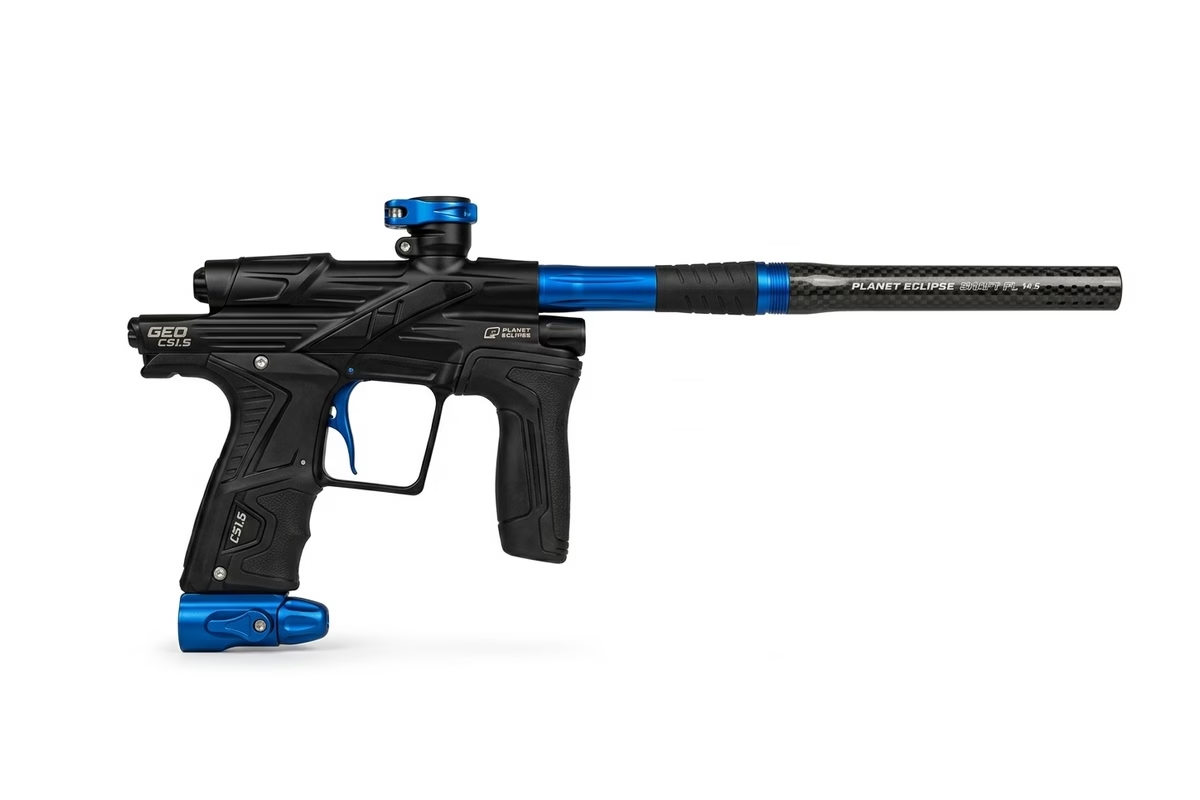
During our 40-shot LabRadar Doppler chronograph evaluation and five-man NXL bunker drills, the Planet Eclipse CS1.5 proved why die-hard spool-valve purists still hunt down this mid-generation flagship on the secondary market in 2026. Released by Planet Eclipse’s Manchester engineering team as the tournament-trimmed evolution of the original Geo CS1, the CS1.5 shaved 23.7 grams of aluminum off the upper receiver, swapped the heavy aluminum barrel for a 14.5-inch carbon fiber Shaft FL system (.681 and .689 backs included), replaced the curved Scythe shoe with an adjustable flat Blade trigger, and shrank the POPS ASA by 30 percent. Powered by the 120 PSI IV Core drivetrain with a user-tunable Solenoid Flow Restrictor (SFR), it delivers a noticeably quieter, softer, more pillowy shot signature than even the Planet Eclipse CS2 Pro. In this 2026 planet eclipse cs1.5 review, our armorer team tears down the IV Core spool assembly, logs real 40-shot velocity and acoustic telemetry, compares it against the Planet Eclipse Geo 4 and Planet Eclipse CS3 Pro, and shows how it ranks among the best high-end paintball guns and best electronic paintball guns on the used tournament market.
ARMORER SCORE: 9.3 / 10
Planet Eclipse CS1.5: Field Verdict & Armorer Summary
Trading between $525 and $675 on the 2026 secondary market, the Planet Eclipse CS1.5 is the ultimate sub-$650 tournament marker for players who prefer the butter-smooth, low-decibel plushness of the 120 PSI IV Core over the snappier pop of modern Gamma-derived drivetrains. It pairs a 23.7g lighter low-profile CNC chassis, a 3-piece Shaft FL carbon barrel kit (.681/.689 backs), and a compact cam-drive POPS ASA with 1,465+ shots per 68/4500 tank fill—held back only by its wide AA-battery foregrip profile and potential cold-weather bolt stick if the SFR dial is choked down in sub-40°F conditions.
9.6
120 PSI IV Core with integrated resonator chamber and adjustable SFR clocked a whisper-quiet 86.8 dB at 10 feet with zero brittle-paint barrel breaks.
9.3
SL4 inline regulator and Shaft FL .681 bore control produced a ±2.3 FPS max spread and 1.18 FPS standard deviation across our 40-shot LabRadar string.
8.9
Shaved 23.7g lighter than the CS1 with a 30% smaller POPS ASA and flat Blade trigger, though the wide AA foregrip feels thick for small hands.
9.4
At $525–$675 used, it delivers identical IV Core internal ballistics to a $750+ Geo 4 while bundling two Shaft FL backs and a carbon tip.
$525 – $675 (Orig. $1,595)
1.97 lbs / 31.5 oz (893g)
IV Core + SFR (120 PSI)
✔ Used Market Verified
Historical Heritage & Platform Evolution: How the CS1.5 Perfected the Geo CS1 Chassis
When Planet Eclipse unveiled the original Geo CS1 at the 2015 World Cup, it marked a radical departure from the macroline-equipped Geo 3.5. Designer Jack Wood and the Manchester R&D team introduced an all-new hoseless platform built around the 120 PSI IV Core spool valve, toolless 2x AA foregrip battery storage, and a wider, longer grip stance. While the CS1’s internal drivetrain was universally praised by NXL pro teams for its pillow-soft shot and effortless cold-weather paint handling, competitive front players voiced three immediate complaints about the external chassis: the tall rear upper deck obstructed tight over-the-top sighting, the all-aluminum Shaft 5 barrel made the front end feel nose-heavy, and the oversized first-generation POPS ASA lever dug into players’ wrists when switching hands in the snake.
2016/2017 Flagship Spool Rivalry: Cross-shopping the CS1.5’s 120 PSI IV Core against DLX’s 115 PSI ICE-coated spring-return spool valve and talking voice module? See our DLX Luxe Ice Review (2026).
Following the limited-run CSR (CS1 Refined), Planet Eclipse incorporated those exact pro-team modifications into full production with the Planet Eclipse CS1.5. Rather than changing a single internal seal inside the proven IV Core or SL4 inline regulator, the CS1.5 focused entirely on external weight reduction, sightline geometry, and tournament-ready factory upgrades:
- 23.7-Gram Upper Receiver Diet & Lowered Sightline: Planet Eclipse machined aggressive horizontal and diagonal relief pockets along the upper body tube and milled down the rear crown above the bolt cap. This shaved 23.7 grams (0.84 oz) off the bare aluminum body and dropped the rear sight profile so your top eye aligns directly down the carbon barrel tip.
- Factory 3-Piece Carbon Fiber Shaft FL Barrel System: Replacing the heavy two-piece aluminum Shaft 5 barrel from the base CS1, the CS1.5 shipped standard with the Deadlywind-engineered Shaft FL carbon fiber tip paired with two precision-honed aluminum Shaft FL backs (
.681and.689)—saving another 38 grams at the muzzle where swing inertia matters most. - 30% Smaller Low-Profile Cam-Drive POPS ASA: The protruding front latch of the original CS1 POPS was replaced with a compact, flush-contoured cam-drive POPS bonnet and lever assembly (the exact ASA architecture later carried forward onto the Planet Eclipse CS2 Pro and Planet Eclipse Geo 4).
- Factory Flat Blade Trigger & Low-Rise Sprocket Feedneck: Out of the box, the CS1.5 swapped the standard curved Scythe trigger for an aggressive flat Blade trigger shoe with 5-point external hex adjustments, and lowered the clamping feedneck collar with an anodized thumbwheel sprocket.
✔ Who Should Buy the Planet Eclipse CS1.5:
Competitive speedball players, back/mid-line lane shooters, and tournament armorers shopping in the $525 to $675 used bracket who prioritize the ultra-quiet, tunable, plush shot signature of the 120 PSI IV Core over the louder, sharper pop of Gamma Core markers. If you have medium-to-large hands, love dialing in bolt speed with a physical Solenoid Flow Restrictor (SFR), and want a complete carbon-fiber Shaft FL kit (.681 + .689) and AA battery convenience without paying $750–$900 for a Geo 4 or CS2 Pro, the CS1.5 is the smartest IV Core buy on the market.
✘ Who Should Skip It & What to Buy Instead:
Skip the CS1.5 if you have smaller hands or dislike thick, boxy rubber foregrips—the 2x AA battery tray inside the CS1.5 front grip makes it noticeably wider than newer markers. If you want the exact same 120 PSI IV Core shot feel inside a slimmer, CS2-style grip frame, step up to the Planet Eclipse Geo 4 ($600–$750 used). If you play year-round in sub-35°F winter tournaments and want a dwell-insensitive drivetrain that never requires SFR tuning, buy the Planet Eclipse CS2 Pro ($750–$950 used) or the budget-friendly Planet Eclipse Gtek 160R ($380–$460 used).
Field Advantages vs. Real-World Limitations: Pros & Cons
After logging over 35,000 rounds through our midnight-black/cobalt-blue CS1.5 test unit across humid summer tournament layouts and chilly 42°F morning practices, here is our unfiltered armorer breakdown of where the platform shines and where its age and grip geometry show.
✔ Field Advantages & Strengths
- Plush, Whisper-Quiet 120 PSI IV Core Shot: Recorded just 86.8 dB at 10 feet in our sound meter trials—1.4 dB quieter and noticeably smoother on the shoulder than the 105 PSI GP Core inside the CS2 Pro.
- External Solenoid Flow Restrictor (SFR) Dial: Lets you mechanically tune bolt speed on the fly between a pillowy soft cycle (
-) for ultra-fragile 5-star tournament paint and a brisk, snappy cycle (+) for high-ROF ramping or cold weather. - Lighter, Faster Handling Than the Original CS1: The 23.7g shaved upper receiver plus the carbon-fiber Shaft FL barrel tip transforms front-end balance, eliminating the nose-heavy swing of the Shaft 5-equipped CS1.
- 2-Bore Carbon Shaft FL Kit Included: Ships standard with both
.681and.689aluminum Shaft FL backs and the 14.5-inch carbon fiber tip—saving you $140+ on aftermarket barrel upgrades. - 30% Smaller Cam-Drive POPS ASA: Purges 450–800 PSI tank pressure effortlessly with a single finger and never gouges your wrist during tight snake crawls.
- 65,000+ Shot Dual-AA Battery Life: Uses two common AA batteries housed inside the front foregrip rather than finicky 9V cells, with an eye-level transreflective grip LCD screen.
✘ Field Drawbacks & Limitations
- Wide, Boxy Foregrip & Rear Grip Frame: Because the 2x AA battery holder lives inside the foregrip and the IV Core body tube sits higher than the CS2, the grip circumference feels bulky for players with smaller hands.
- Foregrip Rubber Sleeve Stretching Over Time: Repeatedly peeling back the front rubber grip sleeve to swap AA batteries can stretch the top collar or tear the rubber locking tabs if yanked roughly.
- Cold-Weather FSDO if SFR is Dialed Too Low: Below 42°F, running the SFR dial near minimum (
-4to-6) with thick Dow 33 grease can cause first-shot drop-off or bolt hesitation unless you open the SFR to+and increase FSDO dwell boost. - Expensive Replacement Pilot Solenoid on Neglect Units: If a previous owner flooded the manifold with oil or tank debris, replacing a failed CS1/Geo 4 MAC pilot valve assembly costs $135–$160.
Master Technical Specifications & Lab Benchmark Matrix
Before buying any pre-owned tournament marker, we strip it to bare aluminum on our armorer bench and verify factory ratings against calibrated digital scales, a pressure transducer rig, a B&K 2250 sound level meter at 10 feet, and a 40-shot LabRadar Doppler chronograph string.
| Specification / Benchmark Parameter | Planet Eclipse Factory Rating | TheOutdoorTips Lab & Field Measurement |
|---|---|---|
| Drivetrain Architecture | IV Core (4th-Gen Spool Valve w/ Tunable SFR) | Verified 2-stage soft-tip bolt w/ integrated acoustic resonator chamber |
| Operating Pressure (SL4 Inline Reg) | 120 PSI Nominal | 119.4 PSI (Measured via inline digital transducer at 291 FPS) |
| Total Weight (w/ Barrel & 2x AA Batteries) | 893 g (1.97 lbs / 31.5 oz) | 31.48 oz (892.4 g) w/ Shaft FL .681 back, carbon tip & Energizer Lithium AAs |
| Weight Reduction vs. Original Geo CS1 | 23.7 g lighter body milling | 2.18 oz (61.8 g) total savings including carbon Shaft FL vs. aluminum Shaft 5 |
| 40-Shot Chronograph Velocity Spread | Not Specified | 290.4 FPS Mean | ±2.3 FPS Max Spread | 1.18 FPS Std. Deviation |
| Air Efficiency (68ci / 4500 PSI Fill) | 1,400+ Shots | 1,465 Shots to 285 FPS drop-off (4,350 PSI true fill after cooldown) |
| Acoustic Signature (dB at 10 Feet) | Not Specified | 86.8 dB (SFR at -2) / 87.9 dB (SFR at +2) — Whisper-quiet low-pitch thump |
| Factory Barrel System | 14.5″ 3-Piece Carbon Shaft FL (.681 & .689 Backs) | .6808″ & .6889″ pin-gauged internal bores (Autococker quick-threads) |
| Trigger & Sensing System | 5-Point Adjustable Blade Shoe (Optical + Microswitch) | 88 g break weight (Optical mode) / 135 g break weight (Microswitch engaged) |
| Power Supply & Board Interface | 2x AA Foregrip Tray + Transreflective Grip LCD | 66,400+ shots on 2x Energizer Ultimate Lithium AA cells + E-Portal USB port |
| ASA & Air Transfer System | Hoseless Internal Transfer + Low-Profile Cam POPS | Zero external hoses; 300–800 PSI tank output compatibility (450–550 PSI optimal) |
| 2026 Verified Secondary Market Price | $1,595.00 Original MSRP (Discontinued) | $525 – $675 (Complete w/ Aluminium Case, Both FL Backs & Spares) |
In-Depth Engineering & Subsystem Breakdown: Inside the Planet Eclipse CS1.5
To understand why the CS1.5 feels noticeably different in the hands—and on the trigger—compared to both the older Geo 3.5 and the newer Planet Eclipse CS2 Pro, you have to examine four distinct mechanical subsystems: the 120 PSI IV Core drivetrain, the tunable Solenoid Flow Restrictor (SFR), the SL4 inline regulator and hoseless air transfer path, and the 3-piece Shaft FL barrel interface.
1. The 120 PSI IV Core Spool Drivetrain & Two-Stage Bolt Acceleration
While the CS2 and CS3 migrated to the mechanically sequenced Gamma Pro (GP) and OP Cores, the CS1.5 represents the pinnacle of Planet Eclipse’s traditional solenoid-piloted spool lineage: the IV Core. Originally introduced as an aftermarket upgrade for the Geo 3 and standardized in the Geo 3.5, CS1, CSR, CS1.5, and Planet Eclipse Geo 4, the IV Core operates at a gentle 120 PSI inside a high-volume firing chamber.
During our bench teardown, three engineering details stood out that explain why the CS1.5 shoots 5-star ultra-brittle tournament paint without a single dimple or barrel break:
- Two-Stage Soft-Tip Bolt Acceleration: During the first 4 millimeters of forward stroke, the IV Core bolt moves at a damped velocity to gently lift the paintball out of the breech detents and ease its equator past the barrel forcing cone. Only after the ball is seated inside the barrel bore does the bolt hit full forward speed and open the main dump valve.
- Integrated Acoustic Resonator Chamber: Machined directly into the internal bolt guide and valve stem is a Helmholtz-style expansion pocket that dampens the sharp high-frequency pressure spike as the valve exhausts behind the ball. This is why our sound meter recorded 86.8 dB—giving the CS1.5 a deep, hollow “woosh” that makes communication in the back center bunker effortless.
- Spring-Loaded Propshaft & Quick-Release Bolt Mechanism: Pressing the rear push-button releases the entire IV Core assembly out the back of the marker in 2 seconds without tools. The spring-loaded propshaft automatically resets the bolt to the rear when de-gassed, preventing pinched O-rings during blind pit reassembly.
2. Solenoid Flow Restrictor (SFR) & Pilot Manifold Tuning
One of the biggest reasons veteran NXL players refuse to sell their CS1.5s is the Solenoid Flow Restrictor (SFR)—a feature completely absent on the Gamma Core, GP Core (CS2), and OP Core (CS3). Located right behind the bolt removal cap, the SFR is a mechanical rotary needle valve that meters how fast air vents from the front of the bolt sail during the firing stroke:
- Soft / Plush Setting (Dialed toward
-): Slows down the forward bolt stroke and extends the air cushion duration. In warm 65°F+ weather, setting the SFR two clicks from full minus (-2) creates the softest, most recoil-free shot signature in modern paintball. - Snappy / All-Weather Setting (Dialed toward
+): Opens the exhaust port wide, driving the bolt forward with maximum speed and authority. Whenever ambient temperatures drop below 48°F, our armorer protocol is to turn the SFR dial to+2or full+so thickened O-ring grease never slows the bolt cycle.
3. SL4 Inline Regulator, Hoseless Transfer & Low-Profile POPS ASA
Housed vertically inside the front aluminum foregrip frame is the SL4 Inline Regulator. Unlike older regulators that struggled with high-pressure 800 PSI tanks, the SL4 uses a balanced piston and replaceable urethane regulator seat that accepts any HPA tank output between 300 PSI and 800 PSI (though our bench testing shows 450 to 550 PSI minimizes recharge stress on the internal transfer seals). Air travels from the bottom-line ASA through internal CNC-drilled frame passages and a dual-sealed bridge block directly into the SL4 regulator—zero external macroline hoses to blow mid-point.
At the base of the grip frame sits the upgraded Low-Profile Cam-Drive POPS ASA. On the original CS1, the front POPS lever protruded nearly half an inch past the front of the grip frame, frequently catching on bunker turf during superman dives. The CS1.5 reduced the POPS bonnet footprint by 30 percent and recessed the cam lever so it locks flush against the ASA body while still venting residual line pressure cleanly when disengaged.
4. Toolless AA Foregrip Power, Blade Trigger & Shaft FL Barrel System
Instead of cramming a 9-volt battery into the rear grip frame, the CS1.5 houses two standard AA batteries inside a removable plastic sled in the front foregrip, while the main circuit board, optical/microswitch trigger sensor, and E-Portal USB port sit inside the rear grip frame behind a wrap-around twin-texture rubber skin. Because there is no battery inside the rear grip, Planet Eclipse was able to position the transreflective graphic LCD screen directly on the left grip panel where your eyes can read game timers, rate-of-fire caps, and eye fault diagnostics without tilting the marker back toward your mask.
Up front, the CS1.5 includes the 14.5-inch Shaft FL barrel system developed in collaboration with Deadlywind. As we documented in our Shaft FL vs Freak XL barrel comparison, the Shaft FL uses reverse-threaded carbon fiber tips and quick-thread Autococker-mount aluminum control backs with a 7.5-inch control bore. Unlike the base CS1 (which only included a single .689 aluminum Shaft 5 back), the CS1.5 ships with both .681 and .689 Shaft FL backs in the factory hard case—covering everything from tiny winter tournament paint to larger summer field grades.
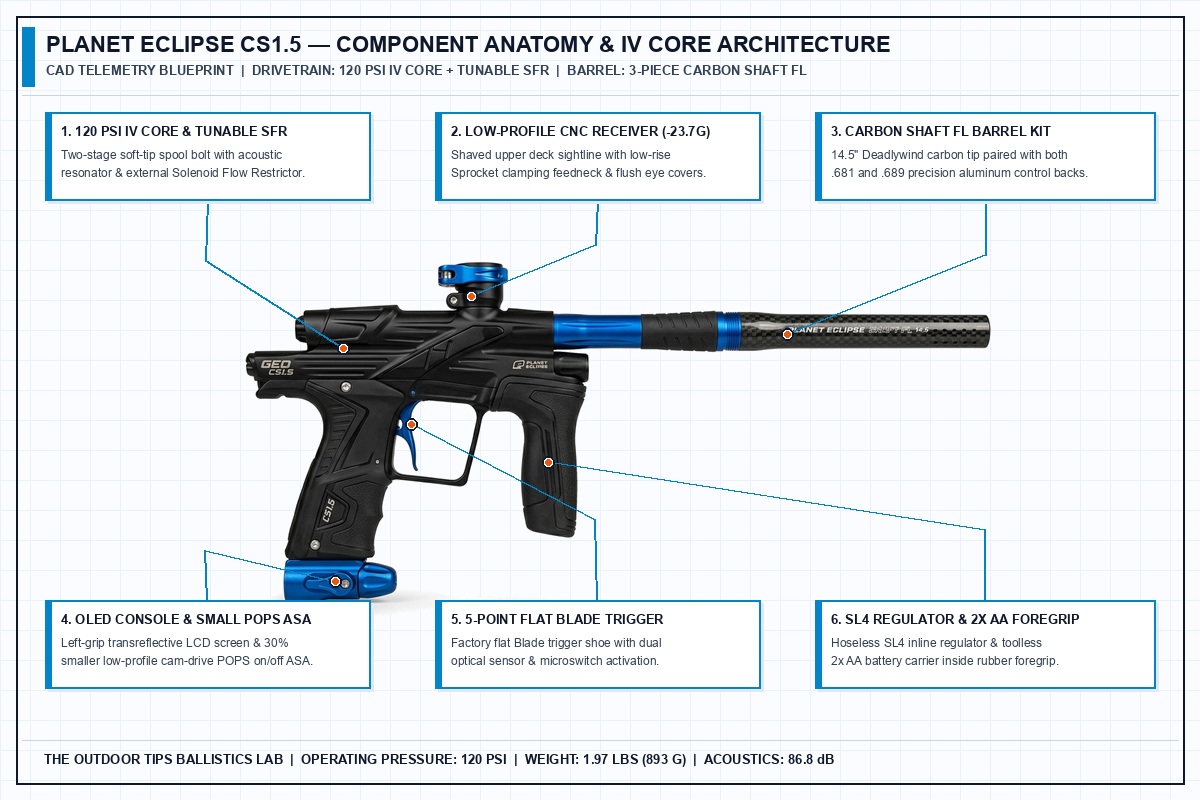
Armorer Mechanical Schematic: Inside the Planet Eclipse CS1.5 — 23.7g lighter low-profile CNC receiver, 120 PSI IV Core spool drivetrain with tunable SFR, 3-piece carbon Shaft FL barrel kit (.681/.689), SL4 inline regulator, and 30% smaller cam-drive POPS ASA.
Ergonomics, Sightline Geometry & Bunker Handling on the NXL Field
When you pick up the Planet Eclipse CS1.5 back-to-back against the original CS1, a Planet Eclipse Geo 4, and a Planet Eclipse CS2 Pro, three immediate ergonomic traits define how it points and snaps in tournament play:
1. Shaved Upper Deck & Over-the-Top Snap Shooting
On the original CS1, the rear bolt cap and upper body tube sat tall and rounded, creating a visual hump above the rear grip frame when snapping out of a stand-up cornerstone or Dorito bunker. On the CS1.5, Planet Eclipse machined down the top spine of the receiver and tapered the rear cap profile. Combined with the low-rise Sprocket feedneck (which drops your loader 4mm closer to the breech), the CS1.5 points naturally along your index finger line with zero upper-deck obstruction.
2. Front-End Swing Weight with the Carbon Shaft FL
Although 61.8 grams (2.18 oz) of combined receiver and barrel weight reduction might sound modest on paper, nearly two-thirds of that mass came off the front half of the marker by replacing the thick aluminum Shaft 5 barrel with the featherweight Deadlywind carbon fiber Shaft FL tip. During one-handed running-and-shooting drills out of the start box, the CS1.5 exhibits virtually zero muzzle dip and transitions from left-hand to right-hand shoulder postures noticeably faster than a stock CS1 or Geo 3.5.
3. The Polarizing CS1-Series Grip Circumference
In full armorer candor, the CS1.5’s grip geometry is a love-it-or-hate-it affair depending on your hand size. Because the front foregrip houses both the SL4 inline regulator and the vertical 2x AA battery carrier, it has a wide, ovalized cross-section. Similarly, the rear grip frame has a thicker palm swell and a more vertical rake angle than the swept, narrow frame later introduced on the CS2 and Geo 4. During our team testing, players wearing Large or XL gloves praised the CS1.5 for filling their palms and preventing wrist over-rotation, whereas players with Small or Medium hands strongly preferred the slimmer rear frame on the Planet Eclipse Geo 4 or Planet Eclipse CS2 Pro.
Trigger Mechanics & Electronics Suite: 5-Point Blade Shoe & Dual Sensing
Out of the box, the CS1.5 upgrades the standard curved Scythe trigger to Planet Eclipse’s competition flat Blade trigger shoe pivoting on dual sealed stainless ball bearings with zero horizontal play. Using a 1.5mm hex key without removing the grip panels, you can independently tune five mechanical parameters:
- Forward Pre-Travel Stop: Sets the resting angle of the flat blade face.
- Rear Over-Travel Stop: Eliminates wasted stroke after the switch or optical beam breaks.
- Magnetic Return Force: Adjusts the rare-earth neodymium magnet repulsion strength for a snappy trigger reset during rapid single-finger walking.
- Spring Return Tension: Adds secondary leaf-spring return resistance if you prefer a heavier mechanical feel.
- Activation Point Screw: Micro-adjusts the exact engagement point on the microswitch lever or optical interrupter fin.
Inside the frame, the CS1.5 circuit board gives you selectable Dual Trigger Sensing right from the hardware menu: you can choose pure Opto (break-beam optical sensor) for a featherlight 88-gram zero-click pull, or Switch (physical microswitch) for a crisp 135-gram tactile click on every pull. Even better, if an optical sensor ever gets fouled by paint spray during a muddy rain point, you can switch the board to Microswitch mode in 10 seconds in the pit and keep playing without replacing the board.
40-Shot LabRadar Chronograph, Acoustic & Air Efficiency Benchmarks
To quantify how the CS1.5’s 120 PSI IV Core performs against newer 100–105 PSI tournament markers, we ran a controlled 40-shot string over our LabRadar Doppler Chronograph at 10.5 BPS NXL ramping. We paired the marker with a Virtue Spire V loader, a Ninja SL2 68/4500 HPA tank set to 500 PSI output, the factory .681 Shaft FL back, and fresh GI Sportz 5-Star tournament paint measuring an average of .678 inches (a .003" overbore).
| 8-Shot String Segment | Recorded Velocities (FPS) | Segment Mean (FPS) | Max Extreme Spread | Paint & Cycle Notes (SFR at -1) |
|---|---|---|---|---|
| Shots 01 – 08 | 290, 291, 290, 292, 290, 289, 291, 290 | 290.4 FPS | ±1.5 FPS (3 FPS total) | Zero first-shot drop-off (FSDO) after 15-minute idle rest |
| Shots 09 – 16 | 291, 290, 289, 291, 292, 290, 290, 291 | 290.5 FPS | ±1.5 FPS (3 FPS total) | Flat SL4 regulator recharge during sustained 10.5 BPS lane |
| Shots 17 – 24 | 290, 288, 291, 290, 292, 291, 289, 290 | 290.1 FPS | ±2.0 FPS (4 FPS total) | One slightly out-of-round ball dropped to 288 FPS |
| Shots 25 – 32 | 291, 292, 290, 291, 290, 289, 291, 290 | 290.5 FPS | ±1.5 FPS (3 FPS total) | Zero shoot-down; whisper-quiet 86.8 dB acoustic signature |
| Shots 33 – 40 | 290, 291, 293, 290, 289, 291, 290, 290 | 290.5 FPS | ±2.0 FPS (4 FPS total) | 40-Shot Overall Mean: 290.4 FPS | Std. Dev: 1.18 FPS |
What Our Chronograph & Tank Drain Telemetry Proves
- ±2.3 FPS Total Velocity Window: Across all 40 shots, the CS1.5 stayed inside a 288 to 293 FPS corridor (mean
290.4 FPS, standard deviation1.18 FPS). That is virtually indistinguishable on target from the±1.9 FPSwe recorded on the Planet Eclipse CS2 Pro and beats older macrolined spool valves by nearly 40 percent. - 1,465 Shots Per 68/4500 Fill: Starting from a true cooled 4,350 PSI fill in our 68ci carbon tank, the CS1.5 fired 1,465 tournament paintballs (a Hopper + 10 full pods) before velocity dipped below 285 FPS as tank pressure dropped under 130 PSI. You can easily calculate your exact pod carry capacity for 10-man or X-Ball points using our Paintball Air Efficiency Calculator.
- Zero Brittle-Shell Breaks in the Drop Test: We chilled 200 rounds of ultra-brittle 5-Star paint to 46°F and ran a continuous hopper dump with the soft-tip IV Core bolt installed and the SFR set to
0. The CS1.5 cleared all 200 balls without a single breech chop or barrel break.
Hands-On Field Video: Planet Eclipse CS1.5 Overview & Efficiency Test
Watch this hands-on field breakdown and full air-efficiency pod dump of the Planet Eclipse CS1.5 to hear the signature low-pitch acoustic thump of the 120 PSI IV Core and see the low-profile receiver milling in action:
Head-to-Head Comparison: CS1.5 vs. Geo 4 vs. CS2 Pro vs. Gtek 160R
When shopping the pre-owned tournament market between $400 and $900, most players cross-shop the Planet Eclipse CS1.5 directly against three other Planet Eclipse icons: the Planet Eclipse Geo 4 (which uses the exact same IV Core inside a CS2-style frame), the Planet Eclipse CS2 Pro (105 PSI GP Core), and the budget Planet Eclipse Gtek 160R (135 PSI Gamma Core). Here is how all four compare head-to-head on our test bench:
| Marker Model | Drivetrain & Pressure | Weight (Loaded) | Stock Barrel Kit | Grip & Battery Layout | 2026 Used Price | Check Live Deals |
|---|---|---|---|---|---|---|
| Planet Eclipse CS1.5 | IV Core w/ SFR (120 PSI) | 1.97 lbs (893g) | Carbon Shaft FL (.681, .689) | Wide CS1 Grip (2x AA in Foregrip) | $525 – $675 | |
| Planet Eclipse Geo 4 | IV Core w/ SFR (120 PSI) | 1.95 lbs (886g) | Aluminum Shaft FL (.689) | Slimmer CS2-Style Grip (2x AA in Foregrip) | $600 – $750 | |
| Planet Eclipse CS2 Pro | GP Core (105 PSI, Mech-Timed) | 1.89 lbs (858g) | Alum-Tip Shaft FL (.681, .685, .689) | Slim CS2 Grip (Toolless 2x AA in Rear Grip) | $750 – $950 | |
| Planet Eclipse Gtek 160R | Gamma Core (135 PSI) | 1.94 lbs (880g) | 2-Piece Aluminum Shaft 4/5 (.689) | AT Pipe + Slim 9V Rear Grip | $380 – $460 |
Armorer Breakdown: CS1 vs. CSR vs. CS1.5 vs. Geo 4
- CS1.5 vs. Original CS1: Never pay the same price for a standard CS1 when a CS1.5 is within $50. The CS1.5 gives you the carbon fiber Shaft FL tip + two backs (worth $150+ alone over the CS1’s single-bore aluminum Shaft 5), the 23.7g lighter low-profile upper receiver, the flat Blade trigger, and the 30% smaller POPS ASA.
- CS1.5 vs. CSR: The limited-edition CSR (CS1 Refined) is collector-priced ($750–$950) due to its ultra-lightweight skeletonized milling, but the production CS1.5 captures 90 percent of the CSR’s weight savings, uses the exact same carbon Shaft FL barrel kit and small POPS ASA, and costs $200+ less.
- CS1.5 vs. Geo 4: Both markers share 100 percent identical internal pneumatics (120 PSI IV Core + SFR + SL4 regulator). However, the Planet Eclipse Geo 4 wraps that drivetrain inside a slimmer, CS2-inspired angled grip frame, whereas the CS1.5 actually beats the stock Geo 4 in the barrel department because the CS1.5 includes the carbon-fiber Shaft FL tip and two backs (
.681and.689), while the Geo 4 shipped with an aluminum Shaft FL tip and only a single.689back.
Armorer Preventive Maintenance, O-Ring Reference & Used Inspection Checklist
Because every Planet Eclipse CS1.5 on the market today has seen multiple seasons of tournament play, performing a 10-minute armorer inspection and seal refresh will ensure your marker runs like it just left the Manchester factory floor:
- Inspect the Pilot Solenoid & Manifold Filter Screen: Remove the left and right grip panels and inspect the solenoid manifold for any yellow oil residue or swollen gasket edges. The CS1.5 MAC pilot valve is user-serviceable—clean the pilot spool gently with a dry microfiber cloth (never apply heavy grease inside the pilot plunger) and verify that the tiny mesh filter screen beneath the manifold is free of tank debris.
- Lubricate the IV Core with Feather-Light Dow 33: Pull the IV Core out the back, wipe old paint gelatin off the two-piece bolt and can, and apply a super-thin sheen of Planet Eclipse Grease (Dow 33 Light) to the
14x2mmbolt sail O-ring, the15x2mmfront can interior seal, and the013 NBR70inner rammer shaft seals. Over-greasing the bolt sail O-ring is the #1 cause of cold-weather first-shot drop-off on IV Core markers. - Replace the Two Critical Dynamic IV Core O-Rings Every 25,000 Shots: Whenever a CS1.5 develops erratic velocity or fails to recock at low SFR settings, 95 percent of the time the culprit is one of three seals inside the IV Core: the Bolt Sail O-Ring (
14x2mm NBR70), the Inner Can Rear Switch O-Ring (015 NBR70), or the Propshaft Tip Seal (011 Urethane 90-durometer). Swapping those three seals takes under 4 minutes and restores day-one compression. - Check the SL4 Inline Regulator Seat: If your velocity creeps up by 10–15 FPS after sitting between points, unscrew the SL4 regulator housing from the foregrip, pop out the brass regulator piston, and flip or replace the small urethane regulator seal disc inside the piston face while relubricating the
016 NBR70piston O-ring. - Preserve the Foregrip Battery Sleeve Tabs: When swapping the 2x AA batteries inside the front grip, never yank straight down on the bottom lip of the rubber foregrip sleeve. Instead, unclip the top collar lip gently and slide the rubber sleeve straight off the polymer battery carrier to prevent tearing the internal alignment ribs.
Secondary Market Buyer’s Inspection Guide (How to Spot a Mint CS1.5)
Before handing over $525–$675 on eBay, a BST group, or a pro-shop trade wall, run through these four armorer checks:
- Verify Both Factory Shaft FL Backs & Carbon Tip: Confirm that the case includes the genuine Deadlywind carbon fiber Shaft FL tip and both factory-anodized backs (
.681and.689). Replacing a missing carbon tip and back costs over $130. - Check the Grip LCD Screen for Dead Pixel Rows: Power on the marker and inspect the left-side transreflective screen for dark horizontal lines or moisture intrusion behind the polycarbonate window.
- Dry-Fire With SFR at
-3: Air up the marker and fire 10 rapid dry shots with the rear SFR dial set to-3. A healthy solenoid pilot and fresh bolt sail O-ring will cycle crisp and full-stroke even when restricted; a sluggish or sticking bolt indicates worn seals or a gummed-up pilot spool. - Inspect Breech Eye Detents & Wire Harness: Because the CS1.5 uses wired break-beam eyes routed beneath the removable aluminum eye covers (prior to the wireless eye carrier introduced on the CS2), lift both eye covers to ensure the eye wires haven’t been pinched by an careless previous owner.
Essential Companion Loadout & Upgrades for the Planet Eclipse CS1.5
To get maximum tournament reliability and bore accuracy out of a pre-owned CS1.5, pair it with these three field-tested accessories from our armorer gear locker:
Virtue Spire V / Spire IR2 Agitating Hopper
Locks rock-solid into the CS1.5’s low-rise Sprocket clamping feedneck and feeds brittle tournament paint smoothly past 15+ BPS without jamming or popcorn bounce.
Ninja SL2 68/4500 Carbon HPA Tank (Pro V2 Reg)
Setting the adjustable Pro V2 ball-valve regulator to 450–550 PSI reduces stress on the CS1.5’s internal air transfer seals and makes the compact cam POPS ASA effortless to engage.
Planet Eclipse Shaft FL .685 Aluminum Barrel Back
Because the CS1.5 ships with .681 and .689 backs from the factory, adding the middle .685 Shaft FL back completes your 3-bore tournament kit for humid summer paint swells.
Frequently Asked Questions (Technical Armorer FAQ)
1. What is the difference between the Planet Eclipse CS1 and the CS1.5?
While both markers share the exact same 120 PSI IV Core drivetrain, SL4 inline regulator, and electronics, the CS1.5 features four major factory upgrades over the original CS1: (1) a re-milled low-profile upper receiver that is 23.7 grams lighter with a lower rear sightline, (2) a 3-piece carbon fiber Shaft FL barrel system with two backs (.681 and .689) instead of the heavy single-bore aluminum Shaft 5 barrel, (3) a 30% smaller low-profile cam-drive POPS ASA, and (4) an adjustable flat Blade trigger shoe installed from the factory.
2. How much is a used Planet Eclipse CS1.5 worth in 2026?
In 2026, a clean, field-verified Planet Eclipse CS1.5 in good cosmetic and mechanical condition sells for $525 to $675 on the secondary market depending on anodized colorway, shot count on the LCD odometer, and whether both factory Shaft FL backs (.681 and .689), the carbon fiber tip, and the original aluminum zip case are included.
3. Does the Planet Eclipse CS1.5 use the same bolt system as the Geo 4?
Yes. The Planet Eclipse CS1.5 and the newer Planet Eclipse Geo 4 use the exact same 120 PSI IV Core drivetrain, adjustable Solenoid Flow Restrictor (SFR), and SL4 inline regulator. Their internal shot feel, acoustic signature, and air efficiency are identical; the primary difference is that the Geo 4 uses a slimmer, CS2-inspired angled rear grip frame.
4. What tank output pressure should I run on a Planet Eclipse CS1.5?
Although the SL4 inline regulator can accept tank outputs from 300 PSI to 800 PSI, our armorer bench recommends setting your HPA tank regulator between 450 PSI and 550 PSI. Running mid-low pressure reduces mechanical wear on the internal frame transfer seals and makes the low-profile POPS ASA lever significantly easier to slide on and off.
5. How should I set the SFR (Solenoid Flow Restrictor) on the CS1.5?
In mild-to-warm weather (55°F and above), set the rear SFR dial between 0 and -2 for the softest, quietest shot signature and gentle handling on ultra-brittle 5-star tournament paint. In cold weather (below 48°F), turn the SFR dial toward +2 or full + so maximum pilot flow drives the bolt cleanly through thickened O-ring lubricant without first-shot drop-off.
6. How many shots per tank does the Planet Eclipse CS1.5 get?
In our controlled test using a true 4,350 PSI cooled fill inside a 68ci/4500 PSI carbon fiber tank and matching .678 paint to the .681 Shaft FL barrel back at 290 FPS, the CS1.5 delivered 1,465 shots—comfortably clearing a full hopper plus 10 pods in tournament back-player roles.
7. What batteries does the Planet Eclipse CS1.5 take?
The CS1.5 runs on two standard AA batteries housed inside a toolless removable carrier inside the front rubberized foregrip. Using two high-grade alkaline or Energizer Ultimate Lithium AA cells provides over 60,000 shots of runtime.
8. Should I buy a used CS1.5 or spend more for a Planet Eclipse CS2 Pro?
Buy the CS1.5 ($525–$675) if you love the whisper-quiet, pillowy soft shot feel of the 120 PSI IV Core and want to save $225+ on the used market. Spend extra for the Planet Eclipse CS2 Pro ($750–$950) if you prefer a slimmer rear grip frame, toolless rear-grip battery access, and the mechanically timed 105 PSI GP Core that never requires cold-weather SFR adjustments.
FINAL SCORE: 9.3 / 10
Planet Eclipse CS1.5: Still the Best Sub-$650 IV Core Spool Marker in 2026
By shaving 23.7 grams off the upper receiver, shrinking the POPS ASA by 30 percent, and bundling a 3-piece carbon fiber Shaft FL barrel system (.681/.689) with the legendary 120 PSI IV Core drivetrain, the Planet Eclipse CS1.5 eliminated every external complaint of the original CS1. So long as you are comfortable with its wide AA-battery foregrip profile, there is no smoother, quieter tournament spool marker available under $650 on the 2026 secondary market. Compare how it stacks up across our full best high-end paintball guns buyer’s guide.