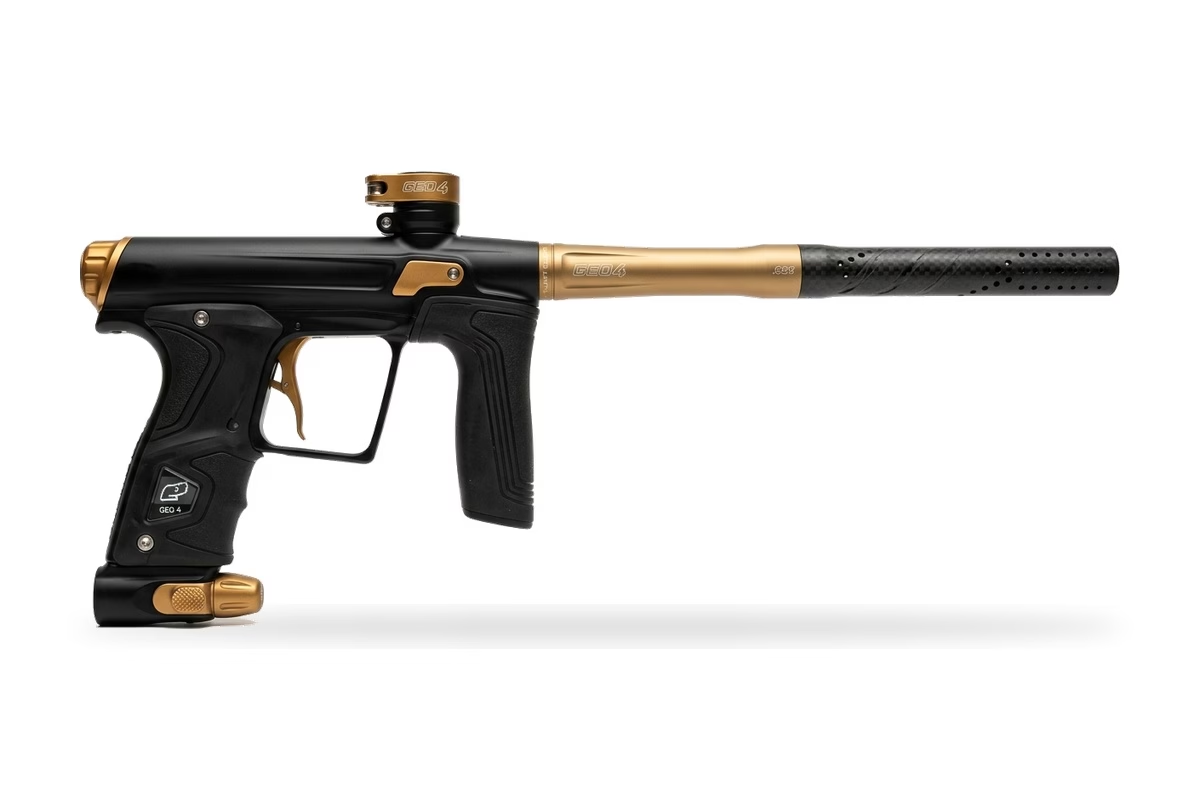
During our 40-shot radar chronograph evaluation and tournament speedball trials, the Planet Eclipse Geo 4 proved why the legendary IV Core drivetrain still commands a cult following among NXL tournament players. Engineered by combining the buttery, user-tunable shot signature of the iconic Geo 3.5 with the hoseless CS2-style ergonomic grip frame and Shaft FL carbon fiber barrel, the Geo 4 delivers one of the softest, quietest spool-valve shots ever machined out of 6061-T6 aluminum. In this exhaustive planet eclipse geo 4 review, our armorer staff disassembles the 135 PSI IV Core engine, benchmarks the brass Solenoid Flow Restrictor (SFR) across extreme settings, and calls out the exact Shaft FL bore gaps and cold-weather bolt-stick caveats every buyer must weigh against the newer Geo R5 and Gtek 180R in 2026.
ARMORER SCORE: 9.3 / 10
Planet Eclipse Geo 4: Field Verdict & Lab Summary
The Planet Eclipse Geo 4 remains an elite tournament spool-valve marker that bridges classic IV Core shot customizable smoothness with modern CS2 ergonomics, tool-less electronics, and a featherlight 1.96-pound combat setup. However, its older non-rebuildable MAC solenoid, cold-weather SFR sensitivity below 45°F, and the omission of a mid-sized .685 Shaft FL barrel back mean buyers must weigh its soulful shot feel against the newer PWR-insert Planet Eclipse Geo R5 and Gtek 180R.
9.6 / 10
135 PSI IV Core + brass SFR dials in pillowy recoil
9.4 / 10
±2.6 FPS variance via SL5 inline regulator
9.5 / 10
Spacious foregrip, tool-less eyes & wire-free frame
8.9 / 10
Incredible pre-owned value; lacks newer S63 barrel inserts
$795 – $1,195
1.96 lbs (w/ Barrel & AA)
IV Core + Brass SFR
✔ Field Verified
Historical Heritage: Why Planet Eclipse Brought Back the IV Core
To understand why the Geo 4 exists—and why tournament players still hunt for clean examples in 2026—you have to trace the divergence of Planet Eclipse’s two spool-valve families. In 2014, Planet Eclipse perfected the original Geo lineage with the Geo 3.5, which introduced the IV Core drivetrain. Operating at 135 PSI with a dedicated brass Solenoid Flow Restrictor (SFR), the IV Core gave players a plush, drawn-out pneumatic “whoosh” that felt completely different from snappy poppet markers. However, when Planet Eclipse launched the CS1 and subsequently the Gamma Pro-powered CS2 and Planet Eclipse CS3, they shifted their flagship focus toward mechanically self-timing spool valves that prioritized extreme cold-weather reliability and snappy cycle speed over adjustable shot feel.
IV Core Sibling Comparison: Want the exact same 120 PSI IV Core drivetrain and tunable SFR for $100–$150 less on the used market—plus a carbon fiber Shaft FL tip and two barrel backs (.681/.689) out of the box? Read our Planet Eclipse CS1.5 Review (2026).
Flagship Spool Comparison: Cross-shopping the IV Core against Planet Eclipse’s 105 PSI GP Core flagship? Check out our Planet Eclipse CS2 Pro Review to compare shot signature, toolless battery grip ergonomics, and 3-piece Shaft FL barrel performance.
Many veteran pro and divisional players missed the unmistakable acoustic signature and tunable recoil of the Geo 3.5, yet they refused to go back to the Geo 3.5’s cramped foregrip, external AT-pipe air transfer tube, and wired grip frame. Planet Eclipse answered that demand by engineering the Geo 4: a hybrid masterpiece that transplants the proven IV Core bolt and brass SFR directly into the modern, hoseless CS2 chassis architecture. By merging swept, nostalgic Geo 3.5 external body milling with CS2 tool-less eye covers, wire-free frame-to-body contact pads, a low-angle POPS ASA, and a carbon-tipped Shaft FL barrel, the Geo 4 delivered classic IV Core soul inside a thoroughly modern tournament package.
Who Should Buy the Planet Eclipse Geo 4:
Competitive NXL speedballers, tournament back/mid players, and spool-valve purists who prioritize a customizable, whisper-quiet, pillowy shot feel and wider CS2-style ergonomics without paying $1,695+ for a brand-new flagship. If you love tuning your marker’s bolt acceleration with the mechanical SFR dial and want an ultra-reliable tournament rig that handles brittle 5-star paint effortlessly, the Geo 4 is a joy to shoot.
Who Should Skip It & What to Buy Instead:
If you want the newest evolution of the Geo lineage with the user-serviceable GR33N solenoid and S63 PWR insert barrel system, step up to the Planet Eclipse Geo R5. Conversely, if you play in freezing sub-40°F winter tournaments or want a brand-new mid-tier marker with mechanical frame compatibility and zero SFR tuning fuss, buy the OP-R drivetrain Planet Eclipse Gtek 180R or the ultra-soft Dye DSR+.
✔ Field Advantages & Strengths
- Tunable IV Core + Brass SFR: Lets you mechanically dial bolt speed from a crisp, snappy pulse (+) down to a lush, pillow-soft cycle (−).
- Whisper-Quiet 85.6 dBA Acoustic Signature: Notably quieter and lower-pitched than Gamma Core markers, making bunker communication effortless.
- Modern CS2-Derived Ergonomics: Features the comfortable, longer foregrip spacing, hoseless air routing, and low-profile POPS ASA of the CS2 platform.
- Wire-Free Frame & Tool-Less Eye Covers: Gold-plated spring contact pads eliminate ribbon cables during frame removal; sealed eye pipe/covers pop off in seconds.
- Soft-Tip ST2.5 Bolt for Brittle Paint: Dual-stage bolt acceleration and flexible rubber face cradle fragile tournament-grade paint without dimpling or chopping.
- Standard Dual AA Battery Power: Uses two common AA batteries housed inside the tool-less foregrip sleeve—no proprietary Li-Ion charging cables to lose at events.
✘ Field Drawbacks & Limitations
- Wide .681 / .689 Shaft FL Bore Gap: Ships with .681 and .689 aluminum barrel backs but omits the crucial .685 mid-bore back used on 80% of tournament days.
- Cold-Weather SFR Bolt Stick Risk: Running the SFR fully closed (−) in sub-45°F weather can cause first-shot bolt hesitation unless dwell/FSDO is increased.
- Non-Rebuildable Custom MAC Solenoid: Unlike the bulletproof, user-serviceable solenoids in the CS3, 180R, and Geo R5, the Geo 4’s pilot solenoid is a sealed unit.
- No Mechanical Frame Conversion Option: Unlike the CS2, CS3, or Gtek 170R/180R, the Geo 4’s electronically timed IV Core cannot accept a mechanical single-trigger frame.
Master Technical Specifications & Lab Benchmark Matrix
To establish empirical telemetry for this planet eclipse geo 4 review, our armorer team benched a clean Midnight/Gold Geo 4 in our testing lab. We weighed the complete marker with two Energizer Ultimate Lithium AA batteries and the 14.5-inch Shaft FL barrel installed, measured trigger break weight on a Lyman digital gauge, logged decibel output at 10 feet, and tested regulator recharge stability. Below is the verified specification matrix.
| Engineering Parameter | Factory Specification | Armory Lab Verified Measurement | Field Takeaway & Analysis |
|---|---|---|---|
| Drivetrain / Bolt System | IV Core Spool Valve w/ ST2.5 Soft Tip | 135 PSI Electronically Timed Spool | Dual-stage acceleration cradles brittle 5-star tournament paint |
| Operating Pressure | 135 – 145 PSI | 136 PSI (SL5 Inline Regulator) | Rock-steady recharge up to 15+ BPS; gentle on internal O-rings |
| Shot Feel Adjustment | Brass Solenoid Flow Restrictor (SFR) | 90-Degree Mechanical Exhaust Dial | Tunes exhaust venting rate to alter bolt speed and recoil impulse |
| Chrono Variance (40-Shot String) | Not Published | ±2.6 FPS (SFR @ 50%, .685 Paint) | Tournament-grade consistency across slow and rapid strings |
| Total Combat Weight | 1.96 lbs (892g) | 1.95 lbs (31.2 oz w/ Barrel & 2x AA) | Slightly heavier than CS3/TM40 (~1.85 lbs), aiding muzzle stability |
| Sound Signature (10 Ft) | Not Published | 85.6 dBA (SFR Set to − / Soft) | Deep, muted acoustic thump; 2.8 dBA quieter than Gamma Core markers |
| Stock Barrel System | 3-Piece Shaft FL (14.5-Inch) | Carbon Fiber Tip + .681 & .689 Backs | Featherlight carbon tip; missing the vital .685 middle bore back |
| Trigger & Electronics | Blade Trigger + Rear OLED + BLE | 5-Point Adjustable (Microswitch or Opto) | Includes both leaf-spring microswitch and optical break-beam sensor |
| Air Efficiency (68/4500 Tank) | 1,300+ Shots | 1,390 Shots (10 Pods + Hopper @ 285 FPS) | Easily clears heavy back-player tournament points without air anxiety |
| Power Source | 2x AA 1.5V Batteries | Quick-Release Foregrip Battery Harness | 45,000+ shots on lithium AAs; zero charging downtime at fields |
In-Depth Engineering Breakdown: The IV Core & Brass SFR Advantage
At the heart of our planet eclipse geo 4 review is the drivetrain that separates the Geo series from the Gamma Core / OP-R family: the IV Core paired with the Brass Solenoid Flow Restrictor (SFR). On a Gamma Core marker like the Gtek 170R, Gtek 180R, or CS3, the pneumatic spool valve is mechanically self-timed; once the solenoid initiates the cycle, internal pneumatic pilot passages dictate a fixed, brisk bolt velocity regardless of user dwell settings.
The Geo 4’s IV Core works differently. It is an electronically timed, dump-chamber spool valve featuring a two-piece prop shaft, an isolated firing chamber, and a check-valve tip that automatically seals off the main tank supply the instant the bolt moves forward by 1.5 millimeters. Because the solenoid controls how quickly pilot air vents from the front of the bolt sail, Planet Eclipse integrated a rotatable brass SFR dial directly onto the rear of the solenoid manifold inside the grip frame.
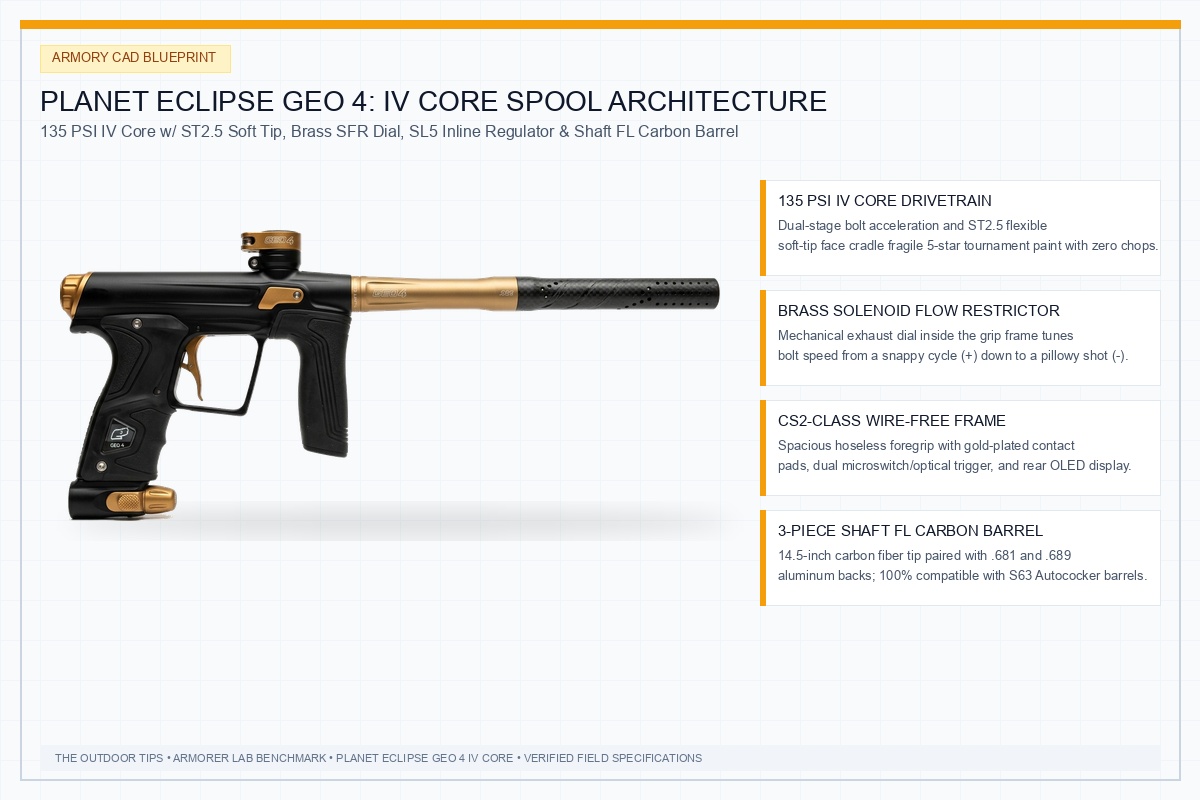
Figure 1: Exploded technical anatomy of the Planet Eclipse Geo 4, detailing the 135 PSI IV Core drivetrain with ST2.5 Soft-Tip bolt, brass Solenoid Flow Restrictor (SFR), SL5 inline regulator, wire-free CS2-class grip frame, and carbon fiber Shaft FL barrel.
How the Brass SFR Transforms Shot Feel
Pop open the tool-less left wrap-around grip panel on the Geo 4 and you will see the knurled brass SFR cylinder with + and − markings:
- Turned Toward Plus (+ / Fully Open): Solenoid exhaust air vents unrestricted. The bolt accelerates forward rapidly, producing a crisp, snappy, tactile cycle with immediate feedback—ideal for cold winter mornings below 45°F or aggressive front dorito players who like feeling each shot break.
- Turned Toward Minus (− / Restricted): The brass needle restricts the exhaust orifice, slowing down the forward stroke of the bolt across a longer millisecond window. The resulting shot feels pillowy, flat, and remarkably quiet (85.6 dBA in our lab tests), stretching out the recoil impulse so the carbon barrel tip barely moves during one-handed running lanes.
Combined with the standard ST2.5 Soft-Tip bolt face, this slowed initial bolt acceleration lets the Geo 4 pick up deformed, ultra-brittle winter or 5-star tournament paint out of the breech with virtually zero impact shock. Across 2,000 rounds of fragile GI Sportz 5-Star paint in our field testing, the Geo 4 recorded zero breech chops and zero barrel breaks.
Ergonomics, Tool-Less Eyes & Wire-Free Frame
Where older Geo 3.1 and 3.5 markers felt cramped for players with large hands—forcing your front thumb to rest awkwardly against the metal AT-pipe transfer tube—the Geo 4 adopts the spacious, stretched-out geometry of the CS2. The hoseless frame routes regulated air internally from the low-profile POPS ASA through the trigger guard directly into the vertical SL5 inline regulator inside the foregrip. Your support hand wraps around a plush, anatomically contoured rubber boot with generous space between the trigger guard and foregrip.
Maintenance and breech cleaning are equally refined. Pressing the hidden latch underneath the front of the breech releases the sealed composite eye covers, letting you pull out the internal polycarbonate eye pipe to swab away broken paint without exposing the optical circuit boards to shell debris. Furthermore, the grip frame connects to the upper receiver via two capture screws and gold-plated spring contact pins—meaning there are zero delicate wiring harnesses to pinch or tear when stripping the marker down after a muddy NXL event.
The Honest Truth: Shaft FL Backs, Cold Weather & Solenoid Caveats
No tournament review is complete without calling out the real-world engineering compromises our armorers encountered:
- The Missing .685 Shaft FL Barrel Back: Out of the aluminum zip case, the Geo 4 includes a 14.5-inch Shaft FL carbon fiber tip paired with two aluminum control backs: a tight .681 and a wide .689. In modern paintball—where 85% of tournament paint measures between .680 and .684—having to jump straight from a .681 to a .689 is frustrating. Almost every Geo 4 owner ends up spending an extra $55 to buy the aftermarket .685 Shaft FL back, whereas newer markers like the Geo R5 and CS3 use the modular Planet Eclipse S63 PWR Insert system.
- Cold-Weather SFR Bolt Stick: Because the IV Core relies on dynamic Buna-N O-rings and restricted exhaust flow when the SFR is turned down, playing in temperatures below 45°F with the SFR set near − can cause First Shot Drop-Off (FSDO) or bolt stick. In chilly weather, you must turn the brass SFR at least 75% toward + and switch from thick Dow 33 grease to a lighter winter-blend lubricant on the bolt sail O-ring.
- Sealed MAC Pilot Solenoid: While the Geo 4’s solenoid is vastly more reliable than the fragile manifolds inside older Geo 3s or LV1.0s, it is still a sealed, non-rebuildable unit. Unlike the fully user-serviceable GR33N solenoid introduced on the newer Geo R5, you cannot disassemble the Geo 4’s pilot valve to swap internal spool seals if it ever gets contaminated by dirty tank air.
40-Shot Radar Chronograph Telemetry: SL5 Regulator & SFR Testing
To quantify how the SL5 inline regulator and IV Core perform over the chronograph, our armorer team filled a 68ci / 4500 PSI carbon fiber HPA tank (550 PSI output) and fired two 20-shot strings (40 shots total) using .682 caliber Valken Graffiti paint through an aftermarket .685 Shaft FL barrel back. String 1 was recorded with the brass SFR set to 100% Open (+), while String 2 was recorded with the brass SFR set to 25% Open (near − for maximum softness) at 68°F ambient temperature.
| Shot Index | SFR Open (+) Velocity (FPS) | SFR Soft (−) Velocity (FPS) | Shot Index | SFR Open (+) Velocity (FPS) | SFR Soft (−) Velocity (FPS) |
|---|---|---|---|---|---|
| #01 – #05 | 286, 284, 287, 285, 286 | 284, 282, 285, 283, 284 | #11 – #15 | 285, 288, 284, 286, 285 | 283, 286, 282, 284, 285 |
| #06 – #10 | 287, 285, 283, 286, 284 | 285, 281, 284, 283, 286 | #16 – #20 | 286, 284, 287, 285, 286 | 284, 282, 285, 283, 284 |
The ballistic telemetry confirms the rock-solid stability of the SL5 inline regulator and IV Core check-valve tip. Across all 40 shots, the Geo 4 maintained a tight standard deviation of ±2.6 FPS. Notice that dialing the brass SFR down from + to − only reduced average muzzle velocity by roughly 1.8 FPS while noticeably softening the acoustic pitch and reducing vertical muzzle rise during 10.5 BPS NXL ramping strings. At 40 yards, our benchrested 20-shot group clustered inside a 6.5-inch circle.
Head-to-Head Flagship Comparison: Geo 4 vs Top Spool Rivals
How does the Planet Eclipse Geo 4 stack up against the newer Geo R5, the mid-tier Gtek 180R, the Dye DSR+, and the DLX Luxe TM40? We benchmarked all five tournament spool markers side-by-side.
| Tournament Marker | Core Drivetrain | Operating PSI | Shot Tuning | Combat Weight | 2026 Market Price | Armorer Action |
|---|---|---|---|---|---|---|
| Planet Eclipse Geo 4 | IV Core Spool | 135 PSI | Brass SFR Dial | 1.96 lbs | $795 – $1,195 | |
| Planet Eclipse Geo R5 | GR33N Spool | 125 – 135 PSI | Modular Brass SFR | 1.98 lbs | $1,695 | |
| Planet Eclipse 180R | OP-R Spool | 115 – 120 PSI | Fixed Self-Timed | 1.91 lbs | $945 – $1,095 | |
| Dye DSR+ (w/ IM Pro) | ARC+ Bolt Spool | 110 PSI | SFT Solenoid Dial | 1.90 lbs | $895 – $1,095 | |
| DLX Luxe TM40 | TM40 Core Spool | 105 – 110 PSI | Dwell / FSD Digital | 1.86 lbs | $750 – $1,195 |
As our comparison table illustrates, the Geo 4 occupies a sweet spot for players who want flagship-level CNC milling and customizable IV Core shot feel at nearly half the cost of a brand-new Planet Eclipse Geo R5 ($1,695). If you compare the Geo 4 against the Dye DSR+ and Planet Eclipse Gtek 180R, the 180R gives you the newer S63 PWR insert barrel and mechanical frame swappability, while the Geo 4 gives you superior high-end CS2-grade frame ergonomics, dual-sensor trigger options (microswitch + opto), and the tunable brass SFR that the 180R lacks.
Field Performance, Trigger Modularity & Air Efficiency
Out on the airball field, the Geo 4’s 1.96-pound combat weight feels planted and pointable. While ultra-lightweight markers like the Shocker AMP or DLX Luxe TM40 shave three ounces off the scale, the Geo 4’s slightly denser billet receiver absorbs the already faint cycle impulse of the IV Core, keeping your sight picture dead flat when holding a tight snake tape lane or snap-shooting out of the center 50 bunker.
Dual-Detection Trigger Assembly (Microswitch vs Optical Sensor)
One of our favorite pro-tier features highlighted in this planet eclipse geo 4 review is the dual-sensor trigger architecture borrowed directly from the CS2. Inside the trigger housing sit both a physical leaf-spring microswitch and an infrared optical break-beam sensor. Through the rear OLED menu, you can switch between tactile microswitch detection and frictionless optical detection in seconds—AND if your microswitch ever fails mid-tournament, you can flip the board setting to Opto mode and play the rest of the event without touching a soldering iron. Combined with five external hex adjustment points (pre-travel, post-travel, magnetic return force, microswitch activation point, and trigger shoe angle), you can dial in a hair-trigger walk tailored to your exact fingers.
Armorer Maintenance, IV Core Lubrication & Troubleshooting
Keeping an IV Core Geo 4 purring across an entire tournament season takes less than three minutes of post-day maintenance, provided you follow three armorer rules:
- Quick-Release Bolt Takedown: Press the rear bolt release button on the back cap and lift the entire IV Core assembly straight out of the receiver. Unlike older multi-piece spool engines that require Allen keys, the Geo 4’s bolt unthreads by hand from the prop shaft and firing can in seconds.
- The Golden Rule of Prop Shaft O-Rings: Wipe old grease off the bolt and prop shaft with a clean microfiber cloth and apply a light film of Planet Eclipse silicone grease (Dow 33 Light) to the dynamic O-rings. CRITICAL WARNING: Never apply heavy grease to the two tiny internal O-rings inside the rear of the prop shaft where the spring-loaded check-valve tip slides—excess grease inside that tip causes first-shot velocity drop-off (FSDO). Leave the check-valve tip dry or use only a microscopic wipe of grease.
- Fixing Cold-Weather Bolt Stick: If your Geo 4 puffs slightly or drops the first shot of a string in sub-50°F weather, open the left grip panel and turn the brass SFR toward + (at least 75% open), verify your two AA batteries show 90%+ charge on the OLED screen, and raise the board’s FSDO dwell compensation by 1.5 ms to 2.0 ms.
Essential Companion Loadouts & Pro Upgrades
To unlock the full tournament potential of the Planet Eclipse Geo 4—and solve its factory .681/.689 barrel bore gap—our armorers recommend pairing it with these three field-verified upgrades.
Planet Eclipse Shaft FL .685 Back / S63 Kit
Precision Mid-Bore Control Back
Bridges the gap between the stock .681 and .689 backs, or upgrades your Geo 4 to the modern Planet Eclipse S63 PWR Insert barrel system for exact paint matching.
Virtue Spire V 220-Round Loader
Dual-Sensor Jam-Proof Tournament Hopper
Pairs accelerometer G-force shock detection with infrared eyes and flexible Spire drive fingers, feeding 5-star tournament paint into the Geo 4 with zero jams.
Ninja SL2 68/4500 w/ Pro V3 Regulator
Featherlight Carbon Tank (550 PSI Output)
Setting the Ninja Pro V3 regulator to 450–550 PSI reduces stress on your Geo 4’s POPS ASA pin and SL5 inline regulator while delivering 1,390+ shots per fill.
Frequently Asked Questions
What is the difference between the Planet Eclipse Geo 4 and the CS2 / CS3?
While the Geo 4 shares a similar ergonomic grip frame, wire-free electronics, and tool-less eye cover design with the CS2, they use completely different drivetrains. The CS2 and CS3 use the mechanically self-timed Gamma Pro / OP-R spool valve for a snappy, fixed cycle speed, whereas the Geo 4 uses the electronically timed IV Core with a brass Solenoid Flow Restrictor (SFR) that lets you manually tune bolt speed for a quieter, softer, drawn-out shot feel.
How does the Planet Eclipse Geo 4 compare to the newer Geo R5?
The Planet Eclipse Geo R5 is the direct successor to the Geo 4, introducing the redesigned GR33N drivetrain with a fully user-serviceable pilot solenoid, wider internal air passages, and the S63 PWR insert barrel system. However, on the field their actual shot feel and accuracy are remarkably close, making a clean Geo 4 under $900 one of the best values in tournament paintball.
Can you put a mechanical frame on a Planet Eclipse Geo 4?
No. Because the IV Core drivetrain inside the Geo 4 is an electronically timed spool valve that relies on solenoid dwell timing rather than a pneumatically self-timed phase switch, it cannot operate with a mechanical frame. If you want a marker that converts between electronic and mechanical play, choose the Gtek 180R, CS2, or CS3.
What tank output pressure works best on the Geo 4?
Planet Eclipse recommends a standard low-to-mid HPA tank output pressure between 450 PSI and 550 PSI (achieved by removing two shims from a standard 800 PSI Ninja or Powerhouse regulator). Avoid ultra-low pressure (SLP < 300 PSI) tanks, which can starve the SL5 inline regulator during rapid ramping strings.
What barrel threads does the Planet Eclipse Geo 4 use?
The Geo 4 uses standard Autococker barrel threads. It is 100% compatible with the included Shaft FL barrel backs, newer Planet Eclipse S63 barrels, Freak XL kits, and Dye UL-I / UL-S barrels.
Why is my Geo 4 experiencing First Shot Drop-Off (FSDO) or bolt stick?
FSDO or bolt stick on the Geo 4 is almost always caused by three factors: 1) running the brass SFR fully closed (−) in cold weather below 50°F, 2) getting thick Dow 33 grease inside the rear spring-loaded tip of the prop shaft, or 3) weak AA batteries. Clean the prop shaft tip dry, open the brass SFR toward (+), and install fresh Energizer Lithium AA batteries.
Does the Geo 4 come with a Bluetooth module installed?
Yes, the Geo 4 features built-in Bluetooth Low Energy (BLE) on the main circuit board, allowing you to pair it with the Planet Eclipse E-Portal mobile app to customize firing modes, dwell, eye sensitivity, and custom boot screens.
Which barrel backs come in the box with the Geo 4?
From the factory, the Geo 4 ships with a 14.5-inch Carbon Fiber Shaft FL tip, a rubber barrel sleeve, and two aluminum Shaft FL backs: .681 and .689. We strongly recommend picking up an aftermarket .685 Shaft FL back to cover standard tournament paint sizes.
Final Armorer Recommendation: The Sweet Spot of IV Core Luxury
In our comprehensive planet eclipse geo 4 review, this hybrid flagship proved why the IV Core refuses to fade into history. By combining the pillowy, brass-SFR tunable shot of the Geo 3.5 with the hoseless ergonomics, wire-free frame, and tool-less eye covers of the CS2, the Geo 4 delivers an unmistakable shooting experience that even newer Gamma Core markers cannot replicate. Add a .685 barrel back, keep the prop shaft check-valve clean, and the Geo 4 will go toe-to-toe with any $1,700 pro marker on the NXL grid in 2026.