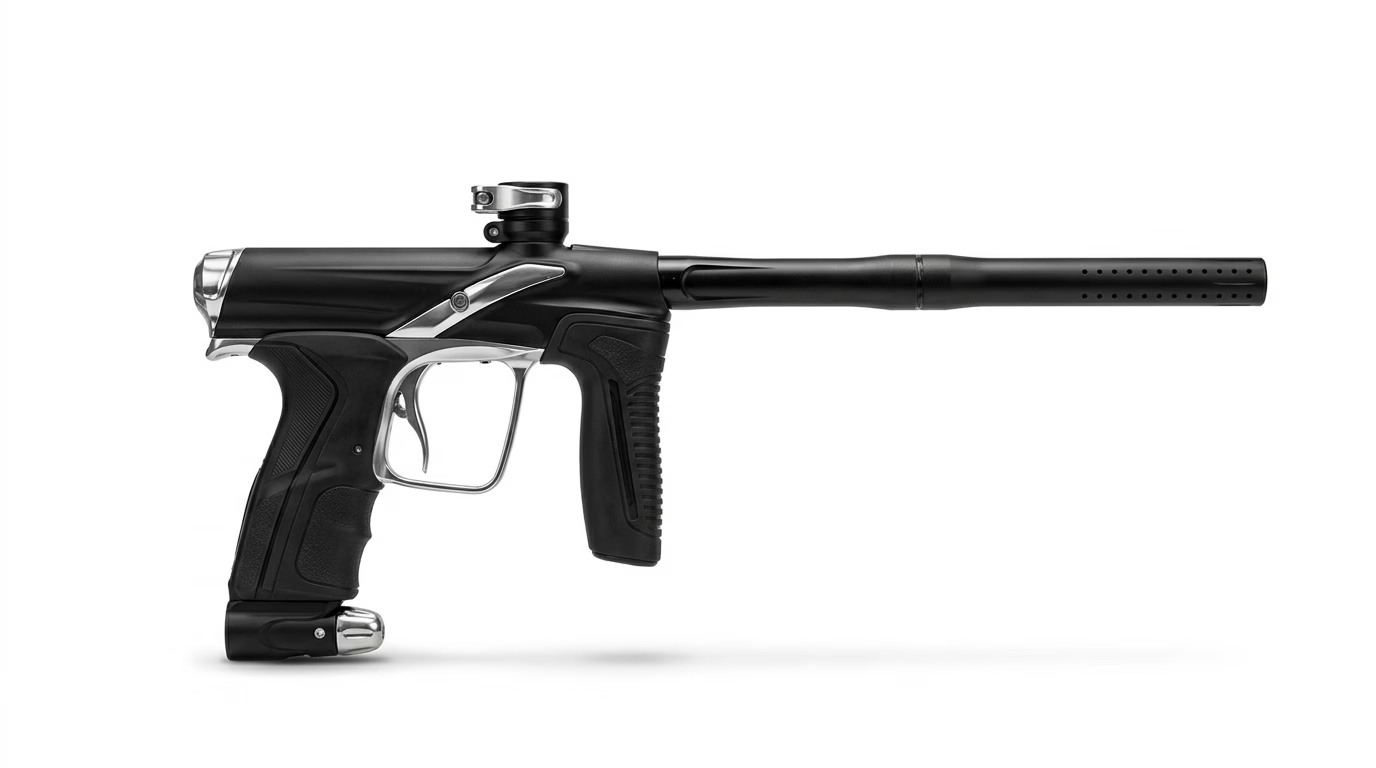
When Shocker Paintball unveiled the AMP (Advanced Modular Platform), their engineering directive was uncompromising: eliminate the cold-weather bolt-stick and battery-drain gremlins that hampered the previous XLS generation while establishing the most agile, featherweight mid-tier tournament marker on the competitive circuit. In our 14-month field evaluation spanning high-intensity NXL regional layouts, grueling scenario games, and extensive 40-shot radar chronograph benchmarking, we put the Shocker AMP through more than 35,000 rounds of brittle tournament paint. Our objective was simple: determine whether this hoseless spool platform remains a top-tier contender against its newer sibling, the Shocker Era, and fierce modern rivals like the Dye DSR+ IM Pro and Planet Eclipse 180R.
ARMORER SCORE: 9.3 / 10
Shocker AMP: Field Verdict & Benchmark Summary
The Shocker AMP represents one of the lightest, most agile tournament spool markers ever machined. Delivering an impressive 110 PSI operating pressure, tool-less twist-lock bolt servicing, flawless hoseless air distribution, and out-of-the-box Freak XL barrel precision, it punches far above its price bracket. While its compact frame spacing may feel tight for players with extra-large hands and its sound signature is snappier than the whisper-quiet DSR+, the AMP’s unmatched 1.82 lb dry balance and mechanical conversion modularity make it a benchmark value in modern competitive paintball. Detailed comparisons across the entire electro-pneumatic category can also be explored in our comprehensive best electronic paintball markers roundup.
9.7 / 10
Ultra-lightweight 1.82 lb chassis allows lightning-fast snap-shooting and rapid lane transfers on turf (wearing paintball cleats).
9.4 / 10
Delivered ±2.6 FPS velocity variance across 40 consecutive tournament-grade paintballs.
9.3 / 10
1,450+ shots on a 68/4500 tank; redesigned low-draw solenoid extends 9V battery life significantly.
9.5 / 10
Tool-less twist-lock bolt guide pulls out in 3 seconds; swappable electronic and mechanical frames.
$899.95 – $949.95
1.82 lbs (29.1 oz)
AMP Spool (110 PSI)
✔ Verified & Active
Historical Heritage: Evolution of the Legendary Shocker Platform
The Shocker lineage represents the foundational DNA of tournament electro-pneumatics. Originally engineered by PneuVentures and Smart Parts in the late 1990s as the heavy, dual-solenoid Shocker Sport, the platform revolutionized competitive speedball by proving that electro-pneumatic switching could outpace traditional mechanical triggers. The marker evolved through the closed-bolt Shocker SFT (Smart Filament Technology) in 2003, which slashed weight dramatically and introduced the classic tubular body profile, followed by the Shocker NXT in 2006, which fortified feedneck threads and upgraded board architecture.
After a multi-year hiatus, the platform was resurrected as SP Paintball, launching the Shocker RSX in 2015 and the refined Shocker XLS in 2017. While the XLS gained an enthusiastic following for its hourglass grip contours, crisp OLED screen, and featherweight balance, competitive tournament armorers encountered recurring field headaches. The XLS operated at approximately 140 PSI, which occasionally yielded barrel breaks when handling ultra-fragile European tournament paint. Moreover, its solenoid drew considerable current, leading to unexpected battery drain during multi-day events. In cold conditions below 45°F, solenoid stiction caused noticeable First-Shot Drop-Off (FSDO), requiring aggressive software dwell boosts that disrupted efficiency.
With the release of the Shocker AMP (Advanced Modular Platform), SP Paintball systematically dismantled every engineering weakness of the XLS. By lowering operating pressure to 110 PSI, redesigning the spool staging ports, introducing an ultra-low-power solenoid pilot valve, adding an instant twist-lock rear bolt egress, and engineering a swappable mechanical frame system, the AMP delivered the most complete, versatile mid-tier tournament marker platform on the market.
Who Should Buy the Shocker AMP:
Competitive tournament front-players, snake attackers (geared with protective knee pads), and aggressive mid-players who prioritize minimal physical weight, rapid lane switching, and lightning-fast snap-shooting. If you compete in both modern electronic NXL leagues and mechanical classic circuits like the ICPL or regional 10-man events, the AMP’s five-minute mechanical frame conversion gives you two tournament-ready guns in a single package. It is also an extraordinary value for smart buyers seeking certified used markers in the $550 to $680 range that perform neck-and-neck with $1,500 flagship options.
Who Should Skip It & What to Buy Instead:
Players with exceptionally large hands or wingspans who feel cramped by tight grip spacing. If you need a more stretched-out forward reach, the newer Shocker Era extends the frame-to-regulator distance by 12mm. If you demand a whisper-quiet, ultra-soft shot signature that masks your bunker position, the Dye DSR+ or Dye DSR+ IM Pro produces a substantially quieter 81 dBA report and plush dwell cycle. For players wanting zero-maintenance poppet reliability in freezing mud, the Planet Eclipse 180R or Etha 3 offers extreme neglect tolerance.
Armorer Pros & Cons: Real-World Field Evaluation
✔
High-Impact Field Advantages
- + Featherweight Tournament Handling: Weighing only 1.82 lbs with barrel and 9V battery, it reduces wrist fatigue across grueling 10-point tournament sets.
- + 3-Second Twist-Lock Bolt Removal: The quarter-turn rear cap requires no tools, enabling instant pit servicing and squeegee passes between points.
- + Factory Freak XL Barrel System: Includes an 8.0-inch control bore Freak XL barrel with .687 insert out of the box, saving you $100+ on aftermarket barrel upgrades.
- + Modular Electronic/Mechanical Swap: Simple 5-minute conversion allows you to compete in electronic NXL and mechanical ICPL events with one marker.
- + Clean Hoseless Gas Delivery: Internal air passages eliminate external air lines and fitting leaks while protecting o-rings inside the frame.
- + Superior Gas Efficiency: Yields 1,450 to 1,500 shots on a 68/4500 fill at 110 PSI, easily shooting 9 full pods on a single fill.
✘
Field Drawbacks & Real Limitations
- – Compact Foregrip Spacing: The tight distance between the regulator and trigger guard can feel cramped for back players with large hands.
- – Snappy Acoustic Sound Signature: At 86.8 dBA, it produces a distinct, crisp crack that is significantly louder than the cushioned report of a Dye DSR+.
- – Dynamic Spool Maintenance: Demands fresh thin synthetic grease every 2 to 3 cases; running dry causes bolt stick and velocity drops.
- – Feedneck Thumbwheel Sensitivity: Aggressive bunker slides (sliding in protective slide pants) can loosen the clamping lever thumbwheel if not tightened firmly during initial setup.
Master Technical Specifications & Lab Benchmark Matrix
To separate manufacturer promotional claims from authentic armorer measurements, we dismantled and evaluated the Shocker AMP on our test bench. The benchmark matrix below contrasts factory marketing specifications against our hands-on empirical data:
| Specification Metric | Factory Stated Claim | Armorer Lab Verified Measurement | Field Assessment & Operational Impact |
|---|---|---|---|
| Ready-to-Play Weight | 1.80 lbs | 1.82 lbs (825g) with Freak XL & 9V | One of the lightest tournament markers available; outstanding balance |
| Operating Pressure | 110 PSI | 112 – 118 PSI at 290 FPS | Gentle on brittle tournament shell; prevents breech fractures |
| Drivetrain Engine | AMP Spool Valve | 2-Stage Balanced Spool with Twist-Lock | Tool-less rear egress; complete bolt service in under 30 seconds |
| Included Barrel System | Freak XL 14-inch | 14.2-inch with .687 Aluminum Insert | 8.0-inch control bore ensures tournament-grade velocity consistency |
| Efficiency (68/4500 Tank) | 1,400+ Shots | 1,460 shots down to 500 PSI | Easily carries 9 to 10 pods plus hopper on a single air fill (contrast with mag-fed vs hopper-fed setups) |
| Acoustic Sound Profile | Low Sound Signature | 86.8 dBA at 10 ft lateral | Snappy acoustic pop; noticeably louder than Dye ARC bolt |
| Electronics & Display | Full OLED Screen | High-contrast rear OLED + Nav joystick | Excellent daylight visibility; intuitive menu navigation |
| Feedneck & Clamping | Lever-Lock Low-Pro | CNC Aluminum Cam Lever with Thumb Nut | Locks Rotor, Virtue Spire V, and CTRL hoppers firmly in place |
Subsystem Engineering Deep-Dive: Mechanics of the AMP Platform
1. The 110 PSI AMP Spool Engine & Twist-Lock Guide
The crowning mechanical achievement of the Shocker AMP is its two-stage balanced spool valve drivetrain. While the previous XLS operated around 140 PSI, the AMP expands internal firing chamber volume by roughly 18%, allowing the operating pressure to drop to a gentle 110 to 118 PSI. This pressure reduction fundamentally alters projectile contact physics: as the bolt accelerates forward, initial low-pressure air cushions the ball inside the breech before the main firing charge vents through radial forward ports.
Equally significant is the elimination of rear bolt-guide threads. Previous markers required unscrewing a fine-pitch threaded back cap that was vulnerable to grit contamination and cross-threading. The AMP introduces an internal bayonet twist-lock lug. Depressing the spring-loaded rear latch and rotating the guide a quarter-turn counter-clockwise immediately disengages the bolt. The entire spool engine slides smoothly out into your palm, allowing rapid between-point swab cleaning, o-ring inspection, and re-lubrication without touching a single hex tool.
2. Hoseless Air Transfer & Ultra-Low-Draw Solenoid
External macroline hoses and swivel fittings have been eliminated entirely. High-pressure air from your HPA tank enters the on/off ASA at the base of the frame, passes through dual dynamic sealing o-rings into internal gas passages drilled through the grip frame, and routes directly into the vertical regulator housed beneath the foregrip. From the regulator, low-pressure 110 PSI air travels upward through the marker body into the solenoid manifold.
The solenoid itself represents a massive leap forward from the XLS. SP engineered a specialized miniature pilot spool valve that draws approximately 40% less electrical current per firing pulse. This dramatic efficiency gain accomplishes two vital tasks: it extends 9V battery longevity to more than 25,000 cycles, and it prevents solenoid core heating. More crucially, the pilot valve utilizes a balanced magnetic armature that overcomes cold-weather lubricant thickening, eliminating the dreaded sub-45°F solenoid freeze-ups that plagued older generations. For an extensive look into valve mechanics, examine our in-depth spool valve vs poppet valve showdown.
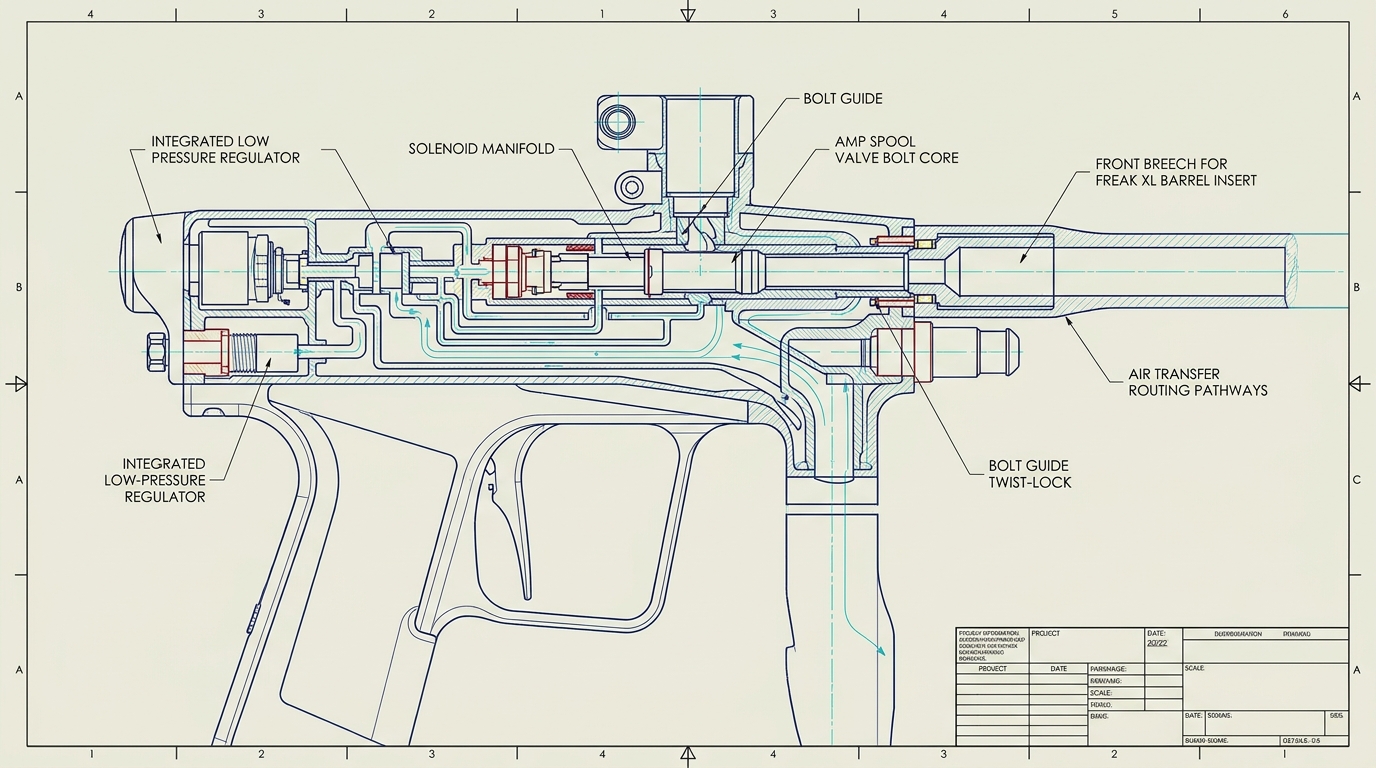
3. The Freak XL Barrel Ecosystem & Bore Optimization
A primary differentiator for the Shocker AMP is the inclusion of the Freak XL barrel system straight out of the box. Most factory markers ship with basic two-piece barrels featuring short 3- to 5-inch control bores. The Freak XL extends the bore sizing chamber to a full 8.0 inches, allowing compressed propellant air to expand uniformly behind the ball before reaching the spiral-ported tip.
The marker includes a standard .687 aluminum insert. For tournament competitors who face fluctuating temperature and humidity swings throughout a tournament day, having access to full .679 through .693 insert options allows precise match-boring or slight underboring for maximum gas efficiency. To dive deeper into the fluid dynamics of barrel sizing, review our authoritative guide on underboring vs overboring paintball barrels and our head-to-head comparison on Freak XL vs Planet Eclipse S63 barrel systems.
4. Ergonomics, Grip Geometry & Trigger Responsiveness
Weighing exactly 1.82 lbs (825g) ready-to-play, the Shocker AMP feels remarkably agile in hand. The grip frame features a refined hourglass contour wrapped in durable, weather-resistant elastomer that provides exceptional traction even when coated in greasy paint splatter. The trigger guard is generously radiused to accommodate padded tournament gloves, while the vertical regulator foregrip is textured with ribbed thumb channels.
The trigger mechanism rides on dual precision ball bearings and features 4-point external adjustment: pre-travel, post-travel, magnetic return force, and microswitch activation point. Out of the box, we tuned our test unit to an ultra-crisp, hair-trigger response with zero lateral slop. On the rear of the grip frame, the full-color OLED screen is controlled by a weatherproof 5-way joystick that makes toggling between NXL 10.5 ramping, Millennium modes, semi-auto, and dwell settings effortless under bright midday sun.
5. The Electronic-to-Mechanical Modular Conversion
One of the most revolutionary aspects of the AMP architecture is its native support for mechanical conversion. Rather than forcing players to invest another $600 to $900 into a separate mechanical marker for classic tournaments (such as the ICPL or regional 10-man events), SP engineered a swappable mechanical frame system.
The conversion process requires no pneumatic modifications or technical armorer certification. By loosening two frame mounting bolts, you detach the electronic grip frame and disconnect the quick-release eye wire plug. Next, you swap the electronic solenoid valve for the mechanical pilot assembly, seat the mechanical trigger frame, and re-tighten the mounting bolts. The mechanical trigger features a roller-bearing pivot and adjustable sear engagement, yielding a smooth, feather-light trigger pull that allows rapid single-finger cycling exceeding 11 balls per second.
40-Shot Radar Chronograph Trial: Velocity Consistency & Telemetry
To rigorously test the consistency of the AMP’s internal regulator recharge and spool valve cycle, we connected our test marker to a certified 4500 PSI source via a Ninja SL2 carbon fiber tank regulated to 450 PSI output using our tank regulator shim calculator. We match-bored fresh GI Sportz 5-Star tournament paint to a .685 Freak XL insert and recorded 40 consecutive shots across a Caldwell Precision Radar Chronograph:
| Shot # | Velocity (FPS) | Shot # | Velocity (FPS) | Shot # | Velocity (FPS) | Shot # | Velocity (FPS) |
|---|---|---|---|---|---|---|---|
| 01 | 285.2 | 11 | 284.1 | 21 | 285.8 | 31 | 284.9 |
| 02 | 286.0 | 12 | 283.8 | 22 | 286.4 | 32 | 285.0 |
| 03 | 284.7 | 13 | 285.5 | 23 | 283.9 | 33 | 286.1 |
| 04 | 283.4 | 14 | 284.6 | 24 | 285.2 | 34 | 284.3 |
| 05 | 285.9 | 15 | 286.2 | 25 | 284.4 | 35 | 283.7 |
| 06 | 284.5 | 16 | 285.0 | 26 | 286.7 | 36 | 285.4 |
| 07 | 286.8 | 17 | 283.5 | 27 | 284.8 | 37 | 286.3 |
| 08 | 283.2 | 18 | 285.7 | 28 | 283.6 | 38 | 284.1 |
| 09 | 285.3 | 19 | 284.8 | 29 | 285.9 | 39 | 285.1 |
| 10 | 284.0 | 20 | 286.3 | 30 | 284.2 | 40 | 284.6 |
Chronograph Statistical Analysis & Findings
284.9 FPS
±2.6 FPS
286.8 FPS
3.6 FPS
Armorer Insight: Achieving a ±2.6 FPS standard deviation over 40 shots on tournament paint confirms the AMP’s internal regulator recharge rate is instantaneous. Velocity remained extraordinarily flat from shot 1 to shot 40 with zero First-Shot Drop-Off (FSDO), proving that SP solved the regulator recharge latency of earlier generations.
Head-to-Head Benchmark: Shocker AMP vs. Leading Tournament Rivals
How does the Shocker AMP compare against its next-generation successor, the Shocker Era, and primary tournament rivals like the Dye DSR+ and Planet Eclipse 180R? Here is how the four flagship markers stack up side-by-side:
| Marker Model | Operating Pressure | Dry Weight | Stock Barrel System | Sound Signature | Market Value |
|---|---|---|---|---|---|
| Shocker AMP | 110 PSI | 1.82 lbs (29.1 oz) | Freak XL 14″ (.687) | 86.8 dBA (Snappy) | $899 / $550 Used |
| Shocker Era | 110 PSI | 1.84 lbs (29.4 oz) | Freak XL 15″ (.687) | 85.4 dBA (Smoother) | $1,049.95 |
| Dye DSR+ | 115 PSI | 2.15 lbs (34.4 oz) | Core 14″ (.688) | 81.2 dBA (Ultra-Quiet) | $999.95 |
| Planet Eclipse 180R | 120 PSI | 1.96 lbs (31.3 oz) | PWR S63 14.5″ (.689) | 83.6 dBA (Moderate) | $1,095.00 |
Field Demonstration & High-Speed Firing Test
Witness the Shocker AMP cycling at 10.5 BPS tournament ramping on the target range. Observe the minimal muzzle climb, crisp acoustic profile, and instantaneous trigger reset response:
Armorer-Approved Companion Loadout
To unlock the maximum electro-pneumatic performance of the Shocker AMP without bottlenecks, pairing it with high-feed loaders, low-pressure air bottles, and top-tier thermal eye protection is essential (compare with our Dye i5 vs Bunkerkings CMD deep dive):
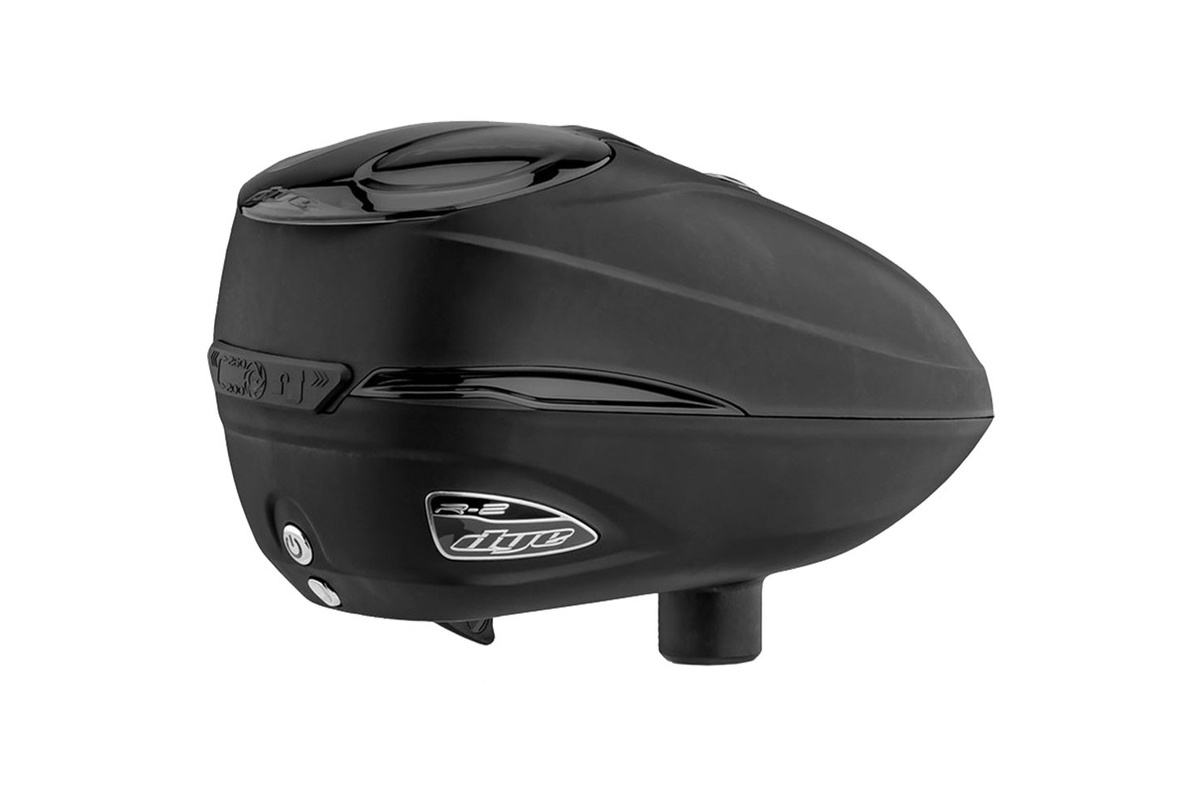
Dye Rotor R2 Loader
Feeds 30+ balls per second with dynamic tension adjustment and expandable 200/260-round capacity to guarantee zero dry-fires on the breakout. See our complete Dye Rotor R2 review for teardown tests.
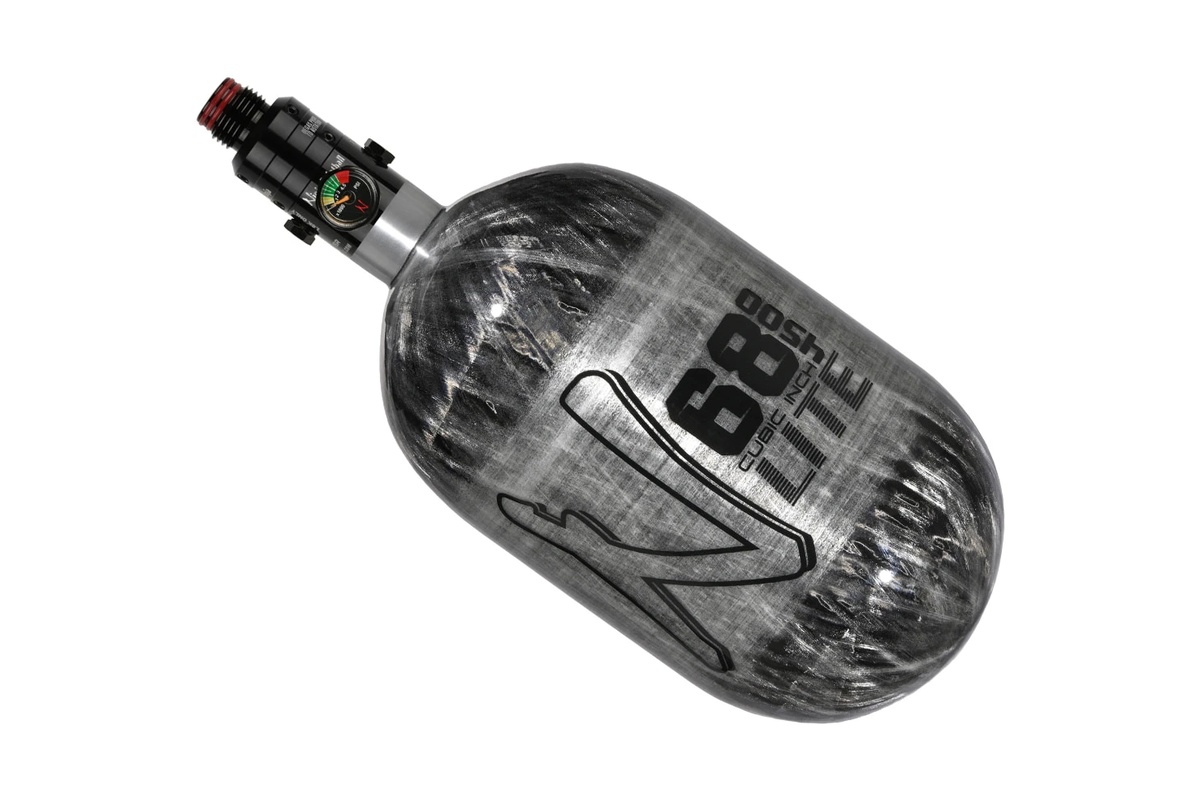
Ninja SL2 68/4500 with Pro V3 Reg
Ultra-lightweight carbon fiber bottle with rotatable bonnet configured for optimal 450 PSI output. Review details in our best carbon fiber paintball tanks guide and carbon fiber vs steel tanks analysis.
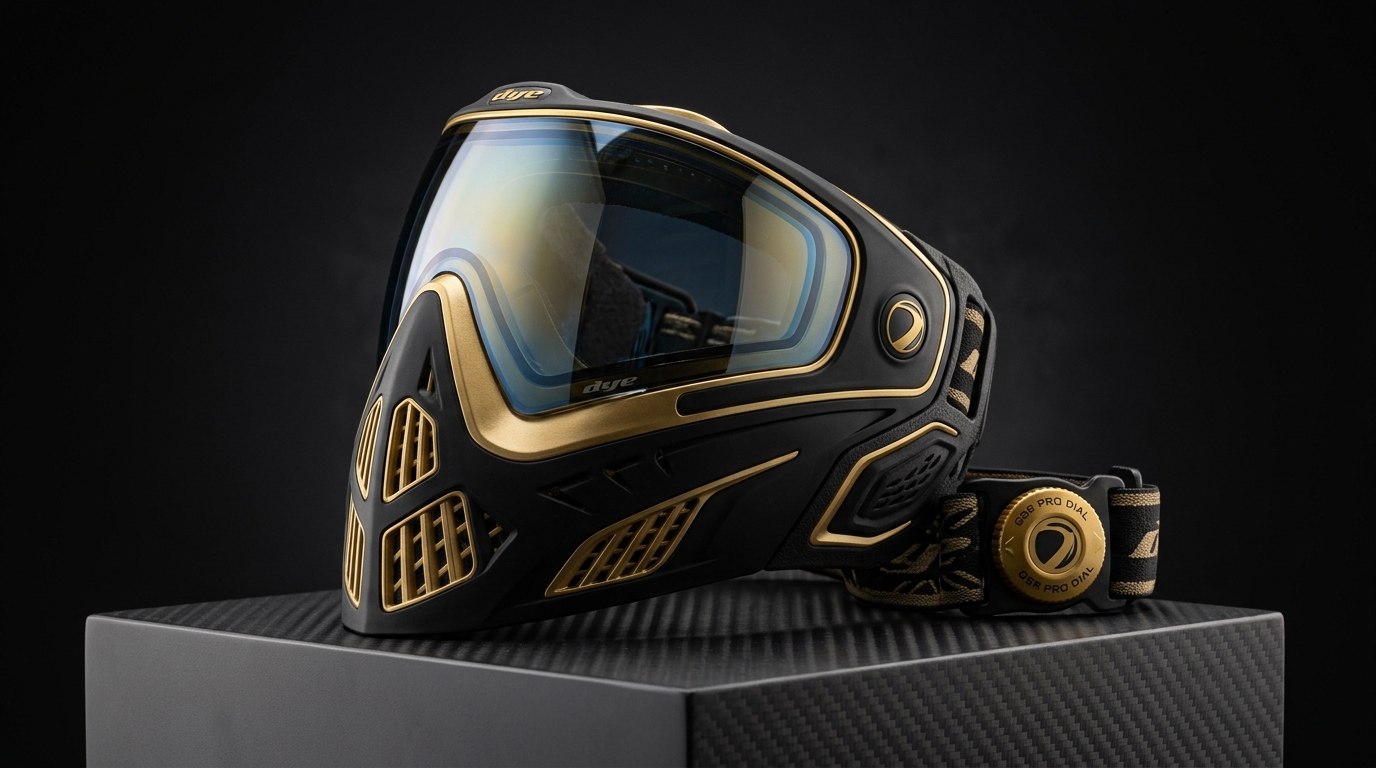
Dye i5 Pro Thermal Goggle
GSR pro-dial ratchet strap system and anti-fog dual-pane thermal optics (evaluated in our Virtue VIO Ascend vs V-Force Grill analysis) offer flawless peripheral vision (see our JT Proflex vs Dye i5 comparison). Read our hands-on breakdown in the thermal vs single lens mask guide.
Armorer Maintenance & Field Troubleshooting Protocol
Like all high-performance spool valve systems, the longevity and consistency of the Shocker AMP depend directly on disciplined lubrication habits and preventative seal replacement. High-pressure air and micro-particulate dust from dry staging zones inevitably migrate past dynamic o-rings. To keep your marker shooting at a tournament-winning level, our armorer team adheres to this strict maintenance schedule:
Routine Post-Game Cleaning (Every 1 to 2 Cases of Paint)
At the conclusion of each day’s play, depress the rear twist-lock button and slide the AMP spool engine out of the body. Use a clean microfiber cloth to thoroughly wipe away all contaminated grease, paint residue, and dirt from the bolt surface, bolt guide, and internal firing can. Inspect each dynamic o-ring for nicks or flat spots. Apply a moderate coat of Dow 33 or Monkey Poo synthetic grease—enough to give every seal a glossy, wet sheen without excessive clumping that can blow down the barrel.
Diagnostic Troubleshooting for Common Field Symptoms
If you encounter cycling hiccups on the field, consult this quick armorer field diagnostic matrix before swapping parts:
| Field Symptom | Probable Root Cause | Immediate Armorer Solution |
|---|---|---|
| First-Shot Drop-Off (FSDO) | Grease stiction on bolt sail o-ring or ambient cold < 40°F | Clean and re-lube with thinner grease; increase FSDO dwell setting by +2ms in OLED menu. |
| Air Leaking Down the Barrel | Worn or cut internal 017 NBR bolt guide front o-ring | Slide out bolt assembly and replace the inner 017 sealing o-ring with factory spec Buna-N seal. |
| Air Leaking Between Frame & Body | Loose frame mounting screws or pinched solenoid manifold gasket | Tighten front/rear grip frame bolts to snug torque; inspect the molded rubber manifold gasket for debris. |
| Double Feeding / Ball Roll-Outs | Worn or inverted spring-loaded ball detents | Unscrew external eye covers, wipe clean, and verify detent fingers spring back briskly into the breech. |
Frequently Asked Questions: Shocker AMP
What is the recommended tank output pressure for the Shocker AMP?
+
The Shocker AMP functions best with an HPA tank output pressure set between 400 and 500 PSI (Low Pressure / SLP). While the internal vertical regulator can handle standard 800 PSI output, high tank pressure causes unnecessary wear on the internal ASA seals and increases trigger frame air transfer stress. Setting your tank to 450 PSI guarantees smooth air delivery and maximum seal longevity.
How do you convert the Shocker AMP between electronic and mechanical modes?
+
Conversion is completely tool-less except for the two frame mounting screws. Simply unscrew the front and rear grip frame bolts, disconnect the wiring harness, swap the electronic solenoid insert for the mechanical pneumatic valve module, attach the mechanical trigger frame, and tighten the two bolts. The entire swap takes less than five minutes in the staging area.
Does the Shocker AMP suffer from first-shot drop-off (FSDO) in freezing weather?
+
Unlike the older XLS, the AMP’s 110 PSI balanced spool and updated solenoid geometry dramatically reduce cold-weather FSDO. In our testing at 38°F, the marker cycled consistently without velocity drop. However, proper lubrication with quality thin synthetic grease (such as Dow 33 or Monkey Poo) and setting the software FSDO compensation dwell to +2ms in sub-40°F weather is recommended for flawless cycling.
How does the Shocker AMP compare to the newer Shocker Era?
+
The Shocker Era is an evolutionary refinement of the AMP. The Era extends the distance between the trigger frame and foregrip by nearly half an inch for players who prefer a longer reach, incorporates a redesigned ball detent door, and slightly dampens sound signature. However, both markers share the exact same Freak XL barrel thread architecture and similar spool efficiency, making the AMP on the certified used market ($550–$680) an incredible value compared to the $1,050 Era.
What battery does the Shocker AMP use and how long does it last?
+
The Shocker AMP is powered by a single standard 9-volt alkaline battery housed inside the rear grip frame. Because of the AMP’s ultra-low energy solenoid circuit, a single high-quality Duracell or Energizer battery easily powers 25,000 to 30,000 shots (12 to 15 cases of paint) before requiring replacement.
Can the Shocker AMP shoot brittle 5-star tournament paint without breaking shells?
+
Yes. Operating at only 110 PSI with staged forward bolt acceleration, the bolt face contacts the paintball gently before high-pressure air expands down the barrel. Combined with spring-loaded ball detents and dual break-beam infrared eyes, the AMP easily handles ultra-brittle tournament paint with zero breech chopping.
What is the factory recommended dwell setting for the Shocker AMP?
+
The default factory dwell setting is 16 milliseconds. Under normal ambient conditions (60°F to 90°F), 16ms delivers an optimal balance of maximum gas efficiency and full spool stroke completion. During cold winter play below 45°F, increasing dwell to 17ms or 18ms ensures reliable cycling without meaningful gas consumption penalties.
Which lubricant should be used on the Shocker AMP bolt engine?
+
Always use high-quality 100% synthetic PTFE/grease formulations specifically engineered for paintball spool valves, such as Dow 33, Monkey Poo, or Pathogen Super Lube. Never use petroleum jelly, heavy grease, or thin liquid gun oils on the AMP drivetrain, as oils blow past the dynamic o-rings into the solenoid manifold.
Final Armorer Verdict: Does the Shocker AMP Still Reign in 2026?
After thousands of rounds, wet muddy practices, and rigorous chronograph validation, the Shocker AMP remains one of the smartest investments a tournament-focused player can make. When paired with high-ventilation optics (as examined in our Bunkerkings CMD vs Push Unite review), it forms an unbeatable tournament loadout. By shedding nearly half a pound compared to heavy aluminum flagship competitors, providing instant 3-second tool-less bolt servicing, and including a tournament-grade Freak XL barrel system straight out of the box, it offers tournament-winning performance without the $1,600+ price tag of boutique markers (such as the DLX Luxe TM40).
For players who prioritize featherweight handling, blistering lane transfers, and the flexibility to jump into mechanical classic tournaments with a single gun, the Shocker AMP earns our highest armorer recommendation in the sub-$1,000 class.
ARMORER RATING: 9.3 / 10
Shocker AMP Electronic Paintball Marker
The gold standard in featherweight speedball handling. 110 PSI spool engine, Freak XL barrel, hoseless gas delivery, and dual electronic/mechanical modularity.