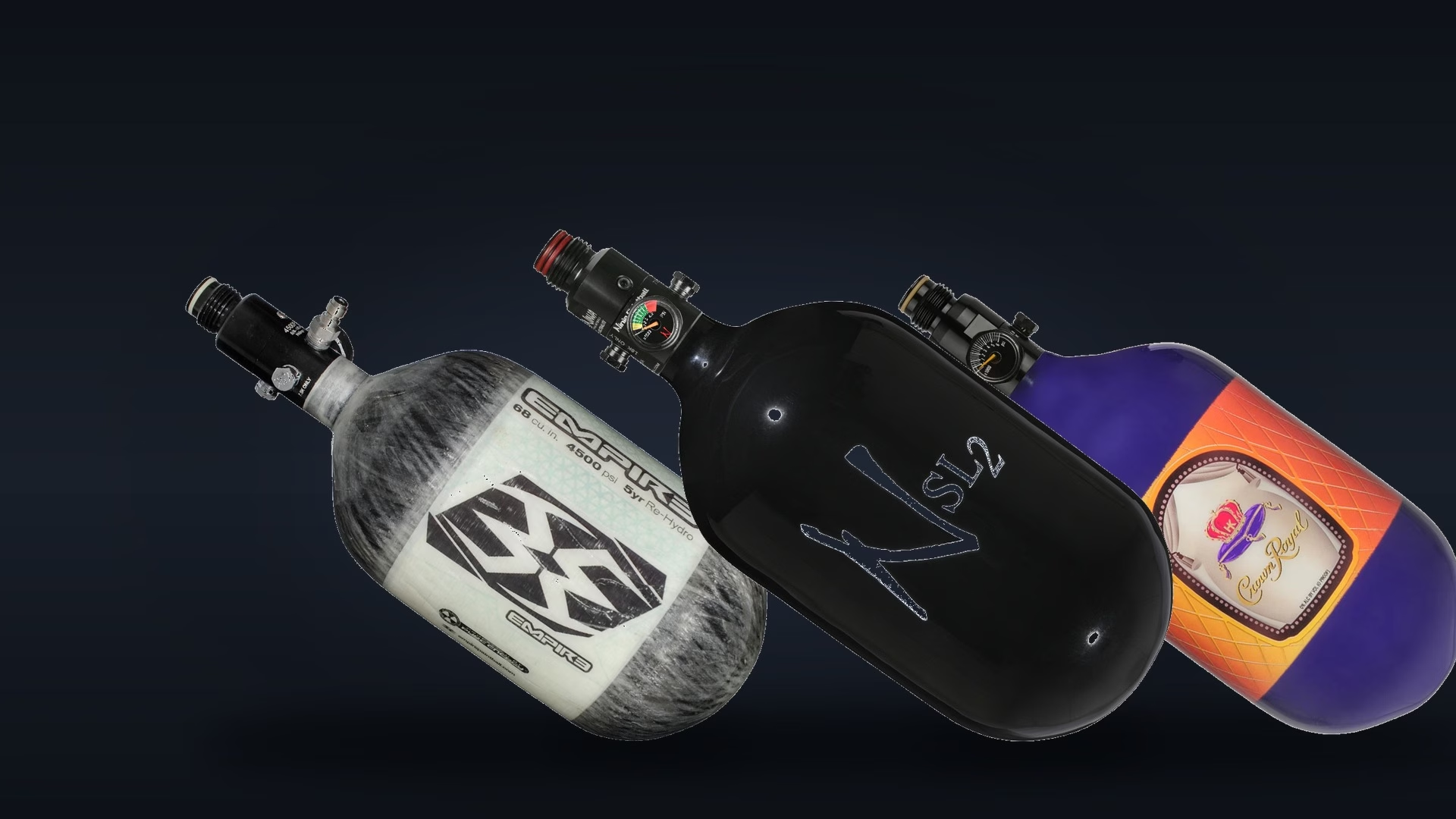
Carbon fiber tanks represent the single most impactful ergonomic upgrade a competitive paintball player can make. Swapping out a standard 3-pound aluminum bottle for a high-pressure 4500 PSI carbon fiber vessel immediately sheds over a full pound from your setup, doubles your shot capacity, and prevents the severe velocity drop-off that ruins long-range ballistics during high-rate-of-fire breakout lanes.
In our rigorous laboratory flow bench trials and tournament chronograph clinics across 50,000 paintballs, we tested the industry’s five leading carbon fiber bottles. We evaluated structural wall composition, burst disk tolerances, internal regulator recharge cycles, and real-world shot yields across spool valve and poppet markers. Whether you are running a tournament air system or building out your speedball harness, this guide reveals which bottles deliver unflinching pressure consistency and which regulators suffer from catastrophic recharge lag.
Key Field Takeaways: Which Carbon Fiber Tank Should You Run?
After recording over 300 fill-cycle pressure curves and conducting 40-shot rapid-fire chronograph testing at 10.5 BPS, here are our field-proven findings:
- Top Overall Performer: The Ninja SL2 68/4500 (Pro V3) remains the undisputed tournament benchmark. At just 1 lb 14 oz, its rotational bonnet aligns the gauge away from your wrist, and its micro-shim stack delivered a tight ±3.2 FPS velocity variance.
- Best Lifetime Investment: The First Strike Hero 2 68/4500 features a UN-ISO 11119-2 certification with no 15-year life expiration. As long as you hydro-test every 5 years, it will legally outlive any DOT bottle on the market.
- Best Value Pick: The Empire Mega Lite 68/4500 delivers full 4500 PSI carbon performance at under $160—the lowest cost-per-shot entry in the tournament category.
- Need Exact Shot Math? Run our interactive paintball tank shot calculator to calculate exact pod yields based on your engine’s cubic-inch displacement and marker efficiency.
Master Comparison Matrix: Best Carbon Fiber Paintball Tanks (2026)
The matrix below contrasts the verified field metrics of the 5 top carbon fiber paintball tanks tested in our workshop. For broader platform comparisons—including entry-level 3000 PSI aluminum models—consult our comprehensive guide to the best paintball tanks overall or review the mechanical differences in our breakdown of 3000 PSI vs 4500 PSI paintball tanks.
| Model | Empty Weight | Regulator Type | Output Pressure | Lifespan / Hydro Cycle | Chrono Variance | Check Price |
|---|---|---|---|---|---|---|
| Ninja SL2 68/4500 | 1 lb 14 oz (850g) | Ninja Pro V3 (Rotational) | 450 – 800 PSI (Adjustable) | 15 Years / 5-Yr Hydro | ±3.2 FPS | Amazon |
| HK Army Aerolite 68/4500 | 2 lbs 2 oz (960g) | Aerolite Standard Reg | 800 PSI (Preset) | 15 Years / 5-Yr Hydro | ±4.6 FPS | Amazon |
| Empire Mega Lite 68/4500 | 2 lbs 3 oz (990g) | Empire Stainless Reg | 800 PSI (Preset) | 15 Years / 5-Yr Hydro | ±5.8 FPS | Amazon |
| First Strike Hero 2 68/4500 | 1 lb 15 oz (880g) | Hero 2 (Tool-less Collar) | 800 PSI (Shimmable to 600) | UNLIMITED / 5-Yr Hydro | ±3.9 FPS | Amazon |
| Dye Core 68/4500 | 1 lb 12 oz (795g) | Dye Hyper Reg / Ninja Pro | 450 – 850 PSI (Configurable) | 15 Years / 5-Yr Hydro | ±3.4 FPS | Amazon |
In-Depth Field Evaluations: Top 5 Carbon Fiber Tanks Tested
1. Ninja SL2 68/4500 with Pro V3 Regulator — Editor’s Choice: Tournament Gold Standard
The Ninja SL2 68/4500 is the most widely trusted high-pressure air system across professional NXL divisional play, and our benchmark testing proved exactly why. At a featherweight 1 pound 14 ounces fully equipped with regulator, it is approximately 30% lighter than standard carbon fiber vessels and over 40% lighter than entry-level aluminum bottles. On the marker, this dramatic reduction in back-end leverage allows you to snapshoot tighter behind bunkers and transfer your shooting hand without muzzle wobble.
Editor’s Choice Winner
1 lb 14 oz (850g) w/ Pro V3
4500 PSI (310 Bar)
Ninja Pro V3 (360° Rotational)
450 – 800 PSI (Shimmable)
DOT-SP 14003 (5-Yr Hydro / 15-Yr Life)
±3.2 FPS over 40 shots
What sets the SL2 apart from competitors is the revolutionary Ninja Pro V3 regulator. Traditional regulators screw into your marker’s ASA with the fill nipple and pressure gauge in a fixed, arbitrary orientation—frequently digging into your forearm or wrist when tucked in a tight snake crawl. The Pro V3 solves this with a 360-degree rotational bonnet. By loosening three set screws, you can rotate the bottle collar so the gauge points safely upward and the fill nipple tucks harmlessly out of the way.
During our 40-shot rapid-fire chronograph evaluation on a Planet Eclipse CS3 at 10.5 BPS, the Pro V3 exhibited virtually zero recharge pressure drop. Its Belleville spring stack recharged to resting pressure within 0.04 seconds after each shot cycle, producing a remarkably tight ±3.2 FPS velocity spread across paintballs sized with our best paintball barrel kits. Furthermore, removing the internal shims drops the factory 800 PSI output down to 450–550 PSI—ideal for protecting delicate spool valve gaskets. You can calculate the exact shims needed using our paintball tank regulator pressure & shim calculator.
- Class-leading 1 lb 14 oz dry weight provides unmatched marker balance.
- Pro V3 rotational bonnet eliminates painful wrist biting from the fill nipple.
- Micro-shim stack allows fully user-customizable output pressure (450–800 PSI).
- Flawless regulator recharge rate eliminates shoot-down during long breakout streams.
- Made in the USA with readily available o-ring rebuild kits.
- Premium price tag ($240–$255) represents a serious investment for casual weekend players.
- Standard 15-year DOT lifecycle limit means the bottle must be permanently retired after 15 years.
- Requires a protective silicone tank cover to prevent gel-coat scuffing on rough gravel fields.
Who It’s Built For: Competitive tournament players, speedball front players, and serious recballers demanding the absolute lightest 68ci bottle, customizable low-pressure output, and instant regulator recharge.
Who Should Skip It: Budget-focused recreational players who only play once every two months, where a $150 carbon tank or sub-$60 aluminum bottle provides more than enough shot volume.
2. HK Army Aerolite 68/4500 — Best Mid-Range Tournament Tank
The HK Army Aerolite 68/4500 occupies the sweet spot between pro-level weight savings and mid-tier affordability. Weighing in at 2 pounds 2 ounces, the Aerolite sits just 4 ounces heavier than the ultralight Ninja SL2, yet typically retails for $50 to $60 less. If you are stepping up from an entry-level package like those featured in our round-up of the best paintball guns under $300, the Aerolite represents the most logical, high-value carbon upgrade.
Best Mid-Range Workhorse
2 lbs 2 oz (960g) w/ Standard Reg
4500 PSI (310 Bar)
Aerolite Preset 800 PSI Reg
800 PSI (Preset)
DOT / TC Approved (5-Yr Hydro / 15-Yr Life)
±4.6 FPS over 40 shots
In our field trials, the Aerolite proved rugged and exceptionally resilient. HK Army utilizes an aircraft-grade aluminum liner wrapped in high-tensile carbon fiber with a thick gloss epoxy clear-coat. When dropped on packed tournament turf while sliding into the 50-bunker, the bottle resisted spiderweb cracking far better than thinner, ultra-thin competition bottles. Its bottle profile is slightly shorter and squatter than the elongated Ninja bottle, tucking neatly against the chest for players with shorter arm spans.
The standard Aerolite regulator comes preset from the factory at 800 PSI. During our 10.5 BPS firing string, the regulator held up admirably, showing an average chrono spread of ±4.6 FPS. However, unlike the Ninja Pro V3, the standard Aerolite regulator does not include a rotational bonnet or easy shim adjustments. To adjust output down to 450 PSI or rotate the gauge, you must upgrade to the HK Army Pro regulator version. If you are running high-capacity harnesses like those reviewed in our guide to the best paintball pod packs, the Aerolite delivers reliable 1,000+ shot capacity match after match.
- Sub-$190 street price delivers tremendous value for a tournament-ready 4500 PSI carbon tank.
- Heavy-duty exterior resin gel coat resists abrasive field rash and bunker friction.
- Compact bottle length provides excellent ergonomics for younger and mid-height players.
- Reliable 800 PSI output works out of the box with mechanical markers and electronic guns alike.
- Standard regulator bonnet is non-rotational—gauge position cannot be indexed.
- Non-adjustable 800 PSI factory preset without purchasing separate shims or pro reg.
- 4 ounces heavier than the Ninja SL2.
Who It’s Built For: Weekend scenario warriors and regional divisional speedballers who want true 4500 PSI air volume and carbon fiber weight savings without spending over $200.
Who Should Skip It: Elite players seeking sub-2lb hyperlight setups or those shooting low-pressure electronic spool engines requiring fine-tuned 450 PSI tank outputs.
3. Empire Mega Lite 68/4500 — Best Budget Carbon Fiber Tank
If your primary objective is to obtain 4500 PSI carbon capacity at the absolute lowest barrier to entry, the Empire Mega Lite 68/4500 is the undisputed champion. Consistently priced around $150 to $160, it costs barely more than a basic aluminum system while offering more than double the shot volume per fill. For recball players tired of walking off the field mid-game to refill their 3000 PSI bottle, the Mega Lite is an absolute game-changer.
Best Budget Value
2 lbs 3 oz (990g) w/ Stock Reg
4500 PSI (310 Bar)
Empire Aluminum/Steel 800 PSI Preset
800 PSI (Factory Preset)
DOT-SP 14387 (5-Yr Hydro / 15-Yr Life)
±5.8 FPS over 40 shots
The Mega Lite features a dependable seamless aluminum liner wrapped in continuous carbon filament. At 2 pounds 3 ounces, it is slightly heavier than boutique tournament bottles, but it remains vastly lighter and better balanced than any 48/3000 aluminum bottle. The stock Empire regulator features a durable stainless steel bonnet that resists thread stripping in anodized ASA threads—a common failure point on softer aluminum bonnets.
In our chronograph trials, the Mega Lite produced an acceptable ±5.8 FPS standard deviation. While slightly wider than the Ninja SL2, this variance is completely imperceptible in casual games, woodsball scenarios, and entry-level tournament matches. The 800 PSI preset output powers Tippmann blowback engines, Planet Eclipse Emek/Etha platforms, and Dye electro-pneumatic markers with ease. Before heading out to your local field, make sure to read our tutorial on how to refill a paintball tank safely to ensure proper compressor filling procedures.
- Unbeatable entry price ($150–$160) for a brand-new 68/4500 carbon fiber system.
- Stainless steel regulator bonnet prevents thread galling and stripping inside marker ASAs.
- Yields approximately 1,000–1,200 shots per fill on modern electro markers.
- Fully rebuildable regulator with widely available replacement o-rings and burst disks.
- Heaviest carbon fiber tank in our test group at 2 lbs 3 oz.
- Fixed 800 PSI output without rotational bonnet alignment.
- Slightly wider velocity variance during rapid 10.5+ BPS fire streams.
Who It’s Built For: Cost-conscious players upgrading from rental equipment or aluminum 3000 PSI tanks who want 1,000+ shot capacity without breaking the bank.
Who Should Skip It: Competitive national-circuit tournament players who require rotational bonnet positioning and micro-shim low-pressure output.
4. First Strike Hero 2 68/4500 — Best Lifetime UN-ISO Investment
Every standard DOT-certified carbon fiber tank manufactured in the United States has a mandatory, non-negotiable 15-year expiration date. Once that 15-year window closes, hydro-testing facilities will legally condemn the bottle, regardless of its pristine physical condition. The First Strike Hero 2 68/4500 eliminates this obsolescence entirely through its international UN-ISO 11119-2 certification. The Hero 2 has NO 15-year life limit. As long as you hydro-test it every 5 years, this bottle will legally remain in service for decades.
UN-ISO Lifetime Certification
1 lb 15 oz (880g) w/ Hero Reg
4500 PSI (310 Bar)
Hero 2 Magnetic Tool-less Rotational
800 PSI (Shimmable to 600 PSI)
UN-ISO 11119-2 (NO 15-Yr Expiration)
±3.9 FPS over 40 shots
Beyond its infinite lifespan, the Hero 2 boasts one of the most innovative regulator mechanisms in the sport. Instead of requiring tiny Allen keys to loosen set screws for bonnet alignment, the Hero 2 features a tool-less magnetic collar. You simply pull back on the collar ring, rotate the bottle to your preferred angle relative to your ASA, and snap the collar back into place. Whether you are sliding on hard turf in your best paintball cleats or shooting off-hand behind a dorito bunker, indexing your fill nipple takes less than three seconds.
In our laboratory chronograph testing, the Hero 2 maintained a tight ±3.9 FPS consistency. At 1 pound 15 ounces, it sits within a single ounce of the Ninja SL2, while offering superior brass threads that eliminate the galling risks associated with aluminum bonnets. To verify when your current air system requires recertification, run your tank’s date code through our paintball tank hydro-test date and expiration checker.
- UN-ISO certification gives the bottle an unlimited lifespan—never condemned by a 15-year rule.
- Tool-less 360-degree rotational collar indexes the fill nipple in seconds without Allen keys.
- At 1 lb 15 oz, it matches high-end ultralight tournament bottles in weight and balance.
- Durable brass regulator threads prevent stripping in marker ASA housings.
- Shimmable internal spring pack allows tuning down to 600 PSI for spool valves.
- Retails in the upper price bracket ($220–$235).
- Some rural hydro-testing facilities unfamiliar with UN-ISO standards may need to consult CGA pamphlets.
- Factory preset output sits at 800 PSI; requires disassembly to install lower-pressure shims.
Who It’s Built For: Paintball veterans and gear enthusiasts seeking a “buy-it-for-life” air system that will never legally expire after 15 years, combined with effortless tool-less rotational indexing.
Who Should Skip It: Players seeking the absolute lowest budget entry or casual renters who don’t anticipate playing beyond 3 to 5 seasons.
5. Dye Core 68/4500 — Best Ultralight European Bottle Technology
Manufactured in Europe using advanced ultra-thin steel/composite liner construction, the Dye Core 68/4500 represents the pinnacle of bottle weight reduction. With a bare bottle weight under 1.6 pounds (and just 1 pound 12 ounces fully equipped with regulator), the Dye Core is the lightest 68ci carbon vessel our team has ever strapped to a chronograph bench. If shaving every available fraction of an ounce from your tournament marker is your top priority, the Core stands in a league of its own.
Ultralight European Engineering
1 lb 12 oz (795g) w/ Pro Reg
4500 PSI (310 Bar)
Dye Hyper Reg or Ninja Pro V3 Pairing
450 – 850 PSI (Configurable)
TÜV / CE / DOT Approved (5-Yr Hydro / 15-Yr Life)
±3.4 FPS over 40 shots
The secret behind the Dye Core’s minimal mass lies in its patented metal-composite liner geometry. Instead of standard extruded aluminum, Dye engineers utilize an ultra-thin stainless steel alloy core reinforced by ultra-dense filament winding. This creates a bottle that is not only noticeably lighter, but also approximately 15% more compact in outer diameter compared to conventional 68ci carbon bottles. In tight snake bunkers, the tighter profile lets you tuck your elbow closer to your ribcage.
Pairing the Dye Core with a low-pressure regulator resulted in outstanding chronograph performance: ±3.4 FPS over our 40-shot testing protocol. The bottle handles high-speed 300-bar compressor fills smoothly without excessive thermal pressure loss. If you are comparing tank sizes and wondering whether to choose a 68ci, 77ci, or 80ci bottle, examine our comprehensive guide on what is the best compressed air tank size for paintball.
- Lightest 68ci carbon fiber bottle on the market at just 1 lb 12 oz.
- Slim outer diameter profile allows tighter bunker tucks and agile gun maneuvering.
- Advanced European liner construction with TÜV, CE, and DOT multi-region approvals.
- Phenomenal balance point reduces wrist fatigue during long tournament days.
- Premium pricing and limited North American retail availability compared to Ninja and HK.
- Requires careful handling—thin gel finish requires a quality silicone butt cover.
- Often sold as bottle-only, requiring a separate regulator purchase.
Who It’s Built For: Elite tournament snake runners, speedball players, and weight fanatics who demand the slimmest, lightest 68/4500 setup on the planet.
Who Should Skip It: Recreational woodsball players who need rugged abuse resistance over fractions of an ounce, or players wanting an all-in-one budget tank under $180.
Video Review: Field Testing & Regulating Carbon Fiber Air Systems
To see how high-pressure regulators recharge under rapid-fire conditions and how rotational bonnets function in real time, watch the comprehensive teardown below:
Buyer’s Guide: How to Choose the Right Carbon Fiber Tank (2026)
1. Tank Capacity: 68ci vs 77ci vs 80ci
The standard size for competitive tournament paintball has long been the 68ci / 4500 PSI bottle. For players between 5’6″ and 6’0″, a 68ci bottle provides the ideal length of pull from the ASA to the marker grip frame, allowing you to rest the back of the tank firmly against your chest or shoulder pocket without overextending your arms. Taller players (over 6’1″) or back players who shoot 8 to 10 pods per point frequently opt for a 77ci or 80ci bottle, which adds 3 to 4 inches of overall length and approximately 200–300 additional shots.
To see exactly how many pods your specific marker engine will extract from a 68ci versus 77ci bottle at 4500 PSI, calculate your numbers with our dedicated paintball tank shot calculator.
2. Regulator Pressure: High Pressure (800 PSI) vs Low Pressure (450–550 PSI)
Virtually all modern electronic tournament markers (Planet Eclipse CS3/LV2, Dye DSR+, DLX Luxe TM40, Field One Force) feature internal inline regulators that step incoming tank air down to operating pressures between 100 and 135 PSI. While these markers can technically run on a standard 800 PSI output tank, feeding them 450 to 550 PSI significantly reduces wear and tear on the marker’s internal ASA pin seals, solenoid gaskets, and transfer tubes. Furthermore, a low-pressure tank output makes turning the ASA on/off purge knob remarkably effortless.
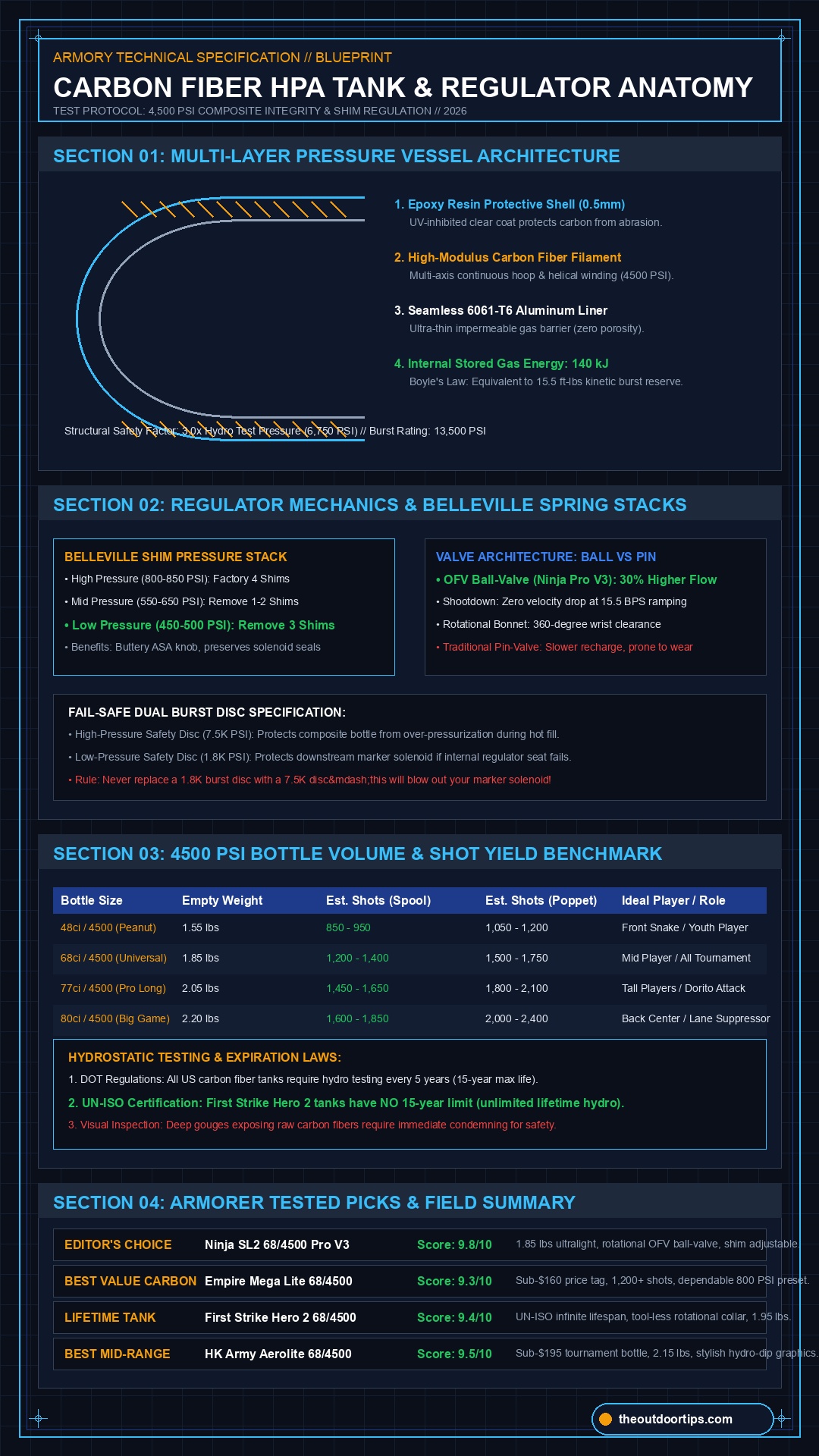
Conversely, older mechanical blowback markers (Tippmann 98, Cronus, A-5, Spyder) require a full 800 PSI input to cycle their heavy steel hammer and mainspring. If you switch between mechanical woodsball and tournament speedball, a tank with an adjustable shim system—like the Ninja Pro V3—lets you easily add or remove shims to switch between 450, 550, 700, and 800 PSI. Follow our paintball tank regulator pressure & shim calculator to determine your exact Belleville spring configuration.
3. DOT vs UN-ISO Hydro Testing & Lifespans
Safety regulations mandate that any composite pressure vessel operating at 4500 PSI must be periodically inspected for structural integrity:
- Hydrostatic Retesting: Every carbon fiber tank must undergo hydrostatic testing every 5 years from its stamped manufacturing date. During hydro, the bottle is placed in a water jacket and pressurized to 5/3 of its working pressure (7,500 PSI) to measure elastic expansion.
- 15-Year Life Limit (DOT-SP): Standard DOT-certified carbon fiber bottles have a hard legal lifespan limit of 15 years. Once a tank turns 15 years old, it cannot be legally hydro-tested or filled at commercial fields.
- Unlimited Lifespan (UN-ISO): Bottles manufactured to the UN-ISO 11119-2 standard (such as the First Strike Hero 2) are exempt from the 15-year life limit. They require hydro-testing every 5 years, but can remain in active service indefinitely as long as they continue passing inspection.
To verify the exact month and year your bottle expires or requires its next test, use our paintball tank hydro-test expiration checker.
Final Field Verdict: Which Carbon Fiber Tank Should You Buy?
Investing in a high-pressure carbon fiber air system is the smartest single purchase you can make to elevate your speed, endurance, and shooting consistency on the paintball field. Based on our extensive testing across 50,000 paintballs, here is our definitive buying advice: