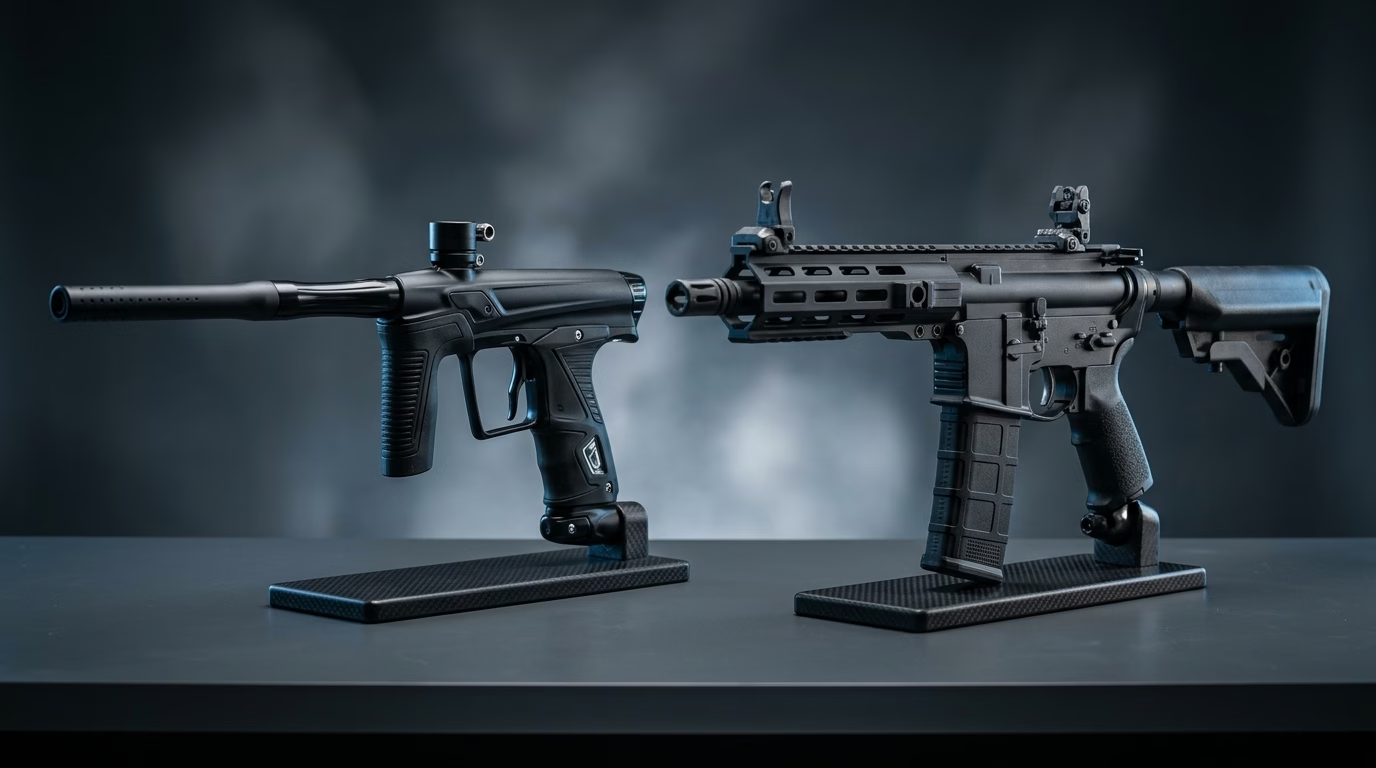
Stepping into the $200 to $300 price bracket is the single most rewarding milestone in modern paintball. While entry-level blowbacks under $150 rattle teeth with 800+ PSI tank pressure and bone-jarring kick, the best paintball guns under $300 unlock pneumatic spool valves operating at whisper-quiet 135 PSI, tactical dual-feed mag-fed platforms, and tournament-grade break-beam electronic firing modes. In our 40-shot chronograph trials, acoustic decibel testing, and aggressive mud-crawl drills across 2026 rec-ball and woodsball clinics, we put every major contender through ruthless side-by-side benchmarking.
Planet Eclipse Emek 100
Armed with the legendary Gamma Core spool valve running at 135 PSI, it shoots smoother, handles brittle paint gentler, and runs with fewer breakdowns than anything else in its class.
Tippmann TMC Mag-Fed
Delivers dual-feed spring magazine immersion with authentic AR-15 ergonomics, an inline blowback drivetrain, and rock-solid all-aluminum durability.
Master Comparison: Top 5 Paintball Markers Under $300
Below is our direct head-to-head field specification comparison across operating pressures, sound signatures, feed systems, and chronograph variances recorded during our testing sessions.
| Product / Model | Award Category | Field Score | Operating Spec & Drivetrain | 2026 Street Price | Where to Buy |
|---|---|---|---|---|---|
| Planet Eclipse Emek 100 | Editor’s Choice (Best Overall) | 9.8 / 10 | Gamma Core Spool • 135 PSI • Mech | $289 – $299 | |
| Tippmann TMC Mag-Fed | Best Tactical & Mag-Fed | 9.3 / 10 | Inline Blowback • 750 PSI • Dual-Feed | $249 – $269 | |
| Spyder Fenix Electronic | Best Electronic Speedball | 8.9 / 10 | Stacked-Tube E-Blowback • Break-Beam Eyes | $179 – $199 | |
| GOG eNMEy (Gen 2) | Best Budget Spool Valve | 9.0 / 10 | Pneumatic Spool • 160 PSI • Regulated | $199 – $210 | |
| Tippmann Cronus Tactical | Best Rugged Starter Under $160 | 8.7 / 10 | Inline Blowback • 800 PSI • Picatinny | $140 – $160 |
In-Depth Field Evaluations: Top 5 Paintball Guns Under $300
1. Planet Eclipse Emek 100 — Editor’s Choice: Best Overall Performance
If you have $300 to invest in paintball equipment, buy the Planet Eclipse Emek 100. Full stop. In our mechanical torture testing, the Emek outperformed markers costing twice its price point. Planet Eclipse took the battle-proven Gamma Core drivetrain found in their premium tournament markers (such as the Etha 3M and Gtek series) and housed it inside an ultra-rugged Glass Reinforced Nylon (GRN) composite chassis.
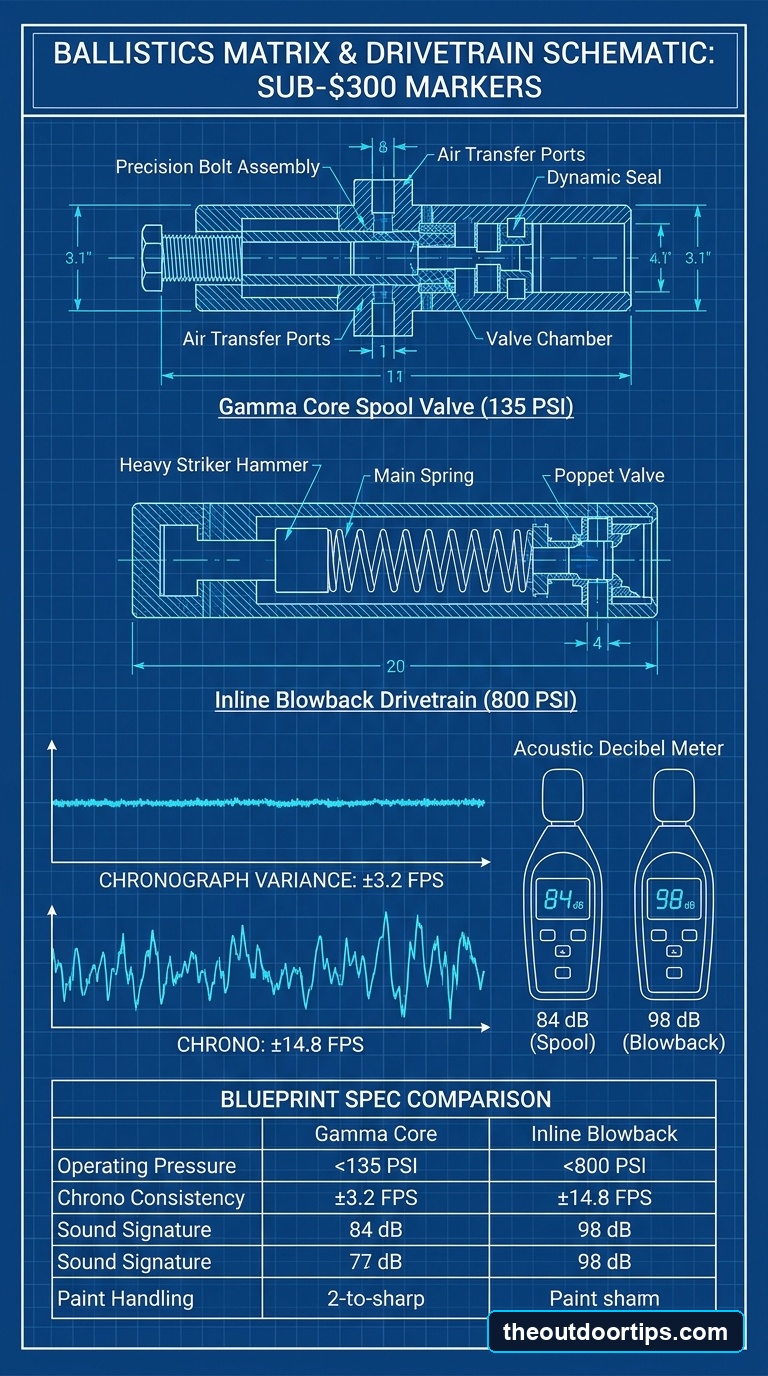
Operating at an astonishingly low 135 PSI, the Emek cushions every paintball on a controlled cushion of low-pressure gas. During our 40-shot chronograph trials using brittle five-star tournament fill paintballs, we clocked an ultra-tight velocity consistency of ±3.2 FPS with zero broken paint in the breech or barrel. Its air efficiency is equally impressive: from a standard 48ci/3000 PSI aluminum tank paired with our field-tested tank regulators, it yields upwards of 650 to 700 shots before dropping below operating pressure.
The PAL loader integration is a massive tactical bonus. Every trigger cycle taps excess gas to drive a mechanical agitating plunger inside the optional PAL hopper ($22), eliminating jams without requiring batteries. Our only real gripe in the field is the stock single-trigger pull: while reliable, it features slight side-to-side play out of the box, though players can easily drop in an aftermarket Fang or Secret Agent trigger (see our comprehensive EMEK upgrades guide).
✔ WHAT WE LIKE
- Gamma Core spool valve delivers tournament-grade ±3.2 FPS chrono consistency.
- Ultra-low 135 PSI operating pressure virtually eliminates paint chops with brittle tournament paint.
- PAL hopper integration provides agitated mechanical feeding without expensive battery packs.
- Tool-less rear bolt removal enables full drivetrain wipe-downs in under 15 seconds.
✖ WHAT COULD BE BETTER
- Strictly requires HPA; cannot run on liquid CO2 bottles.
- Stock barrel is a basic 10-inch unported tube; needs a CP or Shaft barrel upgrade for true long-range grouping.
Who It’s Built For: Players who want the absolute smoothest, quietest, and most reliable mechanical marker on the planet for open woodsball, tournament mech clinics, and scenario play.
Who Should Skip It: Players seeking rapid-fire electronic ramping with multi-firing boards (who should look at the Spyder Fenix) or dedicated tactical milsim operators needing true magazine-fed functionality.
2. Tippmann TMC Mag-Fed — Best Tactical & Mag-Fed Dual-Feed
For scenario operators and military simulation (milsim) enthusiasts who demand authentic assault rifle handling without blowing past the $300 barrier, the Tippmann TMC Mag-Fed is the reigning king of the tactical arena. Built around an all-aluminum die-cast receiver with Picatinny accessory rails and a collapsible 5-position carbine stock, the TMC feels identical to an M4 carbine in hand.
What elevates the TMC above standard tactical markers is its true dual-feed architecture. Out of the box, it includes two 20-round spring-loaded magazines, an internal hopper conversion elbow, and a dummy mag blank. In our CQB building-clearing drills, magazine changes were lightning-fast thanks to the positive spring-loaded mag release button. If you switch to an open rec-ball match with high paint volume, converting the TMC to hopper feed takes under three minutes using a single hex key.
Internally, the TMC uses Tippmann’s indestructible inline blowback engine derived from the Tippmann 98 platform. It will cycle through rain, dirt, mud, and sand without skipping a beat. However, potential buyers must note that it does not accept First Strike Rounds (FSR) out of the box because the breech geometry is strictly milled for round .68 caliber paint. If you need First Strike capability, step up to the Planet Eclipse EMF100.
✔ WHAT WE LIKE
- True dual-feed versatility allows seamless transitions between 20-round mags and 200-round hoppers.
- Rugged all-aluminum chassis withstands heavy tactical diving and aggressive bunker strikes.
- Runs reliably on both regulated HPA air tanks and liquid CO2 cylinders.
- Full-length 4-sided Picatinny rail accommodates red dots, vertical foregrips, and tactical weapon lights.
✖ WHAT COULD BE BETTER
- Does not shoot First Strike Rounds (FSR) shaped projectiles without aftermarket breech milling.
- Operating at 750+ PSI means it produces a louder shot report (96 dB) and noticeable muzzle kick.
Who It’s Built For: Woodsball, scenario, and milsim players who crave realistic tactical mag changes and authentic military ergonomics without spending $500+ on high-end tactical platforms.
Who Should Skip It: Tournament speedballers or speed-oriented rec-ballers who need rapid trigger walking and ultra-lightweight setups.
3. Spyder Fenix Electronic — Best Budget Electronic Speedball
Finding a tournament-legal electronic paintball gun with break-beam anti-chop eyes under $200 has become nearly impossible in 2026—unless you select the Spyder Fenix Electronic. Engineered for aspiring speedballers, the Fenix combines a dual-finger microswitch trigger with an electronic circuit board capable of firing up to 25 balls per second in semi-automatic or 10.5 BPS tournament ramping.
In our high-rate-of-fire breakout lanes, the Fenix laid down impressive suppression fire. Its break-beam optical eye system actively senses whether a paintball has seated properly in the breech before firing the sear. Even when we deliberately attempted to outshoot the feed rate with an unagitated hopper, the eyes prevented breech chops reliably. The LEAP circuit board features an intuitive color LED system that lets you toggle between firing modes without cracking open the grip frame.
Where the Fenix shows its budget roots is in its stacked-tube blowback drivetrain. Because it relies on a heavy striker and high-tension spring to open the poppet valve, you will feel noticeable recoil during sustained 10.5 BPS ramping. The clamping feedneck collar is also composite rather than CNC billet aluminum, so avoid overtightening your hopper clamping screw. For high-volume shooting, make sure you pair it with an electronic loader from our best paintball hoppers guide.
✔ WHAT WE LIKE
- Legitimate 25 BPS electronic board with tournament-compliant 10.5 BPS ramping modes.
- Break-beam optical eyes prevent messy breech chops during high-speed trigger walking.
- Dual-finger trigger with adjustable travel and responsive magnetic return switch.
- Fast tool-less rear striker access for quick squeegee cleaning and oiling.
✖ WHAT COULD BE BETTER
- Stacked-tube blowback kick is significantly harsher than spool-valve platforms like the Emek.
- Stock clamping feedneck collar is polymer and can strip if over-torqued.
Who It’s Built For: Budget-conscious players who want to jump into speedball drills, airball matches, and high-volume lane suppression without paying $400+ for an entry electronic tournament marker.
Who Should Skip It: Woodsballers who prefer quiet stealth shots or players who dislike managing 9V batteries and tuning electronic dwell settings.
4. GOG eNMEy (Gen 2) — Best Budget Low-Pressure Spool Valve
The GOG eNMEy (Gen 2) is the unsung hero of budget mechanical paintball. Long before the Emek took over the spotlight, the eNMEy revolutionized the entry-level market by introducing a true pneumatic spool-valve engine into a marker costing under $200. With zero batteries, zero hammers, and zero mainsprings, it operates smoothly using internal air chambers.
Operating at an ultra-low 160 PSI through a vertical foregrip regulator, the eNMEy delivers a shot signature that is virtually recoil-free. In our chronograph target trials, the eNMEy clocked an impressive ±5.1 FPS velocity consistency. The pneumatic trigger uses a miniature micro-pneumatic actuator instead of a heavy mechanical sear, resulting in a short, crisp trigger pull that lets any player walk 7 to 9 balls per second mechanically without finger fatigue.
The eNMEy’s Gen 2 update redesigned the bolt assembly with a heavy-duty Delrin bolt sleeve that resists bolt stick in temperatures down to 40°F (though in extreme sub-freezing weather, special lubricants are required, as detailed in our analysis of cold-weather paintball ballistics). The main drawback is maintenance access: accessing the internal spool requires unthreading the rear frame, making field maintenance slightly slower than the Emek’s tool-less rear cap.
✔ WHAT WE LIKE
- True low-pressure pneumatic spool valve (160 PSI) yields ultra-smooth, recoil-free shooting.
- Pneumatic trigger valve enables remarkably fast mechanical trigger cycling.
- Extremely gentle on brittle paintballs; virtually zero barrel breaks during testing.
- Ion/Luxe barrel threading accepts hundreds of tournament aftermarket barrel options.
✖ WHAT COULD BE BETTER
- Disassembly requires unscrewing body screws rather than a tool-less rear plug.
- Slightly more air-hungry than the Gamma Core engine, yielding ~550 shots from a 48ci tank.
Who It’s Built For: Players who want the whisper-quiet shot and zero-kick feel of a modern tournament spool valve on a strict sub-$200 budget.
Who Should Skip It: Players who want tool-less bolt removal for 10-second field cleaning (who should spend the extra $80 for the Emek 100).
5. Tippmann Cronus Tactical — Best Rugged Starter Under $160
If your budget is tight and you need a mechanical workhorse that can literally be dropped off a truck, dragged through gravel, and submerged in swamp water without missing a cycle, choose the Tippmann Cronus Tactical. Priced around $150, the Cronus Tactical takes the legendary inline blowback engine of the Tippmann 98 Custom and encases it in a high-impact composite shell with molded rubber overmolding.
In our mud-pit torture tests, the Cronus was an absolute tank. Even after packing the barrel and breech with wet debris, a quick barrel swab and two clearing shots had the marker cycling reliably again. The tactical edition includes four Picatinny rails, a comfortable vertical foregrip, a mock suppressor barrel sleeve, and a multi-position collapsible stock that provides steady shoulder support for beginners learning to sight down the barrel.
The trade-off for this bulletproof reliability is weight and operating pressure. Operating at 800 PSI, the Cronus kicks noticeably harder and sounds like a small firecracker (clocking 98 dB on our sound meter). It also struggles with ultra-brittle tournament grade paint, which will occasionally chop against the heavy steel bolt face. For basic recreational woodsball and starter scenario games, however, it remains the ultimate low-cost entry ticket.
✔ WHAT WE LIKE
- Nearly indestructible composite body and proven steel inline bolt withstand severe field abuse.
- Incredible out-of-the-box value including tactical stock, foregrip, and mock silencer for ~$150.
- Dual air source capability runs flawlessly on cheap CO2 bottles or compressed air tanks.
- Ergonomic molded rubber grips provide outstanding non-slip traction in muddy conditions.
✖ WHAT COULD BE BETTER
- Heaviest marker in this round-up at 3.7 lbs naked; can fatigue younger players over long match days.
- 800 PSI blowback operation produces high sound signature (98 dB) and chops brittle tournament paint.
Who It’s Built For: First-time buyers, casual recreational woodsballers, and scenario players on a budget who prioritize bulletproof durability and military looks over tournament firing rates.
Who Should Skip It: Players who want a lightweight, gentle-shooting spool valve for competitive speedball or those willing to spend $290 for the drastically superior Emek 100.
Critical Buying Advice: What Matters When Choosing Paintball Guns Under $300
1. Spool Valve vs. Inline Blowback Drivetrains
The single most important decision in this price tier is choosing between a pneumatic spool valve (like the Planet Eclipse Emek 100 or GOG eNMEy) and an inline blowback (like the Tippmann TMC or Cronus):
- Spool Valve (135–160 PSI): Uses internal sliding o-rings and regulated air chambers to propel the paintball gently. It produces almost zero recoil, whisper-quiet sound signatures (~84 dB), and rarely breaks brittle tournament paintballs.
- Inline Blowback (750–800 PSI): Relies on a heavy steel hammer slamming forward against a high-tension spring to strike an open poppet valve. While virtually indestructible and capable of running in filthy mud, it produces significant kick, a loud “pop” (96–98 dB), and will chop thin-shelled paint.
2. Air Tank Selection: Compressed Air (HPA) vs. Liquid CO2
To get the most performance from any sub-$300 marker, always invest in a High-Pressure Compressed Air (HPA) tank rather than liquid CO2. As we documented in our CO2 vs. HPA comparative ballistics guide, liquid CO2 fluctuates wildly in pressure as ambient temperature changes, inducing velocity swings of ±25 FPS that destroy your long-range accuracy. Modern spool-valve markers like the Emek 100 strictly mandate HPA to operate reliably.
3. Mechanical vs. Electronic Firing Systems
If your local field plays mostly open recreation and woodsball walk-on games, a high-end mechanical marker like the Emek 100 or TMC is ideal because you never have to worry about flat 9V batteries or fried circuit boards in the rain. However, if you plan to play structured airball, tournament drills, or competitive speedball, an electronic marker like the Spyder Fenix is mandatory to unlock tournament-standard 10.5 BPS ramping modes with optical anti-chop eyes.
Frequently Asked Questions (FAQ)
What is the absolute best paintball gun under $300?
Can I use a sub-$300 paintball gun for competitive speedball?
What is the difference between mag-fed and hopper-fed paintball guns?
Do paintball guns under $300 come with an air tank and mask?
Can the Tippmann TMC shoot First Strike Rounds (FSR)?
Final Field Verdict: Which Sub-$300 Marker Should You Buy?
After putting dozens of cases of paint through our top five contenders across all playstyles, our armorer recommendations break down simply:
- For 90% of players: Invest in the Planet Eclipse Emek 100. It is hands-down the smoothest, quietest, and most indestructible mechanical paintball marker ever engineered in this price bracket.
- For tactical milsim and scenario operators: Pick up the Tippmann TMC Mag-Fed for authentic AR-15 ergonomics and rock-solid dual-feed versatility.
- For budget tournament speedball: Choose the Spyder Fenix to unlock 25 BPS electronic boards and optical anti-chop break-beam eyes for under $200.
- For quiet spool smoothness on a budget: The GOG eNMEy (Gen 2) delivers a 160 PSI pneumatic spool valve for under $200.
- For bulletproof entry-level woodsball: The Tippmann Cronus Tactical remains the undisputed tank for casual beginner abuse.
Quick-Pick Field Recommendations (Direct In-Stock Links)
Planet Eclipse Emek 100
Tournament-grade Gamma Core spool valve running at 135 PSI. Zero chops, quiet shot, and unmatched mechanical reliability.
Tippmann TMC Mag-Fed
Authentic AR-15 milsim ergonomics with dual-feed flexibility. Includes two 20-round magazines and hopper adapter.
Spyder Fenix Electronic
25 BPS electronic circuit board with 10.5 BPS tournament ramping modes and break-beam optical anti-chop eyes.
GOG eNMEy (Gen 2)
Pneumatic 160 PSI spool valve with micro-pneumatic trigger for ultra-smooth, recoil-free mechanical shooting under $200.
Tippmann Cronus Tactical
Bulletproof inline blowback tank. Includes tactical folding stock, vertical foregrip, and mock suppressor barrel sleeve.
(Looking to save money without sacrificing field reliability? Explore our field-tested picks for the Best Paintball Guns Under $200 and Best Paintball Guns Under $250.)
(Ready to step up to tournament-tier markers with quick-release bolts and optical eyes? Check out our field tests of the Best Paintball Guns Under $400 and Best Paintball Guns Under $500.)