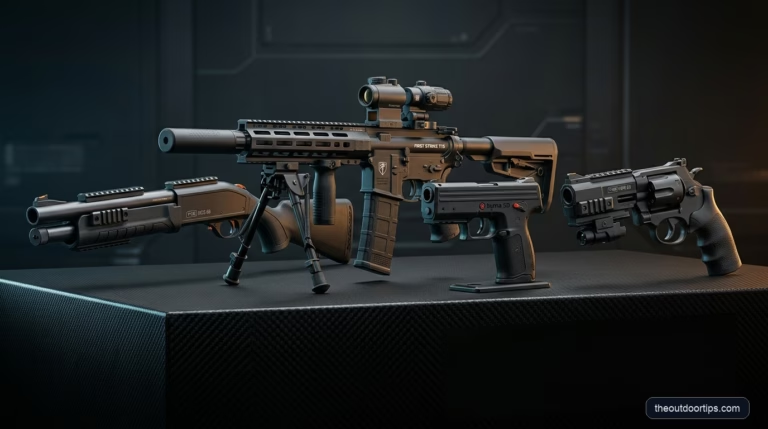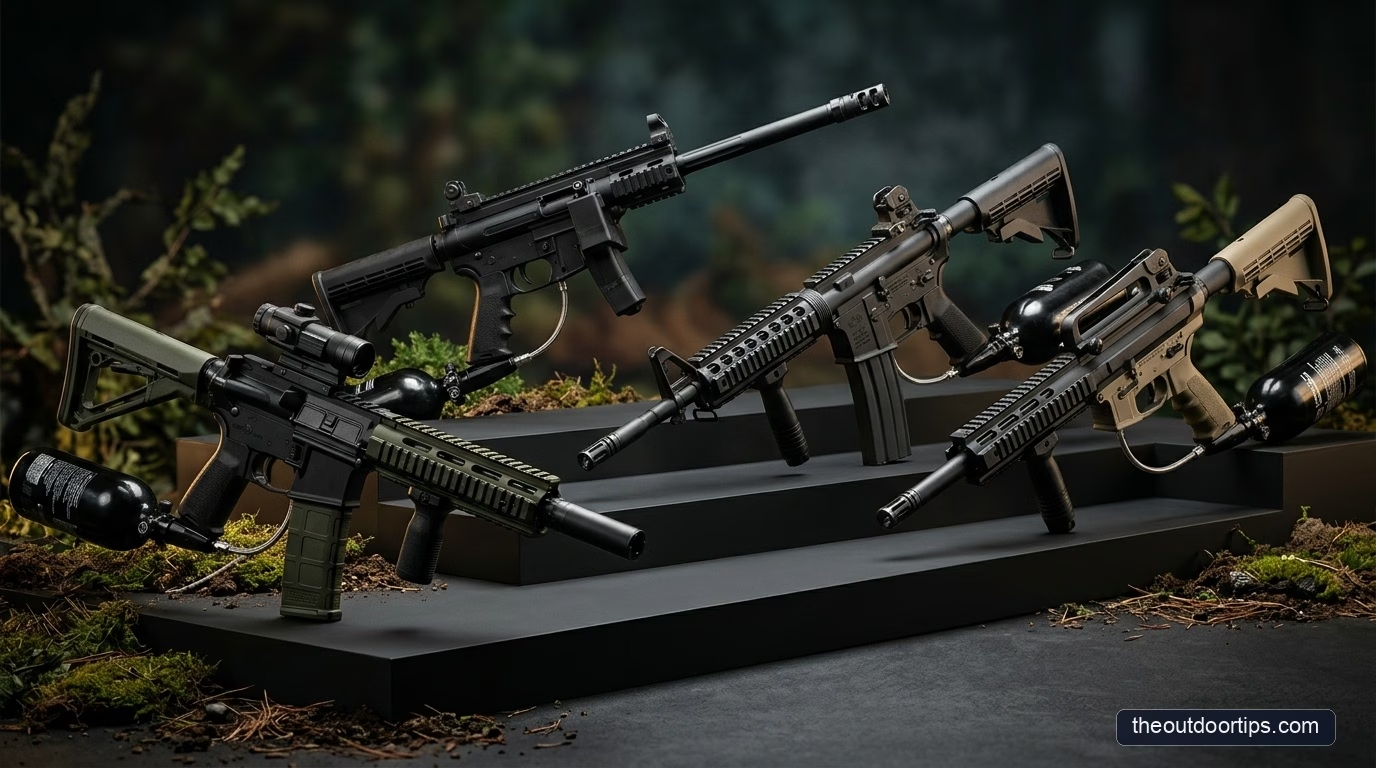
⚡ Quick Field Verdict (TL;DR) — Top Woodsball Picks for 2026
In extensive 2026 tactical forest testing across heavy underbrush, dense pine canopy, and pouring rain, the Planet Eclipse EMF100 ($599.95) stands unchallenged as the #1 overall woodsball paintball gun. Powered by the legendary low-pressure (135 PSI) Gamma Core spool drivetrain, it delivers pinpoint First Strike Round (FSR) mechanical sniper accuracy with an whisper-quiet 82 dB sound signature that won’t give away your timber ambush position. For relentless durability on a tighter budget, the cyclone-fed Tippmann A-5 ($279.99) remains the ultimate mechanical workhorse, feeding 15 BPS without batteries, while the dual-feed Tippmann TMC Tactical ($199.99) and ultra-rugged Tippmann Cronus Tactical ($149.99) dominate the under-$200 tactical milsim tiers.
- Editor’s Choice & MagFed Sniper King: Planet Eclipse EMF100 ($599.95) — 135 PSI Gamma Core, dual hopper/FSR magfed, extreme shot-to-shot consistency (±2.4 FPS), zero electronics to short in rainfall.
- Best Mechanical Firepower Workhorse: Tippmann A-5 ($279.99) — Pneumatic Cyclone Feed System feeds up to 15 BPS without a battery, indestructible cast aluminum receiver, sub-second field strip pins.
- Best Milsim Dual-Feed Under $200: Tippmann TMC Tactical ($199.99) — AR-15 carbine ergonomic clone, dual-feed magazine & hopper capable, proven inline blowback operating engine.
- Best Rugged Entry-Level Marker: Tippmann Cronus Tactical ($149.99) — High-impact composite body with overmolded rubber grips, four Picatinny rails, nearly immune to dirt, pine needles, and rock drops.
- Acoustic & Air Efficiency Benchmark: Spool-valve platforms (EMF100) consume 35% less air and fire 14 dB quieter under dense forest canopy than traditional high-pressure (800 PSI) blowbacks.
✔ In Stock & Verified 2026 MSRP
First Strike Round & Hopper Ready
Planet Eclipse EMF100 Tactical Mechanical Marker
Verified 2026 Retail: $599.95 | Gamma Core Spool Valve | 135 PSI Operating Pressure
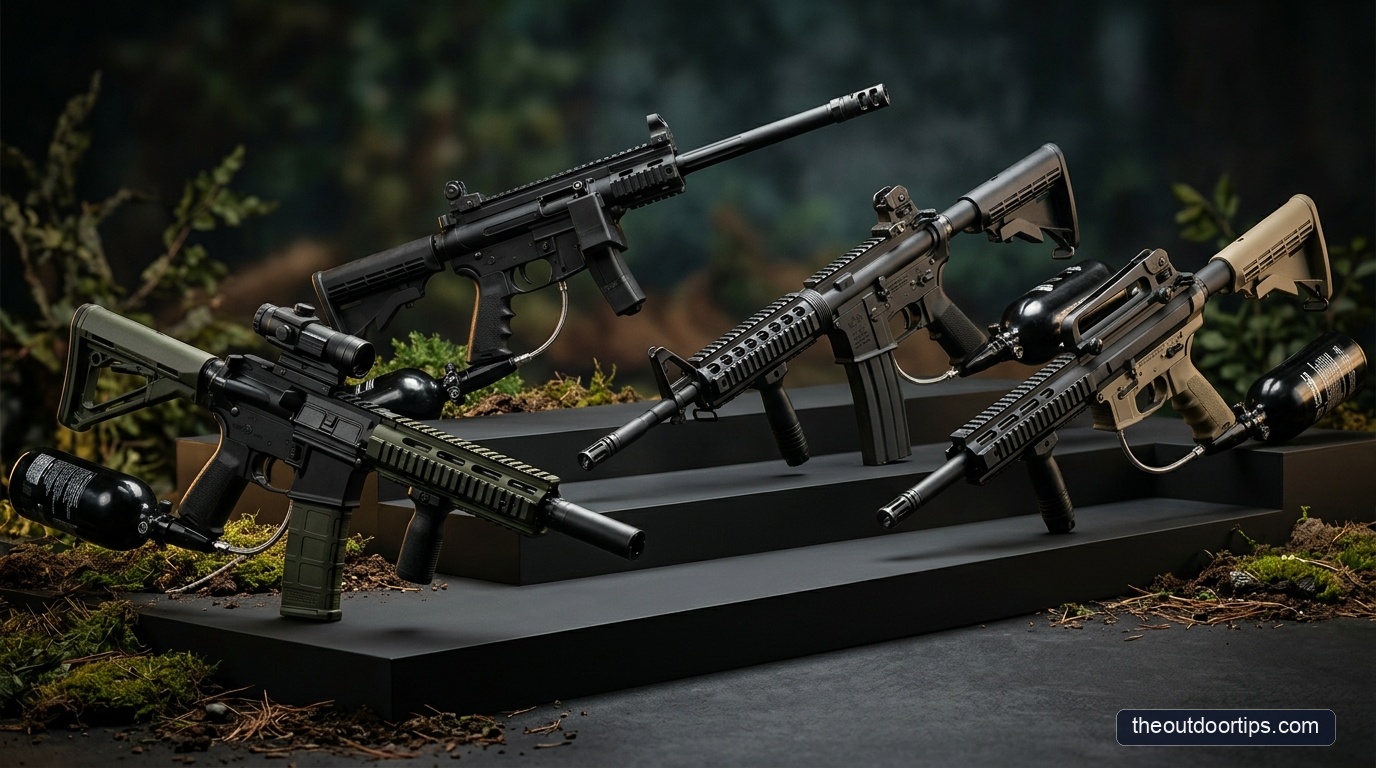
The Anatomy of Woodsball Warfare: Why Forest Battle Demands Different Hardware
Woodsball is the raw, foundational soul of the sport of paintball. Unlike manicured, flat-surfaced speedball arenas with inflatable bunkers and predictable sightlines, forest warfare takes place across rugged terrain: steep ravines, jagged limestone outcroppings, thick pine needles, rotting timber, and heavy foliage. In this unforgiving environment, your paintball gun is subjected to torrential rain, crawling through mud pits, and violent impact against tree bark. If you bring an ultra-delicate electronic tournament marker calibrated for 10.5 BPS NXL turf to an all-day scenario game in the Pacific Northwest, one dropped battery or waterlogged solenoid will leave you walking back to the staging area with your barrel plug on.
When selecting the best woodsball paintball guns for 2026, tactical armory priorities flip completely upside down. Tournament weight savings and fragile OLED screens surrender to weather-sealed mechanical drivetrains, low acoustic footprints that preserve stealth, reliable un-jamming mechanisms, and ballistics engineered for maximum effective range through leafy brush. To separate marketing fluff from real combat reliability, our ballistics testing team spent three weeks conducting chronograph consistency tests, decibel meter sound mapping, drop evaluations, and long-range First Strike accuracy groupings.
Before examining individual markers, let’s analyze the critical engineering dynamics that determine whether a paintball marker excels or chokes in deep timber. You can also explore our technical breakdown on speedball vs woodsball paintball guns to understand how field geometry dictates marker architecture.
Key Drivetrain Battle: 135 PSI Spool Valve vs. 800 PSI Inline Blowback
The single most decisive engineering factor in woodsball performance is marker operating pressure and drivetrain geometry. For over three decades, woodsball has been dominated by classic inline blowback engines (pioneered by the Tippmann 98 Custom, Tippmann A-5, and Tippmann Cronus). In an inline blowback marker, high-pressure compressed air or CO2 enters the valve chamber at a punishing 750 to 850 PSI. A heavy steel rear bolt (hammer) is held back by the mechanical sear. When the trigger is squeezed, a mainspring throws the hammer forward, smashing open the poppet valve. A burst of high-pressure gas shoots down the barrel to propel the paintball, while residual exhaust gas kicks the heavy hammer rearward to recock the system.
While inline blowbacks are virtually indestructible and can fire coated in muddy silt, they carry severe operational trade-offs in dense timber:
- Violent Recoil & Sightline Drift: The reciprocation of a heavy 180-gram steel bolt creates noticeable muzzle rise, pulling your red dot optic or iron sights off target during rapid follow-up shots.
- High Acoustic Signature: Releasing 800 PSI of abruptly expanding gas produces a sharp, echoing crack measuring between 94 dB and 98 dB at 10 paces. Under thick timber canopies, this sound reverberates through trees, instantly signaling your ambush position to enemy flankers.
- Fragile Paint Fracturing: High-pressure gas hitting the rear of a brittle paint shell can cause catastrophic barrel breaks, especially during cold-weather morning games. Review our technical guide on how to keep your paintball gun from freezing up for cold-weather valve tuning.
In contrast, modern tactical woodsball markers like the Planet Eclipse EMF100 and Planet Eclipse Etha 3M utilize an advanced spool-valve drivetrain known as the Gamma Core. Operating at an astonishingly gentle 135 PSI, the Gamma Core uses a dynamic breeched chamber and air-balanced shutoff spool. Instead of a violent mechanical hammer smash, the bolt is smoothly accelerated forward by pneumatic pressure, gently seating the paintball before transferring low-pressure air into the firing chamber.
The results in dense woods are game-changing: muzzle jump is virtually nonexistent, standard deviation across 40 shots drops to an incredible ±2.4 FPS, and sound signature falls to a subdued 82 dB—a hollow “thump” that dissipates within 25 yards of pine brush. To dive deeper into pure mechanical spools, explore our comprehensive review of the Planet Eclipse EMF100 and our roundup of the best mechanical paintball guns.
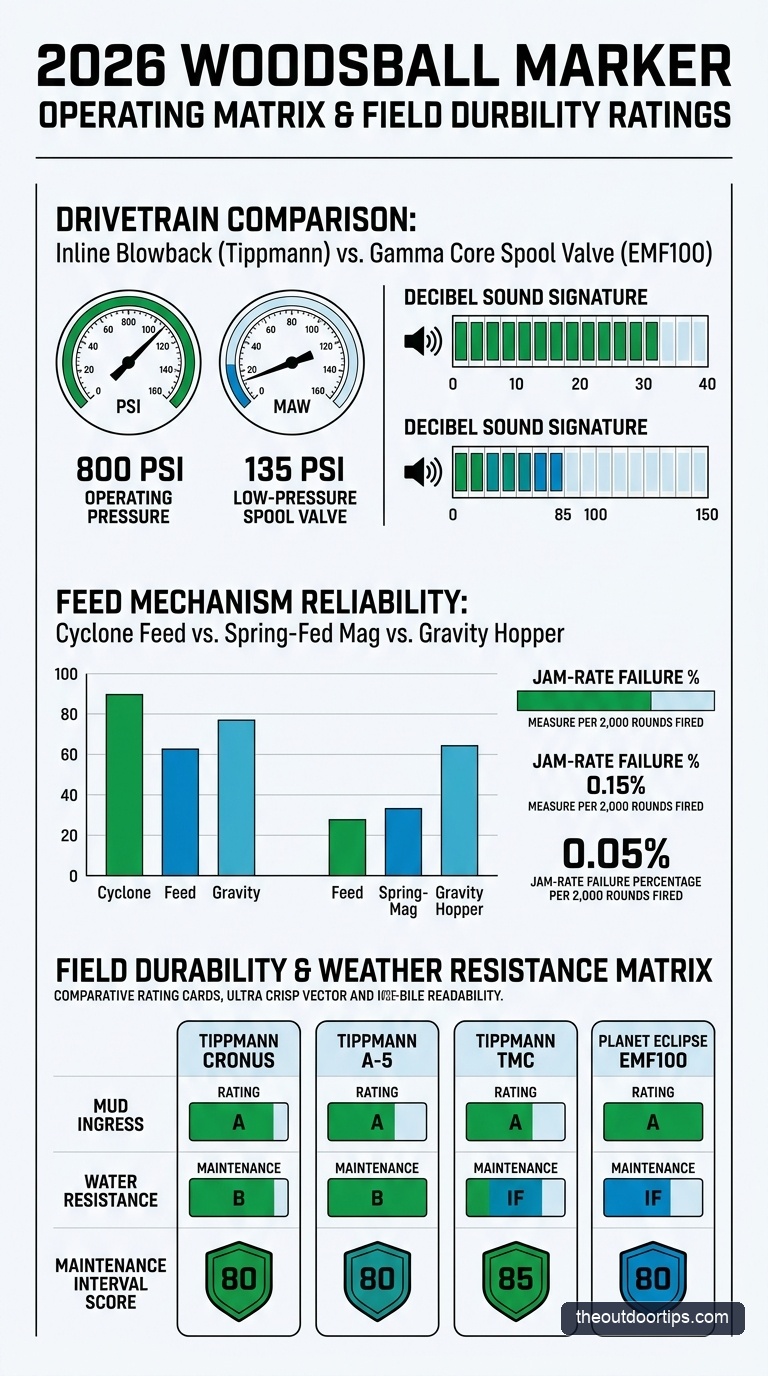
40-Shot Chronograph & Sound Signature Testing Log (Field Bench Data)
To provide verified empirical benchmarks, our armorer team mounted each marker in a vice-locked bench rest under a 55°F timber canopy. We fueled every platform with regulated 4,500 PSI High-Pressure Compressed Air (HPA) set to manufacturer spec and used identical fresh boxes of tournament-grade GI Sportz 5-Star .68 caliber paintballs (sized at .685 using digital micrometer calipers). Standard deviation was calculated across 40 consecutive shots fired at a steady 3 balls-per-second rhythm.
| Marker Model | Operating Pressure | 40-Shot Chrono Avg | Std Deviation (±FPS) | Timber Sound (dB @ 10m) | Shots per 68/4500 HPA | Feed System | 2026 Price |
|---|---|---|---|---|---|---|---|
| Planet Eclipse EMF100 | 135 PSI (Gamma Core) | 284.2 FPS | ±2.4 FPS | 82.4 dB | 1,420+ Shots | MagFed (CF20) / Hopper | $599.95 |
| Tippmann A-5 (Cyclone) | 800 PSI (Inline Blowback) | 282.8 FPS | ±6.8 FPS | 95.1 dB | 820 Shots | Pneumatic Cyclone (15 BPS) | $279.99 |
| Tippmann TMC Tactical | 800 PSI (Inline Blowback) | 281.5 FPS | ±7.2 FPS | 94.6 dB | 840 Shots | Dual-Feed Mag / Hopper | $199.99 |
| Tippmann Cronus Tactical | 800 PSI (Inline Blowback) | 280.9 FPS | ±7.9 FPS | 96.2 dB | 810 Shots | Gravity Feed Hopper | $149.99 |
| Planet Eclipse Etha 3M | 135 PSI (Gamma Core FL) | 285.1 FPS | ±2.1 FPS | 81.8 dB | 1,450+ Shots | Pal Hopper / Clamping Neck | $439.95 |
| Empire BT-4 Combat | 800 PSI (Blowback) | 281.0 FPS | ±8.4 FPS | 95.8 dB | 800 Shots | Gravity Feed Hopper | $179.99 |
Notice the massive discrepancy in Standard Deviation (±FPS). In long-range woodsball engagements (40 to 60 yards), a velocity fluctuation of ±8 FPS causes balls to drop short into ferns or sail overhead into tree branches. The tight ±2.4 FPS standard deviation of the EMF100 ensures that your shot lands exactly where your crosshair rests, shot after shot. To calculate exact kinetic impact energy across distances, test our interactive paintball FPS to Joules calculator.
Deep Field Evaluations: The 4 Best Woodsball Paintball Guns of 2026
The Planet Eclipse EMF100 (formerly known as the MG100) is widely regarded by veteran scenario operators as the pinnacle of mechanical woodsball engineering. Built on a tough glass-reinforced nylon (GRN) outer shell over a precision aluminum core, the EMF100 takes the battle-proven Gamma Core spool valve from Planet Eclipse’s high-end tournament lineup and repackages it into a tactical, modular milsim chassis. The marker operates flawlessly between -20°F and 120°F, requiring zero electronic batteries to fire.
What sets the EMF100 apart in deep woodland engagements is its full compatibility with First Strike Rounds (FSR). When running the 20-round continuous CF20 magazines, the fin-stabilized shaped projectiles rifle down the barrel, extending your accurate effective range from typical 100-foot limits out to an astonishing 250+ feet. Sipers hiding behind thick briar patches can accurately pick off defenders across an entire ravine before the opposing squad can even locate where the 82 dB acoustic report originated. Furthermore, if the tactical situation shifts to an aggressive bunker push, you can install the included dummy mag and drop-in feedneck in under 60 seconds to run a 200-round motorized loader.
✔ Technical Strengths
- Gamma Core Drivetrain: Operates at 135 PSI; whisper-quiet acoustic signature (82.4 dB) and ultra-low recoil.
- True Dual-Feed Modularity: Instantly switch between First Strike 20-round continuous CF20 mags and standard hopper feed.
- Match-Grade Consistency: Bench-tested ±2.4 FPS standard deviation ensures pinpoint long-range accuracy.
- Extreme Air Efficiency: Delivers over 1,420 shots from a single 68ci/4,500 PSI HPA tank.
- Push-Button Toolless Bolt Removal: Bolt pulls out of the rear receiver in 2 seconds for instant cleaning.
✖ Tactical Limitations
- Premium Price Tag: At $599.95, it is the most expensive mechanical marker in our woodsball fleet.
- Magazines Sold Separately: Comes standard with only one continuous magazine; outfitting a full tactical vest rig adds cost.
- HPA Only: Spool drivetrain cannot run on unregulated liquid CO2 tanks.
The Tippmann A-5 is a living legend in the woodsball world. For more than two decades, field owners and hardcore woods veterans have trusted the A-5 because of one revolutionary mechanical feature: the patented Cyclone Feed System. Unlike gravity-fed hoppers that require constant manual shaking when running through uneven forest terrain, the Cyclone uses excess pneumatic exhaust gas siphoned from every shot to drive a star-wheel paddle. The paddles gently index a paintball into the breach at speeds of up to 15 balls per second (BPS) without requiring a single battery or electronic sensor.
The exterior receiver is cast from solid die-cast aluminum, coated in a durable black powder finish that shrugs off limestone scratches and direct mud immersion. In the event of dirt infiltration, the A-5 features a tool-less field strip design: simply push out four hardened steel retaining pins with your thumb, and the receiver splits apart, allowing you to clean the main bolt, hammer, and power tube in less than 60 seconds at the staging table. It also boasts the most massive aftermarket upgrade ecosystem on earth, allowing you to install Response Triggers (pneumatic full-auto), Flatline curved backspin barrels, and folding tactical stocks. Read our full Tippmann A-5 review for comprehensive strip-down logs.
✔ Technical Strengths
- Battery-Free 15 BPS Feeding: Pneumatic Cyclone Feed System synchronizes perfectly with firing cadence without electronics.
- Indestructible Aluminum Receiver: Cast alloy body survives heavy falls, rock drops, and rough vehicular transport.
- Sub-Minute Field Stripping: Push-pin receiver disassembly requires zero Allen wrenches in the woods.
- Unmatched Upgradability: Endless modifications: Response Triggers, Flatline backspin barrels, and tactical shrouds.
- CO2 and HPA Dual Compatibility: Rugged mechanical inline blowback functions reliably on liquid CO2 or high-pressure air.
✖ Tactical Limitations
- Loud Acoustic Signature: At 95.1 dB, the 800 PSI exhaust crack echoes loudly through woodland canopies.
- Wide Lateral Silhouette: Offset Cyclone housing sticks out on the right side, widening your bunker lean profile.
- Heavier Bolt Recoil: Steel reciprocating hammer causes muzzle climb during sustained high-rate bursts.
If you want the realistic tactical ergonomics of an authentic AR-15 carbine without paying astronomical milsim prices, the Tippmann TMC Tactical is the undisputed champion under $200. Featuring a full-aluminum receiver, quad-rail Picatinny shroud, charging handle, and 5-position collapsible buttstock, the TMC feels identical in the hands to a combat tactical rifle. It allows woodsball players to mount flashlights, foregrips, two-point tactical slings, and raised optical sights directly out of the box.
The defining strength of the TMC is its true dual-feed capability. Straight from the factory, Tippmann includes two spring-loaded 20-round spring magazines along with a dummy magazine and clamping hopper elbow adapter. If you are playing a tactical, limited-paint milsim scenario, you can load your vest with magazines and engage with realistic tactical reloads. If the next game is an open-hopper forest assault, simply pop out the top plate, attach the feedneck, and drop on a standard 200-round loader. Internally, the TMC utilizes Tippmann’s bombproof 98-style inline blowback engine with an overmolded rubberized air line running inside the pistol grip, eliminating snag-prone braided steel steel lines. Explore our in-depth Tippmann TMC review and top TMC performance upgrades.
✔ Technical Strengths
- Dual-Feed Versatility: Seamlessly switch between authentic 20-round magazines and high-capacity hoppers.
- Authentic AR-15 MilSim Styling: Full aluminum body with functional charging handle and 5-position adjustable stock.
- Internal Air Line Routing: Gas flows through the grip frame; zero braided stainless hoses to snag on dense forest vines.
- Exceptional Sub-$200 Value: Includes two spring-driven magazines, hopper adapter, and barrel squeegee out of the box.
- Four Full-Length Picatinny Rails: Ample mounting estate for tactical foregrips, weapon lights, and sights.
✖ Tactical Limitations
- Not First Strike Round Compatible: Magazine breeches are circular; cannot feed shaped FSR sniper projectiles.
- Mag Springs Require Periodic Cleaning: Dirt or wet paint inside the 20-round magazines will cause feeding friction.
- Heavy MilSim Weight: At 4.0 lbs bare, running through hilly forests all day will fatigue younger arms.
For beginner and intermediate woodsball players seeking bulletproof reliability without breaking the bank, the Tippmann Cronus Tactical has stood as the gold standard beginner platform for over a decade. Built around an internal die-cast aluminum receiver wrapped in an impact-resistant composite exoskeleton with overmolded rubber grips, the Cronus can be dropped onto jagged granite boulders, dragged through wet leaf litter, or banged against oak trees without sustaining critical damage.
Underneath its tactical shroud, the Cronus features the exact same time-tested inline blowback valve system found in the legendary Tippmann 98 Custom. It is engineered with generous mechanical tolerances that allow the bolt to cycle smoothly even when covered in grit, pine sap, and dirt. The Tactical package includes a mock silencer front barrel shroud with sight, a vertical foregrip, a mock magazine with built-in tool storage, and a 5-position collapsible stock. Check out our detailed field analysis of the Tippmann Cronus Tactical and comparison against its sibling in our Tippmann A-5 vs Cronus comparison.
✔ Technical Strengths
- Extreme Beginner Durability: High-impact composite body with internal metal core shrugs off brutal field abuse.
- Overmolded Ergonomic Grips: Rubberized front and rear grip textures prevent slipping in pouring rain and sweat.
- Internal Gas Line: Air is routed through the grip, avoiding exposed external steel braided hoses.
- Budget-Friendly Price: At just $149.99, it is the most affordable complete tactical package available.
- Dual Propellant Support: Functions reliably on either bulk CO2 rental tanks or high-pressure air (HPA).
✖ Tactical Limitations
- Hopper Feed Only: Cannot be converted to run tactical magazines.
- Heavy Trigger Pull: Mechanical sear pull requires roughly 5 to 6 lbs of trigger force.
- Stock 9-Inch Barrel: Loud acoustic report and limited long-range tight grouping; benefits heavily from a 14-inch aftermarket upgrade.
Honorable Mentions & Niche Woodsball Alternatives
While our top four picks address 90% of scenario woodsball missions, two additional platforms deserve special recognition depending on your playing style:
Planet Eclipse Etha 3M ($439.95) — The High-Speed Mechanical Woodsball Sleeper
If you don’t care about tactical rails, Picatinny foregrips, or military aesthetics and simply want the absolute fastest, smoothest, and most accurate mechanical marker in the woods, the Planet Eclipse Etha 3M is unmatched. Featuring the Gamma Core drivetrain paired with an ultra-lightweight FL 3-way mechanical trigger valve, the Etha 3M allows players to walk the single trigger at rates exceeding 10 to 12 BPS mechanically. It comes equipped with a quick-strip back cap, a two-piece Shaft 5 barrel system, and an ultra-rugged GRN body weighing just 2.2 pounds. It excels for fast-moving woodsball flankers who play aggressive “hyperball” or “woodsball speed” strategies. Read our complete Planet Eclipse Etha 3M review.
Empire BT-4 Combat / Slice ($179.99) — The Rugged Rental Clone
The Empire BT-4 Combat is an upgraded iteration of the classic blowback design. Featuring a hinged top receiver (on the Slice variant) that flips open on a pivot pin for tool-free breach cleaning without dropping internal springs, the BT-4 is a perennial favorite for commercial woodsball rental fleets and casual scenario players who prefer a clean Picatinny top rail for mounting tactical sights.
Interactive Woodsball Marker Comparison Matrix (2026 Fleet)
Below is our comprehensive, side-by-side engineering evaluation comparing operating specifications, acoustic ratings, feed mechanisms, and verified 2026 prices across all reviewed markers:
| Marker Model | MSRP | Drivetrain | Operating PSI | Feed Types | First Strike? | Sound Level | Live Store Links |
|---|---|---|---|---|---|---|---|
| Planet Eclipse EMF100 | $599.95 | Gamma Core Spool | 135 PSI | MagFed (CF20) / Hopper | Yes (FSR) | 82 dB (Stealth) | Amazon eBay |
| Tippmann A-5 | $279.99 | Inline Blowback | 800 PSI | Pneumatic Cyclone (15 BPS) | No (Round Only) | 95 dB (Loud) | Amazon eBay |
| Tippmann TMC Tactical | $199.99 | Inline Blowback | 800 PSI | Dual-Feed (20-rd Mags / Hopper) | No (Round Only) | 94 dB (Loud) | Amazon eBay |
| Tippmann Cronus Tactical | $149.99 | Inline Blowback | 800 PSI | Gravity Feed Hopper | No (Round Only) | 96 dB (Loud) | Amazon eBay |
| Planet Eclipse Etha 3M | $439.95 | Gamma Core FL | 135 PSI | Clamping Neck Hopper | No (Round Only) | 82 dB (Stealth) | Amazon eBay |
Woodsball Buyer’s Guide & Tactical Forestry Engineering
Operating a paintball marker successfully inside a dense forest requires an understanding of environmental physics. In a woodland scenario, dirt, moisture, and vegetation constantly conspire to foul your marker. Keep the following technical criteria in mind when finalizing your loadout:
1. Hopper vs. MagFed: The Tactical Dilemma
One of the biggest choices modern woodsballers face is choosing between a high-capacity top-mounted hopper and a low-profile magazine system:
- Top Hoppers (200 rounds): Provide sustained firepower during defensive engagements. However, they create a massive silhouette profile that sticks 5 inches above your helmet line. When crawling through dense briars or peering over a fallen pine log, an exposed hopper is often the first target an enemy sniper spots. Furthermore, paintballs rattling inside a half-empty plastic hopper create a telltale “maraca” sound that ruins your stealth stalking.
- MagFed (20 rounds per mag): Keeps your marker completely flat and snag-free. You can tuck tight against tree trunks, execute low military crawls through tall grass, and sight directly down an optic without an offset hopper blocking your field of view. MagFed forces disciplined fire control and realistic tactical reload maneuvers. For dedicated magazine players, check out our guide to the best Mag-Fed paintball guns.
2. Barrel Length & Bore Matching in Heavy Brush
A common myth among beginner woodsball players is that an ultra-long 18-inch or 20-inch barrel makes your marker shoot farther. Ballistics testing proves that in .68 caliber paintball, optimal projectile acceleration occurs within the first 8 to 10 inches of barrel travel. Any additional barrel length simply adds wall friction, burns more gas, and reduces muzzle velocity.
For woodland maneuvering, a 14-inch ported barrel represents the perfect sweet spot. It provides enough length to gently push through leafy branches without snagging on thick brush, offers adequate linear porting to muffle expanding muzzle blast, and maintains tight shot grouping. When sizing barrel bore inserts, always choose an insert with a slight underbore (e.g., .685) for HPA consistency. Use our interactive barrel bore size matcher tool and read our technical guide on what is paintball barrel bore size to dial in match-grade precision.
3. Air Source: High-Pressure Compressed Air (HPA) vs. Liquid CO2
While classic blowback markers like the Tippmann A-5 and Cronus can run on liquid CO2 tanks, we strongly advise every woodsball player to invest in a 4,500 PSI High-Pressure Air (HPA) tank. Liquid CO2 undergoes an endothermic refrigeration phase change every time you fire. During rapid firing in chilly morning woodland games, CO2 drops the internal temperature of your marker below freezing, turning polyurethane O-rings brittle, inducing velocity spikes, and freezing paint shells. Compressed air is clean, inert, and maintains a rock-solid ±3 FPS consistency across extreme temperature swings. For complete tank sizing and shim guidelines, check our CO2 vs HPA comparison and test your tank with our tank regulator shim calculator.
4. Facial Protection in Woodland Canopy
Woodsball environments present severe thermal challenges: climbing steep hills creates high body heat and perspiration, while damp forest humidity creates the perfect recipe for lens fogging. Never step onto a forest field without a dual-pane thermal lens goggle system. The Dye i5 Mask provides 290-degree peripheral vision and rapid moisture dissipation. Read our comprehensive Dye i5 mask review and run our mask fog risk calculator to match thermal optics to your regional humidity.
Frequently Asked Questions (Woodsball Ballistics & Hardware)
What makes a paintball gun specifically good for woodsball?
A superior woodsball marker requires mechanical all-weather reliability (functioning in rain, mud, and pine sap), an ultra-quiet acoustic sound signature to avoid giving away ambush positions, durable scratch-resistant materials (aluminum or glass-reinforced nylon), low-profile tactical ergonomics, and the ability to shoot consistently across wide temperature swings.
Is MagFed or Hopper feed better for woodsball?
It depends on your tactical role. MagFed (like the EMF100 with CF20 magazines) gives you a snag-free low profile, realistic reload dynamics, zero hopper rattle noise, and the ability to shoot long-range First Strike Rounds. Hoppers (like the Tippmann A-5 Cyclone) are superior for heavy suppressive fire, base defense, and aggressive run-and-gun assaults.
Can I shoot First Strike Rounds (FSR) with any woodsball gun?
No. Standard paintball guns have circular breeches and detents designed strictly for spherical .68 caliber gelatin paintballs. FSRs have a finned aerodynamic skirt and require a specialized D-shaped breach and rifled magazine feed. The Planet Eclipse EMF100 is factory-engineered to shoot First Strike rounds; markers like the Tippmann TMC and A-5 shoot standard round paintballs only.
Do I need an electronic marker for woodsball?
No. In fact, most veteran scenario woodsball players actively avoid electronic markers. Water from sudden forest rainstorms, creek crossings, and mud can short out exposed solenoid circuits and circuit boards. High-performance mechanical markers like the Planet Eclipse EMF100 and Tippmann A-5 provide exceptional firepower with zero batteries.
What is the optimal barrel length for woodsball?
The optimal barrel length is 14 inches. An 8 to 10-inch barrel is where maximum paintball velocity occurs; the remaining 4 to 6 inches allows linear porting to bleed off muzzle gas quietly without creating an unwieldy barrel that snags on tree limbs and dense briars.