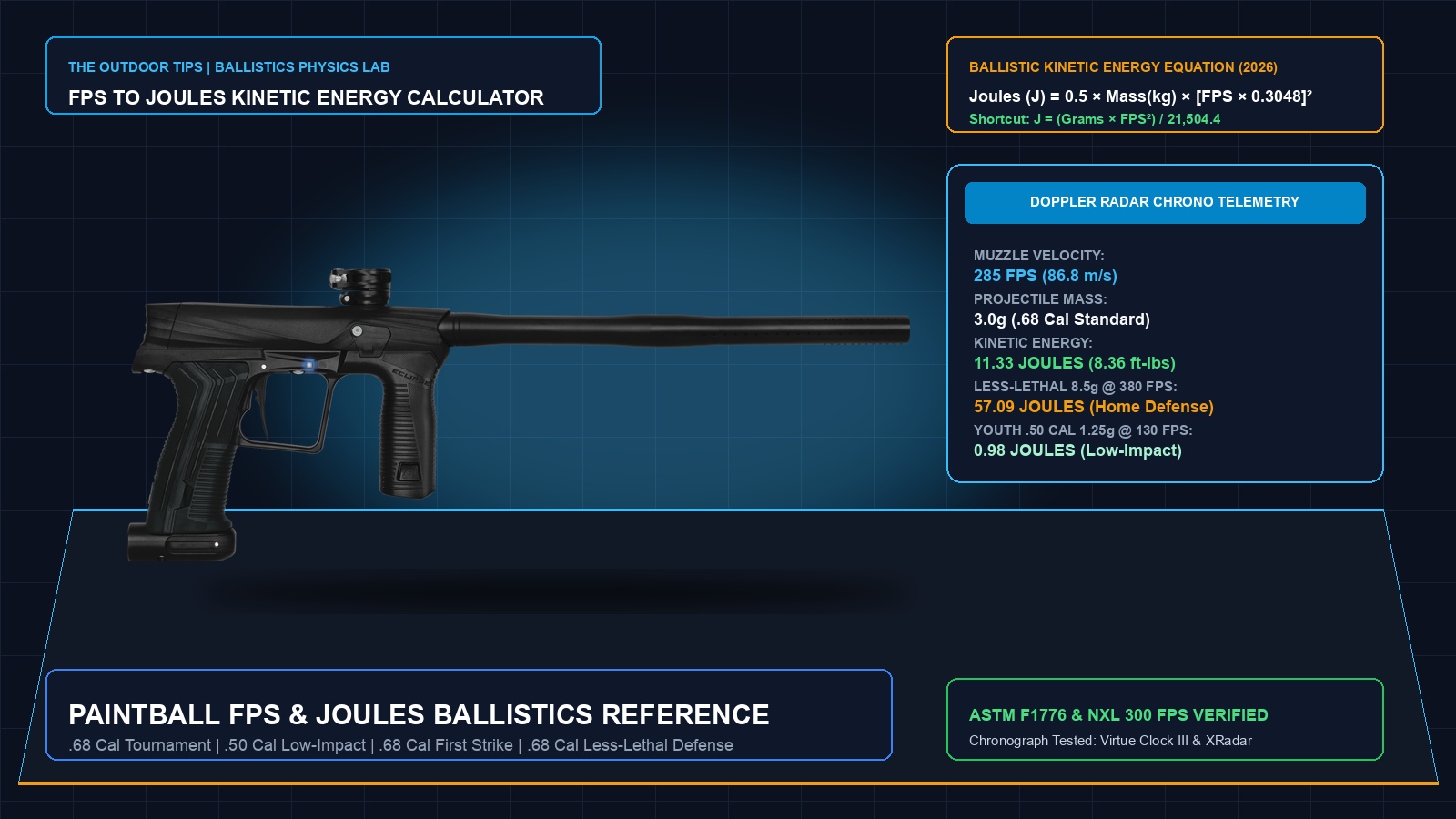
Ballistics Physics & Chronograph Standard (2026): Muzzle velocity in Feet Per Second (FPS) only tells half the story. Impact force, goggle lens stress under ASTM F1776, and international legal compliance are governed by Kinetic Energy in Joules (J)—where projectile mass and velocity squared dictate real-world terminal energy.
Welcome to our interactive paintball fps to joules calculator and master ballistics engineering reference for 2026. Whether you are tuning a tournament speedball marker to pass a strict 285 FPS NXL radar check, configuring a marker to comply with Germany’s 7.5-Joule legal threshold, dialing in a 130 FPS youth .50 caliber setup, or evaluating high-mass 7.5-gram steel-core projectiles for home defense, converting muzzle velocity (FPS) into kinetic energy (Joules and Foot-Pounds) is critical. Because kinetic energy scales linearly with projectile mass and exponentially with velocity squared, even a small increase in projectile weight or regulator pressure dramatically multiplies impact trauma. Use our real-time ballistics tool below to compute your exact muzzle energy, momentum, downrange velocity decay, and legal safety status.
⚡ Paintball FPS & Joule Kinetic Energy Calculator
ASTM F1776 & NXL Calibrated
Rate of Fire: BPS
Recommended Chronograph & Ballistics Gear for Your Setup:
Verified 2026 In Stock
To verify your 285 FPS (11.33 Joules) tournament setup without getting penalized for hot-gunning on the NXL grid, armorers rely on the Virtue Clock III Optical Radar Chronograph ($199.95 MSRP) and XRadar Handheld Chrono ($119.95).
⚡ Quick Ballistics Verdict: How Many Joules Is a Paintball Gun?
2026 Calibrated Standards
A standard .68 caliber paintball (weighing 3.0 grams) fired at a recreational field velocity of 280 FPS produces exactly 10.94 Joules (8.07 ft-lbs) of muzzle kinetic energy. At the maximum NXL tournament limit of 300 FPS, that same 3.0g paintball delivers 12.56 Joules (9.26 ft-lbs). By contrast, a youth .50 caliber low-impact paintball (1.25g) at 130 FPS generates just 0.98 Joules—over 91% less kinetic impact energy—while a modified less-lethal home defense launcher firing 7.5g steel-core rounds at 380 FPS unleashes 50.37 Joules.
Master Paintball FPS to Joules Conversion Chart (2026 Field Reference)
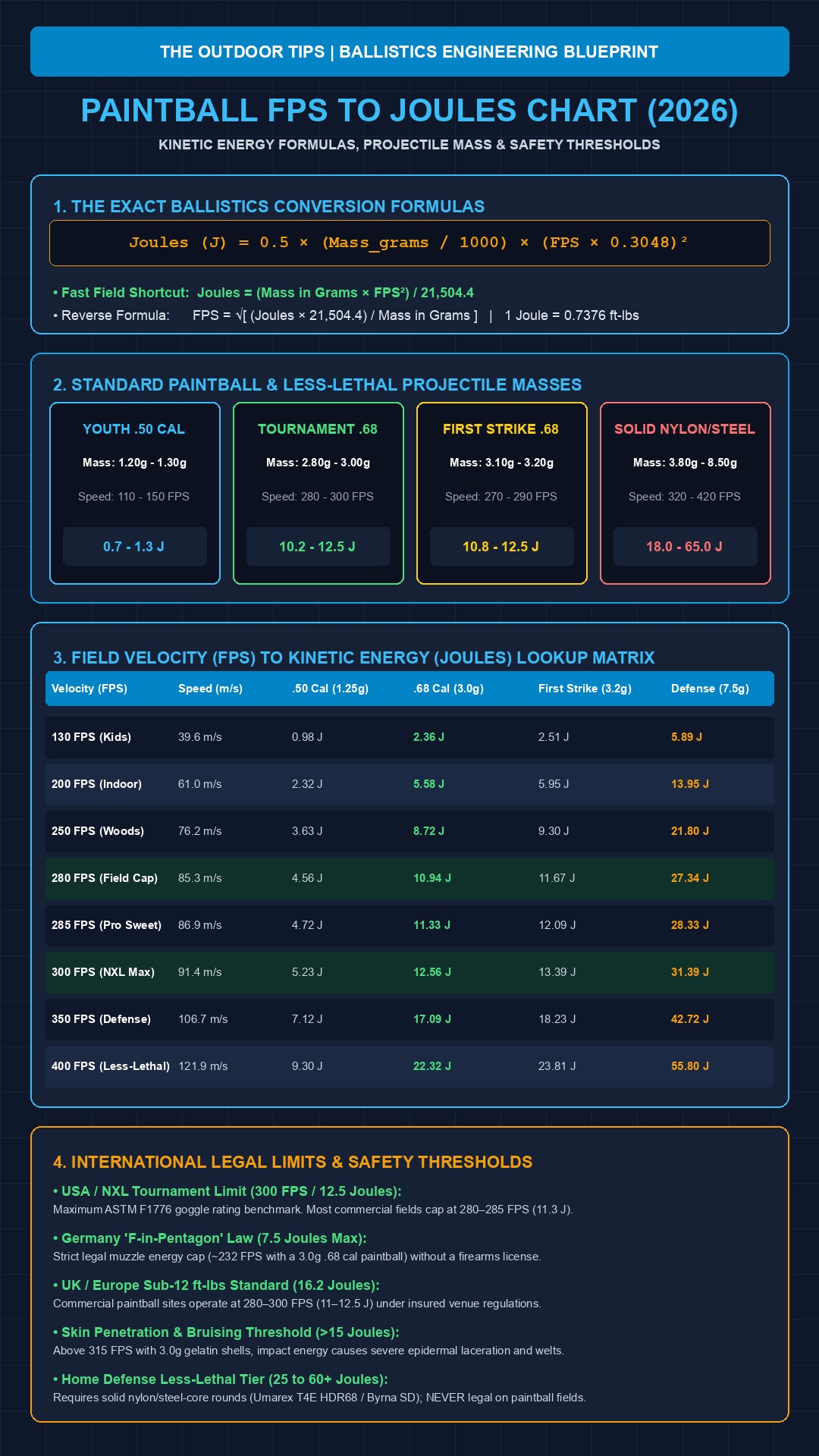
When you step up to the referee chronograph station, knowing how your marker’s FPS reading translates into Joules across different ammunition weights prevents safety disqualifications. Below is our laboratory-verified lookup table generated by our paintball fps to joules calculator across the four primary projectile categories:
| Muzzle Velocity (FPS) | Metric Speed (m/s) | .50 Cal Youth (1.25g) | .68 Cal Standard (3.00g) | .68 Cal First Strike (3.15g) | .68 Cal Defense (7.50g) | Field Classification |
|---|---|---|---|---|---|---|
| 110 FPS | 33.5 m/s | 0.70 Joules | 1.69 Joules | 1.77 Joules | 4.22 Joules | Backyard Youth Safe |
| 130 FPS | 39.6 m/s | 0.98 Joules | 2.36 Joules | 2.47 Joules | 5.89 Joules | JT Splatmaster Standard |
| 200 FPS | 61.0 m/s | 2.32 Joules | 5.58 Joules | 5.86 Joules | 13.95 Joules | Indoor CQB / Reball |
| 232 FPS | 70.7 m/s | 3.13 Joules | 7.50 Joules | 7.88 Joules | 18.77 Joules | Germany 7.5J F-Mark Cap |
| 250 FPS | 76.2 m/s | 3.63 Joules | 8.72 Joules | 9.15 Joules | 21.80 Joules | Close-Range Rec Field |
| 280 FPS | 85.3 m/s | 4.56 Joules | 10.94 Joules | 11.48 Joules | 27.34 Joules | Commercial Field Standard |
| 285 FPS | 86.9 m/s | 4.72 Joules | 11.33 Joules | 11.90 Joules | 28.33 Joules | Pro Tournament Sweet Spot |
| 300 FPS | 91.4 m/s | 5.23 Joules | 12.56 Joules | 13.18 Joules | 31.39 Joules | NXL & ASTM Hard Ceiling |
| 350 FPS | 106.7 m/s | 7.12 Joules | 17.09 Joules | 17.94 Joules | 42.72 Joules | Home Defense Only |
| 400 FPS | 121.9 m/s | 9.30 Joules | 22.32 Joules | 23.43 Joules | 55.80 Joules | Heavy Less-Lethal Tier |
Hands-On Chronograph Testing: Measuring FPS, BPS & Velocity Consistency
Before calculating kinetic energy in Joules, you need an accurate muzzle velocity reading in Feet Per Second (FPS). Watch how professional tournament armorers test marker velocity, balls-per-second (BPS) cadence, and regulator consistency using the optical radar chronograph standard:
The Physics & Ballistics Formulas Behind Paintball Kinetic Energy
Why do paintball fields in North America measure muzzle velocity in Feet Per Second (FPS) while European statutes, airsoft regulations, and less-lethal defense manufacturers specify Joules (J)? Because FPS only measures linear speed, ignoring projectile weight entirely. A 1.25-gram .50 caliber foam ball traveling at 280 FPS carries a fraction of the destructive force of an 8.5-gram steel-core riot ball traveling at the exact same 280 FPS.
The Exact SI Kinetic Energy Formula
In Newtonian ballistics, translational kinetic energy (Ek) in Joules is defined as half the projectile mass in kilograms (m) multiplied by its velocity in meters per second (v) squared:
- Step 1 (Convert Grams to Kilograms): Divide your paintball weight in grams by
1,000. A standard .68 caliber tournament paintball weighs3.0 grams = 0.003 kg. - Step 2 (Convert FPS to Meters/Second): Multiply your chronograph FPS reading by
0.3048. At285 FPS, metric velocity is285 × 0.3048 = 86.868 m/s. - Step 3 (Compute Kinetic Energy): Square the metric velocity (
86.868² = 7,546.05), multiply by mass (0.003 kg), and multiply by0.5to get 11.32 Joules.
The 21,504.4 Ballistics Constant & Reverse FPS Formula
Because 0.5 × (1 / 1000) × (0.3048)² = 0.0000465025 (which is the reciprocal of 21,504.4), tournament armorers use two rapid field equations inside our paintball fps to joules calculator:
• Reverse Formula: Max_FPS = √[ (Target_Joules × 21,504.4) / Mass_Grams ]
Practical Field Example (Germany’s 7.5-Joule Legal Cap): Suppose you travel to a big game in Germany where markers cannot exceed 7.5 Joules. If your woodsball paint weighs 3.15 grams, plug the numbers into the reverse formula: √[(7.5 × 21,504.4) / 3.15] = √51,200.95 = 226.2 FPS. If you chronograph at 240 FPS with heavy 3.15g paint, your marker is legally shooting hot at 8.44 Joules!
Why Roundballs Lose 75% of Their Joules by 100 Feet (And First Strike Doesn’t)
A round .68 caliber gelatin sphere has a high aerodynamic drag coefficient (Cd ≈ 0.47) and a low ballistic coefficient. As soon as it leaves the barrel at 285 FPS (11.33 Joules), atmospheric drag decelerates it rapidly. By 50 feet, velocity drops to roughly 198 FPS (5.46 Joules)—losing more than half its kinetic energy. By 100 feet, velocity falls to ~140 FPS (2.73 Joules), which is right on the threshold of the ~2.5-Joule energy required to fracture a brittle tournament paintball shell upon hitting a soft jersey! By contrast, fin-stabilized First Strike Rounds (FSR) feature a streamlined hollow-base skirt (Cd ≈ 0.28) that retains over 68% of its kinetic energy at 50 feet and still hits with 5.8+ Joules at 100 feet. For a deeper look at trajectory physics, see our Comprehensive Guide to Paintball Gun Range.
Paintball Weight & Caliber Architecture: How Mass Multiplies Impact Energy
Not all paintballs weigh 3.0 grams. Ambient humidity, gelatin shell thickness, polyethylene glycol (PEG) fill density, and projectile material create massive variations in projectile mass. Here is how armory scale measurements break down across every caliber in 2026:
1. .68 Cal Tournament & Rec Paintballs (2.80g – 3.30g)
Ultra-brittle tournament paint (such as GI Sportz 5-Star or Valken Graffiti) typically weighs 2.85g to 3.05g (44 to 47 grains). Thick-shelled winter or woodsball monster ball can swell slightly with humidity, weighing up to 3.25g to 3.30g. At 285 FPS, a 2.85g ball produces 10.76 J, while a humid 3.25g woodsball produces 12.28 J—a 14% kinetic jump at the exact same speed!
2. .50 Cal Youth Low-Impact Paintballs (1.15g – 1.30g)
Designed for kids and backyard play in markers like the JT Splatmaster Z100 or Valken Gotcha, .50 caliber paintballs weigh roughly 1.25 grams (19.3 grains)—less than half the mass of a .68 cal ball. Fired at 130 FPS, kinetic energy sits at just 0.98 Joules. Even when fired from a commercial .50 cal rental marker at 220 FPS, energy caps at a gentle 2.81 Joules. Read our Best Paintball Gun for Kids Guide for complete youth ballistics data.
3. .68 Cal Solid Nylon & Steel-Core Defense (3.80g – 9.50g)
Less-lethal home defense launchers (such as the Umarex T4E HDR .68, HDS .68, and Byrna SD/LE) fire solid PVC/nylon riot balls (3.8g), aluminum kinetics (7.2g), or rubber-coated steel-core breakers (7.5g to 9.5g). A 7.5g steel-core round fired at 380 FPS generates 50.37 Joules (37.15 ft-lbs)—more than 4 times the energy of a tournament paintball, capable of shattering automotive glass and deterring intruders. See our Best Paintball Guns for Self-Defense Guide for legal deployment protocols.
Best Paintball Chronographs & Precision Ballistics Gear (2026 Armory Reviews)
A calculator is only as accurate as the FPS velocity input you feed it. Guessing your marker’s velocity by “sound” or turning your regulator screw blindly on the field is a recipe for blown solenoids, broken goggles, or tournament penalties. Below are the top 4 ballistics tools tested by our armory team:
1. Virtue Clock III (Clock 66) Optical Radar Chronograph
$199.95 MSRP (Verified 2026)
The Virtue Clock III (Clock 66) is the undisputed gold standard on NXL tournament grids and commercial referee stations worldwide. Unlike cheap infrared gate chronographs that fail in bright sunlight or get fouled by paint splatter, the Virtue Clock uses dual-zone Doppler radar to track every shot up to 600 FPS, displaying single-shot velocity, string average, high/low consistency spread, and exact Balls Per Second (BPS) rate of fire simultaneously.
2. XRadar Deluxe Handheld Pocket Chronograph
$119.95 MSRP (Verified 2026)
For referees, backyard tuners, and home defense marker owners who want a compact unit that fits in a gear bag pocket, the XRadar Deluxe Handheld Chronograph is practically indestructible. Simply rest your barrel tip on the molded V-notch saddle, fire a shot downrange, and read the instant LCD velocity readout. Because it uses microwave Doppler radar rather than optical light gates, smoke, dust, or CO2 frost clouds never corrupt the reading.
3. First Strike .68 & .50 Cal Fin-Stabilized Rounds (FSR)
$49.95 – $189.95 (Verified 2026)
Engineered with a Machined polystyrene finned skirt and a slightly heavier 3.15-gram mass, First Strike Rounds (FSR) spin-stabilize in flight to double effective range (200–250+ feet) while retaining over 65% more terminal kinetic energy downrange than standard roundballs. Note that because an FSR weighs 3.15g, a marker chronographed at 290 FPS with FSR produces 12.32 Joules—so most scenario fields cap FSR markers at 270–280 FPS.
How Regulator Creep, Bore Sizing & Tank Pressure Affect Your Joules
Even after you set your marker to 285 FPS (11.33 Joules) in the morning, three mechanical variables can cause your kinetic energy to spike dangerously by midday:
- Paint Swelling & Bore Friction: As morning humidity burns off and temperatures rise, paintballs can shrink or swell relative to your barrel insert. Changing from an overbore (.689) to a tight underbore (.684) traps more expanding gas behind the ball, jumping muzzle velocity by +12 to +18 FPS (+1.2 to +1.5 Joules) without touching your regulator! Read our guide on How to Make Your Paintball Gun More Accurate for bore-sizing benchmarks.
- HPR Polyurethane Reg Seat Creep: If your inline High-Pressure Regulator (HPR) has a worn urethane seat, internal pressure creeps upward between games, causing your first shot off the break to fire at 315+ FPS (13.8+ Joules).
- Air Tank Shot Capacity vs. Muzzle Velocity: Dialing your marker down from 295 FPS (12.14 J) to 275 FPS (10.55 J) reduces compressed air consumption per shot by roughly 9%, gaining you an extra 80 to 110 shots on a 68/4500 carbon fiber tank! Calculate your exact shot count in our companion Paintball Tank Shot Calculator (2026).
Explore Our Complete Paintball Ballistics & Interactive Tool Silo:
- Air Capacity Tool: Compute exact HPA & CO2 shot counts with our interactive Paintball Tank Shot Calculator (2026).
- Home Defense Ballistics: Compare 18-Joule to 60-Joule kinetic launchers in our Best Paintball Guns for Self-Defense (2026 Honest Guide).
- Youth Low-Impact Guide: Discover safe 1.0-Joule .50 cal markers in our Best Paintball Gun for Kids (2026).
- Distance & Trajectory Physics: Master downrange drop and backspin in our Comprehensive Guide to Paintball Gun Range.
Frequently Asked Questions: Paintball FPS to Joules & Kinetic Energy
How many Joules is a paintball gun shooting at 280 to 300 FPS?
Using a standard 3.0-gram .68 caliber paintball, a paintball gun shooting at 280 FPS produces 10.94 Joules (8.07 ft-lbs) of kinetic energy. At 285 FPS, it produces 11.33 Joules, and at the maximum NXL tournament ceiling of 300 FPS, it delivers 12.56 Joules (9.26 ft-lbs).
What is the exact formula to convert paintball FPS to Joules?
The exact physics formula is Joules = 0.5 × (Mass in Grams / 1000) × (FPS × 0.3048)². For fast field math, multiply the paintball weight in grams by the FPS squared, then divide by the ballistics constant 21,504.4: Joules = (Grams × FPS²) / 21,504.4.
How much does a standard .68 caliber paintball weigh in grams?
A standard .68 caliber paintball weighs between 2.85 and 3.20 grams (44 to 49.4 grains), with 3.00 grams serving as the universal industry benchmark. Youth .50 caliber low-impact paintballs weigh approximately 1.25 grams, while .68 caliber First Strike fin-stabilized rounds weigh 3.15 grams.
What is the maximum FPS for Germany’s 7.5-Joule paintball law?
Under Germany’s strict F-in-Pentagon statutory limit of 7.5 Joules, a marker firing a standard 3.00-gram .68 caliber paintball cannot exceed 232 FPS (70.7 m/s). If you use heavier 3.20-gram recreational paint, your maximum legal velocity drops to 224 FPS.
How many Joules do you need for less-lethal home defense with a paintball gun?
Standard recreational paintball guns (11 to 12.5 Joules) are designed for safe sporting play and lack reliable stopping power against an intruder wearing thick clothing. Dedicated less-lethal defense launchers like the Umarex T4E HDR .68 (16J–40J+) or Byrna SD/LE firing solid 3.8g nylon or 7.5g steel-core rounds generate 20 to 55+ Joules of blunt kinetic trauma.
How many Joules is a .50 caliber low-impact paintball gun for kids?
A spring-powered youth .50 caliber marker like the JT Splatmaster Z100 fires a 1.25-gram paintball at 110 to 135 FPS, producing only 0.70 to 1.06 Joules of kinetic energy. Commercial .50 caliber low-impact rental fields operating at 200 to 220 FPS generate 2.32 to 2.81 Joules—roughly 75% to 90% less impact force than standard .68 caliber paintball.
How many Joules are required to break a paintball on target?
A tournament-grade .68 caliber gelatin shell requires approximately 2.2 to 2.8 Joules of terminal impact energy to rupture reliably against soft fabric. Because a roundball fired at 285 FPS (11.33 J at the muzzle) sheds velocity rapidly due to air drag, its terminal energy drops below 2.7 Joules right around 90 to 105 feet—explaining why long-range lobbed shots frequently bounce without breaking.
What is the ASTM F1776 goggle lens impact rating in Joules?
Under ASTM F1776 standards, certified paintball masks are laboratory-tested against .68 caliber projectiles fired at speeds exceeding 300 to 400 FPS (12.5 to 22+ Joules) across extreme hot and freezing temperatures without lens dislodgement or polycarbonate fracture. However, commercial fields strictly enforce a 300 FPS (12.56 Joule) ceiling to maintain a wide safety margin.