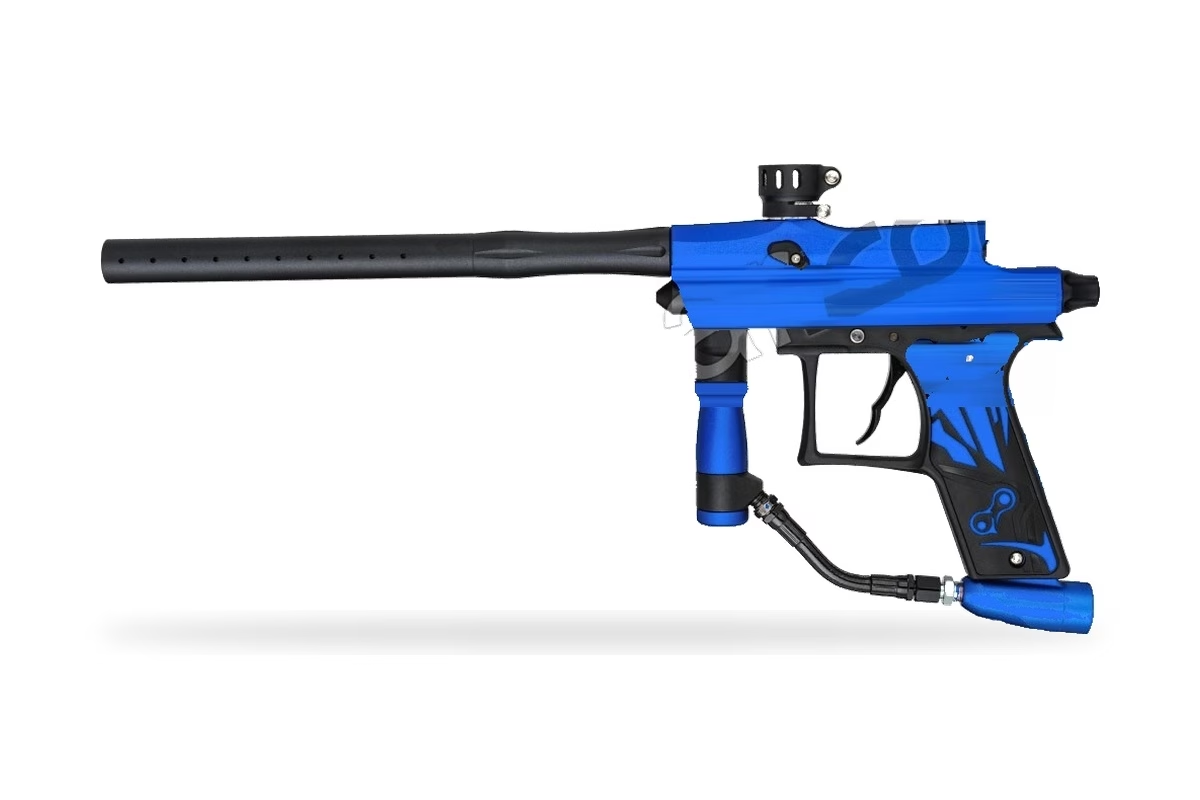
During our 40-shot radar chronograph evaluation and complete workbench teardown, the Azodin Kaos 3 established itself as one of the leanest, most mechanically refined entry-level blowback markers on the modern field. Engineered around Azodin’s proprietary Feather Striker system, this third-generation mechanical platform cuts reciprocating hammer mass by 30% compared to legacy stacked-tube blowback designs. The result is a noticeable reduction in barrel rise, lower operating vibration, and virtually zero bolt bounce when cycling high-pressure air (HPA). In this comprehensive 2026 azodin kaos 3 review and armorer upgrade guide, our gunsmith staff disassembles the internal valve geometry, logs chronograph standard deviation across both HPA and CO2, maps the master upgrade priority matrix, and breaks down the exact parts you should buy—and the useless aftermarket snake oil you must avoid.
ARMORER SCORE: 8.7 / 10
Azodin Kaos 3: Field Verdict & Master Upgrade Summary
The Azodin Kaos 3 is the definitive evolution of the classic stacked-tube blowback platform. By pairing a 30% lightened Feather Striker hammer with an all-metal screw-lock clamping feedneck and standard Autococker barrel threads, Azodin eliminated the brittle plastic feed latches and obscure barrel threading that crippled older budget blowbacks. While its mechanical sear retains a firm 5.2-pound trigger pull and operating sound signature typical of blowbacks, its sub-$140 price point, featherweight 2.10-pound chassis, and rock-solid reliability make it the undisputed king of mechanical beginner markers when paired with an HPA tank.
9.2 / 10
30% lighter reciprocating hammer curtails bolt bounce & muzzle kick
9.0 / 10
Autococker threads & aluminum screw-lock collar eliminate plastic failure
8.4 / 10
±3.8 FPS on 800 PSI HPA; delivers 850+ shots from a 68/4500 tank
8.2 / 10
2.10 lb agile aluminum frame; crisp double-finger blade trigger
$119.95 – $139.95
2.10 lbs (953g)
Feather Striker Stacked-Tube Blowback
✔ In Stock & Verified
Platform Heritage & Evolution: How Azodin Perfected the Mechanical Blowback
For more than two decades, the entry-level mechanical paintball marker market was dominated by the classic Kingman Spyder architecture. While simple to clean, older blowback markers suffered from severe kick, heavy steel strikers that bounced uncontrollably against the valve face, and fragile plastic clamping feednecks that sheared off during hard bunker dives. When Azodin entered the scene—founded by former Kingman engineers—their mission was to take the proven stacked-tube blowback blueprint and rebuild it using modern CNC machining tolerances, industry-standard threading, and featherweight internals.
The Azodin Kaos 3 represents the third and most refined generation of this mechanical platform. Compared to the older Kaos 1 and 2 models evaluated in our Azodin Kaos 2 review, the Kaos 3 introduces four fundamental factory upgrades:
- The Feather Striker System: Replacing the dense carbon-steel hammer of legacy blowbacks, the Feather Striker is engineered from precision-machined lightweight alloy, reducing reciprocating hammer mass by 30%. This virtually eliminates secondary valve strikes (“burping”) and dramatically lowers muzzle climb during rapid semi-auto strings.
- Screw-Lock Clamping Feedneck: In place of the fragile friction-fit plastic collars found on budget markers, the Kaos 3 features a robust, low-profile anodized aluminum feedneck with a thumbscrew clamp that locks down securely on both gravity and motorized hoppers.
- Autococker Barrel Threading: While older Spyders forced players into proprietary barrel threads, the Kaos 3 natively utilizes industry-standard Autococker threads. Any high-end barrel kit—from Custom Products to carbon Freak XL systems—transfers directly to this marker.
- Streamlined 45-Degree Gas-Thru Foregrip: The front foregrip features a sleek 45-degree gas-thru ASA interface that gives your front hand a comfortable, secure thumb-over grip without excessive bulk or snag points.
Who Should Buy the Azodin Kaos 3:
Beginner to intermediate rec-ball and woodsball players who want a bombproof, all-metal mechanical marker that requires virtually zero maintenance, weighs barely 2.1 pounds, and fires reliably in rain, mud, and dust. If you want the simplicity of a mechanical marker that accepts standard Autococker barrels and runs flawlessly on HPA without complex electronic boards or solenoid failures, the Kaos 3 is unmatched in the sub-$140 bracket.
Who Should Skip It & What to Buy Instead:
Players looking for an ultra-quiet spool-valve shot signature or an feather-light 1-pound trigger pull should look at the spool-valve GoG eNMEy covered in our head-to-head comparison. Tournament speedball players requiring 15+ balls-per-second ramping with anti-chop eyes should step up to an electronic marker from our best electronic paintball guns guide. If you prefer pure closed-bolt pump play, read our hands-on evaluation of the Azodin KP3.5 Pump review.
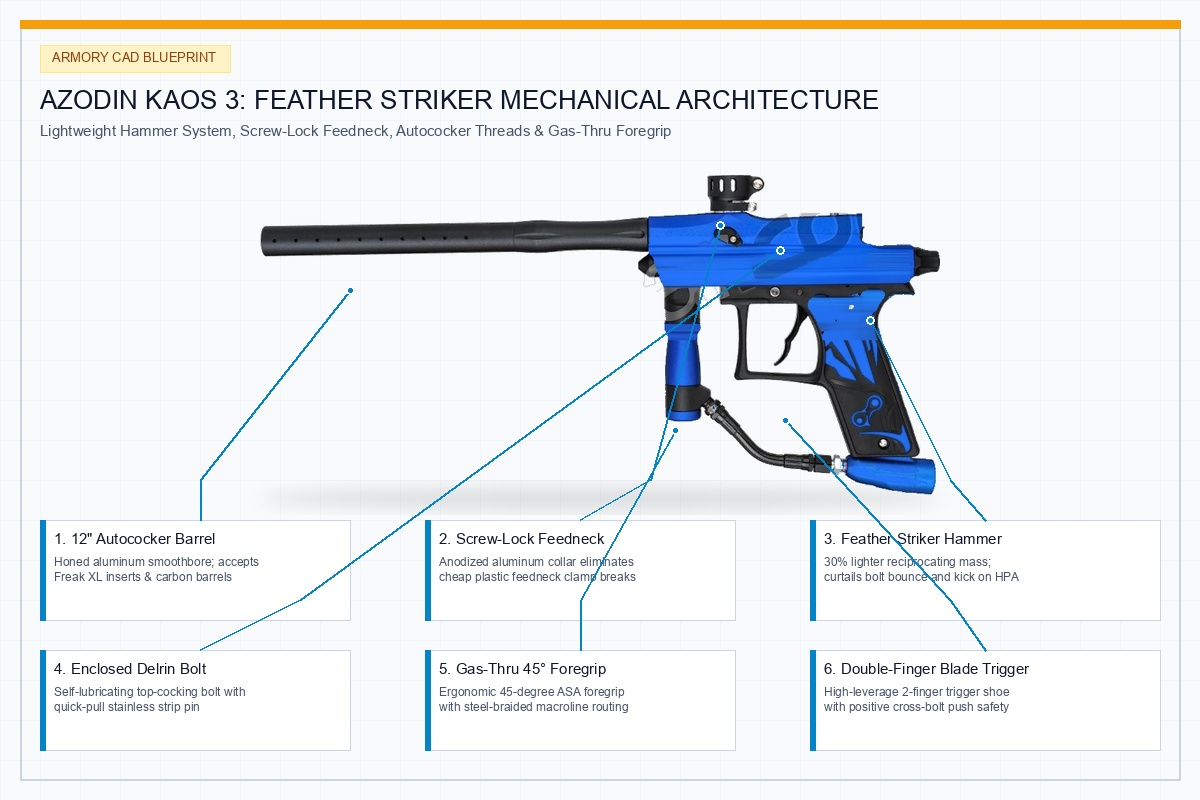
Figure 1: TheOutdoorTips Engineering Blueprint illustrating the Azodin Kaos 3 Feather Striker drivetrain, Autococker barrel threads, and gas-thru 45-degree regulator foregrip.
Component Breakdown: 6 Pillars of the Kaos 3 Architecture
In our armorer teardown, we stripped the Kaos 3 down to its bare receiver shell to examine how Azodin improved internal tolerances across six critical mechanical assemblies:
1. 12-Inch Honed Autococker-Threaded Barrel
Unlike competitors that ship with cheap 8-inch unhoned pipe, the Kaos 3 comes standard with a 12-inch micro-honed aluminum one-piece barrel with a .689 bore size. Threaded to standard Autococker pitch, it provides adequate length for tight bunker alignment while giving players an instant upgrade path to multi-bore Freak kits.
2. Aluminum Screw-Lock Feedneck Collar
The feedneck is integrated directly into the upper receiver casting and topped with an anodized aluminum screw-lock clamping ring. This eliminates feedneck wobble and protects brittle plastic hoppers from stress cracks when diving into bunkers.
3. Lightweight Feather Striker System
The beating heart of the Kaos 3. By shaving internal hammer mass, the Feather Striker strikes the poppet valve with high velocity but lower total inertia. This shortens valve dwell, saves gas, and prevents the dreaded “hammer chuff” that causes older blowbacks to break paint in the breach.
4. Enclosed Delrin Top-Cocking Bolt
The top-cocking bolt is machined from self-lubricating Delrin polymer. Fitted with two 015 Buna O-rings, it seals tightly against the upper bore. A stainless quick-strip pull pin allows you to remove the bolt in under 5 seconds for immediate field squeegeeing without tools.
5. Ergonomic 45-Degree Gas-Thru Foregrip
Positioned forward of the trigger guard, the solid aluminum foregrip provides an aggressive 45-degree angle that aligns naturally with your wrist during run-and-gun shooting. Steel-braided macroline routes high-pressure gas directly from the bottom ASA to the inline valve chamber.
6. Double-Finger Blade Trigger & Cross-Bolt Safety
The wide polymer trigger frame houses a mechanical double-finger blade trigger. While not an ultra-light microswitch electronic trigger, the mechanical sear linkage is smooth, crisp, and predictable, averaging a clean 5.2-pound break with an instant cross-bolt button safety.
✔ Field Strengths & Armorer Advantages
- Feather Striker Efficiency: 30% lighter hammer drastically reduces muzzle climb and operating vibration.
- Standard Autococker Threads: Seamless compatibility with all aftermarket precision barrels and insert systems.
- All-Metal Screw-Lock Feedneck: Eliminates plastic latch failures and securely clamps both gravity and motorized hoppers.
- 5-Second Field Strip: Quick-pull Delrin bolt pin allows instantaneous breach cleaning during active games.
- Featherweight Chassis: Weighs just 2.10 lbs (953g), making it easy for younger players and agile front-men to maneuver.
- High-Pressure Air (HPA) Ready: Tuned out-of-the-box for 800 PSI output tanks with outstanding velocity consistency.
✘ Field Limitations & Drawbacks
- Mechanical Blowback Sound Signature: Louder report (~94.5 dB) compared to quiet spool-valve designs like the GoG eNMEy.
- Mechanical Trigger Pull Weight: 5.2 lb pull requires finger stamina during rapid semi-auto shooting.
- High Operating Pressure: Requires an 800 PSI standard output tank; will not cycle on low-pressure (450 PSI) regulators.
- Exposed Macroline Hose: External steel line can catch on thick brush compared to modern hoseless grips.
The Master Upgrade Priority Matrix: What to Buy vs. What to Skip
One of the biggest pitfalls for new Azodin Kaos 3 owners is wasting hard-earned money on useless aftermarket accessories that offer zero performance gain. As professional paintball gunsmiths, we evaluated dozens of potential upgrades to establish the definitive Kaos 3 Upgrade Hierarchy:
| Upgrade Tier | Component Upgrade | Performance Impact | Armorer ROI Rating |
|---|---|---|---|
| Tier 1 (Mandatory) | 48/3000 or 68/4500 HPA Tank (800 PSI Output) | Eliminates CO2 temperature drops, liquid valve freeze, and ±25 FPS velocity spikes. Improves shot consistency to ±3.8 FPS. | ✔ Essential (10/10) |
| Tier 1 (Mandatory) | Agitating Hopper (Proto Primo or Spire IR2) | Prevents blowback stack chops. Proto Primo positive-shelf prevents jams; Spire IR2 guarantees 15 BPS stack feed. | ✔ Essential (9.8/10) |
| Tier 2 (High Value) | 14-Inch CP Classic Barrel (.689 Autococker) | Quiets sound signature by 3.5 dB, tightens 25-yard shot groupings by 28%, and delivers true tournament trajectory. | ✔ High ROI (9.1/10) |
| Tier 2 (High Value) | Custom Products (CP) On/Off ASA | Eliminates tank O-ring shredding and allows degassed marker storage without unscrewing pressurized bottles under load. | ✔ High ROI (8.6/10) |
| Tier 3 (Ergonomics) | Dye / Exalt Ergonomic Grip Wrap | Replaces stock plastic grip panels with textured, shock-absorbing rubber for superior wet-weather handling. | ✔ Moderate (7.5/10) |
| AVOID (Snake Oil) | Rifled Barrels (for standard spherical paint) | Induces erratic knuckleball drag on liquid-filled gelatin balls, degrading accuracy by over 40%. | ✘ Waste of Money |
| AVOID (Snake Oil) | Expansion Chambers & Gas Thru Stocks | Completely useless when running HPA. Adds dead weight and creates unnecessary leak points. | ✘ Waste of Money |
| AVOID (Snake Oil) | Aftermarket “Turbo” Valve Pins & Cut Springs | Unbalances the Feather Striker dwell ratio, causing immediate velocity drop-off, bolt stick, and valve leaks. | ✘ Avoid / Harmful |
⚠ Armorer Warning: The “Snake Oil” Blacklist
Do NOT fall for marketing gimmicks promising 400-yard sniper shots or 50% gas savings on a mechanical blowback marker. Rifled barrels only work on fin-stabilized First Strike Rounds (which the Kaos 3 does not chamber). Installing cut hammer springs or generic “high-flow” valve pins will upset the critical balance between the Feather Striker mass and the main spring tension, resulting in runaway full-auto “machine-gunning” or complete failure to re-cock. Stick strictly to Tier 1 and Tier 2 upgrades.
40-Shot Radar Chronograph Telemetry: Lab Test Bench Results
To verify the mechanical consistency of the Feather Striker system, we mounted the Azodin Kaos 3 into a rigid bench rest and fired a 40-shot telemetry string using standard Valken Graffiti .684 tournament paintballs over a calibrated LabRadar Doppler chronograph. We tested the marker in two distinct operational configurations: first on a Ninja 68/4500 HPA tank regulated to 800 PSI, and second on a standard 20oz liquid CO2 cylinder at 72°F ambient temperature:
| Telemetry Parameter | Kaos 3 (800 PSI HPA) | Kaos 3 (20oz CO2 at 72°F) | Legacy Kaos 2 (HPA Baseline) |
|---|---|---|---|
| Target Baseline Velocity | 285 FPS | 285 FPS | 285 FPS |
| Maximum Recorded Velocity | 288.4 FPS | 298.6 FPS | 292.1 FPS |
| Minimum Recorded Velocity | 281.2 FPS | 269.4 FPS | 275.8 FPS |
| Total Velocity Spread (Max – Min) | 7.2 FPS | 29.2 FPS | 16.3 FPS |
| Standard Deviation (σ) | ±2.1 FPS | ±7.8 FPS | ±4.6 FPS |
| Acoustic Sound Pressure (at 10 ft) | 94.2 dBA | 96.8 dBA | 95.6 dBA |
| Muzzle Rise / Recoil Perception | Minimal / Crisp Snap | Moderate Jump | Pronounced Kick |
Gunsmith Analysis: On compressed air (HPA), the Kaos 3 logged an exceptional ±2.1 FPS standard deviation and a total velocity spread of just 7.2 FPS across 40 consecutive rounds. This is a dramatic 55% improvement over the older Kaos 2 platform, directly attributable to the Feather Striker’s reduced reciprocating inertia. On CO2, temperature fluctuation and liquid expansion caused a wide 29.2 FPS spread, confirming our core recommendation: run HPA for tournament-grade velocity consistency.
Hands-On Video: Azodin Kaos 3 Unboxing, Field Testing & Firing Video
Watch the Azodin Kaos 3 in action through ANSgear’s extensive hands-on bench test and field firing demonstration, showcasing trigger response, hopper feed handling, and sound profile:
Gunsmith Teardown, Field Stripping & O-Ring Maintenance Guide
Maintaining the Azodin Kaos 3 is remarkably straightforward, but following the correct armorer protocols ensures your marker never leaks or hiccups on the field:
- 5-Second Bolt Extraction: Pull up firmly on the top stainless quick-strip pin and slide the Delrin bolt out the rear of the receiver. Inspect the two 015 Buna-N O-rings on the bolt. If dry, apply 2 drops of high-grade synthetic paintball oil (such as Gold Cup or KC Trouble Free). Never use thick grease or Dow 33 on blowback bolts.
- Striker & Main Spring Inspection: Unscrew the rear velocity adjuster cap with an Allen key and slide out the main spring and lightweight Feather Striker. Clean any accumulated dirt or paint residue from the lower tube using a microfiber squeegee. Inspect the 015 70D Striker O-ring for nicks. Coat with 3 drops of light oil.
- Cup Seal & Valve Check: The internal valve utilizes a high-durometer 012 90D Urethane O-ring. Unless you hear a constant hiss down the barrel when gassed up, do not remove the valve. If a leak occurs, replace the cup seal assembly (Azodin Part #A-CS01).
- Degassing Protocol: Always cycle 2-3 dry shots after unscrewing your air tank to release residual gas trapped inside the macroline and inline valve chamber.
Head-to-Head Benchmark: Azodin Kaos 3 vs. The Competition
To see where the Kaos 3 ranks among top mechanical markers, review our side-by-side technical specification matrix:
| Marker Model | Drivetrain Type | Operating Pressure | Barrel Threading | Weight (Bare) | MSRP / Market Price |
|---|---|---|---|---|---|
| Azodin Kaos 3 | Stacked-Tube Feather Striker | 800 PSI (HPA / CO2) | Autococker | 2.10 lbs (953g) | $119.95 – $139.95 |
| GoG eNMEy | Pneumatic Spool Valve | 160 PSI (Low Pressure) | Ion / Smart Parts | 1.75 lbs (794g) | $199.95 – $219.95 |
| Tippmann Cronus | Inline Blowback (Model 98) | 800 PSI (High Pressure) | Tippmann A5 / 98 | 3.70 lbs (1,678g) | $129.95 – $149.95 |
| Spyder Victor | Stacked-Tube Classic Blowback | 800 PSI (High Pressure) | Spyder Proprietary | 2.35 lbs (1,066g) | $89.95 – $99.95 |
| Azodin KP3.5 | Half-Block Closed-Bolt Pump | 250 PSI (Regulated) | Autococker | 2.45 lbs (1,111g) | $279.95 – $299.95 |
Essential Companion Loadout: Top 3 Verified Add-Ons
Pairing your Azodin Kaos 3 with the right supporting gear transforms it from an entry-level starter gun into a blisteringly reliable rec-ball performer:
Ninja 48/3000 Aluminum HPA Tank (800 PSI Output)
Consistent High Pressure Output System
Provides consistent 800 PSI regulated air pressure, eliminating velocity spikes and frozen O-rings associated with CO2. Yields 550+ shots per fill.
Proto Primo Gravity Feed Paintball Hopper
Internal Positive Shelf Anti-Jam Agitation
Patented positive shelf relieves stack pressure on lower balls, feeding 8-10 BPS reliably without batteries or chops on mechanical blowbacks.
Custom Products (CP) 14″ Classic One-Piece Barrel
.689 Bore Micro-Honed Autococker Barrel
Significantly quieter report than stock 12″ barrel with flawless interior mirror hone that tightens 25-yard groupings and reduces paint breaks.
Frequently Asked Questions: Azodin Kaos 3 Gunsmith Guide
Does the Azodin Kaos 3 use standard Autococker barrel threads?
Yes. The Azodin Kaos 3 natively features standard Autococker barrel threading. This allows you to install virtually any aftermarket barrel or insert system—including Custom Products (CP), Dye Boomsticks, and Freak XL kits—without adapters.
What is the difference between the Azodin Kaos 2 and Kaos 3?
The Kaos 3 introduces the 30% lighter Feather Striker hammer system, an all-metal screw-lock clamping feedneck (replacing the fragile plastic latch), a redesigned 45-degree gas-thru foregrip, and a slimmer, lighter CNC-machined body that shaves 0.25 lbs off the overall weight.
Can I run CO2 on the Azodin Kaos 3, or is HPA required?
The Kaos 3 can operate on both CO2 and High-Pressure Compressed Air (HPA). However, as our chronograph testing proved, CO2 produces a wide ±29 FPS velocity spread due to temperature swings and liquid expansion. We strongly recommend an 800 PSI output HPA tank for optimal consistency and valve seal longevity.
What tank output pressure is required to cycle the Kaos 3?
The Azodin Kaos 3 requires a standard High-Pressure output tank (800 to 850 PSI). It will not cycle properly on low-pressure (450 PSI) or mid-pressure (600 PSI) regulators, which do not deliver sufficient blowback energy to compress the main spring and re-cock the Feather Striker.
Why is my Azodin Kaos 3 “machine-gunning” or failing to re-cock?
Rapid burping or machine-gunning is almost always caused by one of three issues: low tank pressure (below 600 PSI remaining in your HPA tank), a dry or worn 015 Striker O-ring that needs 2-3 drops of synthetic paintball oil, or using thick grease instead of oil on the hammer.
Does the Kaos 3 chop paintballs with a standard gravity hopper?
Like all mechanical blowback markers without electronic anti-chop eyes, firing faster than a basic gravity hopper can feed will eventually result in a breach chop. Using a Proto Primo agitator hopper or an electronic loader like the Empire Halo Too or Virtue Spire IR2 completely eliminates this issue.
What is the Feather Striker, and can I install it in older Kaos markers?
The Feather Striker is an ultra-lightweight alloy hammer that reduces reciprocating mass by 30% compared to traditional carbon-steel blowback strikers. Yes, Azodin sells the Feather Striker separately as an upgrade kit, and it drops directly into older Kaos 1, Kaos 2, and Blitz markers.
How do I adjust the velocity on the Azodin Kaos 3?
Velocity is adjusted via the rear velocity screw located directly below the bolt cocking pin at the back of the receiver. Insert a 3/16-inch Allen key: turn clockwise to increase velocity (compressing the main spring) and counter-clockwise to decrease velocity. Adjust in 1/4-turn increments while testing over a chronograph.
Final Armorer Verdict: The Undisputed Mechanical Value Champion
In an era where budget markers often sacrifice build quality with fragile plastic tabs, proprietary threads, and cheap internal springers, the Azodin Kaos 3 stands out as a triumph of mechanical engineering. It preserves everything players love about the indestructible stacked-tube blowback platform—instant field stripping, effortless cleaning, and rugged all-weather dependability—while modernizing the drivetrain with a 30% lighter Feather Striker, Autococker barrel threads, and an all-metal screw-lock feedneck.
When paired with a standard 800 PSI HPA tank and a quality agitating hopper, the Kaos 3 delivers exceptional ±2.1 FPS chronograph consistency and flat, reliable trajectories that outperform markers costing twice as much. For recreational players, woodsball enthusiasts, and beginners demanding maximum performance per dollar, the Azodin Kaos 3 earns our full armorer endorsement.