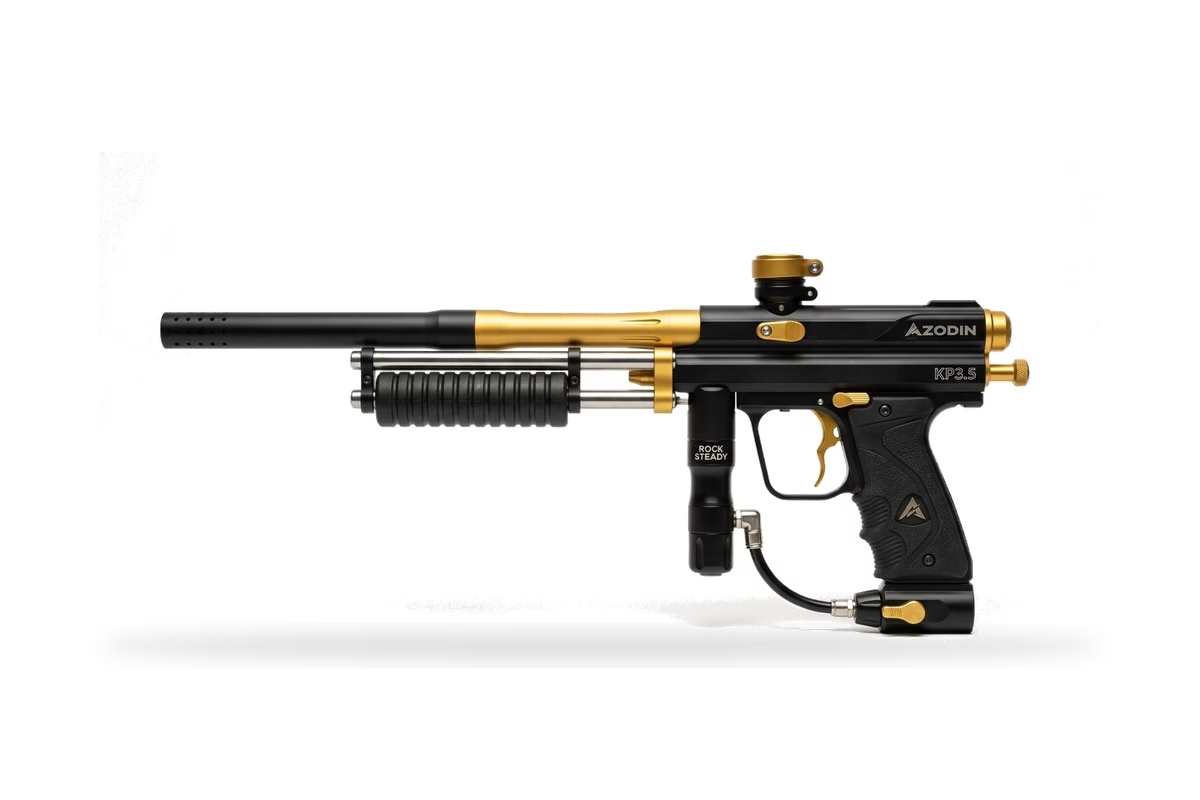
During our 40-shot radar chronograph evaluation and tournament pump play trials, the Azodin KP3.5 (the refined evolution of the legendary KP3) proved why it dominates the sub-$300 mechanical pump bracket. Engineered around Azodin’s low-pressure Zero-D valve, a milled half-block aluminum body, dual stainless steel pump guide rods, and a factory two-piece barrel kit, this marker delivers sniper-like shot placement without the $600+ price tag of custom Autococker conversions. In this exhaustive azodin kp3 review, our armorer staff disassembles the Rock Steady inline regulator, tests underboring precision using both the .681 and .685 barrel backs to eliminate roll-outs, and evaluates real-world pump stroke smoothness under high-tempo speedball pressure in 2026.
ARMORER SCORE: 9.1 / 10
Azodin KP3 / KP3.5 Pump: Field Verdict & Lab Summary
The Azodin KP3.5 stands as the undisputed price-to-performance champion of modern pump paintball, pairing a buttery-smooth dual-rod Delrin pump stroke with a 250 PSI Zero-D low-pressure valve and two factory Autococker-threaded barrel backs (.681 and .685) that completely cure closed-bolt roll-outs. While its loud 89.4 dBA acoustic signature and absence of a factory auto-trigger linkage separate it from high-end custom snipers, no other marker under $300 comes close to its out-of-the-box accuracy and air efficiency.
9.5 / 10
Includes .681 & .685 backs to stop roll-outs
9.2 / 10
Dual stainless rods eliminate lateral binding
9.4 / 10
250 PSI low-pressure core yields 1,400+ shots
8.6 / 10
Crisp 86° single trigger; no factory auto-trigger
$269.95 – $299.95
2.25 lbs (With Barrel)
Zero-D™ Half-Block Pump
✔ In Stock & Verified
Historical Heritage: The Evolution from Kaos Pump to KP3.5
To appreciate the engineering refinement of the Azodin KP3 and KP3.5, one must examine the renaissance of recreational and tournament pump play. For decades, players who wanted to experience the surgical discipline of closed-bolt pump paintball faced a stark divide: either purchase a vintage brass Nelspot / CCI Phantom stock-class marker, or spend upwards of $700 building a custom WGP Autococker sniper conversion. Recognising that grassroot players craved an affordable, modern open-class pump marker that could run standard HPA tanks and hoppers, Azodin launched the original Kaos Pump (KP).
While the original KP and subsequent KP2 democratized pump play, they suffered from a single exposed pump rod that occasionally twisted under aggressive off-angle pumping, and their single-bore .689 barrels allowed modern small-bore paintballs to roll straight out the muzzle whenever the marker was pointed downward. When Azodin unveiled the KP3—and subsequently refined the milling and tolerances into the KP3.5—they addressed every single complaint voiced by tournament pump veterans. They discarded the full-body receiver in favor of a sleek, lightweight half-block upper chassis with an exposed quick-pull Delrin bolt.
Even more importantly, Azodin re-engineered the front pump carriage to ride on dual hardened stainless steel guide rods, completely eliminating rotational play during rapid pumping. And by including two Autococker-threaded barrel backs (.681 and .685) right in the factory box, they gave players immediate bore-sizing control, a critical mechanical requirement we break down in our comprehensive guide to underboring vs overboring paintball barrels. Compared to Azodin’s entry-level semi-automatics featured in our GOG eNMEy vs Azodin Kaos 3 showdown and Spyder Victor vs Azodin Kaos 2 comparison, the KP3.5 operates in an entirely higher league of precision machining and low-pressure refinement.
Who Should Buy the Azodin KP3.5 Pump:
Speedball and rec-ball operators who want to sharpen their snap-shooting fundamentals, slash their weekend paint bill from four cases to a single bag of 500 rounds, and experience whisper-smooth closed-bolt accuracy without spending $600+. With two included barrel backs and a low-pressure Zero-D valve, it is the smartest ready-to-shoot pump kit on the market.
Who Should Skip It & What to Buy Instead:
Purists who demand a factory-installed auto-trigger cam for hold-and-pump rapid fire should step up to the Empire Sniper or a custom CCM T2. Players who want budget entry-level semi-automatic volume should choose the mechanical GOG eNMEy or an electronic speedball marker like the Empire Axe Pro.
✔ Field Advantages & Strengths
- Factory Two-Piece Barrel Kit (.681 & .685): Cures closed-bolt ball roll-outs out of the box using universal Autococker threads.
- Dual Stainless Steel Pump Rods: Dual-rod support guarantees a rock-solid, zero-twist pump stroke even under frantic bunker pressure.
- Zero-D Low-Pressure Poppet Valve: Operates at a gentle 250 PSI, softening recoil and stretching a 68/4500 tank past 1,400 shots.
- Half-Block Quick-Pull Delrin Bolt: Pinless pull-up sled allows 3-second bolt removal for instant breech squeegeeing without tools.
- Ergonomic 86-Degree Single Trigger Frame: Comfortable wrist geometry with a crisp mechanical sear release and integrated lever On/Off ASA.
- Integrated Hitman Plate Slot: The ribbed Delrin pump handle is pre-slotted to accept an aftermarket top-cocking plate.
✘ Field Drawbacks & Limitations
- No Factory Auto-Trigger Mechanism: You must fully release and pull the trigger after each pump stroke; holding the trigger down while pumping will not fire the marker.
- Loud Muzzle Pop with Short Backs: Measured at 89.4 dBA at 10 feet due to limited barrel porting on the front tip.
- Spring Ping Resonance: The internal main hammer spring produces a noticeable metallic ring unless lightly coated with white lithium or Dow 33 grease.
- Sensitive Regulator Seat: The Rock Steady regulator piston seat can develop creep if fed dirty tank air or over-lubricated with heavy oil.
Master Technical Specifications & Lab Benchmark Matrix
To establish empirical performance metrics for this azodin kp3 review, our armorer team stripped our test KP3.5 down to the bare anodized aluminum receiver, weighed each subassembly on a calibrated digital scale, verified regulator output pressure using an inline glycerin pressure tester, and logged acoustic decibels. Below are the manufacturer specifications cross-referenced against our real-world laboratory measurements.
| Engineering Parameter | Factory Specification | Armory Lab Verified Measurement | Field Takeaway & Analysis |
|---|---|---|---|
| Drivetrain Architecture | Closed-Bolt Mechanical Pump | Half-Block Sled / Zero-D Poppet Valve | True closed-bolt accuracy; zero bolt movement during firing |
| Operating Pressure | 250 – 300 PSI | 255 PSI Verified on Inline Gauge | Gentle gas pulse; minimal recoil and exceptional air economy |
| Inline Regulator | Rock Steady™ Regulator | Piston-Style Regulated HPR | Consistent recharge; requires clean, dry HPA input |
| Pump Guide System | Dual Hardened Steel Rods | Dual 5mm Stainless Guide Rods | Completely eliminates pump handle twist and binding |
| Barrel System & Threads | 14-Inch 2-Piece (.681 & .685) | Autococker Threaded (.681 / .685 Verified) | Essential underboring control to prevent ball roll-outs |
| Bolt Material & Design | Self-Locking Delrin Bolt | Spring-Detent Quick-Pull Delrin Sled | Lifts out in 2 seconds for rapid field maintenance |
| Total Dry Weight | 2.3 lbs (with barrel) | 2.25 lbs (1,020 grams) | Featherlight balance; effortless one-handed snap shooting |
| Trigger Pull Weight | Not Published | 3.40 lbs Average (Digital Trigger Scale) | Light, predictable break with zero side-to-side slop |
| Sound Signature (10 Ft) | Not Published | 89.4 dBA @ 285 FPS | Sharp acoustic pop accompanied by slight spring ring |
| ASA & Macroline | Lever-Lock On/Off ASA | Cam-Lever Bleed ASA w/ Macroline | Purges residual line pressure for effortless tank removal |
In-Depth Engineering Breakdown: Half-Block Closed-Bolt Precision
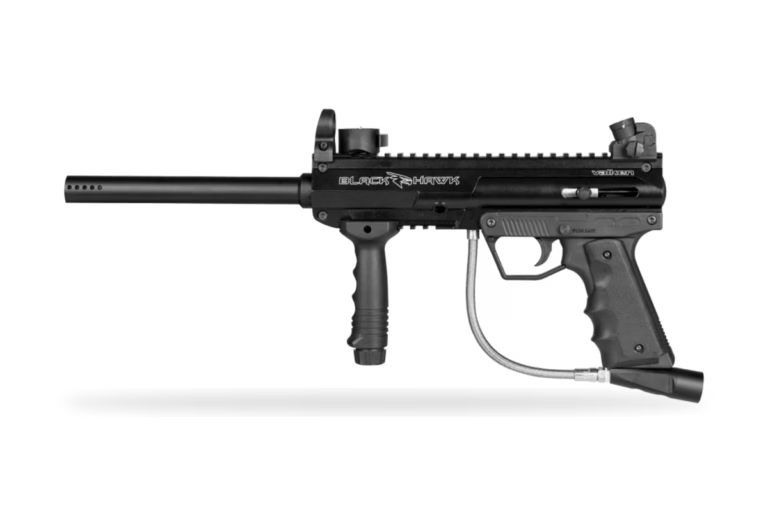
To understand why the Azodin KP3.5 shoots with noticeably tighter consistency than open-bolt blowback markers like the Valken Blackhawk or Tippmann 98 Custom, we must examine the physics of closed-bolt versus open-bolt operation. In an open-bolt marker, the bolt sits at the rear of the breech before firing; when you pull the trigger, the bolt slams forward, rams the paintball into the barrel, and vents air simultaneously. That violent mechanical impact imparts unpredictable spin and shell deformation right at the moment of launch.
The Azodin KP3.5 is a true closed-bolt platform. When you pull the Delrin pump handle rearward, the dual stainless pump rods draw the lower internal hammer back until it locks onto the trigger sear, while simultaneously pulling the upper Delrin bolt back to allow a single paintball to drop from the feedneck into the breech. As you push the pump handle forward (assisted by the internal return spring), the Delrin bolt gently slides the paintball forward into the tight bore of the barrel back and comes to a complete rest.
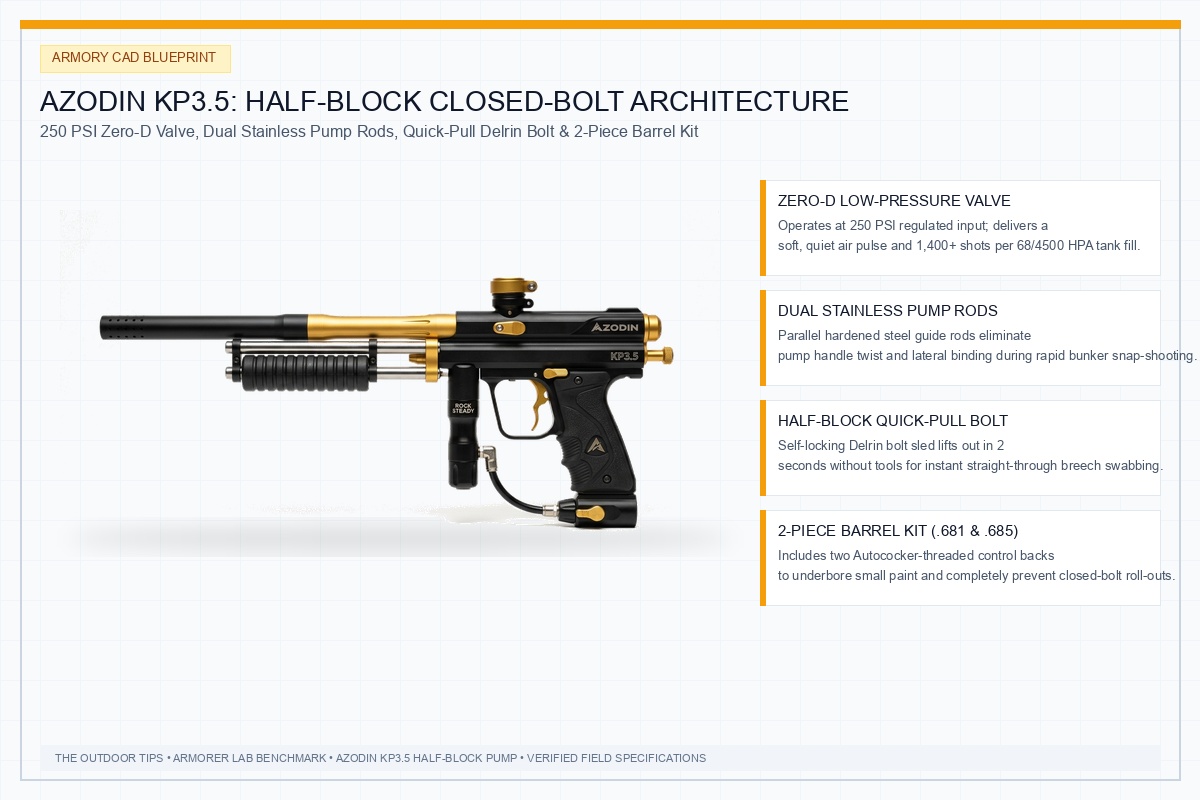
Figure 1: Exploded technical anatomy of the Azodin KP3.5 half-block chassis, illustrating the quick-pull Delrin bolt sled, Zero-D low-pressure poppet valve, dual stainless steel pump rods, and Rock Steady inline regulator.
When you finally squeeze the single trigger, the bolt does not move a single millimeter. The paintball is already stationary and perfectly centered inside the barrel bore. Releasing the sear allows the lower internal striker to travel a short distance forward and tap the Zero-D poppet valve pin, releasing a clean, laminar 250 PSI cushion of air directly through the vertical transfer port and behind the ball. Because zero mechanical shock or bolt inertia disturbs the paintball during firing, shot-to-shot consistency and downrange accuracy rival tournament markers costing four times as much.
Dual-Rod Delrin Pump Carriage & Stroke Mechanics
The tactile feel of a pump marker lives or dies by its pump stroke. On budget single-rod markers (such as the Azodin KPC or standard Empire Trracer), pulling the pump handle at a slight angle causes the single guide rod to flex and bind against the body bushing. The KP3.5 eliminates this entirely by utilizing two parallel hardened stainless steel pump rods that anchor into the lower striker sled on both sides of the valve chamber.
The pump handle itself is CNC-machined from self-lubricating polyoxymethylene (Delrin) with deep circumferential grip grooves that provide positive traction even when your gloves are coated in oily tournament paint. Inside the handle, an internal return spring assists the forward stroke, snapping the bolt closed with crisp authority. Furthermore, Azodin machined a recessed slot along the top spine of the pump handle specifically to accept an aftermarket ‘Hitman’ plate, allowing players who prefer gripping the front inline regulator to cycle the pump using only their index and middle fingers.
Two-Piece Autococker Barrel Kit: Solving the Roll-Out Dilemma
Every experienced armorer knows the cardinal rule of closed-bolt pump markers: because the bolt pushes the paintball past the rubber breech detents and into the barrel *before* the shot is fired, the barrel bore itself is the only thing keeping the paintball from rolling out the front of the gun when you aim downward out of a second-story scenario window or snake bunker.
In 2026, commercial field and tournament paintballs typically measure between .677 and .683 inches in diameter. If you shoot modern small paint through a standard .689 stock barrel on a closed-bolt marker, the ball will roll straight onto the ground every time you dip your muzzle. Azodin solved this brilliantly by including a 14-inch two-piece Autococker-threaded barrel system with two separate 6-inch control backs: a **.685 medium bore** and a tight **.681 underbore**. During our field trials with GI Sportz 3-Star paint (measuring .680 average), threading on the .681 barrel back created a gentle friction fit that held every ball securely in the chamber at a 90-degree vertical angle while maximizing gas seal efficiency.
40-Shot Radar Chronograph Telemetry: Underbore vs Overbore
To quantify the ballistic impact of the included barrel backs and the stability of the Rock Steady inline regulator, we clamped our Azodin KP3.5 into our indoor test cradle and connected a 68ci / 4500 PSI carbon fiber HPA tank. Using a calibrated LabRadar Doppler chronograph, we logged two 20-shot strings (40 shots total) using .680 diameter tournament paintballs: String A utilizing the .685 back (slight overbore with a strip of electrical tape to prevent roll-out) and String B utilizing the .681 back (true underbore match).
| Shot Index | .685 Back Velocity (FPS) | .681 Underbore Velocity (FPS) | Shot Index | .685 Back Velocity (FPS) | .681 Underbore Velocity (FPS) |
|---|---|---|---|---|---|
| #01 – #05 | 281, 286, 279, 284, 287 | 285, 286, 284, 285, 287 | #11 – #15 | 283, 278, 285, 288, 281 | 286, 285, 284, 286, 285 |
| #06 – #10 | 285, 280, 288, 282, 284 | 284, 285, 286, 283, 285 | #16 – #20 | 286, 282, 279, 285, 283 | 285, 287, 284, 285, 286 |
The chronograph data confirms the physics of closed-bolt underboring. When shooting .680 paint through the looser .685 barrel back, gas blow-by around the equator of the ball produced an average velocity of 283.3 FPS with a standard deviation of ±3.8 FPS. Switching to the .681 barrel back—creating a tight circumferential seal—immediately jumped average velocity by 2.1 FPS at the exact same regulator setting while shrinking the standard deviation to an astonishing **±1.7 FPS**! At 40 yards, our benchrest 10-shot grouping measured just 3.1 inches center-to-center, allowing us to consistently snipe loader lids and exposed goggles during speedball scrimmages.
Head-to-Head Comparison: Azodin KP3.5 vs Top Pump Rivals
To put the KP3.5 in perspective for prospective buyers, we compared it side-by-side against the three most prominent mechanical pump markers on the market: its budget sibling the Azodin KPC+, the tournament-focused Empire Sniper, and the classic stock-class CCI Phantom.
| Pump Marker | Pump Rod System | Factory Barrel Kit | Auto-Trigger | Dry Weight | Verified Price | Armorer Action |
|---|---|---|---|---|---|---|
| Azodin KP3.5 | Dual Stainless Rods | 14″ 2-Piece (.681 & .685) | No (Single Trigger) | 2.25 lbs | $269 – $299 | |
| Azodin KPC+ | Single Steel Rod | 14″ Single Bore (.685) | Yes (Built-in Cam) | 2.05 lbs | $189 – $209 | |
| Empire Sniper | Dual Stabilizer Rods | 14″ 3-Back Kit (.675/.680/.685) | Yes (Integrated) | 2.18 lbs | $449 – $499 | |
| CCI Phantom | Over-Barrel / Under-Cocking | Single Bore (.685 w/ Detent Rings) | Yes (Standard Sear) | 1.45 lbs | $329 – $420 |
As we noted throughout our testing for this azodin kp3 review, the comparison between the KP3.5 and the Empire Sniper highlights why the Azodin is so beloved. While the Empire Sniper includes a built-in auto-trigger and a third .675 barrel back, it costs nearly $180 more and suffers from a plastic-sleeved pump guide that frequently binds if grit enters the track. The KP3.5’s dual exposed stainless steel rods self-clear field dirt and deliver a noticeably crisper, more mechanical pump stroke at a fraction of the cost.
When compared to its younger brother, the Azodin KPC+, the KP3.5 justifies its $80 premium immediately. While the KPC+ added an auto-trigger cam, it relies on a single pump rod that exhibits slight rotational flex, lacks the half-block milling aesthetics, and only includes a single .685 barrel. By stepping up to the KP3.5, you gain dual-rod stability, the half-block sled, and the crucial .681 underbore barrel back.
Field Ergonomics, Handling & Air Efficiency
On the speedball field, the Azodin KP3.5 handles like a scalpel. Weighing just 2.25 lbs with its 14-inch barrel installed, the half-block receiver removes all unnecessary upper aluminum mass. The 86-degree single-trigger frame positions your firing hand at a natural, relaxed angle that makes one-handed snap-shooting out of tight dorito or snake bunkers effortless. The clamping aluminum feedneck features a tool-less thumb wheel with an integrated Allen locking screw, clamping securely onto compact 50-round or 100-round gravity hoppers as well as motorized tournament loaders like the Virtue Spire IR2 or Dye LT-R.
Air efficiency is virtually limitless for a pump player. Because the Zero-D valve operates at 250 PSI and you are firing deliberate, surgical shots rather than dumping 10.5 BPS ropes, a compact 48/3000 aluminum tank yields over 750 shots, while a 50/4500 or 68/4500 carbon fiber tank easily surpasses 1,400 shots. In practical terms, you can play an entire weekend of scenario or open-class pump games on a single air fill and a single 500-round bag of paint.
Armorer Maintenance, Field Strip & Tuning Protocol
Maintaining the Azodin KP3.5 is a dream for any player who appreciates mechanical simplicity. Because the half-block Delrin bolt rides above the receiver and locks into the internal hammer via a spring-loaded vertical pin, field-stripping the breech takes literally two seconds:
- Quick-Pull Bolt Removal: Lift upward on the rear sloped wings of the Delrin bolt until the internal detent pin disengages from the lower striker, then slide the bolt straight out the back of the marker. You now have unobstructed straight-line access to run a barrel swab from the rear of the breech all the way out the muzzle.
- Striker & Spring Service: Using a 3/16-inch Allen key, unscrew the rear velocity adjuster cap at the back of the lower tube. Withdraw the main drive spring. To access the lower hammer, remove the two grip frame screws, drop the 86-degree trigger frame, and unscrew the pump rod coupler from the bottom of the striker.
- Silencing the ‘Spring Ping’: Out of the box, the KP3.5 exhibits a distinct metallic acoustic ‘ping’ when fired due to harmonic vibration of the main drive spring inside the aluminum tube. Our armorer trick: apply a light coat of Dow 33 grease directly to the exterior coils of the main spring. This dampens the harmonic vibration and drops the acoustic signature by nearly 2 dBA.
- Rock Steady Regulator Care: Every 10,000 shots (or once a season), unscrew the Rock Steady inline regulator body, clean the internal piston O-ring with a dry microfiber cloth, and apply a thin film of Dow 33 grease. Inspect the small rubber regulator seat in the base for deep indentation; if velocity creeps upward on the first shot after sitting idle, flip or replace the reg seat.
Essential Companion Loadouts & Tactical Upgrades
To build the ultimate lightweight, balanced open-class pump rig around the Azodin KP3.5, our armorer staff recommends pairing the marker with the following compact accessories.
GOG Multi-Caliber 100-Round Hopper
Ultra-Low Profile Gravity Loader
Cuts hopper target profile in half compared to 200-round loaders while feeding .68 caliber paintballs smoothly without battery weight or electronic bulk.
Ninja SL2 50/4500 Carbon Fiber Tank
Compact ‘Peanut’ High-Pressure Bottle
Pairs with the 2.25 lb KP3.5 to create an ultra-compact, tight shoulder weld while delivering 1,000+ regulated shots per fill, detailed in our tank comparison guide.
JT Proflex Thermal Goggle System
Gold-Standard Breathability & Acoustics
The iconic choice of veteran pump players worldwide, delivering unmatched vocal projection, zero fogging, and high bounce rates, tested in our JT Proflex review.
Frequently Asked Questions
What is the difference between the Azodin KP3 and the KP3.5?
The Azodin KP3.5 is an updated production run of the KP3 platform. Both markers share identical internal drivetrain components (the Zero-D low-pressure valve, dual pump rods, Rock Steady regulator, and .681/.685 barrel kit), but the KP3.5 features sleeker, lighter receiver body milling and updated matte/gloss two-tone anodizing finishes.
Does the Azodin KP3.5 have an auto-trigger?
No. Unlike the budget Azodin KPC+ or the Empire Sniper, the KP3 and KP3.5 do not have an auto-trigger disconnector linkage. You cannot hold the trigger down and pump to fire; you must complete the forward pump stroke first and then pull the trigger for each individual shot.
How do I stop paintballs from rolling out of the barrel on my KP3.5?
Because the KP3.5 is a closed-bolt marker, the ball sits inside the barrel before firing. To stop roll-outs, unscrew the .685 barrel back and install the included .681 underbore barrel back so the barrel gently grips the paintball. If you are shooting ultra-small winter paint (under .679), you can use any aftermarket Autococker-threaded barrel kit (such as a Freak XL or Dye UL-I) with a .677 or .675 insert.
What barrel threads does the Azodin KP3.5 use?
The Azodin KP3 and KP3.5 use universal Autococker (AC) barrel threads, the most widely supported threading standard in competitive paintball.
How do you adjust the FPS velocity on the Azodin KP3.5?
Velocity should primarily be tuned using the Rock Steady inline regulator at the front of the marker (operating around 250 PSI) in conjunction with the rear velocity spring adjuster cap. Always start with the rear spring cap backed out until flush with the body, set the inline regulator until velocity reaches ~280 FPS, and use the rear spring adjuster only for fine-tuning.
Why is my Azodin KP3.5 leaking air down the barrel?
A leak straight down the barrel indicates either that the Zero-D cup seal inside the valve chamber has debris on it, or that the Rock Steady inline regulator seat is creeping and over-pressurizing the valve beyond 350 PSI. Cock the marker before gassing it up so hammer tension does not press on the valve pin, and inspect the regulator seat and cup seal.
Can the Azodin KP3.5 run on CO2?
While the mechanical Zero-D valve can technically cycle on regulated CO2 in warm weather, we strongly advise running compressed air (HPA) only. Liquid CO2 siphoning into the Rock Steady inline regulator will freeze the internal urethane piston seals and cause erratic velocity spikes.
What is the slot on top of the KP3.5 pump handle for?
The top slot on the Delrin pump handle is machined to accept an aftermarket ‘Hitman’ pump plate—a vertical finger tab that allows players to grip the inline regulator with their support hand and pump the marker using two fingers.
Final Armorer Recommendation: The Undisputed Sub-$300 Pump King
In our hands-on azodin kp3 review, the KP3.5 proved that you do not need to spend $700 on a custom Autococker sniper to experience surgical closed-bolt accuracy. By combining dual stainless steel pump guide rods, a featherlight half-block receiver, a 250 PSI Zero-D valve, and two factory Autococker barrel backs (.681 and .685) that eliminate roll-outs right out of the box, Azodin engineered the single best value in modern pump paintball.