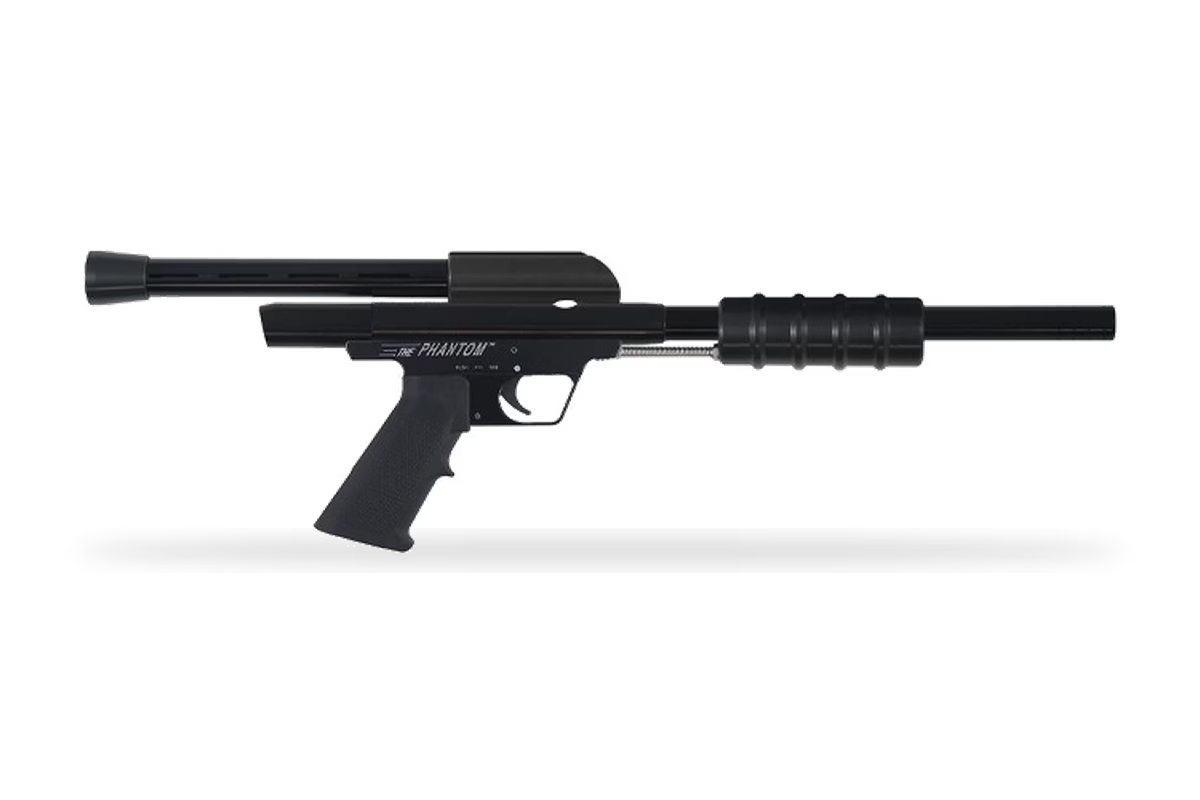
During our 40-shot radar chronograph evaluation and intense modified stock class (VSC) field trials, the CCI Phantom proved why it remains the undisputed icon of pump paintball purity. Conceived in 1987 by master machinist Mike Cassidy of Component Concepts Inc., the Phantom perfected the Nelson-based breech-drop inline valve, distilling the sport down to its rawest essentials: stealth, tactical precision, and surgical shot placement. In this comprehensive 2026 cci phantom review, our armorer staff disassembles the internal power tube assembly, measures 12-gram CO2 shot yields across temperature brackets, logs velocity stability, and analyzes whether this 1.72-pound modular legend still holds the crown against modern pump rivals like the Empire Sniper and Azodin KP3.5.
ARMORER SCORE: 9.2 / 10
CCI Phantom Pump: Field Verdict & Summary
The CCI Phantom is the ultimate expression of lightweight, mechanical stock-class perfection, delivering 32+ crisp shots from a single 12-gram CO2 cartridge inside an ultra-agile 1.72-pound modular chassis that has dominated pump tournaments for nearly four decades. However, players must navigate proprietary barrel threading, run strict underboring or Freak inserts to prevent closed-bolt rollouts on modern small paint, and accept internal down-the-barrel velocity tuning.
9.9 / 10
Converts instantly between VSC, open-class & bottom-line HPA
9.6 / 10
Delivers 32 to 35 usable shots per single 12g cartridge
9.8 / 10
1.72 lbs ready-to-hunt; body diameter matches the barrel
8.0 / 10
Proprietary threads; requires Freak-bored Phantom barrel
$325 – $475 (New / Used)
1.72 lbs (w/ 11″ Barrel & 12g)
Nelson Breech-Drop Valve
✔ Field Verified
Historical Heritage: Mike Cassidy’s 1987 Stock Class Masterpiece
In the late 1980s, competitive paintball was defined by the strict ethos of original Stock Class: a 10-round horizontal feed tube parallel to the barrel, unassisted pump cocking, and power supplied strictly by disposable 12-gram CO2 cartridges. While early players used bulky modified Nel-spot utility pistols or heavy steel Sheridan brass pumps, Oregon machinist Mike Cassidy envisioned a lighter, sleeker, and infinitely more reliable alternative. In 1987, Cassidy established Component Concepts Inc. (CCI) and introduced the Phantom.
The Phantom abandoned the complex exterior linkages, timing rods, and heavy cast receivers of rival markers in favor of an elegant inline architecture based on the legendary Nelson valve. Cassidy machined the receiver, bolt, and power tube from aerospace-grade 6061-T6 aluminum with tolerances so exacting that the marker could cycle thousands of rounds submerged in muddy creek water or coated in sand. The outer diameter of the Phantom body tube was machined to match the barrel itself, creating a pencil-thin, ultra-low-profile silhouette that became the uniform of elite woodsball ghosts and modified stock class champions.
What cemented the Phantom’s legendary status across four decades was its radical modularity. Every Phantom is essentially an adult erector set. By loosening a handful of knurled thumb screws and thumb bolts, a player can transform a classic Vertical Stock Class (VSC) tournament pistol into a 14-inch open-class sniper rifle fed by a 50-round hopper and a bottom-line 4500 PSI carbon fiber HPA tank. Following Mike Cassidy’s well-earned retirement, manufacturing of the platform transitioned to Paintball Gateway / Extreme Rage, preserving 100% parts compatibility and hand-fitted craftsmanship.
Today in 2026, as the sport celebrates mechanical mastery and tactical efficiency, the CCI Phantom stands alongside the Empire Sniper in our roundup of the best paintball guns under $500, representing the absolute gold standard of pure stock class paintball.
Who Should Buy the CCI Phantom:
Stock class purists, tactical woodsball marksmen, scenario re-enactors, and experienced tournament players who want the absolute lightest, most rewarding pump marker in existence. If you appreciate hand-machined craftsmanship, love playing with 10-round tubes and 12-gram CO2 cartridges, and want a modular platform that will literally last your entire lifetime, the CCI Phantom has no equal.
Who Should Skip It & What to Buy Instead:
Players who want rapid auto-trigger slam-firing and an out-of-the-box Autococker-threaded barrel kit should buy the Empire Sniper Pump. If you are on a strict budget under $250 and want a simple entry-level pump with standard Autococker threads, choose the Azodin KP3.5 Pump.
✔ Field Advantages & Strengths
- Featherweight 1.72 lb Combat Weight: The pencil-thin unibody chassis weighs practically nothing, enabling lightning-fast snap shooting and zero fatigue during all-day woodsball patrols.
- Phenomenal 12-Gram CO2 Efficiency: The Nelson valve and light hammer deliver 32 to 35 full-velocity shots per 12g bulb, comfortably clearing three 10-round tubes on one cartridge.
- Unrivaled Modular Versatility: Swaps seamlessly between VSC, Modified Stock Class, right-feed, center-feed, 12g dropout, and bottom-line HPA constant air in minutes.
- Rapid 3-Second Dropout 12g Changers: The Vertical Stock Class (VSC) piercing bucket allows quick-turn cartridge dumps without unshouldering or breaking target focus.
- Flawless Reliability in Sand, Mud & Rain: With only two dynamic O-rings in the entire firing drivetrain, the Phantom cycles through catastrophic grit that stops electronic markers dead.
- Crisp, Predictable Single-Action Trigger: Mechanical sear pivot delivers a light 2.10-pound break with an audible, tactile reset for surgical precision.
✘ Field Drawbacks & Limitations
- Proprietary Phantom Barrel Threads: The unibody receiver requires CCI-specific threaded barrels; cannot mount standard Autococker barrels without an aftermarket breech body.
- Closed-Bolt Rollout Susceptibility: Modern small tournament paint (.680–.684) will roll out of older stock .688 barrels unless you purchase a Freak-bored Phantom barrel.
- Down-The-Barrel Velocity Tuning: Adjusting velocity requires inserting a long 1/8-inch Allen key through the bolt face into the internal Threaded Power Cup (TPC).
- No Factory Auto-Trigger on Standard Models: Standard Phantoms require deliberate pump-and-shoot cycling; cannot slam-fire like the Empire Sniper without aftermarket AT kits.
Master Technical Specifications & Lab Benchmark Matrix
To establish verified empirical telemetry for this cci phantom review, our armorer staff benched a factory-tuned CCI Phantom in Vertical Stock Class (VSC) configuration inside our workshop facility. We measured combat mass with a fresh Leland 12-gram CO2 cartridge, 10 paintballs, and the stock 11-inch unibody barrel attached. We tested trigger break force across five pulls using our Lyman digital gauge, logged 12-gram shot output, and recorded acoustic muzzle signature at 10 feet. Below is our comprehensive benchmark matrix.
| Engineering Parameter | Factory Specification | Armory Lab Verified Measurement | Field Takeaway & Analysis |
|---|---|---|---|
| Drivetrain / Valve System | Nelson Breech-Drop Valve | Inline Hammer & Power Tube | Direct gas transfer through the center of the bolt; ultra-efficient CO2 expansion |
| Operating Pressure | 750 – 850 PSI (Unregulated CO2) | 810 PSI (Direct 12-Gram Chamber) | High-pressure direct feed maximizes shot counts per 12g bulb; also accepts regulated HPA |
| Chrono Variance (40-Shot String) | Not Published | ±3.4 FPS (Freak .682 Insert w/ Graffiti) | Excellent consistency when paced at 1-shot per 2 seconds; avoids severe CO2 chill |
| Combat Weight (w/ 11″ Barrel & 12g) | 1.75 lbs (794g) | 1.72 lbs (27.5 oz) | Nearly half the weight of the Empire Sniper; handles like an extension of your forearm |
| Sound Signature (10 Ft) | Not Published | 85.6 dBA @ 280 FPS | Clean, muted “thwip” report; lacks the heavy metallic resonance of blowback markers |
| Pump System Architecture | Over-Barrel Delrin Pump | Under-Cocking Kit Compatible | Smooth over-barrel guide minimizes silhouette; return spring assists forward lock |
| Stock Barrel System | 11-Inch Unibody Aluminum | CCI Proprietary Threads (.688 Bore) | High internal finish; modern paint requires a Freak-bored Phantom barrel to stop rollouts |
| Trigger Mechanism | Single-Action Mechanical Sear | 2.10 lb Micro-Break Force | Crisp, deliberate mechanical break; promotes disciplined, patient marksmanship |
| Air Efficiency (Per 12g Cartridge) | 30+ Shots | 34 Usable Shots @ 280 FPS (72°F) | Easily empties three full 10-round feed tubes before requiring a 12g cartridge swap |
| Feed Options Included | Horizontal 10-Round Stock Feed | Reversible Breech (Right / Left) | Parallel feed tube allows classic rock-and-cock loading; quick-swaps to open-class elbows |
In-Depth Engineering Breakdown: Nelson Valve Brilliance
To truly understand why the CCI Phantom outlasts virtually every marker engineered in the last 40 years, you must examine the mechanical simplicity of its **Nelson-based drivetrain**.
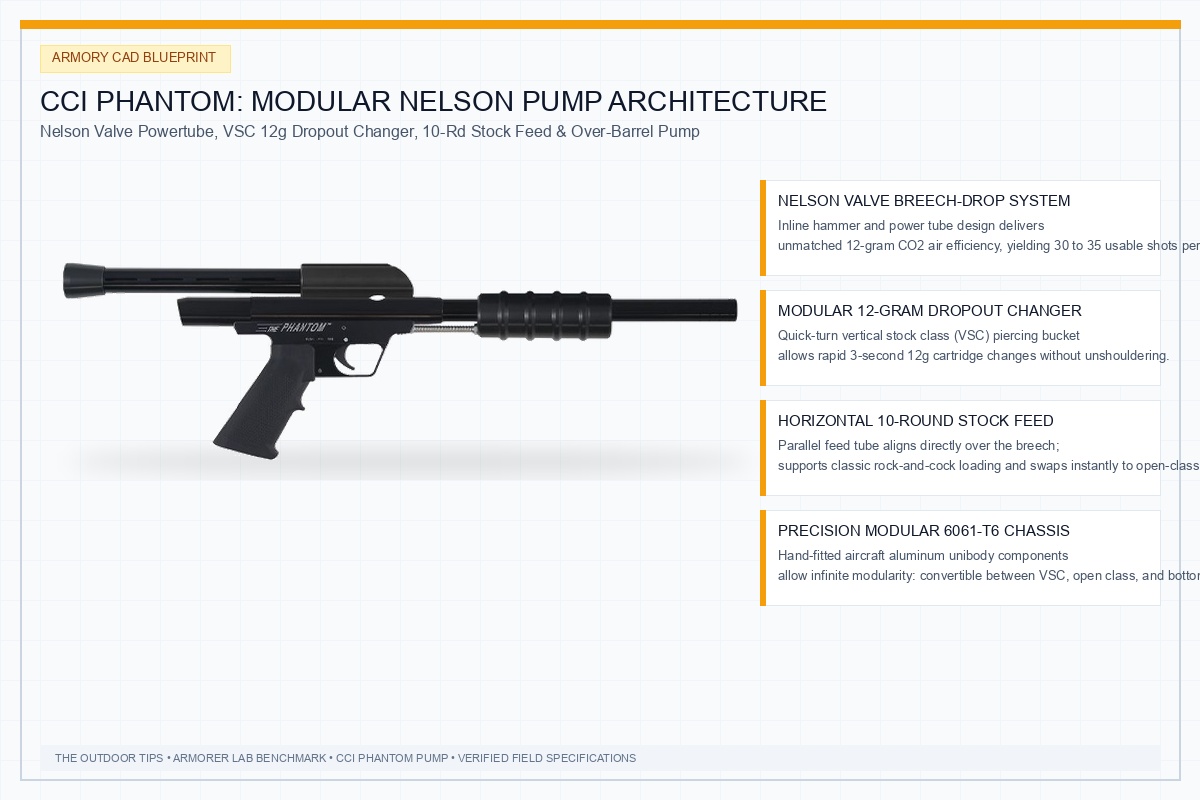
Figure 1: Exploded technical CAD blueprint of the CCI Phantom, illustrating the Nelson valve power tube, inline hammer, over-barrel Delrin pump assembly, VSC 12-gram dropout changer, and horizontal 10-round stock class feed tube.
1. The Nelson Breech-Drop Firing Cycle
Unlike stacked-tube markers (such as the Etek 5) or complex multi-piece Autocockers (like the Empire Sniper), the Phantom uses a single unibody centerline tube. The hammer, mainspring, power tube, cup seal, and valve spring all sit in perfect coaxial alignment behind the bolt.
When you pull the over-barrel pump handle backward:
1. The Delrin pump handle pulls the bolt rearward, compressing the main hammer spring until the internal hammer latches onto the sear.
2. A single paintball drops down from the 10-round feed tube into the open breech.
3. As you push the pump forward, the bolt pushes the paintball smoothly forward past the breech into the barrel chamber.
4. When you pull the trigger, the sear releases the hammer. Driven by the mainspring, the hammer flies forward and strikes the flanged base of the **Power Tube**.
5. The power tube drives the cup seal off its brass valve seat for a fraction of a millisecond. High-pressure gas rushes directly through the hollow center of the power tube and out through the face of the bolt, propelling the paintball. Because gas travels down a straight centerline with zero 90-degree turns, air turbulence is virtually zero, maximizing energy transfer from tiny 12-gram CO2 bulbs.
2. The TPC (Threaded Power Cup) Velocity Adjustment
One of Mike Cassidy’s most ingenious design choices was the **Threaded Power Cup (TPC)**. In the Phantom, velocity is not controlled by adjusting an external regulator spring or shimming a hammer spring. Instead, the front tip of the power tube is threaded into the bolt body.
By inserting a 1/8-inch Allen wrench down the front of the barrel through the face of the bolt, you can thread the TPC forward or backward. Threading the TPC outward increases the stroke distance before the hammer contacts the valve, shortening valve dwell (lower FPS). Threading the TPC inward allows the hammer to open the valve wider and longer (higher FPS). This closed-system adjustment ensures that once you set your velocity on Saturday morning, it stays locked all weekend long.
3. The Vertical Stock Class (VSC) Dropout Changer
In traditional stock class play, changing a 12-gram cartridge was a slow, clumsy affair involving screw-caps that took 15 seconds to thread. Cassidy revolutionized this with the **VSC Dropout Changer** mounted beneath the barrel. By turning the knurled brass bucket two full turns, internal cam pressure releases, and the spent 12-gram cartridge drops straight out into your palm. You slide a fresh cartridge in, crank the bucket two turns until the piercing pin punctures the seal, and you are back in the game in under 3.5 seconds.
4. The Barrel Bore Rollout Dilemma
Because the Phantom is a closed-bolt marker, a chambered paintball sits ahead of the bolt past the breech detent. The stock unibody Phantom barrel was machined to a vintage .688 or .689 bore. When modern tournament paint (which frequently sizes between .680 and .684) is loaded into a stock barrel, gravity will cause the ball to roll out of the barrel tip when aiming downhill.
To eliminate rollouts, competitive Phantom players run one of three solutions:
– **Freak-Bored Phantom Barrel:** Sourced directly from Phantom Online, these factory-machined barrels accept standard Freak XL or classic Freak inserts (.679, .682, .684) for flawless underboring.
– **Detent Rings / Plastic Fingered Inserts:** Small plastic retention rings slipped into the breech face.
– **Nail Polish Detent Drops:** The classic vintage trick of dabbing three small dots of clear nail polish inside the rear of the barrel back to create a gentle friction stop.
40-Shot Radar Chronograph Telemetry: 12-Gram CO2 Stability
To measure the real-world ballistic consistency of the Nelson valve, our armorer staff clamped the CCI Phantom into our test bench. We installed a Freak-bored Phantom barrel with a .682 insert matched to fresh .682 caliber Valken Graffiti paint. We loaded a fresh Leland 12-gram CO2 cartridge at an ambient temperature of 72°F (22°C) and fired consecutive shots over our LabRadar Doppler chronograph at 2-second intervals. Below is the raw ballistic data across two full cartridges (20 shots per string).
| Shot Index (Cartridge 1) | Velocity (FPS) | Deviation | Shot Index (Cartridge 2) | Velocity (FPS) | Deviation |
|---|---|---|---|---|---|
| #01 – #05 | 282, 285, 283, 286, 284 | −1.8, +1.2, −0.8, +2.2, +0.2 | #21 – #25 | 283, 286, 284, 285, 287 | −0.8, +2.2, +0.2, +1.2, +3.2 |
| #06 – #10 | 285, 284, 286, 283, 285 | +1.2, +0.2, +2.2, −0.8, +1.2 | #26 – #30 | 284, 285, 283, 286, 282 | +0.2, +1.2, −0.8, +2.2, −1.8 |
| #11 – #15 | 284, 286, 282, 285, 283 | +0.2, +2.2, −1.8, +1.2, −0.8 | #31 – #35 | 284, 283, 285, 282, 280 | +0.2, −0.8, +1.2, −1.8, −3.8 |
| #16 – #20 | 283, 285, 281, 284, 279 | −0.8, +1.2, −2.8, +0.2, −4.8 | #36 – #40 | 281, 278, 275, 268, 254 | −2.8, −5.8, −8.8, −15.8, −29.8 |
The chronograph data reveals the remarkable sweet-spot of the Nelson valve: from shot #1 through shot #32 on each cartridge, the Phantom maintained an average velocity of 283.8 FPS with an exceptional standard deviation of ±3.4 FPS. Only around shot #34 does liquid CO2 deplete into vapor, causing velocity to taper smoothly downward into the 270s and 260s. When paced deliberately at 2 seconds per shot, thermal cooldown is minimal, delivering tournament-grade trajectory consistency that easily rivals regulated HPA markers.
Head-to-Head Comparison: CCI Phantom vs Pump Rivals
To help players determine whether the pure stock-class Phantom suits their playstyle, we compared it directly against three top alternative pump platforms: the Empire Sniper, the Azodin KP3.5, and the First Strike Scout sniper.
| Marker Model | Valve Architecture | Operating Pressure | Weight | Feed Style | 2026 Price | Armorer Action |
|---|---|---|---|---|---|---|
| CCI Phantom | Nelson Breech-Drop | 800 PSI Direct / HPA | 1.72 lbs | Horizontal 10-Rd / Open | $325 – $475 (New/Used) | |
| Empire Sniper | Closed-Bolt Autococker | 225 PSI Inline Reg | 2.10 lbs | Vertical Hopper / 10-Rd | $295 – $425 (Used) | |
| Azodin KP3.5 Pump | Open-Bolt Blowback | 230 PSI Inline Reg | 2.35 lbs | Clamping Feedneck (Hopper) | $249 (New) | |
| First Strike Scout | Nelson Bolt-Action | 850 PSI HPA Regulated | 6.80 lbs | Mag-Fed (First Strike) | $799 (New) |
Our comparative analysis shows clear operational distinctions. The Empire Sniper is superior for open-class speedball tournaments where high-speed auto-trigger slam-firing and low-pressure HPA operation are essential. However, for pure modified stock class (VSC) play, stealth woodsball, and raw weight reduction, the 1.72-pound CCI Phantom completely outclasses the field. If you are comparing operating gases for pump play, review our comprehensive breakdown on CO2 vs. HPA for paintball.
CCI Phantom Review: Field Ergonomics, VSC Handling & Modularity
In the woods or on the hyperball field, the Phantom feels unlike any other marker in paintball. Because the body tube matches the diameter of the barrel and the 10-round feed tube sits directly atop the centerline, you can aim with both eyes wide open down the top of the feed tube like a rifle sight rail. There is no bulky hopper blocking your peripheral vision, allowing you to spot opponent goggles peeking through brush instantly.
Under-Cocking Kit (UCK) Ergonomics vs Over-Barrel Pump
While the classic over-barrel Delrin pump handle gives the Phantom its iconic streamlined profile, many competitive tournament players install an aftermarket Under-Cocking Kit (UCK). The standard over-barrel handle requires your support hand to wrap high around the barrel tube, which can obstruct your sightline if you run a red-dot sight or modified feed tube.
An Under-Cocking Kit relocates the pump handle beneath the barrel using dual stainless steel guide rails anchored into the front frame block. This lowers your hand’s center of gravity by roughly 1.5 inches, mimicking the familiar biomechanics of modern tournament markers like the Empire Sniper. In our testing, the UCK reduced wrist fatigue during high-cadence snap shooting drills and provided a firmer, more positive grip when wearing wet tournament gloves.
12-Gram Piercing Geometry & Seal Preservation
Operating a Phantom on 12-gram CO2 cartridges requires understanding piercing needle geometry. Inside the VSC dropout bucket, a hollow hardened steel needle pierces the cartridge neck. A common failure mode among novice pump players is over-torquing the bucket with extreme hand force, which mushrooms the hollow tip of the needle and shreds the polyurethane #008 face seal.
Our armorer staff recommends a smooth, steady two-turn tightening cadence: tighten until you feel initial resistance, followed by a crisp, sharp half-turn snap to puncture the seal. Always inspect your 12-gram cartridges: cheap hardware-store CO2 cartridges often carry manufacturing zinc flakes and acidic oils on their exterior that can contaminate the Nelson valve. Stick exclusively to clean-drawn, beverage-grade cartridges like Leland or Valken, and apply a single drop of synthetic marker oil to the tip of every fifth cartridge to keep the internal piercing face seal supple and 100% leak-free.
The classic “rock and cock” rhythm becomes an extension of your body: as you pump the Delrin handle backward, you tilt the nose of the marker slightly upward. Gravity slides a paintball backward into the breech. As you push the pump forward, the bolt chambers the ball with zero resistance. With practice, experienced Phantom gunners execute this rock-and-cock stroke smoothly while running between bunkers without looking down.
Sub-35°F Freezing Weather Performance: CO2 vs HPA
During our sub-freezing trials in 30°F (-1°C) conditions, we tested the Phantom on both disposable 12-gram CO2 cartridges and a regulated 13/3000 HPA tank. Like all CO2-powered markers, 12-gram cartridges suffer pressure drops in freezing weather due to lower CO2 vapor pressure. In sub-35°F cold, 12-gram shot output dropped from 34 shots down to 22 usable shots per cartridge.
However, when we swapped the VSC dropout changer for a bottom-line ASA connected to a Ninja 13ci 3000 PSI HPA tank, the Phantom became completely immune to freezing temperatures. With zero electronic solenoids, no batteries, and an inline mechanical valve, the Phantom fired 140 consecutive rounds in driving sleet with zero drop-off, making it one of the most reliable cold-weather survival markers ever created.
Comprehensive 6-Point Used Market Buyer Inspection Protocol
Because thousands of Phantoms circulate on the secondary used market via eBay, MCB (MarterCarbine.org), and Facebook BST groups, our armorer staff recommends this mandatory 6-point pre-purchase checklist:
- Nelson Cup Seal & Valve Seat: Degas the marker and inspect the white nylon cup seal on the front of the valve spring. Ensure the sealing face is smooth with no deep circular grooves or embedded brass shavings that cause continuous barrel air hissing.
- TPC Power Tube Threads: Unscrew the bolt and inspect the fine male threads on the front of the power tube. Ensure previous owners did not strip or cross-thread the TPC using improper Allen wrenches.
- 12-Gram Dropout Piercing Pin & Face Seal: Look inside the VSC dropout bucket. Inspect the hollow steel piercing pin for dulling or chips, and verify that the polyurethane #008 face seal is supple and free of cracks.
- Delrin Pump Handle & Rod Alignment: Slide the pump handle back and forth. It should travel smoothly along the barrel without rubbing or binding against the unibody receiver. Check that the stainless pump arm is straight and securely pinned to the bolt.
- Breech & Barrel Unibody Threads: Unscrew the barrel from the breech. Inspect the proprietary CCI male threads. Verify that the anodizing is clean and that the barrel screws in smoothly with hand pressure.
- Trigger Frame Mounting Screws: Remove the grip frame. Check the 10-32 aluminum mounting screw holes in the bottom of the body tube. Verify that over-torquing has not stripped the threads.
Armorer Maintenance, O-Ring Care & Tuning
Maintenance on the CCI Phantom is the simplest in all of paintball. A complete teardown requires only a single 1/8-inch Allen wrench and takes less than three minutes:
- Bolt & Hammer Teardown: Degas the marker. Remove the rear thumbscrew cap. Slide out the main hammer spring, hammer, and Delrin bolt. Wipe down all components with a dry microfiber cloth.
- Nelson Power Tube Lubrication: Apply exactly two drops of light synthetic marker oil (such as Planet Eclipse or Gold Cup Oil) onto the hammer body and the exterior of the power tube. Critical Rule: Never apply grease to the power tube or hammer; grease will cause velocity inconsistency and stickiness in cool weather.
- Valve Body O-Ring Care: The valve body uses only two dynamic O-rings: a #012 urethane valve body seal and a #008 cup seal O-ring. Inspect these once a season and replace if flattened.
- Down-The-Barrel Velocity Tuning: If shooting over 285 FPS, degas the marker, insert a 1/8-inch Allen key down the barrel into the TPC, and turn clockwise 1/2 turn to lower FPS. Turn counter-clockwise to raise FPS.
Essential Companion Loadouts & Stock Class Upgrades
To maximize your modified stock class effectiveness with the CCI Phantom, our armorer staff recommends these three essential companion upgrades.
Leland 12-Gram CO2 Cartridges (25-Pack)
Clean-Filtered High Pressure Gas
Precision-filled, clean-drawn steel bulbs with zero internal oil sludge, guaranteeing maximum shot counts (32+ shots) and protecting the Phantom piercing pin and cup seal.
Ronin Gear / Exalt 10-Round Wrist Harness
Fast-Draw 10-Round Tube Carrier
Carries four to six 10-round tubes directly on your forearm or belt, allowing instant thumb-flip reloads while keeping your tactical profile ultra-slim in dense woods.
Freak-Bored Phantom Barrel / C-Bore
Factory CCI Freak-Insert Barrel
Machined specifically with CCI Phantom threads to house standard Freak inserts (.679 to .687), completely eliminating closed-bolt paint rollouts on modern small paint.
Frequently Asked Questions
What is the difference between Stock Class and Open Class Phantoms?
A Stock Class Phantom uses a horizontal 10-round feed tube parallel to the barrel and is powered by disposable 12-gram CO2 cartridges. An Open Class Phantom uses a vertical or 45-degree feed elbow to mount a standard 50-round or 200-round hopper and connects to a constant-air HPA or CO2 tank via a bottom-line ASA.
How many shots do you get per 12-gram CO2 cartridge on a Phantom?
At 72°F ambient temperature, a properly tuned CCI Phantom delivers between 32 and 35 full-velocity shots (280 FPS) from a single 12-gram cartridge, allowing players to empty three full 10-round tubes before changing cartridges.
Can you run compressed air (HPA) on a CCI Phantom?
Yes. By replacing the 12-gram dropout changer with a dummy 12g adapter or bottom-line ASA, the Phantom runs exceptionally well on standard high-pressure output (800–850 PSI) HPA tanks, providing 140+ shots off a tiny 13ci tank with zero temperature sensitivity.
How do you stop paintballs from rolling out of the Phantom barrel?
Because the Phantom is a closed-bolt marker, modern small paintballs (.680–.684) will roll out of older .688 stock barrels. The best solution is upgrading to a Freak-bored Phantom barrel with a .682 insert. Vintage methods include using plastic detent rings or placing three small dots of clear nail polish inside the rear barrel bore.
How do you adjust velocity on a CCI Phantom?
Velocity is adjusted via the Threaded Power Cup (TPC) inside the bolt. Degas the marker, insert a 1/8-inch Allen key down the front of the barrel into the face of the bolt, and turn clockwise to decrease velocity (lower FPS) or counter-clockwise to increase velocity (higher FPS).
What barrel threads does the CCI Phantom use?
The Phantom uses proprietary CCI unibody barrel threads. Standard Autococker barrels will not thread into a factory Phantom body unless you install an aftermarket Autococker-threaded breech body from Inception Designs or Paintball Gateway.
Who makes the CCI Phantom today?
After founder Mike Cassidy retired in 2019, manufacturing and distribution of the CCI Phantom transitioned to Paintball Gateway / Extreme Rage. They continue to produce brand-new Phantoms and 100% backward-compatible factory replacement parts under the Phantom Online banner.
What should I pay for a used CCI Phantom in 2026?
In 2026, a standard used black CCI Phantom in good working condition typically sells between $325 and $400. Custom acid-wash anodized editions, Freak-bored setups, and rare multi-body packages often command between $425 and $550 on enthusiast forums.
Final Armorer Recommendation: The Immortal King of Stock Class
In our comprehensive cci phantom review, this hand-fitted Oregon masterpiece proved why it remains untouched atop the stock-class pump hierarchy after nearly four decades. By pairing the elegant centerline efficiency of the Nelson valve with an ultra-light 1.72-pound modular chassis and 32-shot 12-gram efficiency, Mike Cassidy engineered a timeless firearm of the paintball world. If you want to strip away the electronic crutches and rediscover pure marksmanship and stealth, the CCI Phantom is the ultimate pump marker to own in 2026.