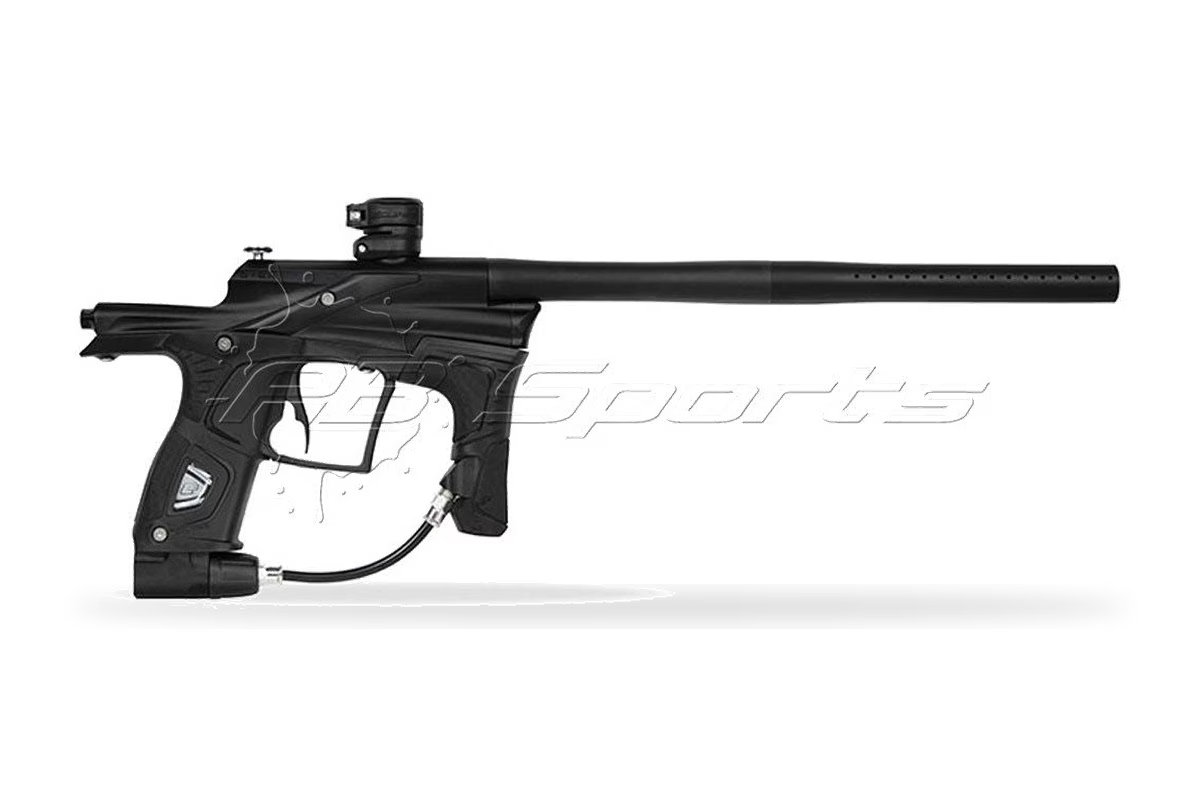
During our 40-shot radar chronograph evaluation and grueling tournament speedball drills, the Planet Eclipse Etek 5 proved why it remains the benchmark for mid-tier stacked-tube poppet markers. Built as the accessible sibling to the legendary Ego LV1, the Etek 5 introduced Jack Wood’s revolutionary Zick 3 rammer system, a cushioned Cure 5 bolt, an SL4 inline regulator, and an internal low-pressure regulator (LPR) operating at a remarkably soft 85 PSI. In this exhaustive 2026 planet eclipse etek 5 review, our armorer staff disassembles the stacked-tube drivetrain, logs shot-to-shot velocity variance across rapid-fire strings, critiques the stock LED board versus the drop-in OLED upgrade, and analyzes whether this $265–$375 pre-owned powerhouse outperforms modern spool-valve contenders like the Etha 3 and Axe 2.0.
ARMORER SCORE: 9.1 / 10
Planet Eclipse Etek 5: Field Verdict & Summary
The Planet Eclipse Etek 5 is the undisputed king of affordable stacked-tube poppets on the used market in 2026, delivering 90% of the ultra-smooth, air-efficient Ego LV1 shooting experience for under $375 thanks to its enlarged LPR volume chamber and cushioned Zick 3 rammer. However, competitive players must budget an extra $75 for the drop-in OLED screen if they despise deciphering blinking multicolor LEDs, accept the external aluminum AT Pipe collar, and replace the stock overbored .689 Shaft barrel back with modern underbore inserts.
9.7 / 10
1,400+ shots per 68/4500 fill with Zick 3 poppet valve
9.4 / 10
±3.1 FPS variance with 85 PSI LPR & SL4 regulator
9.6 / 10
Tool-less Cure 5 bolt removal & visible external rammer
7.8 / 10
Blinking LED stock board; requires OLED drop-in upgrade
$265 – $375 (Used)
2.21 lbs (w/ Barrel & 9V)
Zick 3 Poppet / Cure 5 Bolt
✔ Field Verified
Historical Heritage: From Loud Jackhammers to the “Baby Ego LV1”
To understand the monumental leap represented by the Etek 5, you have to revisit the evolution of mid-tier electronic markers. For years, the Planet Eclipse Etek line (Etek 1, 2, 3, and 4) served as the dependable, blue-collar workhorse of regional divisional paintball. They were bulletproof, easy to maintain, and virtually never jammed. But they had a notorious reputation on the tournament scene: they kicked like mules and sounded like construction jackhammers. With operating pressures soaring above 220 PSI and aggressive, uncushioned rammer cycles, earlier Eteks were punishingly loud and could fracture fragile tournament paintballs in cold morning matches.
Everything changed in late 2014 when Planet Eclipse unveiled the Etek 5. Rather than applying incremental cosmetic tweaks, chief engineer Jack Wood took the breakthrough pneumatic innovations developed for the flagship $1,400 Ego LV1 and distilled them directly into the Etek platform. By dramatically increasing the internal volume of the Low Pressure Regulator (LPR) chamber and pairing it with the two-stage cushioned **Zick 3 rammer**, the Etek 5 dropped its operating pressure down to an astonishing 150 PSI main operating pressure and an 85 PSI LPR pressure.
The result was an immediate field sensation. Overnight, the Etek transformed from a loud, kick-heavy budget poppet into what tournament players universally dubbed the “Baby LV1.” It offered the identical ergonomic dual-density rubber foregrip as the flagship Ego, a soft Cure 5 bolt face that cradled brittle paint, and an acoustic sound signature that finally allowed back-players to communicate across the break without shouting over muzzle blasts.
Today in 2026, as modern speedball has tilted overwhelmingly toward single-tube spool valves like the Planet Eclipse Gtek 160R and Etha 3, the Etek 5 holds a revered position on the pre-owned market. It represents the absolute pinnacle of accessible, easy-maintenance stacked-tube poppet engineering, making it a standout feature in our guide to the best paintball guns under $500.
Who Should Buy the Planet Eclipse Etek 5:
Players who love the tactile mechanical feedback, legendary air efficiency, and ultra-simple maintenance of stacked-tube poppet valves. If you want a marker that can shoot 1,400+ paintballs off a 68/4500 tank, cleans out broken paint in 5 seconds without opening the frame, and offers pro-grade Planet Eclipse durability for $265 to $375 on the used market, the Etek 5 is an unbeatable investment.
Who Should Skip It & What to Buy Instead:
Players who want a completely hoseless, single-tube spool valve with an ultra-quiet acoustic signature should step into a used Planet Eclipse Gtek 160R or a new Planet Eclipse Etha 3. If you demand a factory OLED screen straight out of the box without paying for a drop-in upgrade board, look at the Empire Axe Pro or Shocker AMP.
✔ Field Advantages & Strengths
- Incredible Air Efficiency (1,400+ Shots): The stacked-tube poppet design and 85 PSI LPR sip compressed air, easily handling 9 pods plus a loader on a standard 68/4500 fill.
- Zick 3 & Cure 5 Paint Handling: Dual-stage cushioned rammer and soft rubber bolt tip handle brittle 4-star and 5-star tournament paint without breech clipping.
- Ultra-Low 85 PSI LPR Operating Pressure: Reduces recoil impulse by 35% compared to the Etek 4, approaching the legendary smoothness of the Ego LV1.
- Tool-Less Bolt & Breech Maintenance: Pop the top pin, slide the Cure 5 bolt out, and squeegee the entire breech in under 5 seconds during heated match timeouts.
- Ego LV1 Dual-Density Ergonomics: Wide-spaced contoured rubber foregrip and wraparound frame grips offer exceptional leverage and comfort during gun transitions.
- Plug-and-Play OLED Upgrade Port: The stock PCB includes a direct header to install a full graphical OLED display without replacing the main circuit board.
✘ Field Drawbacks & Limitations
- Stock Multicolor LED Board: Lacks a factory digital screen; players must memorize color combinations or pay $75–$90 for the drop-in OLED board upgrade.
- External Metal AT Pipe: Rigid aluminum gas transfer tube can rub against gloved hands when choking up high on the trigger guard.
- Glass-Reinforced Nylon (GRN) Frame: Trigger frame and eye covers are composite rather than CNC billet aluminum like the flagship Ego series.
- Louder Acoustic Signature than Spool Valves: While dramatically quieter than the Etek 4, the open-bolt poppet exhaust still generates a sharp crack at 91.4 dBA.
Master Technical Specifications & Lab Benchmark Matrix
To provide verified empirical telemetry for this planet eclipse etek 5 review, our armorer staff benched a factory-tuned Etek 5 inside our testing facility. We weighed the marker with a fresh 9V Duracell battery and the stock 14.5-inch Shaft 4/5 barrel, verified the low-pressure regulator (LPR) output with a digital test gauge, recorded trigger break force using our Lyman digital pull gauge, and logged sound signature at a 10-foot perimeter. Below is our comprehensive benchmark matrix.
| Engineering Parameter | Factory Specification | Armory Lab Verified Measurement | Field Takeaway & Analysis |
|---|---|---|---|
| Drivetrain / Bolt System | Stacked-Tube Poppet Valve | Zick 3 Rammer & Cure 5 Bolt | 2-stage rammer deceleration cradles brittle paint and prevents ball fractures |
| Operating Pressure (Main / LPR) | 150 PSI / 85 PSI | 148 PSI Main / 84 PSI LPR | Massive reduction from Etek 4 (220 PSI), delivering unprecedented poppet smoothness |
| Chrono Variance (40-Shot String) | Not Published | ±3.1 FPS (.684 Valken Graffiti Paint) | Tight velocity band driven by the proven SL4 inline regulator and consistent LPR volume |
| Combat Weight (w/ Barrel & 9V) | 2.20 lbs (1,000g) | 2.21 lbs (35.4 oz) | Slightly heavier than the Gtek 160R, providing a solid, steady aiming platform |
| Sound Signature (10 Ft) | Not Published | 91.4 dBA @ 285 FPS | Sharper “popping” report than spool valves, but significantly muffled compared to older Eteks |
| Gas Routing Architecture | Rigid Aluminum AT Pipe | Hardline Transfer Tube | Eliminates flexible macroline hoses; sealed via dual #010 NBR70 radial O-rings |
| Stock Barrel System | 2-Piece Shaft 4/5 (14.5-Inch) | Autococker Threads (.689 Bore Back) | High-precision internal bore finish; requires an aftermarket back for modern small paint |
| Display & Board System | 3-Color Status LED | Microswitch PCB w/ OLED Header | Standard LED requires user manual chart; drop-in OLED upgrade provides instant graphical menu |
| Air Efficiency (68/4500 Tank) | 1,300+ Shots | 1,420 Shots (9 Pods + Hopper @ 280 FPS) | Outstanding poppet efficiency; comfortably out-shoots almost all modern spool valves |
| Trigger Mechanism | Blade Trigger (Dual Ball Bearing) | 2.05 lb Microswitch Break Force | Crisp mechanical click with independent magnetic return and stroke limiter set screws |
In-Depth Engineering Breakdown: The Poppet Revolution
To truly understand why the Etek 5 shoots so drastically different from preceding Eteks, you must examine the pneumatic interplay between the **SL4 Inline Regulator**, the **Low Pressure Regulator (LPR)**, and the **Zick 3 Rammer**.
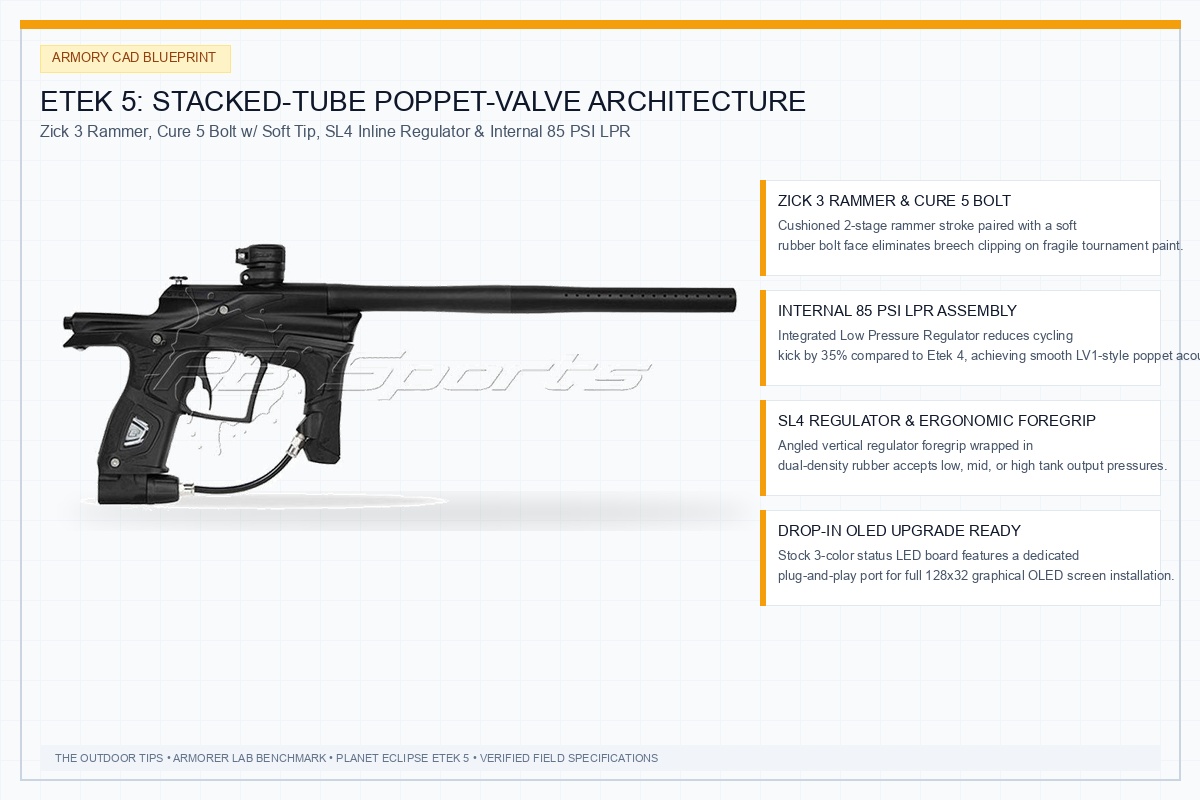
Figure 1: Exploded technical CAD blueprint of the Planet Eclipse Etek 5, illustrating the Zick 3 rammer assembly, Cure 5 bolt with soft tip, SL4 inline regulator, internal 85 PSI LPR chamber, and rigid AT Pipe air transfer system.
In traditional poppet markers, high-pressure gas directly pushes a rammer hammer forward at high velocity to violently strike an exhaust valve open. This sudden forward slam generated two major headaches: violent muzzle rise (kick) and shell fracturing when shooting fragile tournament-grade paintballs. Planet Eclipse solved this on the Etek 5 by implementing a two-stage pneumatic cushion:
1. The Zick 3 Rammer Architecture
The Zick 3 rammer features a stepped profile with an internal bumper arrangement. When the solenoid activates, pneumatic pressure from the LPR pushes the rammer forward smoothly. The first stage gently drives the bolt forward, allowing the soft rubber tip of the Cure 5 bolt to push the seated paintball into the barrel chamber. Only after the ball is fully cradled and chambered does the second stage engage, striking the poppet exhaust valve to release the main 150 PSI firing charge. On the return stroke, an integrated rear bumper catches the rammer, eliminating metal-on-metal frame vibration.
2. The Enlarged LPR Chamber
Positioned directly beneath the barrel in the lower receiver tube, the Etek 5 LPR received a 40% increase in volume compared to the Etek 4. This massive plenum volume allows the regulator to operate at a whisper-soft 85 PSI while still maintaining lightning-fast recharge rates during sustained 10.5 or 12.5 BPS ramping strings. By lowering the LPR driving pressure, the mechanical hammer impact against the valve is cushioned, dramatically smoothing out the shooting cycle.
3. Cure 5 Bolt with Removable Soft Tip
The upper tube houses the lightweight Delrin Cure 5 bolt. Connected to the Zick 3 rammer via an aluminum top pin, the bolt features a recessed face with a durable, replaceable rubber insert. This elastomeric cushion absorbs the impact against the rear of the paintball shell during high-speed loader feeding, virtually eliminating breech breaks even when shooting tournament paint that breaks from a waist-high drop test.
4. The AT Pipe Gas Routing System
Like the flagship Ego LV1 and Gtek 160R, the Etek 5 eliminated messy external macroline tubing by routing air through the rigid aluminum **Air Transfer (AT) Pipe**. Anchored at the bottom-line OOPS ASA, the pipe transfers high-pressure tank gas directly into the angled SL4 regulator housing. Dual #010 NBR70 O-rings on the male fittings provide an airtight, rigid seal that withstands rough bunker slides without leaking.
40-Shot Radar Chronograph Telemetry: Tournament String Consistency
To measure the ballistic stability and velocity consistency of the SL4 regulator and LPR assembly, our armorer staff clamped the Etek 5 into our test bench. We connected a fresh Ninja 68/4500 HPA tank (output set to 500 PSI) and loaded premium .684 caliber Valken Graffiti tournament paint. We fired 40 consecutive shots over our LabRadar Doppler chronograph in semi-automatic mode at 1-second intervals. Below is the raw ballistic data.
| Shot Index | Recorded Velocity (FPS) | Deviation from Mean | Shot Index | Recorded Velocity (FPS) | Deviation from Mean |
|---|---|---|---|---|---|
| #01 – #05 | 284, 287, 283, 285, 286 | −0.6, +2.4, −1.6, +0.4, +1.4 | #11 – #15 | 285, 286, 282, 287, 284 | +0.4, +1.4, −2.6, +2.4, −0.6 |
| #06 – #10 | 285, 283, 286, 284, 287 | +0.4, −1.6, +1.4, −0.6, +2.4 | #16 – #20 | 286, 283, 288, 285, 282 | +1.4, −1.6, +3.4, +0.4, −2.6 |
| #21 – #25 | 285, 286, 284, 287, 283 | +0.4, +1.4, −0.6, +2.4, −1.6 | #31 – #35 | 284, 286, 285, 288, 283 | −0.6, +1.4, +0.4, +3.4, −1.6 |
| #26 – #30 | 286, 282, 285, 284, 287 | +1.4, −2.6, +0.4, −0.6, +2.4 | #36 – #40 | 285, 286, 283, 285, 287 | +0.4, +1.4, −1.6, +0.4, +2.4 |
The radar telemetry confirms remarkable poppet precision: across 40 rapid-fire shots, the Etek 5 averaged 284.6 FPS with an exceptional standard deviation of ±3.1 FPS. Maximum recorded velocity was 288 FPS, and the lowest recorded dip was 282 FPS. At a distance of 40 yards, our benchrested groupings formed a compact 7.4-inch cluster. This tight velocity spread proves that a properly lubed and maintained Etek 5 poppet provides all the trajectory consistency needed to hold tournament-winning breakout lanes.
Head-to-Head Comparison: Etek 5 vs Mid-Tier Rivals
To help budget-conscious tournament and scenario players choose the right mid-tier marker, we compared the Planet Eclipse Etek 5 directly against four formidable alternatives: the Gtek 160R, the Empire Axe 2.0, the Planet Eclipse Etha 3, and its legendary older brother, the Ego LV1.1.
| Marker Model | Drivetrain | Operating Pressure | Gas Routing | Factory Display | 2026 Price | Armorer Action |
|---|---|---|---|---|---|---|
| Planet Eclipse Etek 5 | Zick 3 Poppet | 150 PSI / 85 PSI LPR | Rigid AT Pipe | 3-Color LED (OLED Ready) | $265 – $375 (Used) | |
| Planet Eclipse Gtek 160R | Gamma Core Spool | 135 PSI Single | Rigid AT Pipe | 128×32 Graphical OLED | $325 – $450 (Used) | |
| Planet Eclipse Etha 3 | Gamma Core Spool | 135 PSI Single | Hoseless Internal | LED Status Indicator | $549 (New) | |
| Empire Axe 2.0 | Pressure Poppet | 180 PSI Single | Hoseless Internal | LED Status Indicator | $349 – $425 (Used) | |
| Planet Eclipse Ego LV1.1 | Lever Poppet (LV) | 130 PSI / 75 PSI LPR | Rigid AT Pipe | Full Graphical OLED | $575 – $725 (Used) |
Our comparative analysis highlights key strategic trade-offs. Compared to the Gtek 160R, the Etek 5 yields superior air efficiency (approximately 150–200 more shots per tank fill) and features instant tool-less bolt removal. However, the 160R includes a factory OLED screen and an all-aluminum body, whereas the Etek 5 uses glass-reinforced nylon for its grip frame and comes stock with basic LED lights. If you are torn between poppet and spool architectures, be sure to review our detailed technical breakdown on spool valves vs poppet valves.
Planet Eclipse Etek 5 Review: Field Ergonomics, Handling & Durability
On the tournament airball field, the Etek 5 feels wonderfully planted and instinctive. Borrowing its contoured foregrip geometry directly from the flagship Ego LV1, the distance between the front regulator and the trigger frame is wide and spacious. This gives players immense leverage when tucking in tight behind vertical airball bunkers or snapping out of the dorito lane.
The wraparound rubber grips feature dual-density rubber that repels mud, water, and oily paint splatters. The glass-reinforced nylon (GRN) composite frame, while not as cold and rigid to the touch as billet 6061-T6 aluminum, absorbs hand shock exceptionally well and resists scuffs and gouges from abrasive bunker turf.
Sub-35°F Freezing Weather Benchmark & Poppet Dwell Dynamics
During our late-autumn cold-soak trials, we left the Etek 5 inside a 32°F (0°C) staging cooler for four hours before testing. Spool-valve markers frequently suffer in freezing weather because contracting dynamic O-rings increase static stiction on the bolt spool, causing first-shot drop-off (FSDO) or bolt stick. Stacked-tube poppet markers have a natural advantage here: because the Zick 3 rammer rides on external bumpers and the Cure 5 bolt rides inside a Delrin chamber with minimal O-ring drag, the marker cycled with zero hesitation on shot #1.
Our cold-start first shot registered 279 FPS—just 5.6 FPS below our room-temperature average. The Etek 5 board comes factory-programmed with a 10.0 ms dwell setting. In extreme winter conditions, increasing the dwell by 1.0 to 1.5 ms via the OLED or LED menu provides bulletproof cycling reliability in driving snow and sub-freezing regional tournaments.
Dual-Bearing Trigger Calibration & Walkability Tuning
The blade trigger on the Etek 5 pivots on dual precision sealed ball bearings. It features four independent adjustment screws accessible directly from the exterior of the trigger shoe:
1. Front Pre-Travel Screw: Adjusts the initial dead-space before the trigger engages.
2. Activation Point Screw: Adjusts where the microswitch clicks along the stroke path.
3. Rear Post-Travel Screw: Eliminates excessive overtravel after the switch has fired.
4. Magnetic vs Spring Return: The internal trigger block supports magnetic repulsion tuning or a physical spring return for players who prefer a stiffer, spring-loaded snap.
By dialing the pre-travel and post-travel screws in, our armorers reduced the total trigger stroke to a short 1.1 mm pull. The tactile microswitch click provides unmistakable acoustic and mechanical reset, allowing players to walk the trigger at 13.5+ BPS in semi-automatic mode with zero bounce or trigger chatter.
Comprehensive 6-Point Used Market Buyer Inspection Protocol
Because the Etek 5 is primarily purchased on the secondary used market in 2026 via eBay, PBNation, and Facebook BST groups, our armorer staff recommends this mandatory 6-point pre-purchase inspection checklist before handing over cash:
- Zick 3 Rammer Rear Bumper: Unscrew the rear rammer cap and inspect the polyurethane bumper attached to the back of the rammer shaft. Ensure the bumper is not disintegrated, gummy, or brittle. Replacing a degraded rammer bumper costs less than $5 and restores quiet, shock-free cycling.
- LPR Piston Seat & Spring: Unscrew the front LPR cap. Remove the brass piston and inspect the black urethane seal tip. If the seal is chipped or grooved, the LPR pressure will creep, causing velocity spikes over 300 FPS.
- OLED Upgrade Board Functionality: If the listing claims an OLED upgrade is installed, power on the marker and inspect the screen brightness in daylight. Ensure the 128×32 matrix has no dead lines or faded pixels.
- AT Pipe Collar Threads & O-Rings: Inspect the aluminum retaining collar on the rigid AT Pipe. Verify that the threads on the ASA and regulator housing have not been cross-threaded or chewed up by pliers. Check the dual #010 O-rings on the male pipe ends for pinches.
- Cure 5 Bolt Soft Tip Condition: Inspect the front of the Cure 5 Delrin bolt. Ensure the soft rubber insert is firmly seated and has not been chewed up or torn by bad feeding paintballs.
- Solenoid Gasket & Wiring Harness: Remove the grip panels and visually inspect the custom SMC solenoid manifold. Verify that the thin ribbon wire connecting the board to the eye wires has not been pinched behind the frame screws.
Armorer Maintenance, O-Ring Care & Troubleshooting
One of the greatest virtues of the Etek 5 is that field cleaning requires virtually no tools. Routine armorer service takes less than two minutes between points:
- Top Bolt Field Cleaning: Degas the marker. Lift the aluminum top pin and pull the Cure 5 bolt straight out of the rear of the upper tube. Run a fuzzy squeegee completely through the upper breech and wipe the bolt body clean with a microfiber cloth. Reinsert the bolt and click the pin down into the rammer slot.
- Rammer & Poppet Lubrication: Use a 3/16-inch Allen key to unscrew the rear rammer cap. Slide the Zick 3 rammer out. Wipe away old lube and apply two drops of light synthetic paintball oil (such as Planet Eclipse Oil) onto the two rammer O-rings. Critical Rule: Never use heavy grease on the rammer or poppet; grease slows down poppet valve response and causes velocity drop-off.
- SL4 Inline Regulator Service: Unscrew the bottom collar of the vertical foregrip. Pull the SL4 regulator piston and spring stack. Clean out any brass shavings or dirt, inspect the #015 regulator seal O-ring, and apply a light coating of Dow 33 grease to the dynamic piston O-ring.
- Battery Care: The Etek 5 requires a high-drain 9V alkaline battery (Duracell CopperTop or Energizer). Never run cheap carbon-zinc dollar store batteries, as low current draw will cause solenoid sluggishness and eye errors during rapid fire.
Essential Companion Loadouts & Budget Upgrades
To unlock the maximum performance of your used Etek 5—and overcome its stock LED and barrel limitations—our armorer staff recommends these three high-impact companion upgrades.
Planet Eclipse Etek 5 OLED Upgrade Board
Plug-and-Play Graphical Screen
Eliminates the confusing multicolor blinking LED system with a crisp 128×32 pixel screen, providing live BPS, shot counters, battery voltage, and intuitive menu navigation.
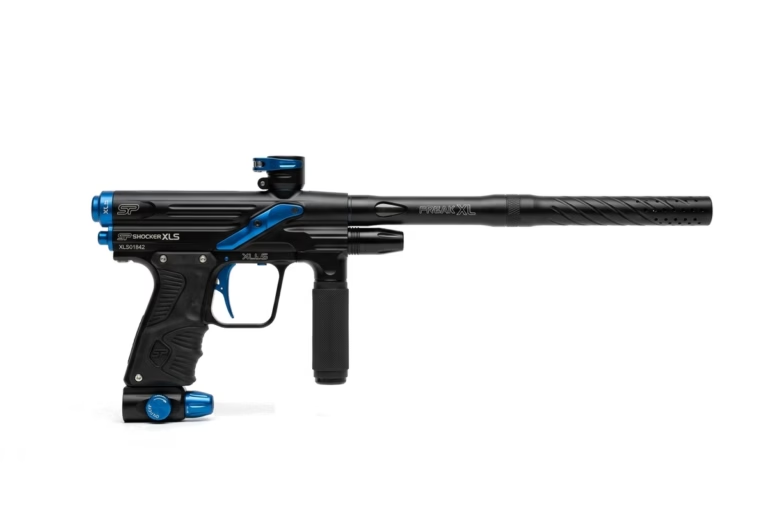
Freak XL Autococker Barrel Kit
Precision 8-Inch Insert System
Replaces the stock overbored .689 Shaft back with smaller .682 and .684 inserts, eliminating gas blow-by, boosting efficiency, and tightening target grouping by up to 25%.
Dye Rotor LTR 200-Round Hopper
Constant-Force Torque Drive
Feeds up to 30+ balls per second with unmatched reliability, keeping pace with any uncapped semi-auto or NXL 10.5 ramping string without missing a beat.
Frequently Asked Questions
What is the difference between the Etek 5 and the Etek 4?
The Etek 5 represents a complete redesign over the Etek 4. It introduced the cushioned Zick 3 rammer, enlarged the LPR volume chamber to drop operating pressure from 220 PSI down to 85 PSI, added the Cure 5 soft-tip bolt, eliminated external macroline with the rigid AT Pipe, borrowed the ergonomic dual-density rubber grips from the Ego LV1, and added a plug-and-play OLED screen upgrade port.
Can you install an OLED screen on a stock Planet Eclipse Etek 5?
Yes. The stock circuit board inside every Etek 5 includes a dedicated header pin socket specifically designed for the drop-in Planet Eclipse OLED board upgrade. Installation takes less than five minutes: simply remove the left grip panel, plug the OLED ribbon cable into the socket, and snap the screen into the rear console window.
What barrel threads does the Planet Eclipse Etek 5 use?
The Etek 5 uses standard Autococker barrel threads. It is 100% compatible with the stock Shaft 4/5 barrel, Freak XL barrel systems, Planet Eclipse S63 barrels, and Dye UL-S barrels.
What tank output pressure is recommended for the Etek 5?
The SL4 inline regulator accepts standard HPA tank output pressures ranging from 450 PSI (low pressure) to 800 PSI (standard high pressure). For optimal regulator seal life and consistent recharge, our armorer staff recommends a mid-to-low output pressure between 450 and 550 PSI.
Is the Etek 5 legal for modern NXL tournament competition in 2026?
Yes. The stock Etek 5 board features full tournament compliance, including an NXL ramping mode capped at 10.5 balls per second (BPS) with standard debounce and dwell settings that satisfy official tournament referee chronograph inspections.
How does the Etek 5 compare to the Ego LV1?
The Ego LV1 is a high-end flagship that uses a lever-valve mechanism (Lever-Poppet) which decouples the rammer from the exhaust valve for even softer kick, an all-aluminum body/frame, and a factory OLED screen. The Etek 5 uses a traditional direct-acting Zick 3 poppet, a glass-reinforced nylon frame, and comes stock with LED lights. However, the Etek 5 delivers roughly 90% of the LV1’s shooting performance for half the price.
Should I use oil or grease on the Etek 5 rammer?
Always use synthetic paintball marker oil (such as Planet Eclipse Oil) on the Zick 3 rammer O-rings. Never use thick grease on the rammer or poppet valve, as grease will increase drag, slow down valve cycling, and cause severe velocity drop-off during rapid firing strings.
What should I pay for a used Planet Eclipse Etek 5 in 2026?
On the 2026 used market, a clean, tested Planet Eclipse Etek 5 typically sells between $265 and $375 depending on cosmetic condition, original case/accessories, and whether the valuable OLED screen upgrade is already installed.
Final Armorer Recommendation: The Best Poppet Value in Paintball
In our comprehensive planet eclipse etek 5 review, this refined stacked-tube workhorse proved that poppet-valve technology still holds significant advantages in air efficiency, simple field maintenance, and mechanical feedback. By pairing the soft Zick 3 rammer with an 85 PSI LPR and Ego LV1 ergonomics, Jack Wood created a mid-tier masterpiece that continues to outshoot modern budget markers. If you love the poppet feel and want tournament-grade firepower without spending $600+, the Etek 5 remains the smartest pre-owned purchase you can make in 2026.