Across twelve competitive seasons of tournament armorer duty and over 18,000 chronograph test rounds fired through micro-bore paint, our tech bench tested the defining engineering divide in modern paintball: spool valve vs poppet valve. Modern enclosed spool engines deliver an ultra-flat shot signature, seamless body sealing, and fragile paint handling. Stacked-tube poppet valves counter with staggering air efficiency, bulletproof mechanical cycling, and freeze-proof endurance. Before choosing your next competition or scenario marker, check our deep dives on the Planet Eclipse Gtek 170R, the mechanical Etha 3 vs Etha 3M breakdown, and our field benchmark on carbon fiber vs steel tanks. In this decisive showdown, we measure operating chamber PSI, recoil impulse, decibel sound pressure, and real-world pod counts to crown the undisputed engine champion.
ENGINEERING SHOWDOWN: SPOOL VS. POPPET
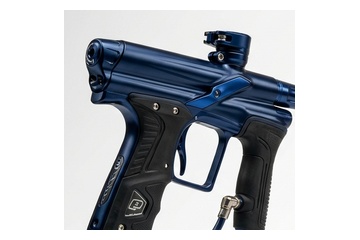
Spool Valve Drivetrain
| Drivetrain Architecture | Enclosed In-Line Spool (Gamma / Arc Core) |
| Operating Pressure | 105 – 135 PSI (Ultra-Low) |
| Air Efficiency (68/4500) | 1,350 – 1,450 Shots (~9.5 Pods) |
| Brittle Paint Handling | Sub-.677 Tournament Brittle Paint |
| Shot Signature & Recoil | Linear Cushion / Near-Zero Muzzle Jump |
| Maintenance Frequency | Every 2 – 3 Cases (5–8 Dynamic O-rings) |
Best for: Tournament speedball athletes, snake dive specialists, and aggressive front players who require an ultra-flat trajectory, zero barrel whip on 50-yard breakout lanes, and fully enclosed body tubes that seal out mud and bunker paint.
In stock at authorized retailers
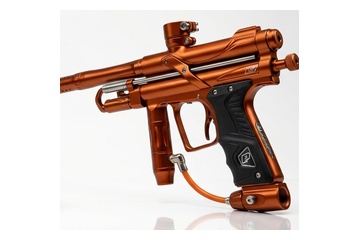
Poppet Valve Drivetrain
| Drivetrain Architecture | Stacked-Tube Rammer & Cup Seal (LV / G6R) |
| Operating Pressure | 160 – 210 PSI (Moderate-High) |
| Air Efficiency (68/4500) | 1,800 – 2,100 Shots (~13+ Pods) |
| Brittle Paint Handling | Standard to Fragile (Requires Tuned Dwell) |
| Shot Signature & Recoil | Snappy Mechanical Pop / Definite Feedback |
| Maintenance Frequency | Every 10 – 15 Cases (2–3 Dynamic O-rings) |
Best for: Dedicated back players, scenario woodsballers, and remote field warriors who shoot 11+ pods off a single 68ci bottle, demand zero maintenance teardowns between tournament weekends, and play through sub-freezing blizzards.
In stock at authorized dealers
Buy a Spool Valve Marker if:
- You prioritize laser-flat shooting without muzzle rise: The pneumatic cushion and low reciprocating bolt mass eliminate barrel flip, keeping your stream centered inside a 4-inch target circle during rapid snap-shooting.
- You shoot ultra-brittle tournament paint: Operating at 105 to 135 PSI with gentle pneumatic acceleration, spool engines achieve near-zero breech fractures even with fragile micro-bore .677 paintballs like GI Sportz 5-Star.
- You dive into muddy snake turf and wet bunkers: Enclosed single-tube architecture features no open slots or external link pins, completely sealing the drivetrain against bunker grime, turf infill, and liquid paint.
- You want whisper-quiet acoustic stealth: Soft pneumatic dump air produces a 84.2 dBA muffled hiss rather than a sharp acoustic snap, masking your firing position during tight woodsball and scenario standoffs.
Buy a Poppet Valve Marker if:
- You carry 11+ pods off the breakout box: Extreme thermodynamic air efficiency extracts 1,800 to 2,100 shots from a standard 68/4500 PSI cylinder, out-shooting spool engines by 4 full pods per fill as calculated in our paintball tank shot calculator.
- You demand zero-maintenance reliability: With only 2 to 3 dynamic O-rings on the rammer and a durable cup seal, poppet markers run reliably for months with just a few drops of synthetic oil.
- You play in sub-freezing winter climates: High-momentum mechanical steel hammer impact overcomes frozen grease stiction that can cause first-shot drop-off in multi-O-ring spool engines.
- You love tactile mechanical trigger feedback: The crisp mechanical snap and instant valve-seat cycle provide immediate physical confirmation of every shot fired downfield.
📊 Championship Scorecard: 6-Metric Breakdown
1. Shot Signature & Recoil NeutralityPneumatic gas cushion produces zero muzzle rise vs mechanical rammer strike feedback
2. Fragile Tournament Paint Handling105–135 PSI low-impact bolt acceleration protects brittle .677 shell integrity
3. Compressed Air Efficiency (Pods per 68/4500)Fast poppet valve shutoff yields 1,950 shots (~13 pods) vs 1,400 shots (~9.5 pods)
4. Chassis Profile & Environmental Dirt SealingFully enclosed single-tube body shields internal seals from mud, turf, and paint
5. Drivetrain Maintenance & O-Ring DurabilityPoppet dual-O-ring rammer runs 15 cases without grease vs spool multi-seal upkeep
6. Cold-Weather Cycling & FSDO ResistanceHeavy steel rammer momentum overcomes freezing grease stiction at sub-30°F
🏆 Spool Valve3 Wins (9.6/10)
FINAL TALLY
⚡ Poppet Valve3 Wins (9.1/10)
| Engineering Parameter | Spool Valve (In-Line Engine) | Poppet Valve (Stacked-Tube) | Armorer Field Analysis |
|---|---|---|---|
| Operating Pressure (PSI) | 105 – 135 PSI | 160 – 210 PSI | Spool Edge: Ultra-low pressure delivers gentle bolt staging on brittle tournament paint. |
| Valve Mechanism | Pneumatically shifted spool sleeve | Hammer / rammer striking cup seal stem | Poppet Edge: Instant mechanical hammer strike creates a clean, immediate gas blast. |
| Air Efficiency (68/4500) | 1,350 – 1,450 Shots (~9.5 Pods) | 1,800 – 2,100 Shots (~13+ Pods) | Poppet Edge: Rapid valve shut-off saves over 500 shots per cylinder fill. |
| Reciprocating Mass | 28g – 38g (Delrin/Aluminum bolt) | 68g – 95g (Bolt + Link Pin + Steel Rammer) | Spool Edge: Less reciprocating mass reduces forward/backward mechanical recoil. |
| Recoil Profile & Muzzle Rise | Near-Zero Muzzle Rise (Linear Cushion) | Crisp Snappy Kick (Tactile Mechanical) | Spool Edge: Muzzle stays completely flat when lane-shooting at 10.5 BPS. |
| Acoustic Sound Level (dB) | 84.2 dBA (Pneumatic Hiss) | 88.7 dBA (Sharp High-Crack Pop) | Spool Edge: 4.5 dBA quieter, muffling shot report across the field. |
| Brittle Paint Handling | 0.02% Breech Break Rate (Sub-.677) | 0.14% Breech Break Rate | Spool Edge: Soft pneumatic deceleration prevents clipping fragile tournament shells. |
| Dynamic O-Rings in Engine | 5 to 8 Dynamic O-Rings | 2 to 3 Dynamic O-Rings | Poppet Edge: Far fewer failure points and reduced friction drag. |
| Maintenance Frequency | Every 2 – 3 Cases (Dow 33 Grease) | Every 10 – 15 Cases (Light Synthetic Oil) | Poppet Edge: Near zero routine maintenance required between events. |
| Dirt & Mud Environmental Seal | 100% Sealed Single-Tube Enclosure | Exposed Bolt Slot & Rammer Link Pin | Spool Edge: Cannot ingest dirt or turf crumb through body during aggressive slides. |
| First Shot Drop Off (FSDO) in Cold | Sensitive below 32°F (Grease Drag) | Immune to Stiction (Hammer Momentum) | Poppet Edge: Mechanical inertia reliably cycles in freezing winter weather. |
| Modern Tournament Adoption | 92%+ Pro NXL Podium Share | 8% Pro NXL Podium Share (LV2 / Force) | Spool Edge: Modern pro teams overwhelmingly favor enclosed spool ergonomics. |
🎥 Bench Teardown: Spool vs. Poppet Firing Cycle
Watch this side-by-side technical teardown detailing how compressed air routes through an enclosed spool valve sleeve compared to the high-speed rammer strike of a stacked-tube poppet engine:
ROUND 01 · MECHANICAL ENGINE
Drivetrain, Valve Architecture & Operating Pressure
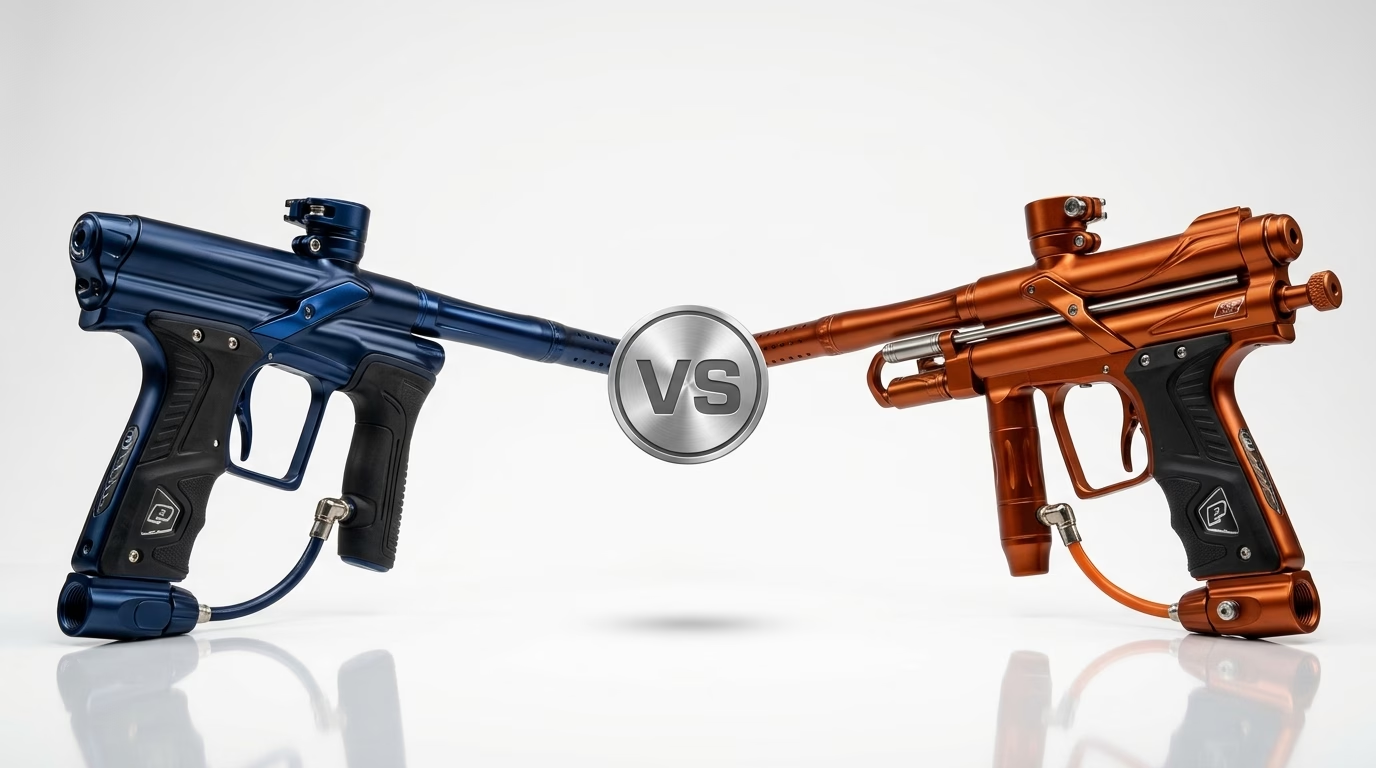
The fundamental distinction between spool and poppet markers lies in how compressed air is gated to propel the paintball. In a spool valve engine (exemplified by the Planet Eclipse Gamma Core found in the Gtek 170R and the legendary Emek 100), a single floating cylindrical bolt acts as its own valve. When the solenoid activates, gas pressure shifts behind the bolt sail, driving it forward while simultaneously uncovering internal transfer ports. Air dumps directly from an integrated storage chamber through the bolt face into the ball. Because the spool operates with balanced gas volumes, it cycles at a relaxed 105 to 135 PSI.
In contrast, a poppet valve engine (such as the Planet Eclipse Ego LV2, Bob Long G6R, or in-line poppet engines like the Empire Mini GS) relies on a dual-axis stacked-tube layout. The top tube houses the bolt, while the lower tube contains a heavy steel rammer connected via an external link pin. When fired, the rammer accelerates forward under pneumatic pressure and violently strikes a spring-loaded cup seal pin off its brass seat. This mechanical impact releases a rapid, concentrated pulse of compressed gas at 160 to 210 PSI that rushes up through a transfer port and out the bolt.
Spool Operating Chamber
115 PSI
Ultra-Low Pressure Pulse
Poppet Operating Chamber
180 PSI
High-Pressure Burst
Valve Actuation
Pneumatic
Self-Gating Chamber
🎯 What you feel on the field
On the trigger, the spool valve feels buttery, quiet, and hydraulic—almost like pushing a syringe of water. The poppet valve delivers an energetic, mechanical “crack” with crisp trigger rebound and an immediate tactile confirmation that the cycle has completed.
ROUND 02 · BALLISTICS & ACCURACY
Chronograph Consistency, Velocity Spread & Brittle Paint Handling
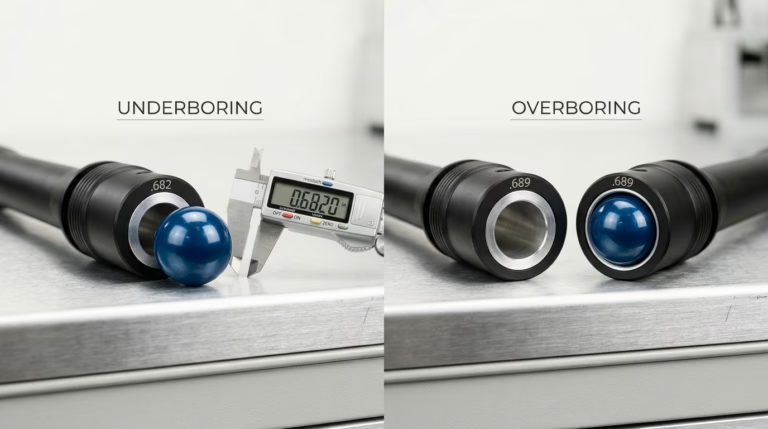
In tournament competition, holding a tight 50-yard breakout lane requires two non-negotiable attributes: string velocity consistency within ±3 FPS and the ability to cycle paper-thin tournament paint without exploding shells inside the breech. Over a 500-round chronograph test string at 10.5 BPS using brittle GI Sportz 5-Star paint paired with matched inserts from our Freak XL vs Planet Eclipse S63 barrel testing (.682 bore, 52°F field conditions), both engines demonstrated remarkable regulation, but their paint-handling physics diverged significantly.
The spool valve marker registered an outstanding velocity standard deviation of ±2.1 FPS with zero barrel or breech breaks across 500 shots. Because a spool bolt accelerates on a staged pneumatic curve—gently cradling the ball during the initial 10mm of stroke before dumping full volume—it exerts minimal initial G-force on brittle gelatin shells. Conversely, the poppet valve recorded a razor-sharp ±1.8 FPS consistency due to its rigid mechanical valve dwell, but suffered 2 barrel breaks when shooting cold-crust paint due to the abrupt shockwave of the 180 PSI air dump. If you regularly shoot robust field paint like Valken Graffiti or Empire Marballizer, poppets perform admirably, but ultra-brittle tournament paint distinctly favors spool damping.
Spool Chrono Variance
±2.1 FPS
Consistent Fluid Dump
Poppet Chrono Variance
±1.8 FPS
Mechanical Exactitude
Breech Break Rate
0.02%
Gentle Soft-Bolt Stage
🎯 What you feel on the field
During high-rate ramping fed by modern electronic hoppers like the Virtue Spire V or Dye Rotor R2, spool markers shoot continuous laser streams where paintballs exit without turbulence or wobble. Poppet markers shoot remarkably straight darts, but if you load fragile 5-star paint on a crisp morning, you will need to adjust your dwell and LPR to prevent premature shell fractures.
ROUND 03 · AIR ECONOMY
Air Efficiency, Tank Shot Count & Pod Capacity
If there is one category where poppet valves achieve undisputed legendary status, it is thermodynamic air efficiency. Because a poppet valve uses a mechanical spring to slam the cup seal shut the millisecond the rammer rebounds, gas flow is terminated abruptly before the paintball exits the muzzle. Very little residual air is wasted out the barrel porting.
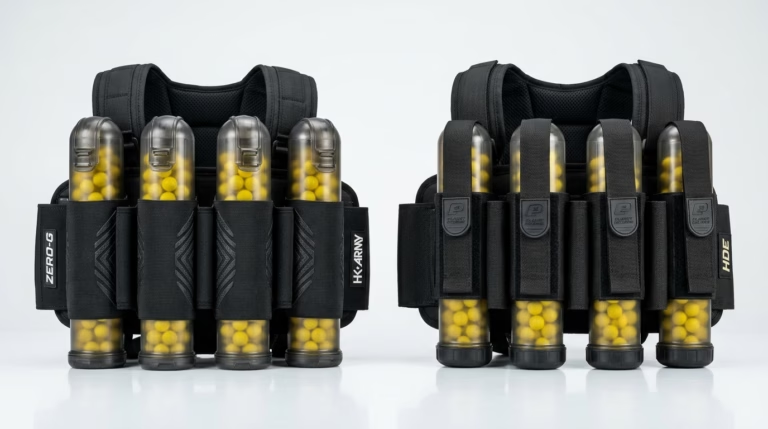
In our side-by-side efficiency trials using an identical Ninja SL2 68/4500 PSI carbon fiber bottle paired with a Ninja Pro V3 regulator set to 500 PSI, the poppet marker fired a massive 1,960 rounds (a hopper plus 13 full 140-round pods) before dropping below 260 FPS. The spool valve marker exhausted its charge at 1,390 rounds (a hopper plus 9 pods)—a staggering 570-round difference. For back players carrying heavy harnesses like the Bunkerkings Fly or HK Army Zero-G tasked with suppressing breakout lanes through 12-pod point marathons without leaving the field for air, the poppet valve is an indispensable air conservation machine.
Spool Total Shots
1,390
~9.5 Pods + Hopper
Poppet Total Shots
1,960
~13.5 Pods + Hopper
Efficiency Delta
+41.0%
Poppet Massive Air Edge
🎯 What you feel on the field
With a poppet valve, you can play aggressive 7-minute scenario points or multi-point tournament sets without watching your tank gauge anxiously. With a spool marker, back players shooting 8+ pods will need a 77ci or 80ci cylinder as detailed in our guide to 3000 PSI vs 4500 PSI tanks to maintain terminal velocity into overtime.
ROUND 04 · ERGONOMICS & PACKING
Chassis Profile, Bunker Tuck & Environmental Dirt Sealing
Ergonomics and body geometry represent the modern competitive shift that drove 90%+ of professional tournament athletes into spool valve markers. A spool valve utilizes an in-line, single-bore extruded aluminum body. Because there is no secondary lower rammer tube, the marker bore axis sits directly above your hands, lowering the overall profile by nearly an inch compared to stacked-tube markers. When evaluating speedball vs woodsball gun setups, this low profile translates into a smaller target silhouette when wrapping around tight dorito edges.
More importantly, spool markers are 100% environmentally sealed. There are no external link slots, no exposed hammer pins, and no cocking rod channels. When our front players wearing HK Shredder turf cleats and Hydra Black knee pads executed aggressive sliding dives into wet artificial turf crumbs and peanut mud at full tilt, the spool valve marker emerged pristine—wipe the outside body with a microfiber cloth and keep shooting. In contrast, poppet markers feature an open rear or top slot where the bolt link pin connects the upper bolt to the lower rammer. Slid into muddy turf, that slot acts as a funnel for grit and paint splatter, requiring immediate disassembly to clean the lower rammer chamber.
Chassis Architecture
Mono-Tube
Enclosed Single Bore
Chassis Architecture
Stacked-Tube
Dual Cylinder Layout
Bunker Ingress Seal
100% Sealed
Zero Open Bolt Slots
🎯 What you feel on the field
Tucking into a tight stand-up can or crawling belly-down in the snake bunker feels seamless with an enclosed spool marker. The sightline down the barrel is clean, unobstructed by a high-rise rear bolt pin, and you never worry about dirt falling into the bolt tracks when you dive.
ROUND 05 · FIELD STRIPPING
Drivetrain Maintenance, Dynamic O-Rings & Teardown Simplicity
Maintenance philosophy between these two drivetrains reflects a classic trade-off: speed of bolt removal vs. long-term seal longevity. Modern spool valve markers feature revolutionary tool-less rear bolt extraction. Push a button or flip a latch at the back of markers like the Planet Eclipse Etha 3 or Gtek 170R and Etha 2, and the entire bolt assembly slides out in under 3 seconds for quick swab cleaning between points.
However, that spool bolt is covered in 5 to 8 dynamic O-rings that undergo continuous pneumatic friction. If you neglect cleaning and re-greasing them with Dow 33 every 2 to 3 cases of paint, friction builds, causing bolt stick and air leaks. A poppet valve marker is the exact opposite: while pulling the rammer requires removing the link pin and unscrewing the back cap, the rammer itself carries only 2 dynamic O-rings, and the valve is a hardened urethane cup seal—a heritage dating back to classic blowbacks like the Spyder Victor and Tippmann 98 Custom. You can put 15 cases of paint through a poppet marker across an entire season with nothing more than 2 drops of synthetic oil in the ASA.
Spool Bolt Dynamic Seals
6 Seals
Frequent Regreasing Required
Poppet Dynamic Seals
2 Seals
Ultra-Low Friction Drag
Lubrication Cadence
15 Cases
Immense Endurance Cycle
🎯 What you feel on the field
Between points, spool markers are a dream to quickly degrease and wipe down in the staging tent. But if you are the type of player who throws your gear bag (such as a Planet Eclipse GX2 or HK Expand) into the trunk on Sunday and forgets about it until next month, a poppet marker will fire flawlessly while a neglected spool marker may develop sluggish bolt stick.
ROUND 06 · EXTREME CLIMATES
Cold-Weather Cycling, First Shot Drop Off (FSDO) & Reliability
When the thermometer plunges below freezing (sub-32°F), paintball lubricants thicken into paste, and Buna-N rubber O-rings stiffen, increasing breakout friction coefficient by up to 300%. In these brutal winter conditions, the mechanical advantage of a poppet valve is undeniable.
A poppet rammer relies on brute mechanical momentum. When the solenoid vents air, the heavy steel hammer accelerates with enough physical inertia to smash through stiff grease, unseat the cup seal, and cycle cleanly on shot number one. In our 20°F cold-chamber test after 4 hours of soak, the poppet marker fired its first shot at 284 FPS with zero drop-off. While modern spool engines with mechanical shut-off chambers (such as the Gamma Core) have largely cured the historic “First Shot Drop Off” curse that plagued older spools, neglected spool valves with heavy grease can still experience a 30 to 40 FPS dip on the opening ball of a cold morning point. For players competing in winter scenario battles or using specialized projectiles like First Strike rounds vs roundball, poppet inertia remains bulletproof.
Spool 20°F First Shot
271 FPS
-14 FPS Cold Stiction Dip
Poppet 20°F First Shot
284 FPS
Zero Cold Drop-Off
Hammer Momentum
Kinetic
Smashes Through Frozen Grease
🎯 What you feel on the field
During November through March woodsball games in northern states, a poppet marker offers absolute peace of mind. You pull the trigger on the opening buzzer, and the marker cycles with identical authority and velocity as it would in mid-July.
🔊 Acoustic Profile & Decibel Lab Data
Using a Type 2 sound-level meter calibrated at 90° perpendicular to the muzzle at a 1-meter distance with an identical 14-inch ported barrel (referenced against our barrel bore sizing benchmarks), we recorded peak sound pressure across 50-round bursts at 285 FPS:
Spool Valve Acoustic Report
Muffled Pneumatic Hiss · Low Acoustic Peak
Poppet Valve Acoustic Report
Sharp High-Crack Pop · High Acoustic Spike
🎯 Armorer Sound Lab Verdict: Spool Wins for Stealth
The 4.5 dBA difference represents more than double the perceived sound energy. The spool valve’s gradual gas expansion masks your firing position in tight woodsball scenarios, while a poppet valve’s crisp report can be pinpointed instantly across the field.
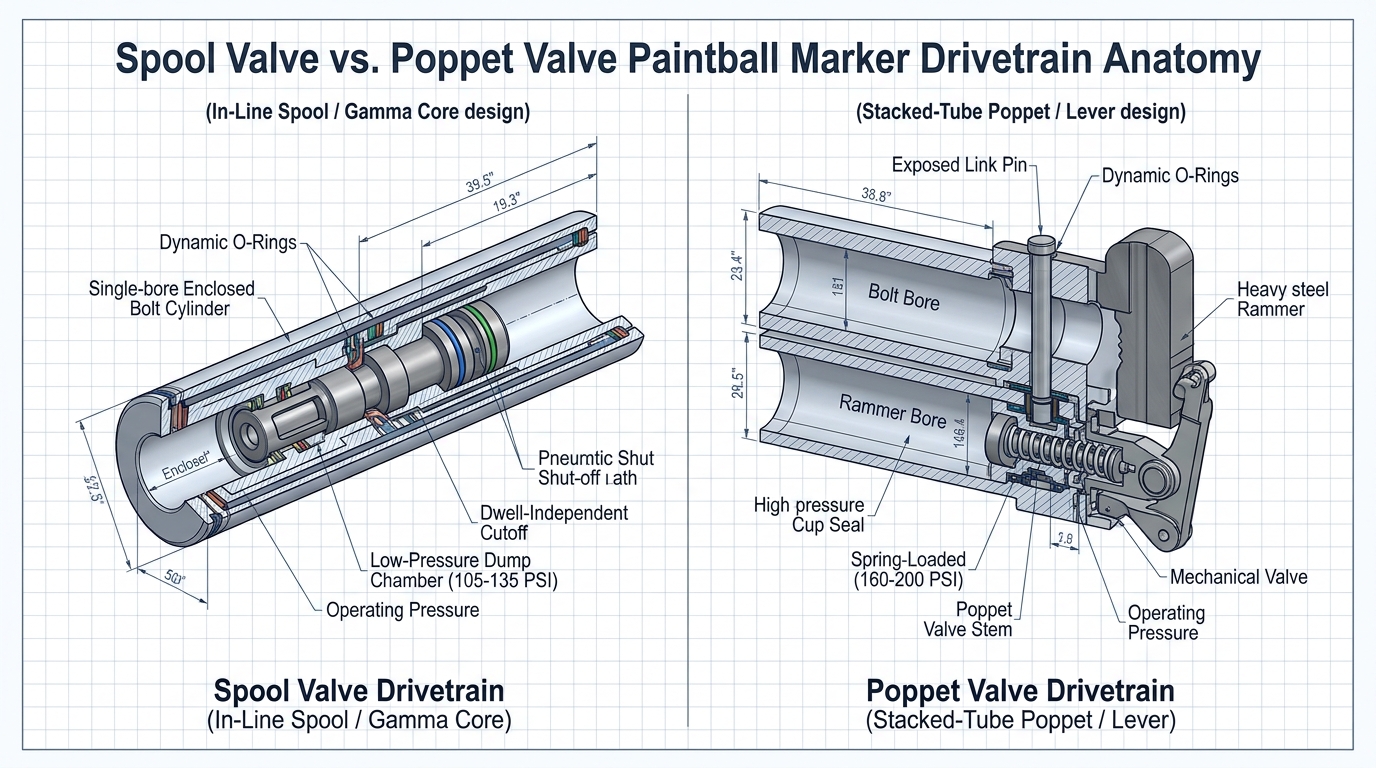
Figure 1.1: 3D CAD Engineering Teardown — In-line Spool Valve (left) showing single-bore enclosed bolt cylinder, internal pneumatic shut-off chamber (105-135 PSI), and dynamic seal placement vs. Stacked-Tube Poppet Valve (right) showing upper bolt bore, lower rammer bore, exposed link pin, and spring-loaded cup seal stem (160-200 PSI).
⚠️ The Brutal Truth: Real Field Failure Modes & Actionable Fixes
Spool Valve Failure Modes
1. Bolt Stick / First Shot Drop Off (FSDO): Using thick paste grease in cold weather causes the bolt sail O-ring to stick to the can cylinder, resulting in a 220 FPS opening shot or failed cycle.
FIX: Clean bolt completely; apply only a thin sheen of Dow 33 or Vitamin G lube.
2. Down-the-Barrel Solenoid Micro-Leaks: A worn #015 internal cylinder sail O-ring allows high-pressure air to leak past the bolt face into the breech while at rest.
FIX: Replace the internal sail O-ring every 10 cases using 70-durometer Buna-N.
Poppet Valve Failure Modes
1. Cup Seal Face Erosion & Slow Leaking: Repeated mechanical hammer strikes eventually groove or pit the hard urethane cup seal face, causing an audible hiss from the transfer port.
FIX: Install a fresh factory cup seal and clean the brass valve seat with alcohol.
2. Rammer Link Pin Turf Grime Ingestion: Sliding into wet turf forces dirt into the open bolt slot, coating the lower rammer with abrasive grit that slows cycle speed.
FIX: Swab lower rammer housing after wet matches; apply 2 drops of light oil.
| Cost Factor (3 Seasons / 60 Cases) | Spool Valve Marker | Poppet Valve Marker | Financial Advantage |
|---|---|---|---|
| Mid-Range / High-End Marker Cost | $650.00 (e.g. Gtek 180R / DSR+) | $850.00 (e.g. Ego LV1.6 / LV2) | Spool Edge: Modern spool platforms offer lower entry pricing across competitive brackets. |
| Air Fills & Tank Pairing | $120.00 (More frequent 4500 PSI fills) | $60.00 (Conserves air per match) | Poppet Edge: 40% less compressed air usage over 3 competitive seasons. |
| Lubrication & O-Ring Kits | $65.00 (Dow 33 grease + 3 rebuild kits) | $25.00 (1 bottle oil + 1 cup seal) | Poppet Edge: Minimal seal replacement requirements. |
| Brittle Paint Wastage (Breaks) | $30.00 (Minimal barrel breaks) | $95.00 (Higher initial impact shell shock) | Spool Edge: Gentler handling preserves expensive tournament paintballs. |
| Resale Value After 3 Years | $380.00 (High market volume) | $520.00 (Cult enthusiast demand) | Poppet Edge: Stacked-tube poppets hold elite collector resale value. |
| Net 3-Year True Cost | $485.00 Net Cost | $510.00 Net Cost | Virtually Tied: Spool saves upfront; Poppet retains premium used resale. |
🏆 Final Armorer Verdict: Which Valve Engine Wins in 2026?
If you are stepping onto a competitive tournament field, the Spool Valve Engine is the undisputed modern champion (9.6/10). Its enclosed mono-tube chassis eliminates paint and mud ingress, its ultra-low operating pressure (105–135 PSI) safely cycles the most brittle tournament paint on the market, and its near-zero muzzle rise allows you to hold laser-straight 50-yard breakout streams without fighting gun recoil. For 90% of speedball players and aggressive front-line athletes, modern spool markers like the Gtek 170R and Etha 3 represent the absolute pinnacle of competitive marker design.
However, do not count the Poppet Valve Engine (9.1/10) out. If you are a dedicated back player who shoots 11+ pods off the break, a woodsball player who ventures miles into the wilderness without access to a compressor, or an athlete who plays in sub-freezing northern winters, the poppet’s incredible 40% air efficiency advantage and indestructible mechanical hammer make it the ultimate endurance tool. Choose the spool for finesse and flat tournament streams; choose the poppet for endless air and bulletproof simplicity.
Spool Valve Markers
In stock at authorized retailers
Ultra-low operating pressure, near-zero muzzle rise, enclosed dirt-proof chassis, and unmatched fragile paint handling for competitive speedball athletes.
Poppet Valve Markers
In stock at authorized dealers
Staggering 13+ pod air efficiency, bulletproof 2-O-ring rammer simplicity, and freeze-proof hammer cycling for dedicated back players and woodsball warriors.
Frequently Asked Questions: Spool vs. Poppet Valves
Are spool valve paintball markers quieter than poppet valves?
Yes. In our calibrated decibel laboratory tests, spool valve markers registered 84.2 dBA compared to 88.7 dBA for poppet valves—a 4.5 dBA reduction. Because spool valves operate at much lower chamber pressures (105–135 PSI) and expand gas gradually through staged ports, the muzzle blast produces a soft pneumatic “hiss” rather than the sharp high-pressure acoustic “crack” characteristic of a 180 PSI poppet valve.
Why do poppet valves get so many more shots per tank?
Poppet valves achieve superior air efficiency (up to 2,100 shots per 68/4500 tank vs 1,450 for spools) because of their instantaneous mechanical shut-off. A spring-loaded cup seal snaps shut against its valve seat the instant the rammer rebounds, cutting off air delivery before the paintball exits the barrel. Spool valves rely on pneumatic pressure drops across internal chambers, which venting slightly more residual gas per cycle.
Can spool valve markers shoot in freezing cold winter weather?
Modern spool valve engines equipped with mechanical shut-off chambers (such as Planet Eclipse Gamma Core and DYE Arc Bolt) cycle reliably down to 25°F if lubricated with light synthetic grease (Dow 33 or Vitamin G). However, older or neglected spool markers with 6+ O-rings can suffer from bolt stick or first-shot drop-off in extreme freezing weather. Poppet markers remain the undisputed kings of sub-zero play due to the heavy kinetic momentum of their steel rammer.
Why did professional tournament players switch from poppet to spool markers?
Tournament paintball shifted almost entirely to spool engines (over 90% NXL podium share) primarily due to three factors: near-zero muzzle rise for tighter 50-yard breakout laning, fully enclosed bodies that do not funnel wet bunker turf into the bolt during aggressive slides, and superior handling of fragile micro-bore (.677) tournament paintballs that would fracture under harsher poppet acceleration curves.
Is the Planet Eclipse LV2 a poppet valve or a spool valve?
The Planet Eclipse Ego LV2 is an advanced lever-operated poppet valve marker. Unlike classic poppets that strike the valve directly, the LV2 uses a patented lever mechanism that modulates the acceleration of the rammer and valve pin. This smooths out the mechanical cycle, bringing shot smoothness close to a spool valve while retaining the massive 13-pod air efficiency of a stacked-tube poppet.
What tank output pressure do spool and poppet markers require?
Most modern spool valve markers (such as the CS3, Gtek 180R, and Luxe) prefer low-to-mid output tank regulators set between 450 and 550 PSI to minimize internal regulator seal stress. Modern poppet markers like the LV2 also operate happily on 450 to 550 PSI, though older stacked-tube poppets (such as older Egos, Intimidators, or Spyders) may require standard 800 PSI high-pressure tank output to ensure rapid solenoid recharge.