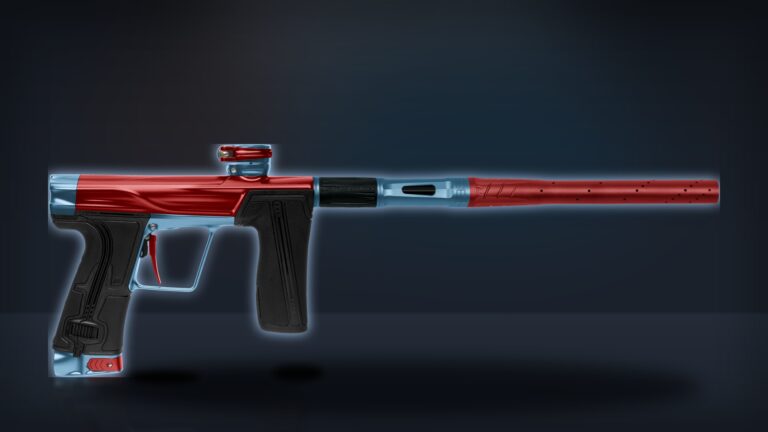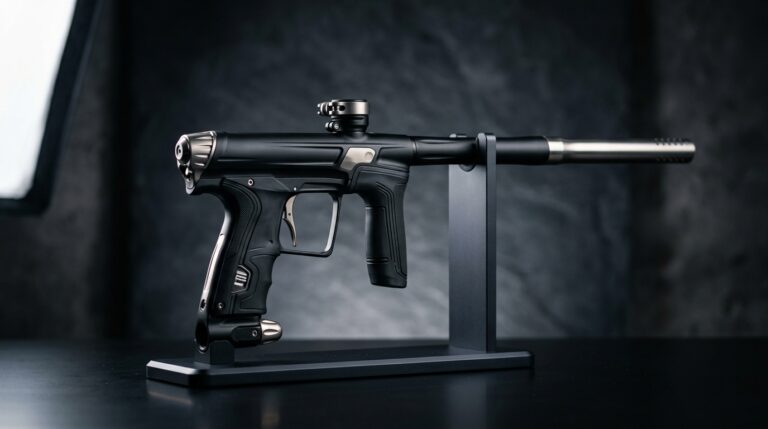
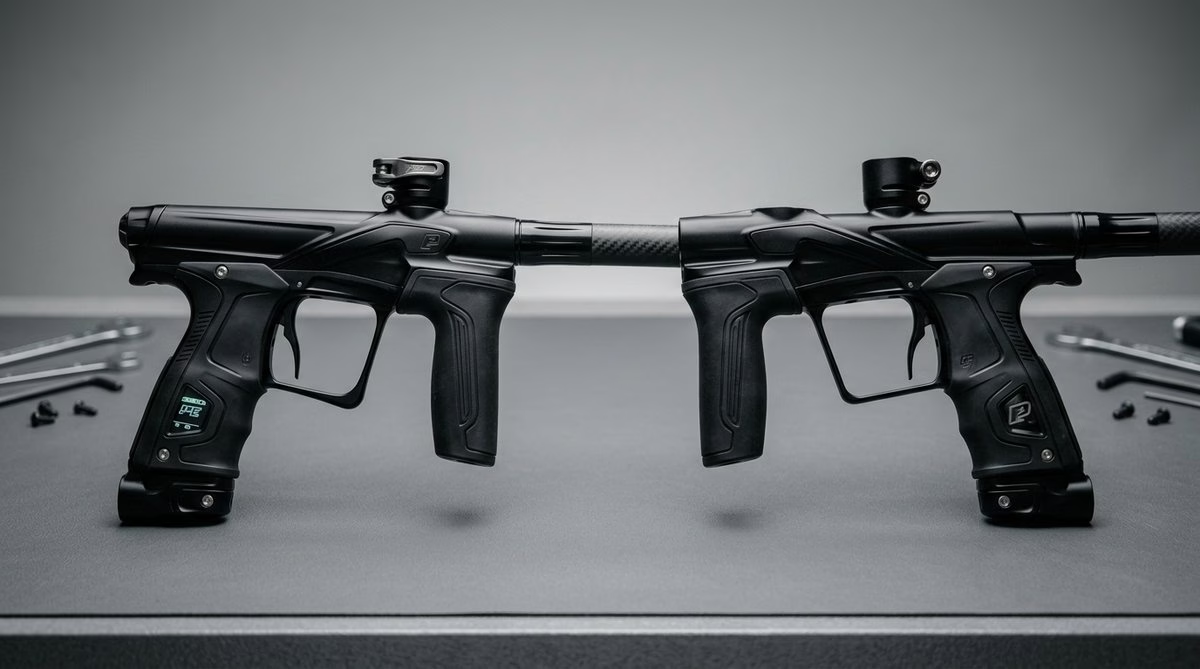
Quick take: the Etha 3 and Etha 3M share the same ergonomic body, low-rise feedneck, tool-less quick-release bolt, POPS air system, and Autococker barrel threading — the entire decision comes down to whether you want the electronic Etha 3’s battery-driven Gamma Core drivetrain, or the Etha 3M’s mechanical spool-valve system that never needs a battery at all. This is a cleaner comparison than most “vs” matchups because almost everything except the trigger/valve mechanism is shared.
What’s Shared Between Both Markers
- Ergonomic, lightweight composite body
- Low-rise aluminum clamping feedneck
- Quick-release, tool-less back cap for bolt access
- POPS (push-on-purge) ASA system
- Autococker barrel threading — same family covered in our barrel kits roundup
- HPA-only air requirement — neither marker runs on CO2, same as the standard Etha 3 covered in our full Etha 3 review
What Actually Differs
| Spec | Etha 3 | Etha 3M |
|---|---|---|
| Drivetrain | Electronic — Gamma Core | Mechanical — spool valve, FL 3-way valve |
| Battery | 9V required | None required |
| Trigger | Aluminum adjustable blade trigger, electronically tunable | Aluminum single-finger flat trigger, adjustable back stop, lighter return spring |
| Bolt | Soft-shooting Gamma Core bolt | Soft-touch bolt with 3-stage bolt acceleration |
| Fire mode control | Programmable via electronics | Fixed by the mechanical valve design |
Check Planet Eclipse Etha 3M Availability & Pricing
As an Amazon Associate, we earn from qualifying purchases at no extra cost to you.
Why This Comparison Maps Onto a Bigger Decision
This is the same mechanical-vs-electronic tradeoff we’ve covered across other markers on this site: electronic markers generally offer a lighter, more tunable trigger pull and programmable fire modes, at the cost of battery dependence; mechanical markers trade some of that tunability for one less thing that can fail mid-game. See our mechanical vs. electronic paintball guns guide for the fuller breakdown of that tradeoff in general — what’s notable here is that Planet Eclipse built both options on the same platform, so you’re not also trading away body ergonomics, feedneck design, or barrel compatibility to make the choice.
Hands-On Impressions
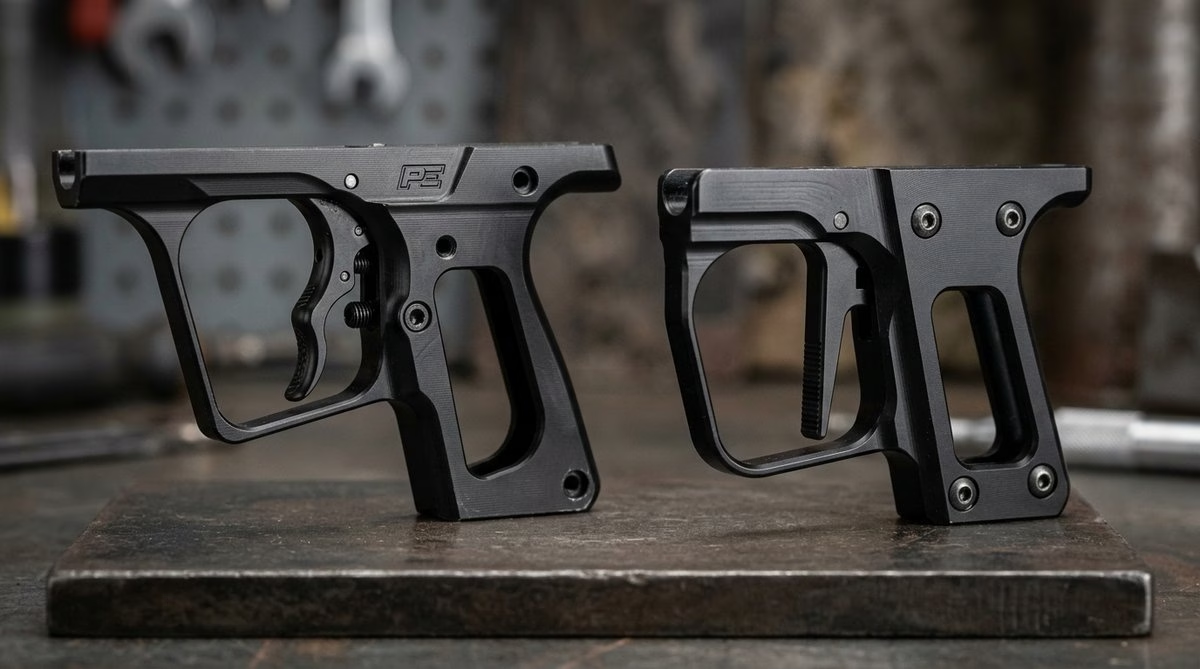
The Etha 3M’s spool valve and FL 3-way valve represent real engineering investment, not a stripped-down afterthought. Planet Eclipse didn’t just remove the electronics from the Etha 3 and call it the 3M — the FL 3-way valve and lighter trigger return spring are specific mechanical components built to make the mechanical trigger pull as light and responsive as a mechanical system reasonably can be, explicitly marketed as a serious step up in mechanical trigger performance.
Both markers share the same maintenance-friendly design philosophy. The quick-release, tool-less back cap means bolt access is just as easy on the 3M as on the electronic Etha 3 — you’re not giving up serviceability by choosing mechanical.
The included rebuild kit (per at least one detailed unboxing account) covers real maintenance needs out of the box. Barrel cover, maintenance grease, tools, and a full rebuild kit with O-rings and detent screws ship with the 3M — useful for anyone planning to maintain the marker themselves rather than relying on a shop.
The HPA-only requirement applies to both, and it’s easy to overlook if you’re coming from a CO2-compatible marker elsewhere on this site. Unlike the Tippmann lineup covered in our other reviews, neither Etha 3 variant runs on CO2 — budget for an HPA setup regardless of which one you choose. See our CO2 vs. compressed air breakdown if you’re not already running HPA.
Buy X If… Buy Y If…
- Buy the Etha 3 if you want a lighter, electronically tunable trigger pull and programmable fire modes, and you don’t mind managing a 9V battery.
- Buy the Etha 3M if you want one less failure point to worry about mid-game and are fine with a fixed mechanical trigger feel, even a well-engineered one.
- Either way, budget for HPA if you don’t already have it — this isn’t optional on either marker.
Check Planet Eclipse Etha 3 Availability & Pricing
As an Amazon Associate, we earn from qualifying purchases at no extra cost to you.
Mistakes to Avoid
- Assuming the 3M is a “lesser” version of the Etha 3. It’s a different engineering approach (mechanical vs. electronic) on the same platform, not a stripped-down budget variant — the FL 3-way valve and trigger work represent real investment specifically in mechanical performance.
- Buying either without an HPA setup already planned. Both are HPA-only; this is the single most common compatibility mistake for anyone used to CO2-compatible markers.
- Expecting electronic-style programmable fire modes from the 3M. Its fire behavior is fixed by the mechanical valve design — if you want that flexibility, the electronic Etha 3 is the one that offers it.
- Overlooking shared barrel compatibility. Since both use Autococker threading, barrel kit purchases (see our barrel kits roundup) aren’t locked to one variant — handy if you’re upgrading between them or own both.
Frequently Asked Questions
What does the “M” in Etha 3M stand for?
Mechanical — the Etha 3M is the mechanical, spool-valve version of the Etha 3 platform, as opposed to the electronic Etha 3.
Do the Etha 3 and Etha 3M use the same barrel?
Yes, both use Autococker threading, so barrel compatibility is shared between the two variants.
Can the Etha 3M run on CO2?
No — like the electronic Etha 3, the Etha 3M is HPA-only.
Is the Etha 3M just a cheaper, stripped-down Etha 3?
No — it’s a distinct mechanical engineering approach (FL 3-way valve, dedicated mechanical trigger system) rather than the electronic Etha 3 with parts removed.
Which is more reliable, the Etha 3 or the Etha 3M?
The 3M has one less failure point (no battery/electronics to fail), which is the general advantage of mechanical over electronic markers, though both share the same quick-release maintenance design.
Verdict
This is one of the cleanest comparisons on this site because the two markers genuinely share almost everything except the trigger/valve system — body, feedneck, bolt access, ASA, and barrel threading are identical. The decision really does come down to electronic tunability (Etha 3) versus mechanical simplicity (Etha 3M), both HPA-only, both well-engineered rather than one being a lesser version of the other.
Related reading: Planet Eclipse Etha 3 Review · Etha 3M Upgrades · Mechanical vs. Electronic Paintball Guns · CO2 vs. Compressed Air (HPA)
Affiliate Disclosure: theoutdoortips.com is a participant in the Amazon Services LLC Associates Program. As an Amazon Associate we earn from qualifying purchases at no extra cost to you.