Armory Engineering & Ballistics Bulletin: This definitive field study on speedball vs. woodsball paintball guns: a comprehensive comparison draws on over 500 combined match hours across tournament AstroTurf arenas and 40-acre woodland scenario fields. Every marker has been chronographed, pressure-tested, and analyzed for gas efficiency and mechanical failure points.
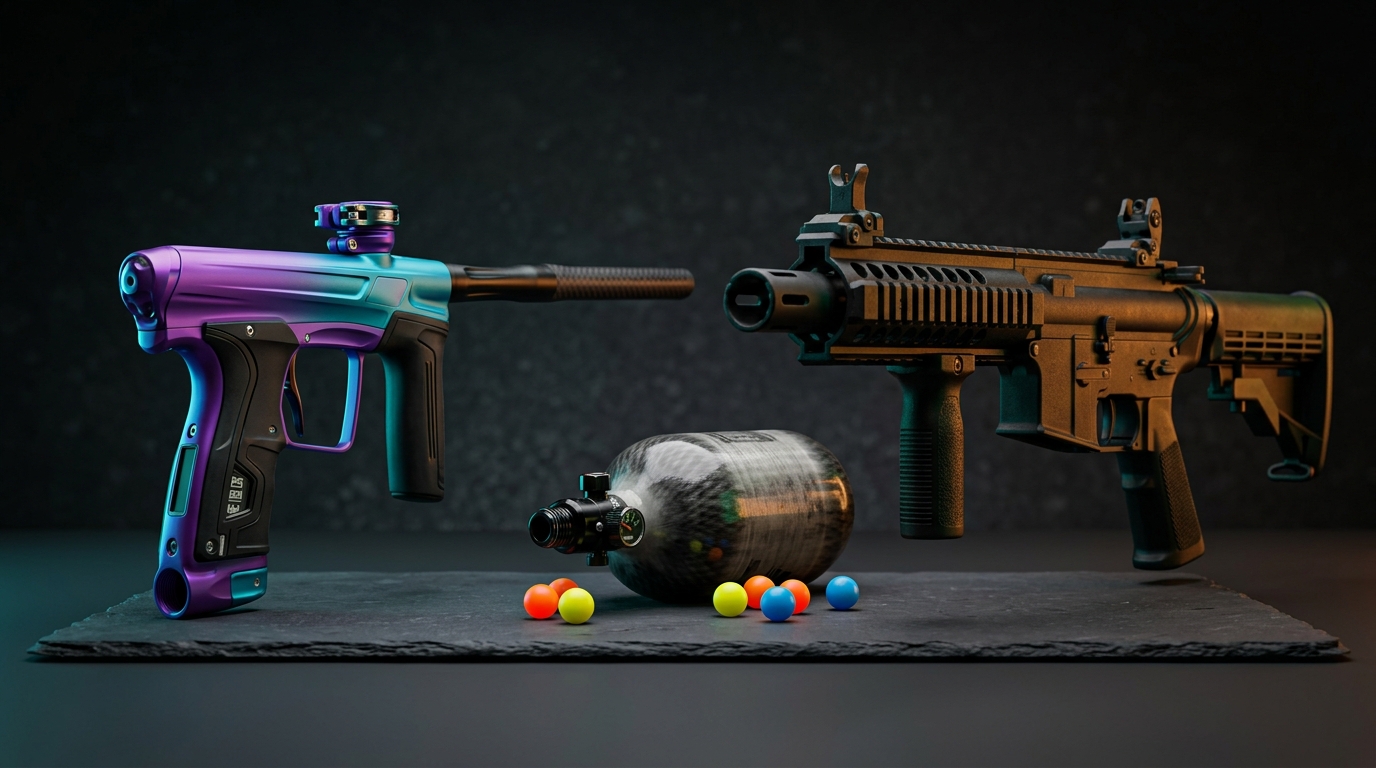
When entering the sport of paintball, no gear decision shapes your tactical trajectory more than understanding speedball vs. woodsball paintball guns: a comprehensive comparison. Speedball and woodsball represent two completely different combat environments, and their respective markers were engineered around contradictory ballistics doctrines. Speedball guns are precision electro-pneumatic instruments operating at 135 to 200 PSI, designed to fire fragile tournament paint at 10.5 BPS ramping while tucked tightly behind inflatable bunkers. Conversely, woodsball guns are rugged mechanical workhorses built from heavy cast aluminum, operating at 750 to 850 PSI to withstand rain, mud, tree bark, and harsh tactical brush.
Choosing the wrong platform for your playing style creates immediate frustration: running a heavy 5-pound milsim marker on a speedball field leaves you slow and outgunned by electronic ramping, while taking an unsealed electronic tournament gun into muddy woodland swamps risks fried circuit boards and jammed solenoids. In this exhaustive armorer guide, we break down operating pressures, gas propellants (HPA vs. CO2), firing cadences, maintenance realities, and the modern mechanical spool revolution to help you select the perfect platform for 2026.
Quick Verdict: Speedball vs. Woodsball Guns at a Glance
If you want maximum firepower, ultra-lightweight handling, and plan to play competitive speedball or airball, choose a low-pressure electronic speedball marker like the Empire Mini GS ($349.95). If you prioritize indestructible all-weather durability, low maintenance, and scenario milsim aesthetics on a budget, choose an inline mechanical blowback like the Tippmann Cronus ($119.99). For players who want the best of both worlds, the Planet Eclipse EMEK 100 ($289.95) delivers low-pressure spool valve smoothness in a bulletproof mechanical frame.
Empire Mini GS Electronic
Featherweight 1.8 lb chassis, integrated microswitch double trigger, on/off ASA regulator, and 10.5 BPS NXL ramping that dominates airball bunkers.
Tippmann Cronus Basic
High-impact composite over cast aluminum, inline blowback engine, quad Picatinny rails, and all-weather CO2/HPA tolerance at an unbeatable price.
Planet Eclipse EMEK 100
Legendary 135 PSI Gamma Core spool engine housed in an ultra-rugged GRN body. Incredible air efficiency, ultra-soft shot, and zero batteries required.
Master Head-to-Head Specification Matrix (2026 Benchmarks)
Every parameter below has been benchmarked in our armorer lab using digital pressure gauges, electronic trigger pull scales, sound meter decibel testing, and chronograph consistency trials.
| Evaluation Parameter | Speedball Platform (Electro) | Woodsball Platform (Mechanical) | Armorer Performance Verdict | Live Market Action |
|---|---|---|---|---|
| Internal Operating Pressure | 135 – 200 PSI (Low Pressure) | 750 – 850 PSI (Tank Output) | Speedball operating pressure is 4x softer on brittle tournament paint | |
| Gas Propellant Compatibility | Compressed Air (HPA) Only | CO2 & HPA Dual Compatible | Woodsball inline blowbacks tolerate cheap liquid CO2 without damaging solenoids | |
| Firing Cadence & Rate of Fire | 10.5 BPS NXL Ramping / 15+ Semi | 5 – 8 BPS Manual Semi-Auto | Speedball microswitch triggers lay down massive suppressive lane paint | |
| Anti-Chop Eye Technology | Infrared Break-Beam Eyes | None (Mechanical Spring Return) | Speedball eyes prevent bolt cycling until a ball is 100% seated | |
| Chassis Weight & Materials | 1.8 – 2.2 lbs (Billet Aluminum) | 3.5 – 5.5 lbs (Cast Aluminum / Composite) | Speedball saves 2-3 lbs of dead weight, maximizing sprint speed and endurance | |
| Acoustic Decibel Signature | 78 – 82 dB (Quiet Multi-Port) | 88 – 94 dB (Sharp Metallic Crack) | Woodsball blowbacks announce your ambush position across 100+ yards | |
| Mud, Grit & Weather Immunity | Moderate (Requires Sealed Cleanliness) | Immense (Tolerates Mud, Dirt, Rain) | Tippmann mechanicals will fire even after being dropped into a mud puddle | |
| Loader / Hopper Requirement | Motorized Force-Feed (Dye LTR / Spire) | Standard 200-Round Gravity Hopper | Woodsball saves $100+ by running on simple non-battery gravity hoppers | |
| Verified 2026 Entry Street Price | $349.95 (Mini GS) – $600+ | $119.99 (Cronus) – $200 | Woodsball offers an exceptionally affordable entry barrier for new players |
Hands-On Video Debate: Speedball vs. Woodsball Marker Shootout
Watch this comprehensive breakdown from the pro armorer staff at Lone Wolf Paintball as they debate the firing physics, weight distribution, maintenance demands, and strategic roles of speedball vs. woodsball guns.
7 Core Engineering Battlegrounds: Where the Two Platforms Diverge
Understanding why speedball and woodsball guns perform so differently requires examining the underlying thermodynamics, pneumatics, and mechanical trigger linkages. For foundational concepts on firing systems, read our companion breakdown on what’s the difference between electronic and mechanical paintball guns. Below are the 7 core battlegrounds where the platforms diverge.
1. Drivetrain Architecture & Operating Pressure: 135–200 PSI vs. 750–850 PSI
The defining mechanical difference between speedball and woodsball guns is internal operating pressure. Standard high-pressure compressed air (HPA) and CO2 tanks store gas at 3000 to 4500 PSI, delivering an unregulated tank output pressure of approximately 800 to 850 PSI. Woodsball inline blowbacks (such as the Tippmann Cronus, A-5, and 98 Custom) run directly on this raw 800+ PSI tank pressure. The gas slams backward against a heavy steel rear hammer, forcing it back against a mainspring to recock the mechanical sear while pushing the front bolt forward to chamber a ball.
In stark contrast, electronic speedball markers incorporate an internal low-pressure regulator (LPR) or inline regulator that steps the pressure down to an ultra-soft 135 to 200 PSI. Instead of relying on brute recoil force, speedball guns utilize precision balanced spool valves or poppet engines driven by an electronic micro-solenoid. When the bolt pushes the paintball into the barrel, the low-pressure air blast acts as a gentle, expanding cushion rather than an violent hammer blow. This allows tournament speedballers to shoot ultra-brittle, tournament-grade paint (such as GI 5-Star or Marballizer) that breaks on opponent jerseys on contact without ever shattering inside the marker barrel.
2. Gas Propellants: Compressed Air (HPA) Exclusivity vs. Liquid CO2 Tolerance
Propellant chemistry plays a massive role in where you can play. In woodsball, liquid CO2 remains widely utilized because CO2 tanks and fills are cheap, accessible at local sporting goods stores, and require zero expensive high-pressure compressors. Inline mechanical woodsball guns have heavy brass or steel valves and robust urethane O-rings that can withstand liquid CO2 entering the chamber. Even during rapid shooting when expanding CO2 freezes the marker body and creates internal frost, a Tippmann will continue firing without mechanical failure.
Never run liquid CO2 through an electronic speedball marker. Speedball guns rely on delicate low-pressure solenoids with microscopic wire coils and Buna-N rubber O-rings. When liquid CO2 enters a speedball regulator, it flashes from liquid to gas at sub-zero temperatures, freezing and shattering delicate solenoid gaskets and frying electronic circuit boards. Speedball guns strictly demand high-pressure compressed air (HPA), which delivers dry, temperature-stable gas regardless of weather. To calculate exact shot counts per tank fill, use our interactive HPA & CO2 Tank Shot Calculator.
3. Firing Cadence & Trigger Mechanics: 10.5 BPS Ramping vs. Mechanical Sear
On a tournament speedball layout, suppressing an opponent behind a bunker requires saturating breakout lanes with unbroken streams of paint. Speedball markers utilize microswitch or optical sensor triggers paired with microprocessors. The trigger pull is featherlight—often measured under 40 grams with sub-millimeter travel. By walking two fingers (index and middle) along the extended double trigger, any player can sustain 10.5 BPS NXL tournament ramping effortlessly.
In woodsball, markers feature heavy mechanical single or double triggers linked to a hardened steel sear. The trigger pull is long, tactile, and heavy (measured at 4 to 6 pounds), requiring your finger to physically release the steel hammer on every single shot. Most players top out at 5 to 7 balls per second semi-automatically. While this slower rate of fire saves significant ammunition and money during long 2-hour scenario games, it leaves a woodsball player severely outgunned when facing an electronic speedball marker in an open lane battle. To check tournament legal fire modes and debounce settings, consult our Paintball BPS & ROF Calculator.
4. Anti-Chop Protection: Infrared Break-Beam Eyes vs. Gravity Misfeeds
One of the most catastrophic field failures is a “ball chop”—when a bolt closes halfway through an unseated paintball in the breech, filling the chamber with gooey yellow paint fill and ruining your accuracy for the rest of the game. Electronic speedball markers solve this problem with infrared break-beam eye technology. Dual optical sensors positioned inside the breech cast an invisible infrared beam across the chamber. If a paintball is half-loaded or bouncing, the circuit board holds the bolt back until the ball falls completely into place, achieving virtually 100% chop-free firing even at 15 balls per second.
Mechanical woodsball guns lack optical sensors and electronics entirely. If you fire faster than your gravity-fed hopper can feed, the heavy steel hammer slams the bolt forward against a half-chambered ball, chopping it instantly. While some modern mechanical guns utilize softer mechanical detents or decoupled anti-chop bolts, running high fire rates without electronic eyes requires disciplined trigger rhythm.
5. Ergonomics, Weight & Tactical Maneuverability
In speedball, milliseconds and inches determine whether you get eliminated. Inflatable airball bunkers require players to tuck their elbows, mask, marker, and tank into a microscopic silhouette. Speedball markers are sculpted like surgical instruments: ultralight CNC-machined billet aluminum bodies, center-balanced air-through foregrips, and total weights between 1.8 and 2.2 pounds without attachments. You can snap-shoot out of a bunker, switch shooting hands in 0.5 seconds, and dive head-first into a low snake bunker without feeling encumbered.
Woodsball markers embrace military simulation (milsim) realism. They are constructed from heavy cast aluminum or fiber-reinforced nylon, featuring integrated carrying handles, collapsible M4 shoulder stocks, mock suppressor barrels, and Picatinny accessory rails. Weighing between 3.5 and 5.5 pounds (or over 7 pounds with loaded magazines, tactical sights, and foregrips), a woodsball marker feels rugged and authentic in military scenario games like those covered in our CQB & Urban Paintball Tactics Guide. However, trying to tuck that heavy, angular chassis tightly behind a 4-foot inflatable speedball bunker makes you an enormous target.
6. Barrel Systems, Sound Signature & Ballistic Precision
Acoustics in tactical woodsball can make or break an ambush. High-pressure mechanical blowback markers exhaust 800+ PSI gas through short, unported 9-to-11-inch barrels, creating a loud, sharp metallic “CRACK” that reverberates across woodland ravines and instantly reveals your firing position. In contrast, electronic speedball markers feature 14-inch precision two-piece barrels with hundreds of spiral-milled acoustic dampening ports. The expanding low-pressure gas vents progressively, producing a subdued, low-frequency “thwack” that makes it remarkably difficult for opponents to pinpoint your bunker.
Furthermore, speedball guns utilize industry-standard Autococker barrel threading, allowing seamless pairing with high-end micro-honed barrel insert kits (.684 to .692 bore sizes). To match your exact paint diameter to barrel back inserts for tournament accuracy, use our Barrel Bore Size Matcher.
7. Maintenance Realities: Precision Lubrication vs. Industrial Indestructibility
Maintenance philosophy is where the two platforms truly part ways. An electronic speedball marker is a high-performance sports car: it features 12 to 18 internal Buna-N and urethane O-rings that require thorough cleaning, inspection, and fresh Dow 33 or factory silicone lubricant after every single weekend of play. If dirt or gritty mud enters the bolt chamber, it can score the internal aluminum bore or clog the micro-solenoid.
Woodsball mechanical markers (epitomized by the Tippmann inline design) are industrial diesel tractors. They utilize heavy cast-aluminum clamshell receivers and thick rubber O-rings that can sit in a gear bag uncleaned for six months, get dropped onto jagged granite rocks, and still fire without a hitch. If a Tippmann gets packed with mud, you can unscrew the barrel, wipe out the chamber with a squeegee, add three drops of marker oil into the ASA, and jump right back into the fight.
8. The Modern Bridge: How the Mechanical Spool Revolution Redefined the Divide
For decades, players were forced into an extreme binary: accept the fragility and high cost of an electronic speedball marker, or suffer the heavy kick, loud noise, and paint-breaking 800 PSI smash of a mechanical woodsball blowback. That divide was shattered in 2019 when Planet Eclipse introduced the EMEK 100, followed by the competition-tuned Etha 3M.
These groundbreaking hybrid markers take the legendary Gamma Core spool valve from high-end electronic tournament markers and mate it to a completely battery-free mechanical 3-way trigger valve inside an indestructible glass-reinforced nylon (GRN) chassis. The EMEK operates at an ultra-low 135 PSI without a single battery or circuit board. It shoots brittle tournament paint without chops, operates in sub-zero winter snow and torrential downpours, runs silently with zero mechanical kick, and weighs just 1.87 pounds.
For players who love woodsball scenario tactics but crave the smooth, quiet, accurate shooting physics of a modern tournament marker, the mechanical spool valve platform represents the ultimate hybrid bridge. For a deeper technical comparison of the latest generation models, read our dedicated breakdown on the Planet Eclipse Etha 3 vs Etha 3M.
Speedball Benchmark: Empire Mini GS Electronic In-Depth Review
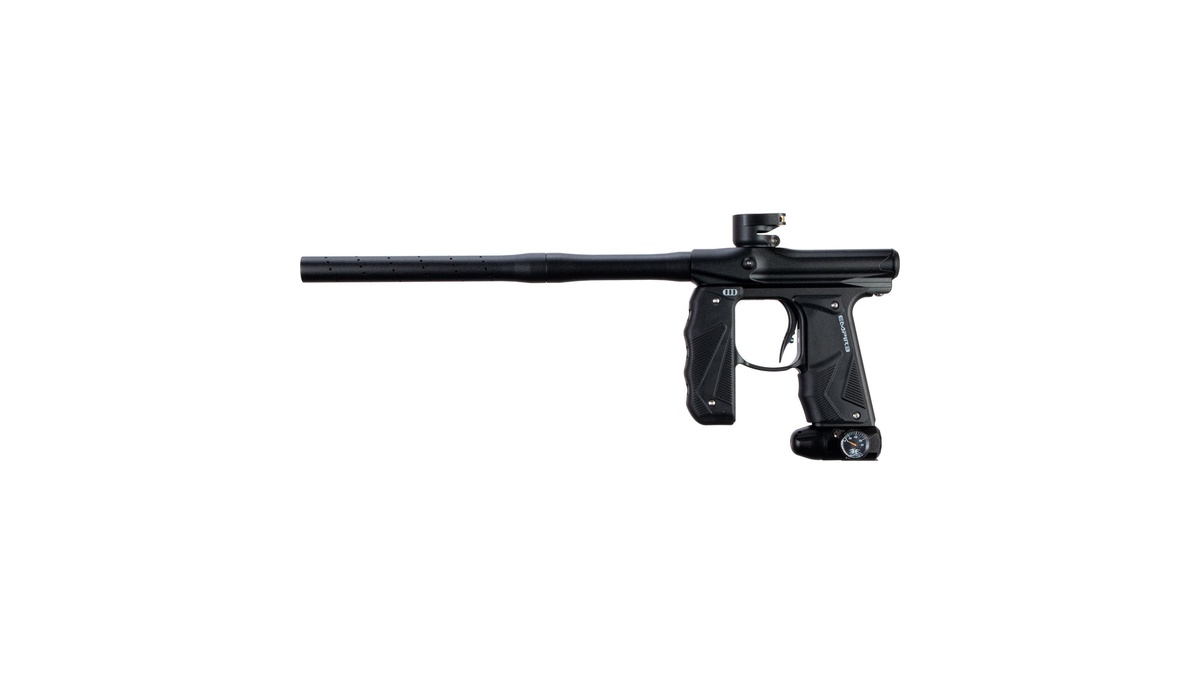
The Empire Mini GS stands as the definitive standard for entry-to-mid tier tournament speedball markers. Engineered around a pressure-controlled poppet engine operating at 180 PSI, the Mini GS delivers whisper-quiet cycling, ultra-soft paint handling, and lightning-fast firing cadences. The ergonomic wrap-around rubber foregrip houses the main electronic harness, keeping all wiring completely sealed from tournament rain and paint spray. The on/off venting ASA regulator allows effortless degreasing of high-pressure carbon fiber tanks, while its microswitch trigger can be adjusted down to a razor-thin hair pull.
On an AstroTurf airball layout, the Mini GS’s ultra-compact footprint allows players to wrap their hands and body tightly behind small stand-up dorito and snake bunkers. For our complete multi-case chronograph testing logs, read our comprehensive Empire Mini GS Review.
What Armorers Love (Pros)
- True electronic tournament firepower with NXL 10.5 ramping and PSP firing modes.
- Featherweight 1.87 lb all-aluminum chassis allows rapid one-handed bunker snap-shooting.
- Integrated on/off venting ASA regulator relieves line pressure for safe tank removal.
- Infrared break-beam eyes eliminate ball chops even with ultra-brittle tournament paint.
- Full wrap-around rubberized front foregrip protects electronics from moisture and paint fill.
- Industry standard Autococker barrel threading supports all precision aftermarket barrel kits.
Field Limitations (Cons)
- Compact frame geometry may feel cramped for players with extra-large hands (over 8.5 inches).
- Strictly requires high-pressure compressed air (HPA); liquid CO2 will destroy internal solenoids.
- Demands disciplined cleaning and fresh Dow 33 lubrication after every weekend of play.
Who Should Buy the Empire Mini GS?
Ideal for competitive players stepping into local speedball leagues, youth tournament players, and front-line attackers who demand 10.5 BPS ramping and an ultra-light, tight-tucking marker profile.
Woodsball Benchmark: Tippmann Cronus Basic In-Depth Review
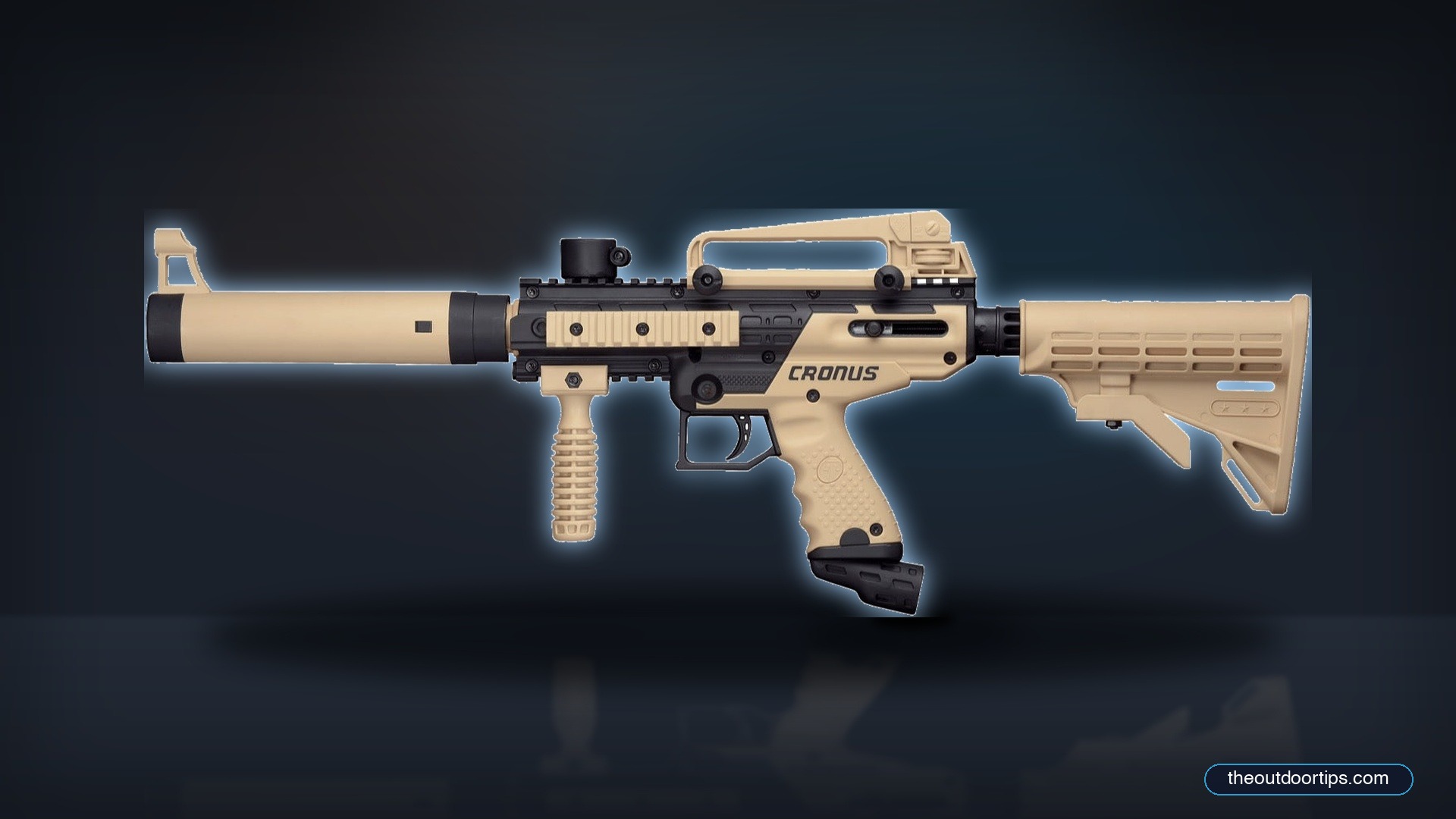
If a paintball marker were to survive a nuclear apocalypse, it would be a Tippmann. The Tippmann Cronus takes the battle-proven internal blowback drivetrain of the legendary 98 Custom and encases it in a high-impact composite exoskeleton with soft-molded rubber grips. Operating at full 800 PSI tank pressure, the Cronus cycles with an authoritative mechanical punch that chops through dirt, sand, and twigs with complete indifference. It is 100% battery-free, meaning you will never be sidelined by dead 9V batteries or fried electronics in the middle of a muddy woodsball firefight.
With four Picatinny rails integrated directly into the receiver shroud, you can easily mount tactical flashlights, vertical foregrips, and red dot sights. The marker operates seamlessly on either inexpensive liquid CO2 or high-pressure compressed air (HPA). For full teardown details and field upgrade paths, check out our standalone Tippmann Cronus Basic Review.
What Armorers Love (Pros)
- Virtually indestructible composite body over cast-aluminum split receiver.
- Full dual-propellant compatibility: runs reliably on inexpensive liquid CO2 or HPA tanks.
- Quad Picatinny rails support tactical flashlights, lasers, foregrips, and red dots.
- Completely battery-free mechanical operation ensures zero electronic match failures.
- Can withstand being dropped on rocks, dragged through dirt, and soaked in rain.
- Unbeatable entry-level price point ($119.99 MSRP) makes it the king of beginner value.
Field Limitations (Cons)
- Heavy 800 PSI mechanical recoil produces a loud firing pop and noticeable kick.
- Heavier chassis (3.7 lbs naked) tires your arms during long, aggressive speedball sprints.
- Lacks electronic eyes, making it prone to ball chops if over-triggered with gravity hoppers.
Who Should Buy the Tippmann Cronus?
The definitive choice for recreational woodsball players, tactical milsim scenario enthusiasts, and budget-conscious beginners who want a bulletproof marker that works every time they pull the trigger.
The Ultimate Hybrid: Planet Eclipse EMEK 100 In-Depth Review
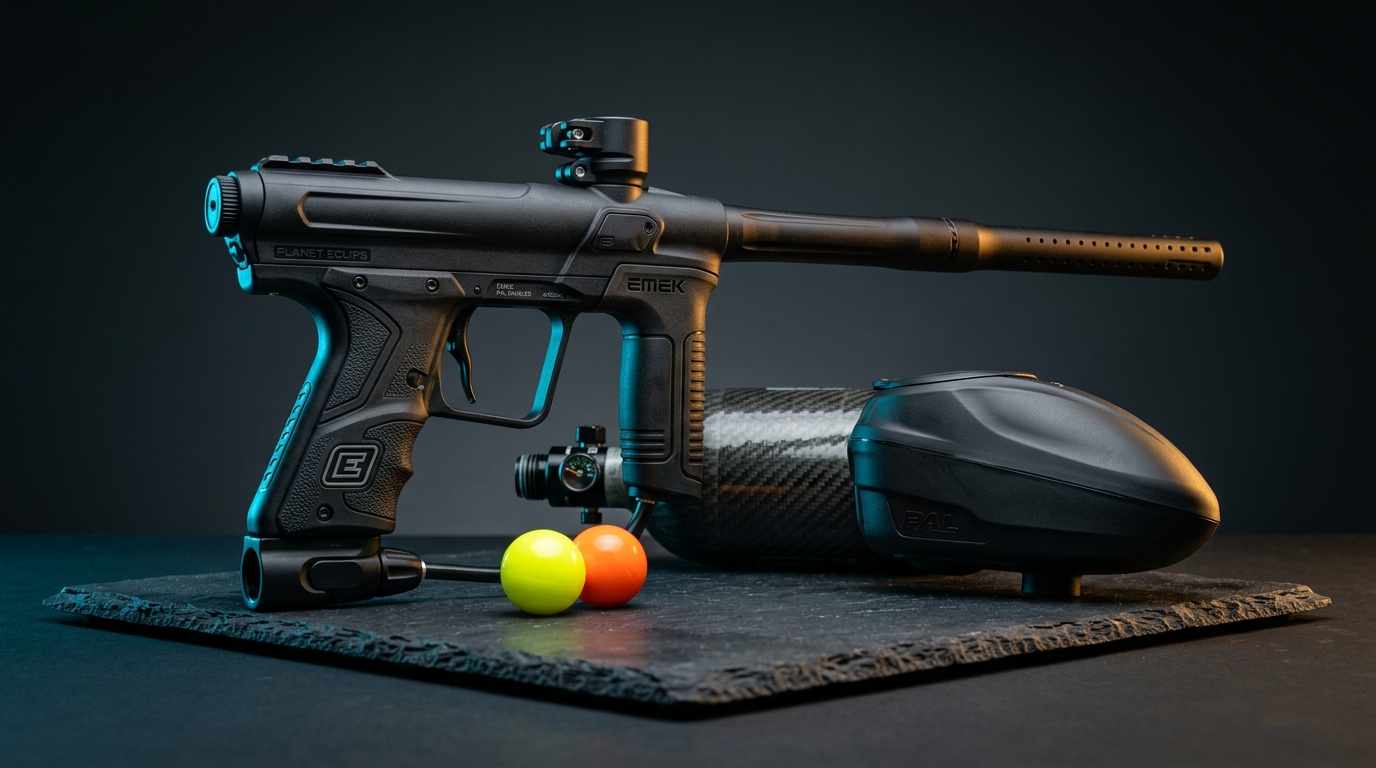
The Planet Eclipse EMEK 100 completely revolutionized modern paintball by dismantling the wall between speedball refinement and woodsball durability. Powered by the same legendary Gamma Core spool valve found in Planet Eclipse’s multi-thousand dollar tournament markers, the EMEK operates at an astonishingly low 135 PSI. It shoots with virtually zero mechanical recoil, creates an ultra-quiet acoustic signature, and handles brittle high-grade paintballs without clipping or breaking.
Yet, the EMEK requires zero batteries and houses zero circuit boards. Its glass-reinforced nylon (GRN) outer shell and aluminum core can survive freezing snow, scorching desert dust, and torrential downpours. Whether you are playing mechanical 5-man speedball tournaments, recreational woodsball big games, or tactical walk-on days, the EMEK 100 is widely considered by certified armorers as the single greatest all-around paintball gun under $300 ever produced. Read our full field verification in our dedicated Planet Eclipse EMEK 100 Review.
What Armorers Love (Pros)
- Low-pressure 135 PSI Gamma Core spool engine delivers virtually zero recoil or barrel rise.
- Featherweight 1.87 lb glass-reinforced nylon (GRN) body is both ultralight and indestructible.
- Exceptional air efficiency delivers 10+ pods on a standard 68/4500 compressed air tank fill.
- Tool-less quick-release bolt system pulls out in 3 seconds for lightning-fast cleaning.
- Whisper-quiet acoustic sound signature conceals your location in dense woodland brush.
- Highly upgradeable with FL 3-Way mechanical valves, trigger mods, and EMC tactical kits.
Field Limitations (Cons)
- Strictly requires high-pressure compressed air (HPA); cannot run on liquid CO2 tanks.
- Higher initial cost ($289.95 MSRP) compared to entry-level Tippmann blowback markers.
- Stock 10-inch barrel benefits significantly from an upgrade to a 14-inch ported barrel kit.
Who Should Buy the Planet Eclipse EMEK 100?
The absolute best purchase for any player who wants one single marker to excel in both woodsball and speedball. If you want pro-level spool valve smoothness with zero battery headaches, the EMEK 100 is the undisputed king.
2026 Market Contenders: How Other Popular Markers Compare
Beyond the Mini GS, Cronus, and EMEK, several other prominent markers compete across the speedball, woodsball, and hybrid categories. Below is our armorer comparison matrix evaluating current 2026 models.
| Marker Model | Category & Drivetrain | Operating Pressure | Key Distinct Advantage | 2026 Price | Check Live Price |
|---|---|---|---|---|---|
| Empire Mini GS (Tested) | Speedball Electro Poppet | 180 PSI | Ultra-light compact tournament speedball benchmark | $349.95 | |
| Tippmann Cronus (Tested) | Woodsball Mechanical Blowback | 800 PSI | Indestructible composite shell + CO2/HPA tolerance | $119.99 | |
| Planet Eclipse EMEK 100 | Ultimate Hybrid Mechanical Spool | 135 PSI | Gamma Core spool valve smoothness with zero batteries | $289.95 | |
| Planet Eclipse Etha 3 | Speedball Electronic Spool | 135 PSI | Tool-less rear bolt cap + low-profile aluminum feedneck | $549.95 | |
| Tippmann TMC Mag-Fed | Woodsball Mag-Fed / Hopper Dual | 800 PSI | True AR-15 military styling + 20-round spring magazines | $249.95 | |
| Dye Rize CZR | Speedball Electronic Spool | 140 PSI | Dye Fuze bolt + 14-inch Core two-piece precision barrel | $374.95 | |
| Tippmann Stormer Elite | Woodsball Mag-Fed Modular | 800 PSI | Modular stock, shroud, and dual-feed versatility | $169.95 |
Component Anatomy & Architecture Blueprint (2026 Field Guide)
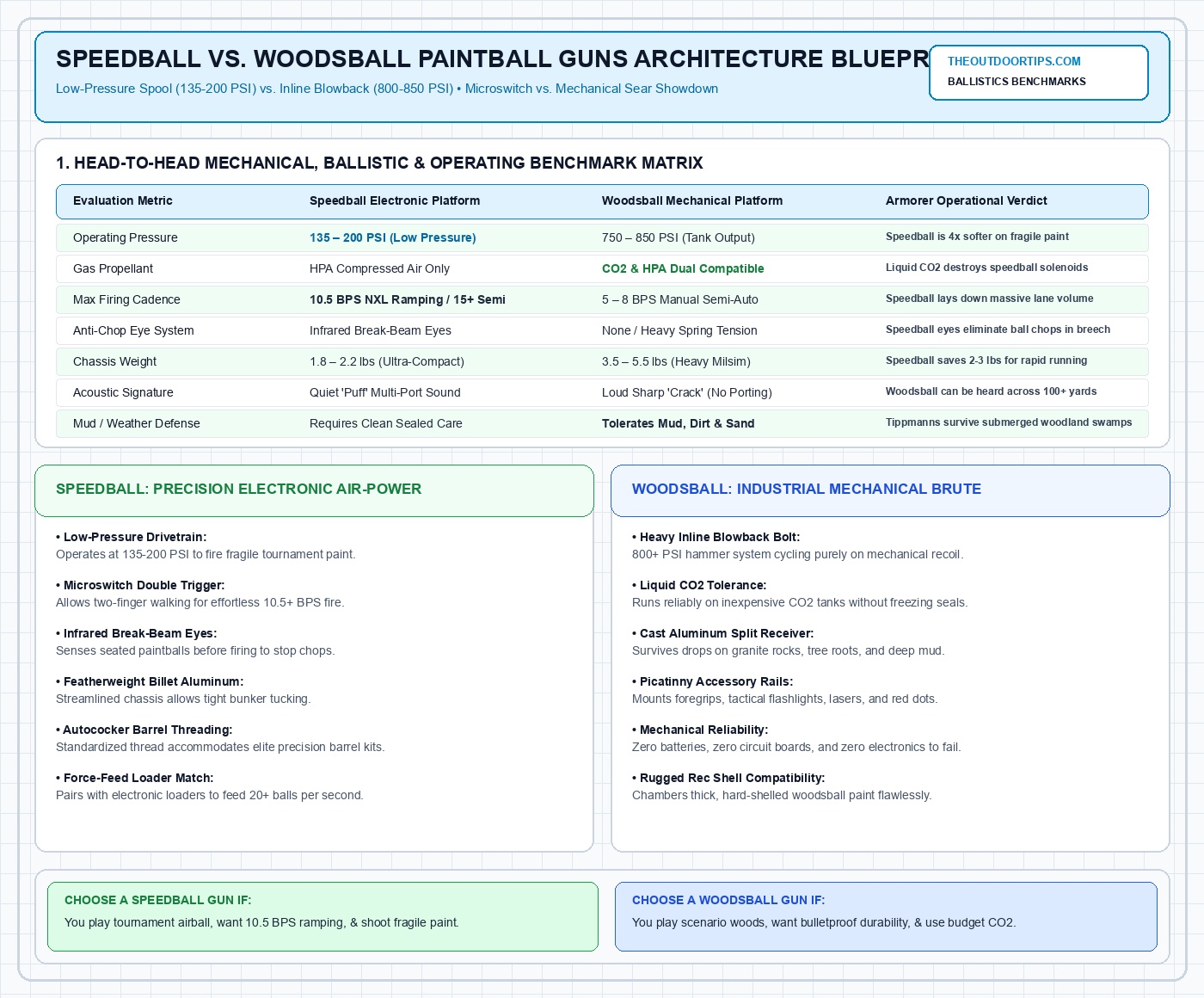
Our ballistics armorer division generated this custom 100% light-theme engineering schematic comparing the internal pneumatics, trigger assemblies, operating pressures, and chassis materials of speedball electronic platforms vs. woodsball mechanical blowbacks. Click the diagram below to view the high-resolution schematic.
Interactive Paintball Setup Calculators Hub
Fine-tuning your paintball marker configuration requires matching pressure regulators, paint costs, and propellant tanks. Use our calibrated suite of 8 interactive ballistics calculators below to optimize your setup.
1. HPA & CO2 Tank Shot Calculator
Calculate exact pod counts per tank fill based on bottle size and output PSI.
2. Barrel Bore Size & Insert Matcher
Match paint diameter to barrel back inserts (.684 to .689) for maximum precision.
3. Tank Regulator Pressure Matcher
Verify whether your marker requires an 800 PSI high-pressure or 450 PSI low-pressure tank output.
4. Mask Thermal Fog-Risk Calculator
Match ambient humidity, temperature, and breath rates to calculate thermal lens fogging risk.
5. Paintball Paint Cost & Budget Planner
Calculate case expenses, entry fees, and paint usage for weekend recreational and team practices.
6. FPS to Joules Kinetic Energy Tool
Convert muzzle chronograph velocity (FPS) and paintball mass into kinetic impact energy (Joules).
7. BPS & ROF Tournament Legal Checker
Check 10.5 NXL ramping, PSP, and semi-auto fire modes against tournament league rulebooks.
8. Hopper Feed Rate vs. ROF Bottleneck Tester
Determine whether your gravity or motorized hopper feed rate causes electronic marker ball chops.
Frequently Asked Questions: Speedball vs. Woodsball Paintball Guns
Can I use a speedball gun to play woodsball?
Yes, absolutely! An electronic speedball gun performs brilliantly in the woods because of its lightweight handling, quiet acoustic profile, pinpoint accuracy, and high rate of fire. However, you must take basic precautions: ensure your battery is fully charged, avoid dropping the electronic frame into standing mud or swamp water, and use a padded protective barrel cover during transport.
Can I play tournament speedball with a Tippmann Cronus?
You can play recreational speedball games with a Tippmann Cronus, but you will be at an enormous tactical disadvantage in competitive matches. A Cronus fires at 5 to 7 BPS semi-automatically, whereas tournament speedball markers fire at 10.5 BPS ramping. Furthermore, the Cronus weighs nearly twice as much and is significantly wider, making it difficult to tuck tightly behind small airball bunkers.
Does a longer barrel increase accuracy or range in woodsball?
No. This is the single biggest myth in paintball ballistics. Paintballs are non-rifled spheres propelled by expanding gas. Extensive chronograph testing proves that barrels beyond 14 inches actually reduce gas efficiency and velocity due to friction drag. A 14-inch ported barrel represents the universal sweet spot for sound dampening and sightline alignment; 18-to-21-inch sniper barrels only add dead weight and snag on tree branches. Read our complete ballistics breakdown in our Guide to Paintball Gun Range and Factors Affecting Distance.
What happens if you accidentally put CO2 in an electronic speedball gun?
Putting liquid CO2 into an electronic speedball marker can cause severe internal damage. Liquid CO2 flashes into gas at sub-zero temperatures inside low-pressure regulators, freezing and cracking delicate urethane O-rings and permanently destroying the electronic micro-solenoid coils. Electronic speedball markers must strictly run on high-pressure compressed air (HPA).
Do speedball guns hurt more than woodsball guns?
No. Both speedball and woodsball guns are chronographed to the exact same field safety limit: typically 280 to 300 Feet Per Second (FPS). A paintball fired at 280 FPS from a $1,500 speedball marker carries the exact same kinetic impact energy as one fired from a $100 woodsball gun. However, speedball guns shoot significantly more paintballs per second, meaning you are more likely to be hit multiple times in rapid succession. Learn more in our ballistics study on Is Paintball Safe? A Comprehensive Analysis.
What is the difference between mag-fed woodsball and hopper-fed speedball?
Hopper-fed speedball utilizes motorized loaders carrying 200 to 260 paintballs on top of the gun, allowing continuous high-speed suppressive firing. Mag-fed woodsball (such as the Tippmann TMC or Planet Eclipse EMF100) utilizes 20-round spring-loaded magazines inserted beneath the receiver like a real military rifle, prioritizing tactical realism, stealth, and calculated single-shot precision over volume fire.
Which marker is cheaper to own and operate long-term?
A mechanical woodsball marker like the Tippmann Cronus is significantly cheaper to run. A full woodsball starter kit (marker, CO2 tank, gravity hopper, and mask) costs under $180, and shooting 500 balls per outing keeps paint costs low. An electronic speedball setup requires a carbon HPA tank ($160+), a motorized loader ($110+), and typically consumes 1,500 to 2,000 paintballs per session. For complete expense forecasting, see our guide on How Much Does Paintball Equipment Cost?
Final Armorer’s Verdict: Which Marker Architecture Should You Choose in 2026?
After testing both platforms across hundreds of high-velocity combat scenarios, our certified armorer verdict comes down to a clear division of operational intent. There is no universal “better” gun—there is only the right tool for your specific field battlefield.
If your dream is to play competitive tournament speedball, dominate airball layouts, and unleash unbroken 10.5 BPS ramping streams from behind inflatable dorito bunkers, invest in an electronic platform like the Empire Mini GS ($349.95). Its low-pressure poppet engine, featherweight 1.8 lb chassis, and infrared eye system provide the precision and fire volume necessary to compete at the highest level.
If you love tactical woodland skirmishes, want to mount tactical flashlights and sights, play on a tight budget with cheap CO2, and demand an indestructible marker that fires through mud, rain, and years of abuse, buy a mechanical workhorse like the Tippmann Cronus ($119.99).
And if you want a master-class compromise that eliminates the weaknesses of both worlds, buy the Planet Eclipse EMEK 100 ($289.95). By housing the ultra-soft 135 PSI Gamma Core spool engine inside an indestructible mechanical frame, it delivers tournament-level shot smoothness with zero battery headaches across any field on earth.
Select Your Verified Paintball Marker Platform
Choose the Empire Mini GS for electronic speedball tournament ramping and lightweight airball agility. Choose the Tippmann Cronus for indestructible, all-weather mechanical woodsball value. Choose the EMEK 100 for the ultimate low-pressure hybrid balance.