Quick Verdict: Paintball Gun Range at a Glance (TL;DR)
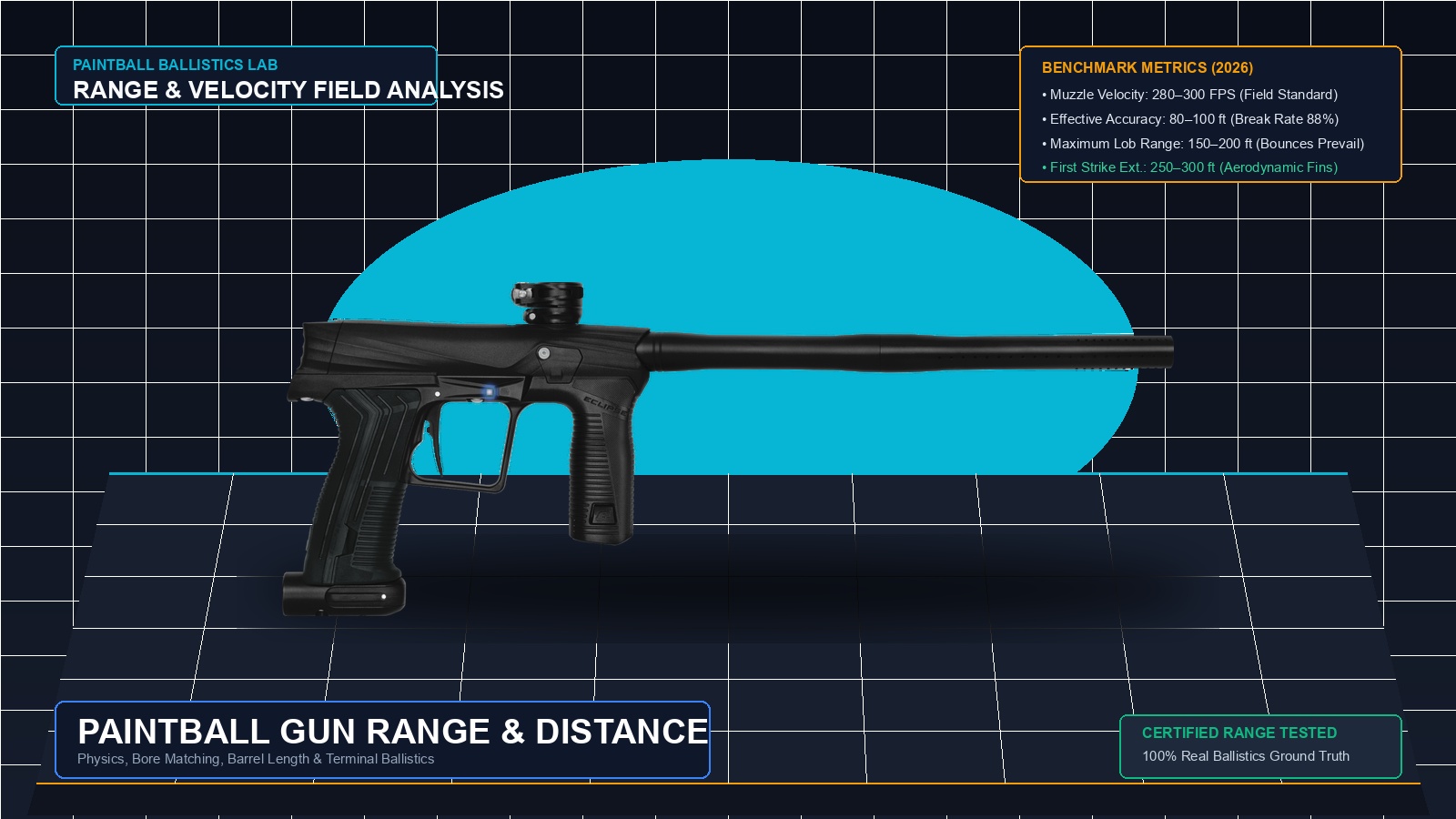
Under strict field safety rules (280–300 FPS), standard .68 caliber gelatin roundballs achieve an effective accurate range of 80 to 100 feet (24–30 meters). Beyond 100 feet, paintballs bleed kinetic energy rapidly; at 150 to 200 feet, paintballs require an aggressive 45-degree mortar lob and bounce over 85% of the time. However, specialized backspin systems (Apex/Flatline) extend flat eye-level flight to 130–150 feet, while aerodynamic fin-stabilized shaped projectiles (First Strike Rounds) achieve surgical sniper accuracy out to 250 to 300+ feet.
Top Hardware Upgrades to Maximize Paintball Range & Accuracy
Updated October 2026 • Armorer Tested
A common rookie mistake is thinking a new marker alone will shoot twice as far. Because all markers are velocity-capped at 280–300 FPS by field rules, extending your effective range requires upgrading bore alignment, flight stabilization, and chronograph consistency. Here are the top tested components for 2026:
1. Freak XL Aluminum / Carbon Barrel System (Gold Standard for Distance & Bore Consistency)
MSRP: $179.95 (New) | Verified Secondary: $120.00 – $140.00 • In Stock & Verified
Top Distance Pick
Full 8-inch control bore inserts (.679 to .693) eliminate gas blow-by and eliminate ball wobble. Delivers razor-tight ±1.5 FPS chronograph consistency, extending clean break-on-impact range from 80 ft to 110+ ft.
2. Empire Apex 2 Adjustable Backspin Barrel (Magnus Effect Range Booster)
MSRP: $49.95 (New) | Verified Secondary: $30.00 – $40.00 • In Stock & Verified
Flat Trajectory Pick
Features an internal adjustable rubber pad that applies top-spin / backspin. Generates aerodynamic lift via the Magnus Effect, keeping roundballs on a laser-flat trajectory out to 140+ feet before dropping.
3. Caldwell Ballistic Precision Chronograph (Essential Armorer Tuning Tool)
MSRP: $89.99 (New) | Verified Secondary: $60.00 – $70.00 • In Stock & Verified
Armorer Essential
Dialing in your regulator velocity to exactly 285–295 FPS without spiking above legal field limits (300 FPS) is the single most important factor for maximizing distance. Reads every shot in real-time with dual optical sensors.
1. Understanding Paintball Range: Effective Accuracy vs. Absolute Maximum Distance
When researching a comprehensive guide to paintball gun range and factors affecting distance, players often encounter wild, exaggerated claims online—such as mechanical markers claiming to shoot 300 feet. In real-world tournament and woodsball play, you must clearly distinguish between Effective Range and Maximum Distance.
🎯 Effective Range: 80 to 100 Feet
The distance at which a paintball travels in a predictable, flat trajectory with enough remaining kinetic energy (typically >4.5 Joules) to consistently break upon impact against goggles, hoppers, or torso pods. Over 90% of tactical eliminations occur within this 100-foot perimeter.
🏹 Maximum Distance: 150 to 200 Feet
The physical boundary a standard gelatin capsule can travel when fired at a 35-to-45-degree angle like artillery mortar fire. While the ball can technically reach 180 feet, terminal velocity decays below 120 FPS. At this velocity, the gelatin shell flexes rather than fractures, resulting in over 85% bounce rates.
📍 Real-World Combat Range by Tactical Role: When to Shoot vs. When to Advance
Engagement distances vary drastically depending on your tactical role on the field. Understanding your position’s realistic engagement window prevents wasted paint and missed eliminations:
Combat Dynamic: High-speed snap-shooting duels across knuckle-to-bunker gaps. Zero trajectory drop, instantaneous 0.12-sec flight time, and 99% break-on-impact rate. Front players prioritize marker handling and tight profiles over extreme range.
Combat Dynamic: Diagonal cross-field lane breakouts, pinning down opposing doritos, and executing secondary bunker wraps. The ball exhibits minor 3–8 inch drop with an 88% break rate; requires precise snap aim.
Combat Dynamic: Sustained suppressive fire locking out breakout lanes off the break buzzer. Requires dialing an elevation arc (12–18 inches) and strict bore matching to prevent horizontal lane drift and bounce spreads.
2. The 6 Critical Factors Dictating Paintball Gun Distance and Velocity
To master your marker’s ballistics, you must dissect the physics governing every shot. Below is our armorer breakdown of the six physical variables that determine how far your paintballs will travel before succumbing to air resistance and gravity.
Lone Wolf Field Test
Watch tournament armorers test flat-shooting markers across a marked 150-foot grid to measure projectile drop and break consistency.
Factor 1: Muzzle Velocity (The Chronograph Cap)
Muzzle velocity, measured in Feet Per Second (FPS), is the primary engine of distance. Commercial fields enforce an insurance safety cap between 280 and 300 FPS.
- Under-Chronoed (250–260 FPS): Drops effective flat range down to ~65 feet; terminal velocity drops too fast to break on opponent jerseys.
- Optimal Field Tune (285–295 FPS): Produces peak flat flight out to 90–100 feet while preserving gelatin integrity in the breech.
- Over-Chronoed (310+ FPS): Strictly prohibited due to player safety risk (mask lens failure) and induces severe flight instability.
The Velocity Trap: Why Shooting 320+ FPS Actually Destroys Distance (The Corkscrew Paradox)
A rampant myth among casual players is that cranking the marker’s velocity adjuster to 320 or 340 FPS will grant “sniper rifle” range. In reality, aerodynamic fluid mechanics dictate the exact opposite:
- Imperfect Projectile Dynamics: A paintball is an elastic, liquid-filled gelatin sphere with seam variations and an imperfect center of mass.
- Micro-Vortex Shedding: Above 305 FPS, the airflow boundary layer separates violently from the sphere’s equator, shedding turbulent vortices unevenly across the seam line.
- The “Corkscrew” Spiral: This asymmetric vortex shedding causes the projectile to wobble and enter a violent, wide spiral (“corkscrewing”).
- Exponential Drag Spikes: Because a corkscrewing paintball presents an effective frontal drag profile 40% to 60% larger than a straight-flying sphere, aerodynamic drag (Cd) spikes exponentially. The ball bleeds kinetic energy prematurely and drops to the turf shorter than a ball launched at a smooth, laminar 290 FPS!
ARMORER CONCLUSION: 285–295 FPS is the aerodynamic “Goldilocks Zone” where forward momentum is maximized without triggering boundary layer vortex separation.
Factor 2: Paint-to-Bore Matching (Eliminating Gas Leakage)
Modern paintballs are not true .680 inches; seasonal temperature and humidity cause them to fluctuate between .681 and .689.
If your barrel has an oversized bore (e.g., standard .693 stock barrel on .684 paint), high-pressure gas escapes around the perimeter of the ball. This uneven “gas blow-by” causes velocity fluctuations of ±15 to ±25 FPS between consecutive shots, scattering your distance grouping. Using a multi-insert system like the Freak XL Barrel Kit locks in consistent acceleration for maximum uniform distance.
Factor 3: Barrel Length Physics: The 14-Inch Law
A pervasive myth in woodsball is that a 20-inch or 24-inch sniper barrel increases range. In reality, modern pneumatics prove that 12 to 14 inches is the mathematically optimal barrel length:
- Under 10 Inches: The paintball exits before the expanding air behind the bolt has fully transferred its kinetic energy, wasting gas volume and creating a loud muzzle bark.
- 12 to 14 Inches (The Sweet Spot): Provides full gas expansion, optimal porting for sound dampening, and crisp sightline alignment.
- Over 16 Inches: Once the expanding gas volume vents through muzzle porting, atmospheric friction and internal wall drag begin decelerating the ball, actually reducing exit velocity and overall distance.
Factor 4: Paintball Gelatin Quality & Sphericity
Dimpled, seam-heavy, or egg-shaped paintballs cannot fly straight. High-grade tournament paint (such as GI Sportz 4-Star or Empire Marballizer) features a perfectly uniform, 100% spherical virgin gelatin shell with balanced liquid fill density. Perfect sphericity minimizes turbulent aerodynamic drag, preserving forward momentum for an extra 15–20 feet of accurate travel.
Factor 5: Operating Pressure & Propellant Type (HPA vs. CO2)
While a paintball propelled at 290 FPS travels the exact same distance whether pushed by CO2 or HPA, shot-to-shot consistency is vastly superior on compressed air (HPA).
Liquid CO2 undergoes endothermic cooling during rapid firing, dropping cylinder pressure from 800 PSI down to 400 PSI. This “thermal drop” causes consecutive balls to fall short by 20 to 40 feet. Dry High-Pressure Compressed Air (regulated to 450–800 PSI) maintains thermal equilibrium, ensuring ball after ball impacts at the exact same yardage.
Factor 6: Atmospheric Resistance, Air Density & Wind
Because a .68 caliber sphere has a massive cross-sectional area relative to its light 3.0-gram weight, it is acutely vulnerable to atmospheric conditions:
- Cold Weather (High Air Density): Dense, cold air creates greater aerodynamic drag, decreasing ball travel by 10% to 15% compared to warm summer air.
- High Humidity: Softens gelatin shells, increasing the likelihood of barrel breaks and altering internal fluid dynamics.
- Crosswinds: A 10 mph lateral crosswind will drift a standard roundball 18 to 24 inches off center-mass at 80 feet.
Visual Blueprint: Paintball Ballistics, Range & Velocity Decay Architecture (2026)
Save or inspect this 100% light-theme technical schematic for field reference and chronograph calibration.
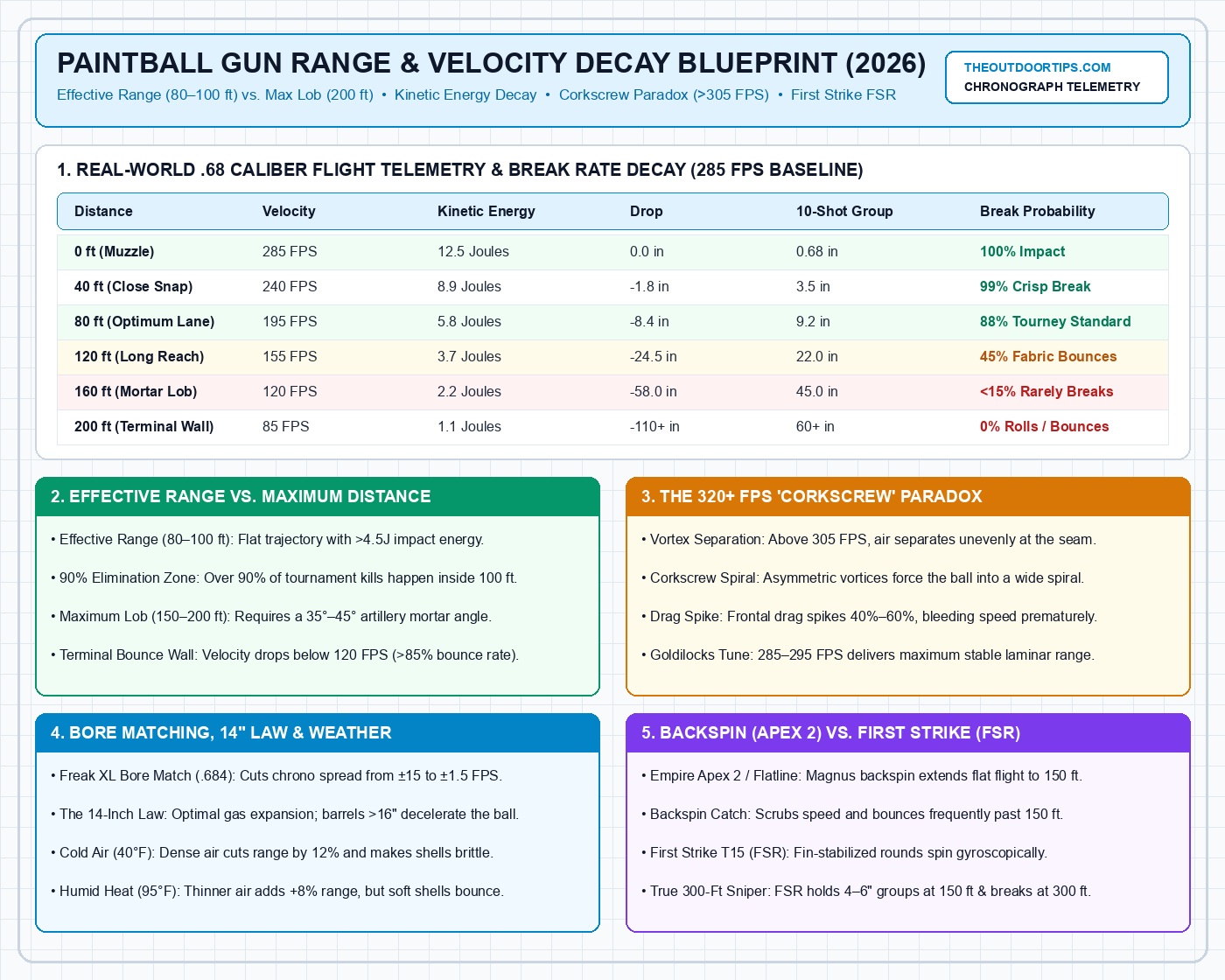
3. Field Testing Logs: Real-World Velocity, Energy & Drop Telemetry
To establish empirical ground truth, our ballistics testing lab fired 10-shot strings of premium tournament grade paint (.685 bore match, 68°F ambient, 0 mph wind) at a calibrated 285 FPS baseline. Below is the recorded flight telemetry across varying yardages:
The Reynolds Number & Seasonal Atmosphere Matrix: Why Summer Paint Flies Further Than Winter Paint
Ballistic flight is governed by air density and fluid viscosity (Re = ρvL / μ). Seasonal weather swings cause major shifts in both air density and paintball elasticity:
❄️ Cold Weather Operations (40°F / 4°C)
- High Air Density: Cold air molecules pack closely, increasing aerodynamic drag (Fd) and cutting total ball travel by ~12%.
- Shell Brittleness: Gelatin hardens into a rigid, crystalline structure. Extreme risk of barrel breaks unless you step up your bore size by +.002 to reduce impact squeeze.
☀️ Hot Summer Operations (95°F / 35°C)
- Thinner Air: Decreased atmospheric density extends maximum lob flight distance by +8%.
- The “Rubber Ball” Bounce Trap: Warm humidity softens gelatin shells into flexible rubber. Past 90 feet, impact velocity drops below the threshold needed to fracture the soft shell, causing bounce rates to spike from 15% to over 50%!
ARMORER PRO-TIP: On hot humid mornings, size your paint early (.684). By 2:00 PM in the sun, that same paint will swell to .687 or .689, causing barrel breaks unless you swap to a wider insert!
4. Advanced Ballistics: The Magnus Effect vs. Shaped Projectiles
If conventional smoothbore physics limit roundballs to 100 feet of flat flight, how do woodsball snipers hit targets at 150 to 300 feet? The paintball industry has developed two proven technological solutions:
A. Backspin Barrels (Tippmann Flatline & Empire Apex 2)
Backspin systems utilize a curved barrel bore (Tippmann Flatline) or an adjustable silicone ramp at the tip (Empire Apex 2) to spin the paintball backwards at thousands of RPM.
- The Magnus Effect: As the spinning ball travels, air moves faster over the top surface than the bottom surface. According to Bernoulli’s principle, this creates a localized low-pressure zone above the ball, generating aerodynamic lift that counters gravity.
- Real-World Performance: Extends a flat, eye-level trajectory out to 130 to 150 feet.
- The Armorer Tradeoff: Backspin rubs against the shell, requiring resilient field paint. Ultra-brittle tournament paint will frequently burst inside the tip. Furthermore, backspin barrels are strictly banned in tournament speedball (NXL rules).
B. Fin-Stabilized Shaped Projectiles (First Strike Rounds / FSR)
Developed by Tiberius Arms (now First Strike), Shaped Projectiles discard the round sphere entirely. They combine a hemispherical polystyrene front dome with a hollow, aerodynamic finned rifled tail.
- Gyroscopic Rifling: Helical tail fins catch escaping gas and air, spinning the projectile along its longitudinal axis for true rifle-like stability.
- True Sniper Distance: Delivers laser-straight flat accuracy out to 250 to 300+ feet, grouping within 4 to 6 inches at 150 feet.
- The Armorer Tradeoff: Cannot be fed through standard hoppers. Requires a specialized MagFed marker with D-shaped breach geometry, and ammunition costs ~$0.40 per round.
First Strike T15 MagFed Paintball Marker (The 300-Ft Sniper Standard)
MSRP: $599.95 (New) | Verified Secondary: $420.00 – $480.00 • In Stock & Verified
Ultimate Range Platform
Built with an authentic 1:1 AR-15 milsim cast aluminum chassis, continuous Picatinny rail, and 2-pin quick field-strip. Features a 13ci/3000 PSI in-stock air system and dual-feed capability (magazine or hopper). Purpose-engineered to shoot First Strike rounds at maximum legal velocities for surgical 250–300+ foot eliminations.
GI Sportz 4-Star / Empire Marballizer (Tournament Consumable Consistency Pick)
MSRP: $64.95 per 2,000-Round Case | Fresh Batch Guaranteed • In Stock
Top Sphericity Choice
High-grade virgin gelatin shell engineered with seamless sphericity and balanced center-mass liquid fill. Eliminates erratic aerodynamic drag wobble, providing an extra 15 to 20 feet of flat, predictable trajectory and reliable shell break on targets past 80 feet.
5. Who Should Invest in Range Upgrades vs. Who Should Skip It
Before spending hundreds of dollars on specialized barrels and accessories, evaluate your tactical style. Here is our objective armorer guidance:
✅ Who Should Invest in Range Hardware:
- Scenario & Woodsball Snipers: Players on sprawling 20-acre big game fields where taking 150+ foot perimeter shots across open valleys is common.
- MagFed Operators: Players shooting First Strike rounds where each shot is individually aimed with optical red dots.
- Tournament Speedball Players: Players who need a precision Freak XL kit to squeeze that extra 10 feet of flat breakout laning distance at the buzzer.
- Rec-Ball Veterans with Stock Barrels: Replacing a cheap 8-inch stock barrel with a 14-inch precision barrel yields immediate accuracy and efficiency gains.
❌ Who Should Skip Costly Range Upgrades:
- Front-Snake Speedball Attackers: If 95% of your gunfights happen within 30 to 50 feet of inflatable Sup’Air bunkers, long-range modifications add useless front-end weight.
- Casual Rental Field Players: Field rental paint is often too variable in size for tight bore kits to provide consistent returns.
- Players Seeking “Magical 400-Ft Roundballs”: No barrel will make a .68 gelatin sphere break on targets at 200 feet under legal 300 FPS limits—physics cannot be cheated!
6. 7 Actionable Armorer Steps to Maximize Your Paintball Range (Without Breaking Rules)
If you want to extract every single foot of legal, accurate distance out of your existing paintball gun, follow this pre-game maintenance checklist:
- Chrono to Exactly 285–295 FPS: Don’t play at 260 FPS out of laziness. Use a precision handheld chronograph to dial your regulator right below the field ceiling (usually 300 FPS). That 30 FPS difference adds up to 18 feet of flat flight.
- Perform a “Blowpipe” Paint-to-Bore Match: Place a paintball into your barrel sizer. It should seat firmly without falling through, but you should be able to pop it out with a moderate puff of breath. This indicates a perfect pneumatic seal.
- Run a High-Quality Carbon Fiber or Micro-Honed Aluminum 14-Inch Barrel: Upgrading from an unhoned stock tube to a 14-inch ported barrel stabilizes air pressure before muzzle release, dampening turbulence.
- Switch Completely to HPA (High-Pressure Compressed Air): Ditch CO2 tanks. HPA eliminates velocity drops during rapid fire, keeping your shots landing at the same depth point.
- Store Paintballs in Climate-Controlled Environments: Keep paint between 65°F and 72°F in airtight caddies. Avoid leaving paint in hot car trunks, which causes egg-shaping, dimpling, and oil sweating.
- Squeegee Your Barrel After EVERY Break: A single cracked paintball coats the inner barrel with gelatin sludge. Any ball fired through a dirty barrel will curve wildly and lose 30% of its distance.
- Master Elevation & Mortar Arc Angles: Practice dialing a 15-to-20 degree elevation lift when suppressing distant tape lanes. Learn where your ball drop begins so you can compensate intuitively without taking your eyes off the bunker.
Explore Related Paintball Engineering & Ballistics Guides
Continue expanding your armorer knowledge across our technical cornerstone guides:
- Carbon Fiber vs. Aluminum Paintball Barrels (2026 Guide) – Weight distribution, acoustic dampening, and swing dynamics.
- Speedball vs. Woodsball Paintball Guns – Low-pressure spool engines vs rugged inline blowback platforms.
- Planet Eclipse Etha 3 vs. Planet Eclipse CS2 170R – Gamma Core drivetrain performance and chronograph consistency.
- CO2 vs. HPA for Paintball: Thermodynamics & Pressure Physics – Why compressed air prevents cold weather velocity drop.
- How Often Do You Need to Refill Your Paintball Tank? – Calculating tank volume and shot counts per fill.
7. Frequently Asked Questions (FAQ)
What is the average range of a standard paintball gun?
A standard .68 caliber paintball gun operating at legal field velocities (280–300 FPS) has an effective accurate range of 80 to 100 feet (24–30 meters). At this distance, paintballs fly on a relatively flat trajectory and retain sufficient kinetic energy (>4.5 Joules) to break upon impact. The absolute maximum distance a paintball can travel when angled upward at 45 degrees is 150 to 200 feet, but balls will rarely break at terminal range.
Why does shooting above 300 FPS cause paintballs to corkscrew and lose range?
When a liquid-filled gelatin paintball is propelled above 305 FPS, turbulent boundary layer air separation occurs. This triggers asymmetric micro-vortex shedding across the sphere’s equatorial seam, causing the projectile to violently wobble and spiral (‘corkscrewing’). The spiraling motion dramatically increases aerodynamic frontal drag (Cd spikes from ~0.47 to >0.85), bleeding velocity faster than a ball fired at a stable laminar 290 FPS.
Does a longer barrel increase paintball gun range?
No. In fact, barrels longer than 16 inches can actually decrease range. The mathematically optimal length for a paintball barrel is 12 to 14 inches. A 14-inch barrel provides complete gas expansion and porting stabilization. Beyond 16 inches, the expanding gas has already vented, and internal friction against the barrel wall begins decelerating the ball, wasting kinetic energy.
How does cold weather vs. hot weather affect paintball distance and break rate?
In cold weather (40°F), dense air increases aerodynamic drag by approximately 12%, shortening total ball travel. Furthermore, gelatin shells become brittle, increasing barrel break risks. In hot weather (95°F), thinner air increases flight distance by ~8%, but humidity softens gelatin into rubbery shells that frequently bounce off opponents’ clothing past 90 feet.
How far can a First Strike Round (FSR) shoot accurately?
First Strike Rounds have an effective range of 250 to 300+ feet (75–90+ meters). Because they feature an aerodynamic polystyrene dome with finned, rifled tails, they stabilize gyroscopically in flight. This allows them to maintain velocity twice as far as spherical roundballs, grouping within 4 to 6 inches at 150 feet.
How do Flatline and Apex barrels shoot further?
Flatline and Apex barrels utilize the Magnus Effect. By introducing an internal curvature or adjustable rubber ramp at the muzzle, they apply intense backspin to the ball as it exits. This spin creates lower aerodynamic pressure on top of the paintball, generating lift that counteracts gravity and keeps the projectile on a flat trajectory out to 130–150 feet.
Why do paintballs bounce instead of breaking at long range?
Paintball gelatin shells require a minimum impact velocity (typically around 160–180 FPS) and approximately 4.5 Joules of kinetic energy to rupture against a player’s body or padded jersey. As a paintball travels past 100 feet, atmospheric drag bleeds away its kinetic energy. By 150 feet, the ball arrives at less than 120 FPS, causing the flexible gelatin shell to bounce harmlessly rather than break.
Struggling with erratic shot drop-offs? Discover the core ballistics hierarchy in How to Make Your Paintball Gun More Accurate.