2026 Ballistics Armory & Internal Dynamics Guide
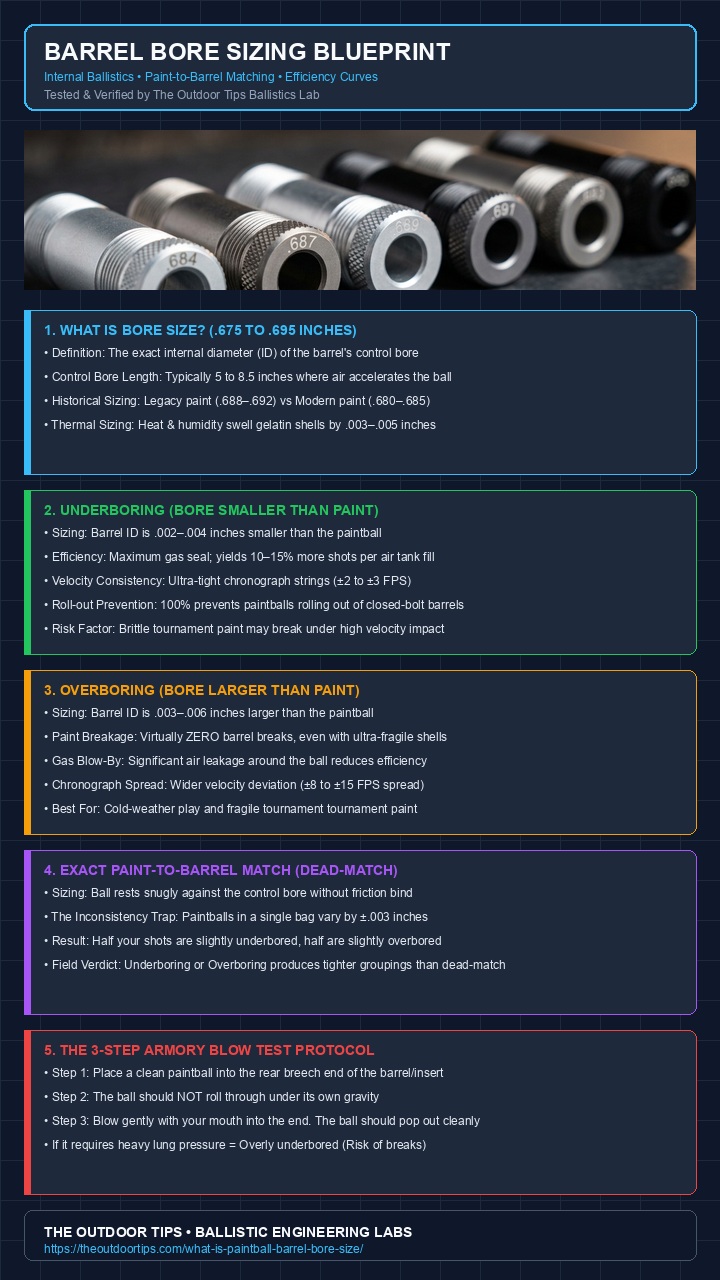
What is paintball barrel bore size? Paintball barrel bore size is the exact internal diameter (ID) of a barrel’s control bore, measured in thousandths of an inch ranging typically from .675 to .695 inches. While legacy .68-caliber paintballs measured .689+, modern paintballs consistently average .680 to .685 inches due to manufacturing material optimization. Underboring (bore smaller than paint) maximizes pneumatic gas efficiency (+15%) and locks shot-to-shot consistency; Overboring (bore larger than paint) guarantees zero ball breaks with brittle tournament shells; Matchboring (dead-match) is technically flawed due to ±.003″ gelatin egging. The Golden Rule: Closed-bolt markers (Autocockers, Pumps) strictly require underboring to prevent rollouts; open-bolt markers can run any sizing strategy safely.
★★★★★ Top Barrel Upgrades
Top Precision Barrel Sizing Systems for 2026
Eliminate pneumatic blow-by, lock chronograph consistency, and match any paintbatch
Verified Retail Range
GOG Freak XL Barrel Kit ($199.95)
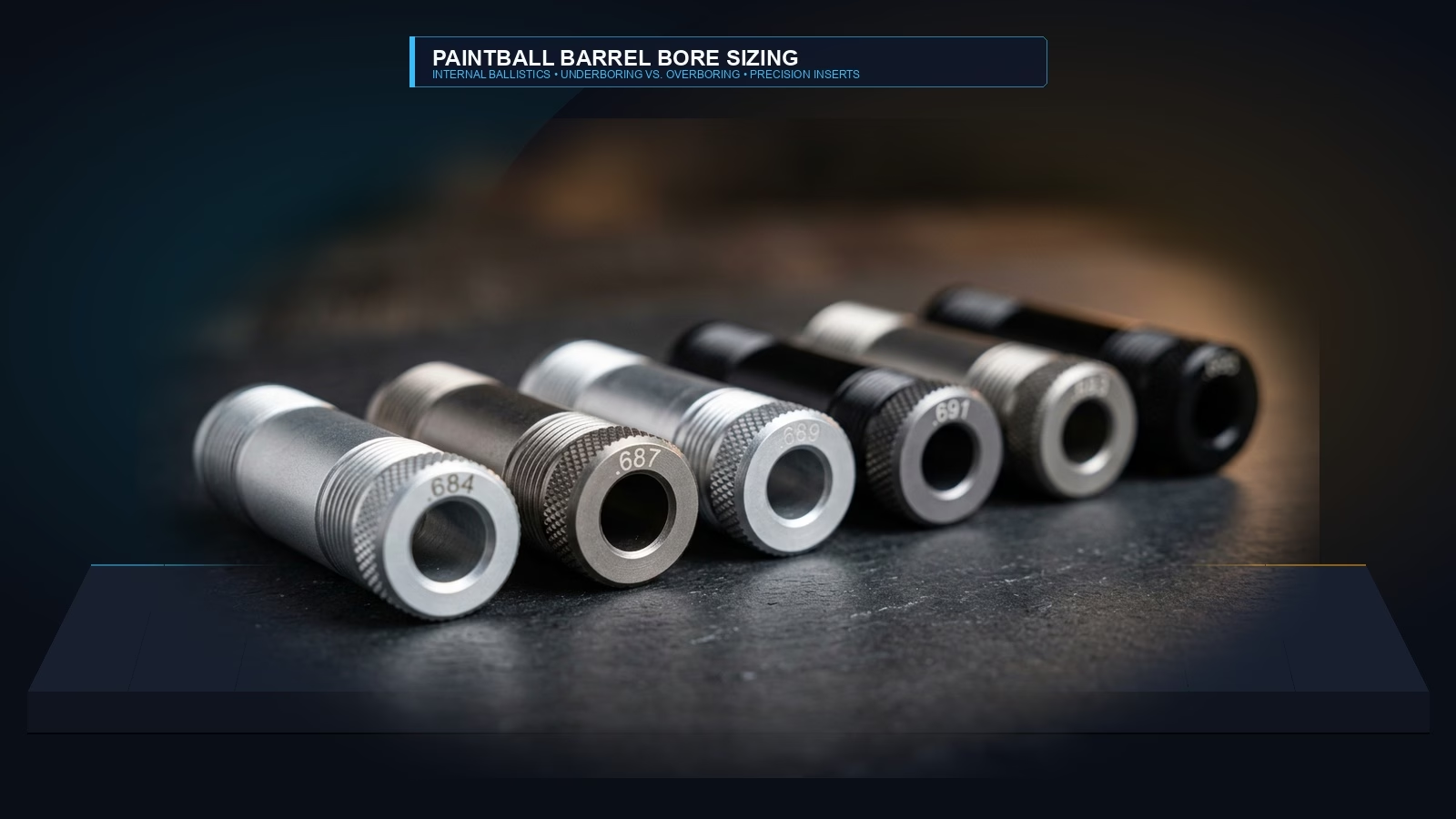
Full 8-insert kit featuring 8.5-inch control bores (.679, .682, .684, .687, .689, .691, .693, .695) in a durable zippered armory case. Available in Autococker, Luxe/Ion, and A-5 threads.
Custom Products (CP) One-Piece (.685) ($39.95)
Precision-honed micro-finish aircraft aluminum (learn more in our carbon fiber vs aluminum barrels guide) with radial porting. Sized at .685 to perfectly match modern medium-grade paintballs, drastically improving shot grouping over loose .693 factory barrels.
Ask five seasoned paintball players what makes a marker accurate, and four will immediately credit their barrel. But among precision ballistic armorers and fluid dynamic engineers, the real question is far more exact: what is paintball barrel bore size? Many recreational players assume a .68 caliber barrel is simply a straight .680-inch metal pipe. In reality, the micro-inch tolerance between your barrel’s inner control bore and the gelatin sphere passing through it dictates gas expansion efficiency, velocity standard deviation, and catastrophic shell ruptures. If you are tuning your overall marker platform, pair this analysis with our armorer review of the Best Paintball Guns for Long Range Precision. In this definitive 2026 technical guide, we break down internal fluid dynamics, sizing matrices, and the physical laws of barrel bore sizing.
🎯 Ballistics & Precision Silo: Discover how this marker ranks against every top laser-accurate speedball and sniper platform in our Best Accurate Paintball Guns (2026 Precision Guide).
1. Anatomy of a Barrel: Control Bore Length vs. Muzzle Porting
To master what is paintball barrel bore size, one must first dismantle the two mechanically distinct zones of a modern two-piece or insert-based barrel architecture:
| Barrel Component | Engineering Dimensions | Internal Ballistics Function |
|---|---|---|
| Control Bore (Back / Insert) | 5.0 to 8.5 inches long; .675″ – .695″ ID | The high-pressure acceleration zone. Propellant gas expands behind the ball to achieve full muzzle velocity (280–300 FPS). Dictates gas seal & consistency. |
| Barrel Tip (Front / Shroud) | 6.0 to 10.0 inches long; oversized .700″+ ID | Houses linear or spiral porting to vent residual gas evenly prior to atmospheric uncorking, stabilizing flight and dropping acoustic report. |
| Control Bore Length Evolution | Legacy: 5.0″ (Classic Freak) → Modern: 8.5″ (Freak XL / S63) | Longer 8.5″ control sections allow markers to operate at lower pressures and gentler acceleration curves without losing muzzle velocity. |
2. Bore Sizing Matrix & Strategy Comparison (Spec Table)
To understand what is paintball barrel bore size in competitive practice, armorers categorize sizing into five distinct operational bands. Each strategy trades pneumatic efficiency against shell shear stress:
| Sizing Strategy | Bore Differential | Air Efficiency Impact | Chrono Consistency | Fragile Paint Handling | Best Suited Drivetrains |
|---|---|---|---|---|---|
| Extreme Underbore | -.004″ to -.006″ | +15% to +20% Gain | ±3 FPS (Very Tight) | High Break Risk | Closed-bolt pumps, stock-class markers, tough field paint rec play |
| Mild Underbore (Recommended) | -.001″ to -.002″ | +8% to +12% Gain | ±2 to ±4 FPS (Optimal) | Low / Moderate Risk | Autocockers, competitive woodsball, scenario markers, high shot-count setups |
| Dead Match (Theoretical) | .000″ (Exact Bore) | Baseline (0%) | ±5 to ±8 FPS (Fluctuating) | Moderate Break Risk | Not recommended due to gelatin egging variance (alternates under/over per shot) |
| Mild Overbore (Tourney Pro) | +.002″ to +.004″ | -8% to -12% Loss | ±6 to ±10 FPS | Zero Break Risk (Max Safety) | Tournament speedball (NXL Pro) shooting brittle tournament 5-star paint |
| Extreme Overbore (Factory) | +.005″ to +.012″ | -15% to -20% Loss | ±10 to ±15 FPS (Erratic) | Zero Break Risk | Stock factory rental markers (e.g. .693″ Tippmann barrels shooting .681″ paint) |
3. The Closed-Bolt vs. Open-Bolt Mandate: Why Drivetrains Dictate Bore Sizing
The most critical engineering rule in paintball internal ballistics is this: your marker’s mechanical bolt cycle dictates your bore sizing strategy. Failing to respect this mechanical distinction results in either constant dry-fire barrel rollouts or catastrophic internal breech breaks. To understand the underlying pneumatic cycles, read our technical breakdown on what’s the difference between electronic and mechanical paintball guns.
🔒 Closed-Bolt Drivetrains (Autocockers, Pumps, Empire Resurrection)
The Mechanical Mandate: In a closed-bolt marker, the bolt rests forward in the sealed breech prior to the trigger pull. When cocked, the bolt pushes a paintball directly into the rear taper of the barrel control bore.
- The Rollout Phenomenon: If the barrel bore is equal to or larger than the paintball (e.g., modern .683 paint sitting in a legacy .689 barrel), gravity immediately takes over. When you aim downward, the ball rolls silently down the barrel and drops onto the ground.
- Mandatory Underboring: Closed-bolt markers strictly require underboring (-.002″ to -.004″). The slight radial compression acts as a mechanical detent, holding the sphere firmly seated until pneumatic blast pressure releases it.
🔓 Open-Bolt Drivetrains (CS3, Axe 2.0, CZR, Tippmann 98 / A-5 / Cronus)
The Mechanical Mandate: In open-bolt spool, poppet, and inline-blowback markers, the bolt rests in the rearward retracted position between shots.
- Physical Ball Detents: The paintball drops into the breech and is physically held in place by spring-loaded or rubber ball detents. The ball never touches the barrel bore until the trigger is pulled and the bolt drives forward.
- Tactical Freedom: Because detents prevent rollouts entirely, open-bolt shooters have total freedom. You can underbore for maximum shot-count on smaller air tanks (see what is the best compressed air tank size for paintball) or overbore for maximum shell protection with brittle paint.
4. The Step-by-Step Field Bore Test (“Blow Test” Protocol)
Professional armorers do not rely on digital calipers at the staging table. Gelatin is soft and compresses under caliper jaws, skewing your readings. Instead, follow this standardized 3-step field armory protocol:
Cleanliness & Sample Selection
Thoroughly swab your barrel back or insert using a clean squeegee to remove oil or paint residue. Grab 4 to 5 random paintballs from your pod. Visually inspect each sphere: reject any paint with raised mold seams, dimples, or flat spots caused by poor storage.
The Gravity Drop
Hold the barrel back or insert vertically. Drop a paintball into the rear threaded breech end. Diagnosis: If the ball falls completely through by gravity and exits the front, the barrel is overbored. If the ball catches gently on the internal chamfer, proceed to Step 3.
The Gentle Huff
Place your lips firmly over the rear threaded opening. Exhale with a gentle breath, equivalent to blowing out a candle. Diagnosis: If it pops out cleanly with light breath, you have a perfect underbore (-.001″ to -.002″). If it requires turning red in the face to dislodge, your insert is dangerously tight; jump up one size (.002″).
5. Thermodynamic Drift: How Weather Resizes Your Paint
Paintballs are not plastic BBs or solid metal bullets; they are liquid PEG (polyethylene glycol) solutions encased in an organic gelatin shell. Gelatin is highly hygroscopic, meaning it actively absorbs and desorbs ambient atmospheric moisture and responds aggressively to ambient temperature swings.
🌡️ The Morning-to-Afternoon Caliber Shift
At 8:30 AM during morning chronograph check-in, ambient air temperature may hover around 55°F (13°C) with dry air. Your paintballs contract and measure a crisp .681 inches. By 2:00 PM, the sun beats down at 88°F (31°C) with rising humidity. The gelatin shell absorbs moisture, softens, and expands into a plumper .686 or .687-inch sphere.
If you keep shooting the tight .682 insert you selected in the morning, your swollen afternoon paint will experience severe radial friction, spiking chronograph velocity by 15–20 FPS (putting you over field limits) or blowing up inside your barrel. Understanding how moisture alters shell elasticity is vital — see our complete armorer guide on how to store paintballs to prevent dimpling and swelling.
Tournament armorers carry complete 5 to 8-insert barrel kits for this exact reason. They do not size their barrel once in the morning and forget it. Every 2 hours — or immediately after lunch break — smart players re-run the 3-step blow test with fresh paint pulled directly from the pod they intend to shoot.
🎥 Expert Ballistics Testing: Does Barrel Bore Sizing Really Change Accuracy?
Watch veteran armory technicians benchmark chronograph velocity spreads, gas efficiency, and target groupings across .679, .684, and .689 bore inserts:
6. Historical Evolution: Why Vintage Barrels (.693) Fail Modern Paint (.682)
If you unbox a legendary mechanical workhorse like the Tippmann A-5 or Tippmann A-5 Basic, you will discover that factory stock barrels come bored at a gaping .693 to .695 inches.
In the late 1990s and early 2000s, commercial paintballs were thick-shelled and large, consistently measuring .688 to .692 inches. Over the last 15 years, paint manufacturers shifted formulations to thinner gelatin shells and smaller physical dimensions to cut material costs and shipping weight. Today, standard field and tournament paint consistently rolls off lines at .680 to .685 inches.
When you fire a .682 paintball down a vintage .693 factory barrel, severe pneumatic blow-by occurs. Compressed gas escapes around the perimeter of the ball before pushing it, creating turbulent muzzle blast, wasting up to 20% of your tank’s air, and causing huge velocity fluctuations. In addition, excess gas blow-by creates loud muzzle report — read our armorer guide on how to make your paintball gun quieter to see how underboring dampens decibels. Upgrading entry-level markers like the CZR (see our Dye Rize CZR upgrades guide) with an aftermarket barrel insert system is the single fastest way to modernize their ballistics.
7. Head-to-Head Comparison: Top Paintball Barrel Systems of 2026
If you are ready to invest in a precision barrel system, here is how the industry’s leading solutions benchmark in 2026 across build quality, insert length, and retail value:
| Barrel System | Bore System Type | Control Bore Length | Bore Sizes Included | 2026 Price | Action Link |
|---|---|---|---|---|---|
| GOG Freak XL Kit | Multi-Insert System | 8.5 Inches | 8 Inserts (.679 to .695) | $199.95 | Buy on Amazon |
| Planet Eclipse S63 Pro | PWR Micro-Insert System | 8.5 Inches | Configurable (.677 to .693) | $159.95 | Check Price |
| CP One-Piece Classic | Fixed 1-Piece Barrel | Full Barrel Length | Fixed: .685 or .689 | $39.95 | Check Price |
| Lapco BigShot Precision | Precision Fixed Barrel | Full Barrel Length | Fixed: .684, .687, .690 | $59.95 | Check Price |
For an in-depth breakdown of multi-insert tournament platforms, explore our dedicated guide to the best paintball barrel kits, including our full review of the HK Army XV barrel kit and our look at flagship tournament hardware in the Planet Eclipse CS3 Pro review.
8. Frequently Asked Questions (FAQ)
Q1: What is paintball barrel bore size and why does it matter?
Paintball barrel bore size is the inner diameter of the barrel’s control section, measured in thousandths of an inch (.675 to .695). It matters because the clearance between the paintball and barrel wall determines pneumatic efficiency, shot-to-shot velocity consistency, and ball breakage. Proper sizing locks velocity spreads to within ±2 FPS and stops air blow-by.
Q2: What is the most common paintball bore size used today?
In modern paintball, the vast majority of fresh tournament and field paint measures between .682 and .685 inches. Because of this, .684 and .685 inserts are the most heavily utilized control bores in any armorer’s insert kit.
Q3: Why must closed-bolt paintball guns be underbored?
Closed-bolt markers (like Autocockers and pump guns) push a paintball into the barrel bore before firing. Without underboring, an oversized bore allows the paintball to roll freely down the barrel and fall out the front (“rollout”). Underboring (-.002″ to -.004″) provides the physical friction hold required to keep the ball chambered.
Q4: Does barrel bore size increase accuracy?
Directly, no (paintballs are smooth spheres with zero rifling spin); indirectly, yes. A uniform pneumatic seal tightens chronograph standard deviation from ±12 FPS down to ±2–3 FPS. Uniform velocity means every shot follows an identical ballistic flight arc, dramatically tightening downfield target groupings.
Q5: How does weather affect paintball bore size?
Gelatin shells are hygroscopic — they absorb ambient atmospheric humidity and expand in warm temperatures. Paintballs measuring .681 on a cool 55°F morning can swell to .687 by an 85°F humid afternoon. Players should always re-test their bore size with the blow test every two hours on game day.
4.9 / 5.0 Rating
The Verdict: The Science of Barrel Bore Matching
Mastering what is paintball barrel bore size separates casual backyard plinkers from elite ballisticians. If you shoot closed-bolt Autocockers or tournament electro-pneumatic markers, investing in a multi-insert platform like the GOG Freak XL provides the dynamic versatility required to match fluctuating humidity and paint batches. For recreational open-bolt players looking for a plug-and-play upgrade over loose .693 factory barrels, the CP One-Piece .685 Barrel unlocks tighter chrono strings and superior gas efficiency at a fraction of the cost.