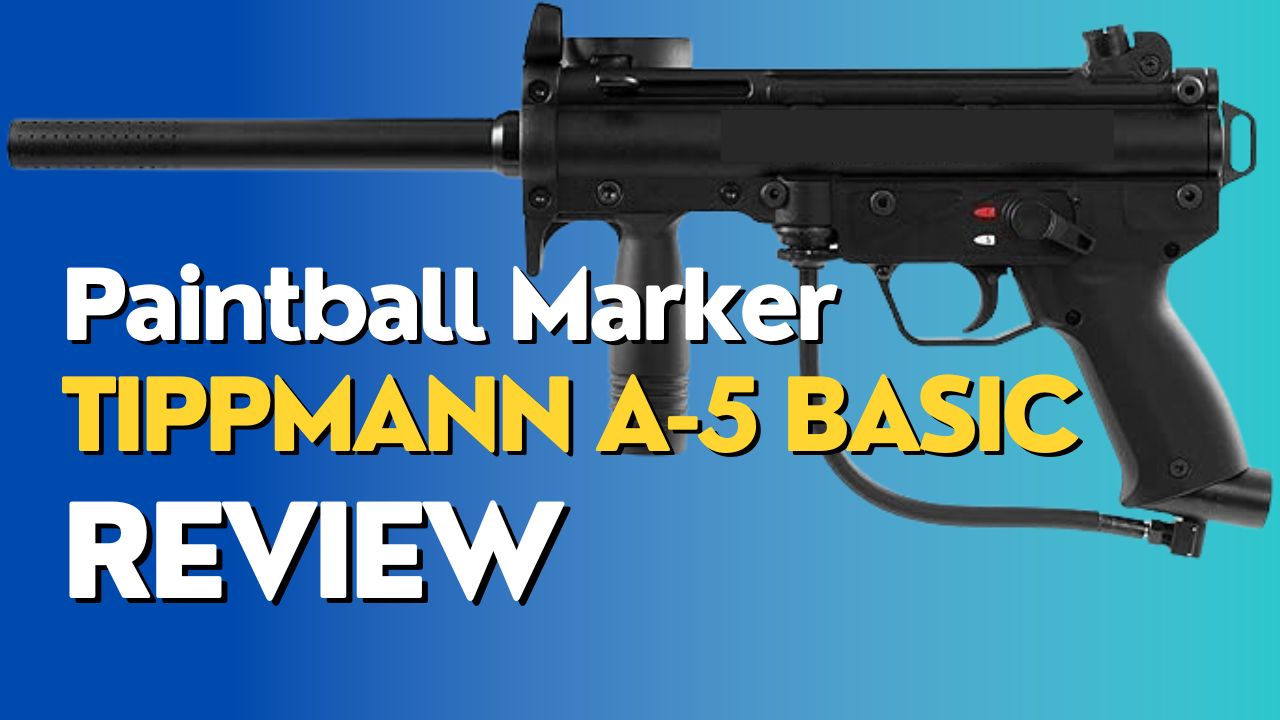
If you’ve spent any time in a paintball Facebook group or a field’s rental rack, you’ve run into a Tippmann A-5. It’s one of the longest-running names in budget-to-mid-range markers, and almost thirty years after Tippmann’s first mechanical guns, the A-5 platform is still being recommended to beginners today. That kind of staying power in a hobby where gear trends move fast is worth paying attention to — but “still around” isn’t the same as “still the right buy.” Here’s an honest look at what the A-5 Basic actually gets you, where it falls short, and who should (and shouldn’t) put one in their cart.
Why the Tippmann A-5 Still Matters
Most entry-level marker recommendations churn every couple of years as brands chase electronic triggers and lighter polymer frames. The A-5 has resisted that churn for one simple reason: it’s mechanical, which means fewer things to break and nothing that dies when a battery does. For a first marker — especially one that’s going to get dropped, dragged through mud, and half-maintained by a teenager — “hard to kill” beats “impressive spec sheet” almost every time.
It also sits in a specific niche: players who want more upgrade headroom than a true starter gun (like a basic Cronus) but don’t want to spend electronic-marker money on their first purchase. The A-5’s aftermarket is genuinely deep — barrels, triggers, feed systems, stocks — which means it can grow with a player instead of being replaced within a season. (Deciding between factory editions? Check our Tippmann A-5 Lineup Guide comparing the Basic, Stealth, and Response Trigger models.)
Key Specs
| Spec | Detail |
|---|---|
| Caliber | .68 Caliber |
| Action | Semi-automatic (mechanical, open bolt blowback) |
| Feed System | Cyclone Feed System — mechanical, sprocket-driven, no batteries needed |
| Air Source | CO2 or compressed air (HPA) compatible |
| Cycle Rate | Up to ~15 balls per second (with upgraded Response Trigger or E-Grip) |
| Barrel Length | 8.5″ stock, threaded for aftermarket swaps |
| Weight | ~3.5 lbs (without tank) |
| Field Strip | Tool-free, roughly 60 seconds |
| Effective Range | ~150 feet (accuracy tapers noticeably past this) |
| Warranty | Tippmann manufacturer warranty (confirm terms at purchase) |
Hands-On Impressions
The Cyclone Feed System is the A-5’s signature feature, and it earns its reputation. Because it’s mechanically linked to the air system rather than battery-driven, it doesn’t jam the way gravity hoppers do under rapid fire, and it doesn’t die mid-game when a 9-volt gets old. Owners consistently point to this as the single biggest reason the A-5 outlasts markers in its price range — there’s just less to fail.
Stock, it’s a semi-auto shooter, and that’s fine for most beginners. The upgrade path to faster cycle rates (Response Trigger kit, or the Selector Switch E-Grip for closer to 15 BPS) is well documented and one of the most common first mods players make. If raw rate of fire matters to you out of the box, budget for one of these add-ons rather than expecting stock performance to compete with electronic markers.
Durability is where the A-5 consistently wins field reports. The all-aluminum die-cast receiver shrugs off the kind of drops and dings that crack polymer-bodied budget guns. Tool-free field stripping in about a minute is a real practical advantage — when something jams mid-game, you’re not hunting for an Allen key.
Accuracy is “good enough,” not exceptional, out of the box. The stock 8.5″ barrel is a fine starting point but is widely considered the first thing worth upgrading — most players report a noticeable tightening of shot groups after swapping to an aftermarket barrel (see our barrel kit guide and barrel distance breakdown for options that fit the A-5’s threading).
CO2 vs. HPA is the one compatibility question people get wrong. The A-5 runs on both, but owner feedback is consistent: CO2 works fine in warm weather but gets noticeably less consistent (and less accurate) in cold temperatures, since CO2 expands unpredictably as temperature drops. If you play in cold conditions or want the most consistent velocity, budgeting for an HPA (compressed air) tank is the single upgrade that most improves the stock experience — see our CO2 vs. compressed air breakdown if you’re deciding between the two.
How the A-5 Basic Compares
| Marker | Action | Feed System | Best For | Price Tier |
|---|---|---|---|---|
| Tippmann A-5 Basic | Semi-auto (mechanical) | Cyclone (mechanical) | Players who want upgrade headroom on a budget | Budget-mid |
| Tippmann Cronus Basic | Semi-auto (mechanical) | Standard gravity hopper | True first-time buyers, lowest cost of entry | Budget |
| Tippmann Stormer Elite | Semi/full-auto capable | Electronic loader-compatible | Players ready for tactical electronic performance | Mid-range |
The short version: the Cronus Basic is cheaper and simpler, the Stormer Elite is faster and more feature-rich, and the A-5 sits deliberately in between — mechanical reliability with a genuine upgrade path, without electronic-marker pricing.
Who Should (and Shouldn’t) Buy the A-5 Basic
Good fit if you:
- Want a first marker that can be upgraded piece by piece as your budget allows, instead of being replaced
- Value reliability and easy field maintenance over top-end rate of fire
- Play mostly recreational or woodsball rather than competitive tournament speedball
Look elsewhere if you:
- Want electronic-marker performance (higher stock cycle rates, lighter trigger pull) right out of the box — see the Stormer Elite review instead
- Are buying on the absolute tightest budget — the Cronus Basic review is the cheaper starting point
- Play primarily in cold-weather conditions and aren’t willing to pair it with an HPA compressed air tank
Mistakes to Avoid
- Skipping the barrel upgrade and blaming the marker for accuracy issues. The stock barrel is a starting point, not the ceiling — see our paintball barrel guide for upgrades.
- Running CO2 in cold weather and expecting consistent velocity. This is a physics problem, not a marker defect — switch to HPA if you play in cold temperatures.
- Neglecting O-ring lubrication. Like any mechanical marker, the A-5’s O-rings dry out with use; skipping regular lube is the most common cause of air leaks owners report.
- Buying upgrades before trying the stock configuration. Learn how the marker performs unmodified first, so you know exactly what problem each upgrade is actually solving.
Maintenance Tips
- Field-strip and inspect O-rings every 3–5 uses; apply paintball-specific oil (not household lubricant) to O-rings and the bolt.
- Store with the tank removed and the marker dry — trapped moisture is the leading cause of internal corrosion.
- Check the Cyclone Feed sprocket for paint residue after any broken-ball incident; it’s the one part that jams if it gets sticky.
- Before storing for the off-season, dry-fire a few times with no air source attached to release spring tension, and store in a case away from direct sunlight (UV degrades seals over time).
Frequently Asked Questions
Is the Tippmann A-5 full auto?
No, it ships as semi-automatic out of the box. It can be upgraded to a significantly higher effective rate of fire with the Response Trigger kit or the Selector Switch E-Grip, both sold separately.
How far can the Tippmann A-5 shoot?
Its effective range is around 150 feet, though accuracy drops off noticeably as you approach that distance — most practical engagements happen well inside that range.
Does the Tippmann A-5 use CO2 or compressed air (HPA)?
Both. CO2 is cheaper and widely available at fields, but performance and shot-to-shot consistency are noticeably better on HPA, especially in cold weather.
Is the Tippmann A-5 good for beginners?
Yes, especially for a beginner who wants room to customize and upgrade over time. If you want the absolute lowest entry cost, the Cronus Basic is a step down in price.
What’s the first upgrade worth buying for the A-5?
Most owners point to either a barrel swap (accuracy) or a Response Trigger / E-Grip (rate of fire) as the highest-impact first mods, depending on which limitation you want to address first.
Verdict
The Tippmann A-5 Basic isn’t the cheapest way into paintball, and it isn’t the fastest-shooting marker at its price point — but it’s one of the few entry-level markers that’s genuinely built to be upgraded rather than replaced. If you want a first marker you can keep for several seasons and grow through mods instead of buying a new gun every year, it earns its long-running reputation. If you want the lowest possible entry cost or out-of-the-box electronic performance, look at the Cronus Basic or Stormer Elite instead.
Related reading: Tippmann A-5 Lineup Guide · Best Paintball Guns Under $200 · Paintball Marker Guide for Beginners · Best Paintball Guns for Beginners · How to Fill a Paintball Tank
See how this marker compares against the top competitors in our comprehensive guide to the best .68 caliber paintball guns.