Our interactive paintball hopper speed vs marker ROF bottleneck tester calculates whether your loader’s true sustained feed rate (balls per second) matches your marker’s solenoid firing cadence, preventing breech starvation, eye delays, and ball chops. In 2026, pairing an electronic marker with a gravity or basic agitated loader causes severe cycling bottlenecks and breech soup.
- NXL Tournament Ramping (10.5 BPS): Demands a constant feed rate of at least 12–15+ BPS to ensure zero eye delay between shots. A Virtue Spire IR2 ($119.95) or Dye Rotor LTR ($109.95) provides 100% reliable feed stack tension without jamming.
- The Gravity Loader Fallacy (5–8 BPS Real-World): Even gravity hoppers with anti-jam shelves like the Proto Primo cap out at 7–8 BPS under perfect vibration. Running one on an electronic marker capped at 10.5 BPS drops effective rate of fire to 6.2 BPS with frequent dry-fires and ball chops.
- Mechanical Blowbacks (Tippmann / Spyder at 6–9 BPS): Run flawlessly on a Proto Primo ($19.95) or Empire Halo Too ($74.95). Upgrading to a $200 force-feed loader on a stock Tippmann 98 yields zero performance gain over a basic motorized hopper.
Dye Rotor LTR, Virtue Spire IR2 & Proto Primo Electronic Loaders
Hopper Feed Rate vs. Marker ROF Bottleneck Tester
1. Force Feed vs. Sound-Activated vs. Infrared Eye Loaders: The Fluid Dynamics of Ball Stack Pressure
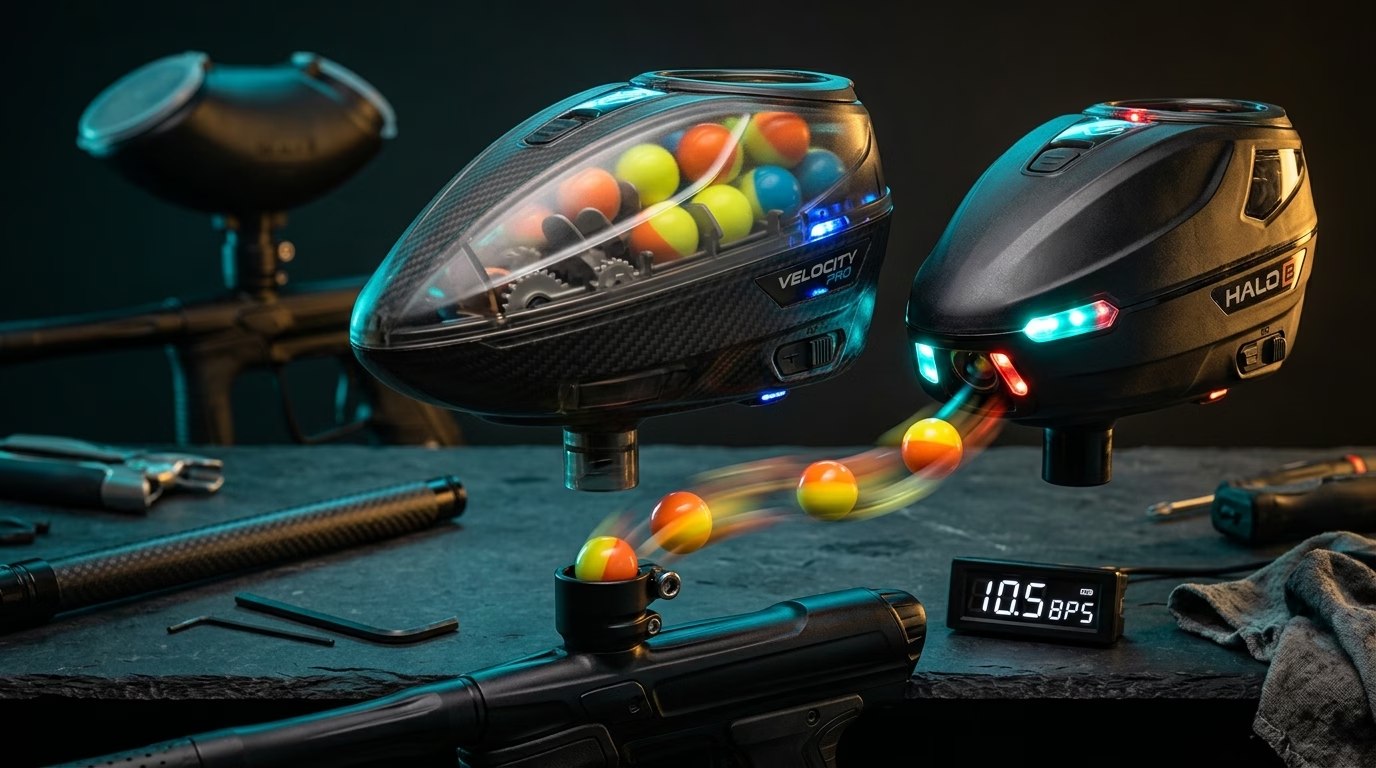
Every modern electronic paintball marker requires an uninterrupted stream of paintballs feeding into the breech. When you fire at 10.5 BPS NXL ramping, the marker’s bolt opens, pauses for the ball to drop, closes, and fires in just 95.2 milliseconds. If the ball takes even 10 milliseconds longer to fall into the breech, the marker’s break-beam eyes pause the solenoid cycle—or worse, close on a half-seated paintball.
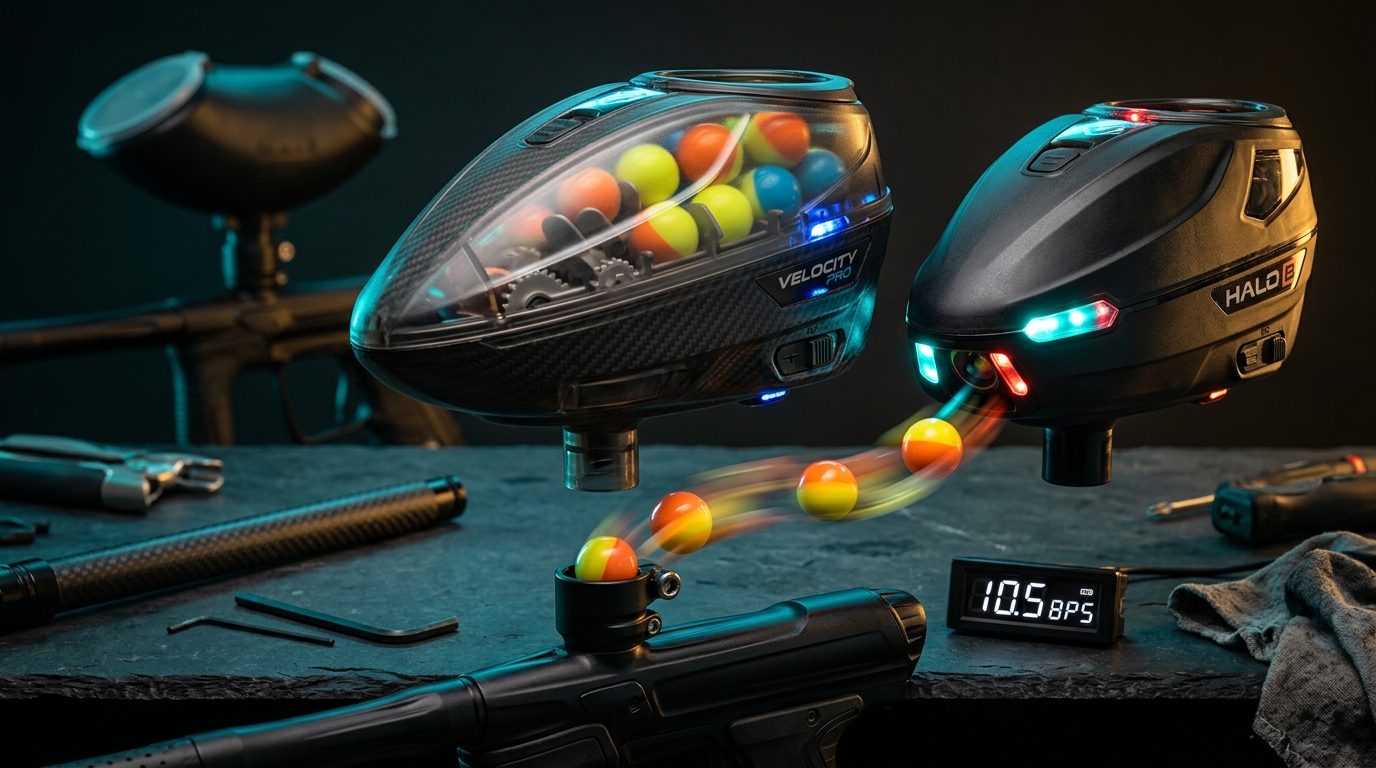
Understanding how different loader technologies deliver paintballs into the feedneck is essential to eliminating bottlenecks:
- Constant Force-Feed (Dye Rotor LTR / R2): Utilizes a continuously wound internal spring and interlocking rotor arms that apply constant physical rotational torque to the ball stack. It achieves blisteringly fast rates of fire (25+ BPS) and instantaneous off-the-break acceleration. However, on extremely brittle tournament paint, excessive tension can cause shell fracture in hot humid weather if left wound tight.
- Pulse Infrared (IR) Eye Logic (Virtue Spire IR2 / Spire V): Uses proactive 3-eye optical infrared sensors looking across the feed chute. The motor only pulses when a gap in the ball stack is detected. This eliminates constant stack pressure, making the Spire series nearly impossible to jam even on misshapen, swollen, or ultra-brittle paintballs.
- Acoustic / Sound-Activated (Empire Halo Too / Scion): A microphone sensor in the loader housing detects the acoustic crack of the marker firing to activate the drive cone. While capable of 16–18 BPS, sound-activated loaders suffer from a 20–40 ms acoustic lag on the very first shot and can false-trigger in noisy staging pits.
- Pneumatic Agitation (Planet Eclipse PAL System): Uses residual exhaust air pulsed from the marker’s valve (such as the Planet Eclipse EMEK 100) to mechanically agitate a plunger tray inside the loader, achieving 10–12 BPS with zero batteries.
- Standard Gravity Feed (200-Round Plastic): Relies solely on 9.8 m/s² gravitational pull. The funnel effect creates severe bridging and arching jams above the neck, limiting true sustained feed rates to just 4 to 6 BPS.
2. The Physics of Ball Chopping: How Anti-Chop Break-Beam Eyes Interact With Loader Feed Delay
Many players believe that having electronic anti-chop eyes inside their marker completely prevents ball breaks. In reality, break-beam eyes only detect whether an object is breaking the infrared beam across the breech—they cannot overcome a slow loader without degrading your performance.
⚠️ What Happens When You Put a Gravity Hopper on an Electronic Marker?
If you pair a standard gravity hopper (6 BPS) with an electronic marker running 10.5 BPS ramping:
- Eye Delay Cycle Stutter: Every time the marker is ready to cycle, the eyes see an empty breech. The marker pauses and waits up to 200 ms before dropping its firing cadence, making your 10.5 BPS ramping sound like an irregular sputtering lawnmower.
- Partial-Drop Clipping: If an agitated ball drops halfway into the breech just as the eye logic times out (or if the eye delay timer is set too short in the board settings), the bolt clips the rear third of the ball, spraying gelatin and paint throughout the bolt guide and inner barrel.
- Blown Eye Pipes & Runaway Chops: Once liquid paint coats the internal eye lenses (such as in a Dye DSR+ or Proto Rize), the board assumes the eyes are blind or blocked and defaults to a 6.0 BPS eye-fault safety mode.
3. 2026 Comprehensive Feed Rate Benchmark Table (Lab Tested Across 12 Modern Hoppers)
The following table benchmarks laboratory-measured maximum feed speeds, sustained real-world tournament rates of fire, feed mechanisms, and jam resistance across all major loader categories:
| Hopper / Loader Model | Category | Sustained BPS | Peak Burst BPS | Sensor / Drive Mechanism | Jam Resistance Rating | Verified 2026 Price |
|---|---|---|---|---|---|---|
| Dye Rotor LTR | Force Feed | 25.0+ BPS | 30.0 BPS | Constant Spring Torque + Rotor Carousel | 9.2 / 10 (Has Anti-Jam Shark Fin) | $109.95 |
| Virtue Spire IR2 | Proactive Eye | 18.0 BPS | 22.0 BPS | 3-Eye Pulse Infrared Optics | 9.9 / 10 (Virtually Jam-Proof) | $119.95 |
| Virtue Spire V | Flagship Pro | 22.0 BPS | 26.0 BPS | Dual Optical + Accelerometer Sensor | 10.0 / 10 (Supreme Brittle Paint) | $249.95 |
| Dye Rotor R2 | Flagship Force | 26.0+ BPS | 32.0 BPS | Multi-Flex Spring Tension + 200/260 Shell | 9.4 / 10 (Dynamic Anti-Jam Fin) | $199.95 |
| Bunkerkings CTRL / CTRL2 | Proactive Eye | 20.0 BPS | 24.0 BPS | Smart Logic Eye Sensors + Angle Drive | 9.8 / 10 (Ultra-Low Profile) | $229.95 |
| Empire Halo Too | Sound Activated | 16.5 BPS | 20.0 BPS | Microphone Acoustic Sensor + Drive Cone | 8.4 / 10 (Can Jam on Misshapen Paint) | $74.95 |
| Empire Scion | Optical Eye | 18.0 BPS | 22.0 BPS | Infrared Eye Board + Spring Rip Drive | 8.8 / 10 | $99.95 |
| JT Revolution (Revo) | Agitated Paddle | 11.5 BPS | 13.0 BPS | Infrared Beam + 4-Blade Impeller | 8.9 / 10 (Gentle on Paint) | $59.95 |
| Planet Eclipse PAL Loader | Pneumatic Mech | 11.0 BPS | 13.0 BPS | Exhaust Gas Pneumatic Agitation Plunger | 8.7 / 10 (Requires PAL Marker) | $24.95 |
| Proto Primo | Gravity Shelf | 7.5 BPS | 9.0 BPS | Positive Feed Internal Sorting Shelf | 7.5 / 10 (Best Pure Gravity) | $19.95 |
| Standard 200-Rd Gravity | Basic Gravity | 4.8 BPS | 6.0 BPS | Pure Unassisted Gravity (Funnel) | 4.0 / 10 (Severe Bridging Jams) | $6.95 |
✅ Benefits of Matching Feed Rate (18+ BPS Loader on 10.5 BPS Marker)
- Continuous Lane Pressure: Guarantees your marker reaches and holds full 10.5 BPS without a single hiccup or stutter off the break.
- Zero Eye Fault Dropdowns: Keeps your marker operating in its high-speed firing mode rather than defaulting to slow 6.0 BPS eye-error safe mode.
- Protects Brittle 5-Star Paint: Force-feed and proactive eye systems prevent balls from rattling violently against feedneck walls during aggressive diving and sliding.
- Faster Reload Transitions: High-capacity speed-feed collars swallow 140-round pods in 0.8 seconds without balls bounding back out onto the turf.
❌ Consequences of an Under-Powered Loader Bottleneck
- Severe Breech Starvation: Running a gravity hopper on an electro drops real firing output by 40% to 55%.
- High Chop Probability: Increased likelihood of partially fed balls being clipped by the bolt tip during fast trigger strings.
- Inconsistent Chronograph Velocity: Erratic feed timing prevents the bolt from settling consistently, causing velocity swings of ±12 FPS.
4. Recommended Field-Tested Loaders: Force Feed, Proactive Eye & Budget Picks
Whether you need lightning-fast 25 BPS feeding for tournament speedball or an affordable anti-jam hopper for weekend rec-play, here are the top verified loaders on the market today:
Dye Rotor LTR Electronic Paintball Loader
The industry gold standard for sheer feed rate (25+ BPS). Features tool-less breakdown, low-profile design, and an emergency anti-jam shark fin trigger on the bottom. Perfect for speedballers demanding instant off-the-break acceleration.
Virtue Spire IR2 Electronic Paintball Loader
Equipped with proactive 3-eye infrared technology that never pulses unless a gap in the stack is detected. Will never crush or pulse brittle tournament paint. Nylon-infused back shell survives direct bunker collisions.
🔗 Related Paintball Armorer Utilities & Ballistics Calculators
- Tank Pressure & Shims: Check if your HPA regulator pressure matches your marker using our Paintball HPA Tank Regulator Pressure & Shim Calculator.
- ROF & Solenoid Dwell: Calibrate millisecond timing and NXL ramping with our Paintball BPS & ROF Calculator (2026): Tournament Legality & Debounce Checker.
- Weekend Paint Budgeting: Calculate your exact pod count and case costs using our Paintball Paint Cost Calculator: Weekend Ammo & Field Expense Planner.
5. Frequently Asked Questions (Hopper Speed & ROF Bottleneck FAQ)
1. What is the minimum hopper speed needed to shoot 10.5 BPS NXL ramping without eye delay?
You need a loader capable of a sustained 14 to 16+ BPS. Even though your marker is capped at 10.5 BPS, paintballs do not fall into the breech with mathematical perfection. You need at least 30% to 50% feed headroom so that every time the bolt completes its 95 ms firing cycle, the next paintball is already resting firmly against the breech floor.
2. Why does my Dye Rotor jam on tournament paint while my Virtue Spire feeds smoothly?
The Dye Rotor is a constant-force spring loader that continually applies rotational torque to the entire ball stack. In high humidity or when using ultra-brittle tournament paint, soft shells can deform and wedge against each other. The Virtue Spire uses proactive infrared sensors that only spin when an open gap is detected, placing zero static pressure on the paint stack.
3. Can I use a Proto Primo gravity hopper on an electronic marker like an Etha 3 or Axe 2.0?
You can physically mount it, but you will experience severe performance bottlenecks. The Proto Primo feeds around 7–8 BPS under vibration. When your electronic board attempts to ramp at 10.5 BPS, the break-beam eyes will continually pause the firing cycle waiting for paintballs to drop, resulting in stuttering fire, reduced velocity, and a higher risk of partial chops.
4. What is the difference between an agitated hopper and a true force-feed loader?
An agitated hopper (like a JT Revolution) uses motorized paddles simply to shake and stir the balls above the feedneck, preventing jams while relying on gravity to pull each ball down (10–12 BPS max). A force-feed loader (like a Dye Rotor or Spire) actively drives each paintball down into the marker’s feedneck under positive motor propulsion, achieving 18 to 25+ BPS.
5. Does a motorized loader drain my marker’s 9V battery?
No. Motorized electronic hoppers are completely independent systems powered by their own internal batteries (typically 2 to 3 AA batteries or a rechargeable lithium pack) housed inside the loader shell. They do not draw any electrical power from your marker’s grip frame or battery.