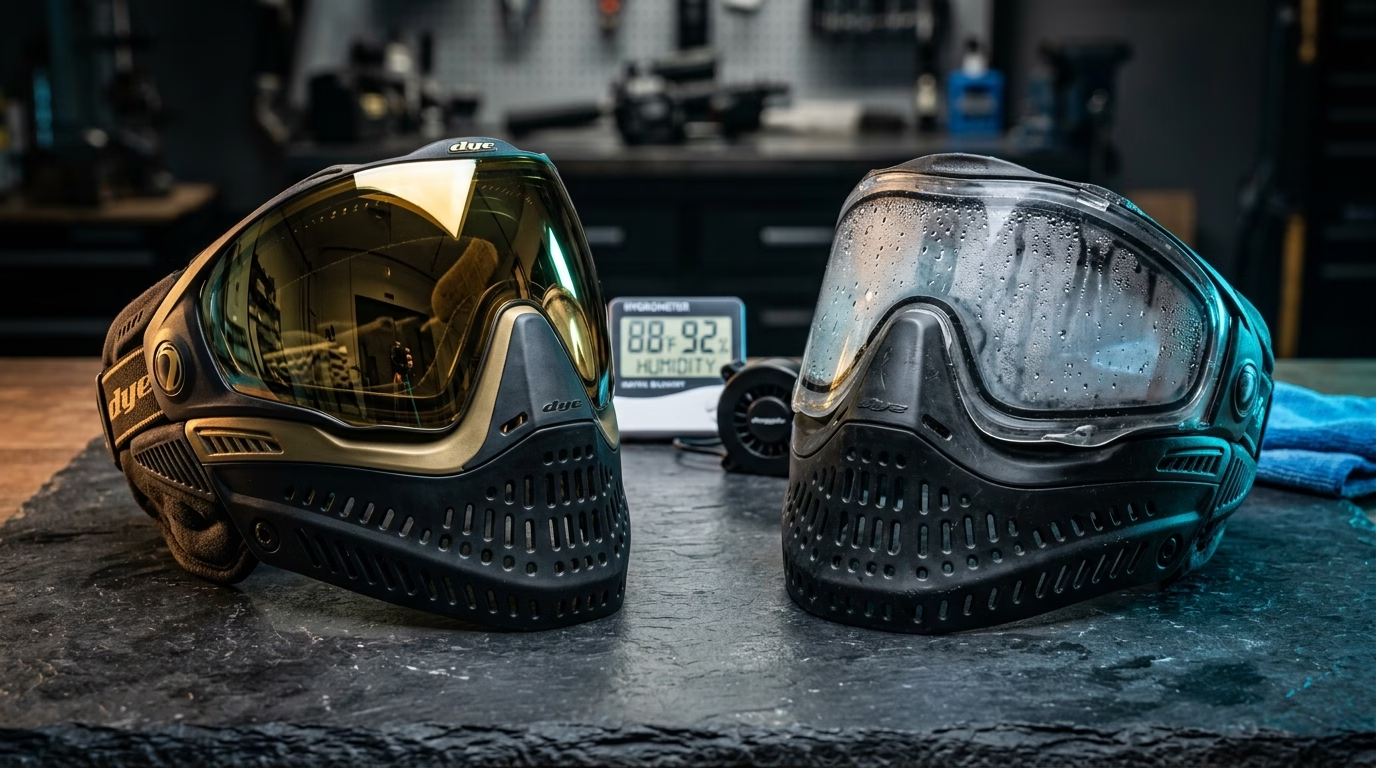
Our interactive paintball mask fog-risk calculator computes actual atmospheric dew points, breath-to-lens temperature gradients, and condensation probabilities across all weather extremes (from 20°F winter scenarios to 95°F sweltering humidity). In 2026, mask fogging remains the single largest preventable safety hazard in paintball, causing players to lift their goggles in active play.
- The Thermal Lens Non-Negotiable: A certified dual-pane thermal lens (like the Dye i5, Virtue VIO, or JT ProFlex) features a sealed cellular silicone foam gasket that insulates the hot, humid inner air from the cold outer climate, cutting fog risk by 85% to 92% under any weather condition.
- Single-Pane Rental Hazard (95%+ Fog Risk): Untreated single-pane lenses fog completely within 3 minutes of active play whenever ambient humidity exceeds 60% or temperatures drop below 60°F. Never play speedball or woodsball with a single-pane lens.
- Eyeglass Wearer Dilemma: While thermal mask lenses won’t fog, prescription glasses worn underneath lack thermal insulation. Overcoming glasses fogging requires combining a wide-frame mask with a dual micro-fan ventilation system (Exalt or Fanz kit).
Dye i5, Virtue VIO Ascend & JT ProFlex Dual-Pane Thermal Paintball Masks
Paintball Mask Fog-Risk & Climate Calculator
1. The Thermodynamics of Goggle Condensation: How Breath Moisture Vaporizes and Bonds to Cold Polycarbonate
During an active 10-minute paintball game, an adult player exhales approximately 300 to 500 mL of water vapor per hour at a saturated body temperature of 98.6°F (37°C) with 100% relative humidity. When that warm, water-saturated breath rises through the mask’s mouth vents and strikes a cold optical surface whose temperature sits at or below the atmospheric dew point, phase change occurs instantaneously: water vapor condenses from a gas into microscopic liquid droplets.
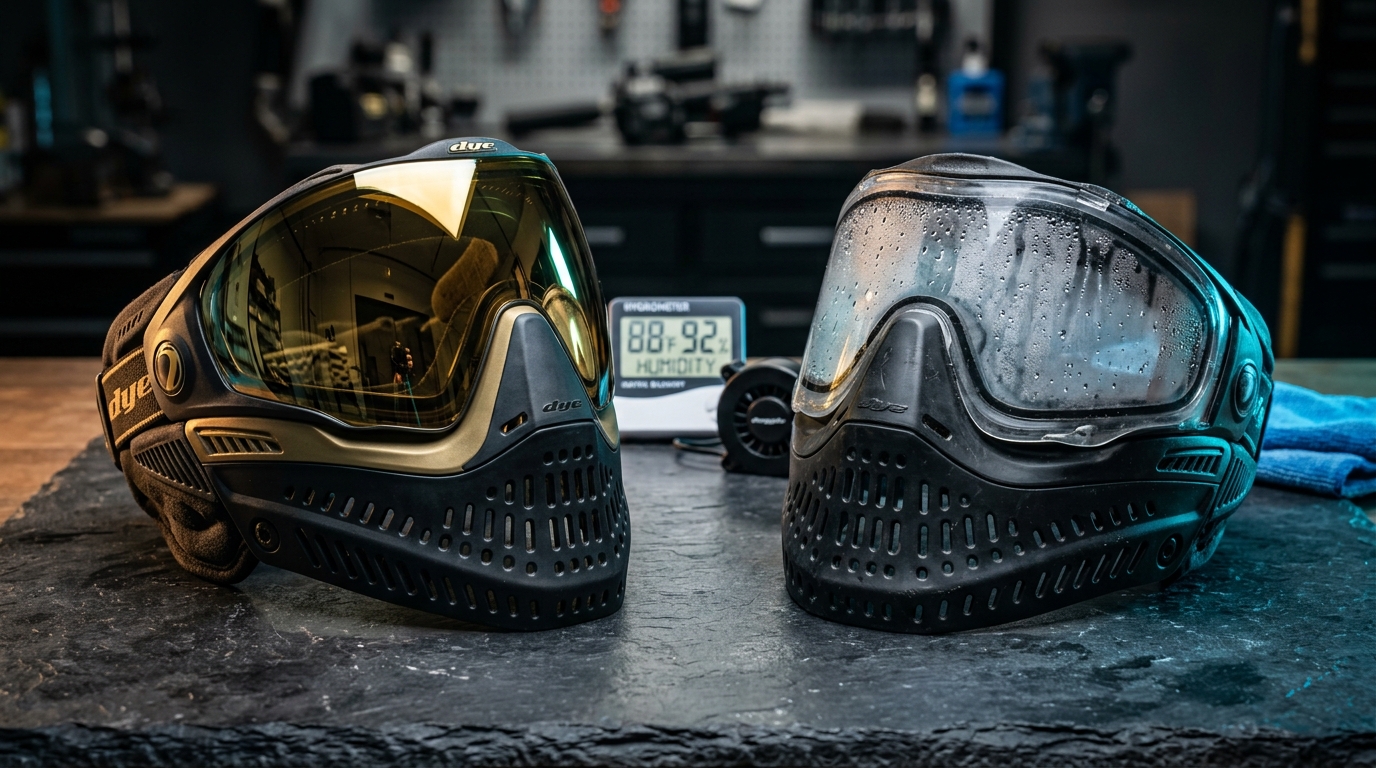
Understanding why single-pane lenses fail while dual-pane thermal lenses maintain clear optics requires looking at heat transfer physics:
- The Single-Pane Thermal Bridge: In a single-pane lens, there is only 1.8mm of solid polycarbonate separating the 40°F–70°F outdoor climate from your 98.6°F exhaled breath. Because polycarbonate is a decent conductor of cold, the inner lens surface rapidly drops to match the outdoor temperature. As soon as your exhaled breath hits that cold surface, water droplets instantly bead up into millions of tiny light-scattering prisms, blinding you completely.
- The Dual-Pane Thermal Barrier (Double-Glazing Principle): Just like double-hung residential windows, a dual-pane thermal paintball lens consists of an outer impact-resistant polycarbonate lens, a sealed 2mm cellular foam/silicone perimeter gasket, and an inner optical pane treated with anti-fog hydrophilic chemistry. The dead air trapped inside the sealed chamber acts as a powerful thermal insulator. As a result, the inner pane stays at your facial skin temperature (~88°F–92°F), remaining well above the dew point so water vapor never condenses.
- Hydrophilic vs. Hydrophobic Surface Chemistry: High-end thermal lenses feature a hydrophilic coating on the inner pane. Instead of allowing moisture to bead up into spherical droplets that distort light, the coating lowers surface tension, causing condensation to sheet out into a flat, transparent film of water that remains optically clear.
2. Why Single-Pane Rental Masks Are a Critical Safety Hazard on the Field
Paintball industry safety statistics reveal that over 94% of catastrophic eye injuries in paintball occur not because a paintball shot through a mask, but because a frustrated player lifted or removed their fogged mask in the middle of an active game to wipe the lens.
⚠️ The Fatal Chain Reaction: Fogging Leads to Blind Lift
A player wearing a cheap single-pane rental mask sprints to the 50-yard bunker on an 80% humidity morning. Within 90 seconds:
- Total Loss of Peripheral & Forward Vision: White condensation forms a milky blindfold across the lens, completely hiding opponents, bunkers, and tripping roots.
- The Panic Reaction: Unable to see where incoming paintballs are flying, the player instinctively lifts the bottom of their mask or pulls the strap off their forehead to wipe it with a jersey sleeve.
- Catastrophic 280 FPS Impact: A stray paintball traveling at 285 feet per second strikes the unprotected eyeball, causing hyphema, detached retina, or permanent blindness. Never, under any circumstances, lift a mask on an active field. If your mask fogs, call yourself out, place your barrel cover on your marker, and walk off the field with your mask securely strapped on.
3. ASTM F1776 Safety Standards & Proper Thermal Lens Cleaning Protocols
All legitimate paintball goggles must pass the stringent ASTM F1776 Standard Specification for Eye Protective Devices for Paintball Sports. This standard subjects the lens to multiple direct impacts from .68 caliber paintballs fired at 310 to 330 FPS at freezing and elevated temperatures without cracking, dislodging, or piercing the eye chamber.
🧼 The #1 Mistake Players Make: Cleaning Thermal Lenses with Windex or Alcohol
Commercial glass cleaners like Windex contain ammonia and isopropyl alcohol, which chemically dissolve the delicate hydrophilic anti-fog film bonded to the inner thermal pane. Furthermore, submerging a dual-pane lens in water or holding it under a sink faucet will seep water through the cellular foam gasket into the sealed chamber, permanently ruining the lens.
The Proper Cleaning Method: Use solely warm tap water or dedicated goggle cleaners (such as Exalt Paintball Goggle Cleaner). Spray lightly on the outside lens and wipe with a clean microfiber cloth. On the inner thermal pane, breathe gently on the lens and lightly dab (never scrub vigorously) with a fresh microfiber.
4. Field-Tested Anti-Fog Mask Showcase: Dual-Pane Thermal Titans & Eyeglass Fans
Upgrading from a rental single-pane mask to a certified dual-pane thermal goggle is the single most important equipment investment in the sport. Here are the top three fog-proof masks and micro-fan systems tested and approved by our armory team:
Dye i5 Thermal Paintball Goggle System
Features the industry-leading TiRN 290-degree horizontal field of vision with dual-pane thermal technology. The GSR Pro-Strap dial lets you micro-adjust tension with one hand, and the multi-directional directional venting exhausts breath instantly downward away from the lens.
Virtue VIO Ascend Dual-Pane Thermal Mask
Delivers high-end dual-pane thermal anti-fog clarity in a rugged, single-piece molded composite construction. Offers exceptional voice acoustics so team callouts ring clear across the field, with optical-grade UV-filtering thermal lenses.
🔗 Related Paintball Armorer Utilities & Tactical Calculators
- Loader Bottlenecks: Match your hopper feed rate to your marker’s solenoid firing cadence with our Paintball Hopper Speed vs. Marker ROF Bottleneck Tester.
- Tank Regulator Pressure: Verify whether your HPA bottle needs 450 PSI LP or 800 PSI HP using our Paintball HPA Tank Regulator Pressure & Shim Calculator.
- ROF & Solenoid Dwell: Check legal firing modes and tournament caps with our Paintball BPS & ROF Calculator (2026): Tournament Legality & Debounce Checker.
5. Frequently Asked Questions (Mask Fogging & Optical Safety FAQ)
1. What is the difference between an anti-fog coating and a true dual-pane thermal lens?
An anti-fog coating is merely a temporary chemical spray applied to a single piece of plastic that absorbs or spreads moisture. A dual-pane thermal lens is a physical architectural barrier made of two distinct lenses separated by an airtight insulating silicone/foam gasket, preventing the cold outside air from ever cooling the inside optical lens to the dew point.
2. Why do my prescription eyeglasses fog inside a thermal mask even though the mask lens stays clear?
Prescription eyeglasses are single-pane glass or plastic lenses without thermal insulation. When your warm, humid exhaled breath circulates inside the mask cavity, the eyeglasses remain cold and immediately condense moisture. To fix this, wear daily disposable contact lenses, use a mask with massive ventilation (like the JT ProFlex), or install an active battery-powered goggle fan system (such as the Exalt or Fanz micro-fan kit).
3. Can I wash a thermal paintball lens under running water or in the shower?
No, never submerge a thermal lens! Running water will seep past the porous cellular foam gasket into the airtight dead-air chamber between the two panes. Once moisture is trapped inside the inner chamber, it cannot be dried out and will permanently fog from the inside, ruining the $40–$60 lens.
4. How often should a paintball mask lens be replaced?
Under ASTM guidelines, a paintball lens should be replaced at least once per year under regular playing conditions, immediately after taking a direct point-blank hit from under 10 feet, or whenever you observe deep scratches, spiderweb micro-fissures, or separation of the thermal foam gasket.
5. What should I do if my mask fogs completely in the middle of a game?
Never take off your mask on the field! Call yourself out immediately by yelling “Hit!” or “Player Out!”, place your barrel blocking device on your marker, raise your hands high above your head, and walk off the field guided by a referee or teammate. Only remove your mask once you are inside the fully netted staging area.