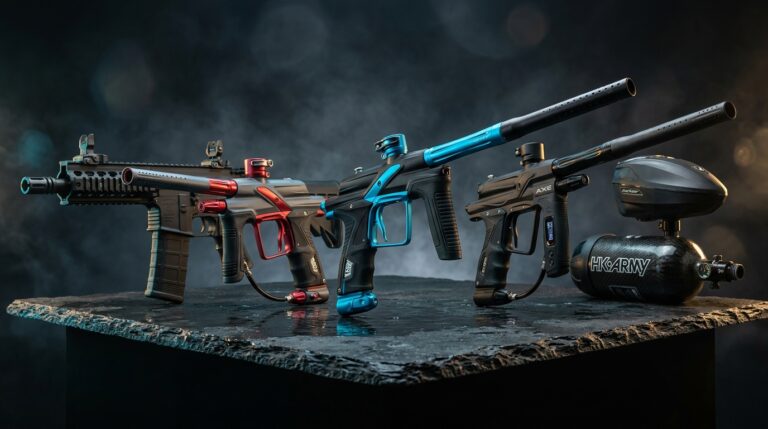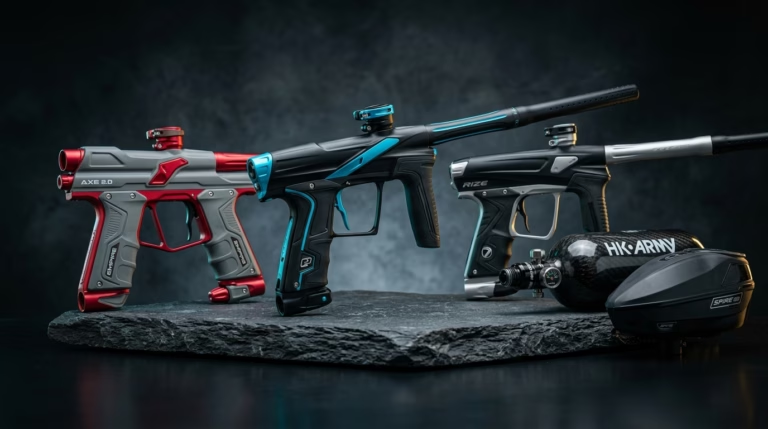
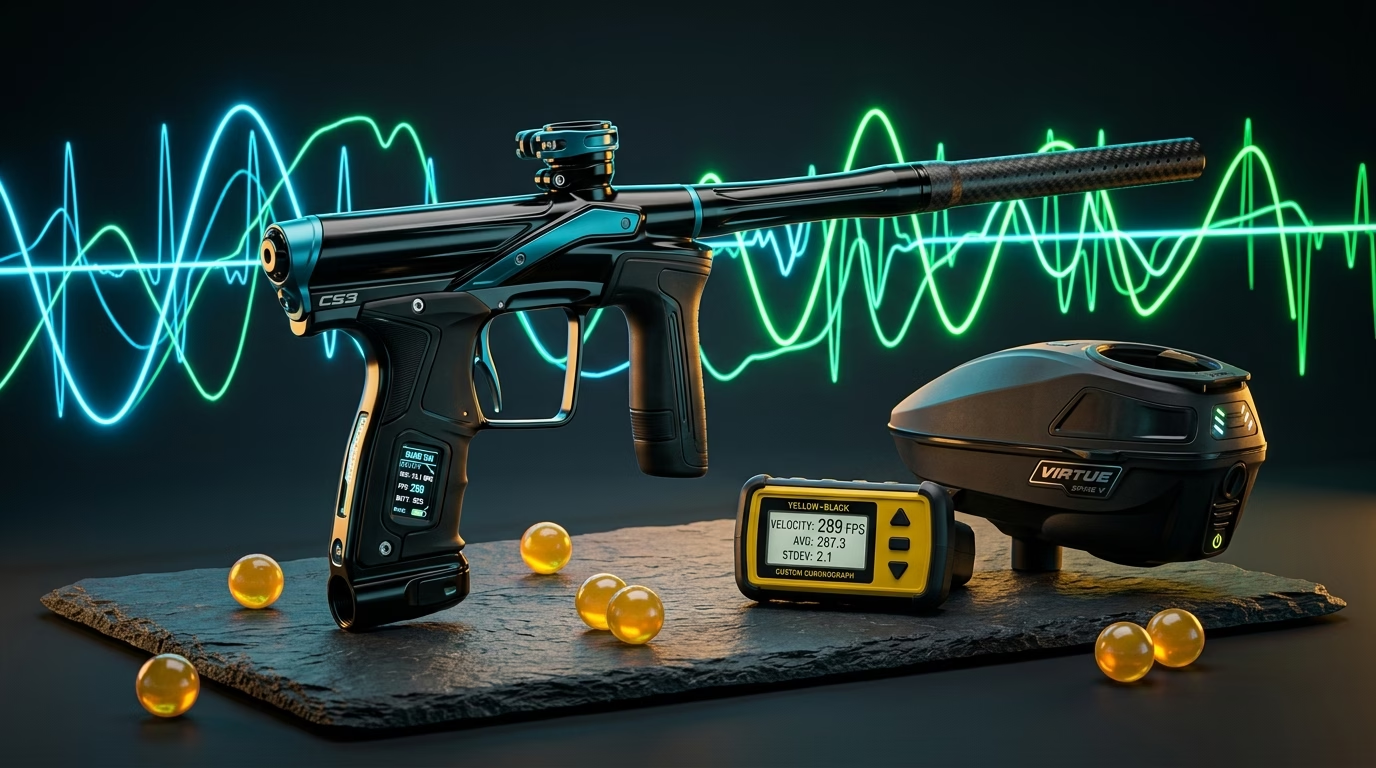
A paintball BPS calculator converts your marker’s Balls Per Second (BPS) rate of fire into exact millisecond (ms) shot-to-shot cycle intervals so you can tune your circuit board, solenoid dwell, and switch debounce without failing a referee chronograph inspection. Under 2026 NXL and Millennium tournament regulations, the universal electronic rate-of-fire cap is 10.5 BPS (95.24ms per shot) using 3-pull ramp activation at a 5.0 BPS minimum sustain cadence, while recreational fields typically enforce a strict 10.0 BPS (100.0ms) or 12.0 BPS (83.33ms) semi-auto ceiling.
- The Pro 10.3 BPS Pit Rule: Never leave your marker board set to
10.5 BPSexact—mid-air paintball spacing variance can spike a handheld radar chronograph to10.65 BPS(automatic penalty). Set your board cap to 10.3 or 10.4 BPS (96.15ms–97.09ms). - Debounce Sweet Spot: Keep microswitch/opto trigger debounce at 4ms to 6ms (Level 4–5) to prevent frame vibration from firing a runaway post-release shot during a referee bounce check.
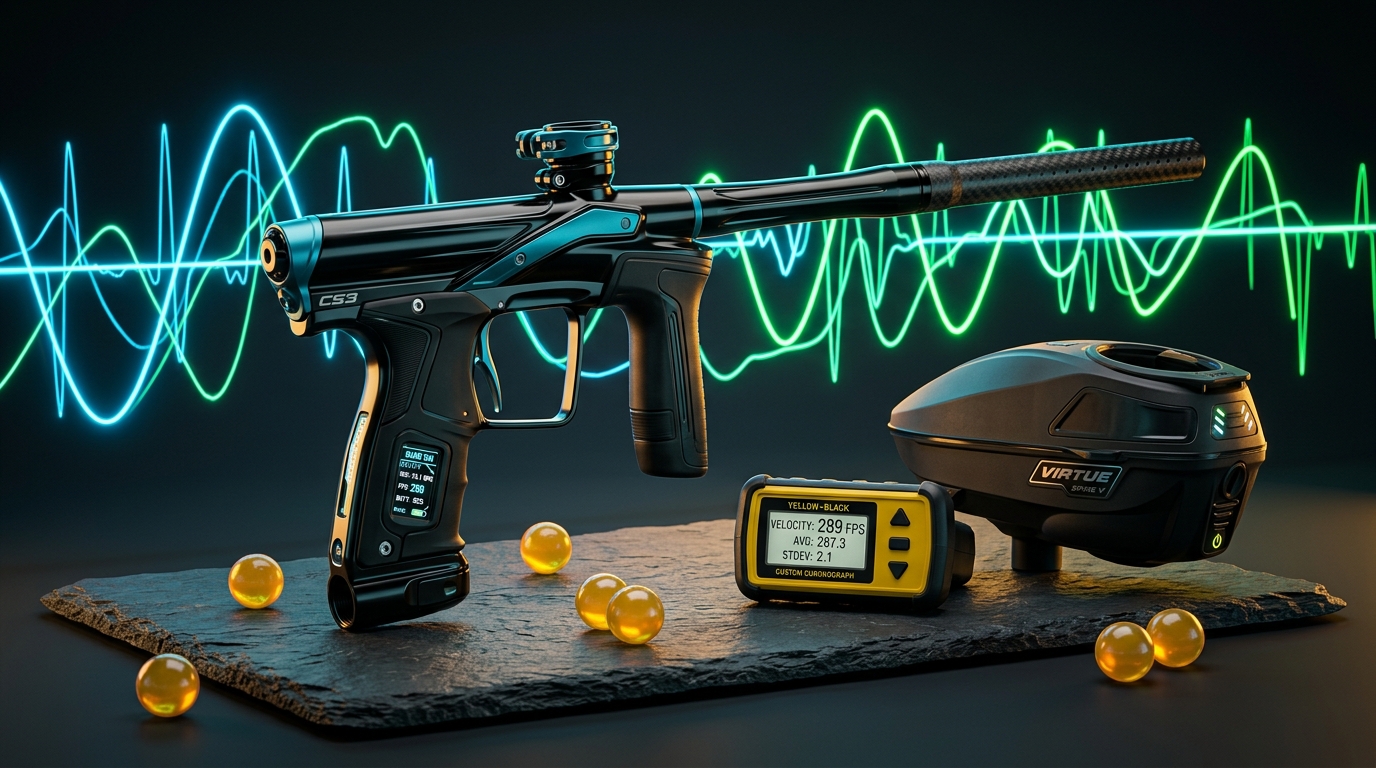
- Essential Pit Verification Gear: Every tournament squad should verify both velocity (<300 FPS) and cadence (≤10.5 BPS) before staging with a Virtue Clock III Radar Chronograph ($199.95 MSRP) stored inside an Exalt Hard-Shell Chrono Case ($34.95 MSRP).
Paintball BPS & ROF Calculator + Tournament Legality Checker
1. The Physics of Cycle Time & Solenoid Debounce (Why Accidental Ramp Spikes Happen)
Every electronic tournament paintball marker—whether you shoot a flagship Planet Eclipse CS3 Pro vs. Dye MXR or an entry-level speedball rig from our best paintball guns under $400 lineup—governs its rate of fire using a microsecond quartz crystal timer on the circuit board. The fundamental equation converting Balls Per Second (BPS) into Shot-to-Shot Cycle Period (T) is:
While 95.24 milliseconds sounds instantaneous to the human finger, your marker’s internal pneumatic engine must execute four distinct physical and electronic phases inside that single 95.24ms window before the next trigger command can safely fire:
Switch Debounce Filter
When a microswitch lever snaps closed (or an optical beam breaks), the metal contacts physically rebound for 1–3ms. The board’s debounce timer waits 4ms–6ms to confirm the pull is genuine and not pneumatic recoil vibration.
Solenoid Pilot Dwell
The processor energizes the solenoid coil for the programmed Dwell Time (e.g., 10.5ms on OP Core, 11.5ms on Luxe Aire, 12.0ms on ARC+), venting the rear spool chamber and driving the bolt forward.
Breech Seal & Launch
The bolt tip pushes the paintball past the rubber detents into your bore-matched barrel insert and releases the 100–135 PSI air charge to accelerate the ball to 285–295 FPS.
Bolt Return & Eye Feed
The solenoid closes, the bolt retracts, the firing can recharges from the HPR, and your force-feed loader drops the next paintball across the breech eyes (~45ms gravity/spring drop time).
How Microswitch Bounce Causes Illegal Ramp Spikes: When players lower their trigger debounce setting to 1 or 2 chasing a “hair-trigger” feel, two dangerous failure modes occur during tournament referee checks. First, as your finger releases the trigger at the end of a string, the return spring snaps the trigger shoe against the forward stop-screw, sending a mechanical shockwave into the microswitch leaf spring. With only a 1ms–2ms debounce filter, the board interprets that rebound vibration as an extra trigger pull—firing two shots after release instead of the NXL-legal single overrun shot. Second, when a referee performs the classic butt-slap / frame-tap bounce test at the chronograph station, an ultra-low debounce setting coupled with a tight magnetic return gap will fire the marker without touching the trigger blade, resulting in an immediate major penalty.
Every NXL event, dozens of divisional players get assessed penalties even though their OLED screen clearly says ROF CAP: 10.5 BPS. Here is the physics behind the trap: your marker board controls solenoid electrical initiation intervals (95.24ms), NOT the aerodynamic spacing of paintballs 3 feet in front of the muzzle where the referee holds the Virtue Clock Doppler radar.
If Shot #1 leaves the barrel at 281 FPS and Shot #2 leaves 95.24ms later at 293 FPS (a normal ±6 FPS dimpled-paint swing that you can model in our Paintball FPS & Joule Kinetic Energy Calculator), the faster second ball closes the physical distance gap in mid-air. The Doppler radar measures the compressed arrival time between those two balls as 93.4 milliseconds (10.70 BPS)! The Fix: Always program your board’s maximum ROF cap to 10.3 BPS (97.09ms) or 10.4 BPS (96.15ms). You lose zero noticeable lane density while guaranteeing your gun never spikes above 10.50 BPS on the referee’s radar.
2. Complete 2026 NXL, WXL, USXBL & Local Field Rulebook Comparison Matrix
Before travelling to a regional X-Ball event, classic mechanical open, or local scenario park, verify your board profile against the official 2026 rate-of-fire and ramping compliance matrix below:
| League / Format (2026) | Max ROF Cap | Min Cycle Delay | Allowed Firing Mode | Ramp Start / Sustain | Release Overrun Limit |
|---|---|---|---|---|---|
| NXL Pro & Divisional X-Ball | 10.5 BPS | 95.24 ms | NXL Ramping / Semi | 3 Pulls / 5.0 BPS Sustain | Max 1 Shot Post-Release |
| WXL / Millennium Series (EU) | 10.5 BPS | 95.24 ms | Millennium / NXL Ramp | 3 Pulls / 5.0 BPS Sustain | Max 1 Shot Post-Release |
| USXBL / Regional X-Ball | 10.5 BPS | 95.24 ms | NXL Ramping / Semi | 3 Pulls / 5.0 BPS Sustain | Max 1 Shot Post-Release |
| WCPPL / Classic Semi-Auto | 10.2 BPS | 98.04 ms | Capped Semi-Auto Only | No Ramping Allowed | 0 Shots (1 Pull = 1 Shot) |
| ICPL / Classic 10-Man Mech | Uncapped Mech | Finger Speed (~70–95ms) | Pure Mechanical Semi | Zero Electronics / Batteries | 0 Shots (No 3-Way Runaway) |
| Standard Walk-On / Rec Field | 10.0 BPS | 100.00 ms | Capped Semi-Auto Only | No Ramping Allowed | 0 Shots (1 Pull = 1 Shot) |
| Local Speedball Open Scrimmage | 10.5 – 12.0 BPS | 83.33 – 95.24 ms | NXL or PSP Ramping | 3 Pulls / 5.0 BPS Sustain | Max 1–3 Shots (Field Rule) |
3. Step-by-Step Board Tuning Guide: Planet Eclipse, DLX Luxe & Dye (10.5 BPS Lock-In)
Whether you are prepping a flagship Planet Eclipse CS3 Pro vs. DLX Luxe Aire or tuning a mid-range Planet Eclipse Gtek 180R or Dye DSR Pro, follow these exact factory board parameters to guarantee zero chronograph penalties while maximizing air efficiency on your 68/4500 HPA carbon tank:
A. Planet Eclipse OLED & LED Boards (CS3 Pro, CS3, Geo R5, Ego LV2, Gtek 180R, Etha 3)
Planet Eclipse markers let you choose between an optical break-beam sensor and a physical microswitch inside the trigger frame (detailed in our Planet Eclipse CS3 vs. CS3 Pro comparison). To enter programming mode with the tournament lock active, hold the trigger while powering on the OLED screen, or press the internal tournament lock button under the left grip panel:
- Firing Mode: Set to
RAMP→Ramp Type: NXL(locks in 3-pull start and 5.0 BPS sustain). - ROF Cap (Balls Eyes On): Dial down from
10.5 BPSto10.3 BPSor10.4 BPS(96.15ms–97.09ms cycle delay). - ROF Cap (Eyes Off / Fault): Set to
8.0 BPSto10.0 BPSso a dirty breech eye never causes a blender chop. - Solenoid Dwell: Leave at factory stock (
10.5 mson OP Core CS3/180R;11.8 mson Gamma Core Etha 3;9.5 mson Ego LV2). - Switch Debounce (Filter): Set to
Level 5for Microswitch mode orLevel 4for Optical sensor mode.
B. DLX Luxe Voice/OLED & Shocker Boards (Luxe Aire, Luxe Idol, TM40, Shocker Era)
On the DLX Luxe Aire, DLX Luxe Idol, and Shocker Era, the tool-less flip-up foregrip or rear frame houses the tournament programming button:
- Firing Mode: Select
NXL 10.5(3-shot ramp entry, 5.0 BPS sustain, 1-shot release cutoff). - Max Rate of Fire: Adjust to
10.3 BPS(97.09ms cycle delay) to prevent Virtue Clock Doppler radar creep. - Solenoid Dwell: Keep at
11.5 msto12.0 ms(in freezing weather below 40°F, bump dwell by +1.5ms to13.5 msrather than raising regulator pressure). - Latch / Debounce Delay: Set to
5 ms(prevents runaway bounce when snapping the featherlight magnetic trigger).
C. Dye MOSair / UL, MacDev GTX & Field One Force V2 Boards
Whether you are navigating the 5-way thumb joystick on the Dye MXR and Dye DSR Pro, tuning Dip-switches on a Dye Rize CZR, or configuring a MacDev GTX or Field One Force V2:
- Dye MXR / DSR Pro (MOSair / UL OLED): Set Boot Profile =
NXL, ROF Cap =10.3 BPS, Trigger Sensitivity (Debounce) =4or5, Dwell =11.0 msto12.0 ms. - Dye Rize CZR (LED Board): Flip internal DIP Switch #1 ON for programming; set Green LED (ROF) to
10.25 BPS(3 blinks), Blue LED (Mode) toMillennium / NXL Ramp(3 blinks), Yellow LED (Dwell) to18 ms(Factory Default), and Purple LED (Debounce) to5. - MacDev GTX & Field One Force V2: Lock Max ROF to
10.3 BPSand Trigger Debounce to5 ms(on the Force V2 Nucleus engine, maintain stock12.5 msdwell).
4. Essential Tournament Compliance Gear: Radar Chronograph & Armor Case
Software calculations only tell half the story. Before walking onto the NXL turf or staging at your local speedball field, every competitive squad relies on these two pieces of pit hardware to verify live FPS velocity and BPS cadence:
1. Virtue Clock III Handheld Radar Paintball Chronograph
The Virtue Clock III is the exact handheld Doppler radar chronograph used by NXL, WXL, and regional tournament head referees worldwide. Unlike cheap shoot-through optical hobby chronographs that require tripod alignment, the Virtue Clock mounts flush beneath your barrel tip and displays Current FPS, Average FPS, Peak FPS, and Peak/String BPS Rate of Fire to 0.1-tenth accuracy on a high-contrast backlit LCD screen. Running a 20-shot string over your own Virtue Clock in the pit is the only 100% foolproof way to confirm your marker reads under 298 FPS and 10.5 BPS before your match starts.
- Measures both muzzle FPS and string BPS simultaneously
- Rubberized barrel rest prevents anodized barrel tip scratches
- Water-resistant housing; runs on standard AA batteries
- Requires a padded storage case to protect the LCD screen in gear bags
2. Exalt Carbon Hard-Shell Chronograph & Tech Utility Case
Throwing an unprotected $200 radar chronograph into a gear bag alongside heavy carbon fiber HPA tanks is the fastest way to crack its LCD display. The Exalt Hard-Shell Carbon Case features a custom-molded microfiber interior engineered to cradle a handheld chronograph, plus zippered mesh pockets for spare AA/9V batteries, hex key sets, Dow 33 grease, and barrel swabs.
- Rigid thermoformed exterior resists heavy gearbag crushing
- Water-resistant carbon-weave skin wipes clean of paint fill
- Internal organizer pockets hold spare batteries & o-ring kits
- Chronograph and tools sold separately
5. Frequently Asked Questions (Tournament BPS & Debounce Compliance)
How many milliseconds per shot is 10.5 BPS in NXL paintball?
At the official NXL 10.5 BPS (Balls Per Second) tournament rate-of-fire cap, the exact shot-to-shot cycle period is 95.24 milliseconds (1,000 ms ÷ 10.5 BPS). If you configure your marker board to a tournament-safe 10.3 BPS buffer, the cycle delay increases slightly to 97.09 milliseconds per shot.
What are the exact 2026 NXL ramping rules for tournament play?
Under 2026 NXL and WXL rules, markers are capped at a maximum rate of fire of 10.5 BPS. To activate ramping, the player must execute 3 consecutive manual trigger pulls before ramping engages, and must maintain a minimum manual pull cadence of 5.0 pulls per second (5.0 BPS) to sustain the 10.5 BPS stream. Once the trigger is released, the marker may fire at most 1 additional shot after the final pull.
Why did my marker fail the NXL rate-of-fire check when my board was set to 10.5 BPS?
There are two primary culprits: radar chronograph ball stacking and ultra-low trigger debounce. When paintballs exit the barrel in rapid succession, slight velocity fluctuations between consecutive balls can shrink the physical air gap between two projectiles, causing a Virtue Clock radar chronograph to read 10.6 or 10.7 BPS even when the board fires at 10.5 BPS. Second, setting trigger debounce to 1 or 2 causes microswitch chatter on release, firing an illegal extra shot after your finger leaves the trigger. Pro armorers set their board ROF cap to 10.3 or 10.4 BPS and debounce to 5.
Does increasing solenoid dwell time make my paintball gun shoot faster BPS?
No. Solenoid dwell time (measured in milliseconds, typically 10ms to 14ms on modern spool valves) only controls how long the electronic pilot valve stays open during a single shot to release compressed air behind the bolt. As long as your total dwell plus mechanical bolt return time is shorter than the 95.24ms cycle window (for 10.5 BPS), changing dwell will not increase your rate of fire. Need help choosing your next tournament marker? Try our interactive Paintball Gun Finder Quiz & Custom Loadout Builder.