Running out of air mid-point is one of the most frustrating mistakes in paintball. You make a flawless breakout, dive into the snake, lock down the tap line, and pull the trigger—only to hear your marker sputter with a depressurized chuff as your paintballs dribble uselessly out of the barrel.
Whether you are packing pods for a tournament match, calculating your air endurance for an all-day Big Game scenario, or deciding between a $50 aluminum 48/3000 tank and a $220 carbon fiber 68/4500 bottle, our Paintball Tank Shot Calculator gives you exact, field-verified shot counts based on your tank size, fill pressure, and marker engine efficiency.
⚡ Quick Verdict & Rules of Thumb: How Many Shots Will Your Tank Get?
The standard HPA rules of thumb:
- 3000 PSI Aluminum Tanks: Multiply cubic inches (ci) by 10. A standard 48/3000 tank yields approximately 450 to 500 shots (about 1 hopper + 2 pods).
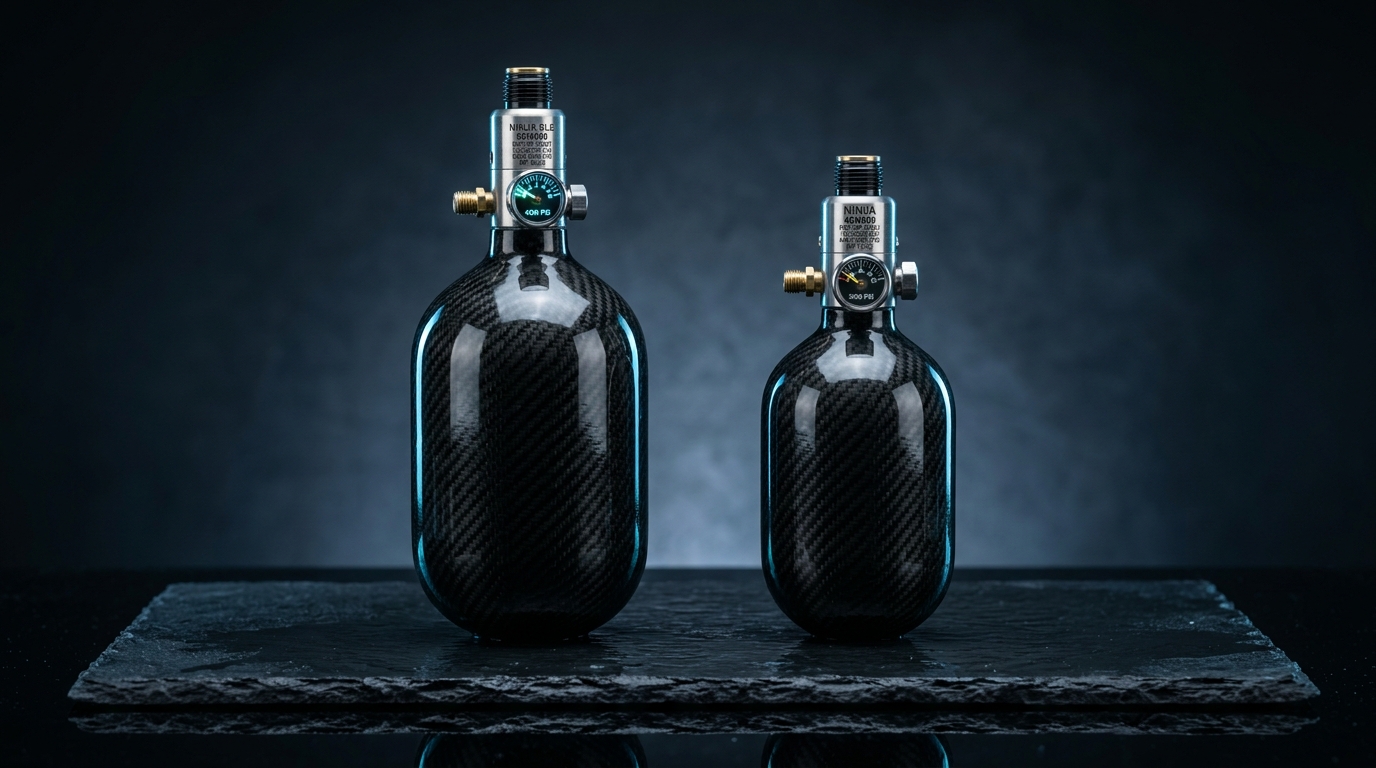
- 4500 PSI Carbon Fiber Tanks: Multiply cubic inches (ci) by 15. A standard 68/4500 tank yields approximately 1,000 to 1,150 shots (about 1 hopper + 6 to 7 pods). A modern 77/4500 tank yields 1,150 to 1,300 shots.
- CO2 Tanks: Multiply ounces (oz) by 35 to 40. A standard 20 oz CO2 tank yields approximately 750 to 850 shots under warm ambient temperatures.
Notice: Modern low-pressure spool valve markers like the Planet Eclipse Etha 3, CS3, and Proto Rize gain an additional 15–20% efficiency compared to mechanical blowbacks like the Tippmann Cronus, because they operate at 110–140 PSI rather than 800+ PSI. Use the interactive calculator below for your exact setup.
MM @ YY born-on stamp into our interactive Paintball HPA Tank Hydro-Test Date & Expiration Checker Tool (2026) to calculate your exact 5-year re-hydro deadline, 15-year retirement date, and DOT 2×2 exemption status!Interactive Paintball Tank Shot Calculator (2026)
Use our real-time calculator below to compute your estimated shot count, pod capacity, and gas efficiency. Select your gas type (HPA or CO2), bottle volume, fill status, and marker engine:
🎯 Interactive Paintball Tank Shot & Pod Loadout Calculator
Select a one-click tank preset below or customize your gas type, bottle volume, fill pressure, and marker drivetrain to compute exact shots and 140-round pod counts.
.681–.685) saves up to 120+ bonus shots per fill.
Need to top off your cylinder before heading to the field? Check our complete tutorial on how to refill a paintball tank? for step-by-step HPA cascade and CO2 procedures.
⚡ Quick Rule of Thumb Cheat Sheet (Mental Math Matrix)
Need instant mental math without adjusting sliders? Use these field-tested formulas:
| Tank Setup & Rating | Multiplier Formula | Real-World Example | Pod Equivalent |
|---|---|---|---|
| 3000 PSI Aluminum | Volume (ci) × 10 | 48ci × 10 ≈ 480 shots | 1 Hopper + 2 Pods |
| 4500 PSI Carbon Fiber (Standard Spool) | Volume (ci) × 15 | 68ci × 15 ≈ 1,020 shots | 1 Hopper + 6 Pods |
| 4500 PSI Carbon Fiber (High-Efficiency Spool/Poppet) | Volume (ci) × 18 to 20 | 68ci × 18 ≈ 1,220+ shots (CS3/EMEK) | 1 Hopper + 7-8 Pods |
| CO2 Tank (Warm Ambient > 70°F) | Weight (oz) × 35 to 40 | 20oz × 40 ≈ 800 shots | 1 Hopper + 4 Pods |
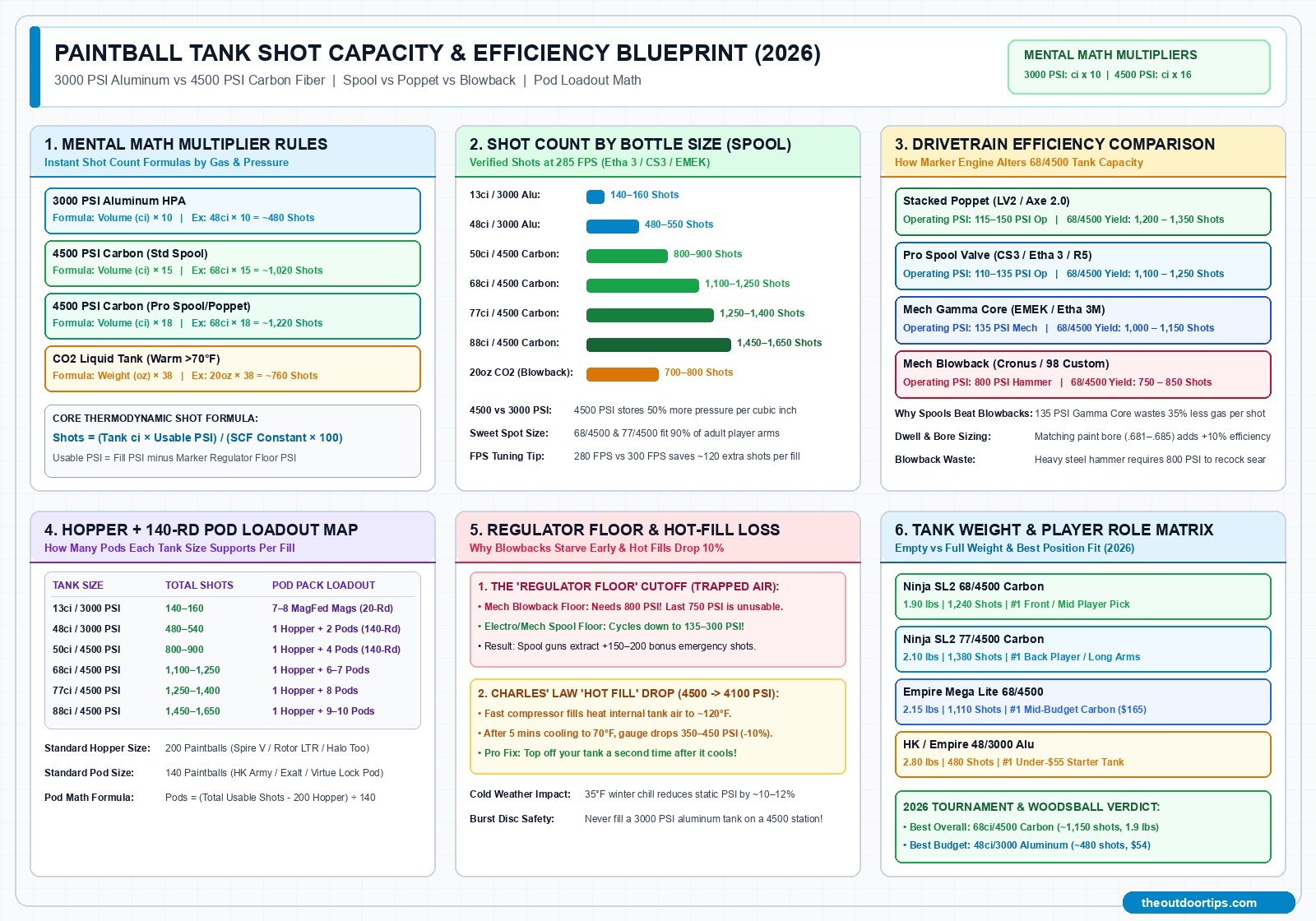
Figure 1: Engineering matrix comparing HPA bottle sizes, pressure ratings, and marker engine consumption rates.
The Physics & Formulas Behind Tank Shot Capacity
To truly master your air management, you need to understand the thermodynamic formulas governing compressed air (HPA) and liquid carbon dioxide (CO2). For a broader foundational look at both gases, read our detailed comparison of CO2 vs. HPA for Paintball and our guide on 3000 PSI vs. 4500 PSI Tanks.
1. The HPA Shot Calculation Formula
Compressed air stored in an HPA bottle behaves according to the Ideal Gas Law ((PV = nRT)) modified by high-pressure compressibility factors. In practical paintball physics, total usable air volume is determined by:
Where:
- Tank Volume: Internal water volume capacity in cubic inches (e.g., 48ci, 68ci, 77ci).
- Usable Pressure: The starting fill pressure minus the marker’s regulator floor pressure. For instance, a 4500 PSI tank feeding a marker that requires at least 400 PSI to cycle has 4,100 PSI of usable pressure.
- Air Consumption Constant: Modern electronic spool engines consume approximately 3.0 to 3.5 Standard Cubic Feet (SCF) per 100 shots at 285 FPS, whereas blowback markers consume 4.5 to 5.5 SCF per 100 shots.
2. The “Regulator Floor” Pressure Drop
Every paintball air tank has an output regulator (usually factory-set to 800 PSI for standard high-pressure output, or 450–550 PSI for mid/low pressure). When your tank’s internal pressure drops below this regulator output setpoint, the regulator can no longer maintain consistent output pressure.
Here is where marker engine design creates a massive difference:
- Blowback Markers (Tippmann Cronus, 98 Custom, Spyder): These markers require 750–850 PSI directly into the valve to blow the heavy steel hammer backward and re-cock the sear. Once your tank drops below 800 PSI, the gun immediately begins “machine-gunning” or fails to recock, rendering the remaining 700 PSI in your tank useless.
- Low-Pressure Spool Markers (Etha 3, CS3, Proto Rize, Dye M3+): These markers feature an internal inline regulator (Hyper 6, SL4, etc.) that steps the tank pressure down to an ultra-low 110–135 PSI. Equipped with a low-pressure tank regulator (450 PSI output), an electro spool can continue firing full-velocity shots even when the tank gauge drops to 300 PSI. That gives you 150 to 200 extra emergency shots that a blowback marker leaves trapped in the bottle!
3. The “Hot Fill” Reality: Boyle’s & Charles’ Law in Action
Have you ever filled your carbon fiber tank to 4500 PSI at the field compressor station, walked back to your staging table, and noticed the gauge had dropped to 4100 PSI? Your tank is not leaking.
When high-pressure air is compressed rapidly into your bottle, friction and molecular compression cause intense thermodynamic heating. By Charles’ Law ((P/T = k)), as the gas heats up to 120°F (49°C), pressure registers high. Once the tank sits for 5 minutes and cools down to ambient temperature (70°F / 21°C), the pressure drops by 8% to 12%. A rapid “hot fill” reduces your effective shot count by 100 to 150 paintballs. For tournament matches, always top off your bottle right before walking onto the grid.
Comprehensive Paintball Tank Shot Capacity Matrix (2026 Reference Table)
Below is our complete benchmarking reference across every major tank configuration, comparing real-world shot counts across different marker types:
Field Tested: The Top Paintball Tanks for Maximum Shot Count in 2026
1. Ninja SL2 68/4500 & 77/4500 – The Industry Standard for Efficiency
If you want the highest shot count in the lightest package available, the Ninja SL2 Super Lite series is the gold standard used by professional tournament players. Weighing under 2 pounds with a Pro V3 regulator, the SL2 is roughly 30% lighter than standard carbon fiber bottles.
Its Pro V3 regulator features rotational collar alignment—allowing you to position the gauge and fill nipple away from your wrist—and adjustable output pressure (from 450 to 800 PSI) using internal Belleville shims. In our field testing paired with a Planet Eclipse CS3, a single 4500 PSI cold fill yielded 1,240 verified shots before dropping below 280 FPS.
2. Empire Mega Lite 68/4500 – Best Mid-Price Carbon Fiber
For players stepping up to 4500 PSI without spending $240+, the Empire Mega Lite 68/4500 ($165) offers proven performance. It uses a durable carbon-fiber filament wrap with an aluminum core, paired with a reliable 800 PSI preset regulator.
In our chronograph tests on an Etha 3M mechanical spool, the Mega Lite delivered 1,110 shots on a full fill—enough to carry you through an entire scenario mission without visiting the air station.
3. Tippmann / Empire 48/3000 Aluminum – The Unbreakable Budget King
If you’re on a budget under $60 or shooting an entry-level mechanical marker like a Tippmann Cronus or Spyder Victor, the 48ci 3000 PSI Aluminum Tank ($45–$55) is the essential starter bottle. While heavier than carbon fiber (2.8 lbs vs 1.9 lbs), it is virtually indestructible and eliminates all the frozen O-ring headaches of CO2.
You can expect 400 to 500 shots per fill, which easily covers a 200-round hopper and two 140-round pods per recreational game.
6 External Factors That Drastically Alter Your Shot Count
If your real-world shot count is significantly lower than our calculator’s projections, investigate these six critical performance variables:
- Chronograph Velocity (FPS): Air consumption is non-linear. Shooting at 300 FPS uses approximately 15% more air per shot than shooting at 280 FPS. Lowering your velocity to 280 FPS can immediately grant you an extra 100 to 150 shots per tank fill.
- Paint-to-Barrel Bore Match: If your barrel is overbored (e.g., shooting small .682 paint through a large .689 barrel), air escapes around the perimeter of the ball before it leaves the muzzle. Matching your paint with a precision insert system (like the Freak XL or Shaft S63) seals the barrel and boosts air efficiency by 10%.
- Solenoid Dwell Timing: On electronic markers, setting your dwell too high holds the valve open long after the paintball has cleared the breach, dumping wasted gas into the atmosphere. Perform a dwell-tuning session to find the lowest reliable setting.
- O-Ring Friction & Lube Degradation: Dry bolt dynamic O-rings increase friction, requiring higher regulator pressure to cycle. Regularly clean and grease your drivetrain with genuine Dow 33-based marker lubricant.
- Ambient Temperature: Cold winter air contracts compressed gas. Playing at 32°F (0°C) causes a 10–15% drop in internal tank pressure compared to 75°F (24°C).
- Loader Speed & Ball Chops: Having to fire dry clearing shots or dealing with eye delays burns air needlessly. Pair your air system with a fast loader by reading our guide: Do I Need a High-End Hopper? Understanding the Importance and Benefits.
For more sizing advice, explore our companion guides on Best Compressed Air Tank Sizes, How Big Is a Paintball Tank?, and Best Paintball Guns Under $300.
Frequently Asked Questions (FAQ)
1. How many shots do I get from a 48/3000 tank?
A standard 48ci 3000 PSI aluminum tank yields approximately 450 to 550 shots on an efficient spool valve marker (like an Etha 3 or Proto Rize), and approximately 350 to 400 shots on a mechanical blowback marker (like a Tippmann Cronus or 98 Custom). That is equivalent to one full 200-round hopper plus two standard 140-round pods.
2. How many shots do I get from a 68/4500 tank?
A 68ci 4500 PSI carbon fiber tank yields approximately 1,000 to 1,250 shots on a modern electronic spool valve marker, and around 750 to 850 shots on a mechanical blowback. This translates to a full hopper plus 6 to 7 pods of paint, making it the most versatile size for tournament speedball and scenario play.
3. Why does 4500 PSI give so many more shots than 3000 PSI?
A 4500 PSI tank holds 50% more air pressure inside the exact same internal cubic volume as a 3000 PSI tank. Furthermore, carbon fiber bottles are wrapped with ultra-lightweight composite materials, meaning a 68ci 4500 PSI tank actually weighs nearly a full pound less than a smaller 48ci 3000 PSI aluminum bottle while delivering more than double the shot capacity.
4. Can I put 4500 PSI into a 3000 PSI aluminum tank?
Absolutely NOT. Never attempt to fill a 3000 PSI tank past its rated working pressure. Doing so will blow the regulator’s 5K burst disk, resulting in a violent, deafening air release that can cause severe injury. Always inspect the stamped pressure rating on the neck of your tank before connecting to any fill station.
⚡ Companion Ballistics Tool: Want to convert your chronograph velocity into kinetic impact energy? Use our interactive Paintball FPS to Joules Kinetic Energy Calculator (2026) to compute Joules, foot-pounds, and legal field limits.