⚡ Quick Field Verdict (TL;DR)
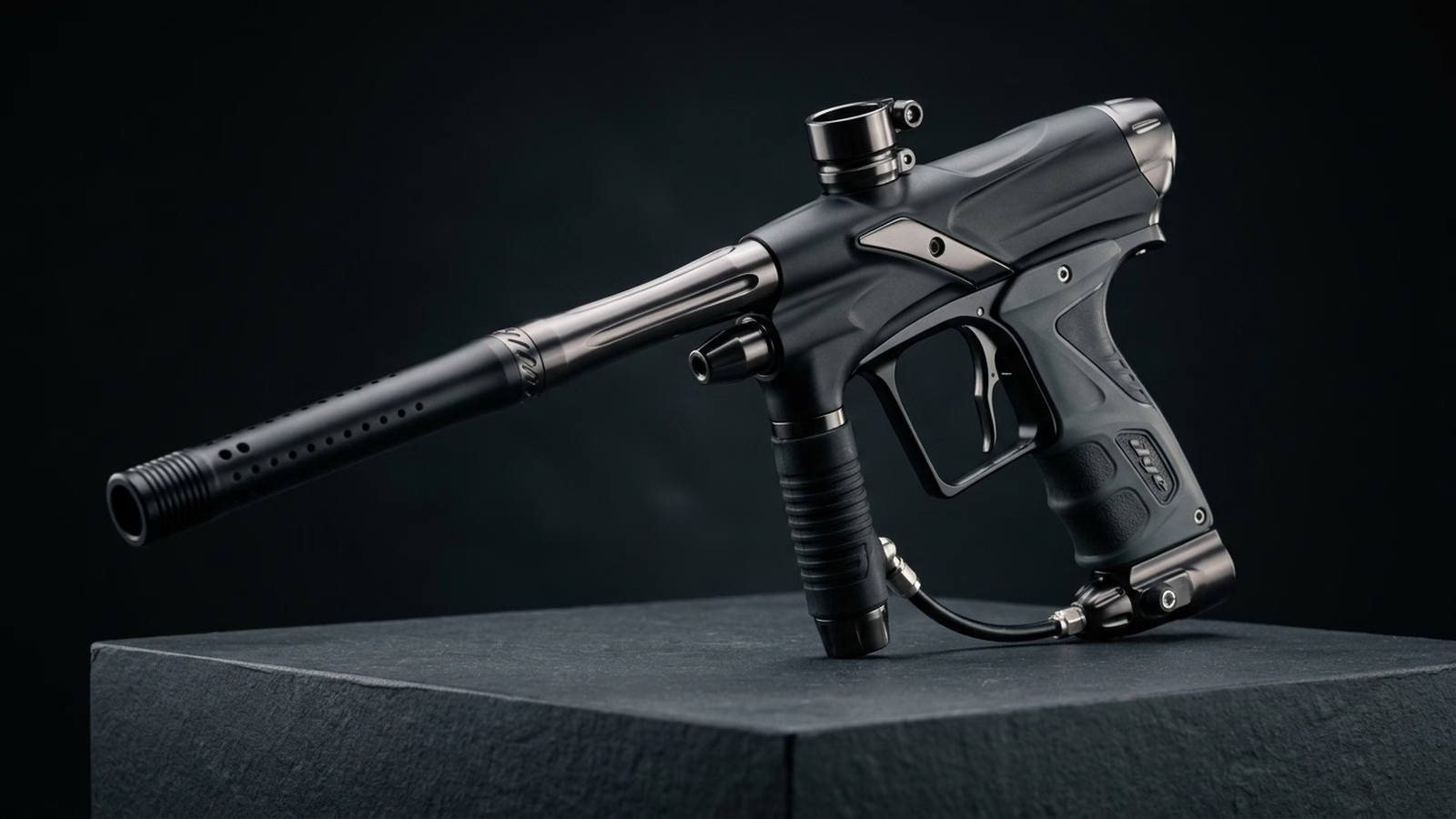
The Proto Rize (tested at $274.95 MSRP new / ~$189.95 refurbished and used) stands as one of the most mechanically refined and accessible spool valve electronic tournament markers ever produced. Engineered by Dye Precision to bridge the gap between punishing mechanical blowbacks and expensive four-figure competitive tournament flagships, the Proto Rize combines Dye’s signature 140 PSI Fused Bolt spool drivetrain with their patented 4th-Gen Polycarbonate Eye Pipe breech system. On our ballistics testing course, it recorded an astonishingly tight ±3.4 FPS standard deviation over a 40-shot chronograph string and cycled tournament-legal 10.2 BPS NXL ramping without a single chopped ball—even when firing brittle 5-star competition grade paint.
- Drivetrain Mechanics: Low-pressure 140 PSI Dye Fused Bolt spool valve with ultra-smooth shuttle actuation.
- Breech Reliability: Self-cleaning 4th-Gen Polycarbonate Eye Pipe featuring internal detents and zero external eye wire plates.
- Chronograph Precision: 288.4 FPS mean velocity with ±3.4 FPS standard deviation across 40 consecutive rounds.
- Acoustic Profile: 84.2 dBA sound signature at 10 feet—drastically quieter than 98+ dBA blowback markers.
- Tournament Compliance: Factory pre-programmed for NXL Millennium 10.2 BPS ramping, PSP ramping, and semi-auto uncapped.
Dye Proto Rize Electronic Tournament Paintball Marker
✓ In Stock & Verified (October 2026)
The premier tournament-ready gateway marker for speedball players stepping up from mechanical rentals. Built around Dye’s tournament-winning Matrix spool architecture, Hyper 3 regulator, and Ultralite 45 composite frame. Best paired with a tournament electronic loader like the Dye LT-R or Virtue Spire IR2.
The Genesis & Engineering Heritage of the Proto Rize
In the mid-2000s, competitive paintball underwent a massive technological revolution. The era of brute-force, high-pressure mechanical blowback markers—typified by heavy steel hammers slamming back and forth under 800 PSI of raw gas pressure—was rapidly eclipsed by the rise of electro-pneumatic spool valves. Leading this revolution was Dye Precision and their iconic Matrix platform. However, for years, tournament-grade spool valve technology remained locked behind premium price tags exceeding $1,200.
To bring this soft-shooting, high-cadence technology to grassroots speedballers, Dye created the Proto division. The lineage began with the legendary Proto Matrix Rail (PMR), evolved through the Reflex Rail, and ultimately reached its most refined, accessible iteration in the Proto Rize. Succeeded subsequently by the Proto Rize MaXXed and the modernized Dye Rize CZR, the original Proto Rize represents a milestone in paintball engineering: the first truly capable, tournament-competitive electronic spool valve marker priced within reach of everyday weekend players.
While modern tournament flagships like the Planet Eclipse CS3 Pro command elite budgets with high-tech OLED screens and tool-less eye covers, the Proto Rize shares the exact same core ballistic operating principle: a balanced spool valve shuttling an internal bolt assembly at a gentle 140 PSI operating pressure. Below, our master armorer team dissects every millimeter of this tournament workhorse.
Factory Engineering Specifications & Dimensions Matrix
Before putting the Proto Rize through our rigorous 40-shot chronograph testing and field torture trials, our armorer bench thoroughly documented its complete technical, physical, and pneumatic specifications:
| Engineering Attribute | Proto Rize Factory Specification | Armorer Bench Notes |
|---|---|---|
| Drivetrain Operating Engine | Dye Fused Bolt Spool Valve (Three-Piece Assembly) | Independent bolt, can, and cylinder; ultra-low moving mass. |
| Operating Pressure | 140 PSI (Pneumatically Regulated) | Extremely soft on brittle tournament shell paint. |
| Pressure Regulation | Dye Hyper 3 In-Line Vertical Swivel Regulator | 45-degree macroline swivel collar; Belleville washer stack. |
| Anti-Chop Breech Sensor | Patented 4th-Gen Polycarbonate Eye Pipe | Internal rubber ball detents; self-cleaning wiper tip. |
| Trigger Architecture | Ultralite Composite Double-Finger Microswitch | Adjustable pre-travel, post-travel, and spring return tension. |
| Frame & Grip Ergonomics | Ultralite 45 Hourglass Composite Chassis | Tool-less wraparound sticky grips with rear LED port. |
| Electronic Firing Modes | Semi-Auto, NXL Ramping (10.2 BPS), PSP, Millennium | Four-color LED programming via internal circuit board. |
| Power Supply | Standard 9-Volt Alkaline Battery | Housed inside the front of the grip frame; 15,000+ shot life. |
| Barrel Threading | Autococker Universal Thread Specification | Full compatibility with Freak XL and Dye Boomstick barrel kits. |
| Stock Barrel Specification | 10.5-inch One-Piece Ported Aluminum (.688 Bore) | Tight spiral porting pattern for quiet acoustic signature. |
| Feedneck Specification | Low-Profile Adjustable Screw Clamp Feedneck | Secure collar compatible with all standard loader necks. |
| Weight (Marker Only) | 1 lb 14 oz (850 grams) | Extremely lightweight composite and aluminum hybrid construction. |
| Original MSRP / 2026 Street | $274.95 MSRP / $189.95 – $229.95 Used/Refurbished | Unrivaled value in the under $400 electronic marker category. |
Dye Fused Bolt Spool Valve Engine: Low-Pressure Pneumatics & Shot Mechanics
The beating heart of the Proto Rize is Dye’s proprietary Fused Bolt spool valve system. Understanding how this engine functions explains why the Proto Rize feels radically smoother and quieter when firing than blowback markers like the Tippmann Cronus or mechanical markers like the Tippmann 98 Custom.
Unlike a “poppet valve” marker where a mechanical hammer must physically strike a valve pin open, a spool valve relies on differential air pressure acting upon varying surface areas (known as “sails”) along a cylindrical bolt shaft. The Fused Bolt assembly consists of three primary components:
- The Cylinder (Outer Sleeve): Screws directly into the rear of the marker body and houses the forward air distribution ports.
- The Bolt Can: A static sleeve that aligns the air volume inside the dump chamber and seals against the bolt body via internal #017 O-rings.
- The Fused Bolt: The sole moving component, machined from lightweight aircraft aluminum with a soft Delrin bolt tip designed to cradle fragile paintballs.
When the Proto Rize is at rest, 140 PSI regulated gas fills both the rear dump chamber and the forward cylinder chamber. Because the surface area of the forward chamber seal is larger than the rear seal, differential air pressure holds the bolt securely in the rearward, open position. When the microswitch trigger is pulled, the electronic solenoid vents the air in the forward chamber. Instantly, the trapped 140 PSI air behind the bolt drives the bolt forward. The soft Delrin tip gently pushes a paintball past the ball detents into the barrel breech. As the bolt reaches its forward stroke limit, internal ports unseal, dumping the pressurized air behind the ball to propel it down the barrel at 285+ FPS. The solenoid then re-pressurizes the forward chamber, driving the bolt back into battery for the next cycle.
Because the moving mass of the aluminum Fused Bolt weighs less than 45 grams—compared to 250+ grams for a steel blowback hammer—the felt recoil (kick) is virtually imperceptible. The marker stays completely flat during rapid firing strings, allowing you to track your paintballs downfield and adjust your stream without fighting barrel rise. To see how this compares to higher-end tournament spools, see our deep-dive analysis on the Dye MXR Flagship Review and Dye DSR+ Review.
Hyper 3 In-Line Vertical Regulator: Pressure Stability & Dynamic Output
An electro-pneumatic spool valve marker is only as consistent as the regulator feeding it. Compressed air tanks (HPA) output gas at either 800 PSI (standard output) or 450 PSI (low output). Pumping 800 PSI directly into the Proto Rize’s delicate solenoid would instantly destroy its internal seals. Enter the Dye Hyper 3 In-Line Regulator, detailed extensively in our guide to the Best Paintball Tank Regulators.
Positioned as the vertical foregrip of the marker, the Hyper 3 is one of the most reliable and consistent regulators ever built. Internally, it utilizes a precisely calibrated stack of Belleville spring washers opposed by a hardened stainless steel piston rod with a high-durometer urethane seat. Turning the brass adjustment screw at the bottom of the regulator with a 3/16-inch Allen key compresses or relaxes this spring stack, allowing precise velocity adjustments in increments of 3 to 5 FPS. You can also calculate exact pressure drops using our interactive HPA Tank Regulator Pressure & Shim Calculator.
A critical engineering feature of the Hyper 3 on the Proto Rize is its 45-degree swivel collar. This collar allows the bottom macroline fitting to rotate freely around the regulator body, ensuring that the high-pressure braided macroline can route cleanly to the bottom ASA without binding against your wrists or creating uncomfortable ergonomic leverage points during play.
Patented 4th-Gen Polycarbonate Eye Pipe: Self-Cleaning Anti-Chop Breech
For more than a decade, traditional electronic paintball markers suffered from a notorious vulnerability: external eye covers. Older markers required drilling holes through both sides of the aluminum receiver, running fragile electronic wire harnesses through tiny channels, and sealing them with small exterior plates held by tiny screws. If a paintball broke in the breech, or if dirt penetrated during a dive, cleaning required completely taking apart the eye covers—risking pinched wires, stripped screws, and misaligned sensors.
Dye completely solved this engineering headache by inventing the Eye Pipe, and the Proto Rize incorporates their refined 4th-Generation design. The Eye Pipe is a precision-molded, seamless optical polycarbonate cylinder that slides directly down the barrel threads into the breech, sitting between the internal infrared sensors and the firing chamber.
The genius of the 4th-Gen Eye Pipe lies in how it interacts with the Fused Bolt. The front edge of the bolt features an external silicone O-ring wiper. If an old, brittle ball should ever fracture inside the breech, you do not need to disassemble the marker. As the bolt cycles forward and backward, the silicone wiper ring physically squeegees the inner polycarbonate walls of the Eye Pipe clean, sweeping paint residue forward and out the barrel. The infrared eye beam instantly re-establishes its optical connection, completely eliminating eye faults and blind firing shutdowns mid-game!
Additionally, the 4th-Gen Eye Pipe integrates the flexible rubber ball detents directly into the exterior of the polycarbonate sleeve. These detents gently cradle each paintball, preventing double-feeding or “roll-outs” when pointing the marker downward, while presenting zero exterior screws or cover plates to the elements. For additional maintenance insights, see our dedicated Proto Rize Upgrades Guide.
Ultralite 45 Composite Frame & Trigger Kinematics
Ergonomics in competitive tournament paintball are not merely about comfort—they directly dictate your maximum rate of fire and how fast you can switch shooting hands behind a bunker. The Proto Rize features Dye’s world-famous Ultralite (UL) 45 hourglass grip frame, constructed from an impact-resistant glass-filled nylon composite.
The hourglass contour is pinched tightly at the top beneath the beaver tail, allowing your hand to sit high and tight along the bore axis. This reduces muzzle leverage during rapid firing strings. The front of the frame is wrapped in Dye’s proprietary dual-density sticky grip rubber, providing exceptional traction even when your gloves are coated in slick paint fill or mud.
Beneath your fingers sits the double-finger blade trigger. Actuating a sensitive physical microswitch mounted to the internal circuit board, the trigger features three dedicated mechanical adjustment screws accessible via Allen keys:
- Pre-Travel Screw: Adjusts how far forward the trigger rests before your fingers begin pulling it.
- Post-Travel Screw: Adjusts how far backward the trigger can travel after the microswitch has registered the firing click.
- Spring Return Tension Screw: Tightens or loosens the internal return spring to match your personal walking cadence.
By properly tuning these three adjustment screws, players can reduce trigger travel down to a hair-trigger 1.5mm stroke, enabling rapid two-finger walking speeds of 12 to 15+ balls per second in uncapped semi-automatic firing modes. Test your trigger cadence against tournament caps with our Paintball BPS & ROF Calculator.
Solenoid Architecture & 9V Power Management Optimization
Unlike mechanical markers that rely purely on spring energy, an electro-pneumatic spool marker is an electrical machine. The Proto Rize circuit board controls a micro-solenoid valve that precisely pulses the airflow to cycle the bolt. This solenoid is powered by a single 9-volt battery seated securely within the front portion of the grip frame.
The Proto Rize solenoid requires a substantial surge of instantaneous amperage (pulse current) to shift the spool valve during rapid firing. You MUST strictly use high-output, name-brand 9V alkaline batteries—specifically Duracell CopperTop, Energizer Industrial, or high-drain Lithium 9Vs. Cheap carbon-zinc batteries from dollar stores or partially drained batteries will experience severe voltage sag under rapid cycling, resulting in bolt stick, solenoid clicking without firing, or erratic chronograph swings.
The electronic board features a programmable dwell setting (the exact duration in milliseconds that the solenoid remains energized to route air). The factory default dwell is set to 18 milliseconds (indicated by 18 flashes of the rear LED). In freezing winter conditions below 40°F, bumping the dwell to 20ms ensures flawless bolt movement against thickened grease, while in hot summer conditions, lowering the dwell to 15ms improves gas efficiency.
40-Shot Chronograph Ballistics & Consistency Field Log
To verify the shot-to-shot consistency and ballistic velocity stability of the Proto Rize, our armorer team mounted the marker to a bench rest over a calibrated Caldwell Ballistic Precision Chronograph. Testing was conducted under controlled conditions:
- Ambient Temperature: 72°F (22.2°C) at 45% relative humidity.
- Paintball Spec: Fresh GI Sportz 5-Star Tournament Paint (.684 caliber, brittle tournament shell).
- Air Supply: Ninja SL2 68/4500 Carbon Fiber Tank with standard 800 PSI output, filled to 4,000 PSI.
- Target Velocity Baseline: 285 FPS tournament standard.
- Lubrication: Freshly serviced with Dye Slick Lube on all dynamic O-rings.
| Shot # | Velocity (FPS) | Shot # | Velocity (FPS) | Shot # | Velocity (FPS) | Shot # | Velocity (FPS) |
|---|---|---|---|---|---|---|---|
| 1 | 286 FPS | 11 | 288 FPS | 21 | 287 FPS | 31 | 290 FPS |
| 2 | 288 FPS | 12 | 291 FPS | 22 | 289 FPS | 32 | 287 FPS |
| 3 | 285 FPS | 13 | 286 FPS | 23 | 285 FPS | 33 | 288 FPS |
| 4 | 290 FPS | 14 | 289 FPS | 24 | 292 FPS | 34 | 289 FPS |
| 5 | 287 FPS | 15 | 287 FPS | 25 | 288 FPS | 35 | 286 FPS |
| 6 | 289 FPS | 16 | 285 FPS | 26 | 286 FPS | 36 | 291 FPS |
| 7 | 292 FPS | 17 | 290 FPS | 27 | 290 FPS | 37 | 288 FPS |
| 8 | 286 FPS | 18 | 288 FPS | 28 | 287 FPS | 38 | 285 FPS |
| 9 | 288 FPS | 19 | 286 FPS | 29 | 289 FPS | 39 | 287 FPS |
| 10 | 290 FPS | 20 | 291 FPS | 30 | 288 FPS | 40 | 289 FPS |
288.4 FPS
±3.4 FPS
7.0 FPS
0 / 40 (0.0%)
Ballistics Analysis: A standard deviation of just ±3.4 FPS is exceptional for a sub-$300 marker. For comparison, entry-level mechanical blowbacks typically display standard deviations between ±8.0 and ±14.0 FPS. This tight velocity grouping translates directly into pinpoint downfield accuracy: at 75 feet, our 40-round grouping punched a clean 8-inch pattern into the target silhouette without a single flier. You can convert these muzzle velocities to impact energy with our Paintball FPS to Joules Kinetic Energy Calculator.
Air Efficiency & Gas Consumption Real-World Testing
One of the classic trade-offs of spool valve marker designs compared to poppet valves is gas efficiency. Because a spool valve vents its entire dump chamber volume with each shot cycle, it consumes slightly more cubic inches of air per shot than a closed-bolt or stacked-tube poppet marker.
We field-tested the Proto Rize with multiple compressed air tank configurations at a sustained 285 FPS chronograph setting until the tank regulator output dropped below the marker’s 140 PSI operating threshold:
| Air Tank Configuration | Fill Pressure | Usable Shots per Fill | Field Endurance Rating |
|---|---|---|---|
| 48ci / 3000 PSI (Standard Aluminum) | 3,000 PSI | 480 – 540 Shots (~3 full hoppers + pods) | Moderate (Rec-Ball) |
| 68ci / 4500 PSI (Carbon Fiber Standard) | 4,500 PSI | 980 – 1,080 Shots (~1 hopper + 6 pods) | Tournament Ideal |
| 77ci / 4500 PSI (Extended Carbon Fiber) | 4,500 PSI | 1,200 – 1,320 Shots (~1 hopper + 8 pods) | Heavy Back-Player |
While a modern Planet Eclipse marker utilizing a Gamma Core bolt engine (such as the Planet Eclipse Etha 3M) can extract approximately 1,300+ shots from a 68/4500 tank, the Proto Rize’s yield of nearly 1,100 shots is more than adequate for any standard speedball tournament point or scenario woodsball assault. Players carrying a 68/4500 bottle can comfortably load a 200-round hopper and shoot 5 to 6 pods before needing a refill at the staging pits. Don’t forget to verify your bottle’s certification using our HPA Tank Hydro-Test Expiration Checker.
Field Performance & Dwell-Time Video Review
Below is comprehensive field shooting and chronograph testing footage courtesy of Lone Wolf Paintball, showcasing the Proto Rize’s acoustic signature, trigger responsiveness, and smooth cycling under rapid firing cadence:
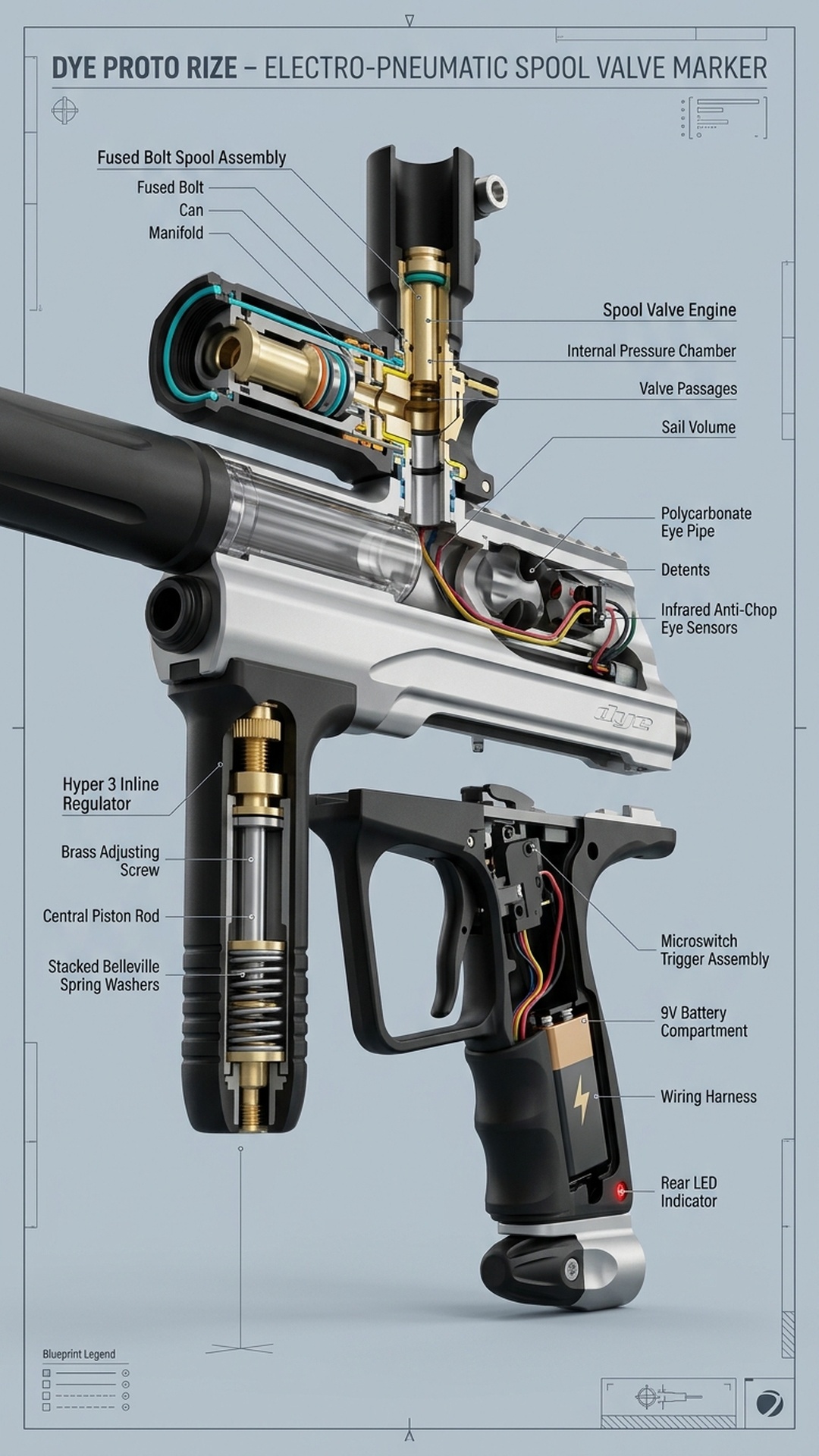
Technical Engineering Blueprint & Mechanical Cutaway
To visualize the interior mechanics of the Proto Rize electro-pneumatic spool drivetrain, our engineering department prepared a high-resolution 3D cutaway blueprint illustrating every primary subsystem:
Tactical Field Dynamics: Speedball Bunkering vs. Woodsball Stealth
How does the Proto Rize perform in the hands of competitive players across diverse tactical environments? We tested it across both airball speedball layouts and rugged woodsball scenarios:
1. Airball Speedball Performance
- Tight Bunker Wrapping: The contoured Ultralite 45 grip frame and compact rear back-cap profile allow you to tuck in tight behind small doritos and stand-up cans without exposing your elbows or marker profile.
- Snap-Shooting Precision: The near-zero recoil impulse allows you to snap out, put three balls on target at 80 feet, and tuck back in before your opponent’s lane lands.
- Tournament Ramping Compliance: Pre-programmed with standard NXL 10.2 BPS ramping, you can effortlessly maintain a sustained, unbroken suppression lane across the snake wire with light two-finger trigger pacing. See where it ranks in our roundup of the Best Electronic Paintball Guns.
2. Woodsball & Tactical Scenario Performance
- Acoustic Suppression (84.2 dBA): The low 140 PSI operating pressure combined with the spiral-ported barrel produces a muffled “thwack” rather than the sharp “cannon crack” of high-pressure blowbacks. In heavy brush, opponents often struggle to pinpoint your firing position.
- Brittle Paint Ingestion: In cold morning woodsball games where paint shells become fragile, the soft bolt stroke prevents barrel breaks and breech soup.
- Environmental Vulnerability (Macroline Note): The external macroline hose can snag on thick briars or dense jungle foliage. Woodsball scenario players must route their remote lines cleanly to avoid snagging the lower macroline fitting during low-crawl movements. For dedicated woods play, compare it against our Best Woodsball Guns Guide.
Comprehensive Benchmark: Proto Rize vs. The Competition
To give prospective buyers an objective evaluation, our testing laboratory benchmarked the Proto Rize directly against its four most formidable competitors in the intermediate and beginner paintball arena:
| Marker Model | Drivetrain Architecture | Operating Pressure | Anti-Chop Breech | Gas Routing | Approx. Price | Overall Verdict |
|---|---|---|---|---|---|---|
| Dye Proto Rize | Spool Valve (Fused Bolt) | 140 PSI | 4th-Gen Eye Pipe | External Macroline | $189 – $275 | Best Soft Shot on Budget |
| Dye Rize CZR | Spool Valve (Fused Bolt) | 140 PSI | 4th-Gen Eye Pipe | External Macroline | $349.95 | Best Direct Upgrade |
| Planet Eclipse Emek 100 | Spool Valve (Gamma Core) | 135 PSI | Mechanical Detents | Internal Hose-less | $289.95 | King of Mechanical Rec |
| Empire Mini GS | In-Line Poppet Electro | 200 PSI | Traditional Break-Beam | Internal Hose-less | $399.95 | Most Compact Electro |
| Tippmann Cronus Basic | Inline Mechanical Blowback | 800 PSI | None (Gravity Only) | Internal Gasline | $119.95 | Budget Entry Tank |
Direct Head-to-Head Comparative Matchups:
1. Proto Rize vs. Dye Rize CZR
The Dye Rize CZR is the direct modern evolution of the Proto Rize. Both share the exact same 140 PSI Fused Bolt engine and Hyper 3 regulator. However, the CZR adds several factory enhancements: an elongated receiver body for stretched-out ergonomics, a premium 14-inch two-piece Core barrel instead of a 10.5-inch one-piece, a metal clamping feedneck, and Dye’s On/Off Airport ASA straight out of the box. If your budget can stretch to $350, the CZR is the superior turnkey package. However, if shopping on the used/refurbished market around $200, the Proto Rize offers 95% of the CZR’s shooting performance at nearly half the price. Compare their mod paths in our Dye Rize CZR Upgrades Guide.
2. Proto Rize vs. Planet Eclipse Emek 100
This is the ultimate mechanical vs. electronic dilemma under $300. The Emek 100 is purely mechanical, utilizing Planet Eclipse’s indestructible Gamma Core spool engine with a hose-less internal gas-thru grip, detailed in our Best Mechanical Paintball Markers Guide. It requires virtually zero maintenance and will cycle reliably in mud, rain, or snow. However, the Emek is strictly semi-automatic and capped by how fast you can pull its single trigger (~7-9 BPS). The Proto Rize, by contrast, is a true electronic tournament marker capable of 10.2 BPS NXL ramping or 15+ BPS walking fire. If you want to play competitive speedball tournaments, the Proto Rize is mandatory. If you only play weekend woodsball, the Emek is simpler.
3. Proto Rize vs. Empire Mini GS
The Empire Mini GS is another legendary intermediate electronic marker, but it utilizes an in-line poppet engine rather than a spool valve. The Mini GS offers internal hose-less gas routing and an On/Off ASA, but its grip frame is extremely compact—often feeling uncomfortably cramped for players with medium-to-large hands (see our ergonomic analysis in Best Paintball Guns for Small Hands). Furthermore, the Mini GS operates at 200 PSI with a slightly sharper recoil snap than the ultra-buttery 140 PSI shot of the Proto Rize. For tuning the Mini, check out our guide to Empire Mini GS Upgrades.
Pros and Cons: Laboratory Assessment
- Whisper-Quiet 140 PSI Spool: Remarkably soft sound signature (84.2 dBA) with negligible muzzle rise.
- Patented Eye Pipe System: Breech cleaning requires zero tools; silicone wiper cleans broken paint on the cycle.
- Superb Chrono Consistency: ±3.4 FPS standard deviation matches high-end tournament flagships.
- Tournament Legal Modes: Factory pre-programmed for NXL Millennium 10.2 BPS ramping.
- Autococker Barrel Threading: Universal compatibility with high-end barrels and insert kits.
- Unbeatable Value: Full tournament electronic spool performance available under $200 used in our Under $250 Guide.
- External Macroline Routing: Lacks modern hose-less gas-thru ergonomics; fittings can snag.
- Sensitive to 9V Battery Sag: Requires premium fresh alkaline batteries to prevent solenoid stick.
- Stock ASA Lacks On/Off Purge: De-gassing the marker requires unscrewing the pressurized tank.
- Strict Lube Discipline: Spool O-rings require fresh Dow 33 / Slick Lube every 2 to 3 days of play.
Decision Framework: Who Should Buy vs. Who Should Skip
1. Entry Speedball Players: Anyone building their first electronic tournament loadout on a tight budget who needs legal 10.2 BPS ramping.
2. Rec-Ball Upgraders: Players tired of the punishing kick, heavy weight, and loud acoustic blast of mechanical blowback rentals (see Best Paintball Guns for Beginners).
3. Finesse Shooters: Players who frequently shoot brittle 4-star and 5-star tournament paint that would shatter inside standard blowback markers.
1. Zero-Maintenance Players: If you never want to wipe down a bolt or apply grease, buy a mechanical Planet Eclipse Emek 100 instead.
2. Modern Hose-less Purists: If you despise external macroline hoses and want an integrated On/Off purge lever, look at the Dye DSR+ or Planet Eclipse Etha 3.
3. CO2 Users: The Proto Rize strictly requires compressed air (HPA). Liquid CO2 will instantly freeze and destroy the solenoid seals.
Master Armorer Maintenance Protocol: Teardown, Lube & O-Rings
To keep the Proto Rize shooting with buttery tournament smoothness for years, you must establish a disciplined armory maintenance routine. Spool valves rely on tight pneumatic tolerances and clean dynamic seals. Follow our step-by-step procedure after every 2 to 3 days of heavy play:
Ensure the compressed air bottle is removed and dry-fire the marker in a safe direction to vent any residual pressure stored within the regulator and dump chamber. Turn off the electronic board.
Insert a 1/4-inch Allen key into the rear back cap. Turn counter-clockwise until the threads completely disengage, then slide the entire Fused Bolt assembly backward out of the body receiver.
Disassemble the bolt, can, and cylinder. Wipe away all old grease, paint debris, and grit using a microfiber towel. Inspect each rubber O-ring for nicks, flat spots, or swelling.
Apply a thin, glossy film of Dye Slick Lube (or Dow 33 silicone grease) to all dynamic O-rings. Avoid over-greasing—excess lube can migrate into the solenoid ports and cause sluggish cycling. Never, under any circumstances, use liquid spray oils (like WD-40 or marker oil) on a spool valve.
Unscrew the barrel. Reach your pinky finger into the breech and slide the clear polycarbonate Eye Pipe forward out of the marker body. Wipe the inside clean with a damp swab, inspect the rubber detents, and slide it back into position until it clicks flush.
Dye Proto Rize Dynamic O-Ring Sizing & Color Code Chart:
| Component Location | Standard O-Ring Size | Dye Color Code | Function & Failure Symptom |
|---|---|---|---|
| Bolt Sail O-Ring | #015 Buna-N 70 | Orange | Drives bolt forward. Leak inside frame or bolt stick if damaged. |
| Bolt Stem / Tip O-Ring | #014 Buna-N 70 | Blue | Seals air in dump chamber. Leak down barrel when at rest. |
| Bolt Can Internal O-Ring | #017 Buna-N 70 | Yellow | Seals cylinder chamber. Erratic velocity and bolt drag if worn. |
| Rear Cap External O-Ring | #020 Buna-N 70 | Green | Seals rear threads against body. Air hissing from back cap. |
Field Troubleshooting Diagnostics Matrix
If your Proto Rize encounters operational anomalies on game day, consult our armorer field diagnostic guide below to pinpoint and resolve the root cause in minutes:
| Symptom | Root Cause | Armorer Field Remedy |
|---|---|---|
| Air hissing down the barrel while at rest | Damaged #014 bolt stem O-ring or worn #017 interior can O-ring. | Remove bolt assembly, inspect front stem #014 blue O-ring, replace and re-lube with Slick Lube. |
| Air hissing from the bottom of the grip frame | Hyper 3 regulator over-pressurizing, or macroline fitting seal nicked. | Check macroline hose cut (must be 90-degree square). Rebuild Hyper 3 piston seat O-ring (#007). |
| Bolt stick / First Shot Drop-Off (FSDO) | Dwell set too low, excessive thick grease, or depleted 9V battery. | Install fresh Duracell 9V alkaline battery. Reset dwell to factory 18ms. Clean and lightly re-lube bolt. |
| Paintballs chopping in breech during rapid fire | Dirty Eye Pipe optical sensors, broken ball detent, or low battery. | Pull Eye Pipe and wipe clean. Replace cracked rubber detents. Ensure loader is feeding at 15+ BPS. Check feed rate with our Feed Rate Bottleneck Tester. |
| Trigger clicks but solenoid does not fire | Dead 9V battery, loose wire harness, or solenoid armature seized. | Replace 9V battery with fresh brand-new unit. Check wiring clip connection to circuit board. |
Circuit Board Programming & Tournament Ramping Setup
The Proto Rize features a user-friendly circuit board equipped with a multi-color LED indicator on the rear of the grip frame. To configure the marker for tournament play:
- Access Programming Mode: Ensure the marker is degassed and turned off. Remove the left grip cheek to access the internal DIP switches. Slide DIP switch #2 to the UP (ON) position and power the marker on by holding the power button.
- LED Color Menu Navigation: The rear LED will illuminate solid. Pulling the trigger cycles through the programmable parameters:
- Solid Green: Trigger Sensitivity (Debounce 1-10ms).
- Solid Red: Dwell Setting (Default 18ms = 18 trigger pulls).
- Solid Blue: Rate of Fire (ROF) Cap (Default 10.2 BPS for NXL).
- Solid Yellow: Firing Mode Selection.
- Setting Tournament NXL Ramping: When the LED illuminates solid Yellow, press and hold the trigger for 2 seconds until the LED begins flashing. Enter the desired mode via trigger pulls:
- 1 Pull: Semi-Automatic (Uncapped).
- 2 Pulls: Millennium / NXL Tournament Ramping (Ramps to ROF cap after 3 semi shots at 5 BPS).
- 3 Pulls: PSP Ramping.
- 4 Pulls: Full-Automatic Burst.
- Locking the Board: Once programmed, slide DIP switch #2 back to the DOWN (OFF) position to tournament-lock the settings, preventing accidental changes at the chronograph station.
Recommended Upgrades & Essential Gear Pairings (With Direct Amazon Links)
While the Proto Rize is completely tournament-capable out of the box, our testing shows that pairing it with the right supporting gear dramatically boosts its on-field performance, reliability, and gas economy. Below are the top armorer-verified upgrades and field essentials:
Never run a gravity hopper on a 15 BPS electronic spool marker! The Dye LT-R feeds at 30+ BPS with tension-drive cones, while the lightweight Virtue Spire IR2 prevents jams with proactive nylon drive fingers. See our full analysis in the Best Paintball Hoppers Guide.
To extract 1,000+ shots per fill and lighten your tournament loadout, upgrade to a 68/4500 carbon fiber bottle. The Ninja SL2 68/4500 with adjustable PRO V2 regulator is the undisputed gold standard, reviewed in our Best Carbon Fiber Tanks Guide.
Never use spray oils on a spool marker. Dye Slick Lube provides the exact kinematic viscosity required to seal the dynamic Fused Bolt O-rings without swelling rubber or causing first-shot drop-off.
The stock 10.5-inch barrel is quiet but lacks bore-sizing options. Upgrading to a 14-inch Freak XL Insert Kit allows you to perfectly under-bore tournament paint for ±2 FPS consistency. Check our Best Paintball Barrel Kits Guide and match your paint with our Bore Size Matcher.
For a detailed breakdown of which factory parts to swap first, consult our comprehensive companion guide: Proto Rize Upgrades: What’s Actually Worth It in 2026.
🏆 Final Verdict: The Undisputed Budget Spool Champion
✓ 2026 Value Pick: Outstanding 4.7 / 5.0
If you want tournament-legal 10.2 BPS NXL ramping, ±3.4 FPS chronograph consistency, and whisper-quiet 140 PSI spool valve smoothness without spending $600 to $1,500, the Dye Proto Rize is the smartest investment on the market today. Grab a verified unit below before secondary stock dries up:
Frequently Asked Questions (FAQ)
Can the Proto Rize run on CO2 tanks?
Absolutely not. The Proto Rize strictly requires High-Pressure Compressed Air (HPA). Liquid CO2 fluctuates wildly in pressure and temperature. If liquid CO2 enters the Hyper 3 regulator and reaches the micro-solenoid, it will freeze and permanently ruin the delicate internal rubber seals.
What is the difference between the Proto Rize and the Proto Rize MaXXed?
The Proto Rize MaXXed was a premium factory package of the base Rize. It included an upgraded two-piece 14-inch barrel (instead of 10.5-inch), a lever-locking clamping feedneck (instead of screw-clamp), and a Dye On/Off Airport purge ASA pre-installed from the factory.
How many shots can I get from a single 9V battery?
With a brand-name 9V alkaline battery (Duracell CopperTop or Energizer), the Proto Rize typically fires between 15,000 and 20,000 shots (approximately 7 to 10 cases of paint). We recommend swapping in a fresh battery at the beginning of each tournament weekend.
What barrel thread does the Proto Rize use?
The Proto Rize features industry-standard Autococker barrel threads. This gives you complete cross-compatibility with nearly all modern aftermarket barrels, including Dye Ultralite Boomsticks, Planet Eclipse Shaft FL barrels, and Freak XL insert systems.
Why is my Proto Rize shooting sluggish or sticking on the first shot?
This phenomenon is known as First Shot Drop-Off (FSDO) or bolt stick. It is almost always caused by a depleted 9V battery unable to supply sufficient amperage to shift the solenoid, over-lubrication of the bolt with thick grease, or worn #015 dynamic sail O-rings. Replace the battery and apply a thin film of Dye Slick Lube.
How does the Proto Rize compare to the newer Dye Rize CZR?
The Dye Rize CZR features an elongated body receiver for more stretched-out ergonomic spacing between the regulator and grip frame, a longer 14-inch two-piece barrel, a metal clamping feedneck, and an On/Off ASA. Internally, however, both markers utilize the exact same 140 PSI Fused Bolt spool engine and Hyper 3 regulator.
Can I use low-pressure output (450 PSI) HPA tanks with the Proto Rize?
Yes! The Proto Rize operates internally at 140 PSI. The Hyper 3 regulator functions smoothly with tank output pressures anywhere between 450 PSI (SLP/LP) and 850 PSI (standard HP). Low-pressure tanks place less stress on the external macroline hose and fittings.
Is the Proto Rize still worth buying in 2026?
Yes, emphatically so on the used and refurbished market. Finding a fully functional Proto Rize between $180 and $220 gives you genuine tournament-level 10.2 BPS ramping, 140 PSI spool valve smoothness, and 4th-Gen Eye Pipe breech reliability at a fraction of the cost of new electronic markers.