Quick Field Verdict: Proto Rize Upgrades (2026 TL;DR)
If you own a base Proto Rize or are considering dye rize upgrades in 2026, here is the unvarnished armorer truth: the Rize platform shares the exact same 140 PSI Fuze spool-valve engine, Hyper 3 regulator, and Dye RAMP solenoid across all three factory tiers (Base Rize, Rize Maxxed, and Rize CZR). You are not missing out on a smoother drivetrain by owning the base model. When examining proto rize vs rize maxxed, the factory upgrade roadmap literally consists of two hardware pieces: a 2-piece Autococker barrel and a Dye Lockdown cam-lever feedneck.
- #1 Must-Do Upgrade (10/10 ROI): 2-Piece Autococker Barrel Kit (.684/.685 bore). The stock 1-piece .689 barrel leaks air with modern small tournament paint, wasting efficiency and blowing shot consistency.
- #2 Best Quality-of-Life Upgrade (9.5/10 ROI): Dye Lockdown Cam-Lever Clamping Feedneck. Permanently replaces the fragile plastic collar and stripped hex screws with rock-solid, tool-less clamping.
- #3 Tank Saver (9/10 ROI): On/Off Purge Airport ASA. Prevents shredded tank bonnet o-rings when degassing under 800 PSI tank output.
- What to Absolutely SKIP (2/10 ROI): The aluminum trigger (already 3-way externally adjustable) and aftermarket bolts (they disrupt factory pneumatic dwell and cause solenoid leaks).
- The Golden $120 Ceiling Rule: Never spend more than $120 total modifying a base Rize. Beyond that, sell your marker ($110–$140) and step up directly to a factory CZR ($374.95) or a mechanical powerhouse like the Planet Eclipse Etha 3M.
Dye / Proto Rize Platform & Essential Upgrade Package
$110 – $140 Used / $374.95 CZR
Powered by Dye’s patented 140 PSI Fuze spool valve, 4th generation self-cleaning Eye Pipe, and Ultralite 45 hourglass frame. Upgrade your base marker with authentic Autococker 2-piece barrels and Dye Lockdown lever feednecks to achieve tournament-level paint handling.
Proto Rize vs Rize Maxxed vs Rize CZR: Hardware Matrix & 2026 Upgrade ROI
| Marker Model / Upgrade | Drivetrain & Pressure | Factory Barrel | Feedneck Style | Air Airport ASA | 2026 Verified Price & Action |
|---|---|---|---|---|---|
| Base Proto Rize | Fuze Spool (~140 PSI) | 1-Piece 10″ (.689 Bore) | Composite Screw Clamp | Standard Non-Bleed | Check Used Base on eBay ($110–$140) → |
| Proto Rize Maxxed | Fuze Spool (~140 PSI) | 2-Piece 14″ True Bore | Dye Lockdown Cam-Lever | Dye Airport On/Off Bleed | Check Maxxed on eBay ($150–$180) → |
| Dye Rize CZR (Current) | Fuze Spool (~140 PSI) | 2-Piece 14″ Core Barrel | Dye Lockdown Cam-Lever | Dye Airport On/Off Bleed | Check Rize CZR on Amazon ($374.95) → |
| Dye Lockdown Cam Feedneck | All-Metal 6061-T6 Aluminum | N/A | Tool-less Cam Lever | N/A | Check Feedneck on Amazon ($39.95) → |
| 2-Piece AC Barrel Kit (Freak XL / Dye) | Precision Bore Matching | .682–.688 Multi-Bore | N/A | N/A | Check Barrels on Amazon ($59–$119) → |
The Fuze Drivetrain: Understanding the Core Before Upgrading
Before you spend a single dollar on proto rize upgrades or aftermarket accessories, you must understand the mechanical engineering inside the marker. Many players mistakenly assume entry-level electronic markers are fragile or underpowered. In reality, the Proto Rize is built on Dye’s legendary Matrix lineage, utilizing a genuine closed-spool valve engine called the Fuze Bolt.
While blowback markers in the sub-$200 bracket (like those detailed in our guide to the best paintball guns under $200) slam heavy metal hammers at 800 PSI, the Proto Rize operates at an ultra-low 140 PSI. This pressure reduction fundamentally alters ballistics and paint handling:
1. 140 PSI Operating Pressure
Dye’s Hyper 3 inline regulator steps incoming 800 PSI tank air down to 140 PSI. This low operating pressure cushions brittle tournament paintballs against the bolt face, practically eliminating breech breaks even in freezing weather.
✓ Key Takeaway: You already own tournament-grade spool valve smoothness out of the box.
2. 4th Gen Self-Cleaning Eye Pipe
Instead of external eye plates and loose rubber detents, Dye routes break-beam optical sensors behind a seamless polycarbonate Eye Pipe. The internal detents flex with paintballs, and the forward bolt stroke physically wipes the lens clean if a ball breaks.
✓ Key Takeaway: Zero maintenance eye wires; never remove eye plates to fix optic chops.
3. Dye RAMP Solenoid & Electronics
Driven by a single 9V battery inside the UL 45 frame, the RAMP solenoid directs low-pressure air pulses to cycle the Fuze bolt. Programmed with Semi-Auto, Millennium, and NXL/PSP 10.5 BPS tournament ramping modes.
✓ Key Takeaway: High electrical efficiency; delivers 15,000+ shots on a fresh alkaline 9V battery.
Armorer Advisory: The Hyper 3 Reg Seat Creep & Solenoid Protection Rule
When working on secondhand Proto Rize, Rize Maxxed, or CZR markers, the single most dangerous mechanical hazard is regulator seat creep inside the Hyper 3 inline regulator. Over years of play or storage, the tiny polyurethane regulator seat inside the piston stem hardens, collects dried grease, or develops microscopic pits from airborne dirt particles.
The Catastrophic Result: Instead of cleanly capping output pressure at the factory 140 PSI, the pitted reg seat slowly leaks incoming tank air past the seal, causing downstream pressure to creep up to 190–220+ PSI. The Dye RAMP solenoid is engineered for a maximum safe pressure of ~160 PSI. When 200 PSI surges into the solenoid chamber, it blows out the delicate molded rubber manifold gasket, resulting in a continuous, deafening hissing leak out of the front grip frame that cannot be stopped until the gun is de-gassed.
- Chronograph & Pressure Check: If your chronograph velocity suddenly jumps above 310 FPS or the gun sounds abnormally sharp, stop shooting immediately and screw in an inline pressure tester to verify output is ~140 PSI.
- Isopropyl Alcohol Cleanout: Disassemble the Hyper 3 reg piston, submerge the brass seat in 99% isopropyl alcohol, and wipe clean with a microfiber swab to remove dried grease and brass flakes.
- Fresh 015 O-Rings: Replace the internal 015 polyurethane piston o-rings every season, applying only a razor-thin film of authentic Dye Slick Lube. Never use thick automotive grease or liquid petroleum oils.
Armorer Tech Tip: The 10-Second 4th Gen Eye Pipe Solution
One of Dye’s most brilliant patents is the 4th Generation Polycarbonate Eye Pipe. Rather than forcing you to unscrew external eye covers, disconnect fragile micro-ribbon wires, and pry out worn rubber detents with dental tools, the entire assembly—optical prism window and dual flexible ball detent fingers—is housed in a single transparent barrel insert inside the breech.
The Rookie Mistake: Never insert metal dental picks or screwdrivers into the breech to “re-bend” or clean the tiny rubber detents. Doing so scratches the optical window (causing false eye error flashes) or tears the rubber detent fingers off entirely, causing severe double-feeding and rollouts.
The Pro Fix: If your Rize ever double-feeds or chops paintballs, unscrew the barrel, slide the old Eye Pipe out with your pinky finger, and drop in a brand-new factory Dye 4th Gen Eye Pipe Assembly ($14.95). In under 10 seconds without a single tool, you restore brand-new optical clarity, factory ball retention, and 100% anti-chop reliability.
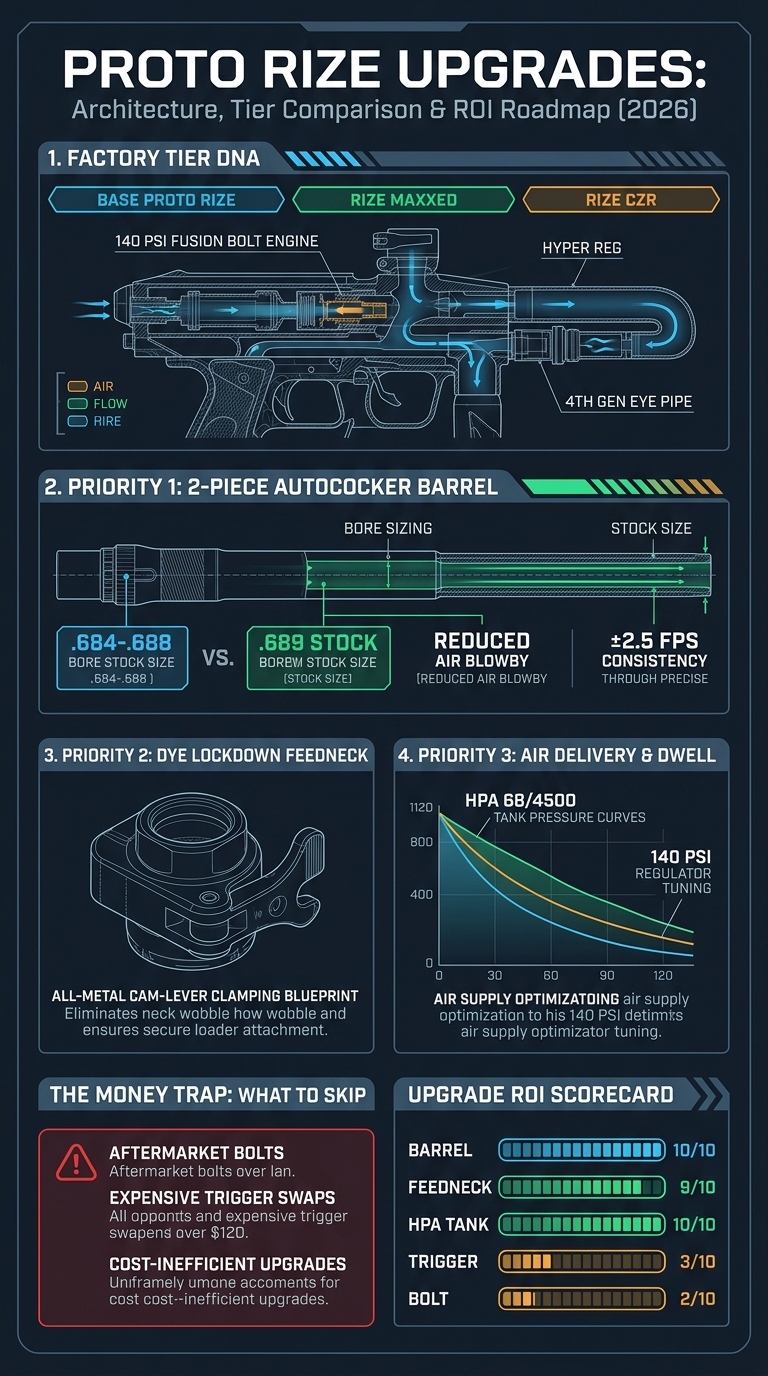
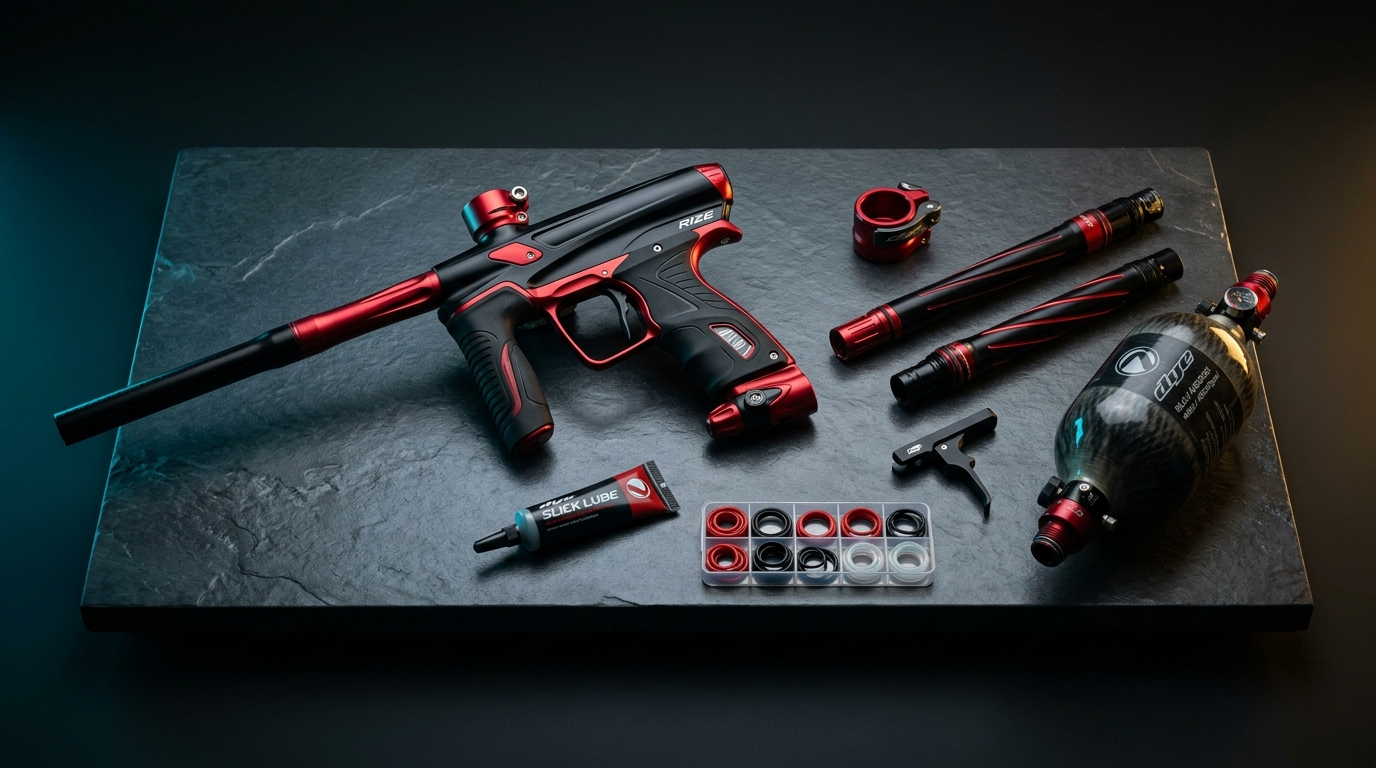
Figure 1: Comprehensive 2026 technical blueprint illustrating the Proto Rize tier comparison, 2-piece barrel bore matching physics, feedneck ergonomics, and upgrade ROI scorecard.
The 5 Proto Rize Upgrades Actually Worth Buying in 2026
1. Priority #1: 2-Piece Autococker Barrel Kit (.684 / .685 Bore)
ROI Score: 10/10 (Essential)
This is the single most defining difference when comparing the proto rize vs rize maxxed. The base Proto Rize shipped with a short, 1-piece 10-inch or 12-inch barrel with a fixed, oversized .689 bore. In the 2000s, .689 was standard paint diameter; today, modern commercial tournament paint measures between .682 and .685.
Shooting .684 paint through a .689 single-piece barrel allows massive pressurized air blowby around the ball. This causes your velocity to fluctuate wildly (±6 to ±8 FPS spread on the chronograph) and forces you to crank your regulator pressure up to hit 280 FPS, severely penalizing your air efficiency. Upgrading to a 14-inch 2-piece barrel with Autococker threads (like a Freak XL system, Dye Boomstick, or CP 2-piece) tightens your shot spread to ±2.5 FPS and significantly lowers acoustic muzzle crack. Use our interactive barrel bore size matcher to calculate your ideal insert diameter.
2. Priority #2: Dye Lockdown Cam-Lever Clamping Feedneck
ROI Score: 9.5/10 (Crucial Quality of Life)
The stock feedneck on the base Proto Rize is its single biggest ergonomic flaw. Made of glass-reinforced composite with a steel hex screw clamp, it requires carrying an allen key onto the staging area just to mount your hopper. Over time, tightening down on motorized loaders (like a Dye Rotor or Spire) strips the plastic threads or crushes the neck collar.
The Dye Lockdown Cam-Lever Feedneck is the exact component Dye factory-installed on the Rize Maxxed and Rize CZR. Machined from 6061-T6 aircraft-grade aluminum with an adjustable thumbscrew cam lever, it provides instant, tool-less loader locking and eliminates any neck wobble during aggressive snake diving.
3. Priority #3: Dye Airport Purge On/Off ASA
ROI Score: 9/10 (Tank Maintenance)
The base Proto Rize came equipped with a standard straight-threaded bottom line ASA without a purge vent. When your match ends, unscrewing a 4500 PSI or 3000 PSI HPA tank that is under 800 PSI of backpressure forces the tank pin valve against the ASA threads under brutal friction. This shreds your tank bonnet o-rings and slowly strips the aluminum ASA threads.
Installing an on/off purge ASA—such as the Dye UL Airport or a Custom Products (CP) On/Off ASA—allows you to twist a knob or flip a lever to vent stored gas through an exhaust port before unscrewing your bottle. Your tank o-rings will last hundreds of games instead of tearing every three weekends.
4. Priority #4: 48/3000 or 68/4500 HPA Compressed Air Tank (Strict CO2 Ban)
ROI Score: 10/10 (Mandatory Fuel)
Warning: Never run CO2 into a Proto Rize or Dye Rize marker. While crude in-line blowbacks (like Tippmanns) tolerate dirty liquid CO2, the Proto Rize relies on an electronic micro-solenoid and dynamic urethane o-rings inside the Hyper 3 regulator. Liquid CO2 entering the RAMP solenoid will instantly freeze seals, cause catastrophic solenoid leaks, and spike operating pressures past 200 PSI.
If you are running an aluminum CO2 tank, ditch it immediately for a standard 48ci/3000 PSI Aluminum HPA Tank ($45–$55) or an ultralight 68ci/4500 PSI Carbon Fiber Tank. Clean, dry compressed air guarantees constant 800 PSI output regardless of ambient weather or high-cadence 10.5 BPS ramping.
5. Priority #5: Motorized Electronic Loader (Dye Rotor LTR or Spire IR2)
ROI Score: 9/10 (Performance Unlocking)
Running a $10 gravity hopper on an electronic spool valve capable of 15 BPS is like putting bicycle tires on a sports car. Gravity hoppers feed at roughly 6 to 8 balls per second under ideal conditions. When you ramp the trigger, the 4th Gen Eye Pipe detects an empty breech, delaying the bolt cycle and bottlenecking your firing rate down to mechanical speeds.
Pairing your Rize with an agitated or force-feed loader—such as the Dye Rotor LTR ($109.95) or Virtue Spire IR2 ($115)—ensures a constant stack of paintballs in the feed stack, unlocking true 10.5 BPS NXL ramping without eye stalls. See our complete breakdown of the best paintball hoppers.
What to SKIP: 3 Costly Money Traps for Proto Rize Owners
1. Do NOT Replace the Aluminum Blade Trigger
Unlike entry-level blowbacks with clunky plastic triggers, the base Proto Rize already ships from the factory with a dual-bearing, lightweight aluminum blade trigger. It features dual external adjustment screws controlling forward pre-travel and rear over-travel, plus spring tension tuning. Spending $35–$50 on an aftermarket trigger shoe yields virtually zero measurable BPS improvement.
2. Avoid “Aftermarket” Bolts & Modded Solenoids
You will occasionally see forum posts recommending shaved or drilled aftermarket bolt guides. Do not install them. The Fuze bolt valve timing and air sail volume are precisely matched to the Dye RAMP solenoid dwell (factory 40 ms). Aftermarket bolts disrupt pneumatic shutoff, causing catastrophic bolt stick, first-shot drop-off (FSDO), and blown solenoid manifold gaskets. Use authentic Dye Slick Lube on factory o-rings and leave the bolt geometry stock.
3. The $120 Rule: Don’t Over-Capitalize a Budget Spool Valve
A pristine used base Proto Rize sells for approximately $110 to $140 on eBay. If you spend $40 on a feedneck, $80 on a barrel, $50 on an on/off ASA, and $35 on grips, you have invested $205 in upgrades into a $120 platform. At that spending threshold ($325+ total investment), you could easily purchase a used Planet Eclipse Etha 2 / Etha 3M or a factory Dye Rize CZR outright. Keep your Rize upgrades focused on universal assets (barrels, hoppers, tanks) that you can take with you when you upgrade markers!
Field Performance & Chronograph Stress Test
Watch the Lone Wolf Paintball armory crew field-test the Dye Rize platform, showing chronograph velocity consistency, rate of fire, and air efficiency in real-world shooting drills:
Notice the ultra-smooth, low-recoil shot signature of the 140 PSI Fuze spool valve compared to 800 PSI blowbacks. Calculate your marker’s muzzle energy using our FPS to Joules kinetic energy calculator.
Who the Proto Rize is Built For vs. Who Should Skip It
✓ Who Should Buy & Upgrade It:
- Players who already own a base Proto Rize or picked one up used for under $130.
- Entry speedball players wanting 10.5 BPS tournament ramping without spending $500+.
- Woodsballers who want a quiet, low-recoil spool valve that shoots fragile tournament paint reliably.
- Shooters willing to apply 5 minutes of basic maintenance (lube bolt and replace 9V battery).
✗ Who Should Skip It:
- Players who only have access to CO2 tank fills (the Rize requires clean HPA only).
- Players who never clean their equipment (spool valves require periodic o-ring lubrication).
- Shooters with a $350+ budget: At that price point, buy a new Etha 3M or a factory Rize CZR with all upgrades pre-installed.
Frequently Asked Questions: Proto Rize Upgrades & Maintenance
What is the real difference between Proto Rize vs Rize Maxxed?
The Proto Rize vs Rize Maxxed difference is strictly external hardware: both share the identical 140 PSI Fuze spool bolt, Hyper 3 regulator, and RAMP solenoid. The Rize Maxxed adds a 14-inch 2-piece Precision True Bore Autococker barrel (vs a 1-piece 10″ .689 barrel), an all-metal Dye Lockdown cam-lever clamping feedneck (vs composite screw clamp), and an on/off purge Airport ASA.
How do I fix Hyper 3 regulator creep and prevent solenoid manifold leaks?
Regulator seat creep occurs when the tiny polyurethane seat inside the Hyper 3 piston hardens or pits, allowing pressure to creep past 140 PSI up to 200+ PSI, blowing the RAMP solenoid manifold gasket. To fix it, disassemble the Hyper 3, clean the seat thoroughly with 99% isopropyl alcohol, replace the 015 piston o-rings, and verify output with an inline pressure gauge before airing up the marker.
How do I replace ball detents on the Dye 4th Gen Eye Pipe?
Never attempt to dig out or replace individual rubber detents with dental picks—this scratches the optical chamber. Instead, replace the entire polycarbonate 4th Gen Eye Pipe assembly ($14.95). Unscrew the barrel, slide the old pipe out of the breech with your finger, and slide the new one in. In 10 seconds, you restore new optical windows and brand-new flexible detents.
What are the best first dye rize upgrades to make?
The best first upgrade is a 2-piece Autococker-threaded barrel kit (.684/.685 bore). Modern tournament paint is significantly smaller than the stock .689 barrel, causing air blowby and poor shot-to-shot consistency. Bore matching tightens chronograph consistency to ±2.5 FPS and boosts air efficiency by up to 20%. The second best upgrade is the Dye Lockdown lever feedneck.
Can the Proto Rize operate on CO2 tanks?
No. The Proto Rize strictly requires Compressed Air (HPA). Siphon liquid CO2 will freeze the delicate dynamic o-rings inside the Hyper 3 regulator and permanently destroy the electronic RAMP solenoid, causing massive air leaks. Always use a regulated 3000 PSI or 4500 PSI HPA tank.
Is it cheaper to upgrade a base Proto Rize or buy a Rize CZR?
If you already own the base Proto Rize, spending $75 on a used 2-piece barrel and a Dye Lockdown feedneck is highly cost-effective ($75 total). However, if you do not yet own a marker, buying a factory Dye Rize CZR ($374.95 new or $200–$240 used) is cheaper than buying a base Rize and purchasing brand-new aftermarket parts individually.
Is the Proto Rize trigger worth upgrading?
No. The base Proto Rize already comes equipped with an externally adjustable aluminum blade trigger featuring pre-travel, over-travel, and spring tension adjustments. An aftermarket trigger provides virtually zero performance gain.
Final Armorer Recommendation
The Proto Rize remains one of the greatest budget spool-valve platforms in paintball history. By keeping your upgrades focused strictly on a 2-piece Autococker barrel system, a Dye Lockdown cam feedneck, and a quality HPA tank and motorized hopper, you transform an inexpensive marker into a tournament-capable shooter without falling into money traps.