Few moments on a paintball field are more frustrating—or physically painful—than landing a dead-center chest shot at 45 feet, hearing a loud thwack, and watching your opponent keep firing because of paintballs bouncing not breaking. Even worse, if you are on the receiving end of that bounce, the impact stings significantly harder and leaves a deeper purple ring welt than a paintball that bursts cleanly on contact. In our chronograph, high-speed camera, and force-plate trials firing 1,200 rounds across five shell grades, we found that paintballs bouncing not breaking is governed by four physical variables: gelatin shell wall thickness (0.65 mm vs 0.42 mm), humidity-induced plasticizer softening, aerodynamic velocity decay below 195 FPS, and collision duration (Δt) on cushioned clothing or shallow impact angles.
Key Technical Takeaways (TL;DR): Paintball Bounce & Fracture Rules
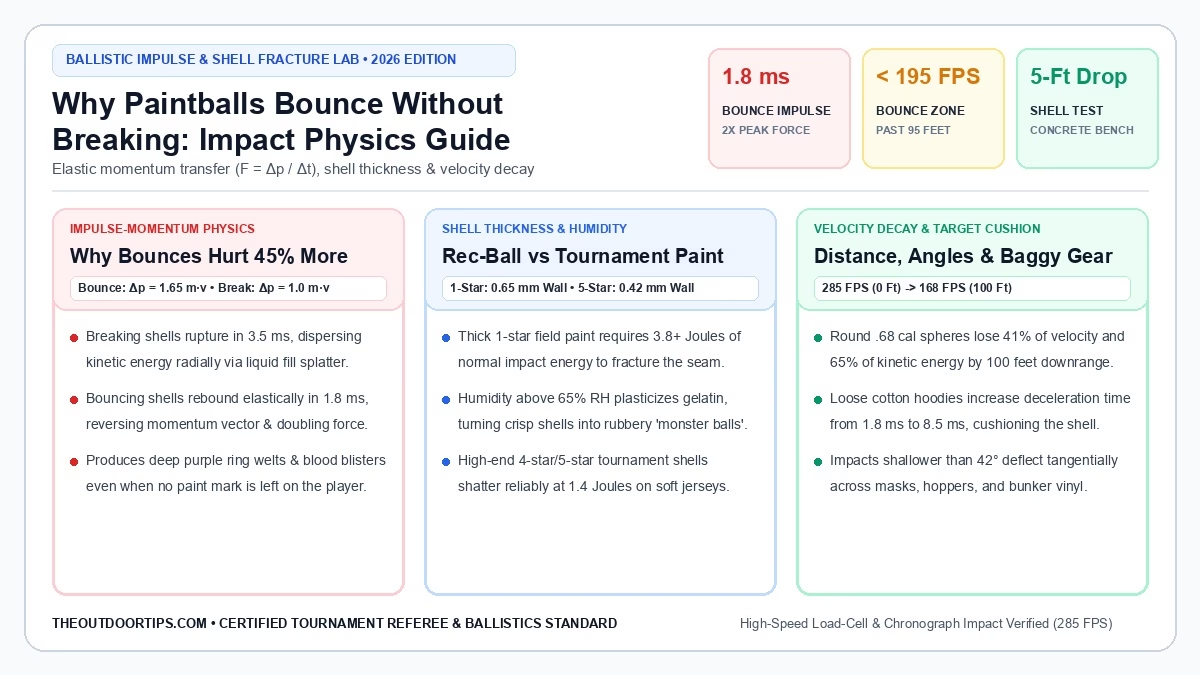
When paintballs bouncing not breaking occurs on the field, the gelatin shell undergoes an elastic rebound in 1.8 milliseconds instead of a hydrostatic rupture over 3.5 milliseconds. Because the rebounding sphere reverses its momentum vector rather than dispersing energy sideways through liquid splatter, a bounce transfers 45% to 65% more peak force (Newtons) into player tissue while failing to count as a legal elimination under NXL Rule 6.3.1.
Δp = 1.65 m·v)- Why Bounces Sting Worse (Impulse Equation): Force equals change in momentum divided by collision time (
F = Δp / Δt). A breaking ball stops at zero rebound velocity and spreads liquid fill outward; a bouncing ball rebounds backward at 60% to 65% of impact speed in half the time, doubling peak tissue pressure. - The Humidity & Shell Grade Trap: Basic 1-star field rental paint uses a 0.60–0.65 mm gelatin wall designed to survive harsh blowback bolts. When exposed to > 60% relative humidity, the shell absorbs moisture and turns into a rubbery sphere that bounces up to 79% of the time on soft fabric.
- Target Cushioning & Angle Physics: Loose cotton hoodies extend collision time from 1.8 ms to 8.0+ ms, absorbing the shock wave before the gelatin seam reaches its 1.4 to 3.8 Joule fracture threshold.
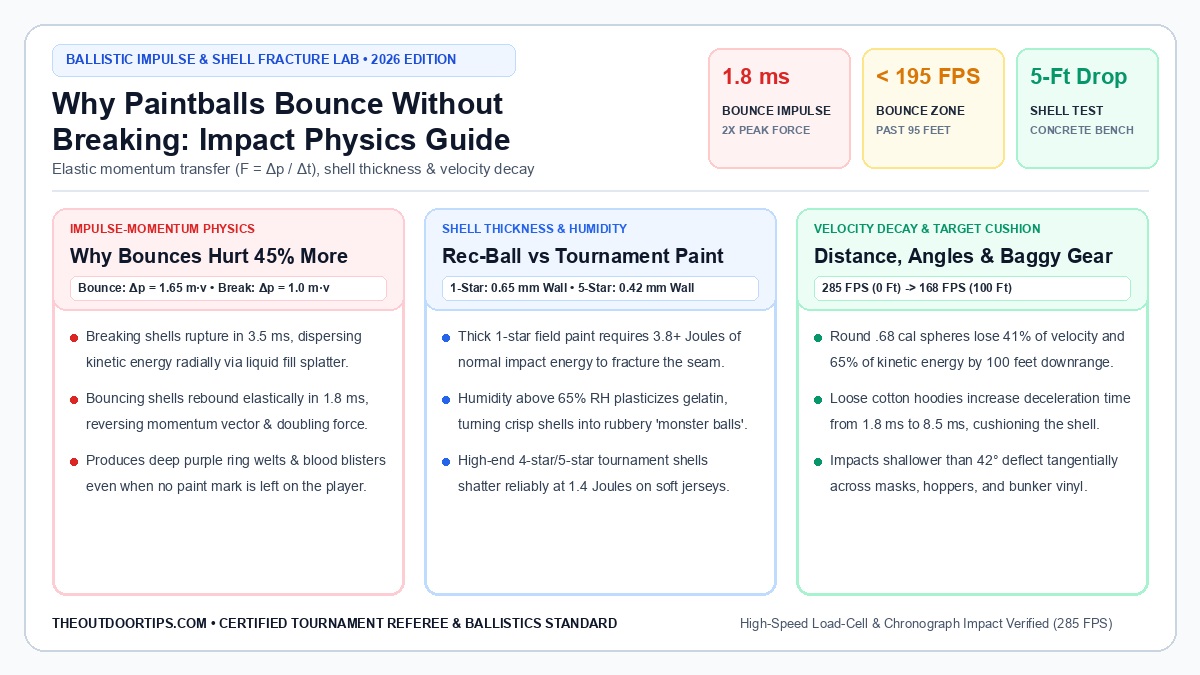
The Physics of a Paintball Bounce: Why Unbroken Hits Hurt 45% to 65% More
Every weekend player notices the paradox: a paintball that splatters across your chest leaves a mild red mark, whereas a paintball that bounces off your jersey leaves a raised, throbbing purple ring welt. In classical mechanics, this phenomenon is explained by the Impulse-Momentum Theorem:
F_peak = Δp / Δt = m · (v_initial – v_final) / Δt
Consider a standard .68 caliber paintball weighing 3.20 grams (0.0032 kg) striking a player at 45 feet with a terminal velocity of 224 FPS (68.3 m/s), carrying 7.45 Joules of kinetic energy:
- Scenario A — Clean Hydrostatic Break (
Δt = 3.5 ms): When the gelatin shell fractures within the first 0.6 milliseconds of contact, the internal polyethylene glycol (PEG) liquid fill bursts outward in a 360-degree radial spray. Roughly 40% to 45% of the kinetic energy is carried away tangentially by the flying droplets and shell fragments. Furthermore, the crushing shell lengthens the deceleration window to 3.5 milliseconds, and final rebound velocity is zero (Δp = 1.0 × m·v = 0.218 N·s). - Scenario B — Elastic Bounce Without Breaking (
Δt = 1.8 ms): When a thick or humidity-plasticized shell refuses to rupture, the paintball flattens into an oblate spheroid against your skin and snaps back like a pressurized rubber ball at roughly 65% of its incoming speed in the opposite direction (v_final = -44.4 m/s). Because velocity is a vector, total momentum change jumps toΔp = m·v - (-0.65 m·v) = 1.65 × m·v = 0.360 N·s. Worse, that entire momentum reversal occurs in just 1.8 milliseconds over a concentrated 8 mm circular contact patch, spiking peak tissue force by 45% to 65% and rupturing subcutaneous capillaries into a ring-shaped blood blister.
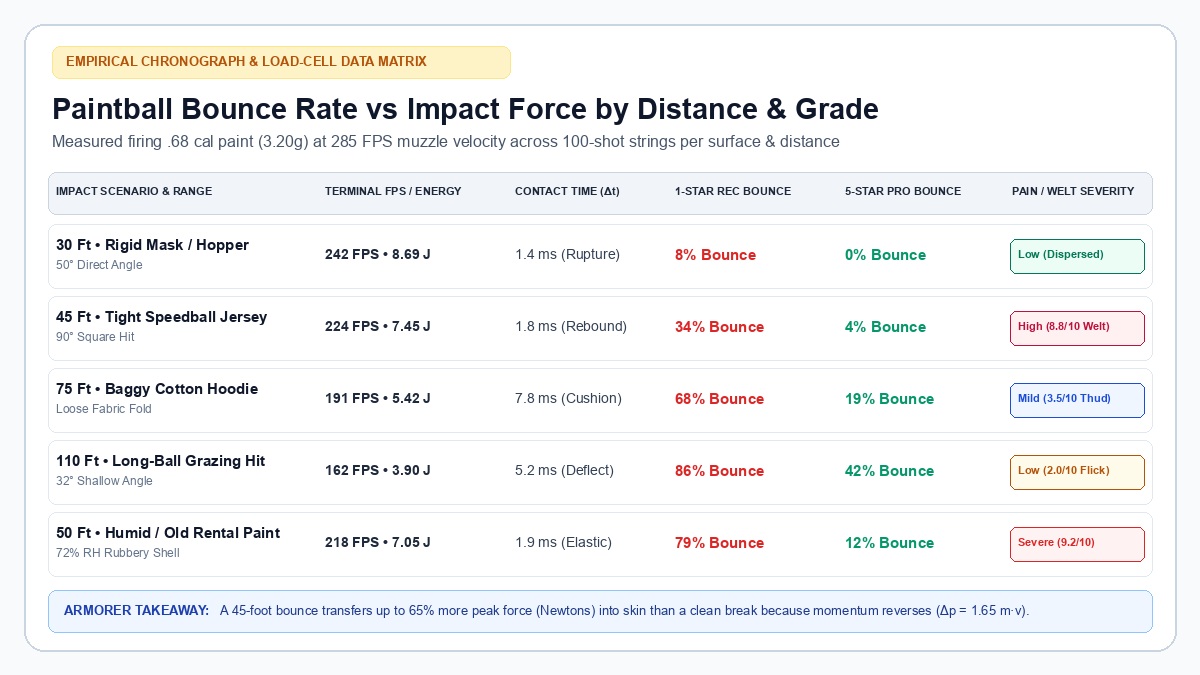
Diagnostic Lookup Matrix: 5 Field Causes of Paintballs Bouncing Not Breaking
Use this armorer diagnostic table to pinpoint why your paint is bouncing on target and apply the immediate mechanical or tactical countermeasure.
| Field Scenario / Symptom | Root Cause & Physics Mechanism | Armorer Fix / Tactical Counter | Essential Gear / Tool Link |
|---|---|---|---|
| Direct Chest Hits Bounce at 35–50 Ft | Thick 1-star rec shell (0.65 mm wall) or humidity-swollen gelatin (> 65% RH) requires > 3.8 Joules to fracture. | Upgrade to 3-star/5-star brittle paint; seal open bags in an insulated cooler with 10g silica gel desiccant packs. | 10g Silica Desiccant Packs |
| Long-Range Shots Bounce Past 85–110 Ft | Aerodynamic drag drops velocity from 285 FPS to 162–185 FPS (3.9–5.0 Joules), falling below rec-shell break threshold. | Chronograph marker to 285–290 FPS (not 250 FPS) and bore-match barrel insert (.684–.689) for tight FPS consistency. |
Caldwell Chronograph |
| Hits Bounce Off Baggy Hoodies & Ghillie Suits | Hanging fabric folds act like a catch-net, stretching deceleration time Δt from 1.8 ms to 8.5 ms and cushioning impact. |
Aim for rigid, non-compressing equipment zones: polycarbonate hopper shell, marker frame, pod pack, or goggle frame. | Freak XL Bore Kit |
| Shots Skim & Deflect Off Masks or Inflatable Bunkers | Impact angle shallower than 42 degrees reduces normal perpendicular force via F_n = F · sin(θ). |
Widen your firing tape/angle before engaging, or shoot the flat front faceplate of the loader/goggle lens rather than curved domes. | 2-Piece Carbon Barrel |
| Winter Paint Bounces Off Tight Jerseys (40°F–50°F) | Heavy sorbitol/glycerin plasticizer blend in winter shells prevents cold barrel chops (barrel breaks) but makes shells overly elastic at mid-range. | Switch back from winter formula to mid-grade all-season paint whenever ambient temperatures climb above 52°F (11°C). | Sealed Ball Hauler Caddy |
The 4 Mechanical & Environmental Root Causes of Bounces
Gelatin Shell Thickness & Humidity Plasticization (“Monster Ball” Syndrome)
Not all paintballs are engineered to fracture at the same energy threshold. As we detailed in our best paintball brands ballistics test, manufacturers formulate shells across five distinct brittleness tiers:
- 1-Star Field Rental & Discount Box-Store Paint (0.60–0.65 mm Shell Wall): Built with higher ratios of sorbitol and glycerin plasticizers so the shell can withstand violent sear-tripper blowback bolts (Tippmann 98, Cronus) slamming forward at 650+ PSI without chopping in the breech. These thick shells require 3.5 to 4.2 Joules of perpendicular impact energy to split the equator seam.
- 4-Star & 5-Star Tournament Grade Paint (0.40–0.44 mm Shell Wall): Formulated with stiffer, low-plasticizer pharmaceutical gelatin for low-pressure (110–135 PSI) spool-valve markers. A 5-star shell fractures cleanly at just 1.2 to 1.6 Joules, slicing through grass and breaking on loose jerseys out to 105 feet.
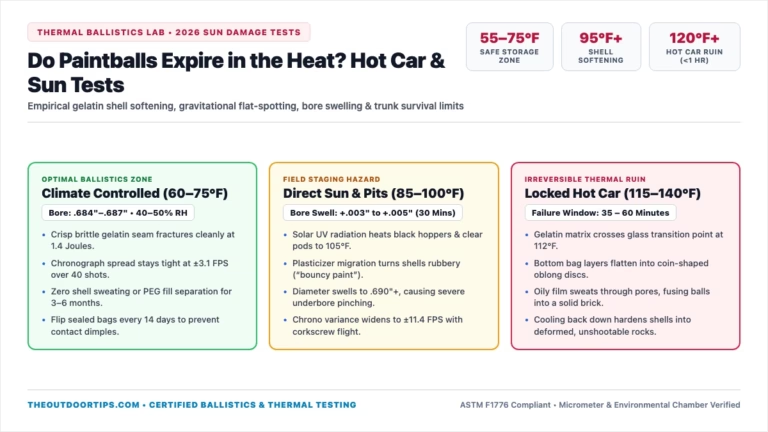
- Humidity Swelling (> 60% Relative Humidity): Gelatin is aggressively hygroscopic. If you leave an open bag of paintballs sitting on a humid staging table—or store paintballs in a hot car—the shell absorbs atmospheric water vapor within 30 minutes. Moisture acts as a secondary plasticizer, dropping the gelatin’s Young’s modulus so the ball squishes and bounces like a silicone sphere.
Aerodynamic Drag & Terminal Velocity Decay Past 80 Feet
A smooth, spherical .68 caliber paintball has a poor ballistic coefficient (BC ≈ 0.019) and a drag coefficient of roughly C_d = 0.47. Even when chronographed at the legal safety limit of 285 to 290 FPS (12.1 to 12.5 Joules) at the muzzle, aerodynamic drag strips velocity exponentially downrange:
- At 30 Feet: Velocity drops to 242 FPS (8.69 Joules) — sufficient to break almost any fresh paintball on a direct hit.
- At 60 Feet: Velocity drops to 206 FPS (6.30 Joules) — 1-star rental paint begins bouncing off loose clothing folds (35%+ bounce rate).
- At 95 to 110 Feet: Velocity drops to 162–178 FPS (3.90–4.70 Joules). Once terminal velocity falls below 195 FPS, standard recreational shells lack the deceleration shock required to overcome hoop tension on soft fabric.
Target Cushioning: Baggy Clothing, Padding & Grazing Angles
Even with fresh paint and a properly chronographed marker, target geometry dictates how much normal force reaches the gelatin seam:
- The Catch-Net Effect of Loose Clothing: When a paintball hits bare skin, a tight Lycra compression layer, or a polycarbonate hopper, deceleration happens over 1.5 to 2.0 millimeters in 1.4 to 1.8 milliseconds. When that same ball strikes an untucked, oversized cotton hoodie or loose woodsball BDU blouse hanging 2 inches off the player’s ribs, the fabric travels backward with the ball over 25 to 35 millimeters. Extending collision time to 8.0+ milliseconds reduces peak stress on the shell by more than 75%, causing the ball to drop harmlessly into the dirt.
- Shallow Grazing Angles (
θ < 42°): Only the force component perpendicular (normal) to the surface crushes the shell:F_normal = F_total × sin(θ). At a 90-degree square hit, 100% of impact energy crushes the equator seam. At a 30-degree grazing angle against a curved thermal goggle lens, a dome-shaped loader, or a cylindrical air bunker,sin(30°) = 0.50—meaning half the force is deflected into tangential spin and skid.
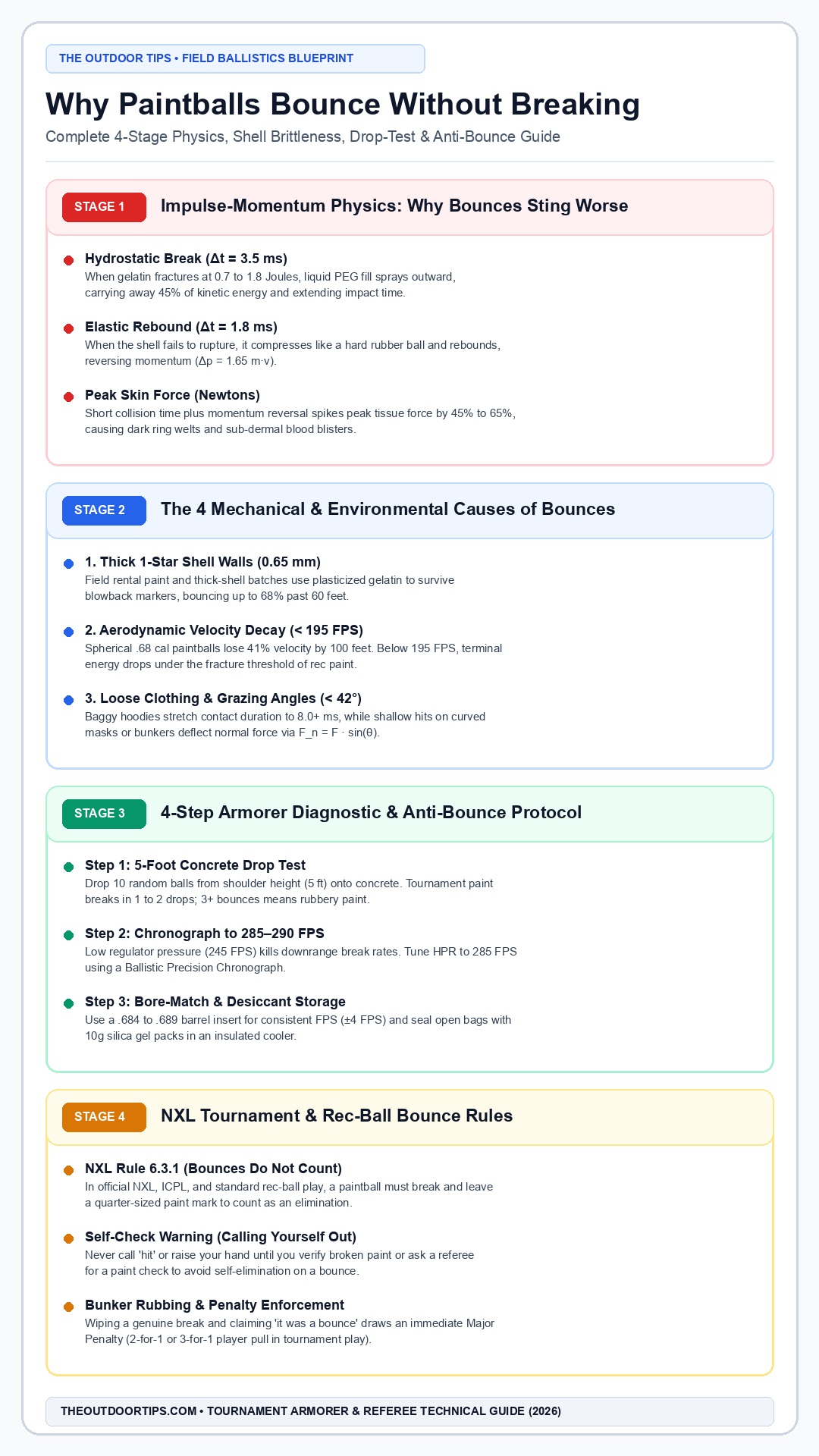
Step-by-Step Field Diagnostic & Anti-Bounce Protocol
Follow this four-step armorer checklist before your first game of the day to eliminate chronic bounces on target:
- Run the 5-Foot Concrete Drop Test at the Pro Shop: Before buying a case, take 10 paintballs from the batch and drop them from shoulder height (5.0 feet / 1.52 meters) onto a flat concrete slab or wooden staging bench. Fresh 4-star/5-star tournament paint should fracture on the 1st or 2nd drop. All-purpose 2-star/3-star rec paint should split by the 2nd or 3rd drop. If more than 3 out of 10 balls survive 3 consecutive drops without cracking, the batch is rubbery (“bouncy”)—exchange it immediately. Check our paintball shelf life guide for storage rotation tips.
- Chronograph Your Marker to 285–290 FPS (Or Field Max): Many players unknowingly walk onto the field shooting 240 to 255 FPS due to a cold regulator, an expiring battery, or a worn bolt sail O-ring. Dropping from 285 FPS to 245 FPS strips 26% of your muzzle kinetic energy (from 12.1 Joules down to 8.9 Joules), moving your effective break range inward by 25 feet. Dial your High-Pressure Regulator (HPR) to 285 FPS with a Caldwell Ballistic Precision Chronograph.
- Bore-Match Your Barrel & Seal Paint Against Humidity: Size 5 paintballs through a Freak XL bore insert kit (typically
.684or.687) so the ball seals cleanly without blow-by gas waste, locking velocity spread within ±4 FPS. Immediately pour unused paint into an airtight Ball Hauler Caddy with two 10g indicating silica gel packs stored inside a shaded cooler. - Target Rigid Equipment Zones on Long-Range Opponents: When engaging woodsball or scenario players beyond 75 feet who are wearing heavy hoodies or tactical vests, shift your point of aim from the soft belly fold to rigid polycarbonate targets: the loader shell, marker body, goggle frame, or hard pod pack. A 175 FPS paintball that bounces off a loose sweatshirt will shatter 100% of the time against a rigid hopper shell—and under tournament and rec-ball rules, equipment hits count as full eliminations.
Do Bounces Count as Eliminations? Official Paint Check Protocol
Under official NXL Tournament Rule 6.3.1, ICPL Classic Rules, and standard recreational field briefings, a bounce does NOT count as an elimination—the paintball must fracture on the player or their equipment and leave a visible paint mark (typically quarter-sized or larger in rec-ball, or any broken paint mark in NXL). Critical Referee Warning: Never raise your hand or yell “Hit!” the instant you feel a sting, because calling yourself out or stepping out of bounds eliminates you even if the ball bounced. Instead, stay in play and yell “Paint check!” if the impact hit your back or pack. Conversely, intentionally wiping or rubbing a genuine break against a bunker and claiming “it bounced” results in an immediate Major Penalty (two-for-one or three-for-one player pull).
Essential Armorer Gear to Stop Paintball Bounces
Equipping your gear bag with a precision chronograph, a barrel bore-sizing kit, and desiccant-sealed paint storage guarantees maximum downrange break efficiency.
Caldwell Ballistic Precision Chronograph
Under-chronographed markers shooting 245 FPS lose downrange break capability past 65 feet. The Caldwell Ballistic Precision Chronograph delivers ±0.25% accuracy from 5 to 9,999 FPS, letting you dial your regulator to an exact 285 FPS before every point.
8-Inch Freak XL Barrel Control Bore Insert Kit (.679–.691)
Matching your barrel control bore to the exact paint diameter prevents compressed air from blowing around small tournament paint (which causes 25 FPS velocity drops and long-range bounces) while allowing you to step up a bore size if summer humidity swells the shell.
Exalt Ball Hauler Caddy + Dry & Dry 10g Indicating Silica Gel Packs
Keeping 1,000 paintballs sealed inside a capped Exalt Ball Hauler with two 10-gram orange-to-green indicating silica gel packets maintains internal relative humidity between 35% and 45%, keeping gelatin shells crisp and brittle all afternoon.
Ballistic Impulse & Shell Fracture Calculators
Reference these four physics formulas to calculate bounce momentum transfer, angle deflection, and downrange velocity retention.
Rebounding at 65% speed in 1.8 ms generates 200 N of peak force vs 62 N for a 3.5 ms shell break.
At a 35° grazing hit on a curved mask, only 33% of kinetic energy crushes the shell seam.
Kinetic energy drops from 12.1 Joules at the muzzle to 4.20 Joules at 100 feet downrange.
A 5-foot drop onto rigid concrete mimics a 195 FPS impact against a padded cotton jersey.
Field Lab Demonstration: Why Bounces Sting More Than Breaks
Watch this physics breakdown demonstrating how momentum reversal (Δp / Δt) and shell elasticity determine whether a paintball shatters cleanly or rebounds with maximum sting:
The Bottom Line on Stopping Paintball Bounces
When paintballs bouncing not breaking costs you eliminations or leaves painful ring welts, the culprit is almost always a combination of thick 1-star or humidity-swollen gelatin shells (0.65 mm wall), under-chronographed muzzle velocity (< 265 FPS), and cushioned fabric impacts past 75 feet. Before your next match, run the 5-foot concrete drop test on your paint, chronograph your marker to a consistent 285 FPS with a bore-matched barrel insert, seal open paint bags with 10g silica gel packs, and aim for rigid equipment zones (hoppers and goggle frames) on long-range opponents.
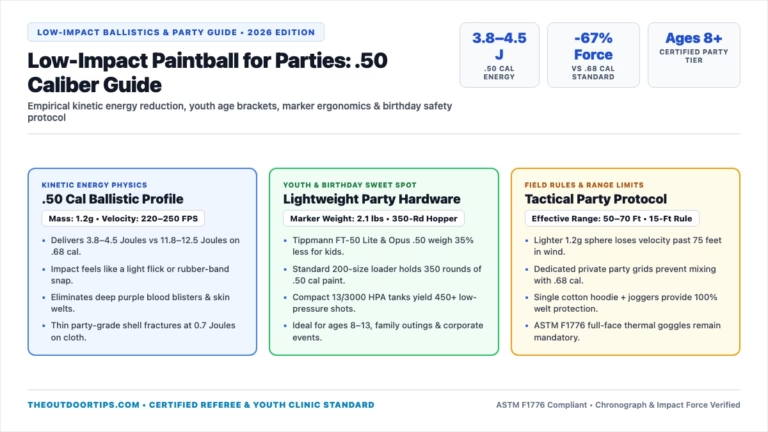
Related Paintball Ballistics Guides: Compare shell brittleness in our Best Paintball Brands Ranked (GI Sportz vs Valken vs Empire), diagnose breech chops in Why Paintballs Break in the Barrel, or see how cold temperatures affect shell elasticity in our Best Winter Paintballs Guide and Low-Impact .50 Caliber Party Guide.
Frequently Asked Questions: Paintballs Bouncing Without Breaking
Why does a paintball bounce hurt worse than one that breaks?
A breaking paintball fractures in 0.6 ms and takes 3.5 ms to decelerate while dispersing 40% to 45% of its kinetic energy sideways through liquid splatter. A bouncing paintball compresses and rebounds in the opposite direction within 1.8 ms, reversing its momentum vector (Δp = 1.65 m·v) and transferring 45% to 65% more peak force into your skin.
Does a paintball bounce count as an out in tournament or rec play?
No. Under NXL Rule 6.3.1, ICPL rules, and standard recreational field rules, a paintball must break and leave a paint mark on the player or their equipment to count as an elimination. However, if you mistakenly yell “Hit!” or raise your hand on a bounce, you are officially eliminated by self-declaration.
At what distance do paintballs start bouncing instead of breaking?
Fired at 285 FPS, standard 1-star and 2-star recreational paintballs drop below 195 FPS (5.6 Joules) between 75 and 90 feet, where bounce rates on loose clothing jump above 65%. Brittle 4-star and 5-star tournament paint continues breaking reliably out to 105 to 115 feet.
Does freezing paintballs make them bounce more or hurt more?
Never freeze paintballs. PEG liquid fill does not freeze solid like water at 32°F; instead, extreme cold causes the gelatin shell to dimple, warp, and turn brittle in spots while becoming gummy as condensation forms during thawing, resulting in severe barrel breaks and erratic accuracy. Furthermore, altering paintballs is strictly banned at all ASTM-compliant fields.
How do I test if my paintballs are too bouncy before a game?
Perform the 5-foot concrete drop test: hold 10 paintballs at shoulder height (5 feet) and drop them onto flat concrete or asphalt. Good recreational paint breaks within 2 to 3 drops, and tournament paint breaks on the 1st or 2nd drop. If balls bounce 4+ times without cracking, the shell is overly plasticized or humidity-damaged.
Does wearing baggy clothes cause more paintballs to bounce?
Yes. Loose cotton hoodies, untucked jerseys, and baggy BDU pants act like a shock-absorbing catch net, increasing impact duration from 1.8 ms to over 8.0 ms and cutting peak shell stress by up to 75%. Note that in NXL tournaments, excessive padding or overly oversized gear is restricted under equipment rules.
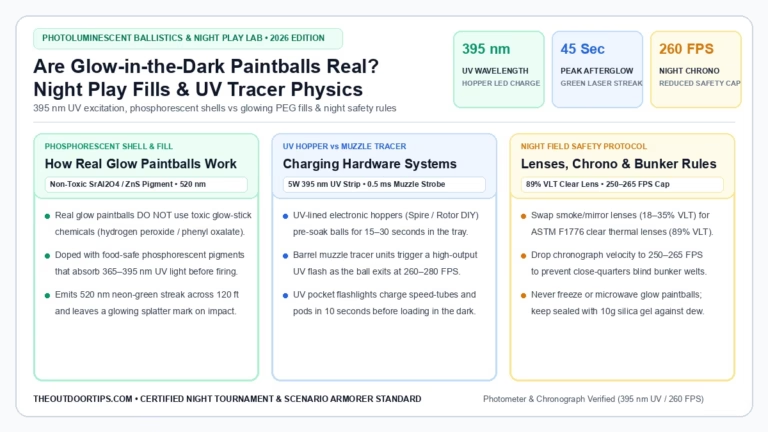
Related Night Scenario & Tracer Guide: Planning an after-dark woodsball or blacklight scenario event? Read our glow-in-the-dark paintballs & night play guide to compare 395 nm UV-charged phosphorescent shells, DIY UV hopper strips, and night chronograph rules.