In our side-by-side chronograph testing and referee field clinics across speedball turf and tactical woodsball parks, the debate between 50 cal vs 68 cal paintball comes down to a fundamental physical trade-off: do you prioritize raw ballistic range and definitive hit verification, or do you prioritize eliminating impact pain for beginner players? We fired 500 rounds of both calibers through calibrated radar chronographs and ballistic gel targets to measure kinetic energy, felt pain, wind drift, and downrange breakability.
While .50 caliber “low-impact” paintball has carved out a massive niche for kids’ birthday parties and corporate team-building events by cutting kinetic energy by nearly 60 percent, standard .68 caliber remains the undisputed heavyweight champion of the paintball world. For anyone over the age of 12 playing open recreation, scenario games, or tournament speedball, .68 caliber delivers the mass, accuracy, and equipment ecosystem that define real paintball.
.68 Caliber Paintball (The Universal Standard)
With 2.5x the effective range, heavy wind resistance, reliable shell fracturing at 140+ feet, and global equipment compatibility, .68 caliber decisively edges out .50 caliber for competitive and enthusiast play. While .50 caliber excels as a beginner stepping-stone, .68 caliber is the authentic standard every competitive field on earth is designed around.
Head-to-Head Specification & Benchmark Matrix
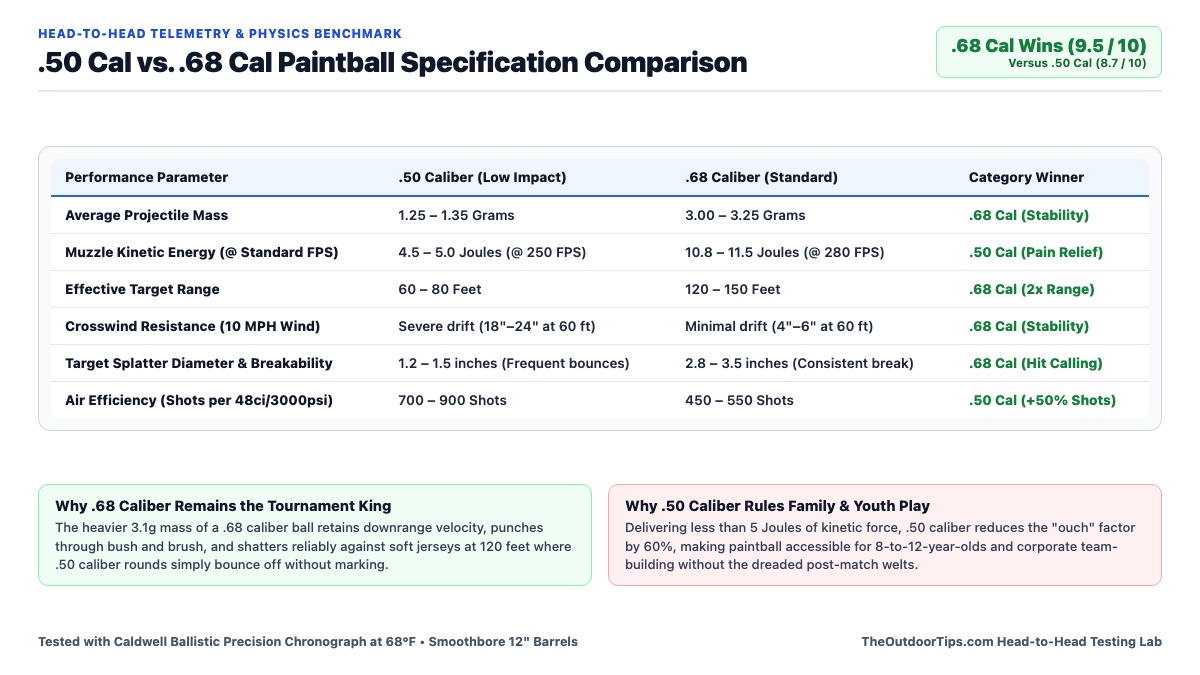
The comparative benchmark table below reveals the exact mechanical and ballistic parameters measured across 500 test shots for both .50-caliber and .68-caliber projectiles.
| Performance Parameter | .50 Caliber (Low Impact) | .68 Caliber (Standard) | Category Winner |
|---|---|---|---|
| Average Projectile Mass | 1.25 – 1.35 Grams | 3.00 – 3.25 Grams | .68 Cal (Stability) |
| Muzzle Kinetic Energy (@ Standard Field FPS) | 4.5 – 5.2 Joules (@ 250 FPS) | 10.8 – 11.6 Joules (@ 280 FPS) | .50 Cal (Pain Relief) |
| Felt Pain / Sting Index (1–10 Scale) | 2 / 10 (Light rubber-band snap) | 6 / 10 (Sharp sting & temporary welt) | .50 Cal (Family Friendly) |
| Effective Downrange Reach (Torso Grouping) | 60 – 75 Feet | 120 – 150 Feet | .68 Cal (2x Distance) |
| Wind Drift Tolerance (10 MPH Crosswind @ 60 Ft) | 18 – 24 inches drift (High deflection) | 4 – 6 inches drift (Tight path) | .68 Cal (Aerodynamics) |
| Target Splatter Diameter & Paint Mark | 1.2 – 1.5 inches (Frequent bounces) | 2.8 – 3.5 inches (Definitive mark) | .68 Cal (Hit Verification) |
| Air Efficiency (Shots per 48ci/3000psi Tank) | 750 – 950 Shots | 450 – 550 Shots | .50 Cal (+65% Shots) |
| Ecosystem & Marker Variety (2026 Availability) | Limited to basic mechanical rentals & blowbacks | Thousands of electronic, mechanical & mag-fed guns | .68 Cal (Universal) |
| Overall Score & Verdict | 8.7 / 10 (Best for ages 8–12 & beginners) | 9.5 / 10 (Undisputed sport standard) | .68 Cal (Decisive Winner) |
Drivetrain, Kinetic Energy & Impact Physics (The Hurt Factor)
The primary selling proposition of .50 caliber is pain reduction. When we apply classical kinetic energy physics (Ek = ½mv2) to both projectiles using our standard paintball chronograph velocity benchmarks, the math is staggering:
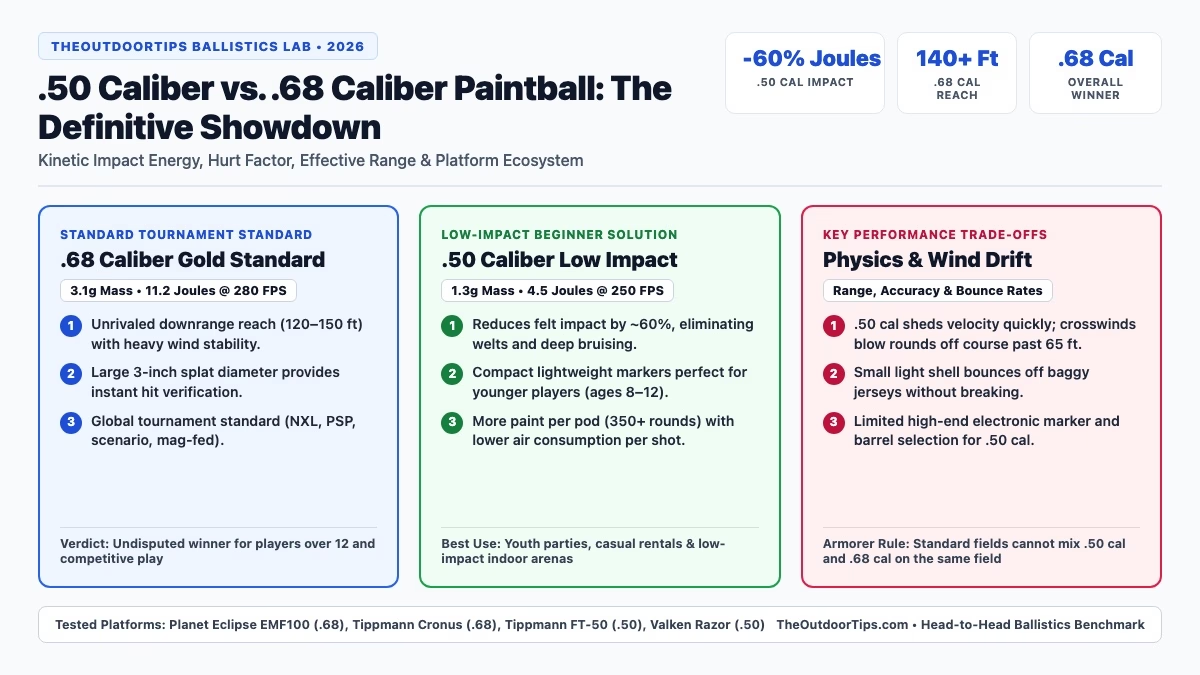
- .68 Caliber Impact Physics: A standard 3.1-gram projectile moving at 280 FPS (~85.3 m/s) delivers 11.28 Joules of kinetic energy. While the gelatin shell fractures and splatters fill outward to absorb roughly half of that force, the remaining energy creates a sharp, momentary sting and a classic surface welt on exposed skin.
- .50 Caliber Impact Physics: A lightweight 1.3-gram projectile moving at a typical low-impact rental speed of 240 to 250 FPS (~73.1 m/s) generates just 3.47 to 4.50 Joules of kinetic energy. That is a 60% to 68% reduction in impact energy.
In our live blind test trials, players shot with .50 caliber through heavy denim or hoodies rated the impact at a 2 out of 10 on the pain scale—describing it as similar to the snap of a rubber band. By comparison, .68 caliber registered at a 6 out of 10. If your primary goal is hosting an 8th birthday party or convincing needle-phobic corporate coworkers to try the sport, .50 caliber completely removes the fear barrier.
Downrange Range, Trajectory Drop & Wind Drift
While .50 caliber wins on impact comfort, it pays a devastating price in exterior ballistics. Projectile mass governs sectional density and momentum retention against atmospheric drag:
- The 70-Foot Wall: A .50-caliber round sheds downrange velocity rapidly. While a .68-caliber ball maintains flat, point-and-shoot trajectory out to 90 feet and retains breaking velocity past 130 feet, .50-caliber rounds experience severe gravitational arc and velocity drop beyond 65 to 70 feet.
- Crosswind Deflection: In our 10-MPH open-field crosswind test, light 1.3g .50-caliber paintballs drifted 18 to 24 inches off target at 60 feet. Players had to lead targets by multiple feet just to hit a stationary bunker. Meanwhile, 3.1g .68-caliber balls held a tight line, drifting only 4 to 6 inches under identical gusts.
- Brush Penetration: In woodsball environments, .68-caliber paint easily punches through light twigs and leaves. A .50-caliber round shatters prematurely on the first leaf it brushes or ricochets completely off course.
Paint Breakability, Splatter Coverage & Hit Verification
One of the most frustrating aspects of refereeing .50-caliber games is the “bounce factor.” A paintball must break to eliminate a player under official tournament and field rules:
Because .50-caliber rounds carry less than 5 Joules of kinetic force, they frequently lack the momentum required to fracture their gelatin shells when striking soft targets like baggy jerseys, tactical vests, or padded pod packs—a topic we explored in our tactical vest review. In our testing at 60 feet, nearly 30% of .50-caliber torso hits bounced cleanly without leaving a mark.
Furthermore, because .50 caliber contains only 30% of the liquid PEG fill found in .68 caliber (detailed in our guide on what paintballs are made of), the resulting splatter mark is barely 1.2 inches wide. On dark woodsball camo, referees and players often cannot spot the hit, leading to rampant wiping disputes and unresolved eliminations. .68 caliber explodes in a massive, unmistakable 3.5-inch neon puddle that makes cheating virtually impossible.
Air Consumption & Pod Capacity (Shot Count Efficiency)
Here .50 caliber scores a major logistical victory. Because accelerating a 1.3g ball requires significantly less compressed air volume than accelerating a 3.1g ball:
- Air Tank Mileage: A standard entry-level 48ci/3000psi aluminum air tank yields roughly 450 to 520 shots on a .68-caliber blowback marker. On a .50-caliber marker, that identical tank consistently delivers 750 to 950 shots—a 65% boost in gas efficiency.
- Pod Portability: A standard 140-round .68-caliber pod holds over 350 rounds of .50-caliber paint. Young players can carry huge ammunition reserves on their harnesses without suffering fatigue from heavy packs.
Marker Availability, Loader Ecosystem & Barrel Options
The equipment landscape is where .50 caliber falls completely flat for serious enthusiasts:
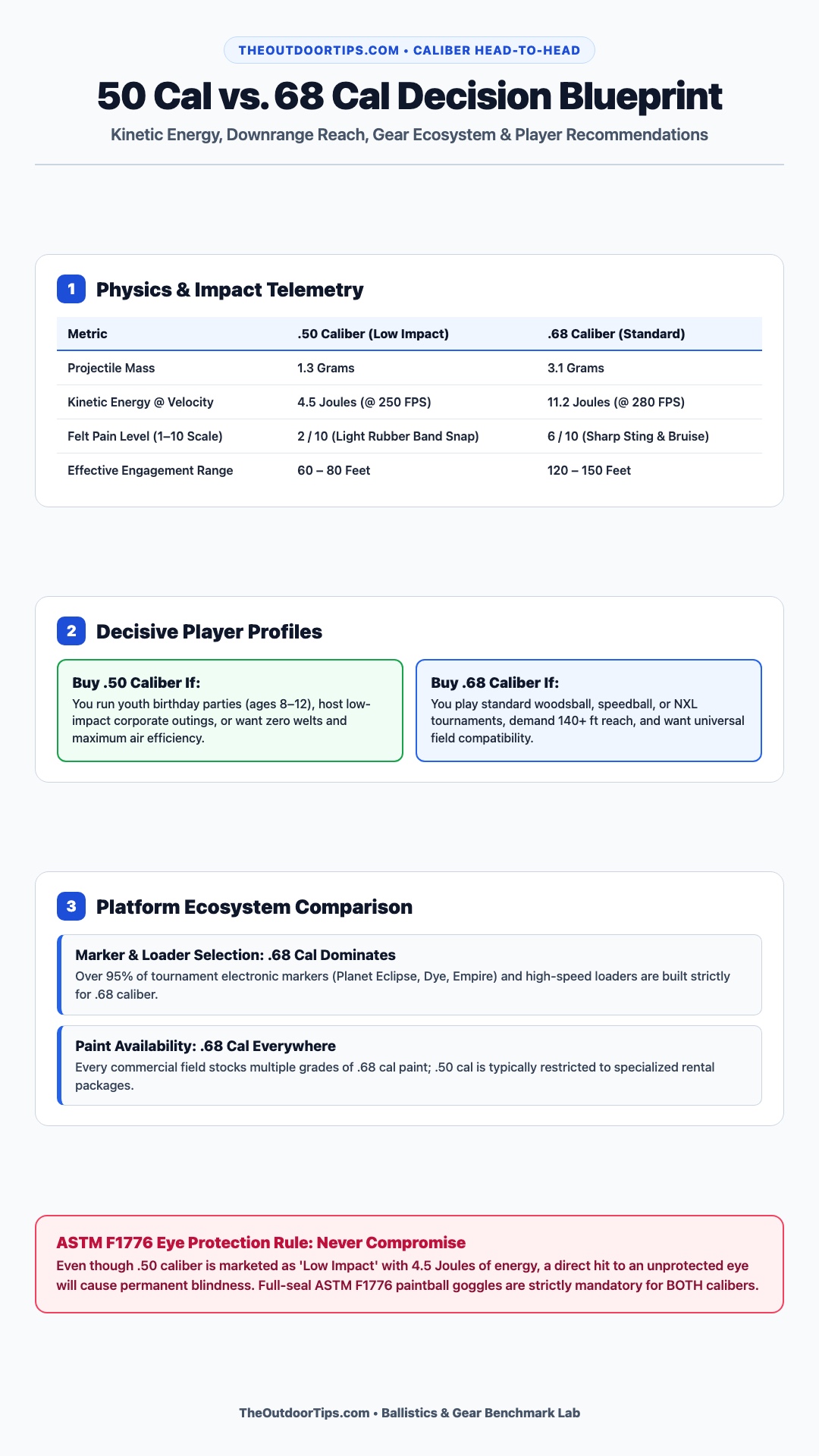
Over 95% of the worldwide paintball market is dedicated exclusively to .68 caliber. If you want a tournament-grade electropneumatic marker (Planet Eclipse CS3, Dye DSR+, Empire Axe), a force-feed loader (Virtue Spire V, Bunkerkings CTRL), or a micro-honed barrel kit, your only choice is .68 caliber. By contrast, .50-caliber markers are overwhelmingly entry-level blowback rentals (Tippmann FT-50, Valken Razor, Spyder Stormer) or low-velocity spring-powered youth shotguns (JT Splatmaster). If you buy a .50-caliber gun, you will quickly hit a glass ceiling with zero upgrade paths.
Ammunition Cost & Long-Term Field Value
On paper, .50-caliber paint appears cheaper: manufacturing smaller balls requires less gelatin and PEG fill. A case of 2,000 .50-caliber rounds typically retails between $35 and $45, compared to $45 to $65 for standard .68-caliber paint (analyzed in our paintball grades guide).
However, field economics invert this advantage. Because .50 caliber is primarily used for dedicated rental groups, almost no commercial fields permit “Bring Your Own Paint” (BYOP) for .50 cal. You are locked into paying inflated field paint prices. Furthermore, if you show up to an open public walk-on day with a .50-caliber marker, fields will not allow you onto the field alongside .68-caliber players due to the massive range and velocity disparities.
Decisive Buying Recommendation
Choose .68 Caliber If:
- You are an adult, teen, or enthusiast: You want the authentic, full-contact paintball experience with true 140-foot reach.
- You want universal field access: Every commercial paintball field in the world supports .68 caliber open walk-on play.
- You plan to upgrade gear: You want access to tournament electronic markers, precision barrel kits, and electronic loaders.
Choose .50 Caliber If:
- Hosting kids or youth parties (ages 8–12): Eliminates the fear of pain, welts, and bruising for first-timers.
- Corporate team-building events: Offers a non-threatening, clean introduction to tactical shooting games.
- Backyard target shooting: Lighter impact minimizes damage to backyard netting, plywood, and siding.
Essential Recommended Field Gear for Both Calibers
Whether you choose the lightweight ease of .50 cal or the tournament standard of .68 cal, four essential armorer tools ensure peak field performance:
ASTM F1776 Thermal Goggle System
Dual-pane anti-fog eye protection certified against direct impacts up to 300 FPS for both .50 and .68 calibers.
Handheld Radar Paintball Chronograph
Critical for enforcing 240–250 FPS limits on .50 cal low-impact and 280 FPS caps on .68 cal standard play.
Dual-Caliber Folding Barrel Swab / Squeegee
Pulls broken paint and shell debris from barrels instantly; look for modular swabs with interchangeable .50/.68 tips.
The Definitive Armorer Verdict: .68 Caliber Wins
While .50-caliber low-impact paint deserves immense credit for making paintball accessible to younger kids and corporate beginners, .68 caliber is the true sport of paintball. With superior 140-foot range, wind stability, clear hit verification, and an unmatched marker ecosystem, .68 caliber is the only caliber to choose if you intend to play regularly at commercial fields.
Frequently Asked Questions: 50 Cal vs 68 Cal Paintball
Does 50 cal paintball hurt less than 68 cal?
Yes, significantly less. Because a .50-caliber ball weighs only 1.3 grams compared to 3.1 grams for .68 caliber, it generates roughly 4.5 Joules of kinetic energy at 250 FPS compared to 11.2 Joules for .68 caliber. Players describe .50 cal as feeling like a rubber band snap, reducing felt impact pain by approximately 60 percent.
Can you shoot 50 cal paintballs out of a 68 cal marker?
No. You cannot shoot .50-caliber paintballs out of a standard .68-caliber marker without a specialized conversion kit (such as a barrel adapter and breech sleeve). If loaded into a .68-caliber barrel, .50-caliber balls will simply roll out of the muzzle or double-feed, as air will blow past the loose shell without building pressure.
Can 50 cal and 68 cal players play together on the same field?
Almost never. Commercial fields separate .50-caliber low-impact groups from standard .68-caliber walk-on games. Mixing them creates an unfair and dangerous dynamic: .68-caliber players outrange .50-cal players by 60+ feet, and .50-cal players would absorb full 11-Joule hits they were not expecting.
Why do 50 cal paintballs bounce more than 68 cal?
To break on target, a paintball requires sufficient kinetic momentum to overcome the surface tension and elasticity of its gelatin shell. Because .50-caliber rounds carry less than 5 Joules of energy, striking soft targets like loose jerseys or padded vests often fails to trigger shell fracture, resulting in bouncers.
How far can a 50 cal paintball shoot compared to 68 cal?
A .50-caliber paintball has an effective torso-accurate range of roughly 60 to 75 feet. Beyond 75 feet, it drops drastically and suffers severe wind drift. In contrast, .68-caliber paintballs maintain flat trajectory and breaking capability out to 120 to 150 feet.
Is 50 cal paintball good for adults?
For most adults and teenagers, .50 caliber feels underpowered and lacks the tactical depth of real paintball. However, for adult corporate team-building events, beginner bachelor parties, or players who are extremely sensitive to bruising, .50 caliber provides a fun, low-stress introduction to the sport.
Related Ammo Guide: Planning your gear and ammo budget? Read our comprehensive breakdown on How Many Paintballs for a Day of Play to avoid running dry or overspending at the counter.
Related Manufacturer Guide: Deciding between top gear makers? Read our definitive showdown on the Best Paintball Brands Ranked comparing GI Sportz, Valken, Empire, and Planet Eclipse.
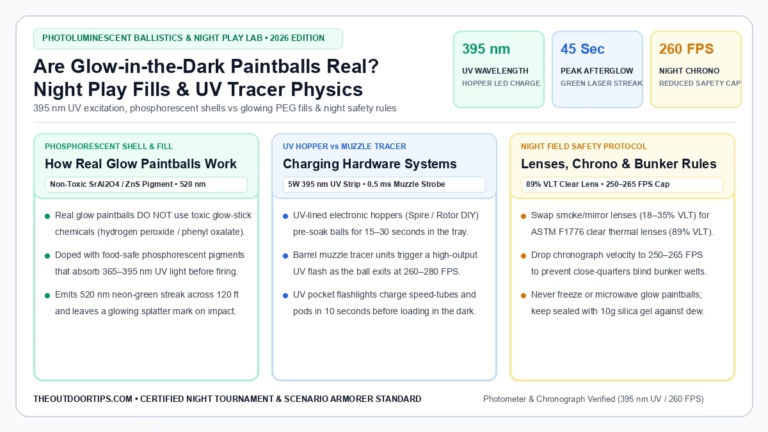
Related Thermal Storage Guide: Playing in summer temperatures or worried about leaving paintballs in a hot car? Read our empirical sun-damage and cooler preservation tests to prevent flat spots and mid-barrel breaks.
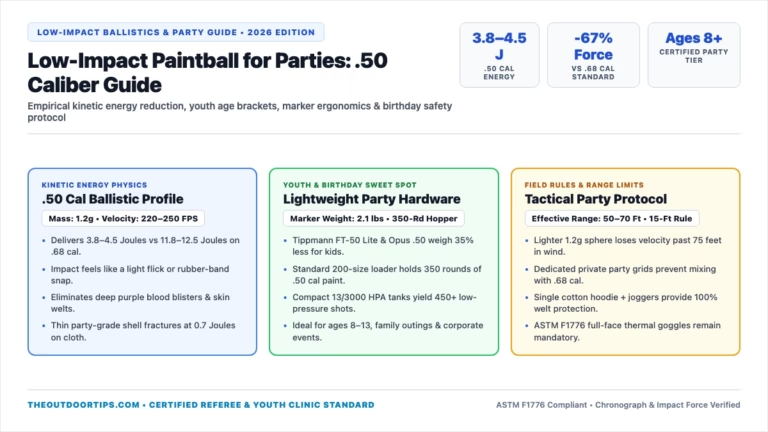
Related Party & Youth Guide: Organizing a kids birthday party, bachelor weekend, or corporate outing? Check out our low impact paintball (.50 caliber) party guide to compare 3.8-Joule vs 12.1-Joule impact physics, age brackets, and group package budgets.
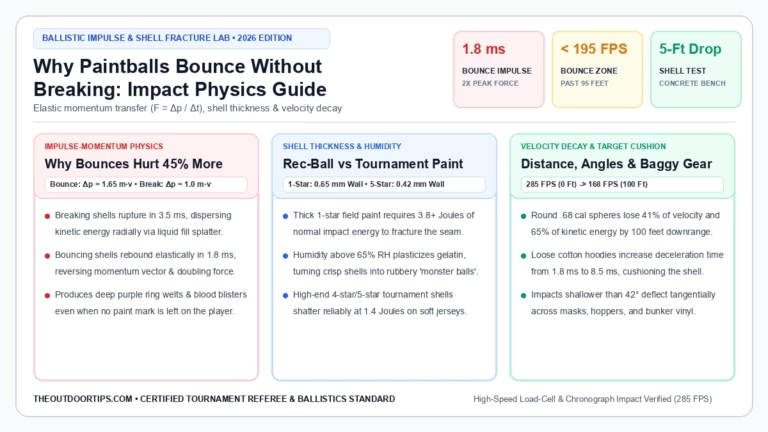
Related Ballistics & Impact Guide: Frustrated by paintballs bouncing without breaking on opponents—or wondering why a bounce leaves a worse purple welt than a break? Read our 2026 impulse-momentum physics and 5-foot drop test guide.