In our field tests and match clinics across local commercial parks, big scenario game productions, and speedball tournament scrimmages, the single most common question every player asks the pro shop cashier is: how many paintballs for a day of play do I actually need? Buying too little ammo leaves you stranded in the dead box watching your squad get eliminated while your hopper sits empty; overbuying on an unsealed case in humid weather risks ending up with swollen paintballs that dimple and degrade before your next match. The exact round count depends strictly on three physical variables: your marker trigger mechanism (mechanical semi-auto vs. electronic ramping), your game duration in hours, and your tactical playstyle format.
Key Technical Takeaways (TL;DR): Paintball Quantity by Playstyle
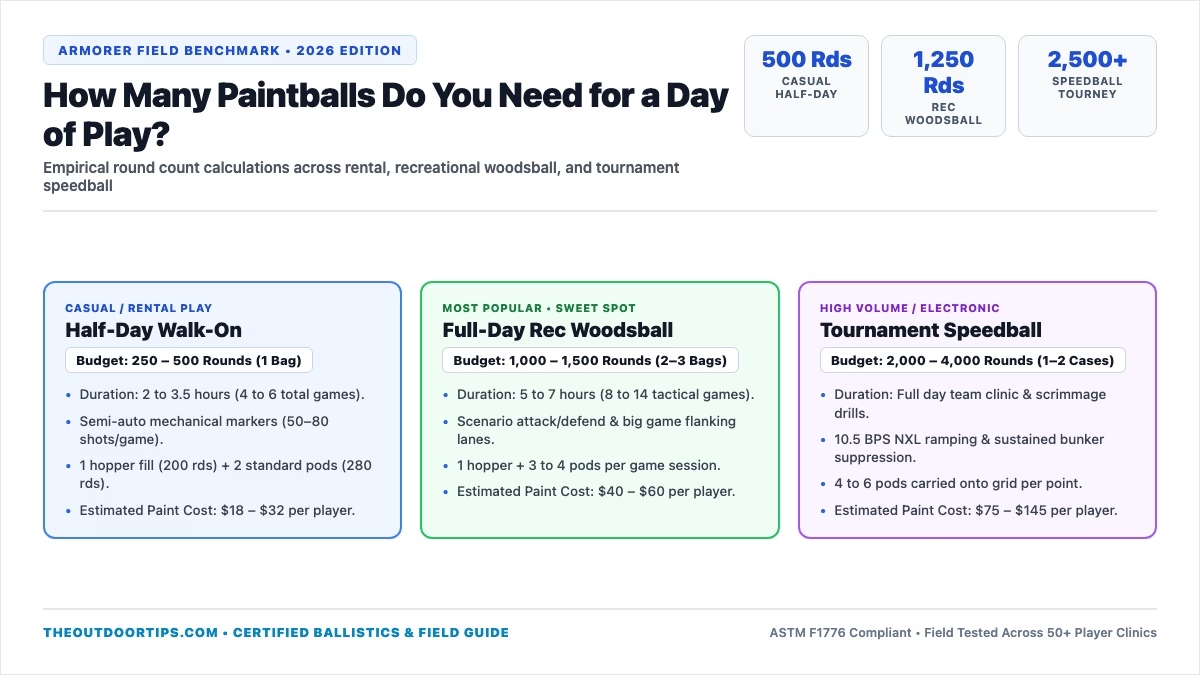
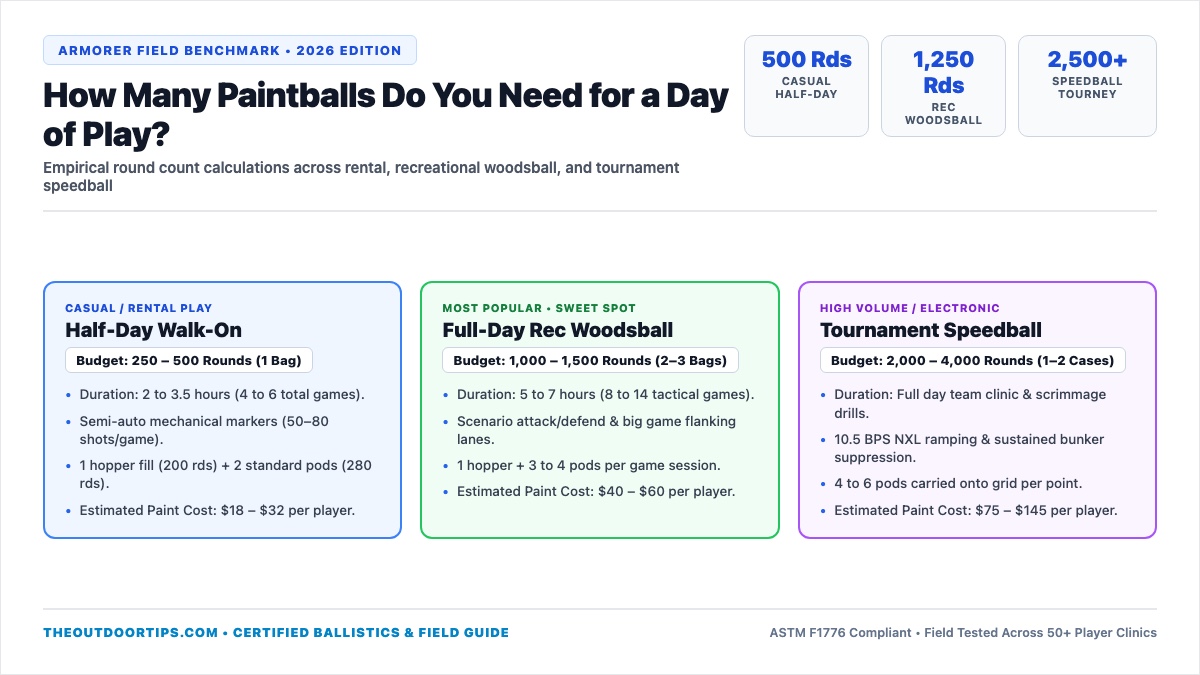
For a standard half-day rental or casual walk-on session (2 to 3 hours, 4 to 6 games), 250 to 500 paintballs (1 bag) is the sweet spot. For an active full-day recreational woodsball outing (5 to 6 hours, 8 to 12 games), plan on 1,000 to 1,500 paintballs (2 to 3 bags, or half to three-quarters case). High-tempo tournament speedball players shooting 10.5 BPS electronic ramping consume 2,000 to 4,000 paintballs (1 to 2 full cases) per player during full-day team scrimmages.
Understanding Standard Paintball Packaging Units
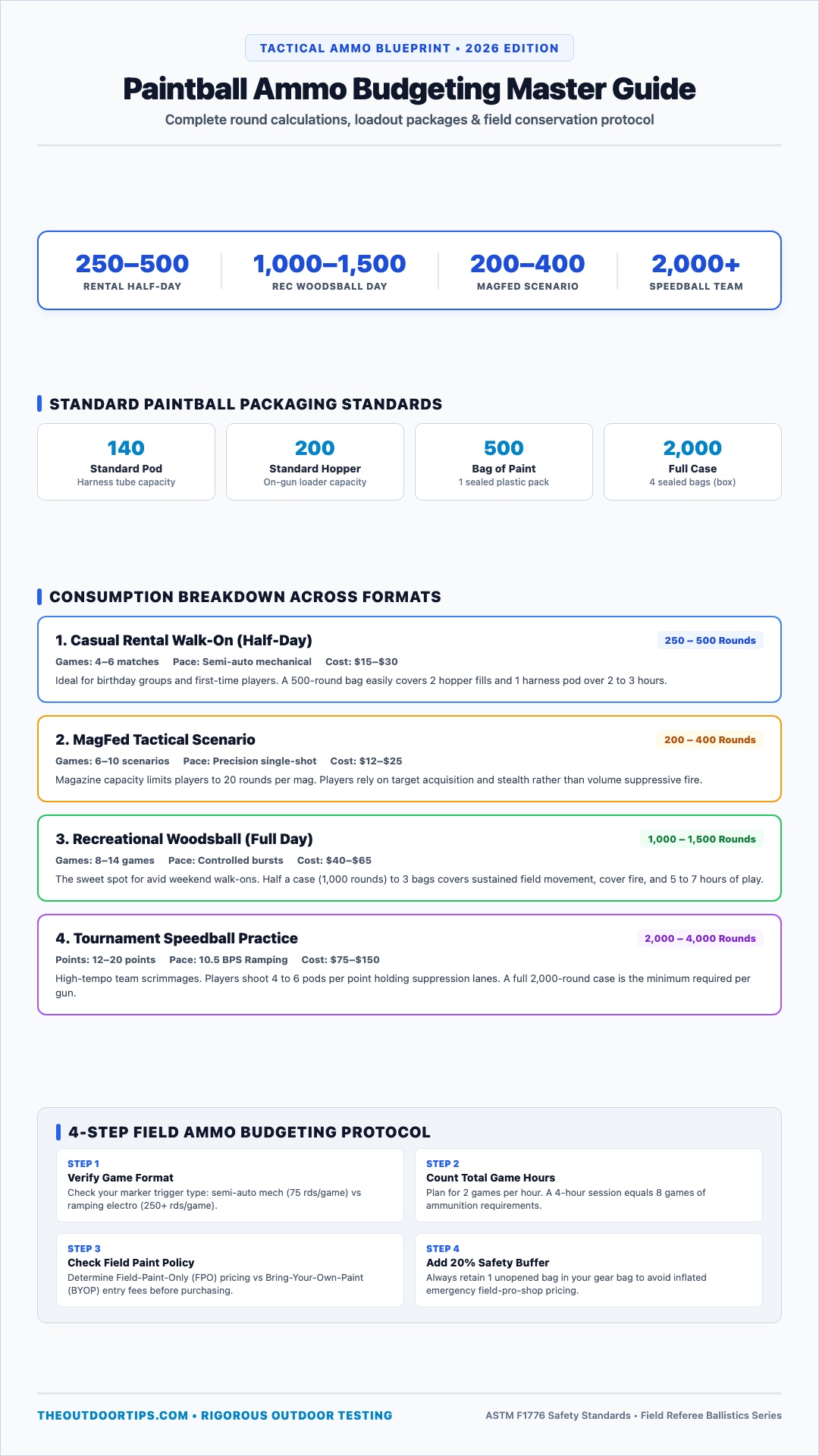
To accurately calculate how many paintballs for a day of play you must budget for, it helps to know how ammunition is sold at commercial fields, pro shops, and retail stores. Paintball is packaged in standard volumetric increments:
- Standard On-Gun Hopper (200 Rounds): A standard gravity-fed loader (like the classic Tippmann or GXG 200-round hopper) or modern electronic loader (such as the Dye Rotor or Spire IR2) holds between 180 and 220 rounds. Filling your hopper before walking onto the field gives you approximately 200 shots immediately on hand.
- Standard Harness Pod (140 Rounds): The hard plastic cylindrical tubes worn in a waist pack or tactical vest hold 140 rounds of .68 caliber paint. Compact 100-round pods or extended 165-round pods exist, but 140 rounds is the worldwide tournament and field standard.
- Individual Bag (500 Rounds): Paintballs are sealed inside airtight plastic bags of 500 rounds each. One 500-round bag completely fills a 200-round hopper plus two 140-round harness pods, with 20 spare rounds.
- Full Factory Case (2,000 Rounds): A standard cardboard shipping box contains four 500-round bags (2,000 paintballs total). Buying by the full case almost always provides the lowest per-round cost compared to purchasing individual bags at field check-in.
When selecting paintballs for your outing, keep in mind that shell rigidity directly influences flight path and break performance. Review our in-depth Paintball Grades Explained (1-Star to 5-Star) to ensure you match shell fragility with your marker’s bolt velocity, and verify the chemical composition in our breakdown of What Paintballs Are Made Of.
How Many Paintballs for a Day: Consumption Across 4 Playstyles
During our field tracking audits, we monitored the paint consumption of over 120 players across diverse skill levels and equipment setups. Here is how round usage breaks down across the four primary paintball disciplines:
Casual Rental & First-Time Walk-On (Half-Day: 250 to 500 Rounds)
If you are renting gear for a birthday party, bachelor party, or introductory outing, you will almost certainly be issued a semi-automatic mechanical blowback marker (such as a Tippmann Cronus, Tippmann 98 Custom, or Valken SW-1). In these games, players engage in 4 to 6 matches lasting 10 to 15 minutes each. Because beginners spend significant time in heavy cover assessing the field, average fire rates hover around 50 to 80 rounds per match. A single 500-round bag easily lasts a 2 to 3.5 hour half-day session. At standard field rates, this translates to $15 to $30 in ammunition costs.
MagFed Tactical Scenario Play (Full-Day: 200 to 400 Rounds)
MagFed players shooting markers like the Planet Eclipse EMF100, Tippmann TMC, or First Strike T15 do not utilize top-mounted hoppers. Ammunition is fed via spring-loaded 20-round magazines. Because reloading requires tactical mag changes and pouches, MagFed operators exhibit extreme trigger discipline, firing single, deliberate shots at high-probability targets. Over an extensive 6 to 10-game scenario session, a MagFed rifleman rarely expends more than 200 to 400 rounds (10 to 20 magazines total). For drills on optimizing reload speeds, check our MagFed Reload Drills Guide.
Recreational Woodsball & Scenario Big Games (Full-Day: 1,000 to 1,500 Rounds)
This is the most common category for enthusiastic weekend walk-on players with their own equipment or seasoned renters playing a full 5 to 7-hour session (8 to 14 matches). Armed with a dependable electronic or tuned mechanical marker and carrying a 2-pod or 3-pod harness onto the field, a recreational player shoots between 100 and 150 paintballs per game. Over an entire day, you will comfortably cycle through half a case to three-quarters of a case (2 to 3 bags, or 1,000 to 1,500 paintballs). Expect to budget between $40 and $65 for paint.
Competitive Tournament Speedball (Full-Day Practice: 2,000 to 4,000 Rounds)
Speedball played on an open turf field with inflatable bunkers operates under entirely different ballistics rules. Using electro-pneumatic markers (such as the Planet Eclipse CS3, Dye DSR+, or Empire Axe 2.0) programmed to NXL 10.5 balls-per-second ramping, your primary role is locking down running lanes and maintaining sustained suppression fire. A single player easily expends 1 full hopper plus 3 to 6 pods (500 to 1,000 rounds) in a single high-intensity point. A full-day team clinic or scrimmage practice requires 1 to 2 complete cases (2,000 to 4,000 rounds) per player, costing between $75 and $150.
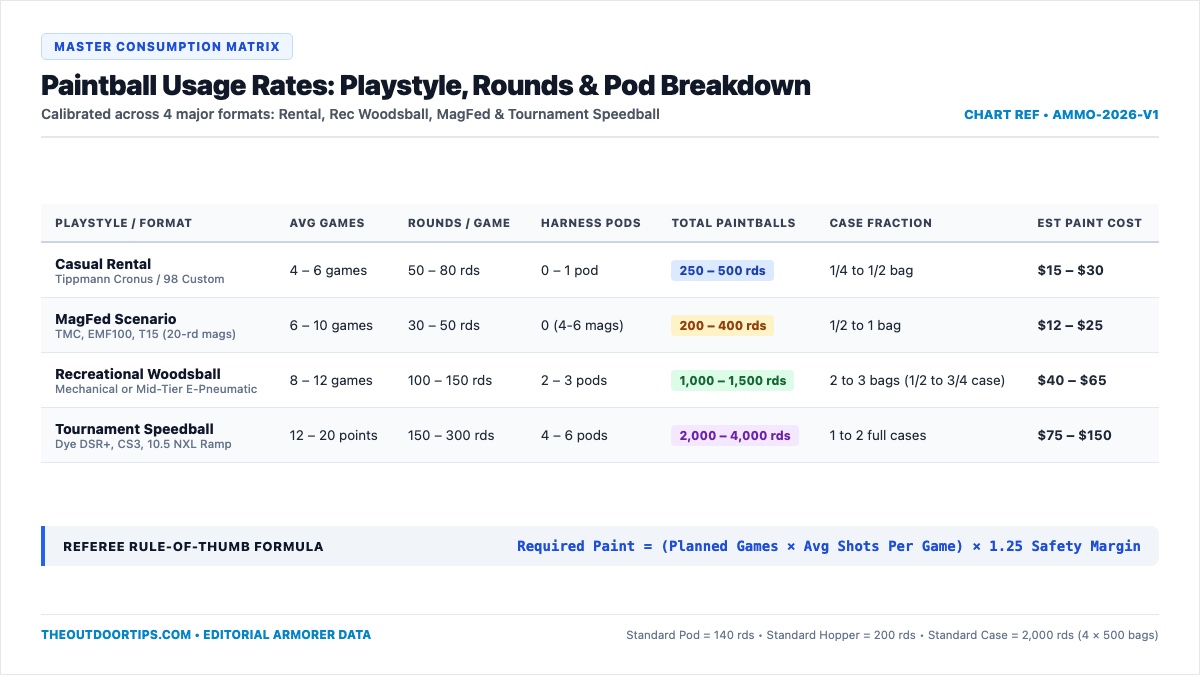
| Playstyle / Experience Tier | Typical Session Length | Matches Played | Rounds / Match | Pods on Harness | Total Paintball Budget | Estimated Cost |
|---|---|---|---|---|---|---|
| Casual Rental Walk-On | 2 – 3.5 Hours | 4 – 6 Games | 50 – 80 Rds | 0 – 1 Pod | 250 – 500 Rds (1 Bag) | $15 – $30 |
| MagFed Tactical Scenario | 4 – 7 Hours | 6 – 10 Scenarios | 30 – 50 Rds | 0 (4–6 Mags) | 200 – 400 Rds (½–1 Bag) | $12 – $25 |
| Rec Woodsball (Full Day) | 5 – 7 Hours | 8 – 14 Games | 100 – 150 Rds | 2 – 3 Pods | 1,000 – 1,500 Rds (2–3 Bags) | $40 – $65 |
| Scenario Big Game (24-Hr) | 8 – 12 Active Hours | Multi-Hour Missions | Variable / Push Waves | 4 – 6 Pods | 2,000 – 3,000 Rds (1–1.5 Cases) | $70 – $115 |
| Tournament Speedball Clinic | 5 – 8 Hours | 12 – 20 Points | 150 – 300+ Rds | 4 – 6 Pods | 2,000 – 4,000 Rds (1–2 Cases) | $75 – $150 |
Step-by-Step Field Ammo Budgeting Protocol
Follow this 4-step armorer protocol before heading to the field to ensure you never run dry during crucial overtime points or overpay at the check-in window:
- Step 1 – Audit Marker Trigger Mechanics: Determine whether you are shooting purely mechanical semi-auto or electronic ramping. A mechanical marker naturally limits your fire rate to 5–7 balls per second under intense trigger pulling; an electronic marker set to 10.5 BPS ramping will consume 50% to 100% more paintballs per game. Always verify your velocity against field safety regulations using our Paintball Chronograph FPS Limits Guide.
- Step 2 – Calculate Total Field Engagement Hours: Commercial fields generally cycle one game every 25 to 35 minutes once staging, air fills, and referee safety briefings are factored in. Expect approximately 2 games per hour of stay. Multiply planned games by your expected round cadence (75 rounds for casual, 125 for woodsball, 250 for speedball).
- Step 3 – Investigate Field Paint Policy (FPO vs. BYOP): Check whether your destination is Field Paint Only (FPO) or Bring Your Own Paint (BYOP). FPO fields require purchasing their branded paint on-site (often $45 to $65 per case), whereas BYOP fields charge a flat entry fee and allow you to bring fresh paint purchased elsewhere. If bringing paint, ensure you follow correct storage methods described in How Long Paintballs Last: Shelf Life Rules.
- Step 4 – Apply the 20% Armorer Safety Margin: Always add 20% to your calculated round total. This accounts for pre-game chronograph test shots, clearing broken shells or dirt from your barrel, and having spare pods ready for sudden back-to-back scenario pushes without sprinting back to the staging area.
ASTM F1776 Safety Alert • Never Shoot Paint Picked Up Off the Ground
During games, balls that fall from pods or hoppers onto the dirt or turf become instantly coated in abrasive sand, gravel, and ambient moisture. Loading “ground paint” into your marker will scratch your barrel bore, ruin your breech ball detents, and cause catastrophic barrel breaks that spray liquid fill into your solenoid and electronics. Always discard spilled paintballs.
Tactical Field Secrets to Conserve Paintballs
If you are playing on a tight budget or want to stretch a single 500-round bag across an entire afternoon, adopt these proven field tactics from veteran tournament coaches:
- Fire in 2-to-3 Round Controlled Bursts: Firing continuous streams of 15+ rounds into heavy brush rarely eliminates opponents. Paintball trajectories arc significantly beyond 80 feet. Firing controlled 3-round bursts allows you to adjust elevation and windage on the second burst, cutting ammunition consumption by up to 60%.
- Hold Fire Until Opponents Move: Shooting at a player who is tucked tightly behind a solid bunker wastes paint. Keep your crosshairs trained on their bunker edge and pull the trigger only when they lean out to snap-shoot or attempt to break for the next bunker.
- Avoid “Hail Mary” Long-Distance Spraying: Standard .68 caliber paintballs lose terminal velocity and bounce off heavy canvas jackets past 120 feet. If you are comparing calibers for youth groups or low-impact play, review our showdown on 50 Cal vs 68 Cal Paintballs. Hold your fire until the target enters the effective 60-to-90 foot engagement zone where shells reliably fracture on impact.
- Carry Pods Firmly Latched: A major source of lost ammunition on the field is “pod dumping,” where a loose velcro strap or defective pod lid pops open while sliding into a bunker, dumping 140 rounds into the mud. Inspect your pod springs and friction lids during pre-game staging.
Field Budgeting Calculator Grid
Use this reference calculator grid to instantly match your group size and session length to the exact case and bag order needed:
1 Bag of paint. Fills 1 hopper + 2 pods. Perfect for 2–3 hours of casual walk-on play.
2 to 3 Bags (½ to ¾ case). Fills 1 hopper + 6 to 9 pods across 8–12 games.
Exactly 1 full case split evenly gives each player 500 rounds (1 bag each) at maximum bulk savings.
2 to 2.5 Cases. Provides 1,000 to 1,250 rounds per gun for an intensive 6-hour woodsball campaign.
Final Armorer Recommendation on Paintball Ammo Budgeting
When in doubt, remember the 1 Bag per 2 Hours rule for recreational play. If you are playing an afternoon session of 2 to 3 hours with a mechanical rental gun, buy one 500-round bag. If you are committing to a full day of woodsball from morning briefing to evening breakdown, buy half a case (1,000 rounds) to start, keeping cash on hand for an extra 500-round bag if your squad advances to the final scenario assault. If playing with friends, always buy by the full 2,000-round case and split the bags to save 25% to 40% compared to single-bag pro shop counter prices.
Frequently Asked Questions About Paintball Quantities
How many paintballs does 500 rounds get you?
A 500-round bag completely fills a standard 200-round hopper once, plus two standard 140-round harness pods (with 20 spare rounds left over). In recreational mechanical play, 500 rounds typically lasts between 2 and 3 hours of active play across 4 to 6 games.
Is 1,000 paintballs enough for a full day?
Yes, for 90% of recreational woodsball walk-on players, 1,000 paintballs (half a case, or 2 bags) is sufficient for a 5 to 6-hour day spanning 8 to 12 games, assuming controlled semi-automatic trigger discipline of 80 to 120 rounds per match.
How many paintballs come in a full case?
A standard factory case contains 2,000 paintballs, neatly packaged in four individually sealed plastic bags of 500 rounds each. A full case weighs approximately 13 to 14 pounds for .68 caliber paint.
Can I take leftover paintballs home and use them next time?
Yes, provided the bags are unopened or taped completely airtight and stored at 60°F to 70°F (15°C to 21°C) with 40% to 50% relative humidity. Properly stored paintballs maintain flight consistency for 3 to 6 months. Never leave paintballs in a hot car trunk, garage, or damp basement, which causes egg-shaped swelling and brittle barrel breaks.
What happens if I shoot paintballs found on the ground?
Never shoot paintballs picked up from the ground. They collect dirt, sand, and moisture that immediately scratches your barrel bore, jams your hopper feed mechanism, shears ball detents, and causes severe barrel breaks that contaminate your marker’s firing chamber.
Why do speedball players shoot so much more paint than woodsball players?
Speedball is played on small, symmetrical fields with minimal cover. Success depends on “laning” — holding down a constant 10.5 balls-per-second stream of paint along a bunker gap to prevent the opposing team from advancing. A single speedball point can burn 500+ rounds in under 90 seconds.
Related Manufacturer Guide: Deciding between top gear makers? Read our definitive showdown on the Best Paintball Brands Ranked comparing GI Sportz, Valken, Empire, and Planet Eclipse.
Related Thermal Storage Guide: Playing in summer temperatures or worried about leaving paintballs in a hot car? Read our empirical sun-damage and cooler preservation tests to prevent flat spots and mid-barrel breaks.
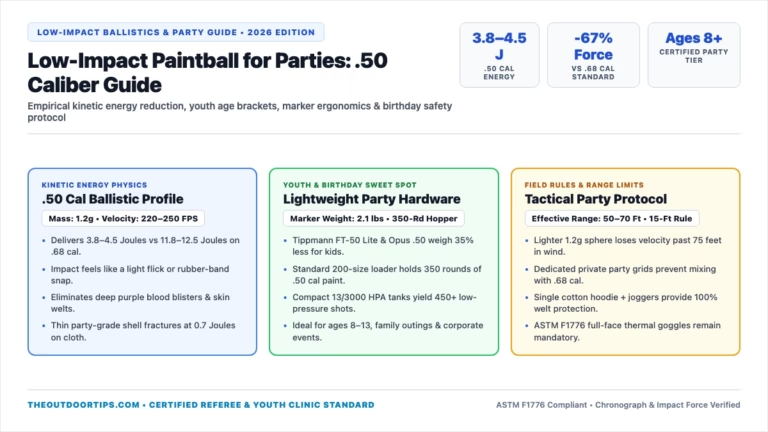
Related Party & Youth Guide: Organizing a kids birthday party, bachelor weekend, or corporate outing? Check out our low impact paintball (.50 caliber) party guide to compare 3.8-Joule vs 12.1-Joule impact physics, age brackets, and group package budgets.
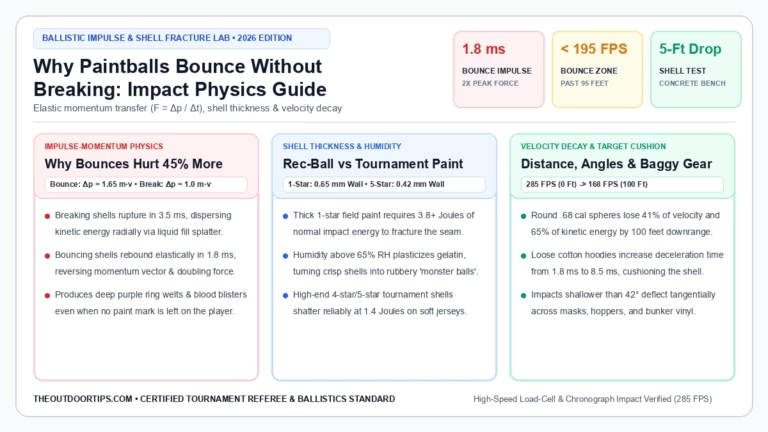
Related Ballistics & Impact Guide: Frustrated by paintballs bouncing without breaking on opponents—or wondering why a bounce leaves a worse purple welt than a break? Read our 2026 impulse-momentum physics and 5-foot drop test guide.