In our field tests and match clinics across rental fleets and NXL tournament layouts, understanding paintball grades explained from 1-star to 5-star is the difference between clean eliminations and endless bounces. Loading premium 5-star tournament paint into a rough mechanical blowback marker shatters the brittle shell in the breech before it ever leaves the barrel, while shooting cheap 1-star field paint in a tournament guarantees opponent jerseys will absorb your hits without breaking.
Key Technical Takeaways (TL;DR): Shell Brittleness vs. Marker Compatibility
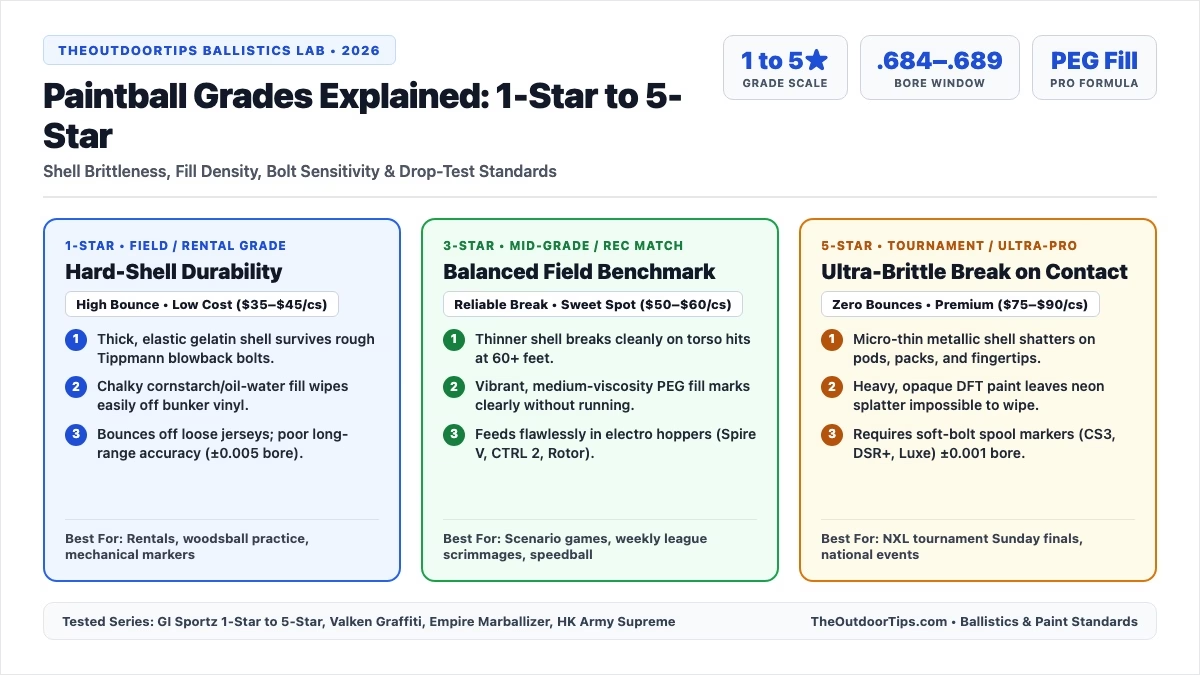
Star ratings measure gelatin shell brittleness, fill opacity, and sphericity tolerance, not just price. 1-Star and 2-Star field paint feature thick elastic shells built to survive stiff mechanical hammers, 3-Star represents the all-purpose sweet spot for 90% of players, and 4-Star to 5-Star feature micro-thin shells designed to shatter on contact through soft-bolt electronic spool markers.
What Paintball Star Ratings Actually Measure (Chemistry & Physics)
Manufacturers like G.I. Sportz, Valken, Empire, and HK Army use the star rating system (1-Star through 5-Star) to categorize four precise chemical and manufacturing variables:
- Gelatin Shell Thickness & Elasticity: 1-Star shells measure roughly 0.40 to 0.44 mm thick with plasticizers that allow the shell to deform without cracking under high bolt acceleration. 5-Star tournament shells measure 0.18 to 0.22 mm thick, engineered to shatter under minimal impact force (less than 1.2 Joules of localized surface shock).
- Fill Chemistry & Viscosity: Field-grade paint uses watery, cornstarch- or mineral-oil-based fill that runs thin and wipes off rental gear easily. Tournament 4-star and 5-star paint use thick, opaque polyethylene glycol (PEG) with neon dyes (like Imperial DFT) that stick to fabric and cannot be wiped off without leaving bright evidence.
- Sphericity & Seam Tolerance: Entry-level paintballs vary by ±0.005 inches across a batch, causing noticeable curving downfield. 5-Star tournament batches undergo laser optical sorting to hold roundness within ±0.001 inches for dead-straight trajectory.
- Storage Fragility: High-star paint absorbs atmospheric humidity rapidly. Leaving a bag of 5-star paint open on a humid 85°F afternoon swells the shell into an unshootable oval within 90 minutes.
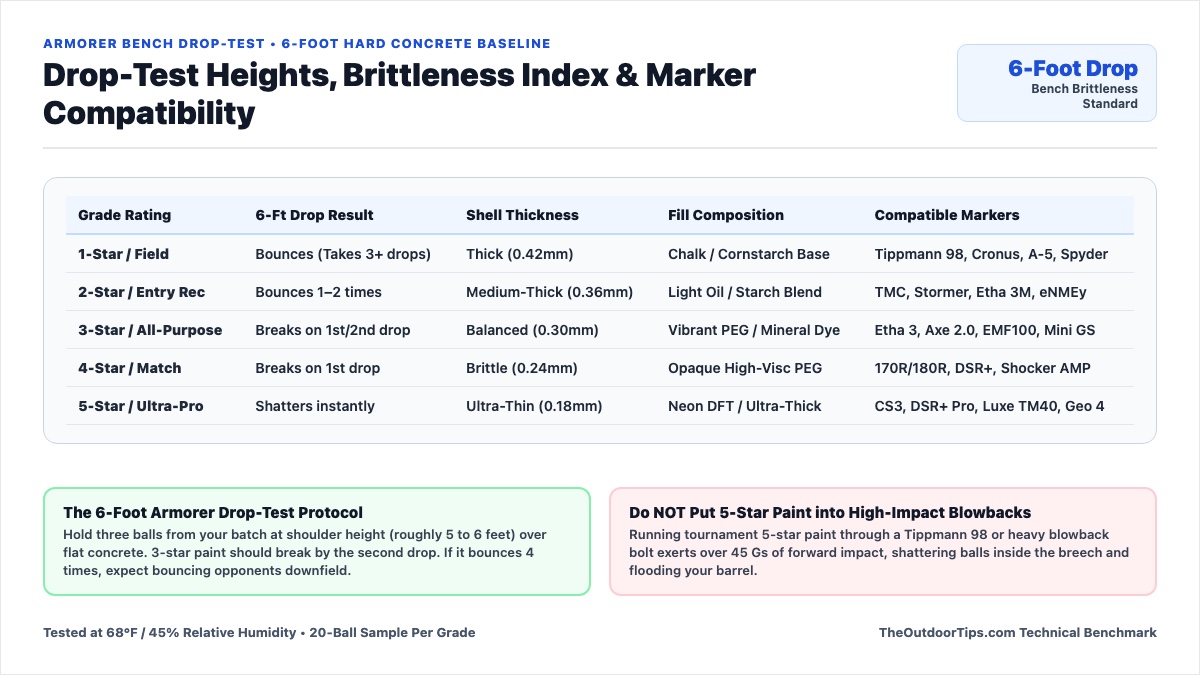
Paintball Grade Diagnostic & Marker Compatibility Matrix
Before purchasing a case, match the paint grade to your marker’s bolt system, operating pressure, and loader speed. If you play in freezing temperatures, pair this knowledge with our Mechanical vs Electronic Paintball in Winter Guide.
| Paint Grade | 6-Ft Concrete Drop Test | Bolt Compatibility | Recommended Case Use | Best Gear Match |
|---|---|---|---|---|
| 1-Star / Field | Bounces 2–4 times before breaking | Heavy blowback & rental hammers (Tippmann 98, Cronus) | Walk-on woodsball, rental fleets, target practice ($35–$45) | Tippmann Cronus (Amazon) |
| 2-Star / Entry Rec | Bounces 1–2 times; breaks on firm hit | Mechanical spool & magfed (TMC, Stormer, Etha 3M) | Recreational woodsball & scenario big games ($45–$52) | Tippmann TMC (eBay) |
| 3-Star / All-Purpose | Breaks reliably on 1st or 2nd drop | Mid-range electro & gentle mechs (Etha 3, Axe 2.0, Mini GS) | Weekly league practice, scenario matches, speedball ($52–$62) | Valken Graffiti (Amazon) |
| 4-Star / Match | Shatters cleanly on 1st drop | Regulated spool valves (Planet Eclipse 180R, DSR+, Shocker) | Regional tournament prelims, competitive team scrimmages ($62–$72) | GI 4-Star (eBay) |
| 5-Star / Ultra-Pro | Explodes on contact; zero bounces | Ultra-soft spool bolts only (CS3, Luxe TM40, DSR+ Pro, Geo 4) | NXL Sunday finals, pro-level tournament events ($75–$90) | Virtue Spire V (Amazon) |
Step-by-Step Field Paintball Testing & Bore Sizing Protocol
Follow this five-step bench procedure before stepping onto the chrono line to ensure you never load swollen, dimpled, or brittle paint that blows up in your loader. Feeding speed is also influenced by loader tension reviewed in our Bunkerkings CTRL 2 vs. Virtue Spire V breakdown.
The 6-Foot Concrete Drop Test
Take three random paintballs from a freshly opened bag. Hold one at eye level (roughly 5.5 to 6 feet) over smooth concrete or asphalt and let it drop. A 3-star ball should break on the first or second bounce; a 5-star ball will explode immediately. If a 1-star ball bounces four times without breaking, expect opponents in loose jerseys to bounce your shots all day.
Check Seams and Visual Dimples
Roll five paintballs across a smooth staging table. Inspect for flat spots (caused by cases stacked too high in warehouses) or swollen “egg” seams. If paint wobbles heavily when rolling, it will spiral wildly past 50 feet regardless of how expensive your barrel is.
Bore-Match with a Sizer Gauge
Push three balls through a stepped barrel sizer gauge. In warm humid weather, paint absorbs moisture and swells (often jumping from .684 to .688). Select an insert where the ball rests gently against the lip and can be blown through with a light puff of air without rolling freely through; verify your marker’s operating velocity in our Paintball FPS Field Limits Guide.
Squeeze-Check Shell Brittleness in the Paddock
Pinch a paintball between your thumb and index finger. A fresh 3-star ball should flex slightly before snapping cleanly. If the ball feels soft and spongy like rubber, it has absorbed excessive humidity and will bounce. If it cracks under feather-light finger pressure, your marker bolt must be tuned to low forward velocity (under 120 PSI drive pressure) to prevent breech chops.
Stage Bags in an Insulated Cooler
Keep unopened bags inside their corrugated shipping box inside an insulated thermal cooler at the field. Never leave bags baking in direct sunlight or on hot truck tailgates where temperatures exceed 95°F.
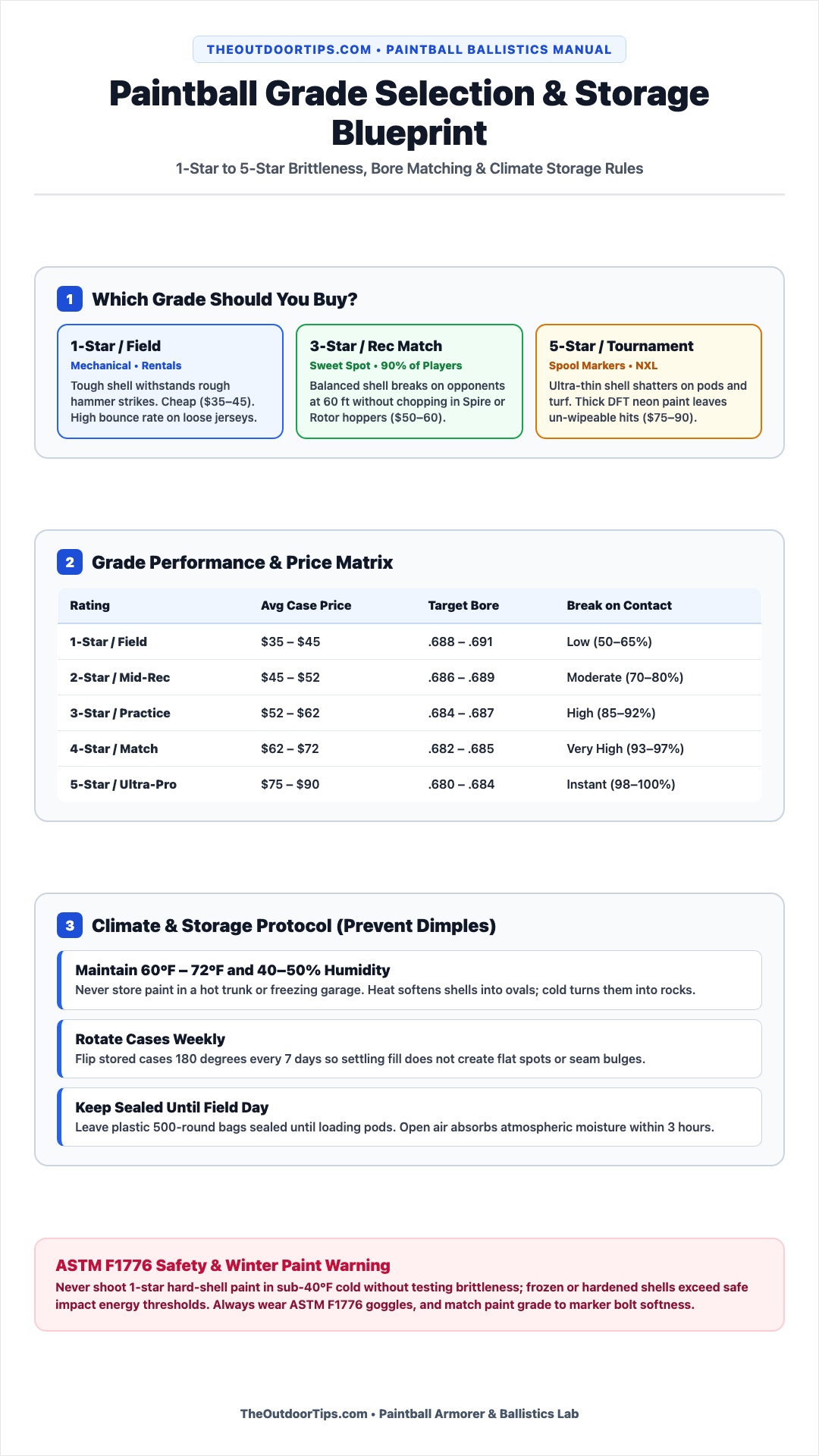
ASTM F1776 Safety Directive & Hard-Ball Injury Warnings
Never shoot rock-hard, unbranded, or expired 1-star paint that fails to break on a 6-foot concrete drop. Extremely hard paintballs deliver localized kinetic energy exceeding safe thresholds, causing severe hematomas and risking goggle lens degradation under ASTM F1776 standards. If paint does not break on hard surfaces, return it to the pro shop for fresh stock.
Essential Paint Maintenance & Cleaning Tools
Even the highest-grade 5-star paint will chop if a single ball breaks inside your barrel or pod pack. Keep these essential cleaning and sizing tools in your gear bag alongside your best paintball squeegees and swabs.
| Tool / Accessory | Primary Purpose | Key Spec | Buy Direct |
|---|---|---|---|
| Exalt Barrel Maid Squeegee | Instant breech & barrel cleaning | Rocket disk cleans paint, fluff buffs dry | |
| HK Army Ball Sizer Gauge | Precise barrel insert matching | Anodized aluminum, .675 to .693 cutouts | |
| Virtue Pod Caddy Bag | Zero-spill quick pod loading | Holds 1,000+ rounds, quick-pour spout | |
| Dye Microfiber Cleaning Towel 3-Pack | Lens & hopper shell buffing | Lint-free plush microfiber, absorbs oil |
Live Demonstration: 1-Star vs 3-Star vs 5-Star Paintball Showdown
Watch how different grades of paint react under real-world drop tests, chrono strings, and target impacts on the field. After selecting your paint, master your movement with our paintball sliding and diving techniques and tight bunker wrap shots.
Interactive Paintball Calculators & Loadout Tools
Paintball Weekend Cost Calculator
Calculate exact case costs across 1-Star ($40) vs. 3-Star ($55) vs. 5-Star ($85) grades.
Paintball BPS & ROF Calculator
Verify whether your loader and paint grade can keep up with 10.5 BPS ramping.
Paintball Gun & Loadout Builder
Match your marker model, loader, and preferred paint grade for optimum reliability.
HPA Regulator Pressure Calculator
Tune marker operating pressure to prevent brittle paint chops in tournament play.
Which Paintball Grade Should You Buy This Weekend?
For 90% of players, 3-Star paint (like Valken Graffiti or GI 3-Star) is the undisputed sweet spot: it delivers consistent roundness, breaks cleanly on opponents at 60 feet, and will not chop in electronic or mechanical markers. Save 1-Star paint for rough rental blowbacks, and reserve 5-Star paint exclusively for regulated spool-valve tournament guns on warm, dry match days.
Frequently Asked Questions: Paintball Grades Explained
What is the difference between 1-star and 5-star paintballs?
1-Star paint has a thick, durable gelatin shell designed to survive rough blowback markers without breaking in the breech, resulting in more bounces on targets. 5-Star paint features a micro-thin brittle shell and thick neon PEG fill engineered to break on the slightest target impact, requiring soft-bolt electronic tournament markers.
Can I shoot 5-star tournament paint in a Tippmann 98 or Cronus?
No. Mechanical blowback markers use stiff mainsprings and heavy steel bolts that slam forward with massive force, which will instantly chop and explode brittle 5-star paint inside the breech. Stick to 1-Star or 2-Star paint for mechanical blowbacks.
Why is 3-star paint considered the best value for recreational players?
3-Star paintballs offer the ideal balance between shell brittleness and durability. They break reliably on opponent torso hits at 60+ feet while remaining sturdy enough to feed through high-speed loaders without chopping, costing $25 to $35 less per case than 5-star tournament paint.
How should paintballs be stored to prevent dimples and swelling?
Store paintballs in a climate-controlled room between 60°F and 72°F with 40% to 50% relative humidity. Never store paint in hot car trunks, freezing garages, or direct sunlight, and rotate cases once a week to prevent the internal fill from creating flat spots.
Do paintballs expire or go bad over time?
Yes. Paintballs are biodegradable gelatin capsules. Over 3 to 6 months, exposure to temperature fluctuations causes shells to harden (causing painful bounces) or absorb humidity (causing soft, dimpled, egg-shaped balls that jam barrels). Fresh paint always shoots straighter.
Why does winter weather make paintballs break in the barrel?
Cold temperatures (below 45°F) make gelatin shells brittle and fragile. If you shoot standard summer paint in sub-freezing weather, the cold shell shatters upon bolt impact. Use winter-specific formula paint or lower-star flexible shells in cold weather.