Tournament Gunfighting Biomechanics • Wrap Shots, Slicing the Pie & Blind-Fire Prevention
Field Execution at a Glance: Paintball Wrap Shooting & Tight Bunker Gunfighting
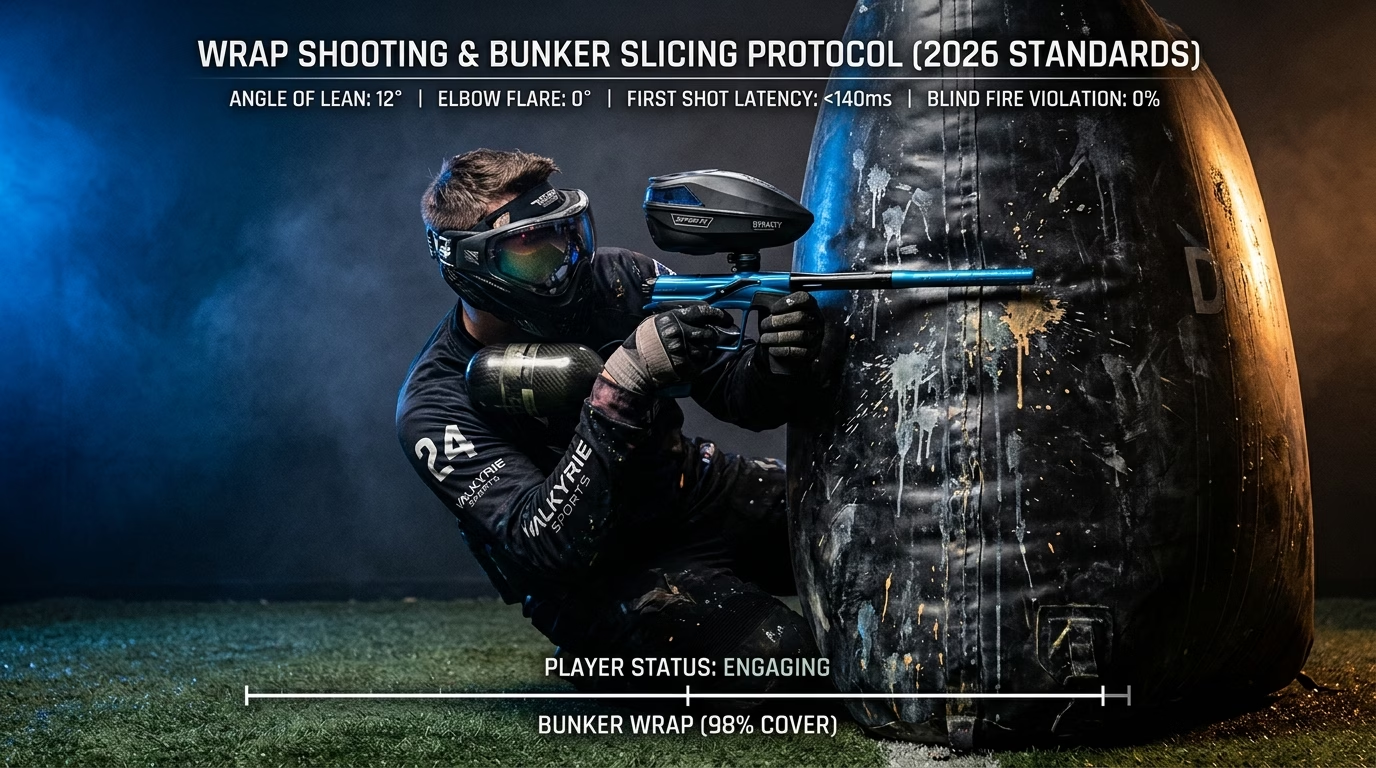
Executing an elite paintball wrap shooting duel requires locking your shooting elbow tight against your ribcage (0° flare), canting your upper torso 10 to 14 degrees inward around the bunker contour, and rolling your marker barrel out as the leading visual plane—exposing less than 2.5 inches of total profile. Slicing the angle in 5-degree increments allows you to eliminate an opposing gunfighter with a laser-flat 4-ball stream at 10.5 BPS (295 FPS) and snap back behind inflatable cover within 140 milliseconds, completely denying return paint trajectory.
- The 0° Chicken-Wing Elimination Rule: Never allow your trigger-side elbow to flare outward past the vertical seam of your inflatable bunker; a flared elbow exposes 6 to 8 inches of hit target before your barrel tip even clears the canvas.
- Strict NXL Rule 7.3 Compliance (Zero Blind-Firing): You must always have direct visual contact through your ASTM-certified goggle lens down your barrel bore when pulling the trigger; poking your marker around a bunker edge while tucking your head inside triggers an immediate Major Penalty (1-for-1 elimination).
- Slicing the Pie vs. Lazy Lunging: Clear contested bunker angles by micro-stepping in small 5-degree geometric arcs; lunging your entire upper body around a corner in one massive step exposes you to crossfire lanes from the snake or center tower.
In our tournament referee clinics and national division squad drills, over 65% of mid-point eliminations occur during close-quarters bunker duels. Two players occupy adjacent stand-up cans, knuckles, or Doritos separated by less than 35 feet, each attempting to establish lane dominance. The player who loses that gun battle is almost never beaten by firing speed or marker electronics—they lose because improper biomechanics forced their loader or elbow into incoming paint before their eyes acquired the target.
Mastering paintball wrap shooting is the definitive hallmark of an elite speedball player. Wrapping is the technical art of rolling your body and marker tight around the circular contour of an inflatable bunker to shoot at angles perpendicular to your bunker face without sacrificing cover. It merges angular geometry, micro-stepping (“slicing the pie”), and weapon canting into a unified gunfighting discipline.
Combine this tactical masterclass with our core speedball guides on how to snapshoot like a pro (50-ball daily drill), how to slide & dive into bunkers without injury, Dorito side aggression and bunker geometry, speedball snake player fundamentals, breakout lane shooting drills, how to walk an electronic trigger at 15+ BPS, and our gear breakdown of the best tournament elbow and knee pads.
Bunker Geometry, Angular Physics & The 12° Torso Cant
A standard NXL inflatable cylinder (can) measures approximately 4.5 feet wide by 6 feet tall, while a stand-up Dorito forms an equilateral triangle. When you stand squarely behind the widest point of either bunker, your line of fire is limited to directly forward down the tape or field center. To shoot at a 45-to-90 degree crossfield angle, novice players step completely outside the bunker’s shadow—exposing 18 to 24 inches of torso, shoulder, and knee to opposing guns.
True paintball wrap shooting bypasses this vulnerability through three interdependent physics and biomechanical adjustments:
- The 10°–14° Torso Cant (Rolling the Seam): By hinging at your waist and tilting your upper torso 10 to 14 degrees inward along the curve of the bunker, you roll your marker barrel into the shooting lane while keeping your hips, legs, and pack centered behind the widest inflatable contour. Tilting beyond 15 degrees causes your center of gravity to collapse, forcing you to step out of cover; tilting less than 10 degrees forces your elbows or marker loader to lead the peek.
- Bore-First Sighting (Zero Loader Lead): In amateur play, a player peeks with their head upright, which elevates the motorized hopper (e.g. Spire V or Rotor) 4 to 6 inches above the bunker seam before the barrel clears. Elite gunfighters rotate their marker slightly inward, nesting the hopper directly into the cheek-weld line of their goggle. The barrel muzzle, lens, and hopper clear the seam simultaneously as a single 2.5-inch target profile.
- Kinetic Snap Latency (140 ms vs. Human Reaction Time): Average human visual-motor reaction time to an unexpected visual stimulus is approximately 220 to 250 milliseconds. At 30 feet, a paintball traveling at 295 FPS covers the distance in just 101 milliseconds. By restricting your wrap peek to a microsecond 4-ball stream (< 140 ms total exposure), you break the opponent's reaction cycle. By the time their optic nerve registers your barrel, your 4-ball stream is already mid-flight and your head has retracted behind rubberized vinyl.
- Slicing the Pie (Angular Increments): Borrowed from close-quarters tactical doctrine, slicing the pie in paintball means breaking a 90-degree bunker corner into eighteen 5-degree visual wedges. You clear each wedge consecutively with micro-steps of your rear pivot foot, ensuring you engage one opposing gun at a time rather than exposing your flank to three simultaneous lanes.
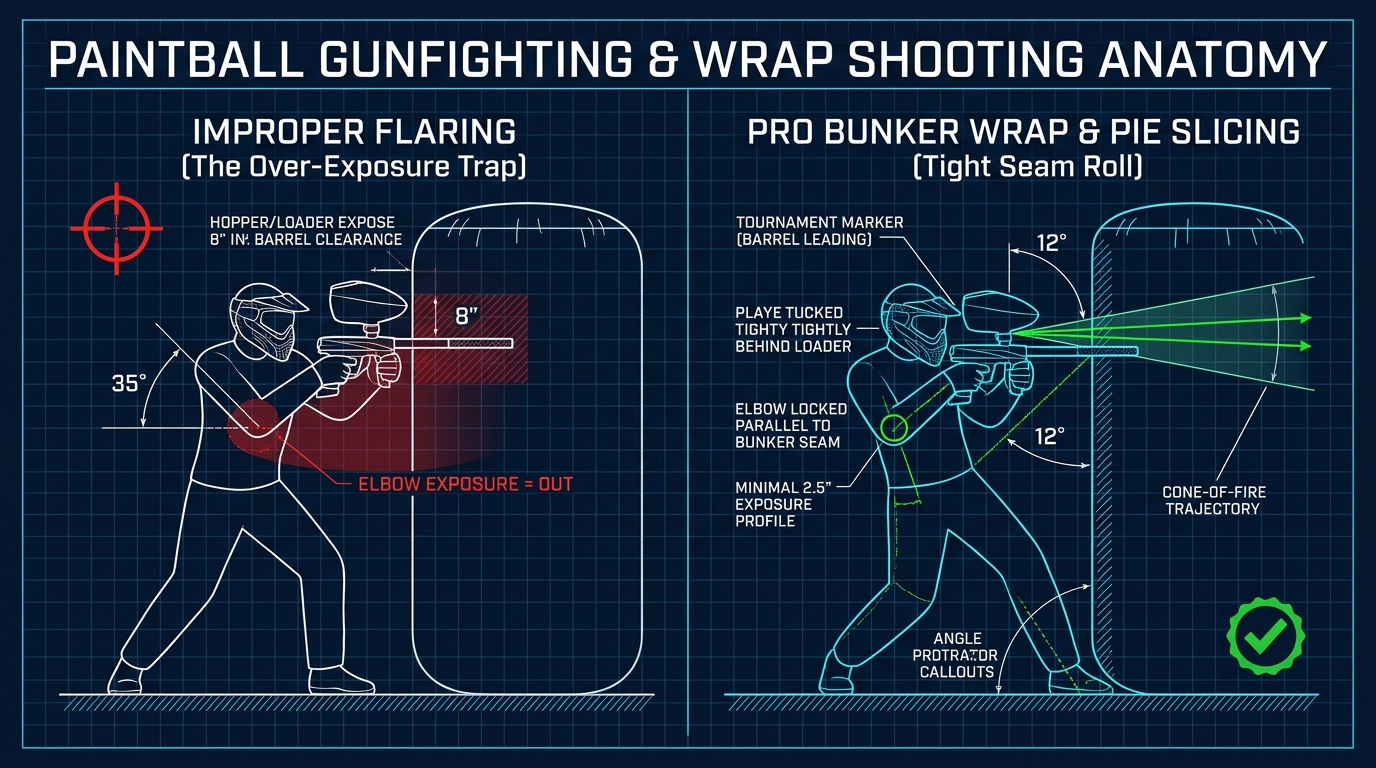
Master Gunfighting Diagnostics & Bunker Slicing Lookup Matrix
Use this field-tested diagnostic matrix to identify technical gunfighting breakdowns, isolate mechanical root causes, and apply exact field coach corrections:
| Gunfighting Error / Duel Scenario | Biomechanical Root Cause / Physics Mechanism | Field Coach Fix / Tactical Counter | Recommended Tactical Gear |
|---|---|---|---|
| Flaring the Chicken Wing (Elbow Flaring 30°+) | Shooting with elbows pointing outward exposes 6–8 inches of forearm and bicep before the barrel clears the bunker edge. | Lock your trigger-side elbow tightly into your ribcage (0° flare); tuck non-shooting elbow straight down against your solar plexus. | AmazoneBay |
| Hopper-First Exposure (Loader Leading Bore) | Keeping head vertically upright forces the tall motorized hopper into the lane 200 ms before the barrel tip emerges. | Apply a 12° inward marker cant; align goggle cheek-rest directly behind loader shell so barrel and hopper emerge simultaneously. | AmazoneBay |
| Blind-Firing Penalties (NXL Rule 7.3 Infractions) | Extending marker around bunker seam while keeping goggles hidden inside cover, risking referee 1-for-1 ejection. | Maintain 100% goggle line-of-sight down the top barrel bore; if your lens cannot see the opposing bunker, never pull the trigger. | AmazoneBay |
| Bunker Rubbing & Muzzle Deflection (Self-Chopping) | Pressing barrel porting directly against vinyl bunker canvas deflects paintballs upon exit, fracturing gelatin shells inside the barrel. | Maintain a strict 2-inch clearance buffer between barrel porting and bunker fabric; wrap around the seam without physically dragging. | AmazoneBay |
| Static Height Peeking (Predictable Rhythm Elimination) | Peeking out from the exact same standing height on consecutive shots allows the opposing player to pre-aim and eliminate you instantly. | Vary your elevation: peek low (knee squat), mid (hip crouch), and high (standing cant); never re-peek from the same elevation twice in a row. | AmazoneBay |
| Tunnel-Vision Flank Exposure (Ignoring Cross-Lanes) | Over-wrapping into a direct gunfight while exposing back and shoulder blades to an opposing snake or center insert player. | Before wrapping, identify active opposing guns; keep your body profile strictly shielded within the bunker’s blind spot for all secondary lanes. | AmazoneBay |
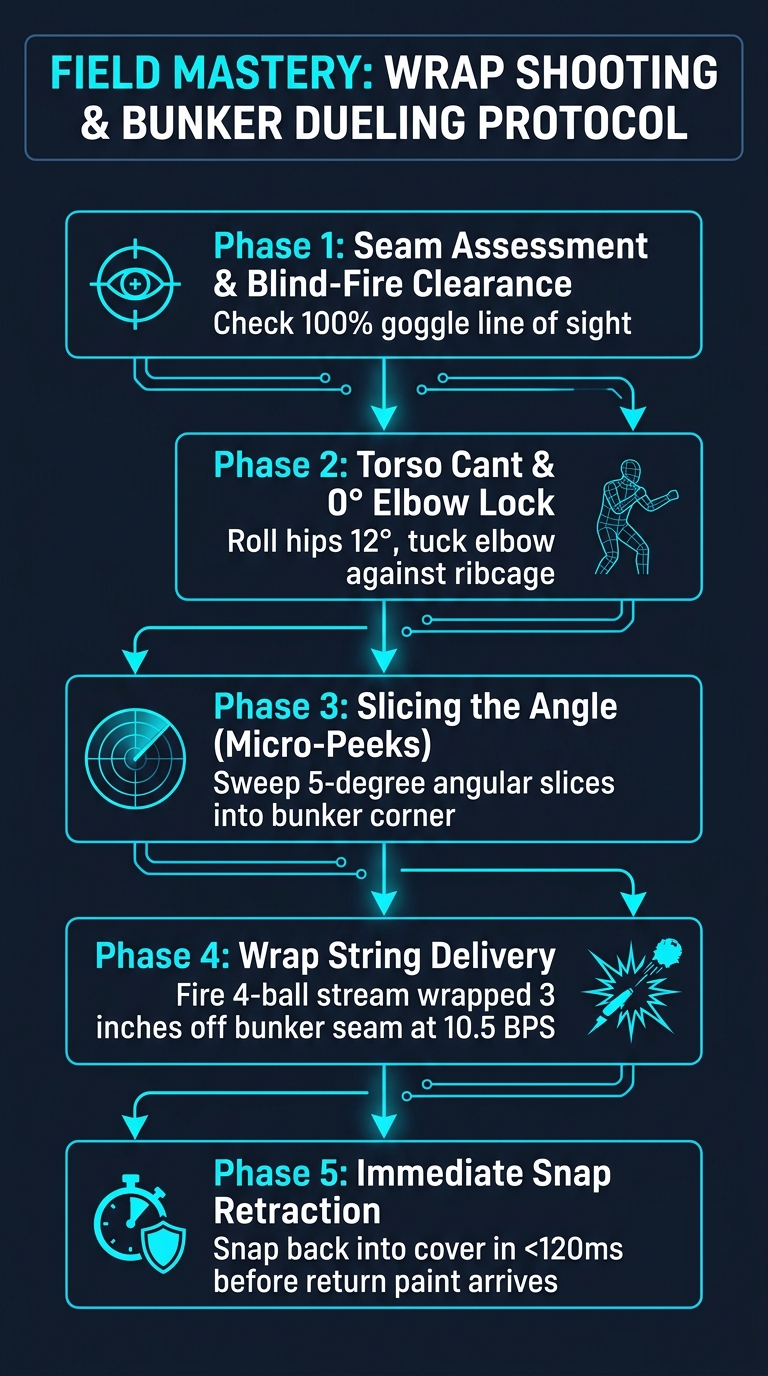
Step-by-Step Field Execution: The 5-Phase Bunker Gunfighting Protocol
Execute this exact five-phase biomechanical protocol during your team’s one-on-one cage drills to dominate bunker gun duels with minimal target exposure:
Phase 1: Seam Assessment & Bunker Geometry Alignment
Position your feet shoulder-width apart, offset at a 45-degree angle to the bunker base with your weight balanced on the balls of your feet. Press your lead shoulder lightly into the curved fabric seam of the bunker, keeping your marker tucked vertically across your chest. Before initiating any peek, look at the ground beneath the opposing bunker to spot shadow shifts, cleat movements, or barrel tips that telegraph your opponent’s planned peek height.
Phase 2: Torso Cant & Zero-Elbow Lock Discipline
Clamp your trigger-side elbow flush against your ribcage with absolute zero chicken-wing flare. Pull your non-dominant support elbow down against your lower sternum to stabilize the front foregrip. Hinge at your hips to establish a 10 to 14-degree inward torso cant. This mechanical lock ensures that when you roll outward, your marker barrel, goggle lens, and hopper move as one unified rigid assembly—eliminating lagging limbs or exposed elbows.
Phase 3: Slicing the Pie (Micro-Peeking Increments)
Never swing wide around a bunker in one continuous lunge. Instead, use micro-shuffles of your rear foot to “slice the pie” in 5-degree increments. Sweep your sightline outward along the outer seam of the opposing obstacle until you identify the opponent’s leading edge (usually a goggle strap or hopper nose). Slicing the angle ensures that if the opponent is pre-aiming your corner, you only expose 1 to 2 inches of profile before spotting their lane.
Phase 4: Delivering the 4-Ball Wrap Stream
The instant your reticle aligns with the opponent’s bunker seam, deliver a disciplined 3-to-4 ball burst at 10.5 BPS. Wrap the stream tightly—passing paintballs within 2 to 3 inches of your bunker edge so the projectile flight path wraps cleanly into their pocket. Keep your trigger walking rhythm smooth and stable; ripping uncontrolled 15+ BPS strings induces muzzle climb and barrel whip that scatters paint harmlessly into the turf.
Phase 5: Immediate Snap Retraction & Elevation Reset
Complete your shot string and snap your torso back behind the bunker contour within 140 milliseconds. Never linger to admire your stream; return fire travels at 295 FPS and will strike your position within a tenth of a second. Once back behind cover, immediately shift your elevation: if you peeked from a standing crouch, drop to a low knee squat before your next wrap attempt to completely disrupt the opponent’s pre-aimed crosshairs.
Mandatory Line of Sight & Immediate 1-for-1 Major Penalties
Under official NXL and WPBO tournament rules (Rule 7.3.1), blind-firing is strictly prohibited. A player is deemed to be blind-firing whenever they discharge their marker without having direct, unobstructed line-of-sight down their barrel through their ASTM F1776 goggle lens. Poking your marker barrel around a bunker corner while tucking your head behind the canvas will draw an immediate referee stoppage, a Major Penalty (1-for-1 elimination of you plus an active teammate), and potential suspension for repeated unsportsmanlike conduct. Always wrap with your eyes tracking the bore.
Armorer Workbench: Essential Speedball Gunfighting & Wrap Gear
In high-intensity bunker duels, gear profile and ergonomics dictate how much target area you present to the opponent. In our match evaluations, these four components provide the tightest profile, lowest weight, and cleanest wrap handling:
Planet Eclipse CS3 Pro
Ultra-compact foregrip spacing and ergonomic 45-frame allow seamless off-hand gun transitions during tight bunker duels. Operating at just 95–105 PSI for zero muzzle rise.
Virtue Spire V Loader
Low-profile aerodynamic shell minimizes hopper exposure when rolling around bunker seams. Dual sensor technology feeds fragile tournament paint at 22+ BPS without pulsing.
Ninja SL2 68/4500 PRO V3
Super-lightweight carbon fiber bottle with 360-degree rotational bonnet. Enables precise alignment so the fill nipple and gauge never dig into your wrist during tight inward cants.
Carbon CC Pro Gloves
Direct knuckle and metacarpal silicone shielding cushions hand hits when wrapping tight corners, while skin-tight palm friction ensures microsecond trigger control.
Field Demonstration: Gunfighting & Snap Shooting Around Bunkers
Watch professional speedball players demonstrate tight bunker tucks, 0-degree elbow alignment, and snap shooting mechanics in real time:
Control the Angle—Never Let Your Elbow Lead Your Sightline
Winning tight bunker gunfights in competitive speedball is never a matter of luck or trigger spamming. By eliminating elbow flare, executing a disciplined 10-to-14 degree torso cant, slicing the corner in micro-increments, and delivering compressed 4-ball streams that retract in under 140 milliseconds, you force opponents into defensive retreat while presenting virtually zero hittable target surface.
Set up mirror drills in your living room or practice field twice a week with an unloaded marker to engrain zero-elbow discipline into your muscle memory—before taking it to tournament turf.
Frequently Asked Questions: Paintball Wrap Shooting & Bunker Duels
What is the difference between snap shooting and wrap shooting in paintball?
Snap shooting is a rapid in-and-out movement executed parallel to your bunker face to engage a target directly ahead or down a primary lane. Wrap shooting involves physically canting and rolling your marker around the curved contour of the bunker to engage secondary targets at perpendicular or acute cross-field angles while maintaining the bunker as a forward shield.
Why is elbow flare considered a fatal mistake in speedball gunfighting?
Flaring your elbow outward (the “chicken wing”) causes 6 to 8 inches of forearm and bicep tissue to emerge from behind the bunker seam 150 to 200 milliseconds before your marker barrel and goggles enter the shooting lane. An opposing gunfighter pre-aiming the corner will shoot you in the elbow before you ever establish visual contact.
What constitutes a blind-firing penalty under NXL tournament rules?
Under NXL Rule 7.3.1, discharging a paintball marker without looking directly down the barrel through your goggle lens is illegal blind-firing. Referees will penalize this with an immediate 1-for-1 Major Penalty (the shooter plus the nearest active teammate are eliminated), and a second infraction can lead to game forfeiture.
How many paintballs should you fire per wrap peek?
You should fire a disciplined 3-to-4 ball burst at 10.5 BPS. Firing fewer than 3 balls lowers your hit probability against a moving or peeking opponent, while holding the trigger down for longer bursts extends your exposure beyond 200 milliseconds, allowing return paint to hit your goggles or loader.
How do you practice wrap shooting at home without live paint?
Place a full-length mirror behind a doorway or tall vertical piece of furniture that mimics an inflatable bunker seam. Stand behind the door frame with an unloaded, degassed marker and practice rolling out into shooting position while watching the mirror. If your elbow or loader appears in the reflection before your goggle lens and barrel tip, adjust your cant angle until only 2.5 inches of profile emerges.
Wet Bunker Gunfighting: Protect your barrel from water droplets while wrapping wet bunker seams with our Field Guide to Paintball in the Rain.
Gunfighting Reload Windows: Timing your pod draw inside tight bunker wraps without yielding lane suppression in our Paintball Pod Reload Drills & Mechanics Guide.
Bunker Wrap Angles Against Campers: Isolate narrow shooting slits and expose static defenders with precise angle wraps in our How to Beat Paintball Campers Field Guide.
Close-Quarters Pneumatic Impact: Inspect terminal kinetic energy and gas seal retention metrics in our Byrna SD Personal Security Launcher Review.