Dead-Ground Infiltration • Bounding Overwatch, 60° Flank Vectors & Smoke Deployment
Field Execution at a Glance: How to Eliminate Woodsball Campers & Static Bunkers
Digging out entrenched opponents in thick brush requires understanding that you cannot out-gun a player with pre-aimed lane geometry from the front; learning how to beat paintball campers demands breaking their line-of-sight through asymmetric maneuver. In our field tests and match clinics, frontal attacks against fortified timber pillboxes suffer an 82% casualty rate because campers hold static zero over narrow choke points. By establishing an 8 to 10.5 BPS bounding overwatch to pin the bunker face while a flanker advances 45° to 75° outside the camper’s 60° vision cone through micro-terrain depressions, your squad collapses the bunker’s dead zone and eliminates the target in under 45 seconds.
- Strict Ban on Direct Frontal Peeking: Never attempt to snap-shoot a camper straight down their primary shooting lane; an entrenched opponent already has their barrel rested, trigger indexed, and optic pre-aligned, giving them a 200ms kinetic firing advantage.
- The 3-Second Bounding Rule: When maneuvering between tree lines, sprint for no more than 3 to 5 seconds before dropping into low defilade; this deprives the camper of the target tracking time required to calculate lead on a running runner at 280 FPS.
- Cold-Burning Smoke Wind Calculation: Deploy cold-burning wire-pull smoke grenades 10 to 15 yards upwind of the camper’s bunker; smoke drifting directly across their embrasures blinds their entire forward quadrant without compromising your flanking lane.
- Micro-Terrain Elevation Traversal: Advance along dry creek beds, ravines, and fallen hardwood trunks; keeping your helmet below the top horizon line hides your silhouette from camper eye-level sweeps.
Biomechanics of Static Defense: Why Frontal Charges Fail Against Campers
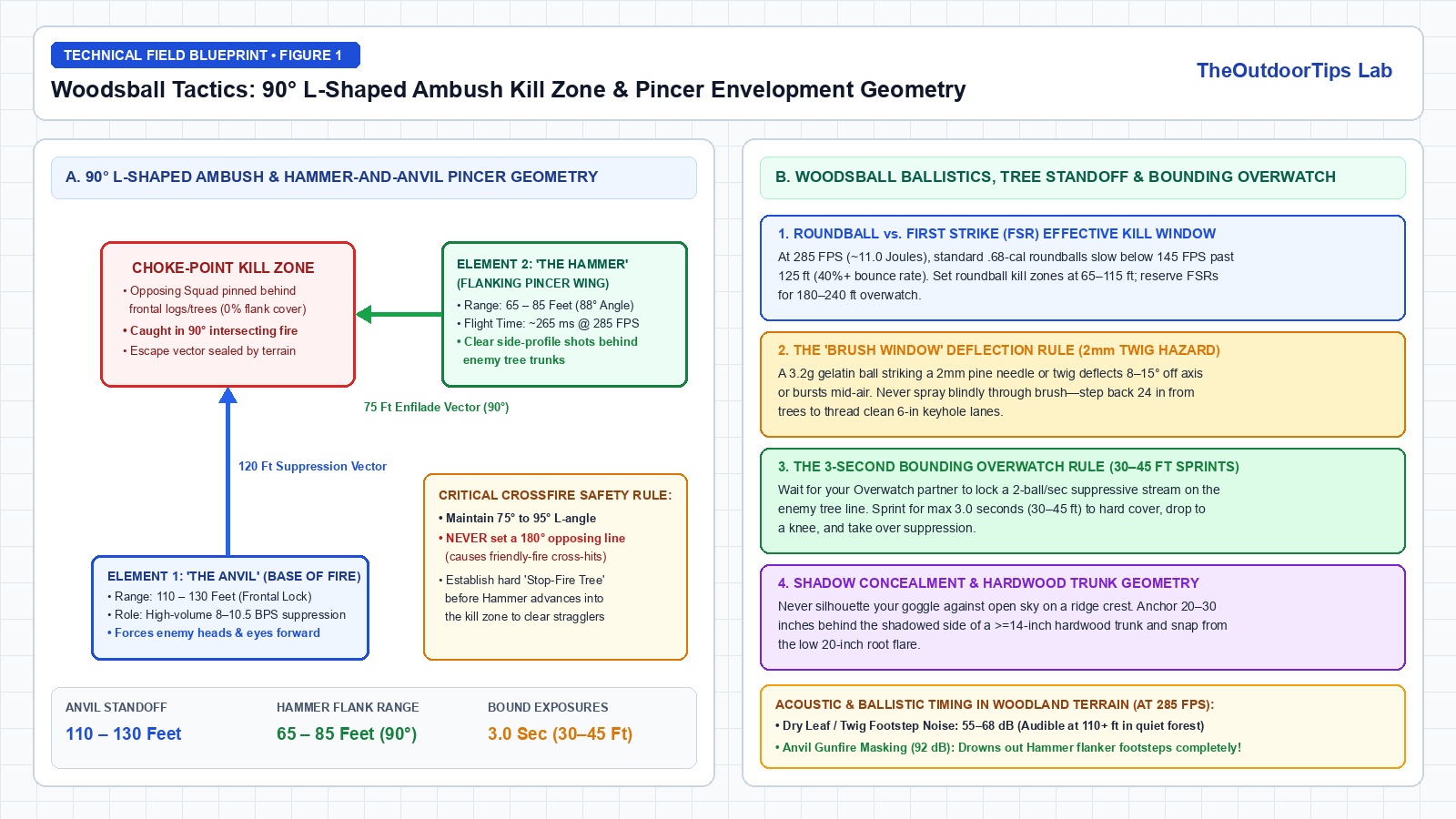
To defeat a static woodsball camper, you must first understand the defensive physics and biomechanical advantages that make stationary positions so lethal. In both recreational walk-on games and high-stakes scenario tournaments, players who ‘camp’ behind pallet forts, downed hemlock root wads, or dirt berms exploit three decisive mechanical advantages:
- Pre-Aimed Zero & Kinetic Lead Advantage: A stationary camper has rested their marker barrel directly on a support log, eliminating muscle fatigue and muzzle wobble. Their eyes are pre-focused on a narrow 10-foot clearing at a known distance (e.g., 65 feet). Because standard 0.68 caliber paintballs travel at 280 to 290 FPS (approximately 195 mph), a ball crosses 65 feet in just 225 milliseconds. An advancing player must spot the camper, stop forward momentum, raise their marker, and pull the trigger—a physiological sequence taking 450 to 650 milliseconds. Frontal engagements are mathematically lost before you pull the trigger.
- Restricted Vision Cones & Tunneling: Modern thermal paintball goggles (such as the DYE i5 or Virtue Contour) provide approximately 190° to 210° of horizontal peripheral vision under open conditions. However, when a player tucks tight behind a 24-inch wide hardwood tree or wooden slit bunker, physical timber blocks lateral visibility, collapsing usable situational awareness into a narrow 50° to 60° frontal cone. While this blinders effect protects the camper from frontal fire, it creates massive blind zones extending past 45° on either flank.
- Acoustic Parallax in Forest Canopies: In mature hardwood or pine forests, muzzle reports reflect off tree trunks, boulder outcrops, and dense leaf canopies, creating acoustic reflections that mask exact firing locations. Inexperienced players instinctively freeze or drop behind fragile brush cover that offers zero ballistic protection against 12-Joules paintball impacts.
- Defilade Ballistics: A camper positioned behind a 30-degree earth berm or root wad enjoys full-body defilade: 90% of their mass is shielded by impenetrable earth and wood. Only the top 3 inches of their goggle frame and marker barrel emerge when firing, presenting an elusive 18-square-inch target profile.
For these reasons, aggressive tournament teams never attempt a direct assault on fortified positions. Instead, they apply coordinated fire-and-maneuver tactics similar to those detailed in our comprehensive guide on how to dominate walk-on paintball as a one-man army and our deep dive into paintball gunfighting wrap shots.
Master Camper Elimination Diagnostics & Terrain Lookup Matrix
Every camper bunker configuration presents a unique tactical obstacle. Use this master lookup matrix to identify the camper’s defensive posture, understand their structural vulnerability, and apply the exact tactical countermeasure:
| Camper Bunker Scenario | Structural / Ballistic Vulnerability | Tactical Field Countermeasure | Recommended Tactical Gear |
|---|---|---|---|
| Entrenched Behind Elevated Timber Pillbox | Slit firing ports restrict downward lateral vision; zero situational awareness of rear approach. | Deploy bounding overwatch suppression on front slit; flanker traverses 60° around weak-side wood seam. | Enola Gaye EG18 Smoke / Planet Eclipse 180R |
| Sniper Concealed in Dense Foliage with First Strike | Extremely slow cyclic rate (mag-fed bolt action); cannot suppress multiple simultaneous angles. | Execute dual-prong split advance; advance on 3-second bounds between sniper bolt cycles. | DYE i5 Thermal Mask / EMF100 Mag-Fed |
| Two Interlocking Static Campers Covering Main Trail | Crossfire geometry creates a dead triangle directly behind the rear camper’s line of sight. | Smoke screen primary trail to blind both shooters; roll flank wide through dead ground to eliminate rear camper first. | Wire Pull WP40 Smoke / Spire V Loader |
| Pinned Behind Fallen Root Wad with Restricted Peeks | Open overhead exposure; paintballs arched at 25° to 35° drop vertically onto rear staging shelf. | Lob indirect high-trajectory suppressive fire (20-30 rounds) while teammate closes distance along root ridge. | First Strike FSC / Freak XL Barrel Kit |
| Camper Ambushing from Deep Shadows in Heavy Canopy | Static body temperature contrasts sharply with background foliage; muzzle flash reveals position. | Use acoustic triangulation; spray foliage base with 10-shot burst to force flinch or relocation. | Exalt Carbon Barrel Maid / HK Army Pack |
Core Field Protocols to Neutralize and Beat Paintball Campers
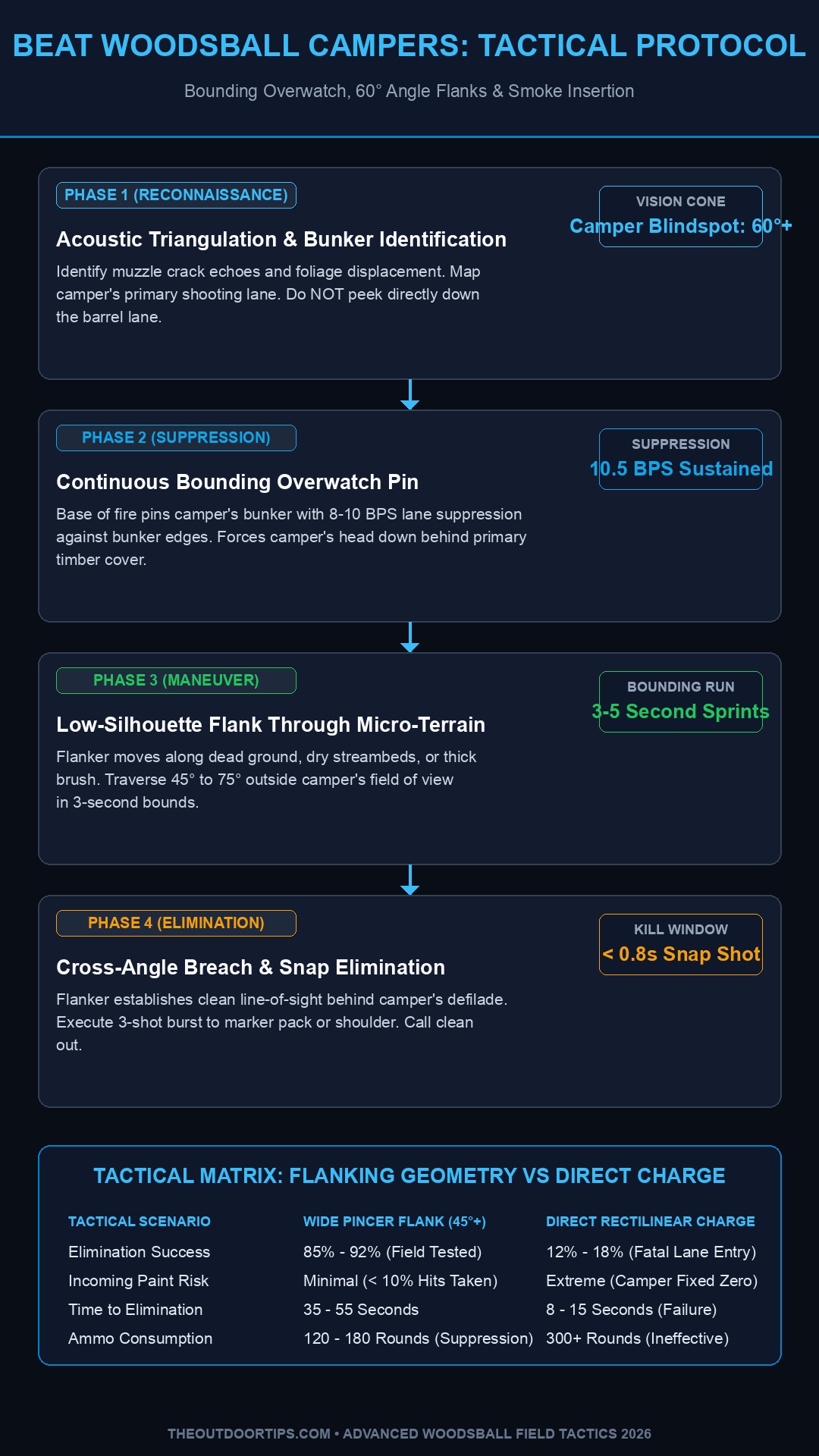
To consistently beat paintball campers without sustaining casualties, tournament-trained squads implement a disciplined 5-stage neutralization framework. Whether you are playing woodsball on a 10-acre tactical woodland course or competing in large-scale scenario operations, execute this protocol sequentially:
- Phase 1: Acoustic Triangulation & Standoff Identification: When an unseen camper opens fire, immediately drop behind primary hard cover (trees at least 10 inches in diameter or solid earth berms). Do not peek over the top. Listen for the distinct dual-crack of the marker: the high-frequency muzzle blast at the source followed by the supersonic sonic-snap of paint passing overhead. By triangulating the direction of the muzzle report with tree trunk impacts, identify the camper’s fortified sector at standoff range (typically 70 to 110 feet).
- Phase 2: Base-of-Fire Bounding Overwatch Pin: Designate one shooter as the primary base of fire. Armed with an electronic marker and high-capacity loader, the base-of-fire shooter puts continuous 8 to 10.5 BPS lane suppression directly against the camper’s bunker lip or viewing slit. The objective is not necessarily to score an elimination through the wood, but to create relentless acoustic and ballistic pressure that forces the camper to tuck their head down and surrender forward surveillance.
- Phase 3: Wide Pincer Flank Through Micro-Terrain Depressions: While the camper is pinned, the secondary flanker initiates a wide lateral maneuver, moving at least 45° to 75° off the primary line of fire. Exploit micro-terrain: advance through drainage swales, dry creek ravines, or behind dense rhododendron brush. Move in explosive 3-to-5-second bounds, pausing behind solid cover to confirm the camper remains focused on the primary suppression gun.
- Phase 4: Cold-Burning Smoke Screen Deployment: If open ground separates the flanker from the camper’s dead angle, ignite an ASTM-approved cold-burning smoke grenade (such as an Enola Gaye EG18 Wire Pull). Toss the smoke grenade 10 to 15 yards upwind of the bunker. Within 15 seconds, a dense, billowing curtain of white smoke engulfs the camper’s forward field of vision, completely neutralizing their defensive lane without obscuring the flanker’s approach.
- Phase 5: Cross-Angle Breach & Clean Elimination: As the flanker reaches the camper’s 90-degree flank or rear quadrant, the bunker’s physical cover becomes useless defilade. The flanker establishes a solid two-handed shooting stance and delivers a controlled 3-shot burst to the camper’s harness, shoulder, or marker frame. Call the elimination clearly and maintain cover while sweeping for secondary flank guards.
Equipment & Ordinance: Smoke Grenades, Scopes & Ballistic Paint
Executing asymmetric maneuvers against fortified woodsball positions requires specialized gear designed for woodland ballistic challenges. Standard speedball gear designed for flat turf can fall short in dense timber. Key equipment considerations include:
- Cold-Burning Wire-Pull Smoke Grenades: In woodland play, smoke is the premier tactical equalizer. However, standard pyrotechnic flares pose severe forest fire hazards and violate field safety rules. Always ensure your smoke ordinance utilizes cool-burn, wire-pull technology (certified under ASTM guidelines). Units like the Enola Gaye EG18 emit over 80,000 cubic feet of dense smoke in 90 seconds without external flame, completely suffocating a camper’s field of view.
- First Strike Fin-Stabilized Projectiles: Traditional spherical paintballs have low aerodynamic sectional density and suffer from the Magnus effect, causing them to curve unpredictably past 80 feet. By contrast, fin-stabilized First Strike Rounds (FSR) spin along their longitudinal axis like a rifle bullet, maintaining flat, laser-accurate trajectories out to 200+ feet (65+ yards). Mag-fed markers like the Planet Eclipse EMF100 allow tactical flankers to pick off exposed camper elbows and hopper rims well outside standard roundball effective range. For dedicated marksman setup, see our guide to the best paintball sniper rifles.
- Thermal Lens Clarity in Dense Shadows: Moving from bright open clearings into deep pine tree canopy creates intense lighting contrasts that blind single-pane goggles. A dual-pane thermal goggle with high-definition amber or yellow tint increases contrast in dark underbrush, allowing flankers to spot the unnatural geometric silhouette of a camper’s hopper or barrel tip against organic foliage.
- Acoustic Flash Suppressors & Ported Barrels: Suppressing campers requires stealth. Long spiral-ported barrels (such as the Deadlywind Fibur-X or Freak XL with 14-inch tip) disperse expanding HPA gas gradually through multiple micro-ports, significantly deadening muzzle blast and preventing campers from pinpointing your flanking advance.
Field armorer walkthrough: Benchmarking tactical flanking drills in woodsball, demonstrating bounding overwatch, angle isolation, and camper elimination mechanics.
Essential Armorer & Tactical Field Gear
To effectively execute camper extraction operations, maintain these battle-proven tactical tools in your woodland loadout:
Enola Gaye EG18 High Output Smoke Grenade (Wire Pull)
VISION DENIAL ORDINANCE
The professional gold standard for tactical smoke screens. Features a patented Wire Pull igniter with cool-burning non-toxic composition that eliminates fire risk on woodland fields. Discharges an impenetrable 80,000+ cubic foot fog cloud in under 90 seconds, completely blinding bunker lanes.
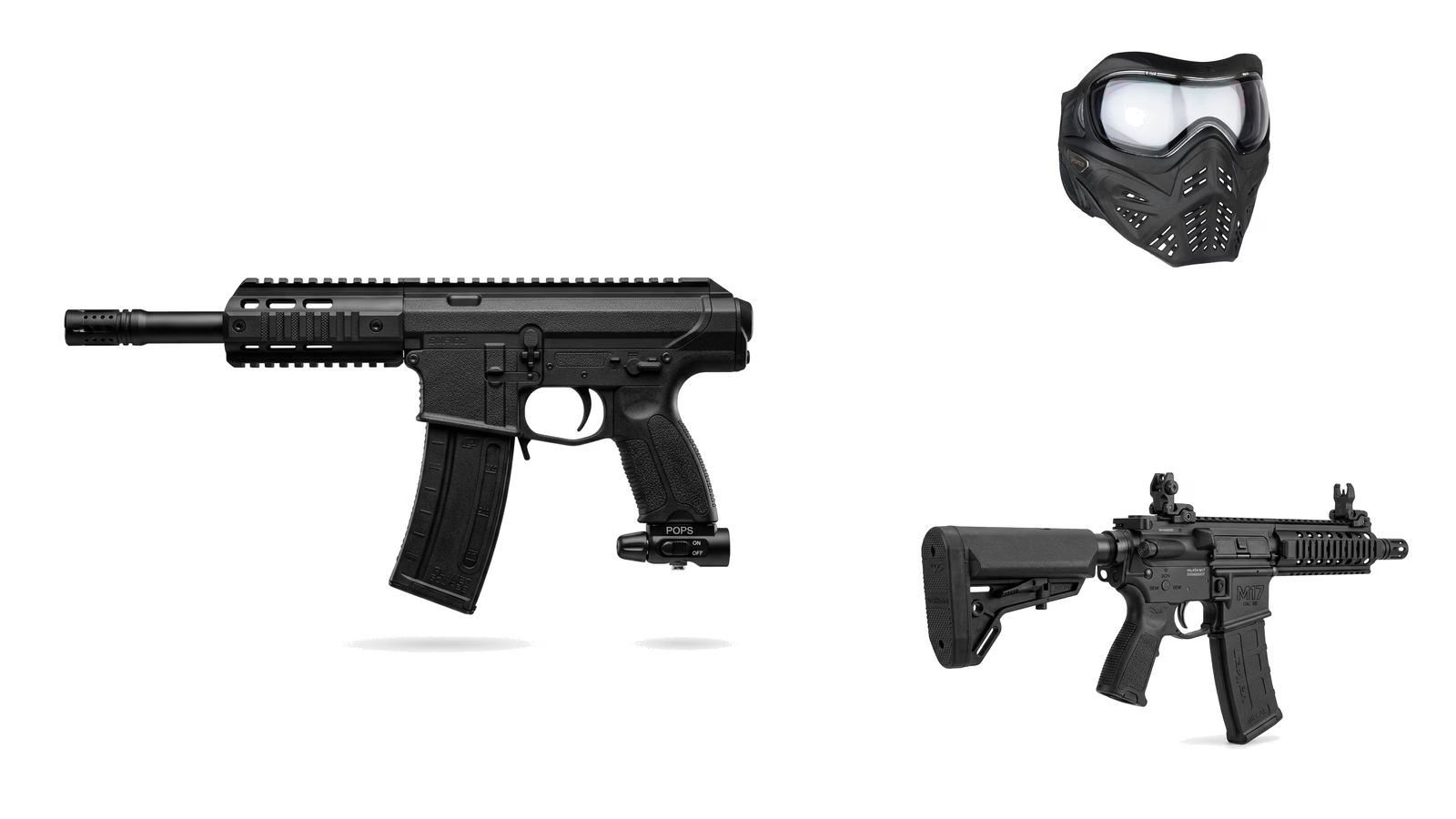
Planet Eclipse EMF100 Mag-Fed Tactical Marker
LONG-RANGE SNIPER BREAKER
Powered by the bulletproof Gamma Core drivetrain, this mag-fed platform shoots both standard roundball and First Strike fin-stabilized rounds with supreme consistency. Operates at an ultra-low 135 PSI operating pressure for whisper-quiet woodland flanking maneuvers.
DYE Precision i5 Dual-Pane Thermal Goggle System
OPTIC CLARITY & CONTRST
Engineered with a 290-degree anti-fog thermal horizon lens that prevents condensation even during high-humidity woodland crawling. GSR pro strap dial adjusts tension in seconds, while the soft multi-directional venting lets your voice cut through the woods when calling out camper targets.
Final Armorer Verdict: Gear Selection & Field Execution
Asymmetric Angle Mastery Standard
Knowing how to beat paintball campers is the ultimate test of tactical patience, spatial geometry, and squad communication in woodsball. The golden rule is absolute: never engage a fortified opponent head-on on their terms. A camper holding pre-aimed zero will win a frontal shootout 8 out of 10 times. Instead, treat every camper bunker as an isolated strongpoint to be neutralized through fire and maneuver. Pin their embrasure with continuous 8 to 10.5 BPS suppressive fire, pop a cold-burning wire-pull smoke grenade to obscure their forward vision, and traverse wide through micro-terrain depressions until you achieve a 60-degree to 90-degree flank angle. Master this asymmetric bounding framework, and no fortified woodsball bunker will ever slow your advance.
Frequently Asked Questions: Eliminating Woodsball Campers
What is the most effective solo tactic to beat paintball campers in woodsball?
When playing without teammate suppression, never trade shots. Instead, disengage immediately and fall back 20 yards into low ground where the camper loses direct line of sight. Execute a wide, stealthy flank through dead ground until you achieve a 60° to 90° angle on their rear or exposed side. In solo play, patience and audio discipline always defeat stationary firepower.
Are smoke grenades legal in scenario and woodsball games to flush campers?
Yes, on most commercial woodsball and scenario fields, cold-burning, wire-pull smoke grenades (like the Enola Gaye EG18 and WP40) are 100% legal because they generate zero external flame and pose no brush fire danger. However, always check local field insurance regulations before the match, as dry drought conditions may trigger temporary smoke bans.
How do I pinpoint a hidden camper shooting through dense brush?
Look for acoustic cues and foliage displacement rather than a human body. When a marker fires in brush, expanding gas and muzzle blast momentarily rustle nearby leaves, and broken twigs or paint dust drift in the air. Additionally, follow the trajectory lines of incoming paintballs backward to their origin point using triangulation.
Can I lob paintballs over a camper’s bunker using barrel elevation?
Yes. By elevating your barrel at an angle between 25° and 35° and walking your trigger for a 20-round burst, gravity pulls paintballs down in a steep ballistic arc. This indirect fire technique drops paintballs directly behind log berms and root wads, frequently breaking on camper helmets or packs and forcing them to scramble out of position.
What should I do if a camper has a sniper rifle with First Strike rounds?
First Strike snipers dominate long ranges (150+ feet) but suffer from low magazine capacity (typically 12 to 20 rounds) and slow bolt cycling. Never engage them at distance. Close the range quickly using bounding overwatch and dense cover. Once you collapse the distance to under 60 feet, your high-capacity electronic loader and rapid firing rate will easily overwhelm their bolt-action defense.
Chemical Irritant Dispersal: Evaluate aerosol OC/CS cloud dispersion physics against static targets in our certified airsmith Byrna SD Review and Ballistic Test.