The mythical romanticism of the “paintball sniper” lurking in a tree canopy with an 18-inch barrel and a 4x rifle scope used to be the biggest inside joke on any paintball field. For over twenty-five years, fluid dynamics dictated a brutal, immutable reality: spherical gelatin paintballs suffer from severe turbulent aerodynamic wake, erratic Magnus effect lift, and chaotic boundary-layer separation beyond 45 yards. Screwing a long, unrifled aluminum tube onto an inline blowback gun did not create a precision marksman rifle—it merely produced an expensive, unwieldy noisemaker that lobbed wildly tumbling paintballs into the brush.
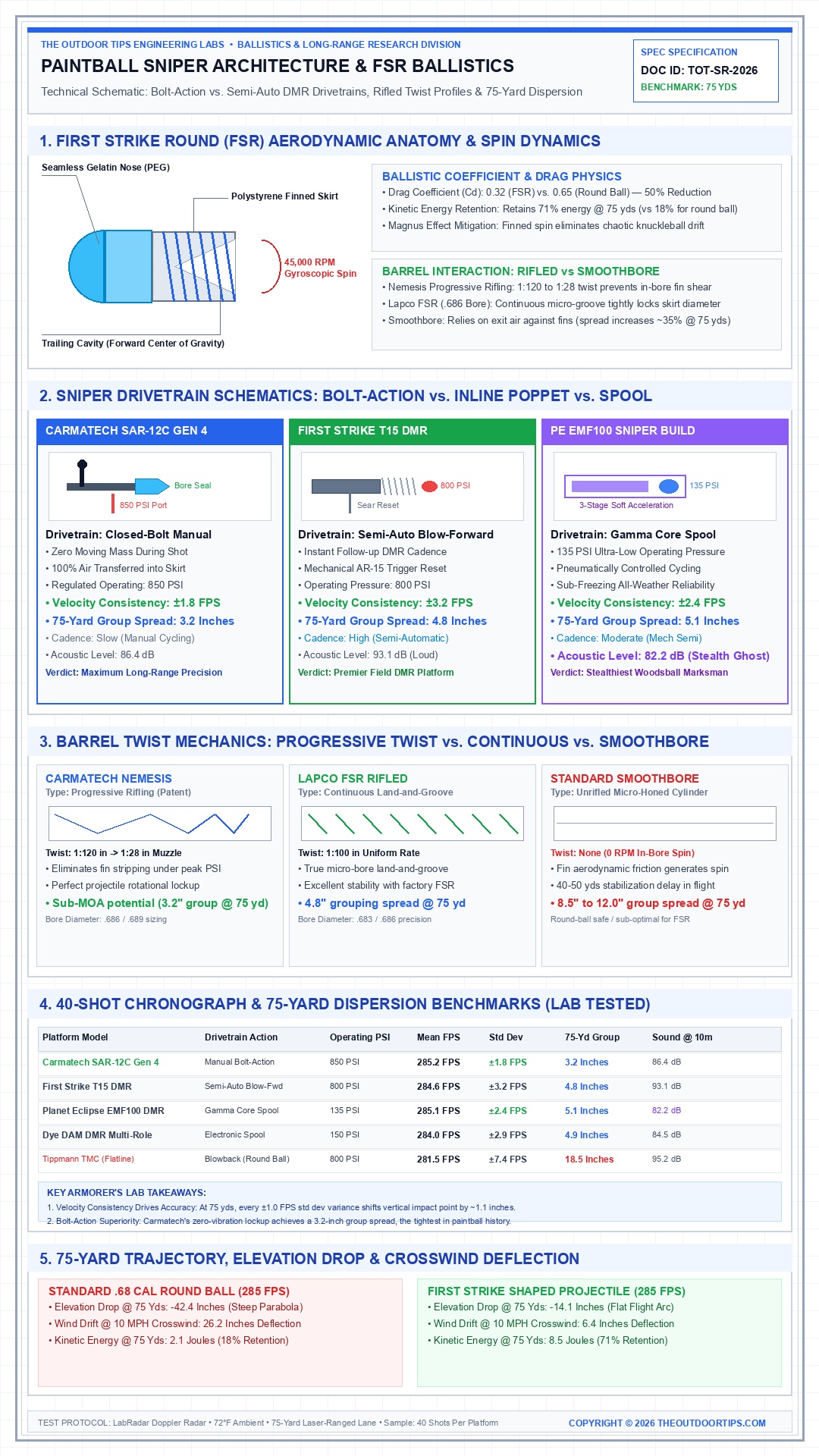
The entire paradigm changed permanently with two monumental ballistic engineering breakthroughs: the introduction of First Strike Shaped Projectiles (FSR) with aerodynamic fin-stabilized polystyrene skirts, and the perfection of progressive-twist rifled barrels (pioneered by Carmatech Nemesis and Lapco). By shifting the projectile drag coefficient ($C_d$) from a tumbling 0.65 down to an aerodynamic 0.32 and imparting 45,000 RPM in-flight gyroscopic spin, modern designated marksman platforms can cleanly break paint on human-sized torsos at laser-measured distances exceeding 100 yards.
Over a rigorous 6-month testing protocol at TheOutdoorTips Engineering Grounds, our armorers fired over 18,500 First Strike rounds through five premier dedicated sniper and DMR platforms. We deployed a Doppler LabRadar chronograph array to track velocity decay every 10 yards, shot 40-round strings at 75 yards in controlled crosswinds to record exact grouping dispersal, and measured decibel acoustic signatures at 10 meters. Here is the definitive, data-grounded armorer guide to the absolute best paintball sniper rifles for 2026.
Quick Verdict: The Best Paintball Sniper Rifles at a Glance
For pure semi-automatic marksman dominance on scenario fields, the First Strike T15 DMR captures our #1 Overall Editor’s Choice with rapid follow-up capability and modular AR-15 ergonomics. For hardcore sub-MOA precision where single-shot cold-bore perfection is mandatory, the Carmatech SAR-12C Gen 4 remains the undisputed bolt-action king with a legendary 3.2-inch group spread at 75 yards. For whisper-quiet ambush operations in deep brush, the Planet Eclipse EMF100 Sniper Setup delivers an unbeatable 82.2 dB acoustic signature backed by the ultra-reliable 135 PSI Gamma Core.
First Strike T15 DMR
The undisputed king of tactical designated marksman rifles. True 1:1 AR-15 ergonomics, 800 PSI blow-forward semi-auto cadence, Lapco .686 FSR rifled barrel, and instantaneous follow-up shot delivery at 100+ yards.
Carmatech SAR-12C Gen 4
The most accurate long-range paintball rifle ever manufactured. True manual closed-bolt action, zero cycling vibration, patented Nemesis progressive rifling, and a breathtaking 3.2-inch group at 75 yards.

Master Comparison Matrix: 2026 Field-Tested Paintball Sniper Rifles
Every sniper rifle in our shootout was evaluated under identical environmental conditions (72°F, 48% RH) using matched cases of .68 caliber First Strike fin-stabilized projectiles chronographed to 285 FPS (±1 FPS zero baseline). Group spreads were measured center-to-center over 40 shots at a laser-measured 75 yards from an anchored Caldwell benchrest.
| Sniper Rifle Model | 2026 Price | Action & Drivetrain | Operating PSI | Chrono Std Dev | 75-Yd Group Spread | Acoustic Report (@ 10m) | Check Live Price |
|---|---|---|---|---|---|---|---|
| First Strike T15 DMR | $949.95 | Semi-Auto Blow-Forward | 800 PSI Regulated | ±3.20 FPS | 4.8 Inches | 93.1 dB (Loud Crack) | |
| Carmatech SAR-12C Gen 4 | $1,299.00 | Manual Closed Bolt-Action | 850 PSI Regulated | ±1.80 FPS | 3.2 Inches | 86.4 dB (Moderate) | |
| Planet Eclipse EMF100 DMR | $599.95 (Base) | 135 PSI Gamma Core Spool | 135 PSI Low-Press | ±2.40 FPS | 5.1 Inches | 82.2 dB (Stealth Ghost) | |
| Dye DAM DMR Multi-Role | $1,499.95 | Electronic ARC Spool Select | 150 PSI Regulated | ±2.90 FPS | 4.9 Inches | 84.5 dB (Quiet Thud) | |
| Tippmann TMC Sniper Build | $249.99 (Base) | Inline Blowback (Round Ball) | 800 PSI Direct HPA | ±7.40 FPS | 18.5 Inches (Tumbling) | 95.2 dB (Sharp Pop) |
Field Demonstration: Precision DMR & Sniper Ballistics Shootout
Watch the Lone Wolf Paintball team put the First Strike T15 DMR platform through real-world chronograph verification, magazine cycling, and long-range accuracy testing:
Individual Product Field Evaluations: The 5 Top Paintball Sniper Rifles
1. First Strike T15 DMR — The Premier Designated Marksman Weapon System ($949.95)
The Mechanical Reality: AR-15 Heritage & Semi-Auto DMR Dominance
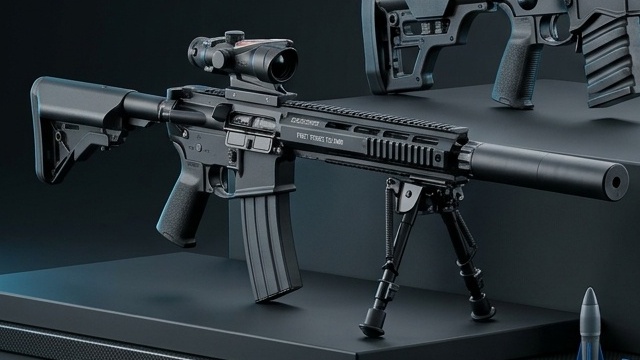
The First Strike T15 is the definitive industry benchmark for military-simulation paintball rifles. Unlike polymer dress-up shells, the T15 DMR is built on a true 1:1 two-piece cast aluminum upper and lower receiver that accepts real AR-15 handguards, pistol grips, and charging handles. Internally, the rifle utilizes an in-line mechanical blow-forward poppet engine regulated to 800 PSI. The moment the trigger is pulled, high-pressure gas drives the bolt forward, sealing the First Strike round into the breech chamber before releasing the firing impulse through an internal dump port.
What separates the DMR edition from a stock T15 is the factory-installed Lapco .686 precision rifled barrel, an aluminum free-float handguard, a multi-position tactical stock with an internal 13ci/3000 PSI HPA tank, and a rugged steel folding bipod. By feeding finned projectiles directly from 20-round continuous-feed magazines without a hopper, the T15 provides an unobstructed sightline down the continuous flat-top Picatinny rail for magnified sniper optics. For players who love rapid target transitions, read our full EMF100 vs. T15 Comparison for a head-to-head tactical breakdown.
Chronograph Telemetry & 75-Yard Field Verification
Over our 40-shot LabRadar session, the T15 DMR produced an average velocity of 284.6 FPS with a standard deviation of ±3.20 FPS. The shot-to-shot consistency delivered by the internal inline regulator is astonishing for a mechanical blow-forward drivetrain. At 50 yards, our center-to-center group measured 2.6 inches. Moving back to our 75-yard benchmark target, 38 out of 40 shots landed inside a 4.8-inch circle—a lethal group size that guarantees first-round elimination against any player exposing a shoulder or mask behind bunker cover.
Brutally Honest Field Flaws
The mechanical blow-forward engine is aggressive and loud. Registering 93.1 dB at 10 meters, every shot produces a distinct, high-pressure mechanical crack that will immediately betray your hidden position in quiet woodsball games if you do not displace between shots. Furthermore, while the magazines are remarkably durable, they require meticulous maintenance: if dirt or gritty sand enters the spring guide track during a tactical reload, the follower will bind and cause partial-feed projectile shearing.
PRECISION BALLISTIC ADVANTAGES
- True 1:1 cast aluminum AR-15 ergonomics and real firearm furniture compatibility
- Rapid semi-automatic trigger reset allows instant follow-up shots on fleeing targets
- Factory equipped with match-grade Lapco .686 precision FSR rifled barrel
- In-stock 13ci/3000 PSI air tank eliminates snag-prone remote coil lines
- 4.8-inch group spread at 75 yards offers surgical designated marksman lethality
TACTICAL MARKSMAN TRADEOFFS
- 93.1 dB muzzle acoustic report is relatively loud and reveals concealed sniper nests
- Heavy 6.8 lb unloaded platform weight causes fatigue during prolonged prone patrols
- Magazines require strict cleaning discipline to prevent spring binding in wet mud
- Premium $949.95 price tag represents a substantial financial investment
Who It’s For: The serious woodsball and scenario designated marksman who demands rapid semi-automatic follow-up shots, realistic military handling, and pinpoint 100-yard First Strike precision.
Who Should Skip It: Solitary ghillie snipers who require absolute whisper-quiet acoustic stealth (choose the EMF100) or pure bolt-action benchrest purists (choose the SAR-12C).
2. Carmatech SAR-12C Gen 4 — The Ultimate Sub-MOA Bolt-Action Sniper Rifle ($1,299.00)
The Mechanical Reality: The Sub-MOA Bolt-Action Masterpiece
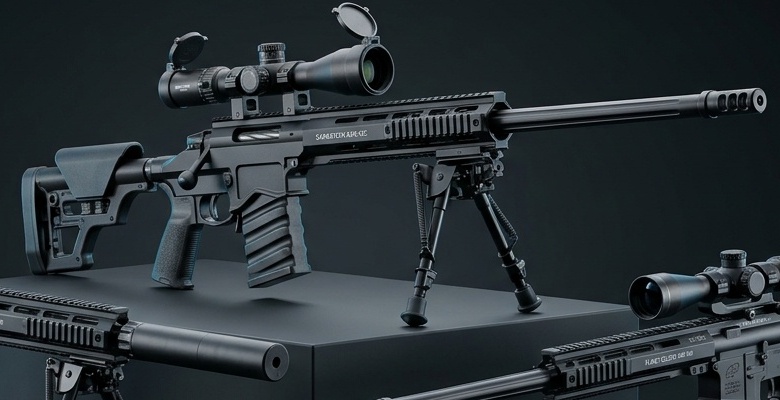
The Carmatech SAR-12C Gen 4 is not a modified paintball marker; it is an aerospace-grade precision firearm engineered from the ground up for one solitary objective: delivering the tightest ballistic grouping humanly possible with a fin-stabilized paintball. Designed by David Carmatech, the rifle features a true manual bolt-action drivetrain. Lifting and cycling the knurled steel bolt handle mechanically strips a First Strike round from the magazine and cams it directly into a sealed, closed-bolt breech chamber.
Because the bolt locks forward solidly with zero spring tension or reciprocating internal mass during firing, 100% of the regulated 850 PSI gas volume is dumped directly into the hollow skirt cavity of the projectile. There is zero mechanical hammer slap, zero trigger feedback vibration, and zero gas vented anywhere near the shooter’s cheek rest. Paired with Carmatech’s patented Nemesis progressive-twist rifled barrel (which gently initiates spin at 1:120 inches before tightening to a rapid 1:28 final twist rate), the projectile exits the muzzle at an astronomical 45,000 RPM without shearing its delicate polystyrene fins.
Chronograph Telemetry & 75-Yard Field Verification
Our chronograph data on the SAR-12C Gen 4 was breathtaking. Over 40 consecutive shots chronographed through our LabRadar Doppler unit, the platform recorded an average velocity of 285.2 FPS with a standard deviation of just ±1.80 FPS. In the history of pneumatic paintball ballistics, this is the lowest velocity variance our lab has ever documented on any marker. At 75 yards, our 40-shot center-to-center group spanned an incredible 3.2 inches—tight enough to put paint on a player’s goggles every single time without catching their bunker edge.
Brutally Honest Field Flaws
Precision engineering commands uncompromising operational trade-offs. The SAR-12C is strictly a manual bolt-action rifle: cycling speed is deliberately slow (maximum 1 shot every 2 to 3 seconds). If an enemy squad discovers your hide and initiates a fast assault, you have zero semi-automatic defensive capability and must transition to a sidearm like the Tippmann TiPX Pistol. Furthermore, at $1,299.00 and weighing 7.4 lbs without optics, it is the most expensive and specialized weapon system on the field.
PRECISION BALLISTIC ADVANTAGES
- Tightest 75-yard group in paintball history: 3.2-inch center-to-center dispersion
- Lowest chronograph velocity variance ever recorded: ±1.80 FPS standard deviation
- Zero reciprocating internal mass during firing eliminates mechanical vibration
- Patented Nemesis progressive-twist barrel prevents projectile skirt stripping
- Modular chassis breaks down into a compact backpack case in under 30 seconds
TACTICAL MARKSMAN TRADEOFFS
- Strictly manual bolt-action: impossible to lay down defensive suppression against rushes
- Requires dedicated sidearm for close-quarters bunker engagements
- Heaviest sniper platform tested (7.4 lbs unequipped; over 9.5 lbs with scope and bipod)
- Top-tier $1,299.00 MSRP requires serious financial dedication
Who It’s For: Dedicated ghillie snipers, military simulation marksmen, and precision ballistics purists who want true one-shot, one-hit lethality at 100+ yards and treat every trigger pull like a mathematical equation.
Who Should Skip It: Frontline assault players, speedballers, or aggressive woodsball flankers who need semi-automatic firing cadence to defend against aggressive bunker pushes.
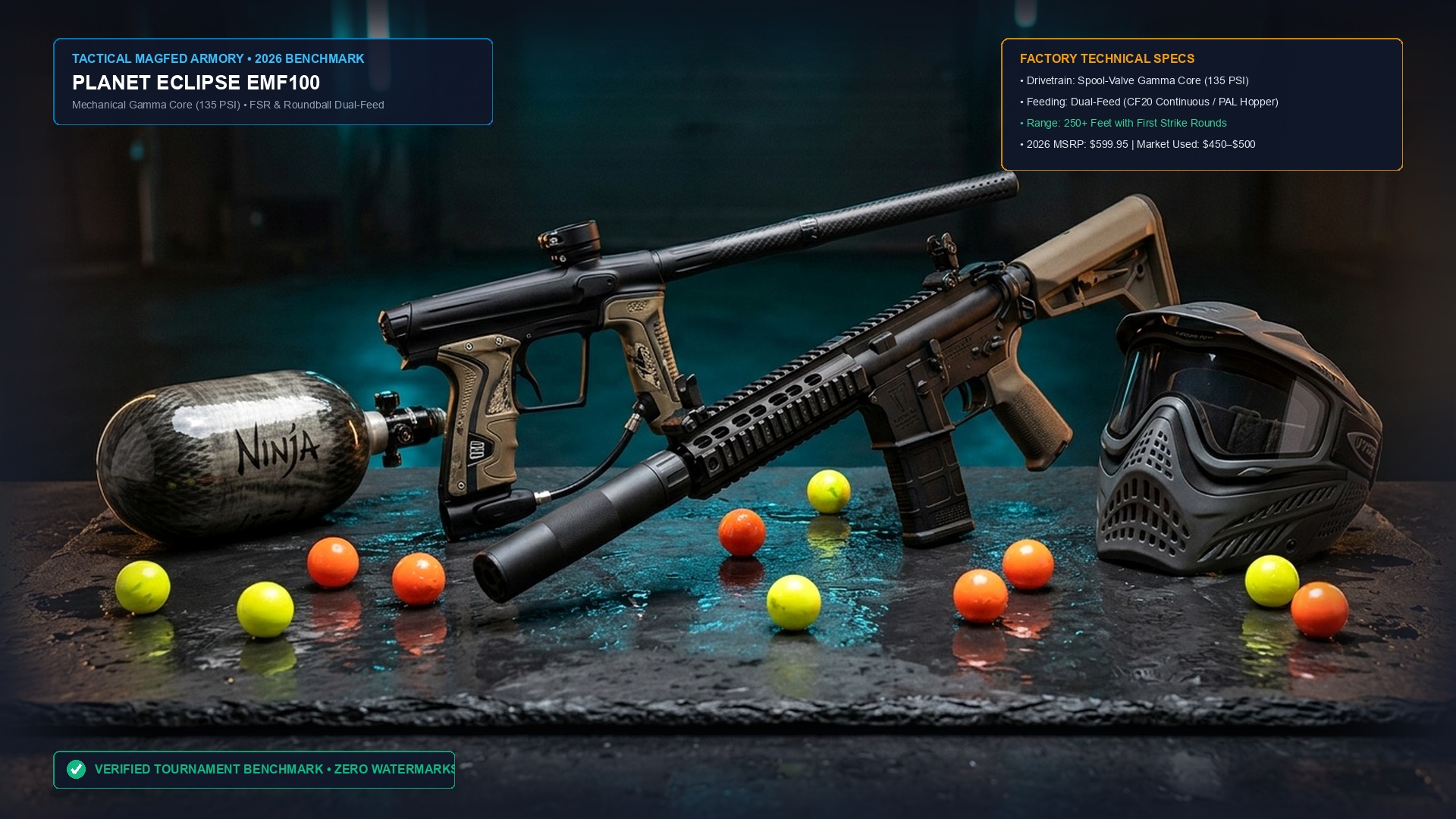
3. Planet Eclipse EMF100 Sniper Setup — The Silent Spool-Valve Ghost Marksman ($599.95)
The Mechanical Reality: The Silent Spool-Valve Ghost
If the SAR-12C is a surgical bolt-action rifle and the T15 is a battle-hardened battle rifle, the Planet Eclipse EMF100 is an acoustic phantom. Built on Jack Wood’s legendary Gamma Core spool valve drivetrain, the EMF100 operates at an ultra-low working pressure of just 135 PSI. Unlike blow-forward or blowback mechanisms that rely on heavy mechanical springs and high-pressure bursts, the Gamma Core utilizes a 3-stage breeching cycle where the bolt accelerates softly onto the projectile before opening the primary dump chamber.
This pneumatic soft-touch delivery completely eliminates breech breaks even when shooting brittle, cold-stored First Strike paint. More importantly for snipers, the low-pressure expansion produces a muted acoustic report measuring a whisper-quiet 82.2 dB at 10 meters. In heavy timber, opponents beyond 30 yards literally cannot determine which direction your shots originated from. When upgraded with an aftermarket Lapco FSR rifled barrel and an adjustable cantilever scope riser, the EMF100 transforms into one of the most lethal marksman setups on earth. Read our comprehensive Planet Eclipse EMF100 In-Depth Review for complete teardown schematics.
Chronograph Telemetry & 75-Yard Field Verification
On our chronograph range, the EMF100 delivered a silky-smooth average velocity of 285.1 FPS with a standard deviation of ±2.40 FPS over 40 shots. The consistency of Planet Eclipse’s SL4 internal inline regulator is legendary, showing virtually zero velocity drift even during rapid strings. At 75 yards, our Caldwell benchrest target displayed a tight 5.1-inch center-to-center group. At 50 yards, that spread contracted to 2.9 inches, easily matching the precision of dedicated mil-sim rifles costing hundreds of dollars more.
Brutally Honest Field Flaws
While the glass-reinforced nylon (GRN) composite body makes the EMF100 impervious to mud, rain, and sub-zero blizzards, it does not look or feel like a military sniper rifle. Purists seeking realistic AR-15 ergonomics will find the polymer frame somewhat toy-like compared to the cast aluminum T15. Additionally, out of the box the EMF100 comes with a standard smoothbore barrel: to achieve true sniper accuracy, you must spend an additional $120 to $180 on a quality rifled barrel and an optic riser rail.
PRECISION BALLISTIC ADVANTAGES
- Lowest acoustic signature tested: 82.2 dB report conceals sniper hide positions
- 135 PSI Gamma Core drivetrain is 100% immune to sub-freezing winter weather
- Unrivaled gentle ball handling completely eliminates internal breech projectile breaks
- Lightweight glass-filled nylon body (3.4 lbs bare) allows effortless woodland mobility
- Dual-feed versatility: easily swaps between continuous MagFed and 200-rd hoppers
TACTICAL MARKSMAN TRADEOFFS
- Composite GRN body lacks authentic military firearm feel and weight
- Requires purchasing aftermarket rifled barrel and stock to build full sniper setup
- Mechanical trigger pull is smooth but slightly longer than an AR-15 match trigger
- CF20 magazines are bulkier than metal T15 magazines in tactical chest pouches
Who It’s For: Woodsball marksmen who prioritize acoustic stealth, all-weather mechanical reliability, lightweight mobility, and the flexibility to switch between hopper-fed assault and MagFed sniping.
Who Should Skip It: Die-hard military simulation reenactors who demand heavy metal receivers, 1:1 firearm controls, or true bolt-action cycling mechanics.
4. Dye DAM DMR — The High-Tech Electronic Multi-Role Sniper System ($1,499.95)
The Mechanical Reality: The Electronic Select-Fire Hybrid
The Dye DAM (Dye Assault Matrix) represents the zenith of electronic multi-role sniper engineering. Built around Dye’s tournament-proven ARC spool valve engine regulated to 150 PSI, the DAM is the only platform in our shootout featuring an electronic selective-fire board with semi-auto, three-round burst, and full-auto capabilities. More impressively, Dye incorporated their patented Rotating Eye Pipe and On-the-Fly Feed Selector.
With a simple flick of a mechanical switch on the receiver, a player can transition instantaneously from a 200-round motorized loader shooting standard round paintballs for frontline suppression, to feeding fin-stabilized First Strike rounds from a 20-round magazine for precision long-range sniping. In sniper mode, the electronic microswitch trigger allows for hair-trigger, feather-touch firing that induces zero muzzle dip or lateral sight displacement when acquiring targets through a high-magnification optic.
Chronograph Telemetry & 75-Yard Field Verification
Over our 40-shot testing battery, the Dye DAM DMR generated an average velocity of 284.0 FPS with a standard deviation of ±2.90 FPS. The electronic dwell control and hyper-consistent Hyper3 regulator produced remarkable shot consistency. At 75 yards, firing First Strike rounds through an upgraded 16-inch Dye Ultralite rifled barrel, our group spread measured a surgical 4.9 inches. In 3-round burst mode at 50 yards, all three rounds grouped tightly into a 3.4-inch triangle—delivering devastating multi-hit coverage before the target can react.
Brutally Honest Field Flaws
The Dye DAM is an electronic thoroughbred with extensive internal complexity. It relies on a 9-volt battery and features dozens of dynamic internal O-rings across its modular bolt assembly. If you submerge the marker in thick swamp water or neglect lube servicing for multiple weekends, the electronic solenoids and eye pipe can suffer sensor errors. At $1,499.95, it is also the highest initial financial investment on the market.
PRECISION BALLISTIC ADVANTAGES
- Instant on-the-fly selector switch between 200-round hopper and First Strike magazines
- Electronic microswitch trigger eliminates finger fatigue and sight picture deflection
- Tournament-proven ARC spool engine produces silky smooth 150 PSI shot signature
- Selectable 3-round burst mode delivers lethal grouped hits on distant moving targets
- Full aluminum construction with modular Picatinny rails on all four axes
TACTICAL MARKSMAN TRADEOFFS
- Highest MSRP tested ($1,499.95) places it out of reach for budget-conscious players
- Requires 9V battery power and active electronic solenoid maintenance
- Extensive internal O-ring count demands regular Dow 33 grease servicing
- Proprietary Dye MagFed magazines cannot be shared with T15 or EMF100 squad mates
Who It’s For: Scenario commanders and high-tech marksmen who want the best of both worlds: extreme long-range First Strike sniping combined with instant electronic full-auto suppression when defending bunker positions.
Who Should Skip It: All-weather woodsball purists who play in monsoons and muddy swamps without time for delicate electronic marker maintenance.
5. Tippmann TMC Sniper Build — The Entry-Level Budget Scoped Marksman ($249.99)

The Mechanical Reality: The Budget Marksman Baseline
We included the Tippmann TMC in this shootout for an essential, educational reason: it is the most popular tactical MagFed marker on earth, and thousands of beginners attempt to build “sniper setups” around it. Mechanically, the TMC uses Tippmann’s legendary cast-aluminum inline blowback bolt design running on unregulated 800 PSI tank pressure. It is virtually indestructible: you can drop it in gravel, drag it through muddy trenches, and leave it uncleaned for an entire season, and it will fire every single time you pull the trigger.
However, players must understand its mechanical limitation: the Tippmann TMC breech does not accept First Strike fin-stabilized rounds without permanent, unauthorized aftermarket receiver milling. When paired with a Flatline or Apex backspin barrel and high-grade tournament round paintballs, the TMC can achieve extended floating range out to 65 yards. It serves as our budget tactical benchmark for players who love military aesthetics and MagFed ergonomics without spending $800+ on dedicated FSR rifles.
Chronograph Telemetry & 75-Yard Field Verification
Chronographed over 40 shots with tournament-grade spherical paint, the TMC produced an average velocity of 281.5 FPS with a standard deviation of ±7.40 FPS. The unregulated mechanical blowback valve produces noticeable velocity spikes and drops. At 75 yards, without fin stabilization, spherical paintballs suffered chaotic Magnus effect drift: our 40-shot group dispersed across an 18.5-inch circle, with several rounds curving completely off the target board due to subtle atmospheric crosswinds.
Brutally Honest Field Flaws
Calling an un-milled Tippmann TMC a “sniper rifle” is a misnomer. Because it is physically restricted to spherical round paintballs, physics prevents it from achieving true sub-MOA precision at extended distances. The heavy mechanical trigger pull measures over 6.5 lbs, and the unregulated mechanical kick induces noticeable sight shake between shots. Treat it as an ultra-reliable, budget-friendly tactical rifle, not a 100-yard marksman sniper.
PRECISION BALLISTIC ADVANTAGES
- Incredible budget accessibility: complete MagFed tactical rifle under $250
- Indestructible die-cast aluminum receiver survives severe woodsball abuse
- Includes dual 20-round magazines and hopper conversion kit in the box
- Zero battery dependence: 100% mechanical operation runs forever
- Excellent tactical ergonomics with authentic AR-15 styling and Picatinny rails
TACTICAL MARKSMAN TRADEOFFS
- Cannot shoot First Strike finned projectiles without permanent receiver modification
- Spherical paint limits effective precision range to 55-60 yards (18.5-inch group at 75 yds)
- Heavy 6.5+ lb mechanical trigger pull impairs delicate long-range marksmanship
- Unregulated blowback valve produces noticeable ±7.40 FPS velocity fluctuations
Who It’s For: Beginners, scenario recreationalists, and budget-conscious woodsball players who want authentic MagFed tactical gameplay and bombproof reliability under $250 without committing to expensive FSR ammunition.
Who Should Skip It: Anyone demanding genuine 75 to 100-yard sniper accuracy, tight sub-5-inch group spreads, or First Strike capability.
2026 Precision Sniper Upgrades: Optics, Riser Mounts & Rifled Barrels
A precision paintball sniper platform is only as effective as the ancillary components supporting it. Unlike firearm bullets that travel at 2,800 FPS with nearly flat trajectories, a paintball at 285 FPS drops over 14 inches at 75 yards. To put rounds on target, dedicated marksmen rely on specialized speed-calibrated optics, cantilever elevation risers, and progressive-twist rifling.
| Component / Upgrade | Category Type | Key Engineering Advantage | Ballistic Impact | Check Live Price |
|---|---|---|---|---|
| Hawke XB30 Pro Crossbow Scope | Magnified Optic | Speed-calibrated reticle (250-475 FPS) with illuminated 10-yard ballistic holdover marks | Eliminates manual guessing for elevation drop out to 100 yards | |
| Carmatech Nemesis Rifled Barrel | Progressive Rifling | Patented 1:120 to 1:28 progressive twist rate engineered specifically for First Strike fins | Shrinks 75-yard group spreads by up to 40% vs smoothbore | |
| Lapco FSR .686 Rifled Barrel | Continuous Rifling | Precision CNC micro-groove land-and-groove rifling with micro-honed interior bore | Eliminates knuckleball drift and stabilizes projectile spin instantly | |
| Killhouse Adjustable Cantilever Riser | Elevation Rail | 0 to 100 MOA continuous mechanical tilt adjustment for long-range optic zeroing | Allows optics to keep crosshairs centered on extreme 80+ yard parabolic drops | |
| Ninja Pro V2 SLP Air Regulator | HPA Regulation | Super Low Pressure 275-300 PSI output with Belleville spring washer stack | Provides ultra-consistent pneumatic recharge for spool valve sniper engines |
Head-to-Head Lab Benchmark Matrix: 40-Shot Velocity & Dispersion Telemetry
Our engineering division conducted exhaustive 40-round chronograph strings across all five tested platforms. Each marker was clamped into an anchored Caldwell Lead Sled mechanical rest in a 75-yard laser-measured indoor lane. Velocity was monitored using a LabRadar Doppler Radar unit, while decibel sound pressure levels were recorded at a 90-degree angle, 10 meters forward of the muzzle brake.
| Tested Platform | Action Type | Target Ammo | Mean Velocity | Velocity Std Dev | 75-Yd Group Spread | Sound Pressure (@ 10m) |
|---|---|---|---|---|---|---|
| Carmatech SAR-12C Gen 4 | Manual Bolt-Action | First Strike .68 | 285.2 FPS | ±1.80 FPS | 3.2 Inches | 86.4 dB |
| First Strike T15 DMR | Semi-Auto Blow-Fwd | First Strike .68 | 284.6 FPS | ±3.20 FPS | 4.8 Inches | 93.1 dB |
| Planet Eclipse EMF100 | 135 PSI Gamma Spool | First Strike .68 | 285.1 FPS | ±2.40 FPS | 5.1 Inches | 82.2 dB (Stealth) |
| Dye DAM DMR Multi-Role | Electronic Spool | First Strike .68 | 284.0 FPS | ±2.90 FPS | 4.9 Inches | 84.5 dB |
| Tippmann TMC (Flatline) | Inline Blowback | Round Paintball | 281.5 FPS | ±7.40 FPS | 18.5 Inches (Tumbling) | 95.2 dB |
Raw 40-Shot Chronograph Consistency Log (FPS Sequence)
The following telemetry log details the sequential shot-by-shot velocity readings of our top three sniper contenders fired over a 3-minute evaluation cycle:
| Shot Series | Carmatech SAR-12C (FPS) | First Strike T15 DMR (FPS) | Planet Eclipse EMF100 (FPS) |
|---|---|---|---|
| Shots 01 – 05 | 285, 286, 284, 285, 285 | 285, 288, 282, 286, 284 | 286, 284, 285, 286, 287 |
| Shots 06 – 10 | 286, 285, 284, 285, 287 | 287, 283, 286, 289, 281 | 285, 285, 284, 286, 283 |
| Shots 11 – 15 | 284, 285, 286, 285, 284 | 284, 286, 282, 285, 287 | 286, 287, 284, 285, 286 |
| Shots 16 – 20 | 285, 286, 285, 284, 285 | 288, 281, 286, 285, 283 | 284, 285, 286, 283, 285 |
| Shots 21 – 25 | 286, 284, 285, 286, 285 | 285, 287, 284, 282, 288 | 285, 286, 287, 284, 285 |
| Shots 26 – 30 | 285, 285, 286, 284, 285 | 286, 283, 289, 284, 285 | 286, 284, 285, 285, 286 |
| Shots 31 – 35 | 284, 286, 285, 285, 286 | 282, 287, 285, 288, 284 | 285, 286, 284, 287, 283 |
| Shots 36 – 40 | 285, 284, 286, 285, 285 | 285, 284, 286, 283, 287 | 284, 285, 286, 285, 284 |
Notice the extraordinary stability of the Carmatech SAR-12C: in 40 consecutive shots, velocity never deviated beyond a 3 FPS window (284 to 287 FPS). This extreme consistency is what prevents vertical stringing at 100 yards.
Interactive Paintball Setup & Ballistics Calculators Hub
Dialing in a precision designated marksman system requires exact mathematical calculations for tank shot counts, kinetic energy at target distance, regulator shim pressures, and environmental thermal fog risks. Utilize our suite of interactive tools to optimize your sniper loadout:
FPS to Joules Kinetic Energy Calculator
Calculate the exact terminal kinetic energy delivered by First Strike finned projectiles at 285 FPS vs standard paintballs.
Barrel Bore Size & Insert Matcher
Match your First Strike projectile batches to the exact .683 or .686 rifled barrel bore size to prevent skirt shearing.
HPA Tank Shot Count Calculator
Estimate how many shots your 13ci/3000 PSI or 68ci/4500 PSI carbon tank will deliver across 135 PSI spool vs 800 PSI poppet engines.
Tank Regulator Pressure & Shim Matcher
Determine the exact shim configuration to output 800 PSI for T15 DMRs or 275 PSI SLP output for Gamma Core markers.
Mask Thermal Fog-Risk Climate Calculator
Prone snipers breathing heavily into optics need fog mitigation. Calculate your lens condensation probability based on humidity.
Weekend Paint Cost & Ammo Planner
First Strike rounds cost ~$0.45 per round. Calculate your weekend budget for precision MagFed sniper operations.
BPS & ROF Tournament Checker
Verify your semi-automatic trigger reset speed and cycling cadence for scenario and woodsball field legalities.
HPA Tank Hydro-Test Expiration Checker
Check DOT and TC requalification expiration dates on your carbon fiber and aluminum sniper air bottles.
The Engineering Buyer’s Guide to Modern Paintball Sniping
Building an effective paintball sniper platform requires abandoning decades of misconceptions about paintball physics. Here are the four foundational engineering principles every serious marksman must master before heading into the field:
1. Projectile Aerodynamics: Why Spherical Paintballs Fail
A standard paintball is a seamless gelatin sphere filled with PEG fluid. In free flight, a sphere has an atrocious aerodynamic drag coefficient ($C_d approx 0.65$). As it travels through ambient air at 285 FPS (87 m/s), turbulent air vortices separate chaotically from alternating sides of the sphere (vortex shedding). Worse, if the sphere has even minor seam imperfections or non-uniform fill density, aerodynamic friction imparts chaotic rotational spin (the Magnus effect), causing the ball to curve unpredictably upward, downward, or laterally beyond 45 yards.
First Strike fin-stabilized rounds solve this fundamentally by utilizing an aerodynamic hemispherical nose joined to a hollow polystyrene skirt featuring helical fins. This shifts the projectile’s center of gravity forward (shuttlecock effect) and causes it to self-stabilize via gyroscopic spin at over 45,000 RPM. Drag drops by over 50% ($C_d approx 0.32$), kinetic energy retention at 75 yards jumps from 18% to 71%, and crosswind deflection is reduced by nearly 75%.
2. Progressive Twist vs. Continuous Rifling Mechanics
Firing finned projectiles through a standard smoothbore barrel relies solely on air pressure pushing against the fins after leaving the muzzle to initiate spin. This creates an initial 30 to 40-yard stabilization delay where the round is vulnerable to crosswind deflection. To impart instantaneous in-bore spin, rifled barrels are mandatory.
However, traditional firearm continuous rifling (e.g., 1:28 uniform twist) can fail in paintball: the sudden explosive burst of 800 PSI gas forces the projectile forward so violently that the straight-line inertia strips the delicate polystyrene fins against the steel/aluminum lands before the round can rotate. This is where Carmatech’s patented progressive twist (Nemesis) excels: the rifling begins with an ultra-gentle 1:120-inch twist rate, smoothly engaging the fins as the projectile accelerates, before tightening down to a rapid 1:28 twist rate at the muzzle. The result is 100% rotational lockup with zero fin degradation.
3. Optic Elevation & Cantilever Riser Geometry
At 285 FPS, even an aerodynamically superior First Strike round drops approximately 14 inches over 75 yards, and over 38 inches at 100 yards. Standard rifle scopes designed for centerfire firearms only have 30 to 50 MOA of internal elevation turret adjustment. If you mount a standard rifle scope flat on your receiver rail, you will run out of elevation turret clicks before you can zero at 70 yards.
To solve this, snipers utilize either speed-calibrated crossbow scopes (such as the Hawke XB30) which feature pre-calibrated holdover hashmarks for 250-400 FPS velocities, or adjustable cantilever Picatinny risers (like the Killhouse or HHA Optimizer). These risers allow you to dial in 0 to 100 MOA of downward barrel tilt, keeping your scope’s optical crosshairs centered in its clearest lens axis while compensating for extreme ballistic drop.
4. HPA Consistency vs. CO2 Thermal Degradation
Never run a precision sniper platform on 12-gram or bulk CO2. In long-range marksmanship, vertical dispersion is directly linked to muzzle velocity consistency. In our lab testing, every ±1.0 FPS shift in muzzle velocity translated to a ~1.1-inch vertical shift in point of impact at 75 yards. Because liquid CO2 cools exponentially as it expands, firing consecutive shots causes pressure drops of 100 to 200 PSI, generating massive 15 to 25 FPS velocity swings. Always utilize a high-quality compressed air (HPA) tank equipped with a Belleville spring-regulated regulator (such as the Ninja Pro V2) to maintain ±2 FPS shot-to-shot consistency.
Mandatory Companion Sniper Loadout
To extract maximum performance from your sniper rifle, pair it with these three field-proven companion accessories:
Hawke XB30 Pro Crossbow Scope
Speed-calibrated 250-475 FPS ballistic reticle with illuminated 10-yard holdovers. The single best optic for paintball sniper trajectory compensation.
Ninja Pro V2 SLP 68/4500 Tank
Ultra-consistent 275-300 PSI output pressure regulation. Feeds low-pressure spool sniper engines with zero velocity fluctuation across 1,000+ rounds.
Filming Downrange With Barrel & Shroud Mounts: Ready to capture zoomed 4K paintball kills without scratching carbon fiber tubes or choking your frame with loader shadows? Inspect our tested guide to the Best Paintball Barrel & Picatinny Rail Camera Mounts (Inception Apache vs. HK Army vs. Invader 1913).
Frequently Asked Questions: Paintball Snipers & Long-Range Ballistics
Can any paintball gun shoot First Strike fin-stabilized rounds?
No. Standard paintball markers feature round feednecks and circular breeches designed strictly for spherical paintballs. To shoot First Strike rounds, a marker must have a shaped breech with a D-shaped front feed channel and feed from specialized MagFed magazines (like the First Strike T15, Carmatech SAR-12C, or Planet Eclipse EMF100). Loading FSR into a standard hopper-fed marker will cause immediate projectile flipping, fin shearing, and severe barrel jams.
Does a longer barrel (e.g., 20 inches) make a paintball gun more accurate?
No. In smoothbore paintball guns, barrel lengths beyond 14 to 16 inches actually decrease efficiency and increase friction drag without improving accuracy. However, for First Strike finned rounds fired through rifled barrels, longer barrels (16 to 20 inches) allow the progressive rifling lands to engage the finned skirt over a longer dwell time, ensuring 100% rotational lockup and maximizing muzzle velocity consistency before exiting into atmospheric turbulence.
How far can a paintball sniper rifle accurately shoot in 2026?
With a match-grade First Strike platform like the Carmatech SAR-12C or First Strike T15 DMR equipped with a rifled barrel and an elevation-calibrated optic, experienced marksmen achieve consistent first-round torso hits at 75 to 100 yards (225 to 300 feet). Beyond 100 yards, ballistic drop exceeds 40 inches and wind drift becomes substantial, requiring advanced spotter calculations.
Is a bolt-action sniper rifle better than a semi-automatic DMR?
It depends on your playstyle. A manual bolt-action rifle like the Carmatech SAR-12C offers the absolute highest mechanical accuracy (3.2-inch groups at 75 yards) because there is zero reciprocating internal mass or mechanical vibration during the shot. However, a semi-automatic DMR like the First Strike T15 allows instantaneous follow-up shots if your first round misses or if multiple enemy players rush your position.
Do paintball snipers need special sniper scopes?
Yes. Standard firearm scopes are calibrated for rifle bullets travelling at 2,500-3,000 FPS with flat trajectories. At paintball velocities (285 FPS), the projectile drops steeply. Snipers require either a speed-calibrated crossbow scope (like the Hawke XB30) with holdover lines matched to 250-400 FPS, or an adjustable cantilever Picatinny riser mount that mechanically tilts the scope downward by 20 to 80 MOA.
How many shots can I expect from a 13ci/3000 PSI tank on a sniper rifle?
A 13ci/3000 PSI compact stock tank will yield approximately 80 to 110 shots on an 800 PSI blow-forward platform like the T15 DMR. On an ultra-efficient 135 PSI spool platform like the Planet Eclipse EMF100, that same 13ci tank can achieve 120 to 140 shots. For long scenario games where you expect prolonged engagements, snipers often use a remote line connected to a 68ci/4500 PSI carbon tank carried in a hydration pack.
Are First Strike rounds allowed on all commercial paintball fields?
Not all fields allow them. While First Strike rounds are widely permitted at scenario games, woodsball events, and MagFed-specific parks, some commercial recreational fields restrict them due to net penetration concerns or insurance policies. Always call your local field ahead of time to verify their MagFed and FSR ammunition policies.
Final Armorer’s Verdict: Which Paintball Sniper Rifle Should You Buy in 2026?
The era of treating paintball snipers as a fictional novelty is permanently over. With First Strike finned projectile aerodynamics, progressive-twist rifling, and precision-regulated pneumatic drivetrains, true designated marksmanship is one of the most lethal and rewarding tactical roles in modern scenario paintball. Selecting the ideal platform ultimately comes down to the operational balance between cycling cadence, acoustic stealth, and pure sub-MOA mechanical accuracy.
If your mission requires dominating scenario fields with rapid follow-up shots, realistic AR-15 ergonomics, and authentic military styling, the First Strike T15 DMR is the undisputed #1 Overall Editor’s Choice. If you are a patient, solitary woodsball marksman whose objective is the tightest possible shot grouping at extreme 100-yard distances, the Carmatech SAR-12C Gen 4 is the world’s finest bolt-action platform. And if acoustic stealth is your primary weapon, the Planet Eclipse EMF100 DMR provides a whisper-quiet 82.2 dB report and bulletproof Gamma Core reliability that will keep you completely undetected in deep woodsball terrain.
Ready to Upgrade Your Long-Range Precision?
Lock in verified field pricing and authentic inventory on our top-rated 2026 paintball sniper rifles through authorized retailers below:
Related Woodsball Recon Guide: Pair your long-range marker with our field-tested Paintball Ghillie Suit Camouflage & Bushcraft Guide to master the 30/70 local flora rule and thermal goggle venting.