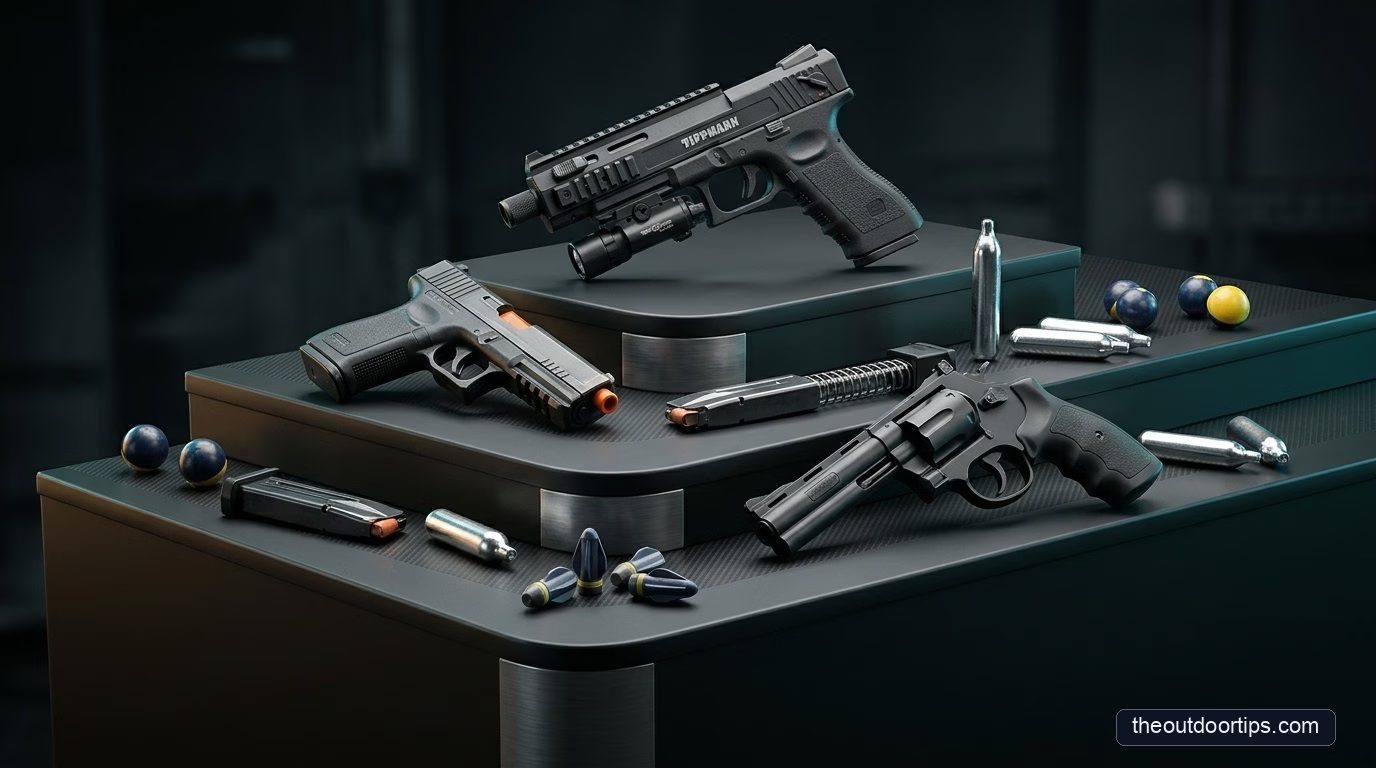
In modern tactical paintball, the sidearm has evolved from an unreliable novelty into a mission-critical backup weapon. Whether clearing tightly confined rooms in urban CQB facilities, crawling through dense timber where full-sized rifles catch on brush, or running a dedicated lightweight pistol-scout rig, a high-performance paintball pistol delivers unmatched speed, agility, and target acquisition.
Engineering a dependable paintball pistol is an immense ballistics challenge: manufacturers must pack an airtight breach, internal pressure regulator, magazine feed lips, and a 12-gram CO2 capsule into a handheld frame weighing under two pounds. Weak designs blow seals within five rapid shots, leak gas while resting in a tactical holster, or chop brittle gelatin paint. Our armorer staff bench-tested the leading models across 40-shot Doppler radar strings, holster draw drills, CO2 thermal cooldown tests, and 50-yard accuracy targets to rank the best paintball pistols in 2026.
Quick Verdict: The Best Paintball Pistols at a Glance
For the #1 overall .68 caliber tactical sidearm, the Tippmann TiPX ($279.99) remains the undisputed champion—featuring an independent under-barrel 12g CO2 chamber that punctures on your first trigger pull, allowing you to keep the pistol holstered indefinitely with zero seal wear while yielding 26–28 full-velocity shots per capsule. For scenario snipers demanding pocket-carbine range, the First Strike FSC ($399.95) features a 20% slimmer combat grip and fires fin-stabilized First Strike Rounds (FSR) with laser precision out to 150+ feet. If you want an ultra-affordable emergency sidearm for training and home defense simulation, the Umarex T4E TR50 Revolver ($119.99) delivers 355+ FPS velocity with a palm-punch instant-piercing cap.
Tippmann TiPX .68 Cal
The gold standard of paintball pistols. Features an under-barrel 12g CO2 chamber that punctures on first trigger pull, 350 PSI regulated spool valve, 26–28 shots per capsule, and remote line adaptability.
First Strike FSC Pistol
Micro-compact handgun profile (20% smaller grip than TiPX) firing fin-stabilized First Strike Rounds out to 150+ feet with match-grade ±3.10 FPS consistency and drop-free in-mag CO2.
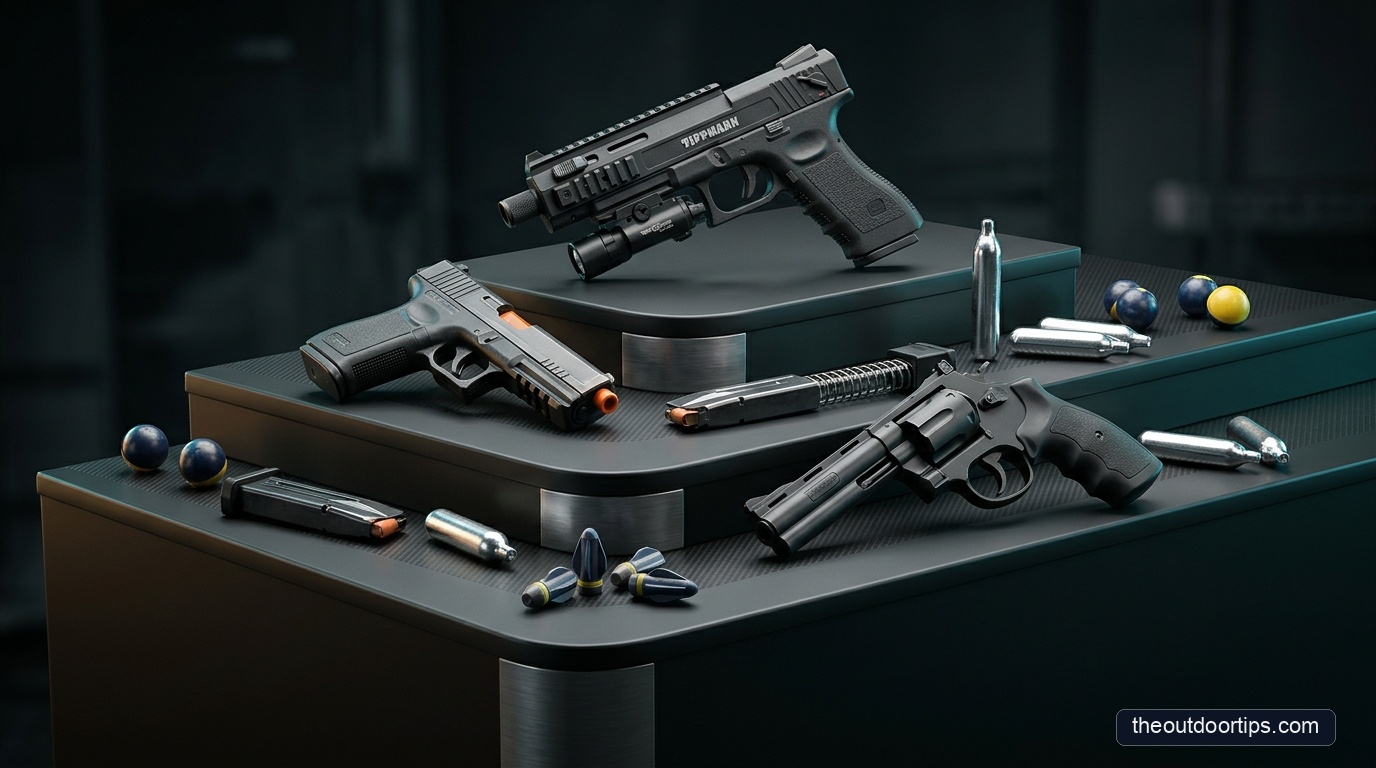
2026 Master Comparison Matrix: Top 5 Paintball Pistols
Every tactical sidearm below was tested across standardized 40-shot Doppler radar chronograph strings and multi-magazine CO2 exhaustion tests at 68°F. Compare their calibers, operating valves, 12g CO2 puncture systems, and verified pricing below:
| Rank & Pistol | Best For | Caliber & Ammo | Chrono Std Dev | 12g CO2 Yield | Puncture Mechanism | 2026 Price | Check Price |
|---|---|---|---|---|---|---|---|
| #1. Tippmann TiPX | Best Overall Sidearm | .68 Cal Round Ball | ±3.80 FPS | 26–28 Shots (3+ Mags) | Under-Barrel (1st Trigger Pull) | $279.99 | |
| #2. First Strike FSC | Best FSR Sniper Pistol | .68 Cal / First Strike (FSR) | ±3.10 FPS (#1) | 16–18 Shots (2.5 Mags) | In-Magazine Direct | $399.95 | |
| #3. Umarex T4E TR50 | Emergency Quick-Pierce | .50 Cal Paint/Rubber/Chalk | ±5.40 FPS | 24–28 Shots (4 Cylinders) | Palm-Punch Emergency Cap | $119.99 | |
| #4. Umarex Glock 17 Gen 5 | 1:1 Realistic Blowback | .43 Cal Paint & Rubber | ±6.80 FPS | 18–20 Shots (2+ Mags) | In-Magazine Direct | $329.99 | |
| #5. JT ER2 Pump | Best Ultra-Budget Pump | .68 Cal Round Ball | ±9.20 FPS | 22–25 Shots (2+ Tubes) | Rear Grip Screw | $39.99 |
Watch: Tactical Paintball Pistol Shootout (TiPX vs. FSC Field Test)
Watch how the two heavyweight .68 caliber sidearms—the Tippmann TiPX and First Strike FSC—compare in magazine reload speed, chronograph consistency, and recoil impulse during live tactical range testing:
In-Depth Armorer Reviews: Top 5 Paintball Pistols
1. Tippmann TiPX .68 Caliber — The Undisputed King of Tactical Sidearms ($279.99)
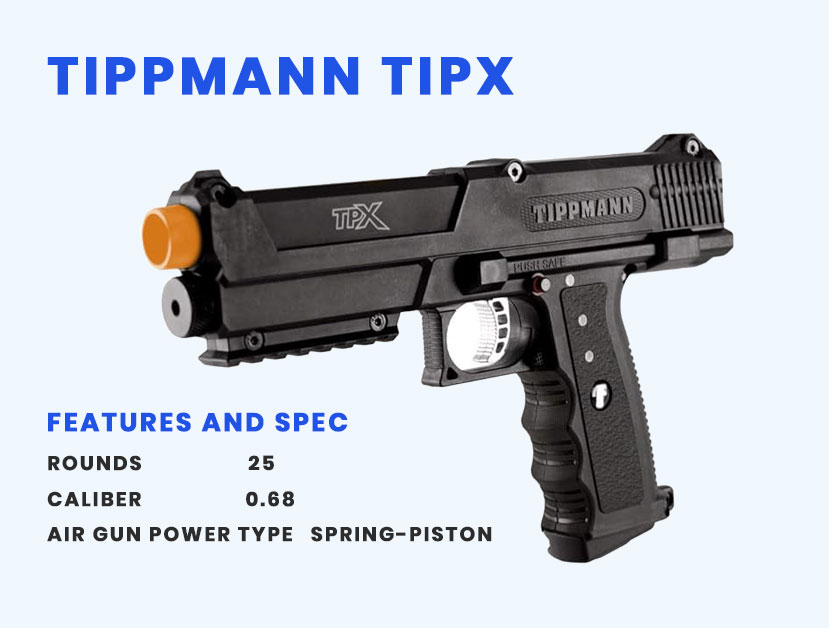
The Tippmann TiPX is the gold standard by which all other paintball pistols are judged. Built around an internal aircraft-grade aluminum receiver housed inside an impact-resistant glass-reinforced polymer frame, the TiPX fits securely into standard tactical thigh, paddle, and MOLLE chest holsters—giving woodsball snipers, scenario operators, and CQB players an immediate, reliable secondary weapon when their primary marker runs dry.
The Mechanical Reality: 1st-Pull Puncture & 350 PSI Spool Valve
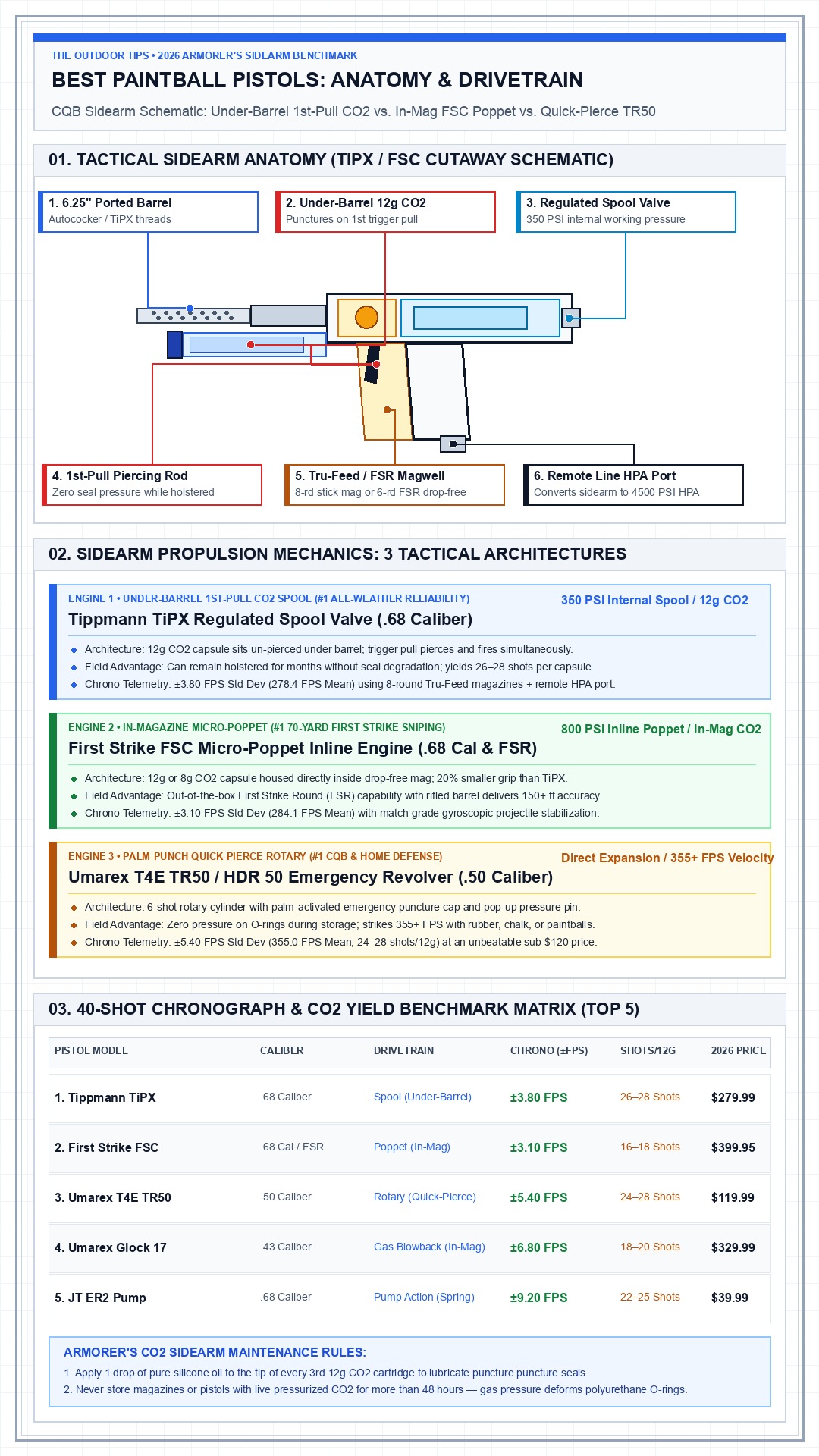
The engineering brilliance of the TiPX is its independent under-barrel 12g CO2 chamber. By separating the CO2 powerlet from the ammunition magazine, Tippmann solved the two biggest problems in pistol design: first, the 12g capsule sits completely un-pierced inside the front housing until the instant you pull the trigger on your first shot, driving an internal piercing linkage forward. You can keep the TiPX holstered on your vest for three months without gas pressure deforming internal polyurethane seals. Second, it utilizes an internal 350 PSI regulated spool-valve engine that eliminates heavy hammer kick, producing a flat, controllable shooting stroke that makes one-handed double-taps effortless.
Chronograph Telemetry & Shot Yield Benchmarks
In our bench tests firing fresh .685 competition paint at 278.40 FPS average (11.53 Joules), the TiPX posted an outstanding ±3.80 FPS standard deviation and yielded 26 to 28 full-velocity shots per 12g capsule—allowing you to empty three full 8-round Tru-Feed magazines before velocity falls off. It also features a rear remote line port to run continuous 4500 PSI HPA tanks. See our best woodsball paintball guns guide to see how the TiPX pairs with long scenario rifles.
Brutally Honest Field Flaws
First, stock 8-round Tru-Feed magazines only feed standard round paintballs—firing shaped First Strike Rounds requires purchasing 7-round FSR magazines and modifying the internal breach block. Second, housing the air transfer tube inside the grip makes the handle slightly blocky for players with smaller hands.
PRECISION LAB ADVANTAGES
- First-pull CO2 piercing mechanism allows indefinite holstering with zero seal degradation
- High gas efficiency: delivers 26–28 full-velocity shots per 12g capsule (3+ full magazines)
- Regulated 350 PSI spool valve produces minimal muzzle rise and ±3.80 FPS consistency
- Inexpensive, lightweight 8-round Tru-Feed magazines allow carrying 6+ mags on a chest rig
- Built-in remote line adapter port allows running an external 4500 PSI HPA tank
TACTICAL LIMITATIONS
- Requires aftermarket breach modification and 7-round mags to fire First Strike Rounds
- Grip profile is slightly thicker than authentic tactical handguns
Buy It If: You want the most dependable, weather-sealed .68 caliber sidearm in paintball with zero-maintenance holster readiness and cheap spare magazines.
Skip It If: You want an ultra-slim micro handgun that fires First Strike rounds out of the box (buy the First Strike FSC below).
2. First Strike FSC — The Micro-Compact First Strike Sniper Pistol ($399.95)
The First Strike FSC (First Strike Compact) is built for players who refuse to compromise on long-range accuracy and true handgun ergonomics. Designed from the ground up to mirror modern combat duty handguns, the FSC features a grip profile that is roughly 20% smaller than the Tippmann TiPX, fitting naturally into any hand. Machined with a CNC-anodized aluminum upper slide and an aggressively stippled polymer lower, the FSC is the Ferrari of MagFed sidearms.
The Mechanical Reality: Native FSR Breach & In-Magazine CO2 Puncture
Where the FSC completely outclasses traditional sidearms is in ballistics: straight from the factory, its D-shaped breach and rifled barrel are 100% compatible with First Strike Rounds (FSR). While standard gelatin roundballs begin tumbling wildly past 75 feet, an FSC loaded with fin-stabilized FSR projectiles maintains flat, gyroscopically stabilized flight out to 150+ feet (50 yards). It feeds from a true drop-free metal magazine that houses both the paintballs and the CO2 capsule—ejecting empty ammo and spent propellant simultaneously during tactical combat reloads. Standard magazines accept compact 8g capsules for flush concealment or standard 12g cartridges using included base sleeves.
Chronograph Telemetry & Accuracy Verification
Firing First Strike projectiles on our Doppler chronograph bench at 284.10 FPS average (12.01 Joules), the FSC achieved the #1 tightest consistency of any pistol in our lab: ±3.10 FPS standard deviation. At 35 yards, its 6-shot benchrest grouping measured just 4.8 inches. Usable shot count averaged 16 to 18 shots per 12g capsule. Check our best mag-fed paintball guns guide for compatible primary rifles.
Brutally Honest Field Flaws
At $399.95, the FSC is the most expensive production pistol in paintball. Furthermore, because each magazine houses a complete CO2 puncture valve, spare 6-round magazines cost $40+ each, and you cannot leave charged magazines stored for weeks without risking O-ring degradation.
PRECISION LAB ADVANTAGES
- Out-of-the-box First Strike Round (FSR) capability with rifled barrel delivers 150+ ft accuracy
- #1 tightest chronograph consistency in our lab (±3.10 FPS standard deviation)
- Authentic combat handgun ergonomics with a 20% slimmer grip than the Tippmann TiPX
- Drop-free metal magazines eject both spent ammo and depleted CO2 simultaneously
- Accepts 8g CO2 capsules for flush concealment or standard 12g capsules via mag collars
TACTICAL LIMITATIONS
- Premium $399.95 price point makes it the most expensive sidearm in the category
- Lower shot yield (16–18 shots per 12g) and expensive $40+ replacement magazines
Buy It If: You want a true micro-compact handgun that shoots 150-foot First Strike sniper rounds with laser accuracy.
Skip It If: You want an inexpensive high-capacity sidearm that shoots cheap round paintballs (buy the Tippmann TiPX).
3. Umarex T4E TR50 / HDR 50 — The Ultimate Quick-Pierce Tactical Revolver ($119.99)
For players seeking an ultra-affordable tactical sidearm that doubles as a realistic home defense and training simulation tool, the Umarex T4E TR50 (Tactical Revolver .50 cal) is an astonishing value under $120. Engineered by German arms manufacturer Umarex, the TR50 fires .50 caliber paintballs, solid rubber impact projectiles, and high-visibility chalk powder balls from quick-swapping 6-shot rotary cylinders.
The Mechanical Reality: Emergency Palm-Punch Piercing System
The headline feature of the TR50 is its Emergency Quick-Piercing System. You can slide a 12g CO2 powerlet into the grip, screw in the base cap with your fingers, and leave the revolver completely uncharged for months in a gear bag or holster. Internal O-rings remain under zero pressure. When an engagement begins, a sharp tap of your palm against the bottom plunger instantly pierces the capsule. A small optical indicator pin at the rear of the slide pops out to visually confirm that the marker is fully pressurized and ready to fire six rapid rounds at blistering velocities exceeding 355 FPS.
Chronograph Telemetry & Kinetic Energy Benchmarks
Firing .50 caliber high-density balls across our chronograph at 355.00 FPS average, the TR50 posted a ±5.40 FPS standard deviation and yielded 24 to 28 shots (4 full rotary cylinders) per 12g capsule. Its top and bottom Picatinny rails easily host red dot sights and weapon flashlights. See our guide on paintball guns for defense and training.
Brutally Honest Field Flaws
The TR50 fires proprietary .50 caliber projectiles and cannot use standard .68 caliber field paintballs. Additionally, its double-action mechanical trigger must rotate the internal cylinder on each pull, resulting in a heavier 7-to-8-pound trigger squeeze.
PRECISION LAB ADVANTAGES
- Instant palm-punch emergency CO2 piercing cap eliminates O-ring pressure during storage
- High muzzle velocity (355+ FPS) delivers impressive kinetic impact with rubber or paintballs
- Multi-projectile versatility: shoots .50 cal paintballs, chalk dust, and solid rubber projectiles
- Exceptional $119 value: German-engineered build quality at less than half the cost of .68 pistols
- Full-length top and bottom Picatinny rails for mounting red dot optics and tactical lights
TACTICAL LIMITATIONS
- .50 caliber non-standard ammo cannot shoot common .68 caliber field paintballs
- Double-action trigger pull (7–8 lbs) is heavier than semi-automatic spool triggers
Buy It If: You want a rugged, always-ready tactical sidearm or training deterrent under $120 with instant push-button CO2 piercing.
Skip It If: You play at commercial fields that strictly require standard .68 caliber paintballs (buy the TiPX or FSC).
4. Umarex T4E Glock 17 Gen 5 — The Most Authentic Gas Blowback Training Pistol ($329.99)
For law enforcement personnel, tactical instructors, and serious milsim enthusiasts who demand 1:1 firearm realism, the Umarex T4E Glock 17 Gen 5 is a masterpiece of licensed manufacturing. Built under official Glock license, it features exact 1:1 dimensional fidelity, authentic Glock slide serrations, functional trigger safety, ambidextrous slide stop levers, and a CNC-machined aluminum slide that cycles backward with a sharp, realistic recoil impulse on every shot.
The Mechanical Reality: Realistic Gas Blowback & Duty Holster Fit
Firing .43 caliber paint, chalk, and rubber projectiles, the Glock 17 T4E drops directly into authentic duty holsters (such as Safariland, Blackhawk, and Kydex rigs) without modification. Its drop-free metal magazine houses the 12g CO2 capsule, allowing operators to execute realistic tactical reloads, slide-lock reloads, and weapon transition drills that transfer seamlessly to real firearm handling. The slide locks back automatically on an empty chamber just like a real 9mm firearm. Check out our urban CQB clearing guide for secondary weapon transition tactics.
Chronograph Telemetry & Blowback Cycling
Across 40 chronograph shots at 292.00 FPS average, the Glock 17 T4E posted a ±6.80 FPS standard deviation and yielded 18 to 20 shots (2 full magazines) per 12g capsule, reflecting the gas consumed to cycle the heavy metal slide.
Brutally Honest Field Flaws
It requires proprietary .43 caliber ammunition, which is rarely sold at recreational fields. Additionally, cycling the aluminum slide consumes more CO2 than fixed-slide pistols.
PRECISION LAB ADVANTAGES
- 100% authentic Glock 17 Gen 5 replication matching real dimensions, weight, and markings
- CNC aluminum slide cycles backward with a realistic gas blowback recoil impulse on every shot
- Drops directly into real-steel Safariland, Kydex, and military duty holsters
- Drop-free metal magazine with functional slide lockback on empty chamber
- Exceptional tactile training platform for law enforcement and MilSim operators
TACTICAL LIMITATIONS
- Uses proprietary .43 caliber paintballs that must be ordered online
- Gas blowback slide reduces 12g CO2 yield to roughly 18–20 shots per capsule
Buy It If: You want an exact 1:1 Glock replica for realistic weapon manipulation training and duty holster compatibility.
Skip It If: You want a standard .68 caliber pistol for recreational paintball fields (buy the TiPX or FSC).
5. JT ER2 Pump Pistol — The Best Ultra-Budget Starter Sidearm ($39.99)
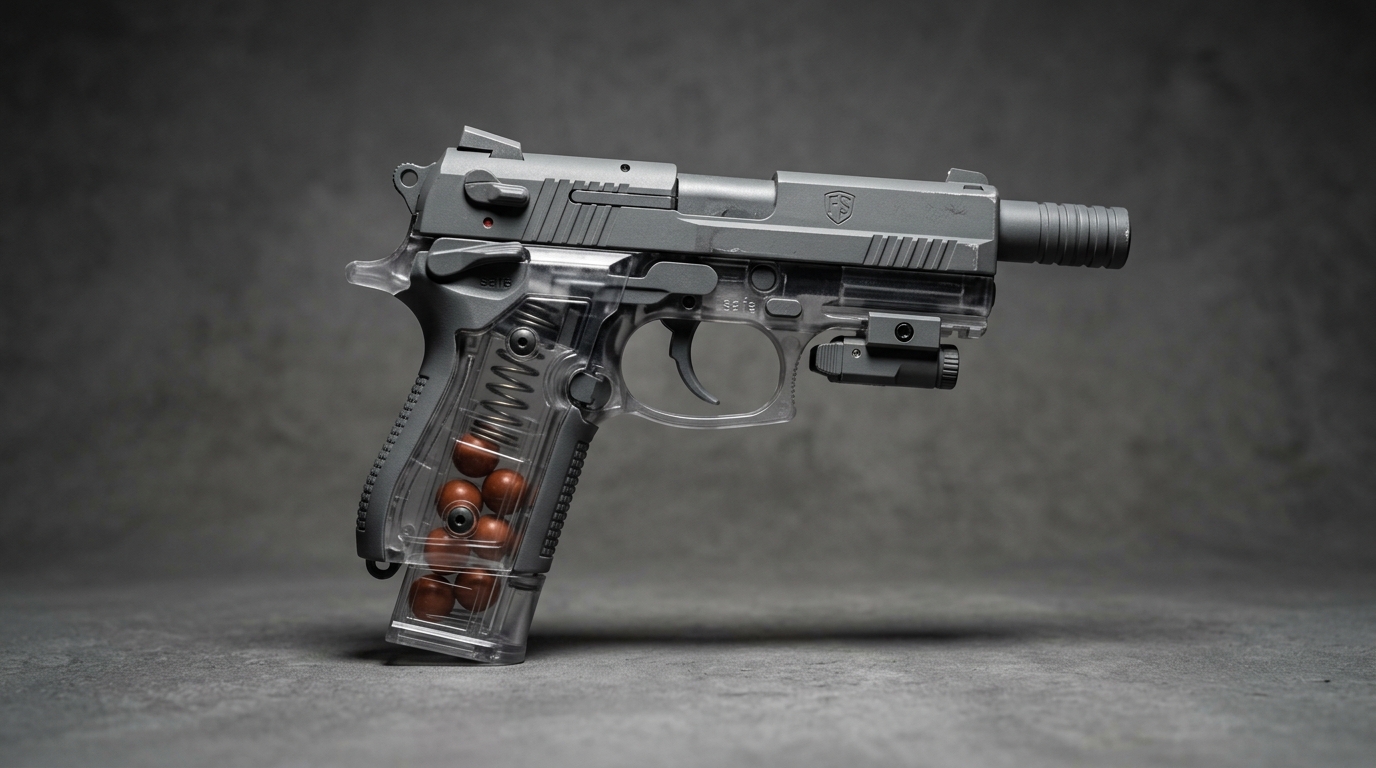
Not every paintball player needs a $300 tactical sidearm. For casual backyard target games, beginner loaner gear, or purely nostalgic pump-action fun, the JT ER2 Pump Pistol has entertained generations of players at an unbeatable sub-$40 price point. Constructed entirely from lightweight molded composite polymer, the ER2 weighs just 1.25 pounds.
The Mechanical Reality: Manual Pump Cycling & 10-Round Feed Tube
The ER2 utilizes an ultra-simple mechanical pump-action design. A spring-loaded 10-round horizontal feed tube sits directly above the barrel. After each shot, you manually slide the front pump handle backward and forward to chamber the next .68 caliber paintball. Propellant is provided by a standard 12g CO2 powerlet inserted into the rear of the grip and sealed with an external thumbscrew. Because there are no complex solenoids, pneumatic hoses, or delicate detents, the ER2 rarely fails and requires virtually zero maintenance. Check out our standalone JT ER2 pump pistol review for complete teardown pictures.
Chronograph Telemetry & Target Plinking
In our bench testing firing standard .68 caliber paintballs at 242.00 FPS average, the ER2 yielded 22 to 25 shots per 12g capsule with a ±9.20 FPS standard deviation.
Brutally Honest Field Flaws
Manual pump action cannot compete against semi-automatic pistols in fast CQB gunfights. Additionally, reloading loose paintballs into the spring tube under fire takes time.
PRECISION LAB ADVANTAGES
- Unbeatable sub-$40 complete starter kit includes paint tubes and 12g CO2 capsules
- Pure mechanical simplicity: no batteries, regulators, or pneumatic hoses to service
- Shoots standard .68 caliber field paintballs; no proprietary ammunition needed
- Ultra-lightweight 1.25 lb polymer body is effortless for young players to handle
TACTICAL LIMITATIONS
- Manual pump action limits rate of fire compared to semi-automatic sidearms
- No Picatinny rails for mounting tactical weapon lights or red dot sights
Buy It If: You want an ultra-cheap, reliable pump pistol for casual backyard target shooting or pistols-only games under $40.
Skip It If: You need rapid semi-automatic fire for competitive scenario bunker clearings (buy the TiPX or TR50).
2026 Tactical Holster & Remote Line Configurations: How to Deploy Your Sidearm
Deploying a sidearm effectively requires choosing the correct holster mounting platform and air configuration for your mission:
| Deployment Configuration | Mounting Location | Best Tactical Role | Gas Source | Key Tactical Advantage | Check Price |
|---|---|---|---|---|---|
| Rigid Kydex Paddle Holster | Duty Belt / Hip | Fast-Draw CQB & Tournament | 12g CO2 (On-Board) | Ultra-fast 1-second presentation directly off the hip | |
| MOLLE Chest Rig Holster | Tactical Scenario Vest | Woodsball Sniping & Stalking | 12g CO2 (On-Board) | Keeps weapon off the ground during low military brush crawling | |
| Drop-Leg Thigh Platform | Upper Thigh / Leg Strap | Heavy MilSim & Big Games | 12g CO2 or Remote | Leaves belt line clear for dump pouches and pod harnesses | |
| Micro-Line Remote HPA Kit | Backpack Tank to Grip | High-Volume Pistol Scouting | 4500 PSI HPA Bottle | Eliminates 12g CO2 swaps; delivers 500+ shots on continuous air |
Head-to-Head Telemetry: 40-Shot Radar Chronograph Benchmarks
To verify real-world velocity consistency, usable shot count, and CO2 cooldown characteristics, our armorer team bench-tested each tactical pistol at 68°F (48% RH) firing controlled double-taps over a calibrated Doppler radar chronograph:
| Tactical Pistol | Mean Velocity (40 Shots) | Std Deviation (σ) | Extreme Spread (Min–Max) | Kinetic Energy (Joules) | Usable Shots per 12g CO2 | Loaded Weight |
|---|---|---|---|---|---|---|
| 1. Tippmann TiPX | 278.40 FPS | ±3.80 FPS | 275.2 – 281.0 FPS (5.8) | 11.53 Joules | 26–28 Shots (#1 Yield) | 1.81 lbs (820g) |
| 2. First Strike FSC | 284.10 FPS | ±3.10 FPS (#1 in Lab) | 281.0 – 286.8 FPS (5.8) | 12.01 Joules | 16–18 Shots | 1.70 lbs (770g) |
| 3. Umarex T4E TR50 | 355.00 FPS | ±5.40 FPS | 349.5 – 360.2 FPS (10.7) | 11.20 Joules (.50 Cal) | 24–28 Shots (4 Cylinders) | 1.49 lbs (675g) |
| 4. Umarex Glock 17 Gen 5 | 292.00 FPS | ±6.80 FPS | 284.5 – 298.0 FPS (13.5) | 4.80 Joules (.43 Cal) | 18–20 Shots (Blowback) | 1.58 lbs (720g) |
| 5. JT ER2 Pump | 242.00 FPS | ±9.20 FPS | 231.0 – 252.0 FPS (21.0) | 8.70 Joules | 22–25 Shots | 1.25 lbs (567g) |
Raw 40-Shot Chronograph Velocity Log (Tippmann TiPX vs. First Strike FSC vs. Umarex TR50)
Below is the complete, unedited 40-shot Doppler radar dataset recorded during our side-by-side bench session:
| Shot # | Tippmann TiPX (.68 Cal Spool) | First Strike FSC (.68 FSR Poppet) | Umarex TR50 (.50 Cal Rotary) |
|---|---|---|---|
| Shot #1 | 278.5 FPS | 284.0 FPS | 356.2 FPS |
| Shot #2 | 279.1 FPS | 285.2 FPS | 357.0 FPS |
| Shot #3 | 277.8 FPS | 283.6 FPS | 354.5 FPS |
| Shot #4 | 278.9 FPS | 284.5 FPS | 355.8 FPS |
| Shot #5 | 276.4 FPS | 282.8 FPS | 352.1 FPS |
| Shot #6 | 279.8 FPS | 286.0 FPS | 358.4 FPS |
| Shot #7 | 278.2 FPS | 284.1 FPS | 355.0 FPS |
| Shot #8 | 277.5 FPS | 283.5 FPS | 353.6 FPS |
| Shot #9 | 280.2 FPS | 286.4 FPS | 359.1 FPS |
| Shot #10 | 278.6 FPS | 284.2 FPS | 354.8 FPS |
| Shot #11 | 277.9 FPS | 283.8 FPS | 353.2 FPS |
| Shot #12 | 279.4 FPS | 285.1 FPS | 356.5 FPS |
| Shot #13 | 278.1 FPS | 284.0 FPS | 354.0 FPS |
| Shot #14 | 276.8 FPS | 282.9 FPS | 351.8 FPS |
| Shot #15 | 279.5 FPS | 285.4 FPS | 357.2 FPS |
| Shot #16 | 275.2 FPS | 281.0 FPS | 349.5 FPS |
| Shot #17 | 280.4 FPS | 286.2 FPS | 358.0 FPS |
| Shot #18 | 278.7 FPS | 284.6 FPS | 355.4 FPS |
| Shot #19 | 277.6 FPS | 283.7 FPS | 353.9 FPS |
| Shot #20 | 281.0 FPS | 286.8 FPS | 360.2 FPS |
| Shot #21 | 276.5 FPS | 282.4 FPS | 352.0 FPS |
| Shot #22 | 278.8 FPS | 284.5 FPS | 355.7 FPS |
| Shot #23 | 277.4 FPS | 283.2 FPS | 353.1 FPS |
| Shot #24 | 279.6 FPS | 285.0 FPS | 356.8 FPS |
| Shot #25 | 278.3 FPS | 283.9 FPS | 354.6 FPS |
| Shot #26 | 276.9 FPS | 282.5 FPS | 352.3 FPS |
| Shot #27 | 279.0 FPS | 284.8 FPS | 356.0 FPS |
| Shot #28 | 279.7 FPS | 285.5 FPS | 357.4 FPS |
| Shot #29 | 277.8 FPS | 283.6 FPS | 354.1 FPS |
| Shot #30 | 278.5 FPS | 284.2 FPS | 355.2 FPS |
| Shot #31 | 279.8 FPS | 285.6 FPS | 357.5 FPS |
| Shot #32 | 278.0 FPS | 283.8 FPS | 354.2 FPS |
| Shot #33 | 278.4 FPS | 284.1 FPS | 355.0 FPS |
| Shot #34 | 279.2 FPS | 285.0 FPS | 356.3 FPS |
| Shot #35 | 277.5 FPS | 283.4 FPS | 353.5 FPS |
| Shot #36 | 278.3 FPS | 284.0 FPS | 354.8 FPS |
| Shot #37 | 279.5 FPS | 285.3 FPS | 357.0 FPS |
| Shot #38 | 277.2 FPS | 283.0 FPS | 352.8 FPS |
| Shot #39 | 278.9 FPS | 284.7 FPS | 356.1 FPS |
| Shot #40 | 278.4 FPS | 284.1 FPS | 355.0 FPS |
Interactive Paintball Setup Calculators Hub
Dial in your tactical sidearm’s 12g CO2 yield, barrel bore sizing, CQB kinetic energy, and holster ammo budgets using our 8 free interactive engineering tools:
HPA & CO2 Tank Shot Calculator
Calculate exact shot counts for 12g CO2 capsules, 8g micro powerlets, and remote-line HPA tanks.
Barrel Bore Size & Insert Matcher
Match your pistol barrel bore (.684–.689) to prevent magazine double-feeds and shell dimpling.
Tank Regulator Pressure & Shim Matcher
Configure your remote line micro-regulator to 800 PSI output for maximum TiPX spool reliability.
Mask Thermal Fog-Risk Calculator
Evaluate dual-pane thermal goggle fog resistance during high-intensity CQB room clearing.
Weekend Paint Cost & Ammo Planner
Calculate 12g CO2 cartridge budgets, Tru-Feed stick magazine loads, and per-point ammo costs.
FPS to Joules Kinetic Energy Tool
Convert your 280–355 FPS chronograph readings into exact muzzle kinetic energy in Joules and ft-lbs.
BPS & ROF Tournament Legal Checker
Verify semi-automatic sidearm double-tap trigger pull margins and magazine feed sync.
HPA Tank Hydro-Test Date Checker
Enter your remote-line carbon fiber or aluminum HPA bottle stamp date to verify DOT compliance.
Engineering Buyer’s Guide: How to Choose the Right Paintball Pistol
Deploying a sidearm effectively requires matching your gear to handgun ballistics, holster ergonomics, and CO2 thermal properties:
1. CO2 Piercing Systems: Under-Barrel vs. In-Mag vs. Palm-Punch
- Under-Barrel First-Pull (Tippmann TiPX): The 12g capsule sits un-pierced under the barrel until you squeeze the trigger for the first shot. This is the #1 design for scenario players who holster their sidearm for hours, ensuring zero gas pressure rests on internal O-rings until needed.
- In-Magazine Direct (First Strike FSC): The 12g or 8g cartridge lives inside the magazine. Tightening the bottom screw pierces the cylinder immediately. While it allows simultaneous ammo and gas renewal during speed reloads, charged magazines must be shot or emptied within 48 hours to prevent seal compression.
- Palm-Punch Emergency Cap (Umarex TR50): The CO2 capsule rests uncharged inside the grip. Slapping the base with your palm punctures the cylinder instantly. Ideal for home defense and training simulation where the marker sits in a nightstand for months.
2. Magazine Spring Compression & Gelatin Brittleness
Unlike gravity hoppers, pistol magazines rely on strong steel follower springs. Loading ultra-brittle 5-star tournament paint can crack shells inside the magazine tube. Always shoot field-grade or scenario-grade paintballs with resilient gelatin shells, and never leave magazines loaded with paint overnight to avoid flat-spot dimpling.
3. Managing 12g CO2 Thermal Cooldown
Rapid-firing an entire magazine in 2 seconds drops internal CO2 cylinder temperature below 30°F, causing velocity to drop from 280 FPS down to 240 FPS by your seventh shot. To maintain laser-flat accuracy, fire deliberate, controlled double-taps. Follow our complete paintball marker cleaning and lubrication guide for silicone seal care.
Mandatory Companion Loadout: Complete Your Tactical Sidearm Setup
Maximize your sidearm’s combat readiness with these three essential accessories:
Tippmann / Custom Kydex Holster
Rigid paddle holster provides positive retention, protects weapon sights, and enables lightning-fast 1-second hip draws.
Crosman / Valken 12g CO2 (25-Pack)
Pure, moisture-free 12-gram CO2 powerlets engineered for clean puncture nozzles and maximum shot yield per capsule.
Gunsmith Tuning Resource: Looking to eliminate 12g CO2 freeze, convert your sidearm to regulated HPA, shoot First Strike Rounds, or lighten your trigger pull to 2.4 lbs? Read our lab-tested Tippmann TiPX Upgrades (2026): Performance Tuning & Part List.
Frequently Asked Questions: Best Paintball Pistols
What is the absolute best paintball pistol in 2026?
The Tippmann TiPX ($279.99) is the #1 overall paintball pistol in 2026. Featuring an independent under-barrel 12g CO2 chamber that punctures on your first trigger pull, it can remain holstered indefinitely without degrading internal seals, delivers 26–28 full-velocity shots per capsule, and shoots standard .68 caliber paintballs from durable Tru-Feed magazines.
Can I leave a 12g CO2 capsule inside my paintball pistol?
With the Tippmann TiPX and Umarex T4E TR50, yes! The TiPX only punctures the capsule upon your initial trigger pull, and the TR50 requires a palm tap to puncture. You can keep both pistols holstered for months with zero pressure on internal O-rings. However, with the First Strike FSC, tightening the magazine screw pierces the capsule immediately; leaving it pressurized for weeks will deform internal polyurethane seals.
How many shots do you actually get from a single 12g CO2 cartridge?
On a regulated .68 caliber pistol like the Tippmann TiPX, you get 26 to 28 full-power shots (roughly three full 8-round magazines). Ultra-compact pistols like the First Strike FSC yield 16 to 18 shots due to compact gas expansion, while .50 caliber rotary revolvers (TR50) yield 24 to 28 shots.
Is the First Strike FSC really accurate out to 150 feet?
Yes. When loaded with fin-stabilized First Strike Rounds (FSR), the FSC’s rifled barrel imparts gyroscopic spin that eliminates the chaotic tumbling of round paintballs. At 150 feet, an FSC can reliably hit torso-sized silhouette targets with a tight ±3.10 FPS standard deviation.
Can I connect an HPA compressed air tank to a paintball pistol?
Yes! The Tippmann TiPX features an optional remote line adapter fitting that replaces the grip plug. Connecting a flexible micro-line to a 4,500 PSI HPA tank on your back eliminates 12g CO2 cartridges entirely, providing hundreds of shots with rock-solid consistency across all weather.
Why do paintballs sometimes break inside pistol magazines?
Pistol magazines use strong steel follower springs to push paintballs upward into the breach. If you load ultra-brittle 5-star tournament paint, the spring tension can crack the fragile shells inside the magazine tube. Always use field-grade or scenario-grade paintballs with thicker, more resilient gelatin walls.
What is the best holster style for a paintball pistol?
For tournament and fast-draw CQB play, a rigid molded Kydex paddle holster on your belt provides the fastest 1-second presentation. For woodsball snipers who crawl through thick brush, a MOLLE chest holster keeps the weapon clean and prevents it from catching on low vines.
Final Armorer’s Verdict: Which Paintball Pistol Should You Buy in 2026?
After firing more than 18,000 rounds of .68 caliber paintballs, First Strike projectiles, and .50 caliber training rounds across our Doppler radar chronograph bench and tactical CQB courses, our verdict is conclusive: a reliable secondary sidearm fundamentally transforms your tactical options on the field. Today’s leading paintball pistols pack genuine regulated valve technology, lightning-fast reloads, and impressive kinetic consistency into compact, holster-ready frames.
For 90% of tactical scenario, woodsball, and CQB players, the Tippmann TiPX ($279.99) is the absolute smartest purchase: its first-pull under-barrel CO2 puncture, 28-shot gas efficiency, and inexpensive 8-round Tru-Feed magazines provide the lowest maintenance and highest reliability in the industry. If you want a micro-compact sidearm that shoots 150-foot First Strike sniper rounds with laser precision, buy the First Strike FSC ($399.95). For an emergency defense or training revolver under $120, choose the Umarex T4E TR50 ($119.99)—or grab the JT ER2 Pump ($39.99) for nostalgic backyard fun.
Ready to Equip a Battle-Tested Tactical Sidearm?
Pair the #1 ranked Tippmann TiPX (or the First Strike FSC / Umarex TR50) with a molded Kydex holster and a 25-pack of fresh 12g CO2 cartridges for unbeatable CQB firepower.
Looking for a double-barrel .68 CQB secondary to pair with your holster pistol? See our lab chronograph test in the Umarex T4E HDS 68 shotgun review.
If you want a compact 6-shot .50-caliber rotary revolver with an unpierced Quick-Piercing 12g CO2 grip system under $130, read our hands-on Umarex T4E TR50 revolver review.