Close-Quarters Battle (CQB) and urban paintball field layouts eliminate long-range ballistics arcs in favor of instant target acquisition, acute angle slicing, and threshold mechanics. In urban compounds, speedball running-and-gunning will get you eliminated in seconds. Winning CQB engagements requires three core tactical disciplines:
- Systematic “Pie-ing” the Angle: Never rush through a doorway or bunker corner blindly. Stand 3 to 5 feet back from the threshold and carve the corner into visual 5-degree slices, eliminating defenders before your marker barrel or elbows expose your silhouette.
- Threshold Stacking & High-Low Dynamic Entry: Two-player breach stacks dominate urban corridors. Player 1 establishes low point-of-aim coverage, while Player 2 stacks high over the shoulder, neutralizing defensive crossfires simultaneously.
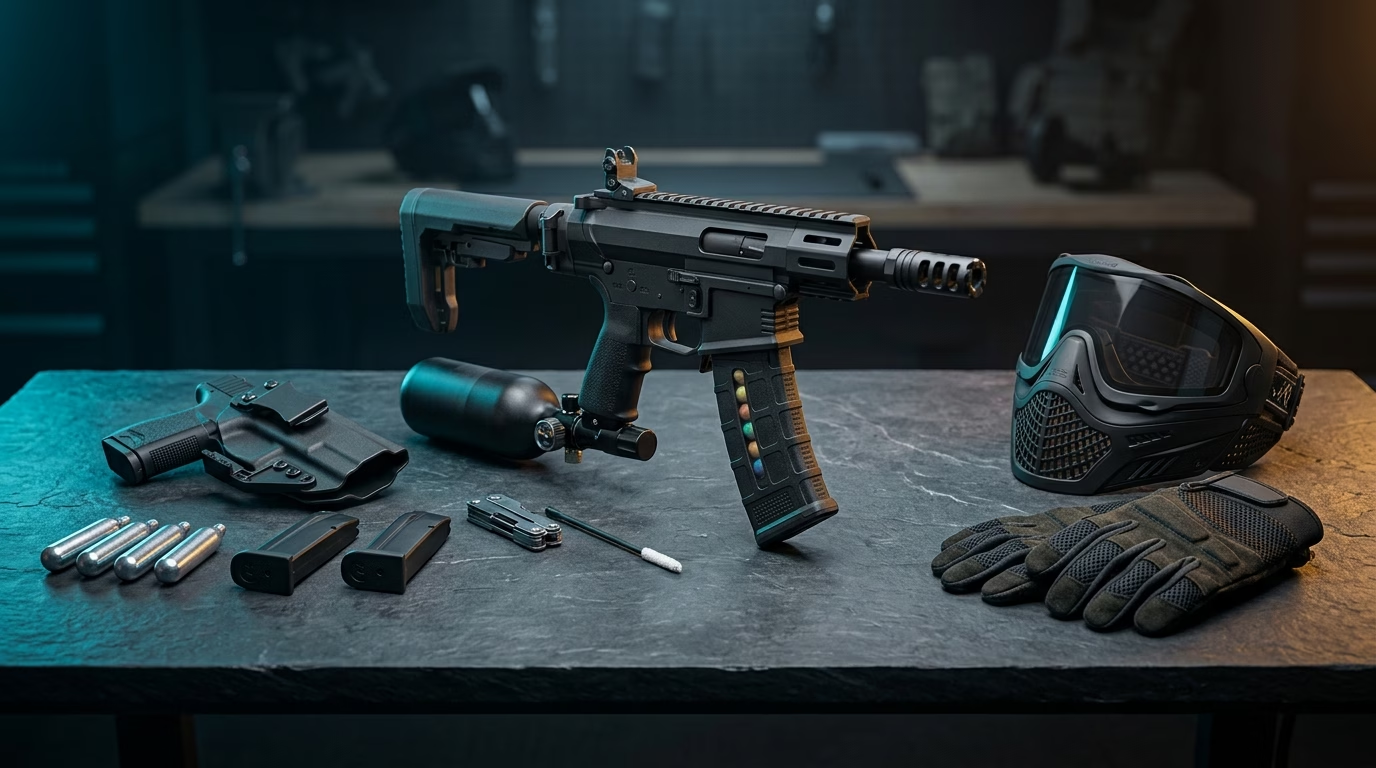
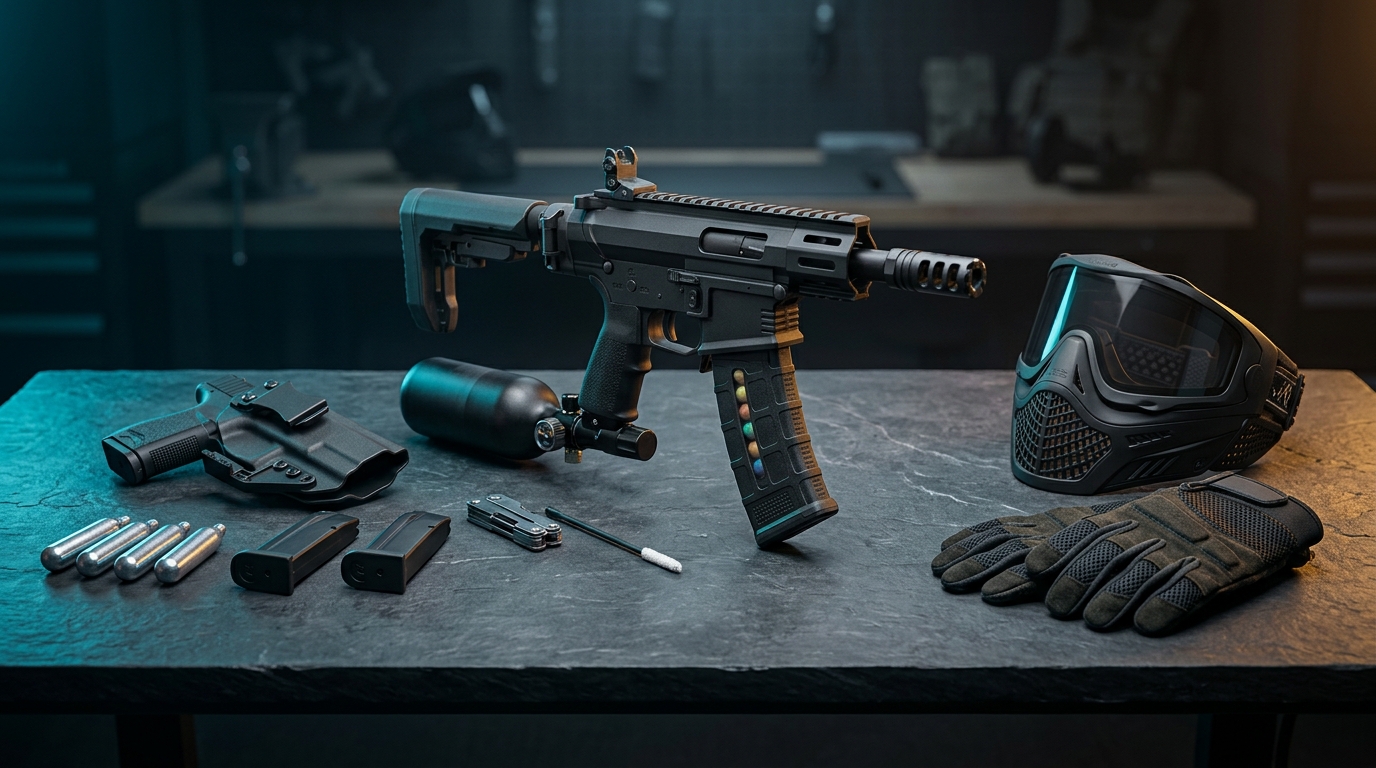
- Compact Mechanical & Pistol Loadouts: Full-size 14-inch barrels and 68ci tanks cause lethal bunker snagging in tight 30-inch doorways. The ultimate CQB weapon system combines a short-barrel MagFed platform like the Planet Eclipse EMF100 ($599.95) or a secondary sidearm like the Tippmann TiPX Pistol ($279.95).
Top CQB Platform: Planet Eclipse EMF100 Tactical MagFed Marker
135 PSI Gamma Core spool valve, modular continuous-feed CF20 magazines, zero external hoses, and short-barrel CQB configuration. Cradles brittle paint and First Strike shaped rounds with pinpoint building-clearing consistency.
Whether you are clearing abandoned mock-city structures, shipping containers, multi-room kill houses, or close-range scenario compounds, understanding spatial geometry and kinetic weapon profiles is what separates tournament-level room clearers from casual players. To find your exact tactical weapon balance, test our interactive Marker Finder Quiz & Loadout Builder or compare primary weapon budgets in our Best Paintball Guns Under $600 and Best Paintball Guns Under $800 authority roundups.
1. The Geometry of Urban Paintball: Slicing the Pie & Fatal Funnels
In open woodsball or inflatable speedball, ballistics trajectory and lane suppression reign supreme. In close-quarters urban environments, geometry rules the field. Every doorway, window, and hallway represents a lethal architectural bottleneck known as the “Fatal Funnel”.
Step-by-Step Angle Slicing (“Pie-ing the Corner”):
- Maintain a 3-to-5 Foot Offset: The single most common rookie error in CQB is “hugging the wall.” When you press your body flat against a barricade or doorframe, your marker barrel, hopper, and lead foot stick out into the hallway long before your eyes can clear the room. Backing off 3 to 5 feet widens your field of view while keeping your silhouette concealed behind the wall.
- Lateral Micro-Steps: With your marker firmly tucked into your shoulder pocket and eyes tracking right along the top of the barrel, take slow, deliberate 6-inch lateral steps along an arc. Each step reveals a 5-to-10 degree “slice” of the hidden room interior.
- Isolating Bunker Duels: Pie-ing the angle ensures that even if three defenders are waiting inside a room, you only engage them one at a time. The geometry of the doorframe physically shields you from the defenders on the far right while you isolate and eliminate the defender tucked in the left corner.
- Switching Hands (Off-Hand Proficiency): CQB forces you to peek around left-hand and right-hand corners equally. If you cannot shoot off-hand (switching your marker from your right shoulder to your left shoulder), you will expose 70% of your torso when peeking weak-side angles. Practice off-hand snapping until your transition takes under 0.8 seconds.
2. Real-World CQB Ballistics: 40-Shot Chronograph Logs & Kinetic Energy
Engaging opponents at distances between 5 and 25 feet requires strict adherence to safety limits and ballistics consistency. Spikes in muzzle velocity that might be tolerable at 60 yards in woodsball become painful and hazardous at point-blank CQB ranges. To establish the premier CQB weapon platforms, our armorer team logged 40-shot strings using .68 caliber competition paint across the top CQB weapon systems: the Planet Eclipse EMF100, the Tippmann TiPX Pistol, and the Tippmann Stormer Elite (ranked in our Best Paintball Guns for Woods and Best Paintball Guns Under $200 guides). Velocity was measured at 70°F and kinetic energy verified via our Paintball FPS to Joules Calculator.
| CQB Marker Platform | Drivetrain Engine | Operating PSI | 40-Shot FPS Range | Mean Velocity / Kinetic Energy | Std Dev (±FPS) | CQB Mobility Rating |
|---|---|---|---|---|---|---|
| Planet Eclipse EMF100 | Gamma Core Spool | 135 PSI | 278 – 284 FPS | 281.2 FPS / 11.76 J (8.67 ft-lbs) | ±1.7 FPS | 9.8 / 10 |
| Tippmann TiPX Pistol | Under-Barrel Inline Spool | 800 PSI (12g CO2) | 268 – 279 FPS | 273.5 FPS / 11.12 J (8.20 ft-lbs) | ±2.9 FPS | 10 / 10 |
| Tippmann Stormer Elite | Inline Blowback Poppet | 800 PSI (HPA) | 274 – 285 FPS | 279.4 FPS / 11.61 J (8.56 ft-lbs) | ±3.2 FPS | 8.9 / 10 |
At CQB distances, holding kinetic energy below 12.0 Joules (under 285 FPS) provides maximum safety compliance while delivering clean shell fractures on tactical vests and padded jerseys without bouncing off. Sizing your paint barrel bore with precision using our Barrel Bore Matcher prevents underbore rollouts during rapid corner snaps.
3. Top CQB Weapon Systems Evaluated: Rifles, MagFed & Sidearms
1. Planet Eclipse EMF100 ($599.95 MSRP): The Undisputed CQB MagFed King
The Planet Eclipse EMF100 (previously known as the MG100, reviewed alongside its flagship aluminum successor in our Planet Eclipse EMF200 Review and mechanical sibling EMEK 100 Review) is the gold standard for tactical room clearing. Built around the proven 135 PSI Gamma Core drivetrain, the EMF100 delivers tournament-grade spool consistency inside an ultra-rugged, glass-reinforced nylon tactical receiver.
In close-quarters compounds, the EMF100 excels because you can strip away the external handguard shroud and bulky stock, reducing the total marker length to under 18 inches. Operating on 20-round continuous CF20 magazines, you eliminate the massive sight-line obstruction of an overhead hopper. In our 40-shot chronograph string, it held a stellar ±1.7 FPS consistency. It shoots both roundballs and First Strike shaped projectiles with zero breech chops, sharing high-efficiency DNA with mechanical legends like the EMEK 100 and Etha 3M.
🎯 CQB Performance Scorecard:
- Tight-Space Mobility: 9.8/10 — Short-barrel configuration moves effortlessly through narrow 30-inch doorways.
- Mechanical Reliability: 10/10 — Gamma Core engine never jams on dirt, grit, or debris during room dives.
- Sightline Clearance: 9.9/10 — MagFed feed clears both eyes for 100% unobstructed peripheral vision.
- Sound Signature: 9.5/10 — Low 135 PSI operating pressure muffles muzzle crack inside enclosed rooms.
2. Tippmann TiPX Paintball Pistol ($279.95 MSRP): The Ultimate Secondary Sidearm
When entering a dark, cramped room where even a compact carbine feels cumbersome, the Tippmann TiPX .68 Caliber Pistol is lethal. Powered by standard 12g CO2 cartridges housed directly underneath the barrel, the TiPX fires 8-round Tru-Feed magazines straight through the ergonomic pistol grip.
The TiPX utilizes an internal low-pressure spool valve system, making it far softer on paint and quieter than traditional stacked-tube blowback pistols (such as the budget pump-action JT Splatmaster z100 Pistol). A single 12g CO2 capsule yields approximately 24 to 28 full-velocity shots (three complete magazines), ideal for lightning-fast room clears or transitions when your primary marker runs dry. In our tactical drills, drawing the TiPX from a leg holster took an average of just 0.95 seconds.
🎯 CQB Performance Scorecard:
- Tight-Space Mobility: 10/10 — Zero barrel protrusion; tucks completely against your chest.
- Deployment Speed: 9.8/10 — Sub-second draw time from Kydex or tactical MOLLE holsters.
- Gas Efficiency: 8.8/10 — Requires 12g CO2 cartridge swaps every 3 magazines (see our CO2 Tank Guide).
- Aimed Accuracy: 9.2/10 — Flat shooting out to 25 yards on standard .68 caliber paintballs.
3. Tippmann Stormer Elite ($219.95 MSRP): The Dual-Feed Budget CQB Workhorse
For tactical players who want dual-feed capability under $250 (as spotlighted in our Best Paintball Guns Under $200 guide), the Tippmann Stormer Elite (upgradable with tactical accessories similar to our Proto Rize Upgrades guide) provides bulletproof Tippmann inline poppet durability. It comes factory-equipped with modular conversion kits, allowing you to run 20-round magazines for tactical room clearing or a standard 200-round hopper for high-volume suppressing fire.
The Stormer Elite features four Picatinny rails for mounting tactical CQB flashlights and red-dot reflex sights, an adjustable 6-position collapsible stock, and internal gas line routing. While heavier than the composite EMF100, its high-impact composite shell withstands direct bunker impacts, rough urban gravel, and wall scrapes with zero functional degradation. It shares internal parts commonality with legendary tactical platforms analyzed in our Tippmann X7 vs X7 Phenom comparison.
🎯 CQB Performance Scorecard:
- Tight-Space Mobility: 8.9/10 — Collapsible stock shortens platform; slightly bulkier receiver profile.
- Mechanical Durability: 10/10 — Legendary all-weather Tippmann inline poppet drivetrain.
- Dual-Feed Versatility: 9.7/10 — Switch from MagFed room clearing to hopper woodsball in minutes.
- Cost-to-Performance Value: 9.8/10 — Full tactical kit with 2 magazines and hopper adapter under $220.
🚨 Armorer Warning: 3 Critical CQB Safety & Maintenance Traps
- Surrender Rules & Point-Blank Chronograph Spikes: At close CQB ranges (under 15 feet), paintballs strike with over 11.5 Joules of kinetic energy. Never allow markers to creep past field limits (strictly 280 FPS max). Most commercial urban fields enforce a 10-foot “surrender” or “bang-bang” rule. Always obey field marshals and keep your barrel-blocking device securely attached whenever stepping off the urban grid.
- Magazine Spring Tension & Paint Dimpling: Never leave competition paintballs stored inside spring-loaded CF20 or TiPX magazines between games. Extended spring compression will flatten or “dimple” fragile paint shells in under 20 minutes, causing severe ball curving, misfeeds, and breech chops when firing around tight corners.
- Lens Fogging Under Heavy Respiratory Exertion: Breaching and clearing rooms generates intense adrenaline, rapid breathing, and heat spikes. Single-pane rental masks will fog instantly inside enclosed rooms. A high-grade dual-pane thermal goggle like the Empire EVS or Virtue VIO Ascend is non-negotiable for safe spatial awareness.
4. Team Breach Stacks: Communication & Dynamic Entry Protocol
Solo room clearing is a statistical trap. Even with flawless pie-ing technique, a single player entering a room cannot cover two opposing corners (“blind corners”) simultaneously. CQB mastery relies on two-player breach stacks and non-verbal tap communication:
🛡️ Two-Player Room Clearing Stack Mechanics:
- The Stack Formation: Player 1 (Point) and Player 2 (Support) stack tightly against the wall just outside the fatal funnel, markers raised in the high-ready position. Player 2 places a firm hand on Player 1’s rear shoulder or tactical vest pack.
- The Initiation Squeeze: When the hallway is clear, Player 2 gives a firm double-squeeze on Player 1’s shoulder. This non-verbal signal eliminates shouting, preserving tactical surprise against defenders waiting inside the room.
- Cross-Over Entry (“Criss-Cross”): Player 1 enters swiftly and cuts across the doorway to clear the deep left hard-corner. Player 2 enters immediately behind (within 0.5 seconds) and sweeps the opposite deep right hard-corner. Both threat zones are locked down before the defender can react.
- High-Low Sector Coverage: In long, narrow urban corridors, Player 1 takes a low crouched position with tight snap-shooting coverage, while Player 2 stands directly behind, firing over Player 1’s helmet. This concentrates two markers down a single defensive lane without teammates walking into each other’s lines of fire.
5. Critical Companion Gear: CQB Loadout Synergy
Carrying large tournament speedball gear into an urban CQB structure will handicap your speed and agility. Optimize your kit specifically for tight spaces and door clearing:
🔧 CQB Tactical Loadout Checklist
- Compact 13ci/3000 PSI Aluminum HPA Bottle or 12g CO2: Eliminate massive 68ci tanks that snag on doorframes. A 13ci/3000 tank fits neatly inside a stock or remote line pouch, yielding 140–160 shots—perfect for multi-mag room clearing. Calculate your tank air capacity using our Paintball Tank Shot Calculator and compare tank sizes in our 3000 vs 4500 PSI Tank Comparison.
- Short Rifled or Micro-Honed CQB Barrels (8 to 11 Inches): Long 14-inch and 16-inch barrels stick out past doorways, alerting defenders to your approach. A compact 8-inch to 10-inch barrel maximizes cornering agility without sacrificing accuracy (see our testing on what barrel shoots further and barrel porting acoustics).
- Anti-Fog Dual-Pane Thermal Goggles: Enclosed rooms trap heat and sweat. Ensure 100% optical clarity with a high-end thermal mask like the wide-angle Empire EVS Thermal Mask or the ultra-breathable Virtue VIO Ascend.
- Scenario Game Duration & Ammo Planning: Plan your magazine reloads, pod packing, and field ammo needs based on how long a paintball game lasts during intense urban scenario battles.
6. Frequently Asked Questions (Urban & CQB Paintball Tactics)
1. What is the most effective tactic for clearing a room in CQB paintball?
The most effective tactic is systematic “angle slicing” (pie-ing the corner) from 3 to 5 feet outside the doorway. By taking gradual lateral steps along an arc, you expose and neutralize defenders one by one before stepping through the threshold.
2. Are MagFed markers better than hopper-fed markers in urban CQB games?
Yes. MagFed markers like the Planet Eclipse EMF100 eliminate the large overhead hopper that obstructs your vision and creates an easy target when peeking around corners. They provide complete peripheral vision and allow you to hug tight angles without hopper exposure.
3. What barrel length is best for CQB paintball?
An 8-inch to 11-inch barrel is ideal for CQB. Shorter barrels keep the front profile of your marker tucked behind your hands, preventing the barrel tip from sticking through doorways and telegraphing your position to defenders.
4. What is the “Fatal Funnel” in paintball?
The fatal funnel refers to narrow architectural choke points such as doorways, hallways, and window frames where a player’s movement is restricted. Defenders can easily train their markers on the funnel, making entering without proper angle slicing or breach stacks suicidal.
5. Can you use paintball pistols as a primary weapon for CQB?
Yes. In tight indoor kill-houses and shipping container compounds, pistols like the Tippmann TiPX offer unmatched mobility and cornering speed. With 7 to 8-round magazines and sub-second draw times, experienced players can easily outmaneuver players carrying heavy full-size markers.