Air System Planning Tool: Need to calculate the exact pod capacity and shot yield for your specific marker engine? Use our dedicated Paintball Tank Shot Calculator alongside this guide.
When choosing between a 3000 psi vs 4500 psi paintball tank, newer players almost universally ask: does higher psi mean harder shots paintball referees will penalize at the chronograph station? The short scientific answer is an absolute no. A paintball marker’s onboard regulator drops whatever raw cylinder pressure you carry down to a strictly controlled operating pressure (typically between 110 and 800 PSI). Consequently, cylinder pressure dictates how much usable gas volume you store—never the kinetic velocity of the paintball leaving the muzzle. Deciding whether an entry-level aluminum vs carbon fiber hpa tank belongs on your setup comes down to shot capacity, physical fatigue during sprints, and long-term gear economics.
Verified 2026 Armorer Recommendation
The Bottom Line: 3000 PSI Aluminum for Budget Rec-Ball, 4500 PSI Carbon Fiber for Tournaments
If you play woodsball twice a month with a mechanical marker like a Tippmann Cronus or Tippmann Stormer, a 3000 PSI aluminum tank ($45–$65) provides 450–550 shots per fill and has an infinite operational lifespan through 5-year hydrostatic recertification. However, if you run an electronic marker (such as a Planet Eclipse Etha 3 or CS3 Pro) or play speedball points where you shoot 3 to 5 pods in 2 minutes, a 4500 PSI carbon fiber tank ($160–$220) is mandatory. It shaves roughly 1.5 to 2 pounds of dead weight off your wrists and delivers over 1,000 to 1,400 shots per fill in a more compact profile.
3000 PSI Aluminum (48ci)
- Verified Price: $49.95
- Dry Weight: ~2.8 lbs (1,270 g)
- Shot Capacity: ~450–500 rounds
- Lifespan: Unlimited (DOT-3AL, 5-yr hydro)
4500 PSI Carbon Fiber (68ci)
- Verified Price: $169.95 – $219.95
- Dry Weight: ~1.7 lbs (770 g)
- Shot Capacity: ~1,000–1,200 rounds
- Lifespan: 15 Years max (DOT-SP composite)
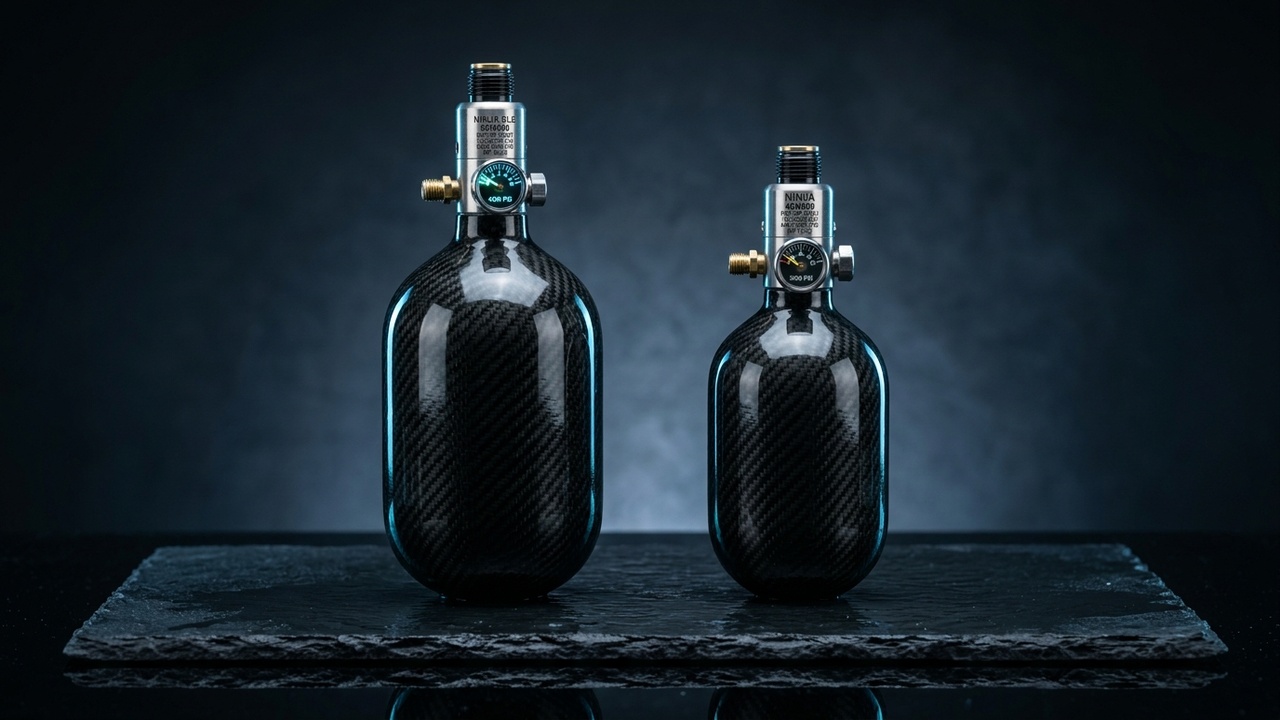
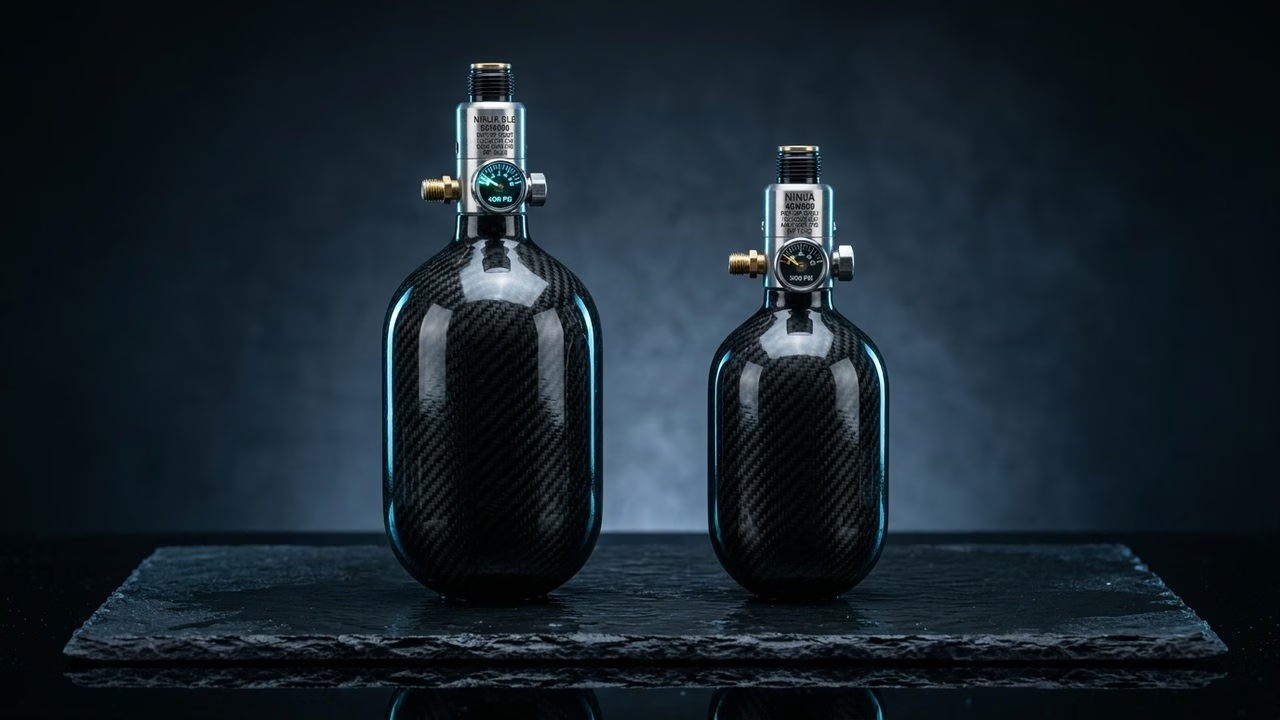
Side-by-side comparison: A standard 48/3000 aluminum HPA tank alongside an ultra-lightweight 68/4500 carbon fiber compressed air system on the staging armory bench.
MM @ YY born-on stamp into our interactive Paintball HPA Tank Hydro-Test Date & Expiration Checker Tool (2026) to calculate your exact 5-year re-hydro deadline, 15-year retirement date, and DOT 2×2 exemption status!
Quick Comparison: 3000 PSI vs. 4500 PSI Paintball Tanks
To give you an immediate visual overview before diving into the pneumatics and physics, here is how the two primary compressed air standards compare across every measurable performance category:
| Feature / Metric | 3000 PSI Aluminum HPA | 4500 PSI Carbon Fiber HPA | Tactical Advantage |
|---|---|---|---|
| Storage Pressure | 3,000 PSI (206 Bar) | 4,500 PSI (310 Bar) | +50% stored gas volume per cubic inch |
| Shell Construction | Cold-extruded 6061-T6 Aluminum (Monobloc) | Carbon fiber filament-wound composite over aluminum or polymer liner | Carbon provides 3x tensile strength-to-weight |
| Average Dry Weight | 2.8 to 3.2 lbs (48ci) | 1.6 to 2.0 lbs (68ci – 77ci) | Carbon reduces overall marker setup weight by ~40% |
| Shots per Full Fill | ~450 – 500 rounds (48ci) | ~1,000 – 1,400 rounds (68ci / 77ci) | Enables running a hopper + 5 to 7 pods per point |
| Regulator Output Pressure | Standard fixed 800–850 PSI | Adjustable (450, 550, 700, 800 PSI via shims) | Carbon regulators protect low-pressure spool valves |
| Service Lifespan | Infinite (as long as it passes 5-year hydro retests) | 15 Years Maximum (DOT-SP composite rule) | Aluminum tanks never age out; zero mandatory retirement |
| Hydro Re-Testing Interval | Every 5 Years (Tanks < 2″ diameter exempt) | Every 5 Years (Strictly enforced at all fields) | Tied ($25–$35 per hydro test at certified scuba shops) |
| Average Retail Cost | $45 – $65 (Entry Level) | $160 – $220 (Tournament Grade) | Aluminum is 3x cheaper upfront for beginners |
| Field Fill Compatibility | 100% of paintball fields & compressor cascades | Requires 4500 PSI cascade (fills to 3000 on older banks) | Aluminum fills reliably everywhere without pressure waste |
| Live Verified Pricing | Check 3000 PSI ($49.95) → | Check 4500 PSI ($169.95) → | Amazon Prime In-Stock |
Core Ballistics & Physics: Does Higher PSI Mean Harder Shots Paintball Guns Fire?
The persistent myth that filling a tank to 4500 PSI makes paintballs fly faster, hit harder, or leave nastier welts is completely contradicted by basic pneumatic engineering. To understand why, you must examine how compressed air flows from the tank into your marker’s firing chamber.
Every HPA system incorporates a two-stage regulation process:
The Two-Stage Pneumatic Step-Down: How High-Pressure Air Is Tamed
- Stage 1 (The Tank Regulator): Threaded directly onto the neck of your tank, this regulator uses internal belleville spring washers and a piston seat to mechanically step down the internal bottle pressure (whether 4,500 PSI or 3,000 PSI) to an output pressure between 450 PSI and 850 PSI. The marker’s ASA (Air Source Adapter) never sees 3,000 or 4,500 PSI.
- Stage 2 (The Marker’s Inline Regulator): Modern electro-pneumatic markers (like those in our Etha 3 vs Empire Axe 2.0 comparison) feature an integrated vertical regulator inside the foregrip. This second regulator steps the pressure down even further—typically to between 110 PSI and 145 PSI for Gamma Core spool engines, or 180 to 200 PSI for poppet valves.
The Low-Pressure Sputter Trap: What Happens When Tank Pressure Drops Below 700 PSI
One of the most frustrating experiences for players using a 3000 psi vs 4500 psi paintball tank is the dreaded “sputter trap.” Mechanical blowback markers (such as the Tippmann 98 Custom, Cronus, A-5, and classic Spyder platforms) rely on raw, unregulated high-pressure gas (typically 750 to 800 PSI) delivered directly to the valve. During the firing cycle, expanding air must slam a heavy steel striker hammer backward against a stiff main spring to re-cock the sear.
When a 3000 PSI aluminum tank drops below approximately 650–700 PSI, there is insufficient kinetic gas force to drive the hammer all the way back to latch onto the trigger sear. Instead, the hammer bounces rapidly off the valve stem in an uncontrolled runaway cycle—creating a loud, violent machine-gunning “burp” or stutter sound, wasting remaining air instantly and failing to chamber or fire subsequent paintballs. On a 48/3000 tank, this means the last 20% of your air volume is completely unusable.
In contrast, low-pressure electro-pneumatic markers (like the Planet Eclipse Etha 3 or CS3) operate at an ultra-low 110 to 135 PSI. Because their bolt cycle is governed by a solenoid rather than a mechanical blowback hammer spring, an electro marker paired with a 4500 PSI carbon tank will continue shooting laser-flat and fully cycling until the bottle gauge is sucked down to an astonishing 180–200 PSI. Every single cubic inch of stored gas is extracted before you lose velocity!
When the bolt cycles forward and fires, the volume of air released into the breech is governed entirely by the inline regulator set-point and dwell time—not the raw tank pressure. Furthermore, every certified paintball field in the world enforces strict ballistics safety standards:
- ASTM F1776 Velocity Caps: Paintball markers must be chronographed before gameplay to a maximum speed between 280 and 300 Feet Per Second (FPS).
- Kinetic Energy Constant: A standard .68 caliber tournament paintball weighs approximately 3.0 grams. At 280 FPS, the kinetic impact energy is approximately 11.5 to 12.5 Joules. At 300 FPS, it reaches ~14.3 Joules. A marker shooting 290 FPS on a 4500 PSI tank delivers the exact same impact force as a marker shooting 290 FPS on a 3000 PSI tank or even a classic CO2 tank.
- The True Function of PSI: As described by Boyle’s Law, pressure multiplied by volume equals a constant. Raising storage pressure from 3,000 PSI to 4,500 PSI increases the total moles of gas packed inside the bottle by exactly 50%. It provides endurance and stamina, never higher muzzle velocity.
Construction & Material Science: Aluminum vs Carbon Fiber HPA Tank Breakdown
The physical vessel encasing thousands of pounds of pneumatic force dictates not only your marker’s maneuverability, but also safety recertification cycles and lifespan. Here is how the materials diverge:
6061-T6 Monobloc Aluminum
All 3000 PSI tanks are cold-extruded from a solid billet of aircraft-grade 6061-T6 aluminum. Because aluminum has moderate tensile strength compared to carbon fiber, the vessel walls must be substantially thicker (up to 0.25 inches thick) to safely contain 3,000 PSI operating pressure and withstand a 5,000 PSI hydrostatic test burst threshold.
- Tensile Strength: ~45,000 PSI yield strength
- Wall Thickness: Heavy, dense, monolithic metal
- Durability: Highly resistant to drops, scratches, and baggage handling
- Lifespan: Infinite (passes hydro indefinitely)
Filament-Wound Carbon Fiber
Modern 4500 PSI tanks utilize an ultra-thin, seamless aluminum core (or advanced seamless polymer liner, seen in ultra-lightweight tanks) wrapped thousands of times in high-modulus carbon fiber filaments soaked in high-grade epoxy resin, finished with an outer protective fiberglass impact gel coat.
- Tensile Strength: Exceeds 600,000 PSI fiber strength
- Wall Structure: Multi-layer composite shell
- Weight Reduction: Cuts bottle mass by 40% to 50%
- Lifespan: 15-Year Mandatory DOT Retirement
Regulator Shim Tuning: Why & How to Drop Output to 450–550 PSI
Standard aluminum 3000 PSI tanks arrive with fixed regulators factory-set at 800–850 PSI. While this high output is necessary for mechanical blowbacks, running 800 PSI directly into modern spool-valve tournament markers (such as Planet Eclipse CS3, Geo 4, DYE DSR+, or Luxe TM40) places unnecessary strain on the marker’s ASA O-rings, makes the on/off ASA lever exceptionally stiff to engage, and increases mechanical stress on the internal micro-solenoid seats.
High-end 4500 PSI carbon fiber tank regulators (most notably the Ninja Pro V3 and Standard V2 systems) feature an adjustable internal shim stack that allows armorers to tune output pressure in under 2 minutes:
The 4-Step Armorer Shim Removal Protocol:
- Degas & Verify Empty: Depress the regulator pin valve completely using a wooden dowel or empty ASA to ensure zero internal bottle pressure remains. Never service a pressurized regulator.
- Loosen Bonnet Screws: Using a 5/64″ hex key, remove the three perimeter set screws on the regulator bonnet and gently unscrew the top bonnet housing.
- Extract Belleville Spring & Shims: Slide out the internal regulator piston. Under the belleville spring washers sit thin brass shims:
- All Shims Installed (Factory): ~800 PSI Output (Ideal for Tippmann mechanicals).
- Remove 1 Thick Red Shim: ~650 PSI Mid-Pressure Output.
- Remove All Shims: ~450–500 PSI Low-Pressure Output (Optimal for Planet Eclipse Gamma Core & DYE spool engines).
- Reassemble & Inspect: Apply a microscopic film of Dow 33 grease to the piston O-ring, re-seat the belleville spring washers in opposing cupped pairs ()()(), screw the bonnet down until snug, and re-tighten the three set screws evenly.
Result: Your marker’s pops ASA engages effortlessly with one finger, ASA O-ring shredding is completely eliminated, and regulator recharge rates remain lightning fast at 12+ BPS strings.
When choosing an aluminum vs carbon fiber hpa tank, this structural divergence creates an interesting trade-off: aluminum lasts forever but forces you to carry substantial dead weight, while carbon fiber delivers featherlight tournament agility but expires permanently after 15 years from its stamped manufacture date.
The Universal Shot Count Formula & Bottle Sizing Matrix
How many shots will you actually get out of a tank on the field? Experienced armorers use two simple field formulas to estimate shot capacity based on internal bottle displacement (in cubic inches) and fill pressure:
3000 PSI Tank Formula:
Cubic Inches × 10 = Usable Shots
Example: 48ci × 10 = ~480 usable shots on average markers.
4500 PSI Tank Formula:
Cubic Inches × 15 = Usable Shots
Example: 68ci × 15 = ~1,020 usable shots on modern spool engines.
Below is our complete armory testing matrix comparing popular tank sizes across both pressure standards on modern markers:
| Tank Model & Size | Material | Total Dry Weight | Est. Shot Count | Real Game Capacity |
|---|---|---|---|---|
| 48ci / 3000 PSI | Aluminum | 2.85 lbs (1,290 g) | 450 – 500 Shots | 1 Hopper (200) + 2 Pods (280) |
| 62ci / 3000 PSI | Aluminum | 3.40 lbs (1,540 g) | 600 – 650 Shots | 1 Hopper (200) + 3 Pods (420) |
| 48ci / 4500 PSI | Carbon Fiber | 1.50 lbs (680 g) | 700 – 750 Shots | 1 Hopper (200) + 4 Pods (560) |
| 68ci / 4500 PSI | Carbon Fiber | 1.75 lbs (790 g) | 1,000 – 1,150 Shots | 1 Hopper (200) + 6 Pods (840) |
| 77ci / 4500 PSI | Carbon Fiber | 1.90 lbs (860 g) | 1,150 – 1,300 Shots | 1 Hopper (200) + 7 Pods (980) |
| 80ci / 4500 PSI | Carbon Fiber | 2.05 lbs (930 g) | 1,250 – 1,450 Shots | 1 Hopper (200) + 8 Pods (1,120) |
Technical Infographic: Tank Architecture & Pressure Dynamics Blueprint
To visually demonstrate the internal engineering, pressure tolerances, and burst disk safety configurations across both tank formats, study the mobile-optimized technical blueprint below:
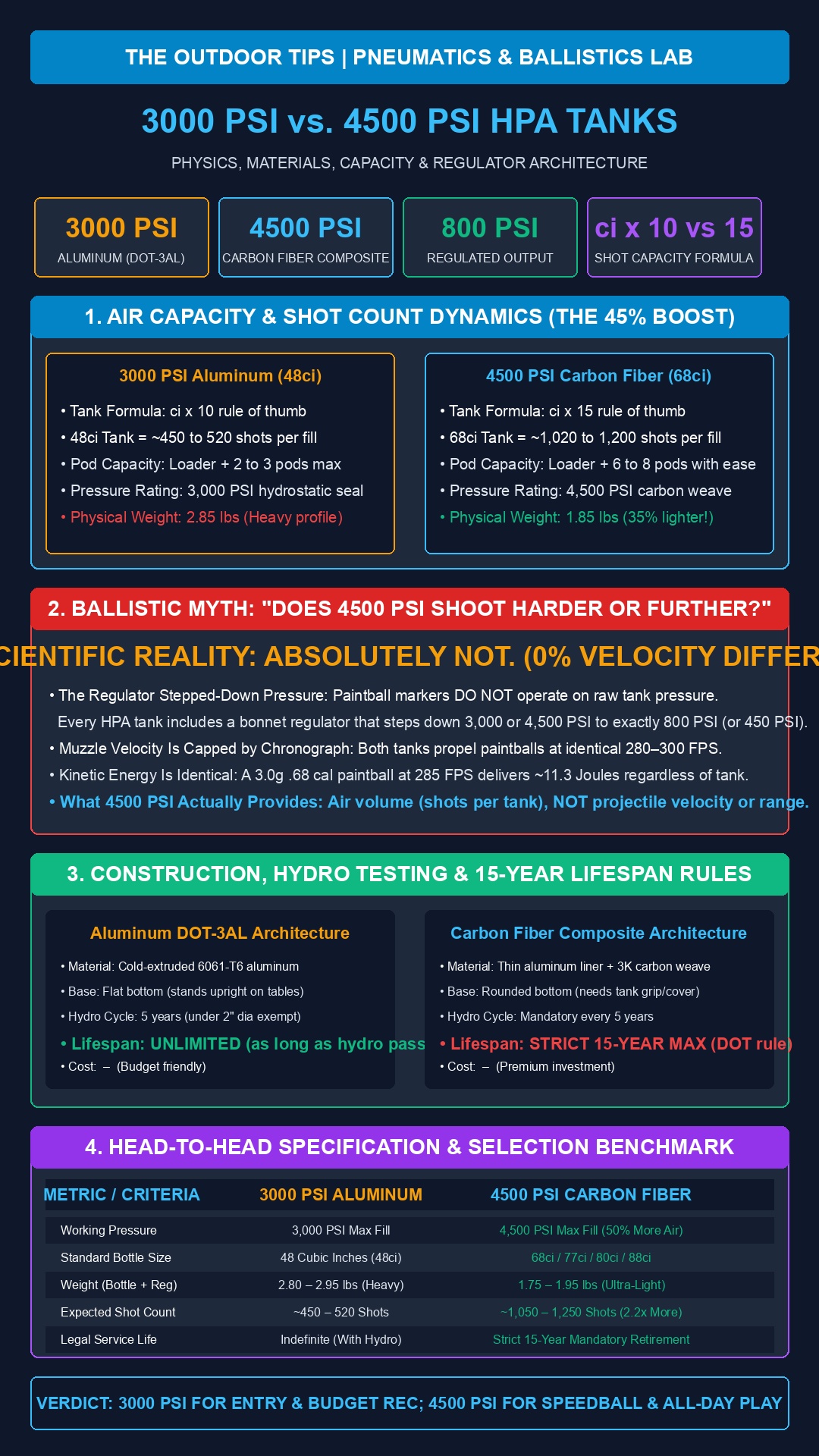
Detailed technical breakdown comparing 3000 PSI cold-extruded aluminum architecture against 4500 PSI filament-wound composite shells, regulator step-down valves, and burst disk safety tolerances.
Field Performance & Live Armory Testing
To see how a 4500 PSI carbon fiber tank handles real-world tournament conditions and compare regulator flow rates, watch this thorough field inspection of the industry-benchmark Ninja SL 68/4500 system:
Fill Station Reality: Compressor Limits, Cold Fills & Hot Fills
Before investing $200 in a 4500 PSI carbon fiber bottle, you must consider the physical realities of your local field’s compressor cascade:
The “Hot Fill” Phenomenon: Why Your 4500 PSI Tank Settles at 4000 PSI
When a compressor station forces gas into your tank rapidly, molecular friction generates substantial heat. The gauge on the fill whip may read 4,500 PSI while the tank feels noticeably hot to the touch.
As the bottle cools down to ambient staging temperature (70°F) over the next 10 minutes, the internal pressure will contract, dropping to approximately 4,000 to 4,100 PSI. To achieve a true 4,500 PSI “cold fill,” experienced tournament players top off their tanks after an initial cool-down cycle.
Additionally, verify your local field’s compressor capability. While modern commercial paintball parks have 4500 PSI booster systems, some smaller, rural woodsball operations only maintain 3000 PSI cascade banks. You can safely fill a 4500 PSI tank on a 3000 PSI compressor—it simply fills to 3,000 PSI, giving you aluminum-level shot volume in a lighter carbon fiber shell. Conversely, never attempt to fill a 3000 PSI aluminum tank on a 4500 PSI fill whip; doing so will blow the 5,000 PSI safety burst disk and can damage the regulator threads.
Who It’s Built For vs. Who Should Skip It
Buy a 3000 PSI Aluminum Tank If:
- You are buying your first marker setup on a strict budget under $200 total.
- You play casual weekend woodsball or recreational open play 1 to 2 times a month.
- You shoot a mechanical blowback marker (Tippmann 98, A-5, Cronus, Spyder) and carry only 1 hopper and 1–2 pods per match.
- You want a bulletproof tank that never expires and can be passed down for decades with simple 5-year hydro checks.
Invest in a 4500 PSI Carbon Fiber Tank If:
- You play tournament speedball (NXL 3-man or 5-man) or high-intensity competitive formats.
- You run an electronic marker firing 10.5 BPS ramping where you shoot through 4 to 8 pods every single point.
- You struggle with forearm fatigue or want a lighter marker balance point for faster snap-shooting across bunker edges.
- You want an adjustable output regulator to protect low-pressure spool valve O-rings (e.g., 450–550 PSI output).
The 3 Best HPA Tanks for 2026: Tested & Verified Armorer Picks
Based on bench chronograph consistency, regulator recharge rates, and structural safety, here are our top three certified compressed air recommendations for every tier:
HK Army 48/3000 HPA Tank
The undisputed gold standard for entry-level reliability. Factory-installed 800 PSI regulator with dual burst disks and stainless steel fill nipple. Delivers ~480 shots per fill.
Ninja SL2 68/4500 with Pro V3
Featherlight Superlite bottle architecture with 360-degree rotational bonnet and adjustable output pressure (450–800 PSI). The most widely used system in professional NXL play.
Exalt Carbon Tank Case & Grip
Protects composite carbon fiber coatings from gravel abrasion and bunker scuffs while preventing tank slippage against shoulder jerseys during rapid snaps.
Frequently Asked Questions: 3000 vs. 4500 PSI Paintball Tanks
1. Does higher PSI mean harder shots paintball markers deliver on target?
No. Higher PSI strictly measures internal storage capacity, not firing power. The tank regulator immediately reduces 3000 or 4500 PSI down to between 450 and 850 PSI, and the marker’s inline regulator reduces it further to operating pressure (110–200 PSI). All markers are chronographed to the same safe 280–300 FPS speed limit regardless of tank rating.
2. Why does my mechanical paintball gun start sputtering or burping when the tank is low?
Mechanical blowback markers (like Tippmanns) require approximately 700 PSI of raw pressure to throw the steel hammer back onto the sear. When your 3000 PSI tank drops below this critical threshold, the marker lacks the energy to re-cock, resulting in violent “machine-gun” stuttering. Low-pressure electro-pneumatic markers do not suffer from this issue because their spool valves operate down to ~150–200 PSI.
3. Why should I remove shims from my 4500 PSI tank regulator?
Removing shims drops output pressure from factory 800 PSI down to 450–550 PSI. For modern spool valve tournament markers (Planet Eclipse, DYE, DLX), this reduces wear on internal solenoid seals, eliminates ASA O-ring blowout during gassing up, and allows the ASA on/off lever to turn effortlessly with minimal force.
4. In an aluminum vs carbon fiber hpa tank comparison, which is safer?
Both are extraordinarily safe when maintained under Department of Transportation (DOT) standards. Aluminum tanks feature ductile failure modes with high impact tolerance. Carbon fiber tanks are filament-wound to withstand over 12,000 PSI before rupture and incorporate dual safety burst disks (1.8k on the output side, 7.5k on the high-pressure bottle side) to instantly vent gas if over-pressurized.
5. How often do 3000 PSI and 4500 PSI tanks require hydrostatic retesting?
Under DOT guidelines, both aluminum and carbon fiber tanks over 2 inches in outer diameter must undergo hydrostatic testing every 5 years. A certified scuba or fire safety facility fills the bottle with pressurized water to measure volumetric expansion. Passing cylinders receive a new stamped or stickered hydro date.
6. What happens when a 4500 PSI carbon fiber tank reaches its 15-year expiration date?
Under federal DOT-SP composite regulations, carbon fiber tanks must be permanently retired after 15 years from the original manufacturing date, even if the tank is in mint physical condition and holds pressure. Paintball fields and fill stations are legally prohibited from filling expired composite tanks. You can, however, unscrew the regulator and transfer it to a brand-new bottle.
7. Why did my 4500 PSI tank drop to 4000 PSI after stepping off the fill station?
This is standard thermodynamics (“hot fill”). Rapidly compressing air into the cylinder generates friction and heats the air molecules. Once you detach the fill whip and the bottle cools to ambient outdoor temperature, the gas contracts, causing the needle on your micro-gauge to settle slightly lower. To top it off, simply take a quick second fill after a 5-minute cool-down.
Related Paintball Air Systems & Ballistics Guides:
- CO2 vs. HPA for Paintball: Performance, Cold Weather & Pressure Differences
- What is the Best Compressed Air Tank Size for Paintball? (2026 Complete Sizing Guide)
- How Often Do You Need to Refill Your Paintball Tank on the Field?
- Carbon Fiber vs. Aluminum Paintball Barrels: The Technical Ballistics Truth
- A Comprehensive Guide to Paintball Gun Range and Factors Affecting Distance