⚡ How Often Do You Need to Refill Your Paintball Tank? (Quick Verdict)
- Casual Rec-Ball Rule: When asking how often do you need to refill your paintball tank?, standard 48ci/3000 PSI aluminum tanks must be refilled every 2 to 3 games (roughly 450–500 shots), while a 68ci/4500 PSI carbon fiber bottle lasts 5 to 7 games (1,000–1,150 shots).
- The Golden Shot Formula: Multiply cubic inches by 10 for 3000 PSI systems (48ci × 10 = ~480 shots) or by 15 for 4500 PSI systems (68ci × 15 = ~1,020 shots).
- The Critical Low-Air Threshold: Never start a match with less than 1,200 PSI. Falling below 800 PSI causes regulator starvation, severe velocity drops below 250 FPS, and catastrophic ball chops.
- Tournament Speedball Protocol: Competitive players top off their tanks after every single match to maintain maximum lane ramping consistency.
Ninja Lite 68/4500 Carbon Fiber Tank
Ultralight DOT-certified carbon composite cylinder with rotational Pro V2 regulator. Delivers 1,100+ shots per fill with rock-solid recharge consistency for tournament speedball and long scenario games.
Empire Basic 48/3000 Aluminum Tank
Indestructible aircraft-grade aluminum HPA bottle factory set to 800 PSI output. The gold-standard entry upgrade for mechanical markers like the Tippmann Cronus, 98 Custom, and Azodin Blitz.
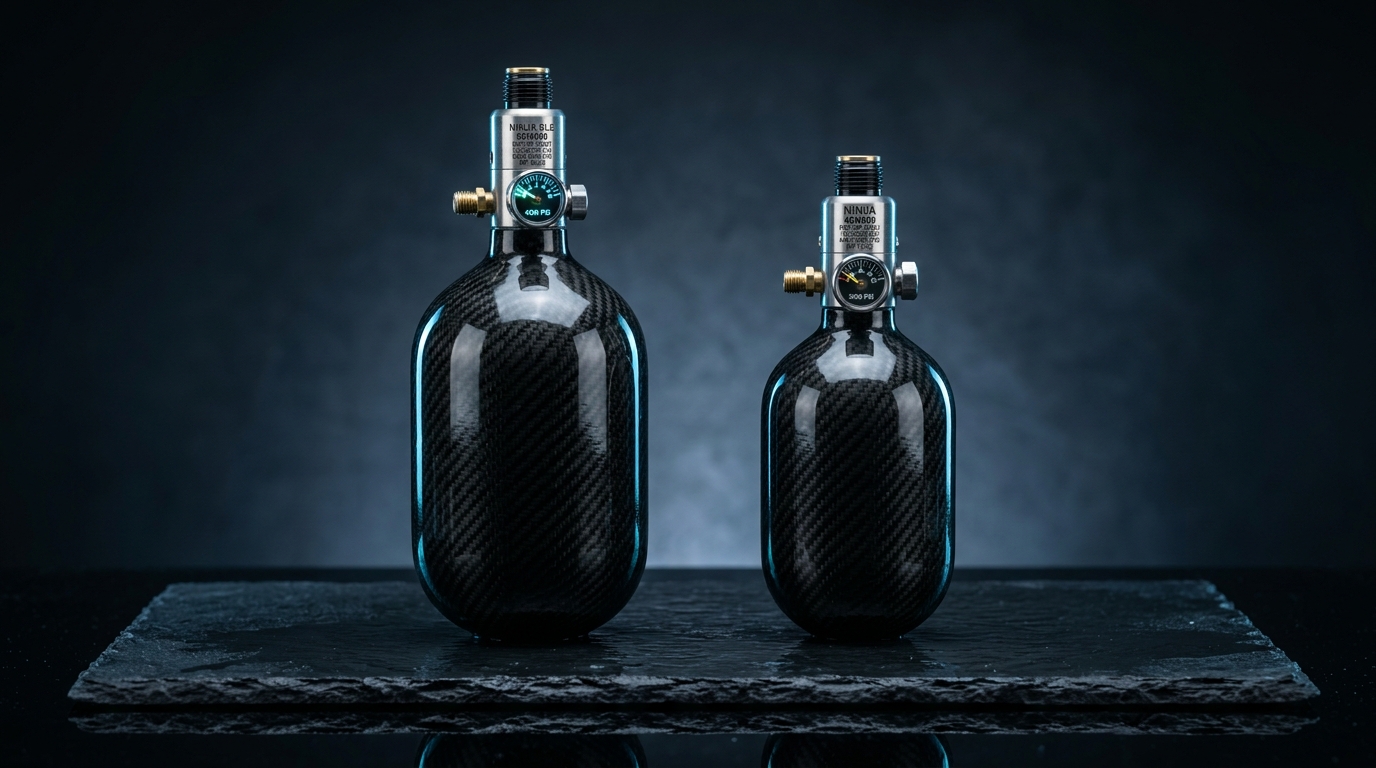
Pneumatics lab setup: 68ci and 77ci carbon fiber HPA tanks on dark graphite stage with high-pressure micro-regulators and fill gauges.
1. Shot Capacities by Tank Size: How Many Pods Can You Shoot?
Nothing ruins a crucial bunker elimination faster than hearing your marker sputter, cough, and dry fire halfway through a match. Understanding how often do you need to refill your paintball tank? comes down to calculating your cylinder’s total usable shot volume against your personal paint consumption cadence.
Paintball tanks are categorized by two numbers: cubic inch volume (ci) and maximum pressure capacity (PSI). In modern paintball, players primarily utilize four distinct air configurations:
48ci / 3000 PSI Aluminum Tank
Shot Count: ~450 to 500 paintballs (1 hopper + 2 standard 140-round pods).
Refill Interval: Every 2 to 3 recreational games.
Field Reality: If you shoot an aggressive lane off the break, you will drain this tank in 2 points. It is best suited for walk-on beginners and light-shooting rec woodsballers.
68ci / 4500 PSI Carbon Fiber Tank
Shot Count: ~1,000 to 1,150 paintballs (1 hopper + 6 pods).
Refill Interval: Every 5 to 7 recreational games (or 1 complete competitive speedball set).
Field Reality: The undisputed gold standard of tournament paintball. It holds enough gas for an entire 500-round bag of paint with margin to spare.
77ci – 80ci / 4500 PSI Carbon Fiber Tank
Shot Count: ~1,300 to 1,450 paintballs (1 hopper + 8 pods).
Refill Interval: Every 7 to 9 games (or 1 multi-hour scenario mission).
Field Reality: Built for back-center lane gunners who shoot 1,000+ rounds per match to pin opposing snake players down. Check our complete sizing guide on the best compressed air tank size for paintball.
20oz CO2 Aluminum Cylinder
Shot Count: ~800 to 1,000 paintballs (warm weather).
Refill Interval: Every 4 to 5 recreational games.
Field Reality: Liquid CO2 expands into gas; however, rapid firing causes thermodynamic freeze-up, reducing velocity dramatically in cold conditions.
Field Refill Frequency by Game Format (Never Run Dry Mid-Match)
How often you walk to the fill compressor depends directly on your field format, firing rate, and tactical role. Follow these tournament-proven rules:
Top Off After EVERY Single Point
Shooting 4 to 6 pods per point means entering the next game with 2,500 PSI guarantees a mid-point shootdown. Walk directly from the field pit to the 4,500 PSI compressor every single game.
Refill Every 2–3 (3000 PSI) or 5–6 (4500 PSI) Games
If using a rental or budget aluminum 48/3000 tank, top off every 2 to 3 rounds. If running a 68/4500 carbon fiber bottle, you safely play 5 to 6 rounds before your needle enters the warning sector.
Refill Strictly During Base Camp Respawn Rotations
Running out of air deep in enemy territory leaves you defenseless. Carry a 77ci or 80ci tank plus a full 4-pod harness; refill at base camp every 1.5 to 2 hours during scheduled team respawns.
2. The Physics of Shot Counting: The 3000 vs. 4500 PSI Rules
To accurately gauge your tank refill schedule without guessing, armorers utilize mathematical shot calculation formulas based on tank pressure and displacement:
📐 The Master Shot Estimation Formulas
For standard high-pressure air (HPA) cylinders operating between 280 and 300 FPS velocity:
- 3000 PSI Tanks: $ ext{Total Shots} = ext{Cubic Inches} imes 10$ (e.g., $48 imes 10 = 480 ext{ shots}$)
- 4500 PSI Tanks: $ ext{Total Shots} = ext{Cubic Inches} imes 15$ (e.g., $68 imes 15 = 1,020 ext{ shots}$; $77 imes 15 = 1,155 ext{ shots}$)
Want an exact calculation tailored to your specific marker and tank combination? Use our interactive paintball tank shot calculator.
Watch veteran paintball technician Brad from Paintball Ruined My Life break down tank dimensions, real-world shot yields, and how to select the ideal air bottle for your setup below:
Marker Drivetrain Impact: Spool Valve vs. Poppet vs. Inline Blowback
Your tank’s shot yield is not decided by the bottle alone; your marker’s internal engine architecture determines how much gas is consumed per trigger pull:
- Low-Pressure Spool Valves (110–135 PSI): Markers like the Planet Eclipse Etha 3, CS3 Pro, and Dye DSR+ operate on soft pneumatic cushions. They extract approximately 15% to 20% more shots per cubic inch because they dump lower gas volumes per cycle.
- In-Line Pressure Poppet Valves (180–200 PSI): Markers like the Empire Mini GS and Axe 2.0 offer outstanding gas efficiency, delivering tight shot strings and low air consumption per pod.
- High-Pressure Mechanical Blowbacks (800 PSI): Classic rental guns like the Tippmann Cronus, 98 Custom, and Spyder Victor require full 800 PSI output to recock heavy striker hammers. They burn roughly 25% more gas per shot, reducing a 48/3000 tank’s yield to ~400 paintballs.
Does Tank Output Pressure (850 PSI vs. 450 PSI) Affect Total Shot Count?
The Short Answer: No. A common misconception among players is that dropping a tank’s output regulator from standard high pressure (850 PSI) down to low pressure (450 PSI or SLP 300 PSI) yields more shots per fill. In reality, total shot yield is governed strictly by the marker’s internal operating pressure (e.g., 110–135 PSI on a Gamma Core spool valve) and bolt cycle dwell.
The tank regulator is merely a primary step-down stage. Whether gas enters your marker’s inline regulator (hyper reg) at 850 PSI or 450 PSI, the inline regulator drops it to the identical 135 PSI chamber pressure. However, setting your tank output to 450–550 PSI reduces mechanical wear on internal transfer seals, makes your on/off ASA noticeably easier to engage, and guarantees lightning-fast solenoid recharge during sustained 10.5 BPS ramping.
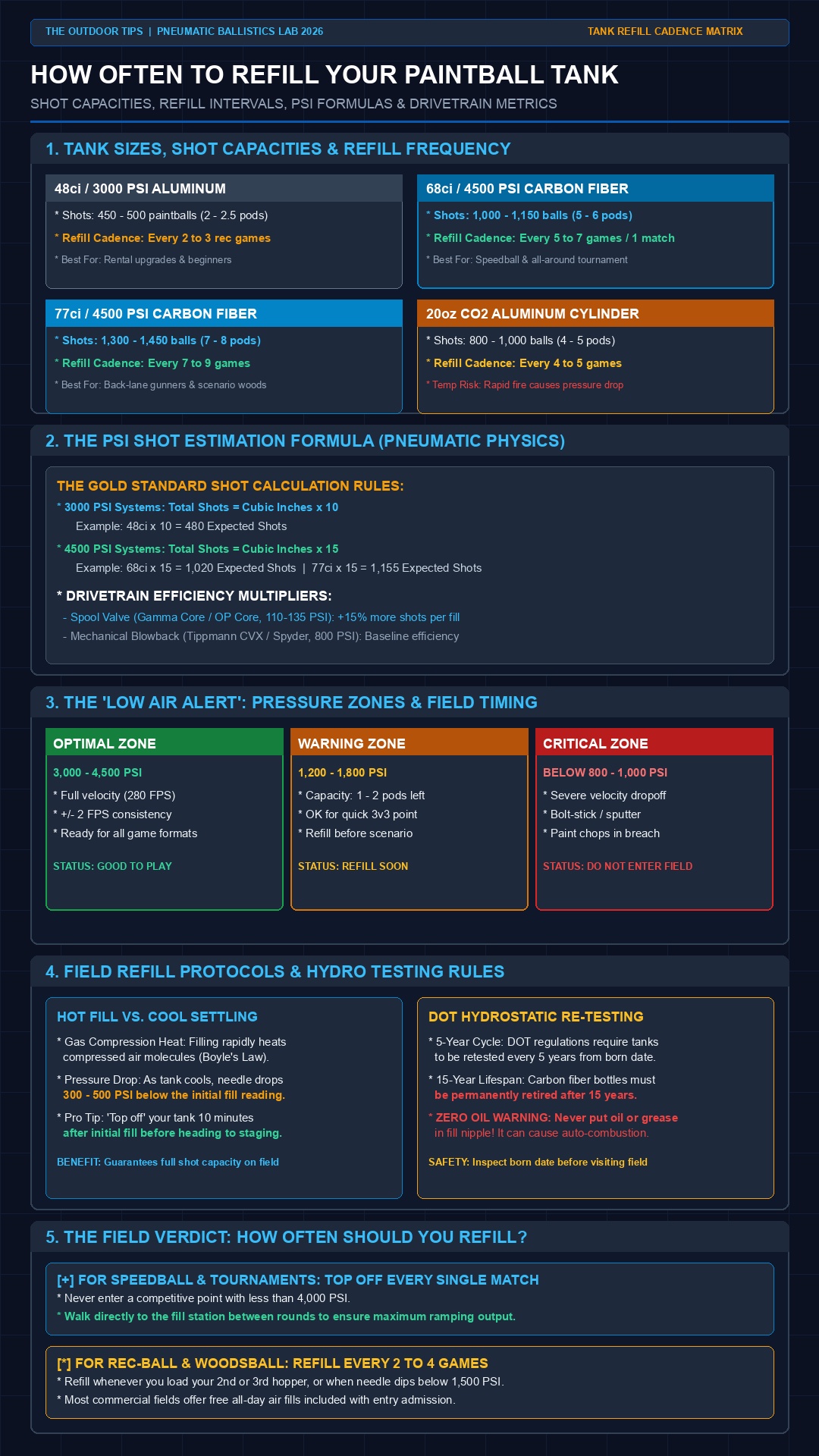
Technical Blueprint: Tank refill cadences, PSI shot calculation formulas, pressure drop-off zones, and safety protocols.
3. The “Low Air Alert”: How to Read Your Gauge & Prevent Shootdowns
Every quality HPA tank regulator features a miniature analogue pressure gauge reading from 0 to 5,000 PSI. Knowing exactly when to step off the field to refill prevents devastating mid-game failures:
🟢 Optimal Zone (2,500 – 4,500 PSI)
Full operating pressure. Your marker maintains rock-solid ±2 FPS velocity consistency. You are cleared for all gameplay formats, long woodsball patrols, or high-cadence tournament points.
🟡 Warning Zone (1,000 – 1,800 PSI)
Tank capacity is down to roughly 1 to 2 pods. You can survive a short 3v3 rec-ball point, but entering a 20-minute scenario game will leave you stranded without air. Refill at the next break.
🔴 Critical Drop-Off Zone (<800 PSI)
Do not enter the field! The tank pressure approaches the marker’s inline regulator setpoint. Muzzle velocity drops below 240 FPS, bolts stick forward, electronic solenoids miscycle, and paintballs chop in the breech.
4. The Refill Protocol: Hot Fills, Pressure Settling & Station Etiquette
If you have ever filled a 4,500 PSI tank, stepped away, and noticed the needle resting at only 4,000 PSI ten minutes later, your tank did not leak. You experienced the thermodynamic reality of hot fills.
🔥 The Thermodynamic Physics of Gas Compression
Under Gay-Lussac’s Law of thermodynamics ($P_1/T_1 = P_2/T_2$), rapidly compressing gas from a field bank system (holding 5,000+ PSI) into your empty cylinder generates substantial heat. The tank shell becomes warm to the touch. As that thermal energy dissipates into ambient air over 10 to 15 minutes, molecular velocity decreases and internal pressure drops by 300 to 500 PSI.
Pro Tournament Habit: Fill your tank immediately after finishing a match. Let it rest in your staging pit for 10 minutes to cool down, then take it back to the fill station for a 5-second “top-off” bump. This guarantees a true, cold 4,500 PSI fill when you walk onto the field.
The 4-Step Self-Serve Refill Protocol (Never Blow a Fill-Nipple O-Ring)
Blown fill-nipple O-rings and deafening air station leaks are 100% preventable. Follow this strict 4-step sequence every time you hook your tank to a field fill whip:
Inspect your male fill nipple for sand, dried paint, or metal burrs. Wipe it completely clean with a microfiber towel. Debris forced in at 4,500 PSI shreds the internal urethane check-valve O-ring instantly.
Retract the female quick-disconnect collar on the fill whip, seat it firmly over your tank nipple, and push the collar fully forward until you hear a positive mechanical ‘click’. Give it a tug to verify lock.
Do not yank the fill lever open! Depress it gradually to introduce gas at a measured cadence. This suppresses Gay-Lussac compression heat, avoids regulator thermal shock, and minimizes post-fill pressure settling.
Never yank a pressurized whip off a tank! Firmly press the station bleed valve until all air exhausts with a loud ‘hiss’. Only when line pressure reaches 0 PSI will the collar slide back effortlessly without damage.
For more detailed step-by-step guidance on regulator maintenance and station rules, consult our full guide on how to refill a paintball tank safely.
5. CO2 vs. HPA Refill Realities: The Temperature Trap
While compressed air tanks (HPA) rely on pure gas, CO2 cylinders store carbon dioxide as a liquid under ~800 PSI equilibrium pressure. This difference dictates drastically different refill behaviors:
- Liquid Weight vs. PSI: CO2 tanks cannot be filled with a standard air compressor. They are filled by mass using a hanging digital scale (e.g., adding exactly 20 ounces of liquid CO2 from a siphon tube mother bottle).
- The Rapid Fire Freeze: As liquid CO2 boils into gas to fire shots, it absorbs environmental heat. Rapid semi-auto firing chills the bottle; in temperatures below 55°F, internal pressure plummets from 800 PSI to under 400 PSI, causing massive velocity drop-off.
- Field Availability: In 2026, most commercial fields have completely phased out CO2 fill stations in favor of clean HPA. If you still shoot CO2, you must pay $4 to $6 per fill at commercial sporting goods stores. Read our full comparison on CO2 vs HPA for paintball.
6. Tank Hydro Testing & The Zero-Oil Safety Warning
Paintball tanks are high-pressure vessels regulated under United States Department of Transportation (DOT) and Transport Canada (TC) safety codes. Keeping your tank compliant is non-negotiable for field access:
⛔ CRITICAL WARNING: Never Put Oil in Tank Fill Nipples
Placing paintball marker oil, WD-40, or petroleum grease into a tank’s fill nipple will cause a catastrophic explosion. When 4,500 PSI of compressed air slams into hydrocarbon oil molecules during a rapid fill, adiabatic compression creates flash temperatures exceeding 1,000°F. The oil auto-ignites like a diesel engine piston, rupturing the regulator and cylinder. Only use clean, dry air.
DOT Hydrostatic Retest Rules: All aluminum and carbon fiber tanks must undergo hydrostatic retesting every 5 years from their stamped “born date” (except small aluminum tanks under 2 inches in diameter). Carbon fiber bottles have a mandatory maximum lifespan of 15 years, after which they must be permanently decommissioned. For pressure threshold comparisons, review our guide on 3000 PSI vs 4500 PSI paintball tanks.
7. The 2026 Head-to-Head Paintball Tank Comparison
Compare verified weights, shot yields, refill cadences, and 2026 market prices across the top paintball air systems:
| Tank System | Material & Pressure | Weight | Shot Capacity | 2026 Price | Live Check |
|---|---|---|---|---|---|
| Ninja Lite 68/4500 | Carbon Fiber (4500 PSI) | 1.98 lbs | 1,100+ shots | $179.95 | Check Amazon ($179.95)eBay Deals |
| Empire Mega Lite 68/4500 | Carbon Fiber (4500 PSI) | 2.05 lbs | 1,050+ shots | $159.95 | Check Amazon ($159.95)eBay Deals |
| Empire Basic 48/3000 | Aluminum (3000 PSI) | 2.85 lbs | 450 – 500 shots | $49.95 | Check Amazon ($49.95)eBay Deals |
| Tippmann 48/3000 | Aluminum (3000 PSI) | 2.90 lbs | 450 – 500 shots | $47.95 | Check Amazon ($47.95)eBay Deals |
| Infamous 80/4500 Skeleton | Carbon Fiber (4500 PSI) | 2.15 lbs | 1,400+ shots | $219.95 | Check Amazon ($219.95)eBay Deals |
8. Frequently Asked Questions (FAQ)
Q1: How often do you need to refill your paintball tank during a typical day?
During a full 5-to-6-hour day of recreational play (shooting roughly 1,000 to 1,500 paintballs), you will refill an aluminum 48/3000 tank 3 to 4 times. If you use a 68/4500 carbon fiber tank, you will typically refill only 1 to 2 times throughout the entire day.
Q2: How often should you refill your tank in tournament speedball vs. woodsball?
In tournament speedball (NXL 10.5 ramping), players top off after every single point (shooting 4 to 6 pods per point to maintain 4,500 PSI). In recreational woodsball (15-minute rounds), players refill every 2 to 3 matches for 48/3000 tanks, or every 5 to 6 matches for 68/4500 tanks. In 24-hour scenario games, players run 77ci or 80ci tanks and refill strictly during base-camp respawn rotations every 1.5 to 2 hours.
Q3: Does an 850 PSI high-pressure tank shoot fewer paintballs than a 450 PSI low-pressure tank?
No. Tank regulator output pressure (850 PSI vs 450 PSI) has zero impact on total shot yield. Shot count is governed strictly by your marker’s internal operating pressure (e.g., 110–135 PSI on spool valves) and bolt chamber volume. The tank regulator simply performs a primary step-down before the marker’s inline regulator sets final firing pressure.
Q4: What is the proper 4-step self-serve refill station protocol?
To prevent blowing fill-nipple O-rings: 1) Cleanliness Check: Wipe dirt and paint off the male nipple; 2) Full Collar Lock: Slide the female quick-disconnect collar forward until it clicks; 3) Slow Lever Depression: Fill slowly to minimize Gay-Lussac compression heat; 4) Mandatory Bleed: Depress the bleed button completely to exhaust trapped line pressure before disconnecting.
Q5: How many pods can you shoot on a 48/3000 tank?
A 48ci 3000 PSI tank holds enough compressed air to empty your 200-round loader plus approximately 2 pods (140 rounds each) before pressure drops into the critical sputter zone below 1,000 PSI.
Q6: Can I fill my paintball tank with a regular garage tire compressor?
No. Standard home garage shop air compressors max out at 120 to 150 PSI. Paintball HPA tanks operate at 3,000 to 4,500 PSI (twenty to thirty times higher pressure). You must use dedicated 4,500 PSI paintball compressors, scuba dive compressors, or specialized high-pressure PCP hand pumps.
Q7: What happens if your paintball tank runs out of air during a game?
As pressure falls below your marker’s operating pressure, shot velocity plummets from 280 FPS down to 180 FPS. Paintballs curve sharply into the dirt. On electronic markers, the bolt fails to cycle completely, leading to ball chops in the breach. On mechanical blowbacks, the marker will violently ‘machine-gun’ or sputter without recocking.
Q8: Do commercial paintball fields charge for air refills?
At almost every registered commercial paintball park, unlimited all-day HPA fills are 100% free and included with your general admission wristband. You can refill at the self-service air station as often as you want between rounds.
The Final Verdict: Mastering Your Field Refill Strategy
Mastering how often do you need to refill your paintball tank? removes field anxiety and keeps you focused on winning matches. If you play casual walk-on games with an aluminum tank, make it a habit to walk to the fill station every time you reload your second pod pack. If you want true all-day freedom, upgrade to a Ninja Lite 68/4500 ($179.95) or Empire Mega Lite 68/4500 ($159.95). A quality carbon fiber bottle gives you 1,100+ shots per fill, saves over a pound of marker swing weight, and ensures you never get caught dry in an overtime firefight.
Pair your high-pressure air system with an efficient electronic loader from our paintball hopper buying guide and an ultralight barrel from our carbon fiber vs aluminum barrels breakdown to build the ultimate tournament-ready setup.