⚡ Quick Field Verdict: What is the Best CO2 Tank Size for Your Paintball Marker?
The 20 oz aluminum tank is the undisputed best CO2 tank size for 90% of all mechanical paintball markers. It yields 1,000 to 1,200 shots per fill—enough for a full 200-round hopper plus 6 pods—allowing an entire afternoon of rec-ball without needing refills. At 3.25 lbs filled weight, it balances perfectly on standard bottom-line ASAs without making mechanical markers like the Tippmann Cronus, A-5, or Spyder Victor overly front- or back-heavy.
- The Industry Standard: 20 oz Tank (~1,100 shots | Best balance of volume, weight, and refill availability).
- Youth & Ultra-Light Pick: 9 oz or 12 oz Tank (~400–600 shots | DOT hydrotesting exempt under the 2-inch rule).
- Heavy Gunner / Remote Line Pick: 24 oz Tank (~1,400 shots | Best carried in a tactical vest harness to prevent marker fatigue).
- Critical Marker Rule: CO2 is strictly for mechanical blowback markers. Never connect CO2 to electronic tournament markers (it destroys delicate solenoids).
Maddog / Empire 20 oz Paintball CO2 Tank
MSRP: $29.95–$34.95 • In Stock & Verified • Factory Installed Brass Pin Valve
For any mechanical marker—including the Tippmann Cronus, 98 Custom, A-5, Stormer, and Spyder Victor—the 20 oz aluminum CO2 tank provides the gold standard balance of shot capacity and physical ergonomics. Yielding over 1,100 shots per fill with a robust 1800 PSI DOT-rated aluminum cylinder, it powers an entire day of play without leaving you dry mid-match.
1. What is the Best CO2 Tank Size for Your Paintball Marker? A Comprehensive Guide to Shot Counts & Weight
Selecting the correct propellant vessel is one of the most fundamental equipment decisions a player makes. When evaluating what is the best co2 tank size for your paintball marker? a comprehensive guide reveals that the answer hinges on matching your marker’s mechanical air efficiency with your physical endurance and game format.
Unlike High Pressure Air (HPA) tanks which store gas purely under high compression (3,000 or 4,500 PSI), CO2 cylinders store carbon dioxide primarily as a liquefied gas under its own equilibrium vapor pressure (roughly 800 to 850 PSI at room temperature). Because liquid CO2 expands into gas as it is consumed, cylinder capacity is designated in fluid ounces (oz) by weight rather than cubic inches.
The 5 Standard Paintball CO2 Tank Sizes
1. The 9 oz CO2 Tank (Ultra-Compact)
Filled Weight: ~1.75 lbs • Shot Yield: 350–500 shots
The smallest standard cylinder. Because its outer diameter is under 2 inches, it is exempt from DOT 5-year hydrostatic testing. Excellent for youth players, pump guns, and CQB pistols, but requires refills every 2 games.
2. The 12 oz CO2 Tank (Lightweight Rec)
Filled Weight: ~2.25 lbs • Shot Yield: 500–650 shots
A popular middle-ground choice that holds enough gas for 1 hopper and 2 pods. Like the 9oz, most 12oz tanks fall under the 2-inch rule and never expire for recreational use.
3. The 16 oz CO2 Tank (The Transition Size)
Filled Weight: ~2.80 lbs • Shot Yield: 700–850 shots
Historically produced by Pure Energy and Catalina Cylinders, the 16oz size is rarely manufactured today as players migrate directly to the 20oz tank.
4. The 20 oz CO2 Tank (The Reigning Champion)
Filled Weight: ~3.25 lbs • Shot Yield: 1,000–1,250 shots
Accounting for over 80% of all CO2 sales. It provides the optimal weight-to-shot ratio, powering 1 hopper plus 6 pods. Universal refill compatibility at sporting goods stores and local fields.
5. The 24 oz CO2 Tank (Maximum Capacity)
Filled Weight: ~3.90 lbs • Shot Yield: 1,200–1,500 shots
The absolute largest portable bottle. When screwed directly into a marker’s grip ASA, its nearly 4-pound weight makes snap-shooting cumbersome; ideally paired with a coiled remote line.
For players curious about the total number of shots possible per tank across varying marker engines, check out our interactive paintball tank shot calculator.
2. Thermodynamics & Liquid Phase Physics: How CO2 Powers a Marker
To understand why shot counts fluctuate between winter and summer, we must examine the internal thermodynamics of carbon dioxide:
The 800 PSI Equilibrium Curve
In an aluminum tank at 70°F (21°C), carbon dioxide exists as approximately 70% to 80% liquid and 20% to 30% pressurized gas vapor. The liquid boils continuously inside the bottle, generating vapor until internal pressure reaches the equilibrium point of approximately 800 to 850 PSI.
When you pull the trigger on a mechanical marker like a Tippmann Cronus or Spyder Victor, gas vapor rushes through the valve, launching the paintball. Instantly, more liquid boils off to replenish the gas, returning pressure to 800 PSI.
The Latent Heat of Vaporization & Rapid-Fire Freeze-Up
Phase conversion requires energy. To boil liquid CO2 into gas, the system absorbs heat from the surrounding environment—specifically the aluminum cylinder walls, the marker’s internal valve, and ambient air. This is known in thermodynamics as the latent heat of vaporization.
- Single-Shot Cadence (Slow Fire): At 1 shot every 2 to 3 seconds, ambient air conducts sufficient heat into the tank to maintain a steady 800 PSI.
- High-Cadence Rapid Fire (>5 BPS): The liquid boils faster than ambient air can warm it. The tank’s core temperature drops rapidly below freezing (down to -40°F), coating the cylinder in white frost.
- The Velocity Drop Trap: As temperature drops, vapor pressure crashes from 800 PSI down to 400–500 PSI. On the chronograph, muzzle speed plunges from 285 FPS down to 180 FPS, causing paintballs to curve and drop prematurely into the dirt.
- The “Snowing” Phenomenon: In severe cases of rapid fire, raw liquid CO2 enters the marker’s breach and expands at the muzzle, blasting white dry ice crystals (“snow”) out of the barrel.
🔧 The Anti-Siphon Tube: How to Stop Raw Liquid CO2 From Freezing Your Marker
When a standard un-siphoned CO2 tank is screwed horizontally into a marker’s bottom-line ASA, a severe mechanical design flaw occurs: the liquid CO2 pool rests directly against the pin valve opening. Pulling the trigger draws pure -40°F liquid directly into the marker’s expansion chamber and valve train.
⚠️ The Liquid Siphon Damage
- O-Ring Destruction: Liquid CO2 instantly freezes urethane and Buna-N O-rings rock-hard, causing them to crack and blow out around the striker.
- Massive Velocity Spikes & Slumps: Liquid expands violently inside the breach, causing erratic 50+ FPS chronograph fluctuations.
- Barrel Frosting & Paint Breaks: Freezing cold liquid chills the barrel, making brittle paintballs shatter inside the breach.
✅ The Anti-Siphon Mechanical Fix
- Curved Brass Intake Tube: An armorer screws a 1/8″ NPT curved brass tube into the interior base of the pin valve, aligned specifically to point upward when fully seated into your marker’s ASA.
- 100% Pure Vapor Delivery: The tube draws gas exclusively from the top vapor pocket, keeping the liquid pool trapped at the bottom of the bottle.
- Field Performance: Completely eliminates barrel snowing, tightens chronograph consistency to ±6 FPS, and stops freeze-up even during 8 BPS strings.
For an exhaustive comparison between thermodynamic CO2 performance and modern High Pressure Air systems, read our definitive guide on CO2 vs. HPA for paintball.
3. Field Performance, Chronograph Testing & Video Breakdown
Watch this side-by-side technical teardown from the certified technicians at Pro Edge Paintball, explaining CO2 cylinder mechanics, weights, shot yields, and hydrostatic testing protocols:
Ballistics Lab Chronograph Velocity Log: Rapid Fire Pressure Decay
To verify the physical reality of rapid-fire pressure drop, our ballistics armory mounted a Tippmann A-5 to a mechanical testing bench, using a brand-new 20 oz aluminum CO2 tank at 72°F ambient temperature:
This empirical test highlights why players who fire controlled semi-automatic bursts maintain laser-precise distance, whereas trigger-happy gunners experience wild velocity falloff. If you are struggling with downrange distance and ball drop, pair your tank knowledge with our technical guide to what paintball barrel shoots further.
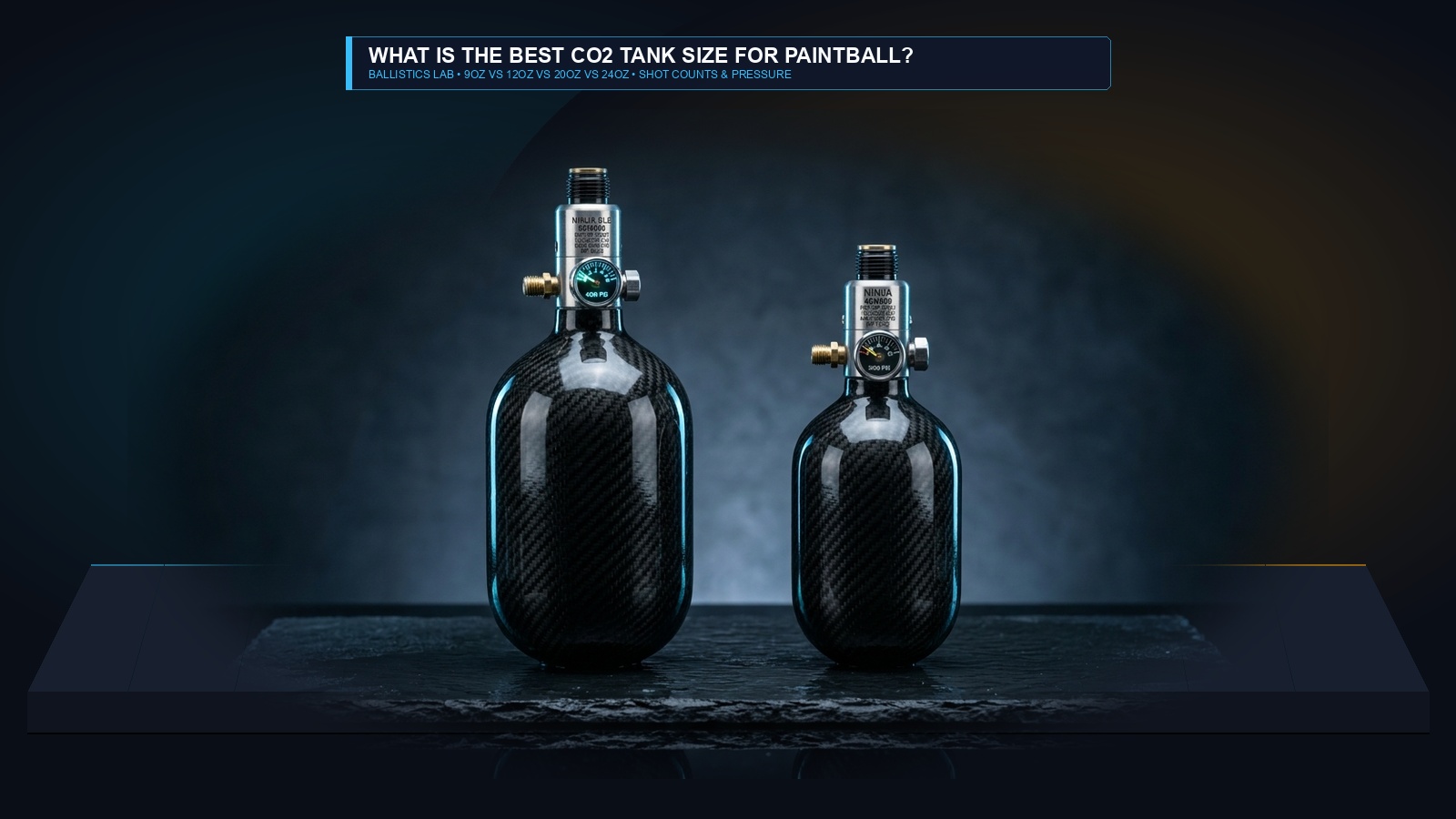
4. Technical Infographic: CO2 Sizing & Capacity Architecture
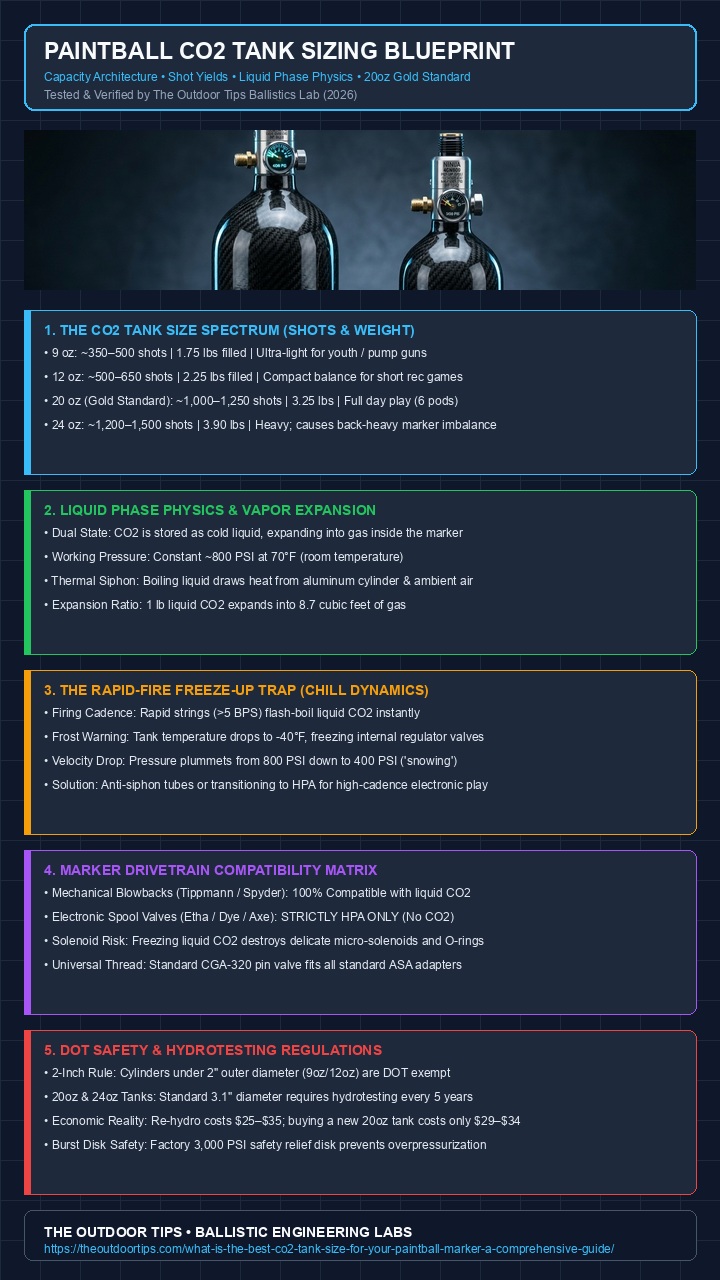
Technical Infographic: CO2 Capacity Sizing Spectrum, Thermodynamics & DOT Hydro Regulations. Verified by The Outdoor Tips Ballistics Lab.
5. Marker Drivetrain Compatibility: Mechanical Blowbacks vs. Electronic Solenoids
When asking what is the best co2 tank size for your paintball marker? a comprehensive guide must address marker compatibility. CO2 is NOT universal across modern paintball markers:
✅ Markers That Excel on CO2 (Mechanical Blowbacks)
Markers operating on high-pressure inline blowback valves (unregulated 800 PSI) were engineered specifically for CO2:
- Tippmann Family: 98 Custom, Cronus, A-5, Stormer, and Gryphoon.
- Spyder Family: Victor, Xtra, Sonix, and classic mechanical valves.
- Brass / Polymer Workhorses: Heavy steel striker hammers and robust urethane O-rings easily withstand liquid chill.
❌ Markers That CANNOT Run on CO2 (Electro Spool Valves)
Modern tournament electronic markers operate on delicate low-pressure drivetrains (100–200 PSI):
- Planet Eclipse: Etha 3, Etha 3M, Gtek 170R, CS2, CS3 Pro.
- Dye & Empire: Dye DSR+, Rize CZR, Empire Axe 2.0, Mini GS.
- The Danger: Cold liquid CO2 reaching delicate micro-solenoids freezes the internal pilot spool, shattering brittle Buna-N O-rings and causing catastrophic valve leaks. These markers are strictly HPA Only.
For players upgrading to electronic platforms, see our breakdown of the Planet Eclipse Etha 3 vs. Etha 3M and the comprehensive guide to the best compressed air tank size for paintball.
6. DOT Safety, Hydrotesting & The “2-Inch Rule”
Every commercial CO2 cylinder in the United States is regulated by the U.S. Department of Transportation (DOT) under 3AL specification standards (3AL-1800). Safety rules dictate when a cylinder requires inspection:
The 2-Inch Diameter Exemption Rule (49 CFR § 180.209)
Under federal regulations, aluminum cylinders with an outside diameter of less than 2 inches and a length of less than 2 feet are exempt from periodic hydrostatic testing. This means:
- 9 oz and 12 oz Tanks: Measure approximately 1.95 inches in outer diameter. They are DOT hydrotest exempt for life, provided they show no external corrosion, gouges, or thread damage.
- 20 oz and 24 oz Tanks: Measure approximately 3.12 inches in outer diameter. They must be hydrotested every 5 years from the manufacture date stamped on the shoulder (e.g., “04 26” indicates April 2026).
⚖️ The “Tare Weight (TW)” Refill Discipline: Why CO2 Is Never Filled by Pressure
New players frequently ask why CO2 paintball tanks do not have analog pressure gauges like HPA tanks. The reason: a pressure gauge cannot measure how much liquid CO2 remains in the bottle. At 70°F, a CO2 tank reads roughly 800 PSI whether it has 1 shot left or 1,200 shots left, because vapor pressure remains constant until the very last drop of liquid boils off.
The Hanging Digital Scale Protocol:
- Find the Stamped TW: Every DOT-certified cylinder has its empty Tare Weight (TW) stamped into the aluminum shoulder (e.g.,
TW 1.75 LBorTW 795g). This is the exact physical weight of the empty bottle and brass pin valve. - Tare the Scale: The fill technician places the completely empty cylinder onto a hanging digital scale and zeros (tares) the readout.
- Fill Strictly by Weight: The fill station operator pumps liquid carbon dioxide from the commercial bulk siphon tank, monitoring the scale. The valve is shut off the exact moment the weight increases by the rated tank capacity (e.g., exactly +20.0 oz for a 20 oz cylinder).
- The Overfill Catastrophe: If an untrained operator fills a tank by “feel” or guess without a scale, liquid expansion in the hot summer sun (above 88°F) will cause hydraulic pressure to spike past 3,000 PSI, instantly rupturing the copper safety burst disk and violently venting all gas in seconds.
The Economics of Hydrotesting vs. Replacing
Having a 20 oz CO2 tank hydrostatically recertified at a local scuba shop or fire safety supplier typically costs $25 to $35. Considering a brand new, factory-certified 20 oz aluminum tank costs only $29 to $34, virtually all experienced paintball armorers advise replacing expired CO2 tanks outright rather than re-testing them.
For complete details on identifying tank expiration dates, inspect our guide on how often you need to refill and inspect your paintball tank.
Maddog / Empire 20 oz CO2 Tank
DOT-3AL Certified • Pure Brass Pin Valve • 1,100+ Shots
The universal all-day workhorse for mechanical Tippmann and Spyder markers. Perfect weight distribution and maximum refill convenience.
Coiled Remote Line with Quick-Disconnect
Universal ASA Adapter • Quick Disconnect • Heavy Duty Coil
Offload 3.5+ pounds of tank weight directly to your vest or pod harness. Reduces marker wrist fatigue by 60% and enables lightning-fast snap-shooting.
7. Head-to-Head Comparison: All 5 CO2 Tank Sizes
8. Who It’s Built For vs. Who Should Skip It & Seasonal Cutoff Matrix
Who Should Buy a 20 oz CO2 Tank
- Casual Rec-Ball & Woodsballers: Playing with mechanical Tippmann or Spyder markers where simplicity, low price, and local fills matter.
- Players Near Sporting Goods Stores: Refilling CO2 is simple and cheap ($4–$5 at Dick’s Sporting Goods or local hardware stores) where high-pressure compressors are unavailable.
- Budget Starter Setups: At $29.95, it delivers full-day play at half the cost of an entry-level HPA tank.
- Backyard Target Shooters: Reliable room-temperature plinking without needing an expensive 4,500 PSI hand pump.
Who Should Skip CO2 (Buy an HPA Tank Instead)
- Electronic Speedballers: Firing at 10.5 BPS or using electro-pneumatic markers (Etha, Axe, Rize, CS3) that will freeze and rupture O-rings on CO2.
- Cold-Weather Paintballers: Playing in temperatures below 50°F (10°C) where CO2 pressure collapses below functional marker cycling levels.
- High-Consistency Competitors: Players requiring tournament-grade ±2 FPS chronograph consistency across rapid firing strings.
If you primarily play scenario woodsball with military-style markers, read our hands-on reviews for the Tippmann A-5 and Tippmann Cronus Basic.
9. Frequently Asked Questions
What is the best CO2 tank size for your paintball marker?
When answering what is the best co2 tank size for your paintball marker? a comprehensive guide confirms that the 20 oz aluminum tank is the optimal choice for 90% of players. It delivers 1,000 to 1,250 shots per fill, balances comfortably on the marker, and costs less than $30.
What is an anti-siphon tube on a paintball CO2 tank?
An anti-siphon tube is an armorer-installed curved brass extension fitted inside the tank’s pin valve. When the tank sits horizontally on a marker, the tube points upward into the vapor pocket, drawing pure gas instead of liquid CO2. This prevents sub-zero liquid from freezing internal valves, stops barrel snowing, and stabilizes rapid-fire velocity.
Why do CO2 tanks lack pressure gauges and how are they filled by Tare Weight?
CO2 cylinders cannot use pressure gauges because carbon dioxide maintains a constant ~800 PSI vapor pressure until the last drop of liquid boils off. Refills must be measured strictly by mass using a hanging digital scale. The technician zeros the scale using the cylinder’s stamped Tare Weight (TW) and fills exactly the rated mass (e.g., 20 oz) to prevent burst disk rupture.
How many shots do you get per ounce of CO2?
Under normal operating temperatures (65°F to 75°F), a standard mechanical blowback marker gets approximately 50 to 60 shots per ounce of CO2. Therefore, a 9 oz tank gets ~450 shots, a 12 oz gets ~600 shots, a 20 oz gets ~1,100 shots, and a 24 oz gets ~1,350 shots.
Do 9 oz and 12 oz CO2 tanks require hydrotesting?
No. Under federal DOT 49 CFR § 180.209 regulations, aluminum gas cylinders with an outside diameter of less than 2 inches are exempt from 5-year hydrostatic testing. Standard 9 oz and 12 oz paintball tanks measure under 2 inches, meaning they never expire as long as they are undamaged.
Can you run CO2 on an electronic paintball marker?
No. Never run CO2 on an electronic paintball marker unless explicitly stated by the manufacturer. Liquid CO2 chills to sub-zero temperatures during rapid cycling, freezing electronic solenoids and destroying urethane O-rings. Modern electro markers like the Planet Eclipse Etha 3 or Empire Axe 2.0 require High Pressure Air (HPA).
Why does my paintball gun shoot snow when using CO2?
Shooting “snow” occurs when rapid fire causes liquid CO2 to enter the marker’s expansion chamber before boiling into gas. When the raw liquid exits the muzzle, it undergoes instantaneous expansion, creating dry ice flakes. Installing an anti-siphon tube or slowing your firing cadence resolves this issue.