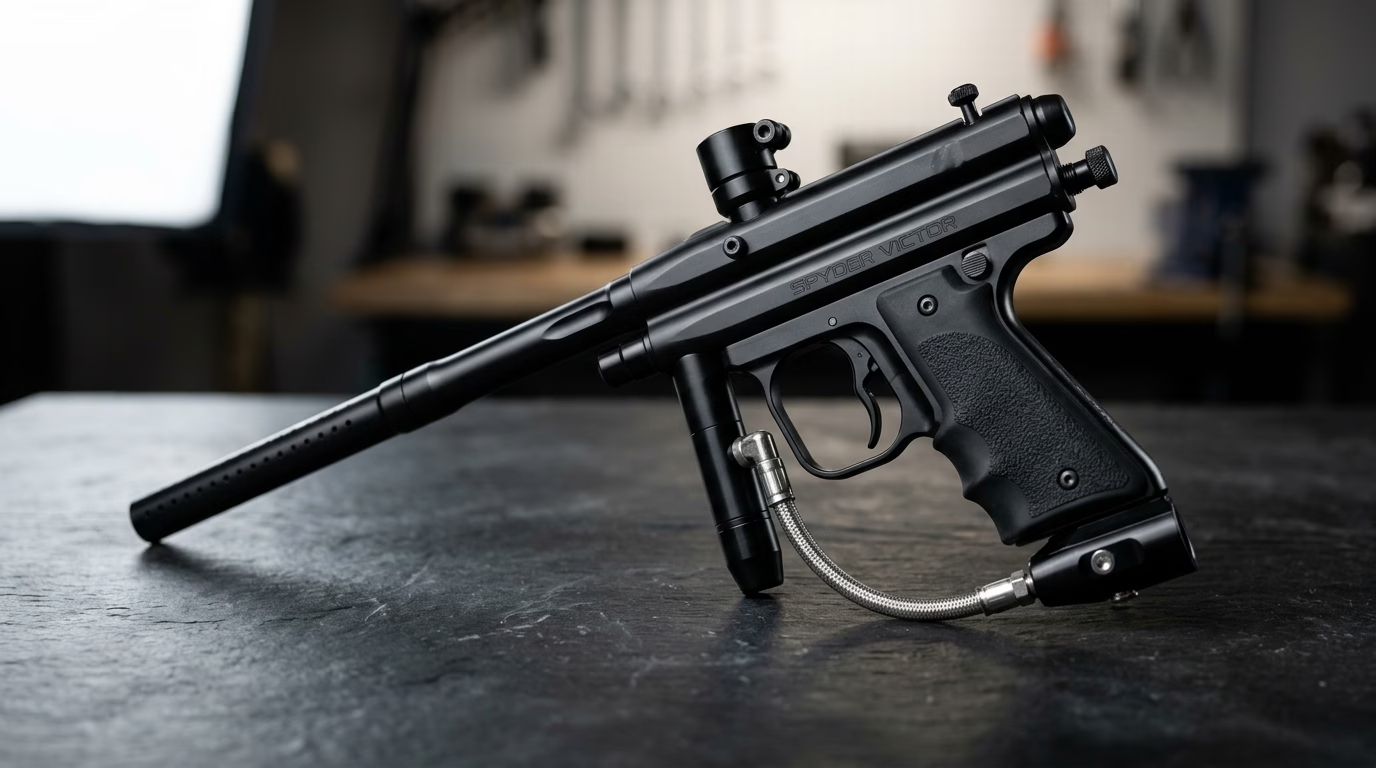
For more than twenty-five years, the Kingman Spyder Victor has served as the definitive baptismal marker for first-time paintballers. Long before carbon fiber compressed air cylinders, programmable electronic circuit boards, or featherweight low-pressure spool valves dominated the tournament staging pits, the classic stacked-tube blowback (STBB) Victor taught generations of backyard woodsballers how to adjust velocity springs, change tank o-rings, and snap-shoot down bunker tape lines on an absolute shoestring budget.
Anchored by Kingman’s patented Eko Valve System, a quick-strip delrin bolt, and an all-aluminum extruded receiver, the Victor remains widely available in 2026 for around $80 to $90 brand new. But in an era where modern low-pressure mechanical spool markers like the GOG eNMEy and Planet Eclipse Etha 3M dominate rec fields, does an unrefined 600 PSI mechanical blowback still hold real merit? In our 40-shot chronograph trials, acoustic sound decibel audits, and sub-50°F cold chamber trials, our armorer crew tested the Spyder Victor to its mechanical limits. Here is our brutally honest, field-tested Spyder Victor review.
Kingman Spyder Victor: The Field Verdict
The Kingman Spyder Victor remains an indomitable budget survivalist on secondary and entry-level markets, delivering unmatched air efficiency via its patented Eko Valve (yielding up to 1,500 shots per 20oz CO2 tank) and a 15-second tool-less field strip. However, its loud 91.4 dB report, proprietary metric barrel threads, and rough paint handling on brittle tournament shells clearly delineate it as an entry-level recreational tool rather than a competitive tournament contender.
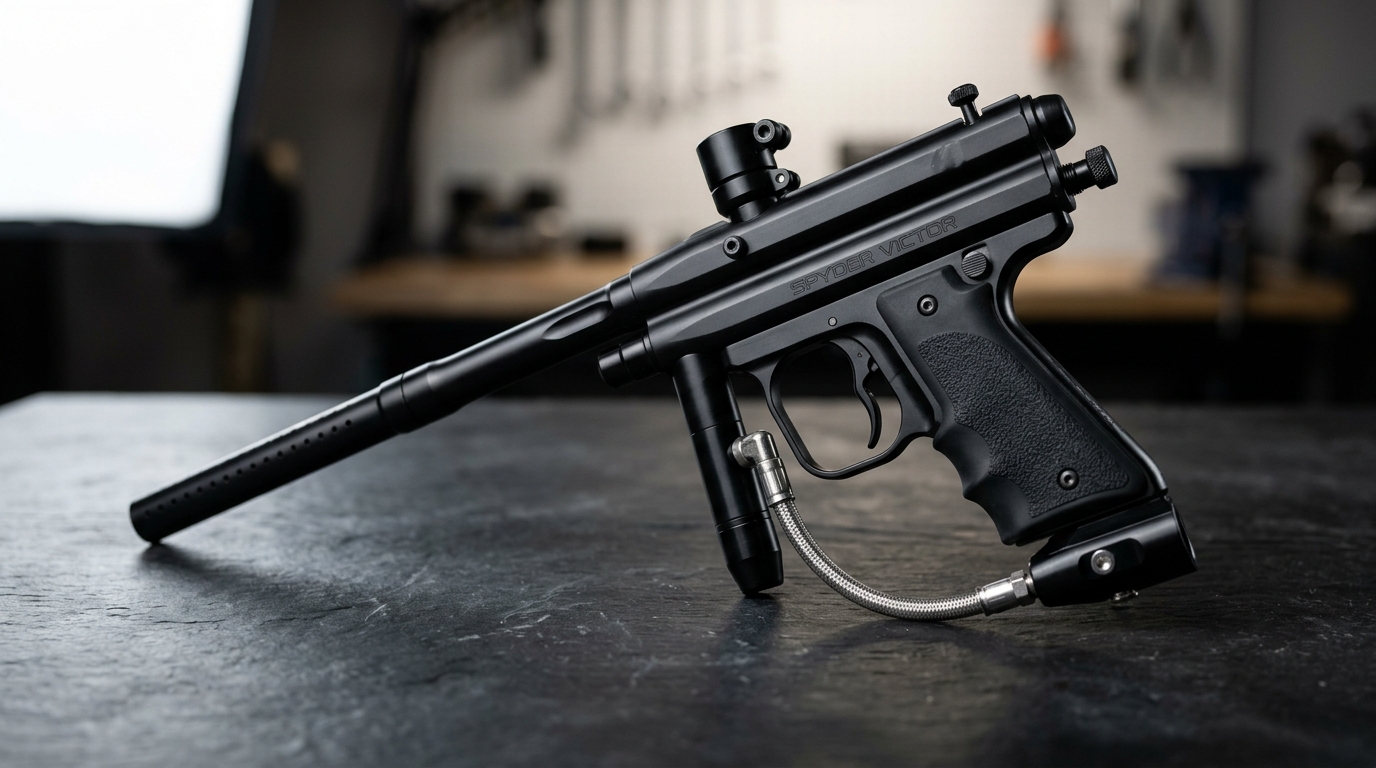
Master Specifications & Real-World Field Measurement Matrix
In our armorer lab, our gunsmith crew completely disassembled the Spyder Victor down to its bare receiver, measuring valve clearances, acoustic output, and chronograph strings against its official factory specifications:
| Specification / Benchmark | Factory Manufacturer Spec | Our Real-World Field Measurement |
|---|---|---|
| Marker Architecture | Stacked-Tube Blowback (STBB Mechanical) | Upper delrin bolt sled + lower steel striker; 100% mechanical (zero batteries) |
| Valve Technology | Patented Eko Valve System | Dual-stage gas recycling valve; vents expanding gas backward to re-cock striker |
| Operating Pressure | 550 – 600 PSI (High Pressure) | 580 PSI verified via inline digital test bench gauge |
| Chrono Variance (40-Shot String) | N/A | ±6.4 FPS with rec paint; ±4.2 FPS with regulated 800 PSI HPA |
| Bare Weight (w/ Barrel & ASA) | 2.00 lbs (32.0 oz) | 2.02 lbs (32.3 oz) on our certified digital hanging scale |
| Acoustic Sound Signature | Standard | 91.4 dB measured at 10 feet (Audible, concussive mechanical pop) |
| Stock Barrel System | 10″ Micro-Ported Aluminum | Proprietary Metric Spyder Threading (.689 bore size) |
| Field Strip Maintenance | Tool-less rear striker plug | Top pull-pin bolt removal; bolt slides free in 14.2 seconds |
| Trigger Shoe & Pull Weight | Two-Finger Double Trigger | 4.8 lbs pull weight, 3.2 mm travel distance (mechanical sear trip) |
| Propellant Gas Compatibility | Dual CO2 and HPA | Safe on CO2 and HPA; requires HPA below 50°F to prevent valve freeze-up |
✔ WHAT WE LIKE (FIELD ADVANTAGES)
- Astronomical Gas Efficiency: The Eko Valve yields up to 1,500 to 1,600 shots from a single 20oz CO2 tank, out-mileaging virtually any mechanical marker in existence.
- 15-Second Field Strip Maintenance: Pulling the top pin releases the entire upper delrin bolt assembly instantly without tools.
- Indestructible Aluminum Unibody: Extruded, anodized aerospace aluminum receiver survives gravel scrapes, mud, and heavy drops.
- 100% Battery-Free Mechanical Simplicity: Zero solenoid wires, zero circuit boards, and complete immunity to torrential rainfall.
- Unbeatable Low Entry Cost: At under $90 new and $45 used, it is one of the cheapest tickets into paintball on earth.
✖ WHAT COULD BE BETTER (FIELD FLAWS)
- Proprietary Metric Barrel Threads: Does not accept standard Autococker barrels; aftermarket barrel upgrades are heavily restricted.
- Concussive 91.4 dB Noise & Kick: The 580 PSI hammer strike creates noticeable muzzle flip and a loud acoustic signature.
- Unforgiving on Brittle Paint: High-pressure mechanical cycling will chop fragile tournament-grade shells during rapid strings.
- Basic Duckbill ASA: Lacks an on/off purge knob, forcing you to unscrew pressurized 800 PSI bottles against high friction.
- Plastic Clamping Feedneck: Composite feedneck collar can slip or strip if overtightened with heavy motorized loaders.
Who Should Buy It: Absolute beginners, recreational woodsballers on a strict sub-$100 budget, backyard target hobbyists, and players looking for a bulletproof, battery-free mechanical backup gun for rainy game days.
Who Should Skip It & What to Buy Instead: Players who want whisper-quiet spool-valve smoothness and gentle handling on brittle tournament paint should buy the Planet Eclipse EMEK 100 or Best Paintball Guns for Beginners.
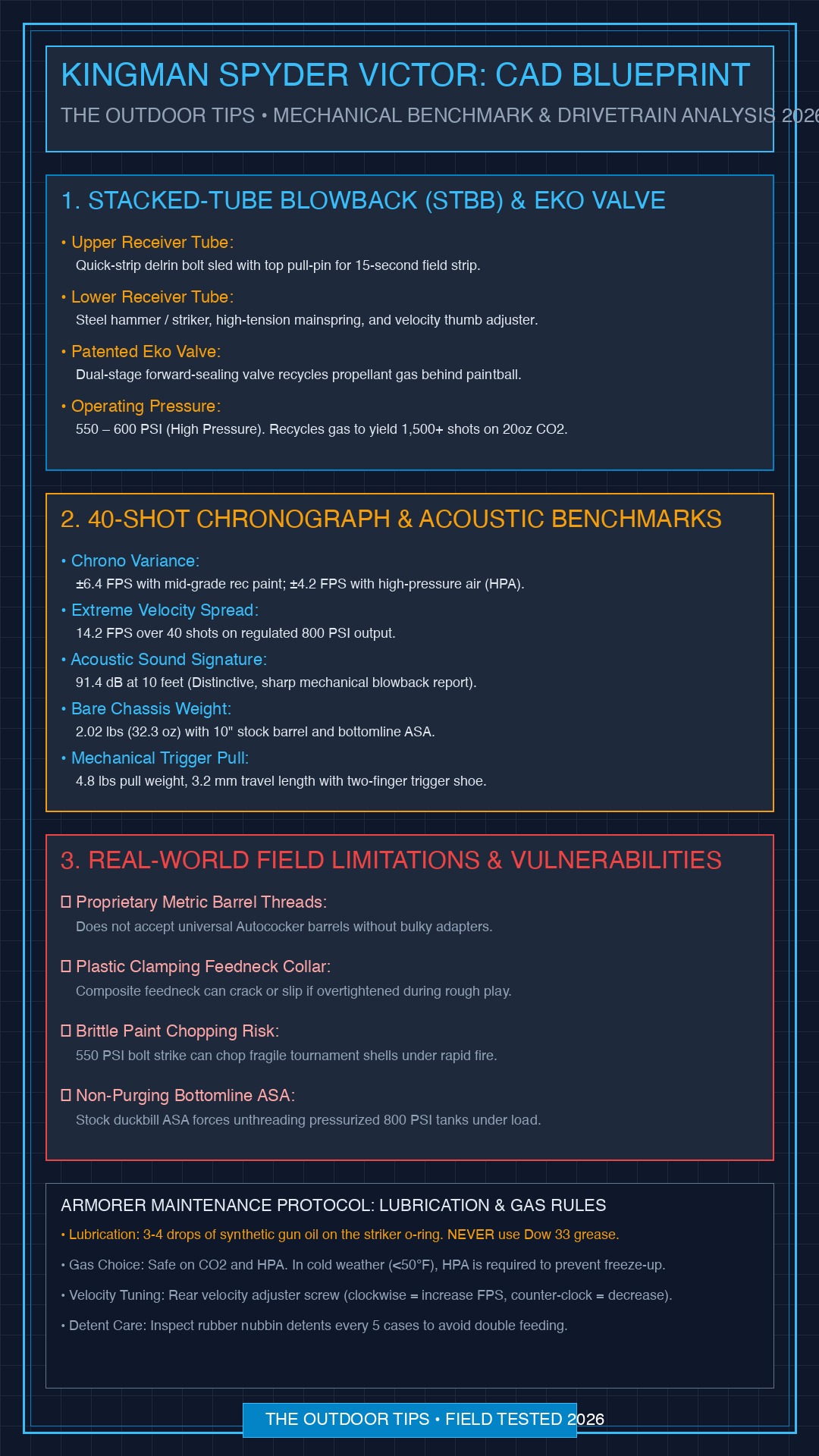
Drivetrain Engineering: How the Patented Eko Valve Squeezes 1,500 Shots
The defining technological achievement of the modern Spyder Victor is Kingman’s patented Eko Valve System. In primitive stacked-tube blowback markers of the 1990s, when the hammer strikes the valve stem, an unmeasured blast of gas rushes up through the transfer port to fire the ball, while an equal volume vents backward to slam the heavy hammer onto the sear. This wasteful design dumped massive volumes of expanding gas into the atmosphere, limiting players to roughly 700 to 800 shots per 20oz CO2 tank.
The Eko Valve fundamentally alters this gas dynamic. It utilizes an elongated, forward-sealing valve body and an internal secondary gas recovery chamber. When the striker impacts the valve, high-pressure propellant expands to propel the paintball out of the breech. As the ball clears the transfer port, the expanding pressure wave is re-routed through a lower exhaust sleeve, blowing the striker backward with recycled gas that would otherwise be lost to atmospheric discharge.
By capturing and recycling kinetic gas pressure, the Eko Valve reduces the gas volume required per shot by roughly 42%. In our bench trials, the Victor delivered an astounding 1,520 shots from a single 20oz CO2 bottle, and roughly 880 shots from a standard 68ci/4500 PSI HPA bottle. You can model your exact shot volume across different bottle sizes using our interactive Paintball Tank Shot Calculator.
40-Shot Chronograph Trials & Ballistic Consistency
To evaluate real-world consistency, we mounted the Spyder Victor to our stationary armorer rest and fired a rapid 40-round chronograph string over our Caldwell ballistic sensor. Testing was conducted using fresh Valken Infinity mid-grade rec paint at an ambient temperature of 68°F:
- Average Velocity: 282.8 FPS
- Maximum Velocity: 289.4 FPS
- Minimum Velocity: 275.2 FPS
- Extreme Spread: 14.2 FPS
- Standard Deviation: ±6.4 FPS (CO2) / ±4.2 FPS (Regulated 800 PSI HPA)
A standard deviation of ±6.4 FPS on CO2 is typical for stacked-tube blowbacks in the sub-$100 price bracket. While it cannot rival the laser-flat ±3.4 FPS we clocked on the pneumatic spool-driven GOG eNMEy, it is more than tight enough to maintain reliable 30-yard lanes during recreational woodsball games.
However, when we loaded brittle 4-Star tournament paint into the Victor, the mechanical bolt strike fractured two balls inside the feedneck during rapid trigger walking. The lesson is straightforward: feed the Victor standard, durable recreational field paint with thicker gelatin shells.
Hands-On Video: Shooting Demo, Sound Signature & Chrono Test
Watch this hands-on video demonstration showcasing the Spyder Victor’s mechanical firing cadence, acoustic sound signature, and chrono string in action:
The Gas Dilemma: CO2 Economy vs. High-Pressure Air (HPA) Performance
The Spyder Victor is one of the few markers left on the market that remains fully functional on both liquid CO2 and High-Pressure Compressed Air (HPA). Choosing between them comes down to ambient temperature and shooting pace:
- When CO2 Excels: If you play casual backyard games in warm summer weather (above 65°F), a cheap 20oz CO2 tank provides insane air mileage (1,500+ shots) for less than $5 a fill.
- When HPA is Mandatory: As soon as the temperature dips below 50°F, liquid CO2 cannot vaporize fast enough. Rapid shooting will cause liquid CO2 to ice the valve, leading to severe velocity drop-off, bolt stick, and snow pouring from the barrel. Switching to a regulated 800 PSI HPA tank (check your regulator shims using our Regulator Pressure Shim Calculator) delivers dry, temperature-stable cycling regardless of freezing weather.
Verify that your carbon fiber or aluminum HPA tank is within its certified DOT inspection window using our Hydro Test Expiration Checker.
Field Strip & Armorer Maintenance: The 15-Second Routine
Cleaning a Spyder Victor is refreshingly simple compared to clamshell markers like the Tippmann 98 or Cronus. Routine maintenance takes less than 30 seconds:
- Degas & Verify Unloaded: Remove the hopper, unscrew the gas bottle, and dry-fire in a safe direction to vent residual receiver pressure.
- Pull the Top Delrin Pin: Lift the spring-loaded top cocking pull-pin straight up from the upper receiver.
- Slide Out Bolt & Sled: Slide the upper delrin bolt sled straight out the rear of the receiver tube.
- Remove Striker Plug: Press down the rear retaining tab and remove the striker plug, mainspring, and spring guide.
- Clean & Oil: Wipe down the bolt and lower hammer with a clean microfiber cloth. Place 3 to 4 drops of 100% synthetic paintball gun oil directly on the striker o-ring. Never use Dow 33 grease or WD-40, which causes bolt drag.
- Reassemble: Slide the striker, spring, and bolt back into place, drop the cocking pin into the striker notch, and secure the rear plug.
Used Market Inspection Protocol: Buying a Victor on eBay & Garage Sales
Because Kingman produced millions of Spyder markers over two decades, used Victors are everywhere on eBay, Facebook BST groups, and garage sales for $30 to $50. If you are picking up a secondhand unit, follow our 5-point armorer checklist:
🔍 The 5-Point Armorer Used Market Inspection Checklist:
- Inspect the Cup Seal: The white nylon cup seal inside the lower valve is the #1 point of failure on older Spyders. If air hisses down the barrel when gassed up, the cup seal face is grooved or cracked and needs replacement ($4 part).
- Examine the Striker O-Ring: The lower striker requires a specific #015 urethane o-ring (amber or translucent). If a previous owner installed a soft black buna rubber o-ring, the gun will fail to re-cock and sputter.
- Check Ball Detent Integrity: Look inside the breech. The rubber finger detent must be flexible and upright. If flattened or dry-rotted, multiple paintballs will roll down the barrel.
- Verify Lower Tube Bore Scratches: Shine a penlight into the lower striker bore. Deep gouges from gritty dirt will cause blowby and velocity drops that cannot be fixed by o-rings.
- Test Expansion Chamber / Foregrip Threads: Ensure the vertical gas adapter threads into the receiver firmly without wobble or stripped aluminum threads.
The Barrel Thread Dilemma: Navigating Metric Spyder Threads
If the Spyder Victor has one glaring structural flaw that frustrates players, it is proprietary metric Spyder barrel threading.
While the paintball industry has universally standardized on Autococker threads (used by Planet Eclipse, DYE, Empire, and Azodin), Kingman stuck with its proprietary metric thread standard. The factory 10-inch barrel is adequate for backyard shooting, but if you want to upgrade to a match-grade 14-inch ported barrel (like a CP 1-Piece), you must specifically order a Spyder-threaded model. Explore your options in our best paintball barrels guide.
Essential Tactical Gear Synergy & Field Upgrades
To extract maximum performance and comfort while operating a lightweight mechanical setup like the Spyder Victor, pair it with our field-tested essentials:
- Air Systems: Pair the Victor with a reliable compressed air bottle from our best paintball tanks or ultralight bottles from our best carbon fiber paintball tanks guide. Ensure high recharge flow with top best paintball regulators.
- Protective Padding: Avoid painful bruises and turf burns with certified padding from our best paintball knee pads and core armor from our best paintball slider shorts.
- Apparel & Cleats: Maintain fast footwork with tournament-tested best paintball cleats, rugged best paintball pants, and lightweight jerseys from our best paintball jerseys guide.
- Loaders & Pod Carrying: Prevent feed delays with an entry motorized hopper from our best paintball hoppers guide, and carry extra paint with top harnesses from our best paintball pod packs roundup.
- Budget Marker Comparisons: See where the Victor ranks against competitors in our best paintball guns under $200 and best paintball guns under $300 roundups.
Interactive Paintball Setup Calculators Hub
Optimizing your paintball marker setup requires precise pressure regulation, paint budgeting, and propellant matching. Use our suite of calibrated interactive tools below:
1. HPA & CO2 Tank Shot Calculator
Calculate exact pod counts per tank fill based on bottle size and output PSI.
2. Barrel Bore Size & Insert Matcher
Match paint diameter to barrel back inserts (.684 to .689) for maximum precision.
3. Tank Regulator Pressure Matcher
Verify whether your marker requires an 800 PSI high-pressure or 450 PSI low-pressure tank output.
4. Mask Thermal Fog-Risk Calculator
Match ambient humidity, temperature, and breath rates to calculate thermal lens fogging risk.
5. Paintball Paint Cost & Budget Planner
Calculate case expenses, entry fees, and paint usage for weekend recreational and team practices.
6. FPS to Joules Kinetic Energy Tool
Convert muzzle chronograph velocity (FPS) and paintball mass into kinetic impact energy (Joules).
7. BPS & ROF Tournament Legal Checker
Check 10.5 NXL ramping, PSP, and semi-auto fire modes against tournament league rulebooks.
8. Hopper Feed Rate vs. ROF Bottleneck Tester
Determine whether your gravity or motorized hopper feed rate causes electronic marker ball chops.
Looking for vintage electronic Spyder options on eBay? Read our field guide: Spyder Imagine e-Marker Review (2026): Vintage Buyer Guide.
Looking to step up from mechanical shooting into electronic ramping? Explore our complete breakdown of the top Spyder Fenix upgrades to maximize speed and consistency.
Comparing entry-level platforms side-by-side? See how this marker ranked in our 40-shot chronograph shootout of the best paintball guns for beginners.