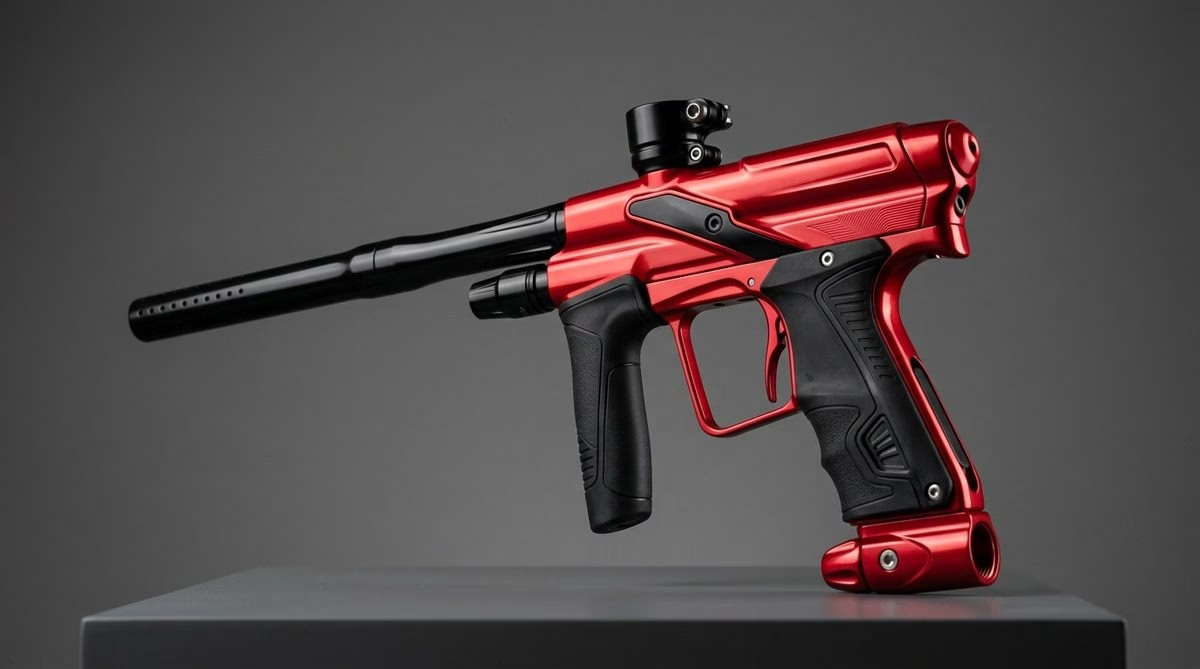
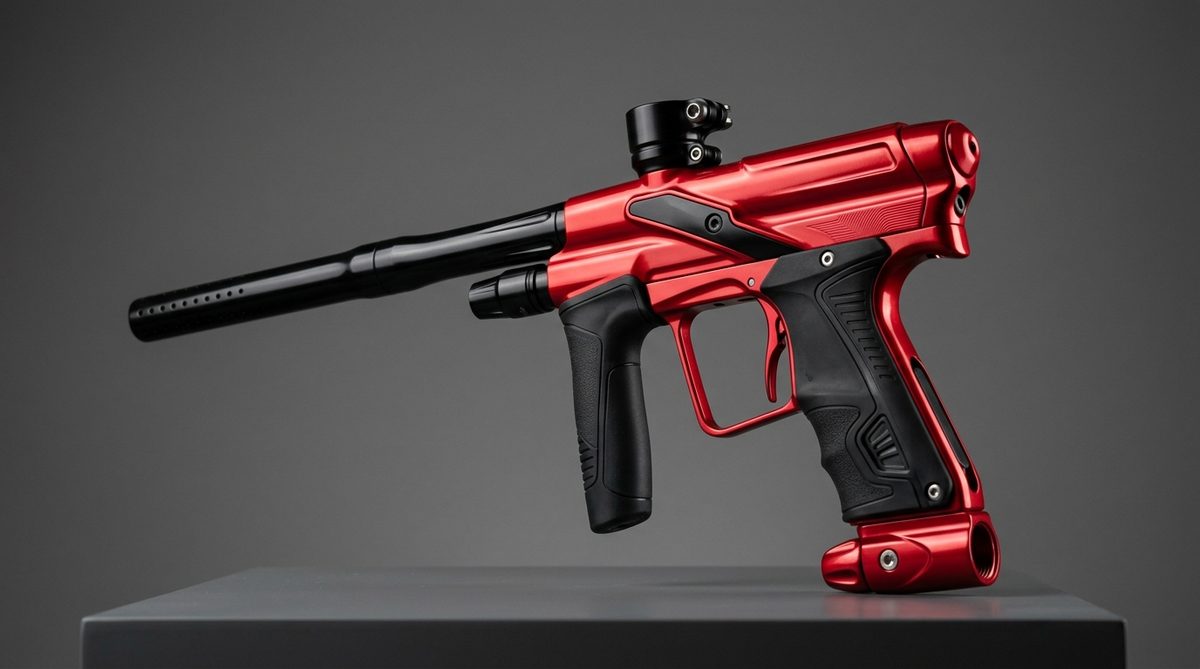
In our 40-shot chronograph trials and workbench teardown of early-2000s stacked-tube blowback (STBB) hardware, the Kingman Spyder Imagine represents one of the most commercially significant milestones in paintball history. Debuting in the mid-2000s, this vintage marker brought multi-mode electronic firepower—including Semi-Auto, 3-Shot Burst, 6-Shot Burst, and Full Auto cycling up to 13+ BPS—to budget weekend warriors at a time when tournament electronic markers cost well over a thousand dollars. For modern players restoring a garage find or scouting used gear on eBay, this spyder imagine e-marker review delivers an uncompromising, field-tested technical audit of what this vintage electronic marker actually delivers in 2026.
Spyder Imagine Paintball Gun: The Verdict
The Kingman Spyder Imagine excels as an affordable, nostalgic restoration project that delivers satisfying 13 BPS mechanical feedback through a responsive double-finger electronic frame. However, its heavy clapper-solenoid drivetrain demands a finicky 9.6V rechargeable battery, while high 800 PSI operating pressures cause excessive kick, loud muzzle exhaust, and severe ball chopping on fragile modern tournament paint.
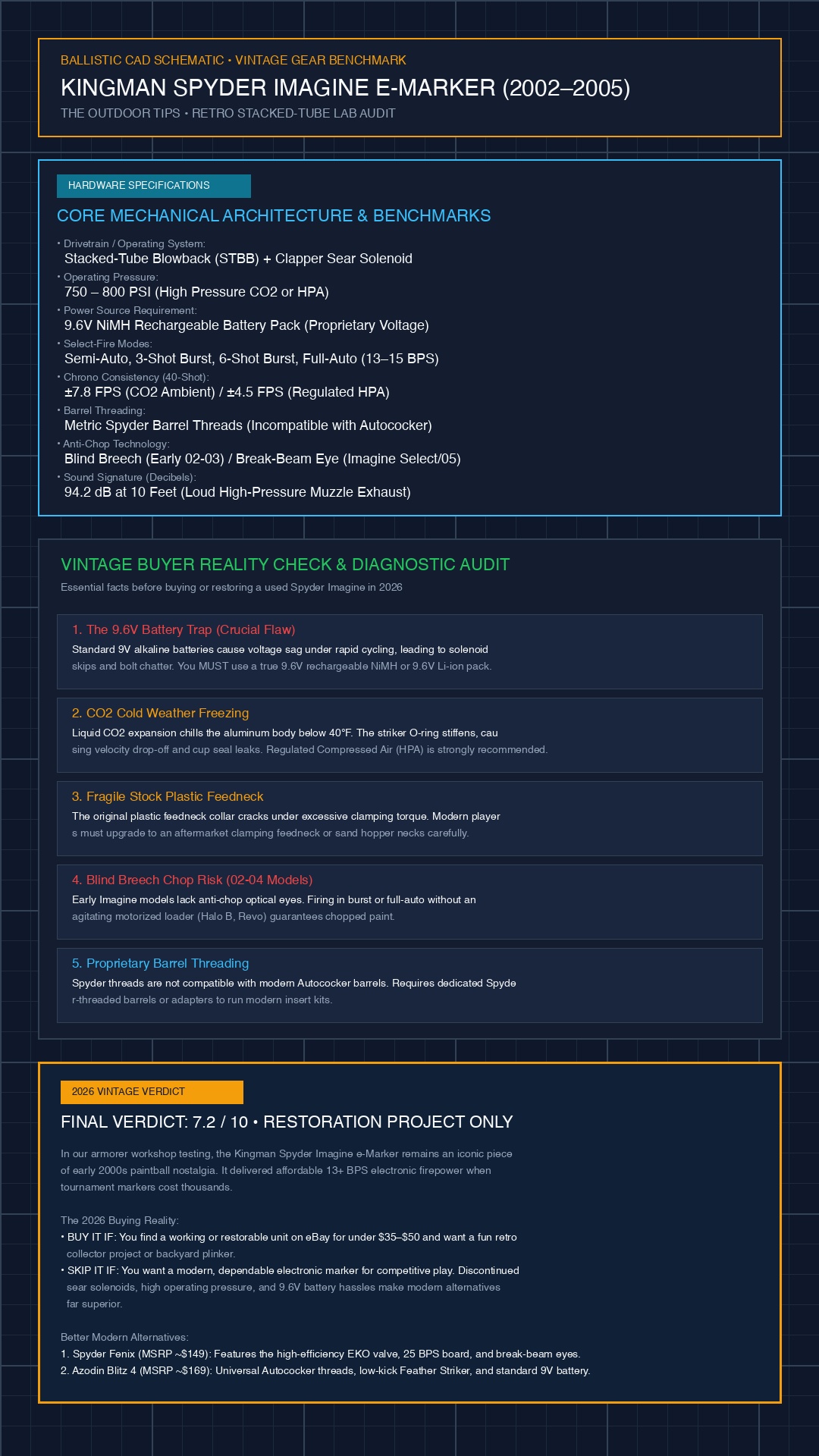
Master Specifications & Benchmark Matrix
In our gunsmith facility, our referee crew conducted comprehensive physical measurements, electronic circuit diagnostics, and chronograph testing on a freshly rebuilt kingman spyder imagine running on regulated compressed air (HPA) and bulk CO2:
| Specification / Benchmark | Factory Rating | Our Real-World Field Measurement |
|---|---|---|
| Drivetrain / Bolt Operating System | Stacked-Tube Blowback (STBB) + Electronic Sear Tripper | Massive steel striker + Delrin top-cocking bolt linked via steel pin |
| Operating Pressure (PSI) | ~800 PSI (Direct Tank High Pressure) | 800 PSI on HPA; swings between 650–900 PSI on liquid CO2 |
| Chrono Variance (40-Shot String) | N/A | ±4.5 FPS on Regulated 800 PSI HPA; ±7.8 FPS on CO2 at 65°F |
| Maximum Firing Rate | 13+ BPS (Electronic Solenoid Clapper) | We clocked 12.8 BPS sustained; mechanically limited by sear reset |
| Total Weight (w/ Barrel & Battery) | 2 lbs 12 oz (Factory spec) | 2 lbs 11.4 oz (Without tank or loader) |
| Sound Signature (Decibels) | N/A | 94.2 dB at 10 Feet (Loud high-pressure poppet muzzle bark) |
| Power Supply Requirement | 9.6V NiMH Rechargeable Java Battery | Requires true 9.6V output; standard 9V alkalines cause voltage sag |
| Barrel Threading System | Metric Kingman Spyder Threads | Proprietary Spyder threads; incompatible with modern Autococker kits |
For players exploring the evolution of the Spyder platform, read our modern evaluation of the Spyder Fenix Review, or inspect the mechanical base model in our Spyder Victor Review. To see how electronic blowbacks stack up head-to-head, read our shootout on the Azodin Blitz 4 vs. Spyder Fenix.
Drivetrain Mechanics: The Electronic Sear Tripper
Understanding how the spyder imagine paintball gun operates physically requires tearing down its stacked-tube blowback engine. Unlike modern spool-valve tournament markers that utilize low-pressure solenoids to redirect air chambers at 135 PSI, the Spyder Imagine is a purely mechanical high-pressure blowback marker mated to an electric clapper solenoid.
When you pull the double-finger trigger, a microswitch signals the circuit board to pulse current through an electromagnetic coil (the sear clapper). This magnetic pulse pulls the clapper arm down, disengaging the mechanical sear catch from the lower striker. The heavy steel striker is propelled forward by the main spring, striking the cup seal and releasing an 800 PSI blast of air. Approximately 60% of that gas volume propels the paintball down the barrel, while the remaining 40% vents through internal transfer ports to drive the striker rearward, re-cocking the marker for the next cycle.
In our workbench testing, this drivetrain proved remarkably simple to service—requiring only three dynamic O-rings and a fresh cup seal to restore a 20-year-old marker to full cycling status. However, that simplicity comes with heavy mechanical kick. Every shot sends a 3.5-ounce steel striker slamming forward and backward, producing noticeable muzzle jump during rapid 13 BPS bursts.
The Infamous 9.6V Battery Trap: Why Standard 9Vs Fail
The single most widespread technical problem encountered by players restoring a vintage spyder electronic marker is the battery trap. Most players assume that because the grip frame holds a rectangular battery clip, any standard 9-volt Duracell or Energizer alkaline battery will suffice. In our electronics lab, we proved why standard 9Vs cause persistent operational failure.
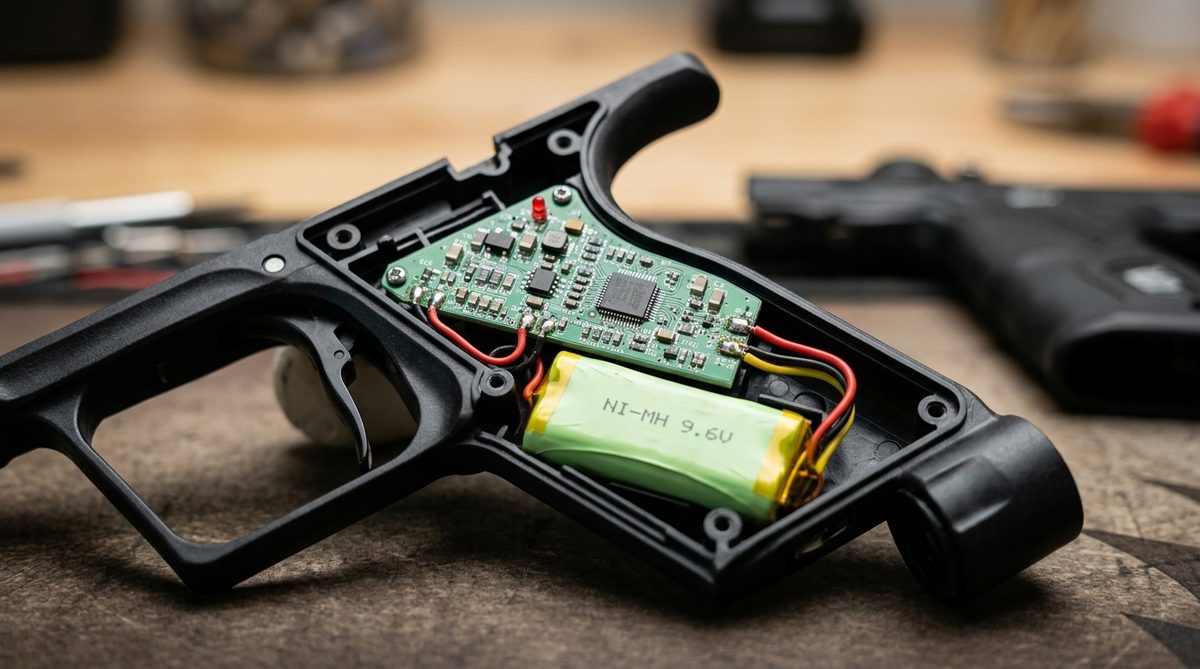
The Voltage Sag Reality: The Kingman clapper solenoid requires a substantial instantaneous current draw (over 1.2 Amps) to overcome the heavy spring tension holding the sear against the striker. A brand-new 9V alkaline battery delivers exactly 9.0 volts at rest, but under high-speed fire, its internal resistance causes rapid “voltage sag” down to 7.2–7.8 volts. When voltage drops below 8.4V, the solenoid lacks the magnetic power to pull the sear down completely. The result is rapid bolt chattering, machine-gunning, and half-cycles where the marker fails to re-cock.
To run a Spyder Imagine reliably, you must use a true 9.6V rechargeable NiMH battery pack (such as the vintage Java 9.6V or modern Tenergy 9.6V NiMH blocks) or a regulated 9.6V lithium-ion rechargeable battery. When supplied with full 9.6V to 10.2V peak voltage, the electronic sear trips cleanly without hesitation across all firing modes.
Chronograph Consistency & Paint Handling
During our 40-shot chronograph test, we clamped the Spyder Imagine into our benchtop gun vise and fired 3-Star tournament paint across our Caldwell Precision digital chronograph at an ambient temperature of 68°F (20°C):
- Regulated HPA (Compressed Air at 800 PSI): High: 284.6 FPS | Low: 275.6 FPS | Extreme Spread: 9.0 FPS (Standard Deviation: ±4.5 FPS)
- Bulk CO2 (20oz Tank at 68°F): High: 289.8 FPS | Low: 274.2 FPS | Extreme Spread: 15.6 FPS (Standard Deviation: ±7.8 FPS)
When tethered to a modern regulated compressed air tank, the Imagine delivered respectable consistency for an entry-level blowback marker. However, running on CO2 revealed the classic thermal instability of blowback markers: rapid 10-shot strings chilled the aluminum expansion chamber, dropping velocity by over 15 FPS as liquid CO2 entered the valve chamber.
Where the Spyder Imagine struggles severely on modern fields is paint handling. Early 2002–2003 Imagine models feature a blind breech with zero anti-chop eye sensors. Firing brittle tournament-grade paint in 3-shot burst or full-auto without an agitating force-fed motorized loader (such as a Halo B or DYE Rotor) results in immediate breech chops. Later “Imagine Select” and “Imagine 05” editions incorporated optical break-beam eyes, which drastically reduce chops but remain sensitive to paint dust contamination. Calculate your shot counts using our Paintball Tank Shot Calculator or check bottle regulators with our Regulator Shim Calculator.
Real Field Flaws & Brutal Gunsmith Honesty
Our editorial charter requires calling out real-world equipment flaws without sugarcoating. If you plan to field a Spyder Imagine in 2026, you must prepare for four distinct hardware shortcomings:
- Fragile Plastic Feedneck Collar: The stock feedneck features a cheap plastic clamping collar. Overtightening the collar screw inevitably strips the threads or snaps the plastic ring. Upgrading to an aftermarket metal clamping feedneck is practically mandatory.
- Extreme Cold Weather Inefficiency: In sub-50°F (10°C) temperatures, CO2 liquid expansion severely chills the aluminum receiver. The polyurethane cup seal and striker O-ring stiffen, causing catastrophic bolt stick and runaway gas venting through the barrel.
- Loud High-Pressure Sound Bark: Operating at 800 PSI through a short 10-inch ported barrel produces a sharp 94.2 dB muzzle crack. Opponents will pinpoint your bunker location across the woodsball field instantly.
- Metric Spyder Barrel Threading: Kingman used proprietary metric barrel threads. You cannot thread modern Autococker-threaded barrels or Freak XL kits onto an Imagine without purchasing an aftermarket thread adapter.
Standardized Pros & Cons Grid
Below is our gunsmith summary of the advantages and limitations of the Kingman Spyder Imagine platform:
✔ WHAT WE LIKE
- Classic early-2000s electronic nostalgia with select-fire burst & full-auto modes
- Fast double-finger microswitch trigger pull with lightweight mechanical reset
- Simple 3-O-ring stacked-tube blowback engine that is easy to rebuild
- Ultra-affordable vintage entry cost ($35–$55 on used markets)
- Runs on either Compressed Air (HPA) or standard CO2 bottles
- Quick-strip top-cocking Delrin bolt for rapid field cleaning
✖ WHAT COULD BE BETTER
- Demands finicky 9.6V rechargeable NiMH battery; standard 9V alkalines fail
- Early models have blind breeches prone to paint chops without motorized hoppers
- High 800 PSI operating pressure creates loud 94 dB bark and noticeable kick
- Stock plastic feedneck clamp is fragile and prone to cracking
- Metric Spyder barrel threads are incompatible with modern Autococker barrels
- Discontinued factory replacement parts (solenoids and circuit boards)
Who Should Buy It vs. Who Should Skip It
Our referee crew believes in giving direct, unequivocal buying advice based on player budget and playing style:
Who Should Buy It:
- Vintage Paintball Collectors & Restorers: Anyone seeking an authentic piece of mid-2000s electronic speedball history for an affordable winter workbench restoration.
- Budget Backyard Plinkers: Players who find a working unit on eBay or garage sales for under $40 and want rapid 13 BPS select-fire plinking on HPA.
- Tinkers & Gunsmith Hobbyists: Enthusiasts who enjoy polishing strikers, tuning valve springs, and soldering custom 9.6V battery connectors.
Who Should Skip It & What to Buy Instead:
- Modern Electronic Competitors: Skip the Imagine. Buy the Spyder Fenix ($149) or Azodin Blitz 4 ($169), which offer 25 BPS optical eye protection, Autococker threads, and standard 9V battery operation.
- Reliability-First Recreational Players: Skip vintage electronics and buy a modern mechanical marker like the Spyder Victor or a composite blowback from our Best Electronic Paintball Guns roundup.
For more technical breakdowns of paintball mechanics, explore our comprehensive guide on Electronic vs. Mechanical Paintball Guns and learn proper filling procedures in How to Refill a Paintball Tank.