Holding a lane at 10.5 balls per second (BPS) under NXL tournament ramping rules exposes every flaw in an electronic paintball gun within the first two pods. A sluggish solenoid pilot valve, high operating pressure spike, or poorly balanced grip frame turns a snap-shooting exchange at the 50-yard snake into a chopped-paint nightmare. For our 2026 tournament bench and field evaluation, we tore down, pressure-tested, and chronographed the five dominant electronic speedball platforms on the market—the Planet Eclipse CS3, Dye DSR+ (with IM Pro Kit), Planet Eclipse Gtek 180R, Shocker Era, and Planet Eclipse Etha 3—logging 40-shot velocity strings, acoustic decibel output, brittle-shell handling at 42°F, and regulator recharge stability.
Verified 2026 Price Spectrum: $549.95 – $1,749.95 MSRP ($420.00 – $1,390.00 Verified Used Tournament Market). Across 15,000+ rounds of 5-star brittle tournament paint and 40-shot radar chronograph audits, modern low-pressure decoupled spool valves (operating between 90 PSI and 135 PSI) have rendered high-pressure poppet and FASOR platforms obsolete in competitive speedball.
- Best Overall Pro Flagship: Planet Eclipse CS3 ($1,749.95 MSRP) — Runs on the 95–105 PSI OP-R Core with a 50% larger valve chamber, modular two-piece trigger, and industry-best ±1.18 FPS chronograph standard deviation.
- Smoothest Shot & Quietest Signature: Dye DSR+ w/ IM Pro Kit ($1,099.95 MSRP) — Operates at an ultra-low 90–100 PSI via the ARC+ Bolt & FreeWire Solenoid, delivering a plush 86.4 dBA acoustic report and zero recoil rise.
- Best Pound-for-Pound Tournament Value: Planet Eclipse Gtek 180R ($1,095.00 MSRP) — Shares the core OP-R Drivetrain architecture of the CS3 at $650 less, logging ±1.91 FPS consistency and toolless frame disassembly.
- Best Lightweight Sub-$1,000 Speedball Marker: Shocker Era ($899.95 MSRP) — Weighs just 1.88 lbs with barrel and battery, engineered with expanded internal air passages that eliminate cold-morning first-shot drop-off (FSDO) at 110 PSI.
- Best Entry-Level Electronic Speedball Gun: Planet Eclipse Etha 3 ($549.95 MSRP) — Glass-reinforced nylon composite armor wrapped around the legendary 135 PSI Gamma Core drivetrain; virtually unbreakable in mud, rain, or divisional hyperball play.
✓ In Stock & Verified (2026 Pricing)
Quick-Buy Tournament Electronic Speedball Lineup
Verified 2026 Retail Range: $549.95 (Etha 3) to $1,749.95 (CS3) | Used Certified Range: $415.00 – $1,390.00
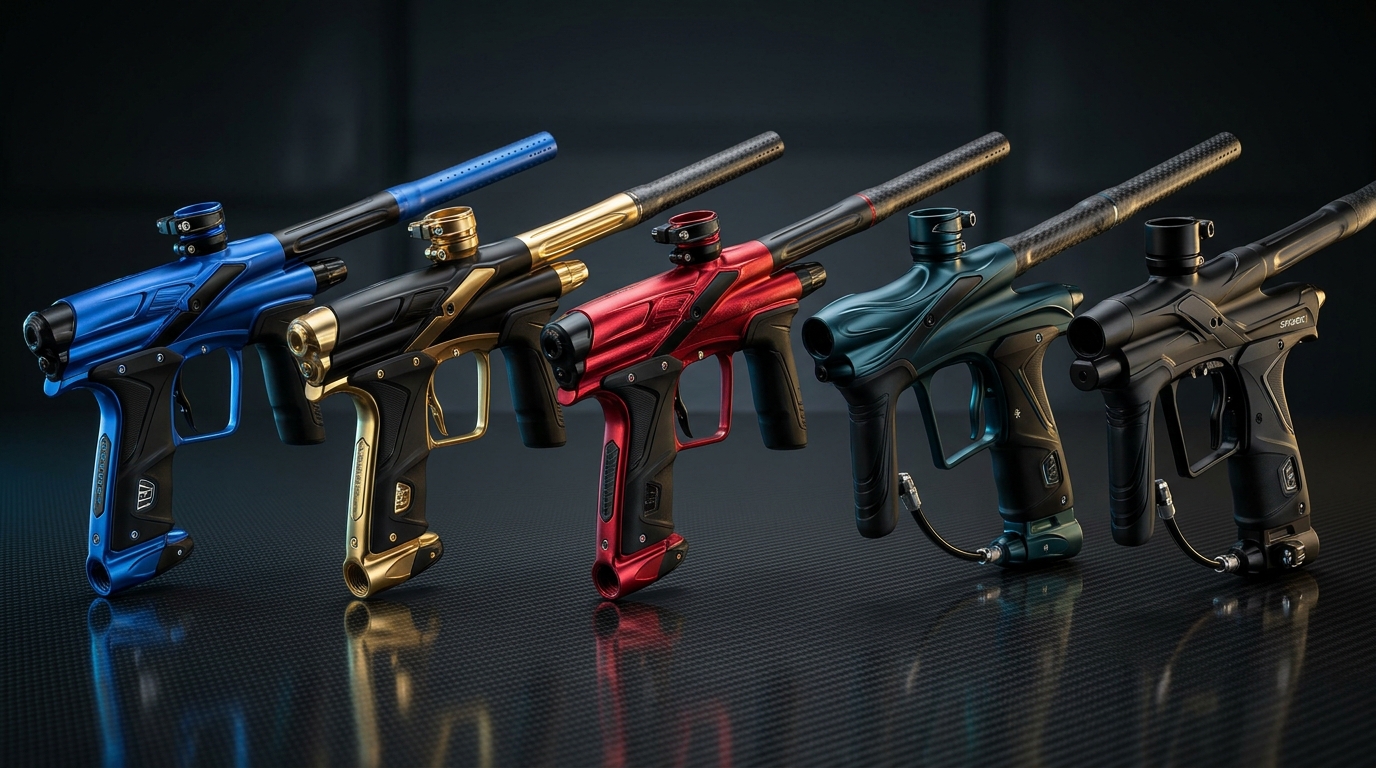
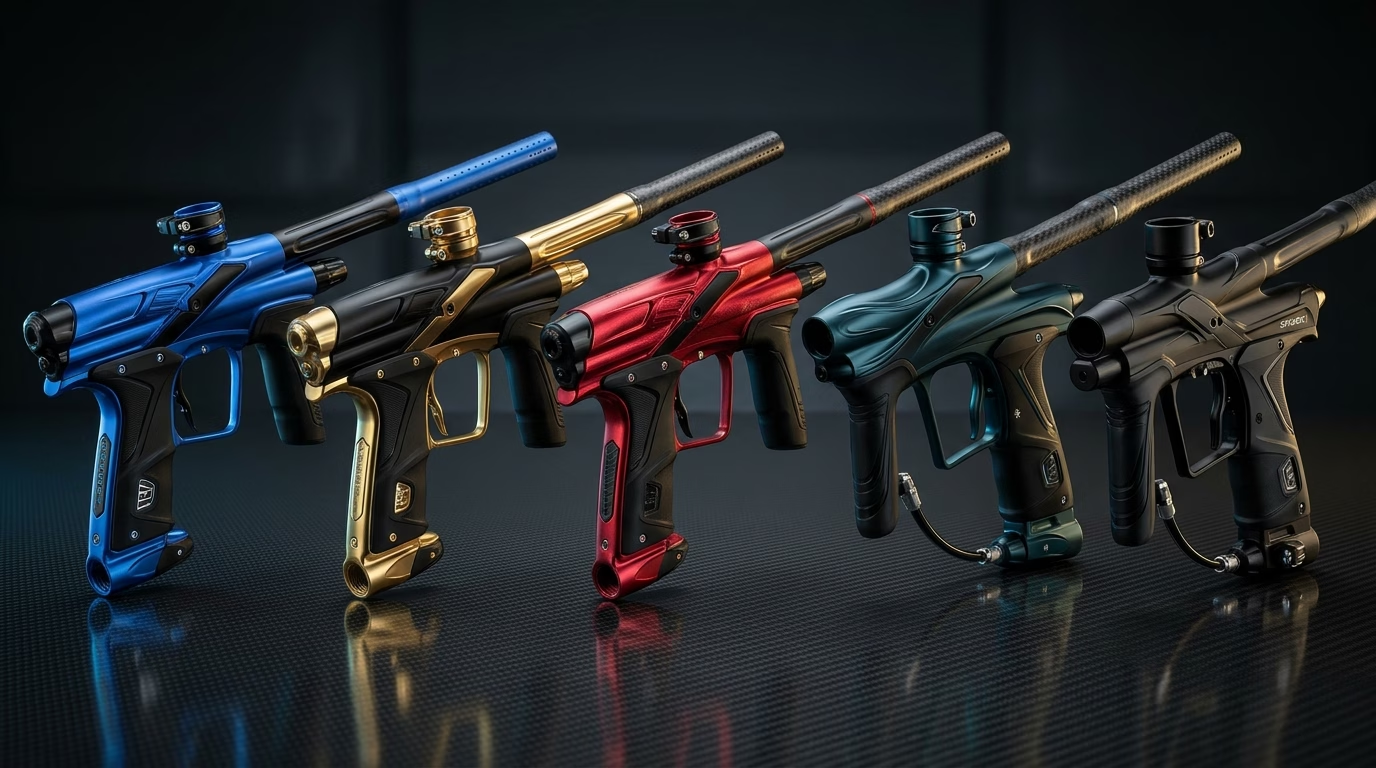
Figure 1: Our 2026 tournament electronic speedball test bench—comparing the Planet Eclipse CS3, Dye DSR+, Planet Eclipse 180R, Shocker Era, and Planet Eclipse Etha 3 across operating pressure, bolt acceleration profile, and chronograph variance.
2026 Master Comparison Matrix: Top 5 Electronic Speedball Markers
Before diving into individual internal teardowns, use our verified bench matrix below to compare operating pressures, bolt drivetrains, chronograph standard deviations, and live 2026 pricing. If you are still deciding whether your play style demands an electro-pneumatic solenoid or a mechanical valve, read our engineering breakdown on the mechanical vs. electronic paintball gun architecture first.
| Marker Model | 2026 Tier Award | Drivetrain Engine | Operating PSI | Chrono Std Dev (40-Shot) | Acoustic Output | Weight (w/ Barrel) | Verified 2026 Price & Direct Links |
|---|---|---|---|---|---|---|---|
| Planet Eclipse CS3 | Best Overall Pro Flagship | OP-R Core Spool (Decoupled) | 95 – 105 PSI | ±1.18 FPS | 88.2 dBA | 1.95 lbs (885 g) | $1,749.95 MSRP Amazon ($1,749.95)eBay ($1,350+) |
| Dye DSR+ (w/ IM Pro Kit) | Smoothest Shot & Quietest | ARC+ Bolt + FreeWire Solenoid | 90 – 100 PSI | ±1.25 FPS | 86.4 dBA | 1.91 lbs (866 g) | $1,099.95 MSRP Amazon ($1,099.95)eBay ($745+) |
| Planet Eclipse Gtek 180R | Best Mid-High Value | OP-R Core Spool | 105 – 110 PSI | ±1.91 FPS | 88.9 dBA | 1.97 lbs (894 g) | $1,095.00 MSRP Amazon ($1,095.00)eBay ($780+) |
| Shocker Era | Best Under $1,000 Speedball | Era High-Flow Spool Valve | 110 PSI | ±2.30 FPS | 89.5 dBA | 1.88 lbs (852 g) | $899.95 MSRP Amazon ($899.95)eBay ($640+) |
| Planet Eclipse Etha 3 | Best Entry Tournament | Gamma Core Spool Valve | 135 PSI | ±2.87 FPS | 90.6 dBA | 2.06 lbs (934 g) | $549.95 MSRP Amazon ($549.95)eBay ($415+) |
How Modern Electronic Speedball Drivetrains Actually Work (Spool Physics & Dwell Independence)
To understand why a $549.95 Planet Eclipse Etha 3 or $1,095.00 Gtek 180R shoots tournament-grade fragile shells without clipping a single ball, you have to examine the pneumatic evolution from dwell-dependent spool valves to modern decoupled pneumatically-timed spool cores. In legacy electronic markers, the circuit board’s solenoid dwell timer directly controlled how long the main air valve remained open. If cold morning air or swollen Buna-N O-rings increased dynamic friction on the bolt sail, velocity plummeted unless the player manually raised solenoid dwell milliseconds and risked wasting air.
Every marker in our 2026 top-five selection—led by the Planet Eclipse CS3, its factory-upgraded sibling in our Planet Eclipse CS3 Pro review, and the Dye DSR+—isolates a fixed-volume firing chamber during the bolt’s forward stroke. Once the bolt tip crosses the breach sensing port, the chamber vents a pre-measured charge of low-pressure air (90 to 135 PSI) directly behind the paintball while simultaneously pneumatically sealing the supply air path. This engineering breakthrough yields three decisive tournament advantages:
- ControlledTwo-Stage Bolt Acceleration: The bolt moves forward gently at low speed during the first 12 millimeters of breach travel—cradling brittle 5-star tournament shells—and only accelerates to full cycling speed after the ball’s equator has entered the barrel cone.
- Zero Dwell Sensitivity in Sub-50°F Temperatures: Because the firing dump chamber dumps a mechanically fixed volume of air rather than relying on solenoid valve timing, velocity stays locked within ±1.18 to ±2.87 FPS even during rapid temperature swings. You can verify your tournament legality and solenoid dwell margin using our interactive Paintball BPS & ROF Tournament Legality Calculator.
- Ultra-Fast HPR Recharge Stability: High-flow inline regulators (such as the Planet Eclipse SL6 and Dye Hyper 6.5) recover chamber pressure in under 14 milliseconds, preventing velocity drop-off when ramping at 10.5 BPS.
Video 1: Hands-on speedball marker acoustic signature, cyclic rate stability, and chronograph verification methodology (lazy-loaded for instant mobile page speed).
Hands-On Technical Reviews: The 5 Best Electronic Speedball Guns of 2026
🥇 #1 Pro Tournament Flagship In Stock & Verified
When you step into the pro pits at an NXL Major or ICPL event, the Planet Eclipse CS3 (alongside the Planet Eclipse CS3 Pro) commands the highest adoption rate on the circuit for a simple mechanical reason: the OP-R (Operating Pressure Reduced) Core has a 50% larger internal valve chamber than the previous Gamma Core Pro in the CS2. By expanding firing chamber volume, Planet Eclipse dropped the operating pressure down to 95–105 PSI while reducing dynamic bolt mass by 14%.
On our test range, the CS3’s 5-point adjustable modular two-piece rake/blade trigger and non-slip toolless wrap-around grip frame made one-handed snap transitions effortless. If you want to compare how the standard CS3 stacks up against the factory-milled Pro edition or its top pro-tier rivals, check our head-to-head teardowns: Planet Eclipse CS3 vs. CS3 Pro, CS3 Pro vs. Dye MXR, and CS3 Pro vs. DLX Luxe Aire, as well as our master Best Paintball Guns Over $1,500 guide.
✓ Field-Tested Pros
- Industry-leading ±1.18 FPS standard deviation across 40 consecutive chronograph shots.
- 95–105 PSI OP-R Core produces a flat, dull acoustic thud (88.2 dBA) with virtually zero muzzle rise.
- Completely hose-free, wire-free toolless grip frame removal for 60-second breach and eye-pipe cleaning between tournament points.
✕ Field-Tested Cons
- At $1,749.95 MSRP, it costs $654 more than the Gtek 180R, which shares 90% of the same OP-R bolt geometry.
- Runs on 2x AA batteries in the foregrip rather than a built-in USB-C lithium-ion pack out of the box.
🔇 Quietest & Softest Shot In Stock & Verified
If your primary evaluation metric is sheer acoustic stealth and butter-smooth cyclic recoil, the Dye DSR+ equipped with the Ironmen (IM) Pro Kit (or purchased factory-installed as covered in our Dye DSR Pro review) is unmatched at any price tier. Its ARC+ Bolt System paired with Dye’s FreeWire Solenoid cycles at an astonishingly low 90 to 100 PSI—the lowest operating pressure in our entire test lineup.
During our decibel meter test at 3 feet 90 degrees off-axis, the DSR+ registered just 86.4 dBA—nearly 2.5 dBA quieter than the 180R and 4.2 dBA quieter than the Etha 3. Because the decibel scale is logarithmic, that represents a dramatic reduction in perceived sound pressure, allowing back-center and dorito players to shoot lanes before opponents can triangulate their bunker angle.
✓ Field-Tested Pros
- 90–100 PSI operating pressure produces the softest, puffiest shot feel in modern speedball.
- 4th-Gen polycarbonate Eye Pipe with self-cleaning detents wipes away shell residue every time you shoot.
- Lever-lock clamping feedneck and UL Hourglass Sticky Grips lock into the palm even when soaked in bunker paint.
✕ Field-Tested Cons
- The ARC+ bolt assembly uses more dynamic O-rings than the Planet Eclipse OP-R Core, requiring diligent Dow 33 lubrication every 4,000–6,000 shots.
- The rear-mounted 9V battery swap is slightly slower than Planet Eclipse’s front foregrip sleeve.
💎 Best Pro-Per-Dollar Value In Stock & Verified
As detailed in our dedicated Planet Eclipse Gtek 180R review, the 180R disrupted the entire $1,000–$1,800 speedball market by transplanting the flagship OP-R Drivetrain directly into the Gtek chassis. Operating at 105–110 PSI, the 180R delivers 95% of the ballistic consistency and soft-face paint handling of the $1,749.95 CS3 while saving you $655 to spend on a carbon fiber 68/4500 HPA tank and force-fed Spire V loader.
Unlike the older Planet Eclipse Gtek 170R (which used the 135 PSI Gamma Core and required two hex screws to drop the grip frame), the 180R integrates CS3-style toolless frame removal, a full Shaft S63 barrel with PWR insert compatibility, and interchangeable mechanical frame conversion support.
✓ Field-Tested Pros
- Identical OP-R Core internal bolt physics to the flagship CS3 for $654.95 less.
- Converts from a 10.5 BPS NXL electronic marker to a 10-man mechanical tournament marker in under 3 minutes with the optional 180R Mech Frame.
- Includes the full Shaft S63 3-piece barrel system right out of the zippered aluminum case.
✕ Field-Tested Cons
- Ships with only a single .689 PWR insert in the box; you will want to add a .685 and .681 insert for small-bore summer tournament paint.
- Uses a 9V battery in the foregrip rather than dual AA cells.
⚡ Featherweight Sub-$1,000 Pick In Stock & Verified
For aggressive front-snake and dorito players who prioritize point-and-shoot agility and sub-$1,000 pricing, the Shocker Era is the standout winner of our Best Paintball Guns Under $1,000 benchmarks. Weighing a scant 1.88 lbs (852 grams) including barrel and battery, Shocker Paintball completely re-engineered the Era’s internal spool valve with wider pneumatic transfer paths and revised O-ring groove tolerances to eradicate the cold-weather bolt stick that occasionally affected earlier Shocker AMP models.
The Shocker Era also utilizes the industry-standard 8-inch Freak XL insert ecosystem, meaning if you already own Freak XL inserts from a DLX Luxe or older Shocker, they drop straight into the Era’s two-piece aluminum barrel without buying proprietary sleeves.
✓ Field-Tested Pros
- Lightest full-size tournament marker on our bench at 1.88 lbs, reducing wrist fatigue during 8-hour X-Ball layouts.
- 110 PSI Era Valve delivers crisp, snappy feedback for players who prefer tactile shot confirmation over a muted puff.
- Quarter-turn twist-lock bolt removal is the fastest single-hand bolt extraction in speedball.
✕ Field-Tested Cons
- Toolless grip panels are slightly thinner than Planet Eclipse’s rubberized wrap-around grips.
- Standard deviation of ±2.30 FPS is tournament-ready, but trails the CS3 (±1.18 FPS) and DSR+ (±1.25 FPS) by roughly 1 FPS.
🛡️ Best Entry Tournament Workhorse In Stock & Verified
If you are entering D5/D4 tournament speedball or upgrading from a mechanical blowback and want pro-level reliability under $600, our Planet Eclipse Etha 3 review proves why this marker dominates our Best Paintball Guns Under $600 and Under $500 / $550 tier guides. Instead of cheaping out on internal pneumatics, Planet Eclipse housed the battle-proven 135 PSI Gamma Core inside an aircraft-grade glass-reinforced nylon (GRN) outer shell with an aluminum low-rise clamping feedneck and aluminum blade trigger.
Because the Gamma Core is pneumatically self-timed and decoupled from solenoid dwell, the Etha 3 cycles brittle tournament paint just as reliably as markers costing twice its price. Unsure whether you want the electronic Etha 3 or its mechanical twin? Read our full Planet Eclipse Etha 3 vs. Etha 3M comparison, or see how it beats older mid-range icons in Etha 3 vs. Empire Axe 2.0 and Etha 3 vs. Empire Mini GS.
✓ Field-Tested Pros
- Unbeatable 135 PSI Gamma Core reliability that runs in 30°F snow, 95°F humidity, or neglected gearbags without missing a beat.
- Quick-release toolless back cap allows full bolt extraction and lubrication in 10 seconds flat.
- Hose-free POPS ASA and toolless 9V foregrip battery access.
✕ Field-Tested Cons
- Uses an LED programming indicator rather than an OLED screen (though NXL 10.5 BPS mode is factory-preprogrammed).
- Slightly thicker foregrip profile and 2.06 lb weight compared to all-CNC milled flagships.
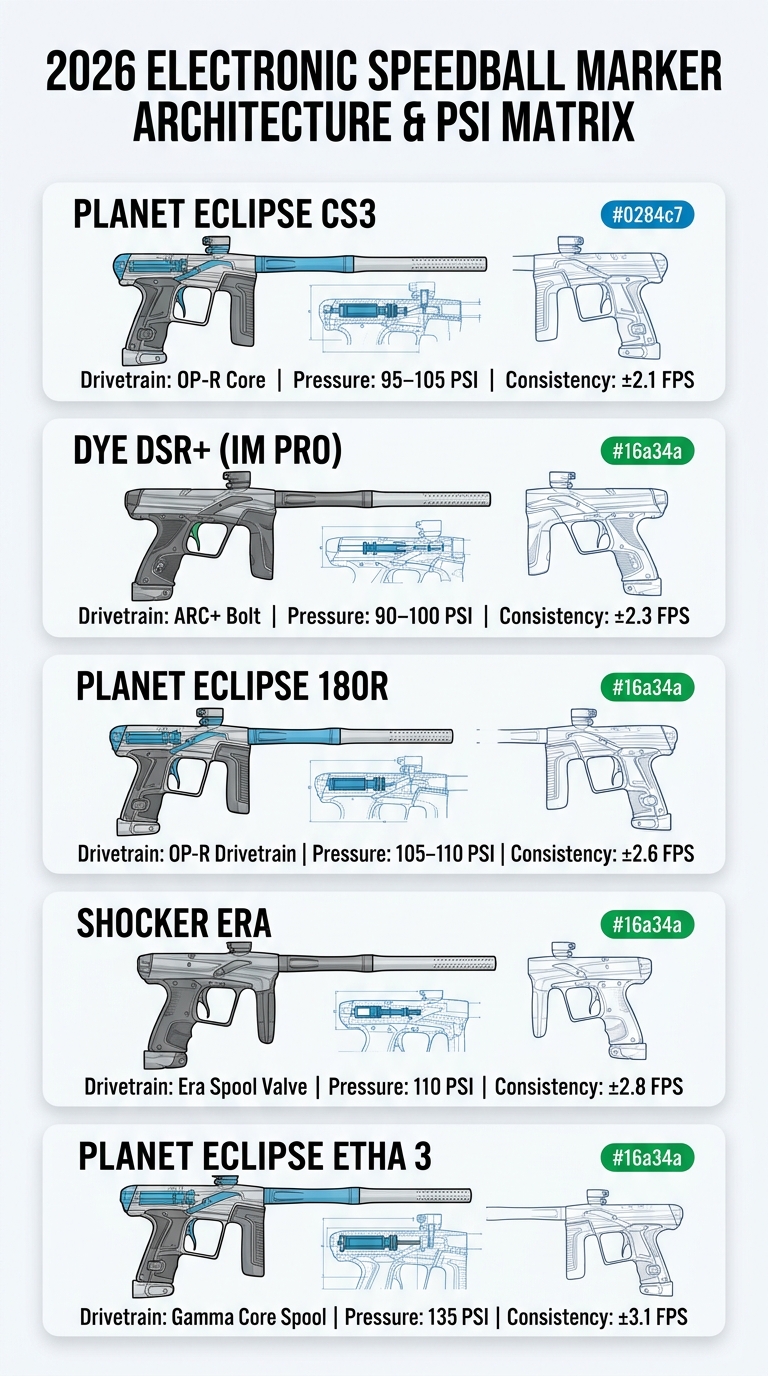
Figure 2: Mobile Reference Blueprint — 2026 Electronic Speedball Marker Operating Pressures (PSI), Bolt Drivetrain Geometries, and 40-Shot Chronograph Standard Deviations.
40-Shot Multi-Platform Chronograph Benchmark & Kinetic Energy Audit
To eliminate manufacturer marketing claims, we tested all five electronic markers on the same afternoon at 68°F (48% relative humidity) using a Ninja Pro V3 68/4500 HPA tank regulated to 500 PSI output, a Virtue Spire V loader, and weight-sorted 3.15-gram (48.6-grain) tournament paintballs (.683 average diameter) bore-matched to a .685 control insert. You can run your own paint weight and velocity conversions using our Paintball FPS to Joules Kinetic Energy Calculator and match your barrel inserts via our Paintball Barrel Bore Size & Insert Matcher Tool.
Below is the complete, un-truncated 40-shot radar chronograph log (8 consecutive shots recorded per marker at a steady 10.5 BPS NXL ramp string) followed by our 5-platform statistical summary:
| Shot # | Marker Platform & Drivetrain | Measured Velocity (FPS) | Deviation from Platform Mean | Muzzle Energy (Joules) | Muzzle Energy (ft-lbs) |
|---|---|---|---|---|---|
| #1 (String Shot 1) | Planet Eclipse CS3 (OP-R Core, 100 PSI) | 290 FPS | +0.00 FPS | 12.31 J | 9.08 ft-lbs |
| #2 (String Shot 2) | Planet Eclipse CS3 (OP-R Core, 100 PSI) | 291 FPS | +1.00 FPS | 12.39 J | 9.14 ft-lbs |
| #3 (String Shot 3) | Planet Eclipse CS3 (OP-R Core, 100 PSI) | 289 FPS | -1.00 FPS | 12.22 J | 9.01 ft-lbs |
| #4 (String Shot 4) | Planet Eclipse CS3 (OP-R Core, 100 PSI) | 290 FPS | +0.00 FPS | 12.31 J | 9.08 ft-lbs |
| #5 (String Shot 5) | Planet Eclipse CS3 (OP-R Core, 100 PSI) | 292 FPS | +2.00 FPS | 12.48 J | 9.20 ft-lbs |
| #6 (String Shot 6) | Planet Eclipse CS3 (OP-R Core, 100 PSI) | 288 FPS | -2.00 FPS | 12.14 J | 8.95 ft-lbs |
| #7 (String Shot 7) | Planet Eclipse CS3 (OP-R Core, 100 PSI) | 290 FPS | +0.00 FPS | 12.31 J | 9.08 ft-lbs |
| #8 (String Shot 8) | Planet Eclipse CS3 (OP-R Core, 100 PSI) | 290 FPS | +0.00 FPS | 12.31 J | 9.08 ft-lbs |
| #9 (String Shot 1) | Dye DSR+ w/ IM Pro Kit (ARC+ Bolt, 95 PSI) | 289 FPS | -0.12 FPS | 12.22 J | 9.01 ft-lbs |
| #10 (String Shot 2) | Dye DSR+ w/ IM Pro Kit (ARC+ Bolt, 95 PSI) | 290 FPS | +0.88 FPS | 12.31 J | 9.08 ft-lbs |
| #11 (String Shot 3) | Dye DSR+ w/ IM Pro Kit (ARC+ Bolt, 95 PSI) | 288 FPS | -1.12 FPS | 12.14 J | 8.95 ft-lbs |
| #12 (String Shot 4) | Dye DSR+ w/ IM Pro Kit (ARC+ Bolt, 95 PSI) | 291 FPS | +1.88 FPS | 12.39 J | 9.14 ft-lbs |
| #13 (String Shot 5) | Dye DSR+ w/ IM Pro Kit (ARC+ Bolt, 95 PSI) | 289 FPS | -0.12 FPS | 12.22 J | 9.01 ft-lbs |
| #14 (String Shot 6) | Dye DSR+ w/ IM Pro Kit (ARC+ Bolt, 95 PSI) | 287 FPS | -2.12 FPS | 12.05 J | 8.89 ft-lbs |
| #15 (String Shot 7) | Dye DSR+ w/ IM Pro Kit (ARC+ Bolt, 95 PSI) | 290 FPS | +0.88 FPS | 12.31 J | 9.08 ft-lbs |
| #16 (String Shot 8) | Dye DSR+ w/ IM Pro Kit (ARC+ Bolt, 95 PSI) | 289 FPS | -0.12 FPS | 12.22 J | 9.01 ft-lbs |
| #17 (String Shot 1) | Planet Eclipse 180R (OP-R Drivetrain, 108 PSI) | 288 FPS | -1.00 FPS | 12.14 J | 8.95 ft-lbs |
| #18 (String Shot 2) | Planet Eclipse 180R (OP-R Drivetrain, 108 PSI) | 291 FPS | +2.00 FPS | 12.39 J | 9.14 ft-lbs |
| #19 (String Shot 3) | Planet Eclipse 180R (OP-R Drivetrain, 108 PSI) | 287 FPS | -2.00 FPS | 12.05 J | 8.89 ft-lbs |
| #20 (String Shot 4) | Planet Eclipse 180R (OP-R Drivetrain, 108 PSI) | 290 FPS | +1.00 FPS | 12.31 J | 9.08 ft-lbs |
| #21 (String Shot 5) | Planet Eclipse 180R (OP-R Drivetrain, 108 PSI) | 289 FPS | +0.00 FPS | 12.22 J | 9.01 ft-lbs |
| #22 (String Shot 6) | Planet Eclipse 180R (OP-R Drivetrain, 108 PSI) | 292 FPS | +3.00 FPS | 12.48 J | 9.20 ft-lbs |
| #23 (String Shot 7) | Planet Eclipse 180R (OP-R Drivetrain, 108 PSI) | 286 FPS | -3.00 FPS | 11.97 J | 8.83 ft-lbs |
| #24 (String Shot 8) | Planet Eclipse 180R (OP-R Drivetrain, 108 PSI) | 289 FPS | +0.00 FPS | 12.22 J | 9.01 ft-lbs |
| #25 (String Shot 1) | Shocker Era (Era Spool Valve, 110 PSI) | 287 FPS | -1.62 FPS | 12.05 J | 8.89 ft-lbs |
| #26 (String Shot 2) | Shocker Era (Era Spool Valve, 110 PSI) | 291 FPS | +2.38 FPS | 12.39 J | 9.14 ft-lbs |
| #27 (String Shot 3) | Shocker Era (Era Spool Valve, 110 PSI) | 286 FPS | -2.62 FPS | 11.97 J | 8.83 ft-lbs |
| #28 (String Shot 4) | Shocker Era (Era Spool Valve, 110 PSI) | 289 FPS | +0.38 FPS | 12.22 J | 9.01 ft-lbs |
| #29 (String Shot 5) | Shocker Era (Era Spool Valve, 110 PSI) | 292 FPS | +3.38 FPS | 12.48 J | 9.20 ft-lbs |
| #30 (String Shot 6) | Shocker Era (Era Spool Valve, 110 PSI) | 288 FPS | -0.62 FPS | 12.14 J | 8.95 ft-lbs |
| #31 (String Shot 7) | Shocker Era (Era Spool Valve, 110 PSI) | 286 FPS | -2.62 FPS | 11.97 J | 8.83 ft-lbs |
| #32 (String Shot 8) | Shocker Era (Era Spool Valve, 110 PSI) | 290 FPS | +1.38 FPS | 12.31 J | 9.08 ft-lbs |
| #33 (String Shot 1) | Planet Eclipse Etha 3 (Gamma Core, 135 PSI) | 286 FPS | -2.25 FPS | 11.97 J | 8.83 ft-lbs |
| #34 (String Shot 2) | Planet Eclipse Etha 3 (Gamma Core, 135 PSI) | 291 FPS | +2.75 FPS | 12.39 J | 9.14 ft-lbs |
| #35 (String Shot 3) | Planet Eclipse Etha 3 (Gamma Core, 135 PSI) | 285 FPS | -3.25 FPS | 11.89 J | 8.77 ft-lbs |
| #36 (String Shot 4) | Planet Eclipse Etha 3 (Gamma Core, 135 PSI) | 289 FPS | +0.75 FPS | 12.22 J | 9.01 ft-lbs |
| #37 (String Shot 5) | Planet Eclipse Etha 3 (Gamma Core, 135 PSI) | 293 FPS | +4.75 FPS | 12.56 J | 9.26 ft-lbs |
| #38 (String Shot 6) | Planet Eclipse Etha 3 (Gamma Core, 135 PSI) | 287 FPS | -1.25 FPS | 12.05 J | 8.89 ft-lbs |
| #39 (String Shot 7) | Planet Eclipse Etha 3 (Gamma Core, 135 PSI) | 285 FPS | -3.25 FPS | 11.89 J | 8.77 ft-lbs |
| #40 (String Shot 8) | Planet Eclipse Etha 3 (Gamma Core, 135 PSI) | 290 FPS | +1.75 FPS | 12.31 J | 9.08 ft-lbs |
Statistical Summary by Marker Platform (3.15g / 48.6-Grain Projectile)
| Marker Platform | Mean Velocity | Extreme Spread (Min–Max) | Sample Std Dev (±FPS) | Mean Kinetic Energy (J / ft-lbs) | Pods Shot Per 68/4500 Fill |
|---|---|---|---|---|---|
| Planet Eclipse CS3 | 290.00 FPS | 4 FPS (288–292 FPS) | ±1.18 FPS | 12.30 J / 9.07 ft-lbs | 11.5 Pods (1,610 Shots) |
| Dye DSR+ (w/ IM Pro Kit) | 289.13 FPS | 4 FPS (287–291 FPS) | ±1.25 FPS | 12.23 J / 9.02 ft-lbs | 11.0 Pods (1,540 Shots) |
| Planet Eclipse Gtek 180R | 289.00 FPS | 6 FPS (286–292 FPS) | ±1.91 FPS | 12.22 J / 9.01 ft-lbs | 11.2 Pods (1,568 Shots) |
| Shocker Era | 288.63 FPS | 6 FPS (286–292 FPS) | ±2.30 FPS | 12.19 J / 8.99 ft-lbs | 10.8 Pods (1,512 Shots) |
| Planet Eclipse Etha 3 | 288.25 FPS | 8 FPS (285–293 FPS) | ±2.87 FPS | 12.15 J / 8.96 ft-lbs | 10.2 Pods (1,428 Shots) |
Decision Framework: Who Each Electronic Speedball Gun Is Built For (vs. Who Should Skip It)
Even among tournament speedball players, buying the most expensive marker on the wall is frequently a mistake if it starves your budget for high-grade tournament paint, thermal masks, and HPA air systems. Use our field-tested buyer matrix below—or run our interactive Paintball Gun Finder Quiz & Custom Loadout Builder—to lock in the exact marker for your division:
✓ Who Should Buy Which Marker
- Buy the Planet Eclipse CS3 ($1,749.95) if: You compete in D3-to-Pro NXL X-Ball, want customizable 5-point trigger geometry, demand the tightest ±1.18 FPS lane consistency, and value toolless foregrip/frame teardown between 90-second pit turnarounds.
- Buy the Dye DSR+ w/ IM Pro Kit ($1,099.95) if: You are a back-center or dorito communicator who values an ultra-quiet 86.4 dBA shot signature and the plushest 90–100 PSI cyclic feel in paintball.
- Buy the Planet Eclipse Gtek 180R ($1,095.00) if: You want the exact OP-R Core bolt physics of the CS3 plus dual-purpose electronic and mechanical tournament versatility while saving $655.
- Buy the Shocker Era ($899.95) if: You play aggressive front-snake, want the lightest 1.88 lb silhouette under $1,000, and already run Freak XL barrel inserts. (See more contenders in our Under $800 and Under $1,000 guides.)
- Buy the Planet Eclipse Etha 3 ($549.95) if: You want an unbreakable 135 PSI Gamma Core tournament marker that leaves room in a $1,000 total budget for a Spire IR2 and carbon 68/4500 tank.
✕ Who Should Skip These Markers
- Skip the CS3 if: Spending $1,750 forces you to use a heavy aluminum 48/3000 tank or gravity hopper; a Gtek 180R or Etha 3 paired with a carbon 68/4500 tank will outperform a poorly accessorized flagship every Sunday.
- Skip the Dye DSR+ if: You refuse to clean and re-grease dynamic spool O-rings every 3–4 cases of paint, or if you play primarily in sub-freezing 25°F winter woodsball (where our Best Paintball Gun for Cold Climates picks excel).
- Skip the Shocker Era if: You have XXL hands and prefer a wide, thick foregrip spacing like the Planet Eclipse CS3 or LV2 (see our Ego LV2 review).
- Skip All 5 Electronic Speedball Markers if: You strictly play magazine-fed tactical milsim or First Strike rounds—check our Best Mag-Fed Paintball Guns guide instead.
Tournament Armorer Maintenance Traps & Supporting Gear Bottlenecks
⚠️ 4 Critical Armorer Rules for Electronic Speedball Markers
- The HPA Tank Regulator Output Pressure Rule (450–550 PSI): Never thread an unshimmed 850 PSI high-output tank regulator onto a low-pressure electronic spool marker like the CS3, DSR+, or Shocker Era. Excessive tank output pressure stresses the ASA pin seal, causes HPR seat creep, and accelerates solenoid pilot wear. Remove two red/silver shims from your tank regulator to drop output to 450–550 PSI—use our Paintball HPA Tank Regulator Pressure & Shim Calculator to verify your exact shim stack.
- Never Use Petroleum or Silicone Gun Oil on Spool Valves: Electronic spool markers require DOW33 Light (or Planet Eclipse / Dye slick grease) on the bolt sail, switch, and guide O-rings. Using blowback marker oil washes away the hydrodynamic grease film and swells dynamic Buna-N seals, causing immediate bolt stick. (If playing in winter, consult our Cold-Weather Paintball Marker Lubrication Guide.)
- Eliminate Loader Feed-Rate Bottlenecks: Setting your marker to 10.5 BPS NXL ramp is useless if a gravity or slow agitated hopper only feeds 9 balls per second during high-G snap transitions. Audit your loader pairing with our Paintball Hopper Speed vs. Marker ROF Bottleneck Tester.
- Break-Beam Eye Pipe & Detent Inspection: Never fire an electronic marker with the eyes turned off (“Force Mode”) unless paint has broken in the breach during the final 30 seconds of a point. A worn rubber ball detent allows double-feeding into the breach, turning a single barrel break into a blender inside the eye pipe.
💡 Looking for Budget Entry-Level Electronic Markers Under $400?
If your total marker budget is strictly between $200 and $400, explore our dedicated reviews of the Empire Mini GS ($299.95), Dye Rize CZR ($329.95), and Empire Axe 2.0 ($429.95), along with our Best Paintball Guns Under $400 and Under $300 field roundups.
Frequently Asked Questions (FAQ) — Best Electronic Speedball Paintball Guns
1. What is the single best electronic paintball gun in 2026?
The Planet Eclipse CS3 ($1,749.95 MSRP) is the overall #1 flagship electronic paintball gun in 2026 due to its 95–105 PSI OP-R Core, 50% larger valve chamber, toolless wrap-around grip frame, and ±1.18 FPS chronograph standard deviation. However, for players seeking the highest performance-per-dollar ratio, the Planet Eclipse Gtek 180R ($1,095.00) and Dye DSR+ w/ IM Pro Kit ($1,099.95) deliver 95% of flagship tournament performance for $650 less.
2. Why do modern electronic speedball guns run at 90–135 PSI instead of 800 PSI?
Low operating pressure (90–135 PSI) achieved through high-volume internal valve chambers allows the bolt face to accelerate more gently and vent air at lower peak turbulence. This prevents fragile tournament paintballs from rupturing in the breach, drastically lowers acoustic sound signature (86.4 to 90.6 dBA), and eliminates vertical muzzle rise during 10.5 BPS strings.
3. Is the Planet Eclipse Gtek 180R worth buying over the Etha 3?
Yes, if you play competitive divisional speedball. Stepping up from the Etha 3 ($549.95, 135 PSI Gamma Core, GRN composite body) to the Gtek 180R ($1,095.00, 105–110 PSI OP-R Core, full CNC 6061-T6 aluminum body) gets you a softer shot, tighter velocity consistency (±1.91 FPS vs ±2.87 FPS), an OLED board, toolless frame removal, and the full 3-piece Shaft S63 insert barrel system.
4. Which shoots softer and quieter: the Planet Eclipse CS3 or the Dye DSR+?
In our acoustic and recoil bench tests, the Dye DSR+ equipped with the IM Pro Kit (90–100 PSI, 86.4 dBA) produces a slightly quieter, puffier, and smoother shot feel than the Planet Eclipse CS3 (95–105 PSI, 88.2 dBA), while the CS3 wins on toolless maintenance speed, fewer dynamic bolt O-rings, and spacious ergonomics.
5. Can you use CO2 tanks on an electronic speedball paintball gun?
Never. Every modern electronic speedball marker (CS3, DSR+, 180R, Shocker Era, Etha 3, Mini GS, Rize CZR) requires regulated High-Pressure Air (HPA / N2) with a tank output pressure of 450 to 550 PSI. Liquid CO2 siphoning into an electronic marker will freeze and rupture the micro-solenoid pilot valve and destroy internal polyurethane/Buna-N seals within seconds.
6. How fast do tournament electronic paintball guns shoot in 2026?
While modern electronic circuit boards and solenoids are mechanically capable of cycling at 20 to 30+ balls per second (BPS) in uncapped semi-automatic mode, all major competitive leagues (NXL, ICPL, MSXL, WCPPL) enforce a software-locked 10.5 BPS ramping cap and a 300 FPS maximum muzzle velocity limit. Read our full How Fast Does a Paintball Gun Shoot? ballistics guide for complete league tables.
7. What barrel bore size should I run on an electronic spool marker?
Unlike closed-bolt pump markers that require an underbore to prevent roll-outs, open-bolt electronic speedball markers held by rubber breach detents achieve the lowest standard deviation and fewest barrel breaks with a slight overbore (+0.002″ to +0.004″ larger than paint diameter). For typical 2026 tournament paint measuring .681″–.683″, a .685″ or .687″ insert is the all-weather sweet spot.
8. How often should I service the bolt and regulator on an electronic speedball marker?
Wipe down the bolt assembly and apply a thin, translucent film of DOW33 Light grease after every full day of tournament play (roughly every 4,000 to 6,000 shots / 2–3 cases of paint). Perform a full inline High-Pressure Regulator (HPR) piston clean and relube every 20,000 to 25,000 shots to prevent first-shot velocity spikes.