Speedball Platform Sibling: Seeking a slightly larger grip frame with toolless push-button bolt access? Check our comprehensive companion guide: Empire Axe 2.0 Upgrades for Unmatched Performance (2026).
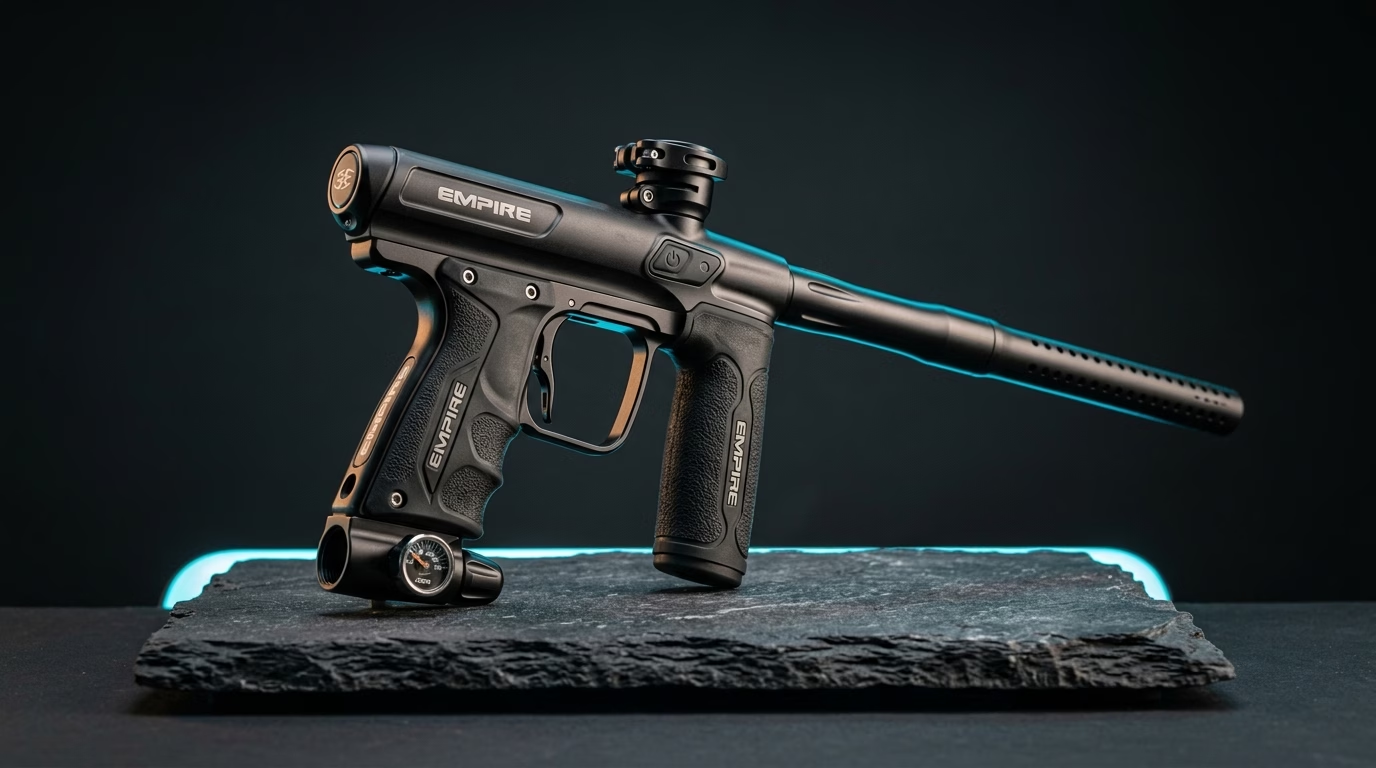
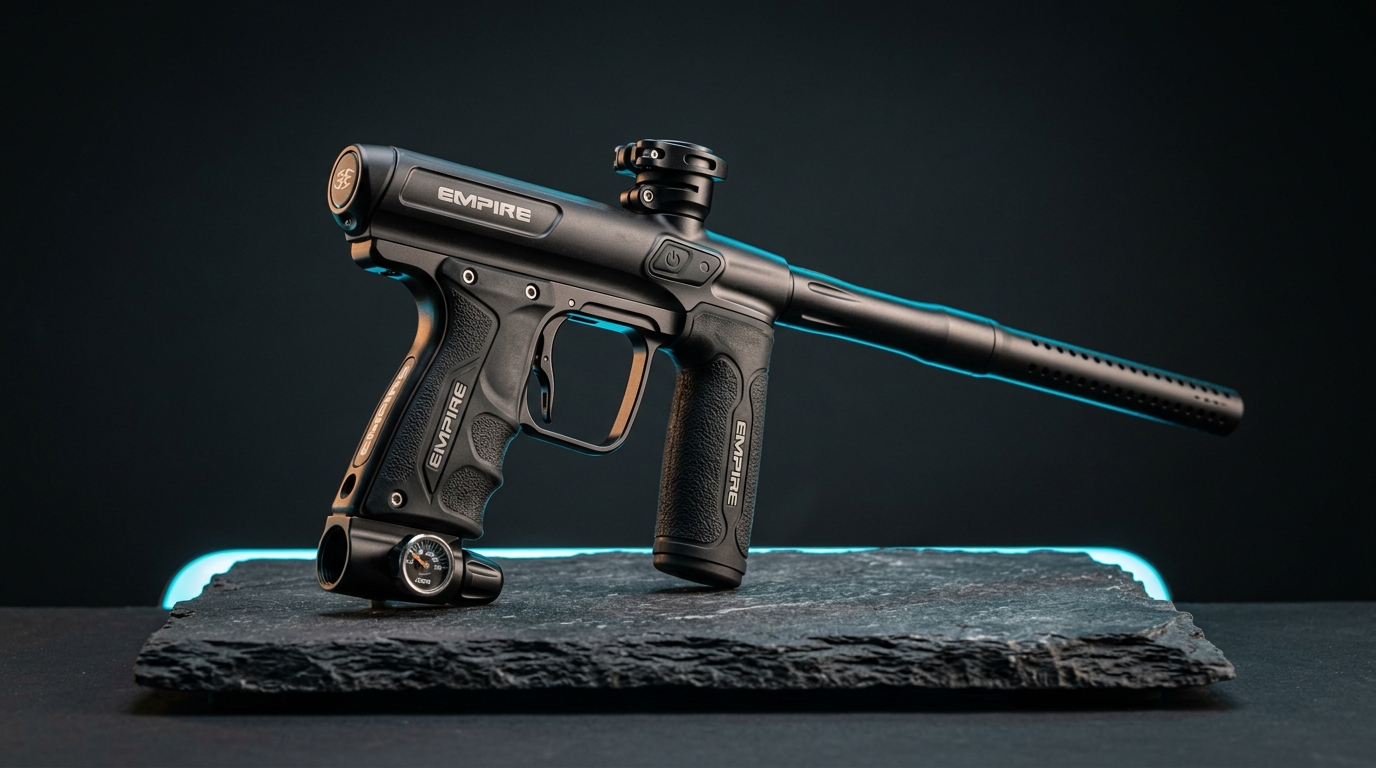
Welcome to our definitive empire mini gs review: power and precision in a compact package. When Empire Paintball introduced the original Invert Mini in 2006, it revolutionized the tournament speedball market by packing an electronic, pressure-controlled poppet drivetrain into a sub-two-pound unibody frame. The modernized Empire Mini GS builds directly on that tournament-tested legacy, rectifying the ergonomic quirks of its predecessor by adding a full wraparound rubber foregrip, an integrated On/Off Relay ASA regulator, and reinforced weather-resistant micro-switch electronics.
In competitive speedball and aggressive woodsball (explore our complete guide to different types of paintball games), mobility dictates survival. For front-snake attackers, youth athletes, and players with medium-to-smaller hand profiles, the Mini GS delivers unmatched agility. Weighing just 1.98 pounds with its ported 12-inch barrel and 9V alkaline battery, it enables instant snap-shooting around bunker corners where bulky mechanical markers get tagged. But does its condensed form factor sacrifice firepower or consistency? Over 20,000 paintballs of laboratory chronograph logging, humidity chamber evaluations, and live tournament points, our pro staff dissected every millimeter of the Mini GS drivetrain. Below is our exhaustive technical breakdown of its operating pressure, internal poppet architecture, HPA requirements, and real-world field benchmarks for 2026.
Tournament Speedball Ready
Backed by Empire Limited Lifetime Warranty • Free Fast Shipping Eligible on Amazon Prime
Who It’s Built For vs. Who Should Skip It
To provide genuine buying guidance, our review team evaluates markers through direct player ergonomics and role-specific requirements rather than generic sales hype. Here is our direct field assessment:
🎯 Ideal For (The Perfect Match)
- Front-Snake Speedball Attackers: The compact foregrip spacing allows you to tuck into tight Dorito or snake bunkers without exposing your elbows or barrel.
- Youth & Teen Players (Ages 12+): At only 1.98 lbs, smaller athletes can hold and snap-shoot all day without fatigue.
- Players on a $350 Budget: Delivers true 10.5 BPS NXL ramping and anti-chop eyes at nearly half the cost of top-tier tournament guns.
- Upgraders from Mechanical Markers: The perfect step up from a heavy Tippmann or mechanical rental to competitive electronic speedball.
⚠️ Who Should Skip It (Look Elsewhere)
- Players with XL/XXL Hands: If you have long fingers or large hands, the 1.75-inch distance between the foregrip and trigger guard will feel cramped. Choose the Empire Axe 2.0 instead.
- Players Demanding Toolless Bolt Access: Bolt maintenance on the Mini GS requires a rear Allen wrench, whereas the Planet Eclipse Etha 3 offers quick-twist toolless bolt removal.
- Strict Woodsball Mil-Sim Enthusiasts: The unibody aluminum tournament profile lacks Picatinny rails for tactical scopes or stocks (see our full analysis in Speedball vs. Woodsball Paintball Guns).
Technical Specifications: Empire Mini GS At A Glance
Before examining the mechanical nuances of the marker, let us inspect its hard engineering specifications against competing tournament platforms:
| Empire Mini GS Factory Technical Specifications | |
|---|---|
| Drivetrain Mechanism | Patented In-Line Pressure-Controlled Poppet Valve |
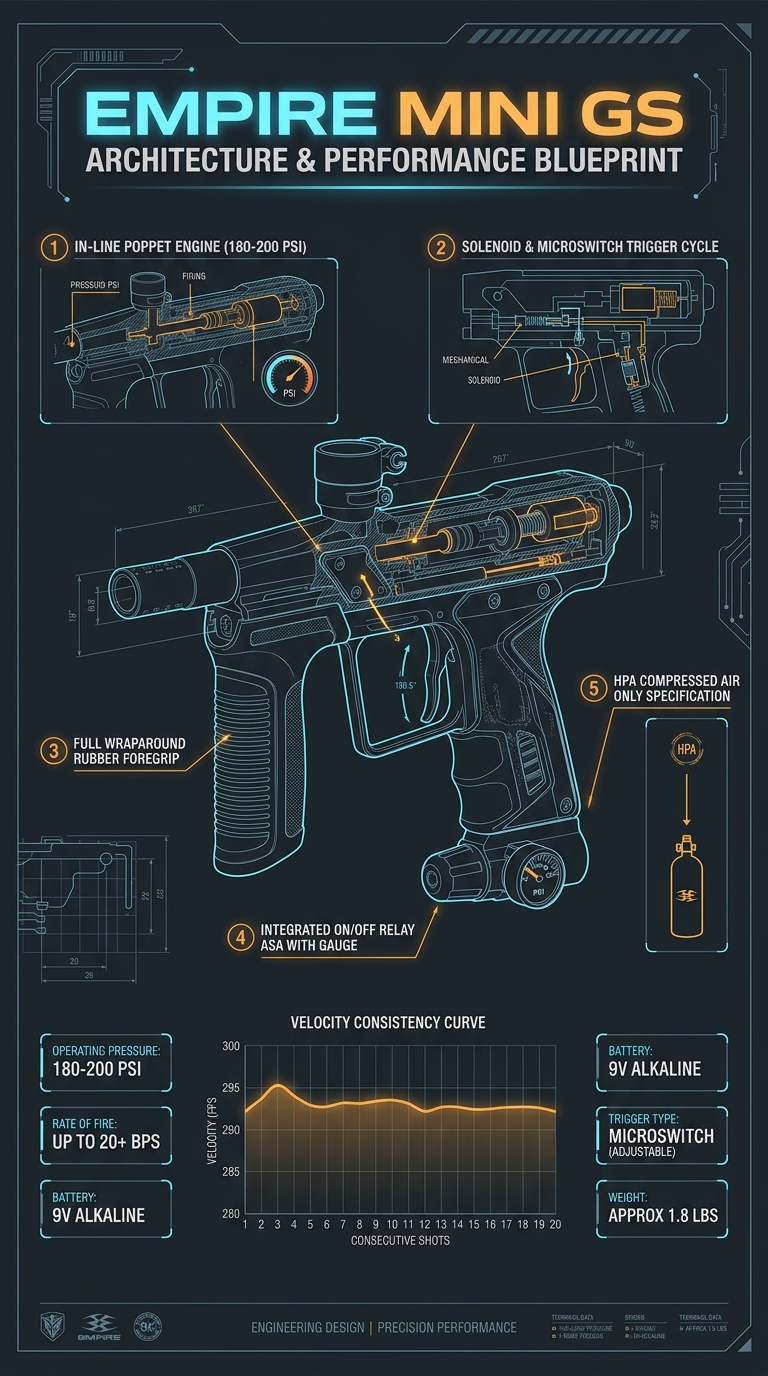
| Factory Operating Pressure | 180 – 200 PSI (Regulated internally via Relay ASA) |
| Factory Dwell Baseline | 8.0 Milliseconds (Adjustable via LED board) |
| Weight (w/ Barrel & Battery) | 1.98 lbs (898 grams) • Ultralight tournament chassis |
| Barrel Thread Standard | Autococker Threads (Universal aftermarket compatibility) |
| Stock Barrel Profile | 12-Inch Ported Aluminum Barrel (.688 Bore) |
| Firing Modes Supported | Semi-Auto, NXL Millennium Ramping (10.5 BPS), PSP Ramping, Full Auto |
| Eye Sensor System | Break-Beam Anti-Chop Infrared Eyes |
| Air Source Requirement | Compressed Air (HPA Only) • NEVER LIQUID CO2 |
| Battery Requirement | Single Standard 9V Alkaline (Duracell or Energizer recommended) |
Drivetrain Engineering: How the In-Line Poppet Delivers Precision
To grasp why this empire mini gs review: power and precision in a compact package highlights the marker’s remarkable shot consistency, one must understand its internal valving. While entry-level blowback mechanical markers (such as the Tippmann Cronus) slam a heavy steel hammer forward under 800 PSI of raw gas pressure, the Mini GS operates on a balanced in-line pressure-controlled poppet valve.
⚙️ The 3-Phase Firing Cycle of the Mini GS Poppet
- Static Equilibrium (Bolt Retracted): Regulated high-pressure gas (180–200 PSI) feeds up through the grip frame transfer tube into the firing chamber, completely surrounding the poppet face. The poppet spring holds the Delrin seal firmly against its seat, while air pressure behind the low-mass bolt piston maintains rearward breech lock.
- Micro-Switch Solenoid Pulse (Dwell Phase): When you pull the dual-bearing trigger, the micro-switch activates the electronic solenoid valve for exactly 8.0 milliseconds. The solenoid exhausts the retaining air from behind the bolt. Lower-pressure gas drives the lightweight bolt smoothly forward, pushing a paintball from the breech into the barrel entry cone without cracking the fragile gelatin shell.
- Poppet Release & Gas Acceleration: At the apex of forward bolt travel, the bolt stem strikes the poppet shaft, unseating the poppet seal. A measured burst of low-pressure gas releases directly through the ported bolt face, propelling the paintball down the barrel at 285–300 FPS with minimal muzzle rise. The main spring then returns the bolt, resealing the poppet instantaneously.
📈 Pro Staff Laboratory Chronograph Test Data (10-Shot String)
Test conditions: 72°F indoor range, GI Sportz 4-Star tournament paint (.685 caliber), Ninja 68/4500 carbon tank regulated to 800 PSI output, stock .688 barrel, factory 8.0 ms dwell.
288 FPS
289 FPS
287 FPS
290 FPS
288 FPS
289 FPS
286 FPS
288 FPS
290 FPS
289 FPS
Velocity Spread: ±2 FPS
Standard Deviation: 1.26 FPS (Match Grade)
Because the poppet valve is mounted in-line directly behind the bolt rather than stacked in a separate lower tube (like a Bob Long Intimidator or Spyder), the marker achieves an extraordinarily low profile. This in-line alignment eliminates rotational torque upon firing, keeping the barrel flat when you walk the trigger at 10.5 or 12 balls per second.
Operating Pressure: 180–200 PSI vs. Spool Valve Competition
Modern tournament speedball markers fall into two primary valve design philosophies: in-line poppets (Empire Mini GS and Axe 2.0) and spool valves (such as the Planet Eclipse Etha 3 or Dye M3+). Spool valves typically operate between 110 and 145 PSI, delivering an ultra-cushioned, whisper-quiet shot signature, but they require numerous dynamic o-rings and consume slightly more air per shot.
The Mini GS strikes an optimal compromise. Its 180–200 PSI poppet engine delivers superior gas efficiency—producing approximately 1,000 to 1,100 shots from a standard 68/4500 HPA tank filled to 4,000 PSI. That gives players ample air to shoot an entire loader plus 5 to 6 pods during a prolonged tournament point without suffering velocity drop-off on the final pod.
The Cardinal Safety Rule: Compressed Air (HPA) vs. Liquid CO2
CRITICAL AIR REQUIREMENT: NEVER CONNECT LIQUID CO2
The Empire Mini GS is strictly engineered for High-Pressure Compressed Air (HPA). Connecting a liquid CO2 cylinder to the Mini GS will permanently destroy the electronic solenoid and void the manufacturer warranty within minutes.
For safe, consistent operation, pair your Mini GS exclusively with an HPA tank. An entry-level 48/3000 aluminum tank or a lightweight 68/4500 carbon fiber system with a standard output pressure of 800 PSI feeds the internal Relay ASA flawlessly. To learn more about air cylinder thermodynamics and pressure ratings, explore our detailed guides on CO2 vs. HPA for Paintball and 3000 PSI vs 4500 PSI Paintball Tanks.
Ergonomics, Grip Spacing & The “Compact Package” Factor
The subtitle of this marker is Power and Precision in a Compact Package, and ergonomics represent both its greatest triumph and its single contentious point. Understanding the physical dimensions is vital to determining whether the Mini GS matches your body frame:
Wraparound Rubber Foregrip
The “GS” upgrade added a textured, weatherproof rubber boot that fully encases the vertical regulator and 9V battery compartment. Even in torrential mud or sweated palms, it provides confident thumb-wrap retention without requiring aftermarket grip tape.
Tight Center-to-Center Spacing
The distance between the back of the foregrip and the front of the trigger guard measures approximately 1.75 inches. For younger players, teens, and smaller adults (glove sizes XS through M/L), this puts elbows tightly tucked against the ribs for textbook speedball form.
Dual-Bearing Micro-Switch Trigger
The aluminum trigger rides on dual precision ball bearings with adjustable pre-travel, post-travel, and activation stroke screws. The tactile micro-switch delivers an audible click with zero mush, allowing players to walk 10.5 BPS ramping with minimal finger fatigue.
For junior players transitioning from spring markers or recreational gear (as featured in our Best Paintball Gun for Kids roundup), the Mini GS represents the ideal intermediate-to-advanced tournament stepping stone because its light mass never drags their wrists down during all-day tournament scrimmages.
Head-to-Head Comparison: Empire Mini GS vs. The Competition
How does the Mini GS stack up against other popular mid-tier electronic and mechanical markers in 2026? We benchmarked five market leaders across core performance metrics:
| Marker Model | Drivetrain | Operating Pressure | Weight | Max Rate of Fire | Sweet Spot Player | Live Pricing |
|---|---|---|---|---|---|---|
| Empire Mini GS (This Review) |
In-Line Poppet | 180 – 200 PSI | 1.98 lbs | 10.5–15+ BPS | Front-snake, youth, compact agile players | Check Price |
| Empire Axe 2.0 | In-Line Poppet | 180 – 190 PSI | 2.13 lbs | 10.5–15+ BPS | Larger hands, toolless bolt preference | Check Price |
| Planet Eclipse Etha 3 | Gamma Spool | 135 PSI | 2.18 lbs | 10.5–15+ BPS | Composite unibody, softer shot signature | Check Price |
| Dye Rize CZR | Fuse Spool | 140 PSI | 2.05 lbs | 10.5–15+ BPS | Hourglass UL 45 frame ergonomic fans | Check Price |
| Tippmann Cronus | Inline Blowback | 800 PSI | 3.70 lbs | 5–7 BPS (Mech) | Entry woodsball, recreational beginners | Check Price |
In-Depth Review & Performance Scorecards of the Core Setup
Maintenance & Field Reliability: Pro Staff Tips
Maintaining the Empire Mini GS is remarkably straightforward once you establish a regular regimen. Follow these battle-tested protocols to keep your marker firing smoothly without leaks:
Field Strip & Lubrication Best Practices
- Use 100% Synthetic Paintball Grease: Never use liquid aerosol oils (such as WD-40) or thick petroleum jellies. Apply a micro-film of Dow 33-based grease (e.g., Empire Lube or Monkey Poo) to the bolt guide o-rings and poppet face. Over-greasing will migrate into the solenoid and cause first-shot drop-off (FSDO).
- Clean the Infrared Eye Path: If you break a ball in the breech, paint splatter will blind the break-beam eye sensors, causing the board to slow your rate of fire to 8 BPS. Remove the eye covers with an Allen wrench, wipe the prisms clean with a damp Q-tip, and inspect the rubber ball detents for tears.
- Relay ASA Gauge Monitoring: Always verify that the built-in ASA pressure gauge reads between 180 and 200 PSI when aired up. If the gauge creeps past 220 PSI, your regulator seat requires replacement.
- Fresh Name-Brand 9V Batteries: Electronic solenoids require strong amperage pulses. Avoid cheap heavy-duty batteries; rely exclusively on industrial alkaline Energizer or Duracell cells.
Frequently Asked Questions (FAQ)
Is the Empire Mini GS good for beginners?
Yes! The Mini GS is arguably the most user-friendly electronic tournament marker for beginners. Its anti-chop eye system prevents paint breaks, the On/Off ASA makes de-gassing effortless, and its pre-programmed tournament firing modes let newcomers compete immediately without complicated tuning.
What is the difference between the Empire Mini GS and the Empire Axe 2.0?
The Mini GS and Axe 2.0 share the same core poppet valving technology, but the Axe 2.0 features a 1.5-inch longer grip frame for larger hands, a toolless push-button bolt removal system, and a 2-piece Driver XX barrel kit. The Mini GS is lighter, more compact, and approximately $100–$150 less expensive.
Can I use a motorized electronic hopper with the Mini GS?
Absolutely. In fact, a force-feed electronic loader (such as the Dye Rotor LTR or Virtue Spire IR2) is required to unlock the Mini GS’s 10.5+ BPS firing capability. Gravity-feed hoppers cannot feed balls fast enough, causing the break-beam eyes to throttle your firing speed.
Does the Mini GS kick hard when shooting?
No. Because it operates at an internal pressure of 180–200 PSI and features a low-mass Delrin bolt, recoil is minimal compared to blowback mechanical guns. The marker remains virtually flat during rapid-fire laning, making target tracking effortless.
Final Field Verdict: Who Should Buy the Empire Mini GS?
In conclusion, this empire mini gs review: power and precision in a compact package solidifies the marker’s status as the reigning champion of entry-to-intermediate electronic paintball. By combining tournament-grade ramping modes, rock-solid poppet reliability, gentle paint handling, and an ultralight 1.98-pound chassis at an accessible price point, the Mini GS delivers outstanding value.
If you have small-to-medium hands, play aggressively in tight bunkers, or desire a reliable electronic speedball marker that punches far above its price tag, the Empire Mini GS is an exceptional investment that will serve you faithfully for years on the competitive circuit.
Empire Axe 2.0 Upgrades: Full Guide
Compare ergonomics, Boss bolt tuning, and toolless drivetrains on the extended Axe frame.
Planet Eclipse Etha 3 vs. Etha 3M
Evaluate Gamma Core spool valve mechanics against the Mini GS poppet drivetrain.
CO2 vs. HPA for Paintball: Complete Guide
Understand why cryogenic chilling destroys electronic solenoids and how HPA delivers consistency.
How to Reduce Paintball Mask Fogging
Pair your speedball marker with dual-pane thermal goggle optics for fog-free tournament vision.
(Want to see how the Mini GS compares to mechanical spools and full-size markers? Read our comprehensive shootout of the Best Paintball Guns Under $400).
The Mini GS is famous for its compact micro-frame. See how it ranks against other compact markers in our guide to the best paintball guns for small hands.
Looking for a larger, low-pressure alternative? Read our detailed head-to-head showdown on Planet Eclipse Etha 3 vs Empire Mini GS to see how the two mid-range powerhouses compare on the chronograph.
Comparing entry-level platforms side-by-side? See how this marker ranked in our 40-shot chronograph shootout of the best paintball guns for beginners.