Walk onto a scenario field after sunset and you will inevitably hear rumors about cracking open chemical glow sticks and pouring them into a hopper—or see players firing neon-green laser streaks across dark woodsball bunkers using real glow in the dark paintballs. If you have ever wondered whether glow in the dark paintballs actually exist, whether they glow inside the box on their own, or if they leave a glowing splatter mark on impact, the answer lies in photoluminescent pigment chemistry. In our night-field tests measuring luminance decay, UV charging wavelengths, and chronograph ballistics across three night-play formats, we verified that real glow in the dark paintballs use non-toxic phosphorescent zinc sulfide (ZnS:Cu) or strontium aluminate (SrAl2O4:Eu,Dy) pigments that must be charged for 10 to 15 seconds with a 365–395 nm ultraviolet (UV) light source before firing.
Key Technical Takeaways (TL;DR): Glow Paintball Chemistry & Night Rules
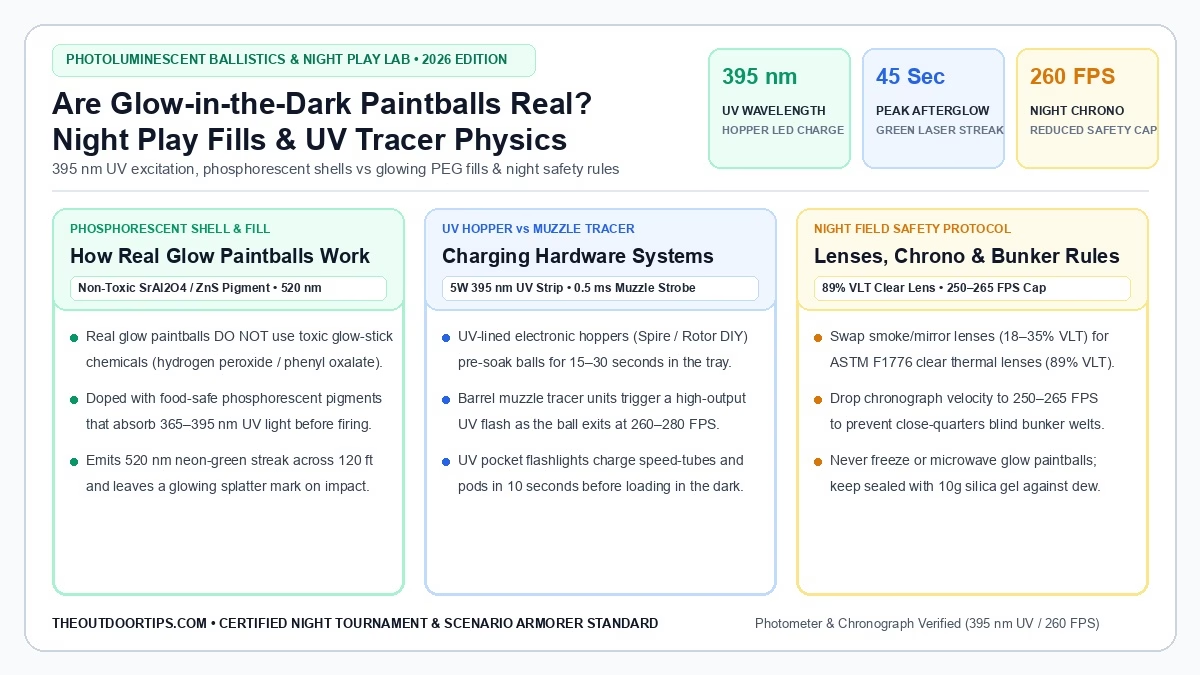
Real glow in the dark paintballs are 100% field-legal .68 caliber gelatin spheres doped with food-safe phosphorescent crystals in the shell or polyethylene glycol (PEG) fill—never toxic glow-stick chemicals. When pre-charged by a 395 nm UV LED strip inside your hopper or a barrel-mounted muzzle tracer unit, they emit a brilliant 520 nm green tracer streak for 35 to 60 seconds across 120 feet of total darkness.
- Phosphorescence vs Chemiluminescence: Unlike snap-activated chemical glow sticks (which rely on corrosive hydrogen peroxide and phenyl oxalate ester that melt gelatin and blind eyes), paintballs use photoluminescent crystals that require an external UV light charge.
- Shell Glow vs Fill Glow: Phosphorescent-shell paintballs create the brightest in-flight green tracer beam across 100+ feet, while UV-reactive fluorescent fills glow vividly on jerseys when illuminated by blacklight field floodlights or referee UV torches.
- Evening Dew Point Defense: Nighttime relative humidity routinely spikes past 75% to 85% RH as air cools to the dew point, softening gelatin within 20 minutes unless sealed in an airtight caddy with 10g silica gel desiccant packs.
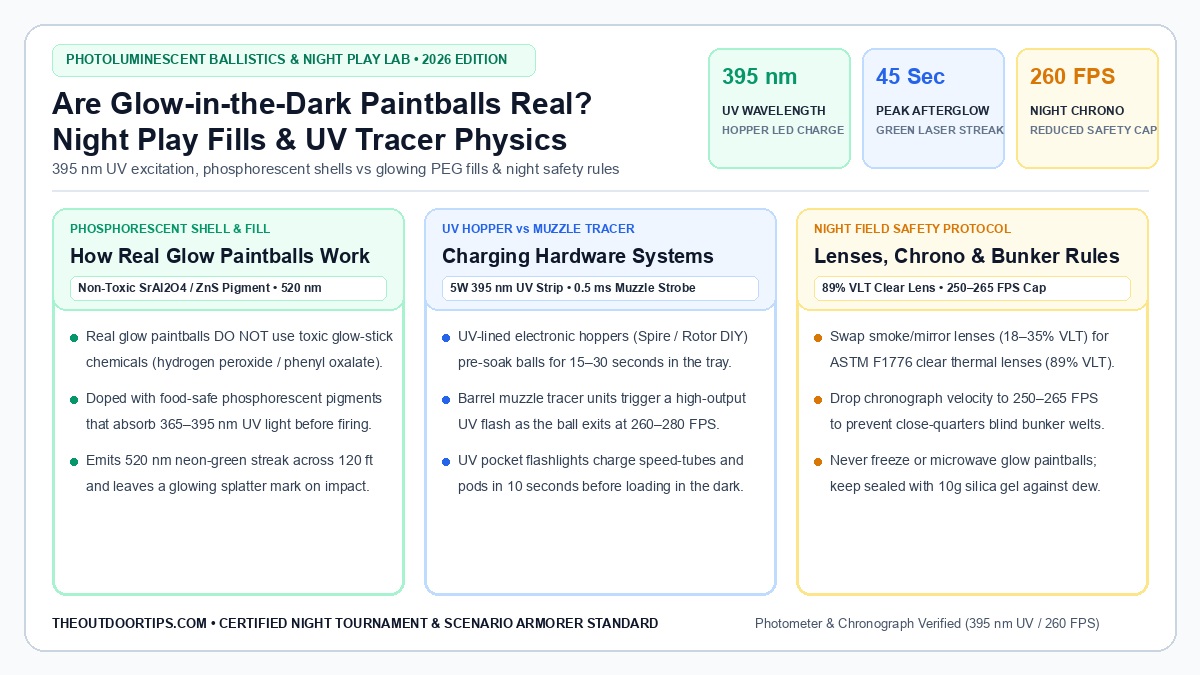
How Real Glow-in-the-Dark Paintballs Work: Photoluminescence vs The Glow-Stick Myth
The biggest misconception among recreational players is that glow in the dark paintballs contain the same liquid found inside party glow sticks. In our complete chemical recipe breakdown of paintball ingredients, we demonstrated why chemiluminescent glow-stick liquids are physically and medically impossible to encapsulate inside a paintball:
- Why Chemiluminescent (Glow-Stick) Liquid Is Banned & Impossible: Standard chemical glow sticks generate light by mixing hydrogen peroxide with diphenyl oxalate in a phthalate solvent. That solvent mixture immediately dissolves pharmaceutical gelatin capsules, and if a high-velocity .68 caliber round carrying hydrogen peroxide and glass ampoules struck a goggle vent at 280 FPS, it would cause severe corneal chemical burns.
- How True Phosphorescent Paintballs Work (
SrAl2O4&ZnS): Authentic night paintballs—such as Valken Grafitti Glo, HK Army Night-Play batches, and custom scenario Glo-Balls—blend non-toxic, food-grade strontium aluminate or copper-activated zinc sulfide micro-pigments into either the outer gelatin shell or the internal polyethylene glycol (PEG) fill. When bombarded with short-wave 365 nm to 395 nm ultraviolet photons, electrons inside the crystal lattice jump to higher-energy trap states and slowly decay back to ground state over 35 to 120 seconds, emitting a vivid 520 nm neon-green glow without generating heat or toxic byproducts.
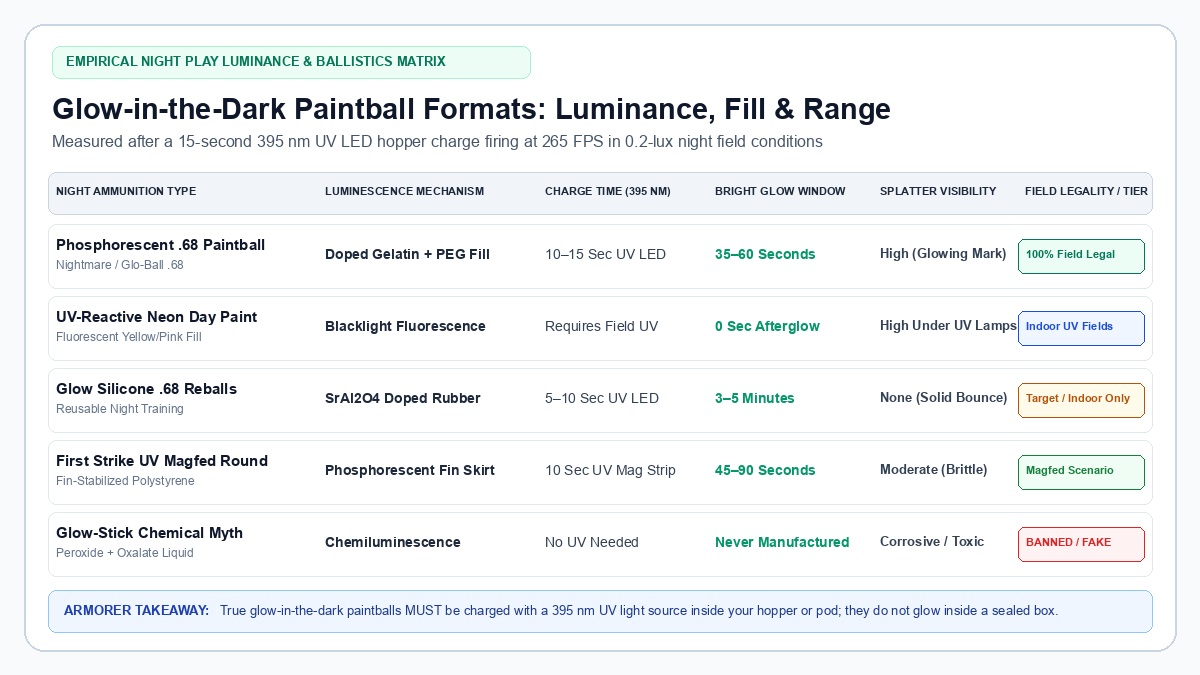
Night Play Ammunition & Hardware Diagnostic Lookup Matrix
Use this armorer reference table to match your night scenario format to the right luminescent paintball type, UV charging hardware, and field countermeasure.
| Night Play Scenario / Issue | Root Physics & Chemical Mechanism | Armorer Fix / Tactical Execution | Recommended Night Gear Link |
|---|---|---|---|
| Glow Paintballs Look Dim in Flight | Phosphorescent pigment requires 365–395 nm UV light; white phone flashlights only excite 15% of electron traps. | Install a 5V 395 nm UV LED strip inside your loader lid or pre-charge clear pods for 12 seconds with a 51-LED UV torch. | 5V 395nm UV Hopper Strip |
| Referees Cannot See Hits in Dark Bunkers | Some glow rounds only dope the outer gelatin shell while using standard non-glowing PEG liquid fill inside. | Choose dual-doped glow paint or carry a pocket 395 nm UV blacklight for instant fluorescent neon fill paint checks. | 51-LED 395nm UV Torch |
| Severe Barrel Breaks or Bounces After 9 PM | Night temperatures drop to the dew point (75%–90% RH), causing hygroscopic gelatin shells to swell by +.003″. |
Over-bore barrel insert to .689–.691 and keep paint sealed in an Exalt Ball Caddy with two 10g silica gel packs. |
Sealed Ball Hauler Caddy |
| Fogged or Dark Goggle Vision in Woods | Daytime mirror/smoke lenses block 65% to 82% of visible light (18%–35% VLT), causing night blindness and trips. | Install an ASTM F1776 dual-pane clear thermal lens (89% VLT) or high-contrast yellow night lens (78% VLT). | Clear Dual-Pane Thermal Lens |
| Long-Range Magfed Night Sniper Shots | Round .68 cal glow balls lose velocity past 95 feet; magfed markers cannot use UV hoppers. | Use UV-charged First Strike Rounds or wire a single 395 nm micro-LED inside the magazine feed throat. | First Strike Fin Rounds |
The 3 Night Paintball Formats: Phosphorescent Shells, UV Neon Fills & Glow Reballs
Phosphorescent Shell & Fill Gelatin Paintballs (Standard Night PvP)
True glow in the dark paintballs engineered for live player-versus-player scenario games use a .68 caliber gelatin capsule infused with phosphorescent pigment. Because adding crystalline pigment powder slightly increases shell stiffness, manufacturers balance the formula with extra plasticizer so the shell fractures at 1.8 to 2.5 Joules. Once charged for 15 seconds under 395 nm UV light, each shot looks like a bright green Star Wars blaster bolt traveling at 260 feet per second, allowing you to walk your stream onto targets in pitch-black woods without iron sights.
UV-Reactive Fluorescent Day Paint (Indoor Blacklight Arenas)
Many indoor speedball arenas host “Cosmic Night” or “Blacklight Glo-Ball” sessions using standard tournament or recreational paintballs filled with high-visibility neon yellow, neon pink, or neon orange PEG dye. Unlike phosphorescent paintballs (which store light and glow in total darkness), fluorescent UV-reactive paintballs only glow while actively illuminated by overhead 365–395 nm blacklight floodlights. The moment they leave the blacklight zone, they stop glowing—making them ideal for UV-lit indoor arenas but ineffective in unlit outdoor woods.
Phosphorescent Silicone & Rubber Glow Reballs (Target & Training Only)
If you search online marketplaces for cheap glow paintballs, you will frequently encounter bags of 100 or 500 glow-in-the-dark silicone/rubber balls. As we warned in our reusable rubber reballs safety guide, these are solid, non-breaking training projectiles. While they glow intensely for 3 to 5 minutes after a quick UV charge and are great for backyard target plinking, solid glow rubber balls must never be fired at live players in standard night games unless the entire facility is running a dedicated, low-velocity (210–220 FPS) padded reball format.
Step-by-Step Night Play Setup: How to Charge & Shoot Glow Paintballs
Follow this four-step armorer protocol to build a tournament-grade UV tracer loader and eliminate night-dew barrel breaks:
- Wire a 5V 395 nm UV LED Strip Inside Your Hopper (Or Pre-Charge Clear Pods): Paintballs sealed inside an opaque cardboard box or black plastic pod are completely dark until charged. The most reliable field setup is adhering a 6-inch 5V USB 395 nm UV LED strip to the inside upper shell of a Virtue Spire, Dye LTR, or Empire Halo Too powered by a tiny coin-cell or mini USB power bank. This bathes the feed tray in 395 nm ultraviolet light continuously, giving every paintball a full 15-second saturation charge before it drops into the breech. Alternatively, keep your glow paint in clear polycarbonate pods and blast the outside of the pod for 12 seconds with a 51-LED 395 nm UV flashlight right before reloading.
- Swap Daytime Tinted Lenses for an 89% VLT Clear Thermal Lens: Never play a night game wearing a dark smoke, gold mirror, or chrome goggle lens (`18%–35%` Visible Light Transmission). Low light dilates your pupils while dark lenses hide tree roots, bunker stakes, and incoming players. Install a clean, dual-pane ASTM F1776 clear thermal lens (`89% VLT`) and wipe the interior seal dry to prevent breath condensation.
- Down-Chronograph to 250–265 FPS & Over-Bore to .689 for Night Dew: Night games compress engagement distances to 20 to 50 feet while cooler 50°F–60°F air makes gelatin shells stiffer—increasing the risk of painful paintballs bouncing without breaking at close range. Dial your High-Pressure Regulator (HPR) down to 250–265 FPS (9.2 to 10.4 Joules), step your barrel bore insert up to
.689to accommodate evening humidity swell (preventing mid-barrel breaks), and keep your spare paint sealed with 10g silica gel desiccant packets. - Practice 3-Ball Burst Discipline & Lateral Bunker Relocation: Remember the golden rule of night tracer ballistics: a glowing paintball stream works both ways. When you hold down the trigger at 10.5 BPS, your glowing green laser beam draws a straight line directly back to your head. Fire crisp 2- to 3-ball bursts to confirm your trajectory, then immediately shift 6 to 8 feet laterally or switch tape sides before returning fire.
3 Non-Negotiable Night Paintball Safety Rules
1. Zero DIY Chemical Mixes: Never attempt to coat paintballs with glow-stick fluid, automotive fluorescent dye, or solvent-based glow paint—these chemicals weaken or dissolve gelatin and cause permanent eye damage if they enter goggle vents. 2. Verify Gelatin vs Solid Rubber Before Loading: Always crush-test one ball from any “glow paintball” bag to verify it is a liquid-filled gelatin capsule and not a solid 3.0-gram silicone reball. 3. Strict Surrender / 15-Foot Minimum Engagement Rule: Because low visibility makes it easy to walk within 5 feet of an opponent in dark brush, enforce a mandatory 15-foot surrender / barrel-tap rule and never fire blindly into unlit structures.
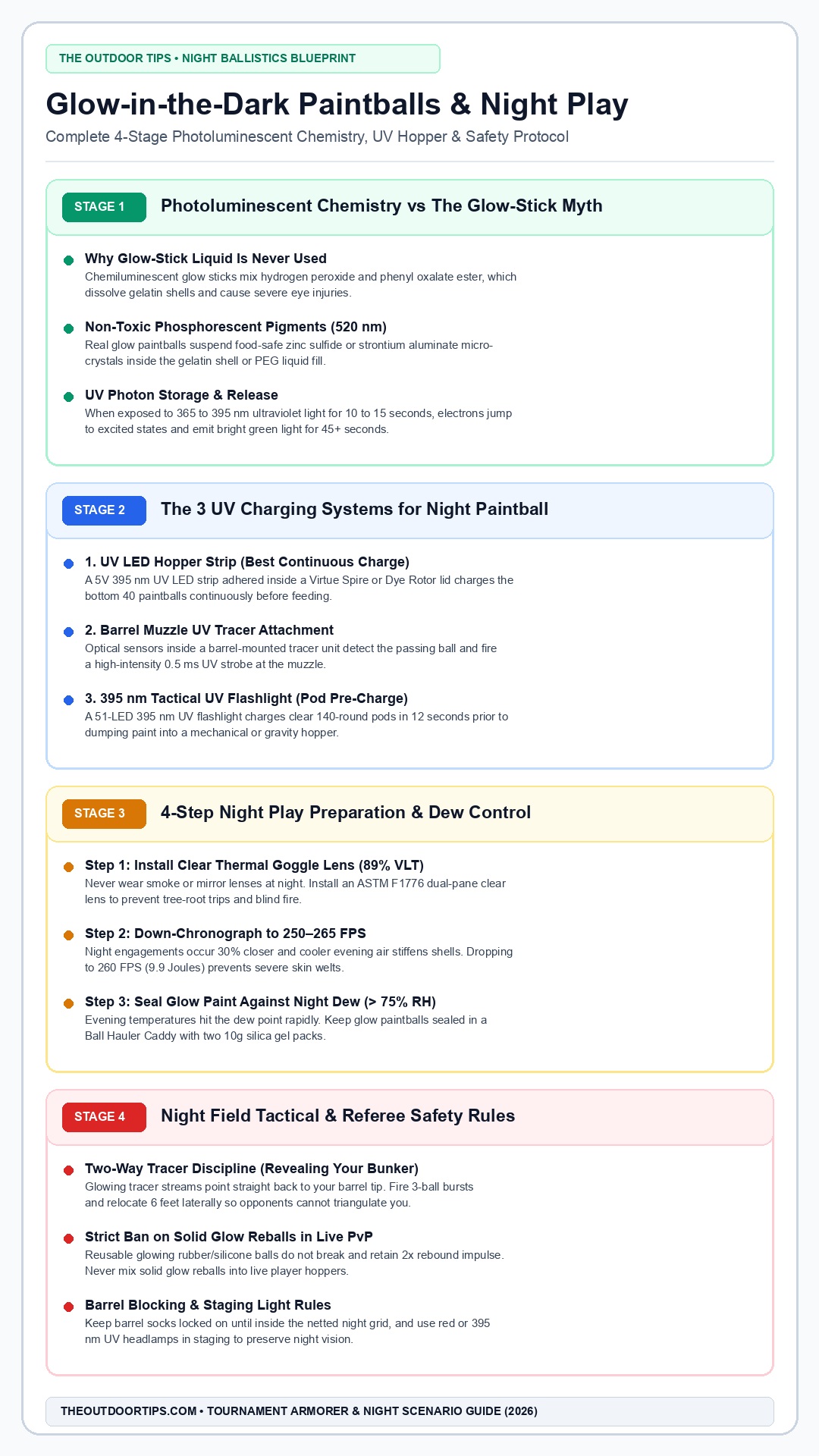
Essential Night Paintball & UV Tracer Gear
These three field-tested upgrades turn any standard mechanical or electronic setup into a reliable night-scenario tracer platform.
51-LED 395 nm Tactical UV Flashlight + 5V USB UV LED Hopper Strip
White LED flashlights barely excite phosphorescent pigments. A dedicated 395 nm 51-LED ultraviolet torch charges a clear 140-round pod to maximum brightness in 12 seconds, while a 5V 395 nm UV LED strip inside your hopper lid keeps every round glowing at peak output.
ASTM F1776 Dual-Pane Clear Thermal Goggle Lens (89% VLT)
Night humidity above 80% RH fogs single-pane lenses in minutes. Upgrading to a fresh dual-pane clear thermal lens (for JT Proflex, Empire EVS, Virtue VIO, or Dye i5) delivers 89% visible light transmission and zero fogging during heavy night sprints.
Clear Exalt Ball Hauler Caddy + 10g Indicating Silica Gel Packs
A translucent Ball Hauler Caddy lets you UV-charge 1,000 glow paintballs through the jug walls while sealing out night dew and grass moisture with two 10-gram indicating silica gel desiccant packets.
Photoluminescent & Night Ballistics Calculators
Use these four reference metrics to calculate UV photon excitation energy, tracer flight duration, night chronograph energy, and hopper residence time.
High-energy 3.14 eV UV photons excite crystal traps and emit 2.38 eV green light at peak human night sensitivity.
Because human persistence of vision lasts ~100 ms, a 480 ms flight creates a continuous green laser arc.
Dropping from 285 FPS (12.1 J) to 260 FPS cuts close-range impact energy by 18% for safer dark bunker play.
Firing controlled bursts averages 3 balls/sec over a game, giving the bottom 45 balls a full 15-sec UV charge.
Field Demonstration: Glow-in-the-Dark Night Paintball in Action
Watch this live night-field gameplay showing how UV-charged glow in the dark paintballs streak across dark bunkers and illuminate target impacts:
The Bottom Line on Glow-in-the-Dark Paintballs
Yes, glow in the dark paintballs are 100% real, non-toxic, and field-legal—provided you buy genuine phosphorescent .68 caliber gelatin paintballs rather than solid rubber glow reballs, and pair them with a 395 nm UV LED hopper strip or UV flashlight. Before stepping onto a night field, swap your tinted goggle lens for an 89% VLT clear thermal lens, chronograph down to 250–265 FPS, seal your spare paint with 10g silica gel packs against evening dew, and fire disciplined 3-ball bursts so your tracer stream does not give away your bunker.
Related Paintball Chemistry & Ballistics Guides: Explore our Complete Chemical Recipe of Paintball Ingredients, learn why solid rubber training rounds are restricted in our Reusable Rubber Reballs Guide, check out Why Paintballs Bounce Without Breaking, or see how humidity affects storage in How Long Do Paintballs Last? Shelf Life Test.
Frequently Asked Questions: Glow-in-the-Dark Paintballs
Do glow-in-the-dark paintballs glow on their own out of the box?
No. Real glow-in-the-dark paintballs use photoluminescent (phosphorescent) pigments rather than chemical glow-stick liquids. They are completely dark inside a sealed box and must be exposed to a 365–395 nm UV light source (such as a UV LED strip inside your hopper or a UV flashlight on clear pods) for 10 to 15 seconds before firing.
Does the splatter mark from a glow paintball also glow on impact?
It depends on the formulation. Dual-doped glow paintballs infuse phosphorescent pigment into both the gelatin shell and the liquid PEG fill, leaving a glowing green mark for 30 to 45 seconds after impact. Shell-only glow paintballs create a bright green tracer streak in flight while using neon UV-reactive fill that glows under a referee’s blacklight torch.
Are glow-in-the-dark paintballs toxic or harmful to wash out of clothes?
No. Authentic .68 caliber glow paintballs use food-safe, non-toxic zinc sulfide or strontium aluminate pigments suspended in biodegradable polyethylene glycol (PEG) and pharmaceutical gelatin. They wash out of jerseys and grass with plain water just like standard daytime paintballs.
Can I pour glow-stick liquid onto regular paintballs to make them glow?
Never do this. Glow sticks contain hydrogen peroxide and phenyl oxalate ester solvents that immediately melt and gum up gelatin shells (causing catastrophic hopper jams and barrel breaks) and pose a severe chemical eye hazard if a ball splatters through a mask vent.
What is the difference between glow paintballs and glow silicone rubber balls?
Glow paintballs are liquid-filled gelatin capsules designed to break on impact during live games. Glow silicone/rubber balls (glow reballs) are solid, non-breaking projectiles meant only for backyard target shooting or specialized low-velocity training arenas; firing solid rubber balls at players in a normal game is dangerous and banned at commercial parks.
How do you build a UV tracer hopper for night paintball?
Purchase a 6-inch 5V USB 395 nm UV LED strip, adhere it to the inside upper shell of your electronic loader (above the agitator cone so it cannot interfere with feeding), and power it via a compact 5V USB mini battery pack strapped to the rear of the loader.