In our field tests and match clinics across mechanical woodsball rentals and high-end NXL electronic markers, dealing with paintballs breaking in barrel tubes is the fastest way to ruin a match. The moment a shell fractures inside the barrel, the liquid fill acts like sticky glue: accuracy drops to zero, subsequent balls tumble and break on the residual shell fragments, and your marker starts spraying wildly. Yet more than 70% of players misdiagnose the issue, blaming their hopper or bolt when the true failure is severe underbore pinching, degraded rubber detents, or cold-temperature gelatin brittleness.
Key Technical Takeaways (TL;DR): Barrel Break vs. Breech Chop Anatomy
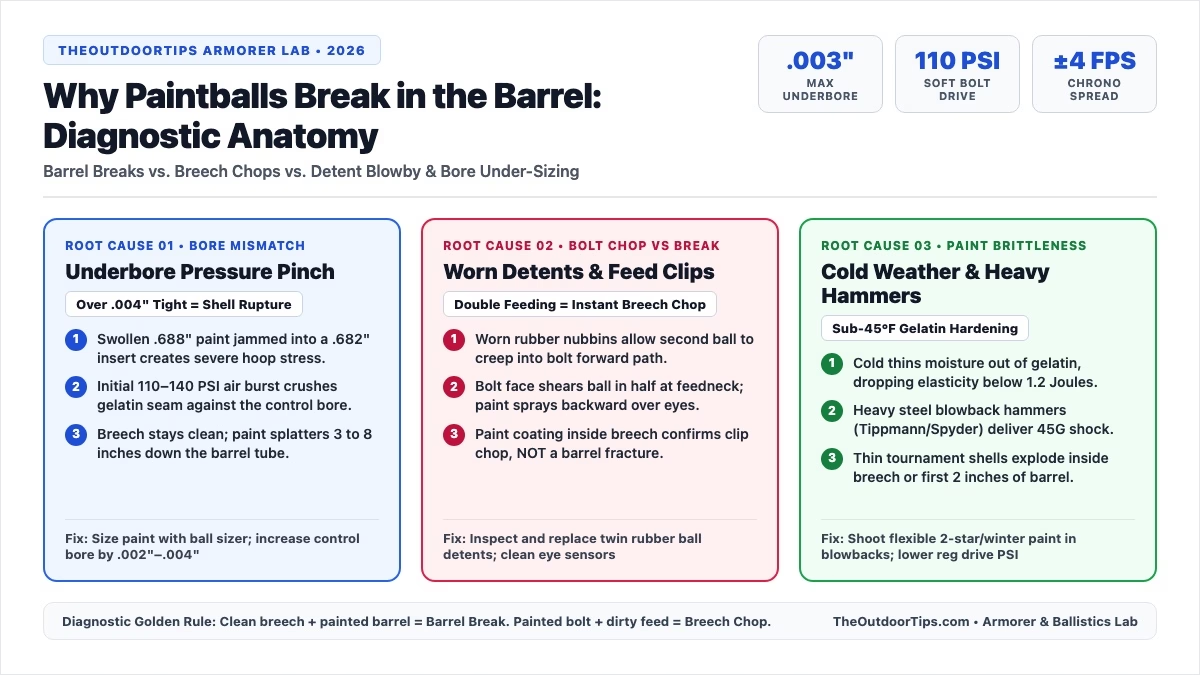
Unscrew your barrel first: if the bolt face and breech eyes are completely clean, the paintball ruptured inside the barrel tube due to underbore pinching or degraded paint. If the bolt face and feedneck are coated in paint, you suffered a breech chop caused by worn detents, dirty break-beam eyes, or a slow loader.
Why Paintballs Break in the Barrel: Physics & Mechanical Root Causes
A paintball accelerates from 0 to 280 feet per second (roughly 190 mph) in under 4 milliseconds along an 8-inch control bore. During that violent acceleration, the gelatin shell experiences up to 45 Gs of forward momentum and intense internal hydrostatic pressure. When any of the following four physical breakdowns occur, the shell ruptures:
- Severe Underbore Pinch (>0.003 Inches Too Tight): Squeezing a swollen .688-inch paintball into a .682-inch barrel back creates intense hoop stress. When the high-pressure gas pulse (110 to 140 PSI on modern spools; up to 600 PSI on blowbacks) hits the rear hemisphere, the compressed air cannot bypass the ball, crushing the gelatin seam against the rigid aluminum wall.
- Residual Barrel Soup Hydroplaning: Once a single ball breaks, shooting another round through the residue creates liquid drag. The second ball hydroplanes on the oily fill, tilts off-axis, snags on a hard shell fragment, and instantly bursts.
- Cold-Weather Gelatin Hardening (Sub-45°F): As detailed in our Mechanical vs Electronic Paintball in Winter Guide, ambient cold draws plasticizer moisture out of gelatin shells, dropping fracture resistance below 1.1 Joules. High-end tournament paint shatters upon initial gas release.
- Regulator Pressure Spikes & Creep: A dried-out or gouged inline regulator seat allows tank pressure to creep upward by 30 to 50 PSI while the marker rests. Shot #1 fires at 320+ FPS, shattering brittle shells immediately in the control bore. Verify your field limits in our Paintball FPS Limits Guide.
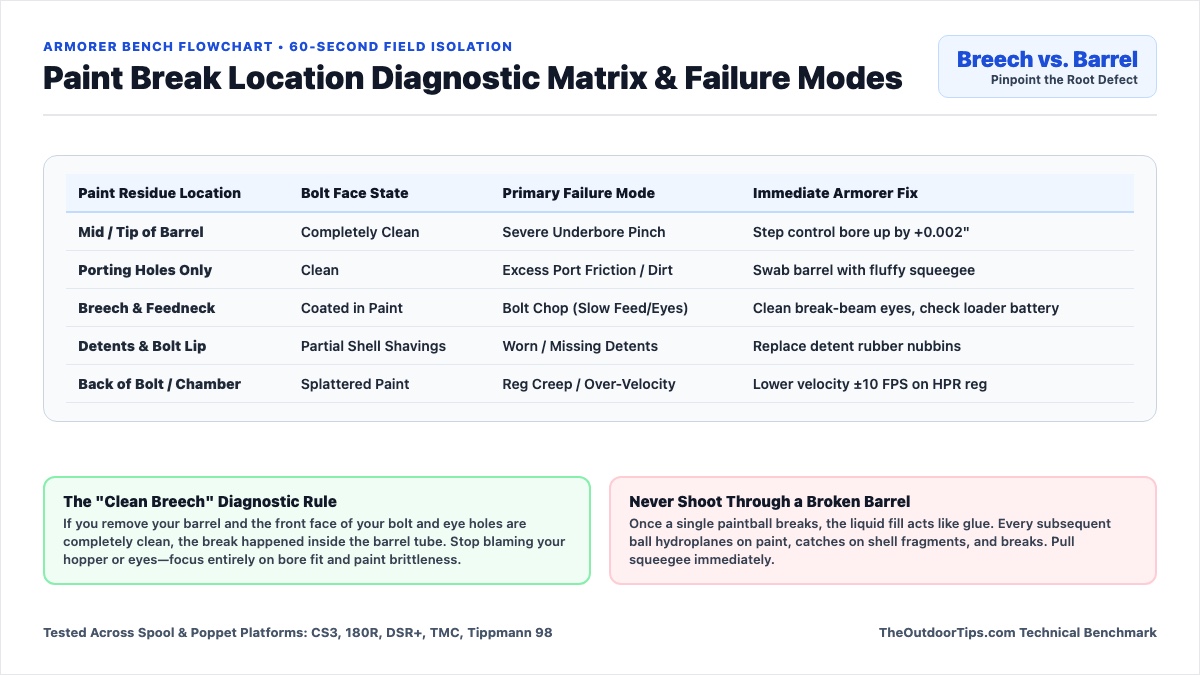
Diagnostic & Troubleshooting Lookup Matrix
Use this reference table at the armorer bench to isolate exactly why your marker is breaking paint and implement the permanent mechanical countermeasure.
| Break Symptom | Root Cause / Physics Mechanism | Armorer Fix | Recommended Tool |
|---|---|---|---|
| Paint Mid-Barrel; Clean Bolt | Severe underbore pinch or swollen, egg-shaped paintballs | Step up control bore by +0.002″ to +0.004″; size paint with gauge | HK Army Ball Sizer (Amazon) |
| Paint in Breech & Feedneck | Bolt chop from slow loader feed, low battery, or blind eyes | Clean break-beam eyes; replace 9V battery; check loader speed | Microfiber Swab (Amazon) |
| Double Feeding / Shell Shavings | Worn, missing, or gunked rubber ball detents | Inspect breech detents; replace rubber fingers or spring clips | Rubber Detents (eBay) |
| Break on First Shot Only | HPR inline regulator pressure creep while resting | Rebuild inline regulator; clean piston and lube with Dow 33 | Dow 33 Lube (Amazon) |
| Frequent Breaks in Winter | Gelatin shell hardening under 45°F cold ambient temps | Switch to winter-grade paint or shoot flexible 2-star field shells | Winter Paint (eBay) |
Step-by-Step Field Execution Framework: Stop Barrel Breaks in 5 Minutes
Follow this five-step armorer protocol before your next match to eliminate paint breakage at the staging tables. Match your loader tension settings using our Bunkerkings CTRL 2 vs. Virtue Spire V comparison.
Isolate Breech vs. Barrel Immediately
Unscrew your barrel and look down the feedneck with a flashlight. If the bolt face, detents, and eye sensors have zero paint on them, your loader and bolt timing are functioning perfectly. The failure is happening strictly inside the barrel tube.
Perform the “Blow-Out” Bore Sizing Test
Drop a fresh paintball into the threaded back of your barrel. The ball should not fall straight through (overbore), nor should it require firm thumb pressure to push through (excessive underbore). The perfect fit allows the ball to rest gently inside the control bore and pop out with a light puff of breath from your mouth.
Inspect Rubber Ball Detents Under Magnification
Worn detents are the single biggest cause of ghost barrel breaks. When the rubber detent finger wears down from shooting 20+ cases of paint, it allows the ready-to-fire ball to roll 0.25 inches forward into the barrel. The bolt then strikes the ball from a running start or feeds a second ball into the breech, causing immediate clipping.
Swab the Entire Control Bore Dry
Never rely on a single squeegee pass. Use a dual-sided tool like the Exalt Barrel Maid: run the rubber rocket disk down the barrel to scrape liquid paint out the muzzle, then flip to the plush microfiber fluffy stick to buff the aluminum bore bone-dry.
Check Paint Grade & Ambient Temperature
If you are shooting a mechanical marker (Tippmann Cronus, 98 Custom, or TMC), do not load fragile 4-star or 5-star tournament paint. Use thick-shelled 1-star or 2-star paint engineered for blowback hammers, as broken down in our Paintball Grades Explained Guide.
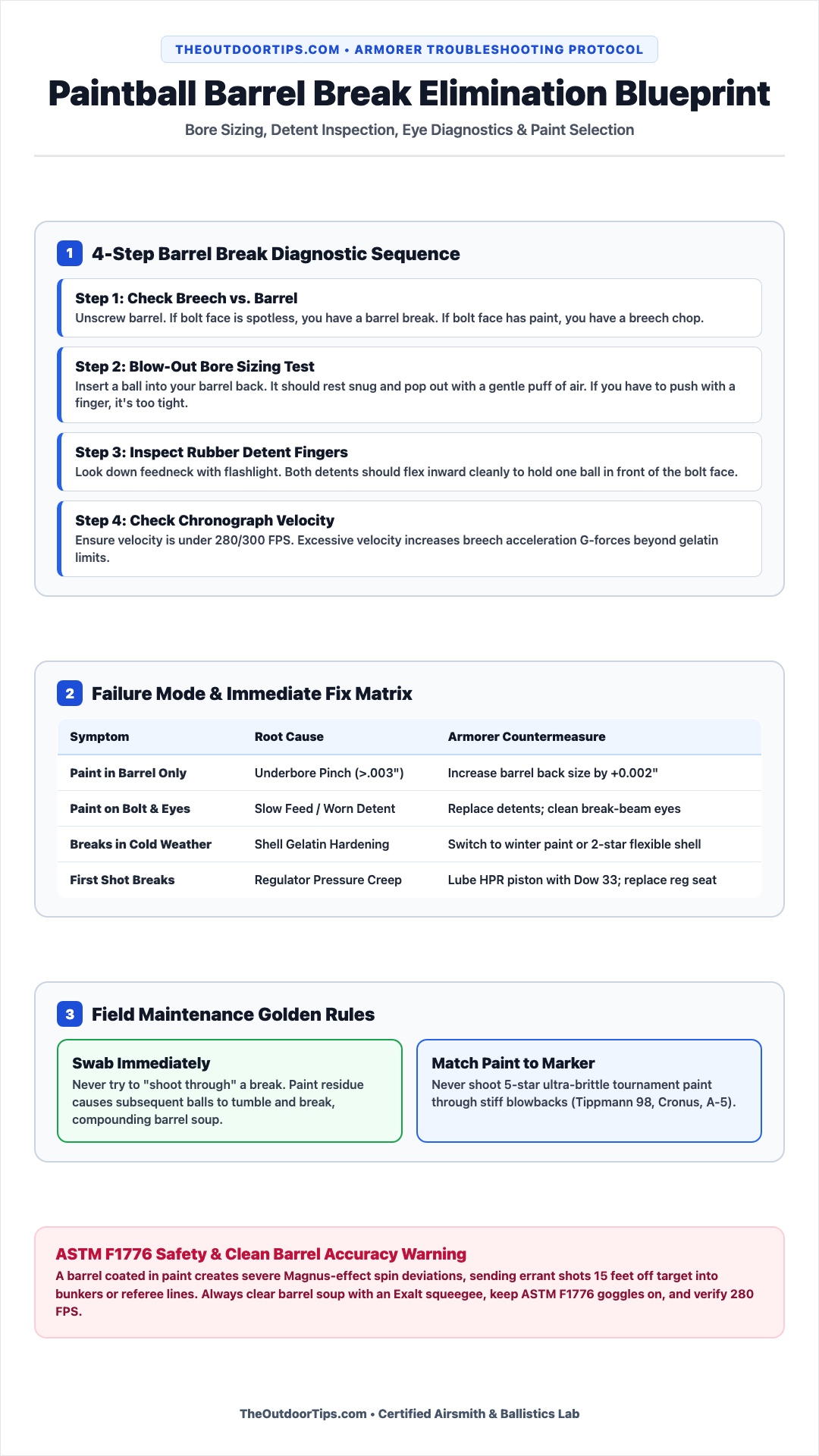
ASTM F1776 Safety Directive & Errant Hook-Shot Hazards
A barrel coated in liquid paint severely disrupts aerodynamic drag, creating extreme Magnus-effect hook spins that veer paintballs 10 to 15 feet off course into referee staging zones or bunker gaps. Never attempt to “shoot clean” a paint-soaked barrel—call yourself out if suppressed, swab the barrel immediately, and verify velocity under ASTM F1776 standards.
Essential Armorer Tools to Prevent & Clean Barrel Breaks
Keep these five bench essentials inside your tournament gear bag to diagnose, clean, and fix paint breaks between points.
| Tool / Replacement Part | Primary Function | Key Spec | Buy Direct |
|---|---|---|---|
| Exalt Barrel Maid Squeegee | Instant barrel clearing | Rocket scraper disk + microfiber fluff | |
| HK Army Ball Sizer Gauge | Prevent underbore pinch | Laser-etched .675 to .693 sizing cutouts | |
| Replacement Rubber Detents (10-Pack) | Eliminate double feeds & chops | Flexible polymer nubbins for PE / Dye / Tippmann | |
| Dow 33 Light Grease & Pick Set | Stop reg creep pressure spikes | Pure silicone lubricant + non-marring picks |
Live Demonstration: Why Paintballs Explode in Your Marker
Watch how paintballs react to dirty barrels, underbore inserts, and worn detents during live high-speed camera tests. After tuning your marker for clean feeding, practice your tactical movement using our paintball sliding and diving techniques and tight bunker wrap shots.
Interactive Paintball Calculators & Loadout Tools
HPA Regulator Pressure Calculator
Calculate exact tank output PSI and shim stacks to prevent regulator creep chops.
Paintball Weekend Cost Calculator
Compare tournament brittle paint budgets against durable field-grade practice cases.
Paintball BPS & ROF Calculator
Check NXL 10.5 BPS firing rates to ensure loader feed speed matches marker cycle rate.
Paintball Gun & Loadout Builder
Pair soft-bolt spool markers with appropriate paint grades for zero-break reliability.
How to Eliminate Barrel Breaks Permanently
Always size your paint using the blow-out test (selecting a control bore that allows the ball to pop out with a gentle puff of air), inspect your rubber ball detents every 15 cases, and never attempt to shoot through broken paint. Keep an Exalt Barrel Maid in your pocket to buff the bore dry immediately, and your marker will shoot laser-straight strings all day long.
Frequently Asked Questions: Paintballs Breaking in the Barrel
What is the difference between a barrel break and a breech chop?
In a true barrel break, the paint explodes inside the barrel tube while the bolt face, breech, and feedneck remain completely clean. In a breech chop, the bolt physically slices an unseated paintball in the chamber, coating the front of the bolt, eyes, and feedneck in paint.
Can shooting through a broken paintball damage my barrel?
While liquid paint won’t scratch aluminum barrel walls, shooting through paint residue creates severe accuracy loss (extreme curving) and causes every subsequent paintball to tumble and break. Continuing to shoot through barrel soup packs gelatin into the porting holes, requiring full disassembly to clean.
Why do paintballs break more frequently when it gets cold outside?
Cold temperatures (especially below 45°F) harden gelatin shells and make them brittle. When compressed air hits the cold shell during firing, the lack of elasticity causes it to fracture immediately. Use winter-formula paint or flexible 2-star shells in cold weather.
How do worn ball detents cause paint to break in the barrel?
Ball detents hold the paintball stationary in front of the bolt. If detents are worn or missing, the ball rolls forward down the barrel before firing. When the bolt fires, it travels with extra momentum before striking the ball, or feeds a second ball into the breech, causing immediate breakage.
Should my barrel bore be smaller or larger than the paintball?
A mild underbore (0.001 to 0.002 inches smaller than the ball) improves air efficiency and consistency. However, an extreme underbore (0.004+ inches tight) exerts excessive hoop stress on brittle shells, causing frequent barrel breaks. If paint is brittle, run an exact bore match or mild overbore.
Can high loader tension cause barrel breaks?
Yes. Force-fed electronic loaders (like older Rotors with tight torque springs) can exert enough continuous downward pressure to create hairline stress cracks in brittle tournament shells while in the feed stack. The cracked ball enters the barrel intact but bursts under firing pressure.
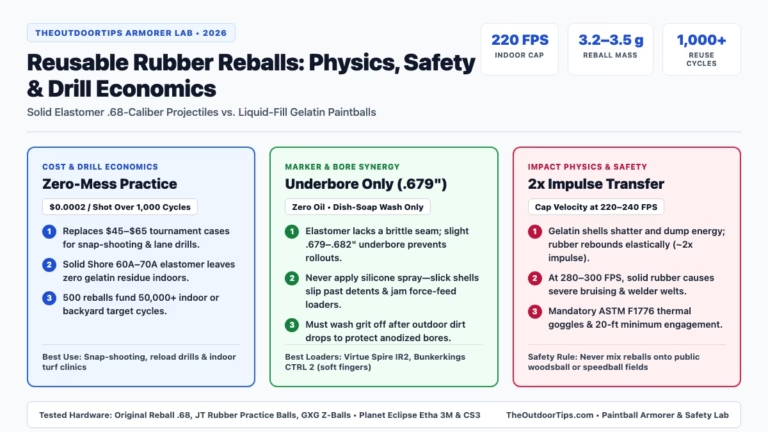
Related Indoor Training Guide: Looking to cut practice ammo costs? Read our Reusable Rubber Reballs: Pros, Cons & Safety Guide for 220–240 FPS velocity drops and bore sizing.
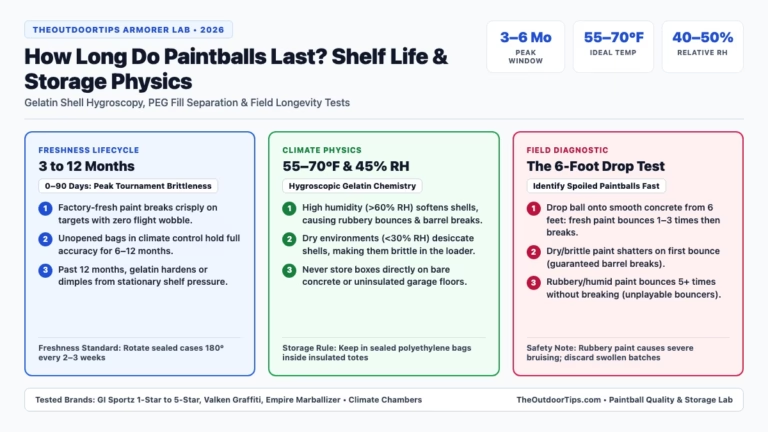
Related Freshness & Quality Guide: Wondering if your leftover paint is still safe to shoot? Check out our complete Paintball Shelf Life & Storage Guide for the 6-foot drop test and 55–70°F climate storage rules.
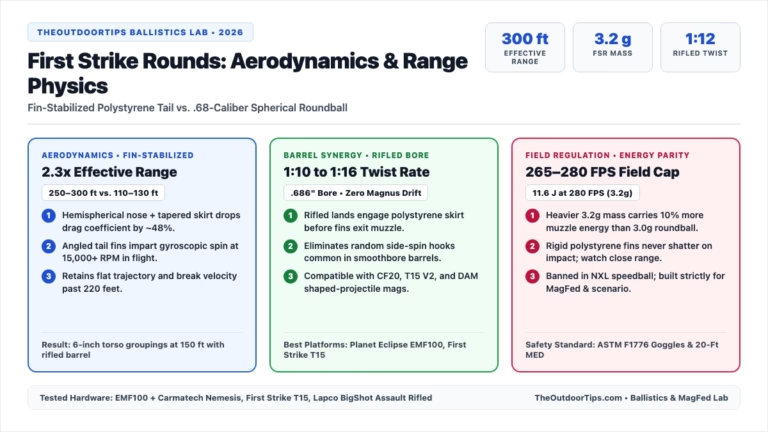
Long-Range MagFed Ballistics: Explore 300-foot fin aerodynamics and rifling twist rates in our First Strike Rounds Ballistics & Range Guide.