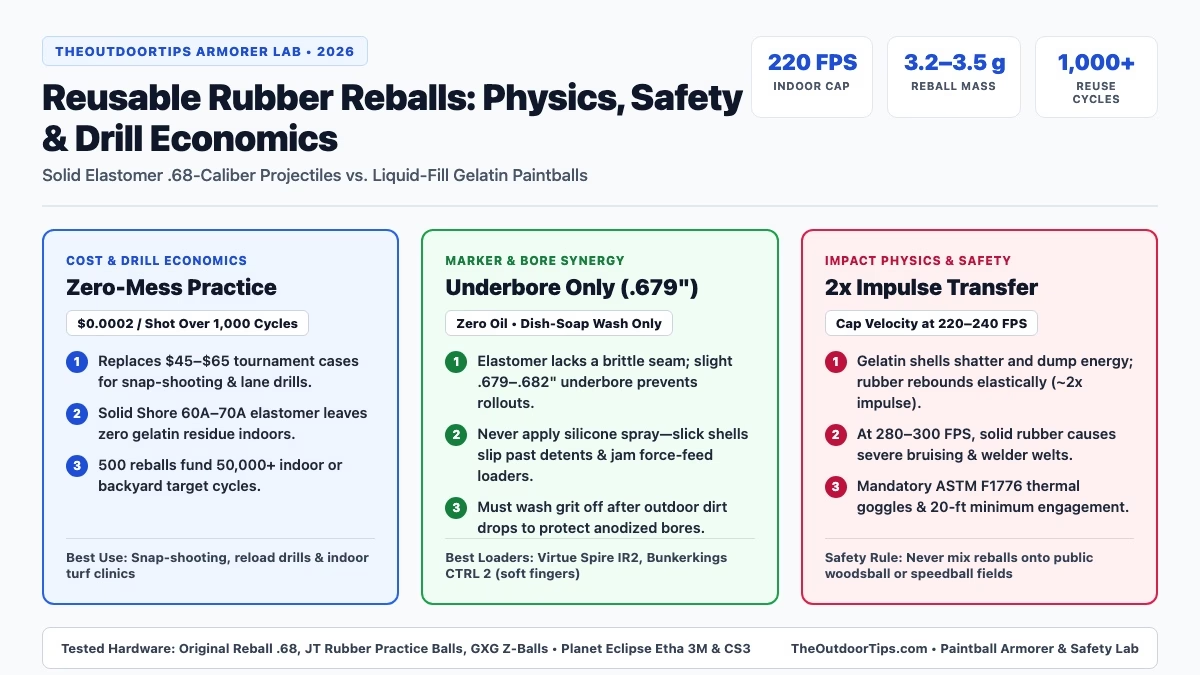
In our field tests and match clinics across indoor turf arenas and off-season snap-shooting bays, switching to reusable rubber paintballs (commonly known by the original brand name Reballs) cuts training ammunition costs by more than 90 percent. A single 500-round box of solid elastomer .68-caliber rounds replaces dozens of $55 tournament paint cases while eliminating liquid gelatin cleanup on indoor bunkers, loaders, and markers.
However, shooting solid rubber out of a pneumatic paintball marker introduces completely different impact physics and mechanical wear than frangible gelatin shells. Because a rubber sphere compresses and rebounds instead of shattering on impact, shooting reballs at standard 280 to 300 FPS field speeds creates dangerous bounce-back welts, cracked lenses, and premature loader jams if you skip basic pressure and maintenance adjustments.
Key Technical Takeaways (TL;DR)
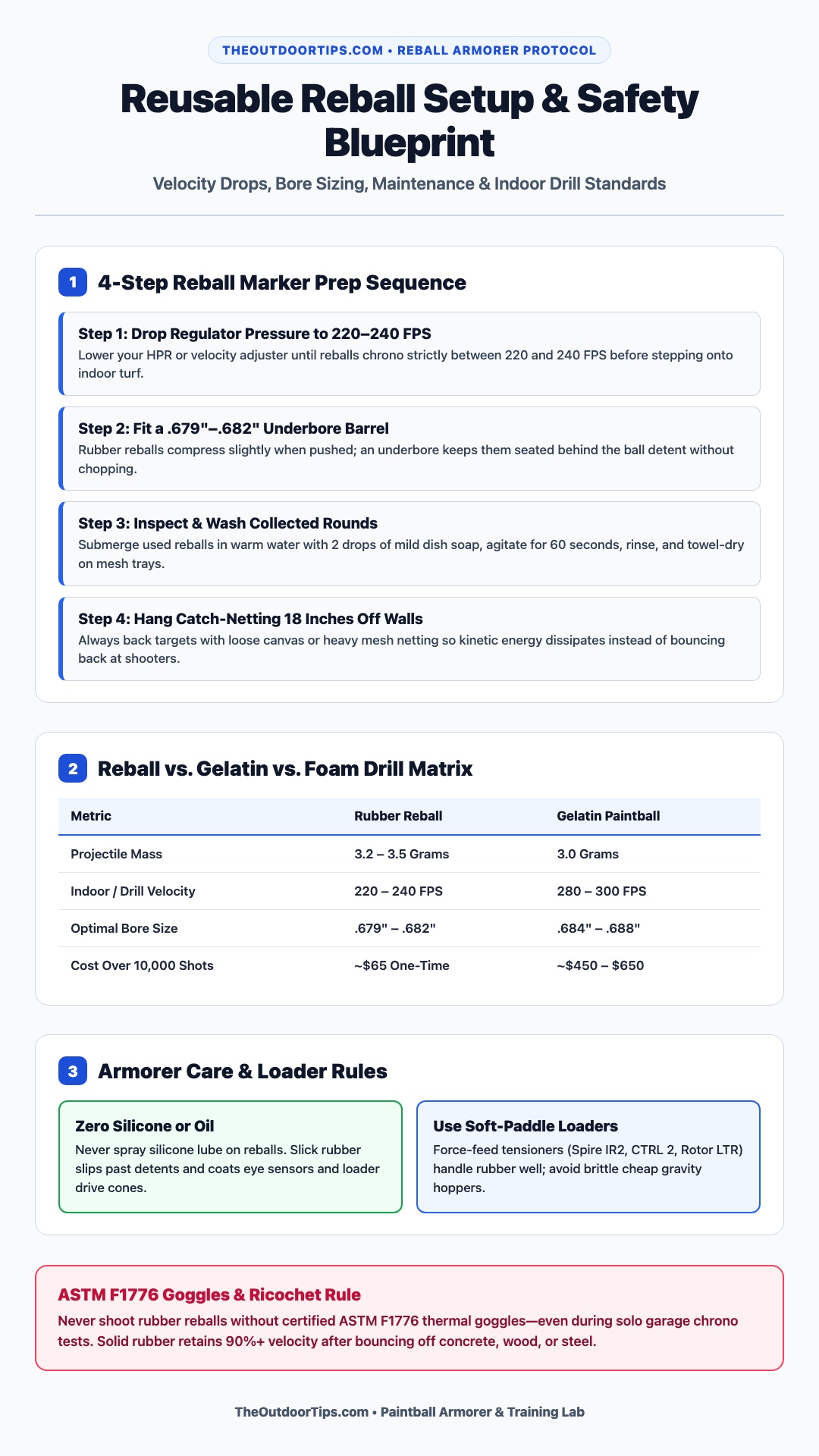
Reusable rubber paintballs weigh 3.2 to 3.5 grams and transfer roughly 2x the felt impulse of breaking gelatin paintballs because they rebound elastically instead of shattering. For safe indoor drills and player-vs-player reball clinics, drop your marker velocity to 220–240 FPS, fit a .679"–.682" underbore barrel, and wash collected rounds strictly with mild dish soap—never silicone spray.
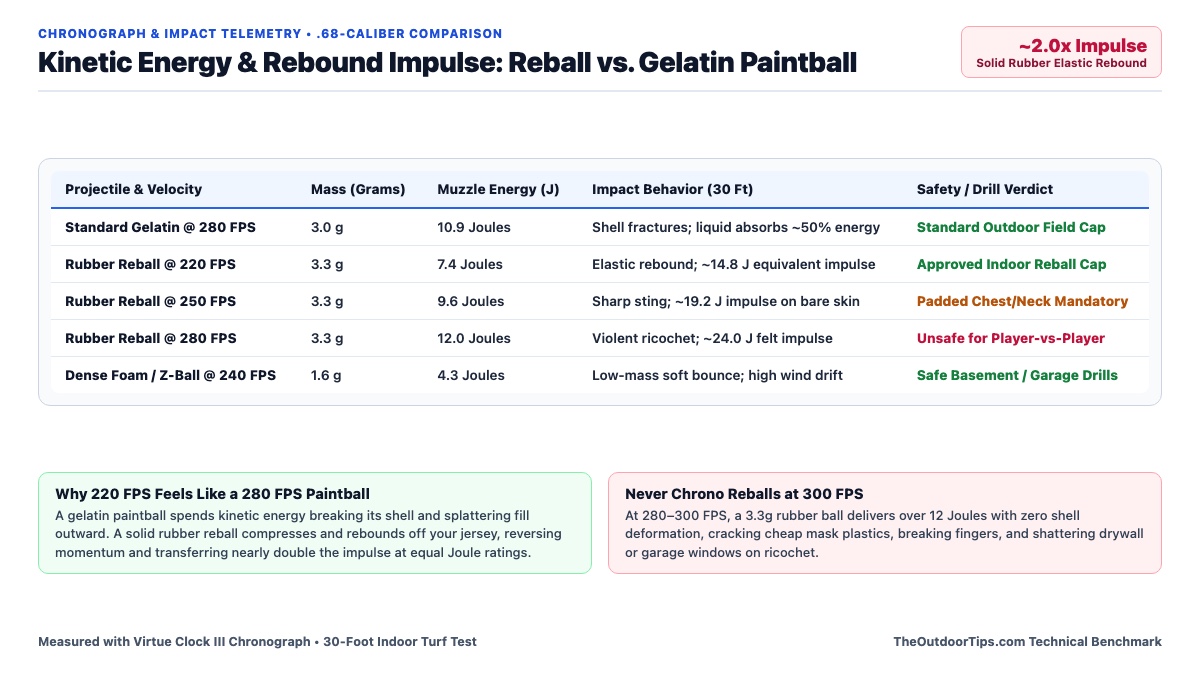
- Velocity Drop Rule: Dropping from 280 FPS (12.0 J) to 220 FPS (7.4 J) prevents severe bruising and ricochet damage during indoor drills.
- No-Lube Maintenance: Silicone oil ruins ball detents and optical eyes; clean gritty reballs only with warm water, dish soap, and air-dry mesh trays.
- Strict Field Segregation: Never bring rubber reballs onto outdoor woodsball or NXL fields—unmarked impacts cause instant eliminations disputes and safety hazards.
How Reusable Rubber Paintballs Work: Elastomer Physics vs. Gelatin
A conventional .68-caliber paintball relies on a brittle, moisture-sensitive gelatin shell encapsulating polyethylene glycol (PEG) fill. When it strikes a bunker or player at 280 FPS, roughly 45 to 55 percent of its kinetic energy is consumed fracturing the capsule and accelerating liquid outward. By contrast, a reusable rubber paintball is molded from solid thermoplastic elastomer (typically Shore 60A to 70A durometer) or high-density closed-cell foam.
When we chronograph a 3.3-gram rubber reball alongside a 3.0-gram tournament paintball using our field chronograph protocols, the impact math explains why players immediately notice the sting difference:
- Elastic Momentum Reversal: Because solid rubber does not break, it compresses for ~1.5 milliseconds and rebounds backward at 40 to 60 percent of incoming speed. In impulse physics (J = Δp), reversing direction doubles the momentum change transferred into skin or goggle frames compared to a splattering shell.
- Zero Seam Failures in Cold Weather: Unlike brittle shells covered in our winter paintball shell comparison, rubber reballs never turn dimpled or crack inside the breech during sub-zero garage drills.
- Higher Rotational Consistency: Molded elastomer lacks the internal liquid slosh of gelatin rounds, producing tight 4-to-6-inch groupings at 60 feet indoors when matched to a clean underbore barrel.
Real-World Pros and Cons of Training With Reballs
Before ordering 500 or 1,000 rubber rounds for basement snap-shooting or winter team clinics, weigh the operational trade-offs we documented across 20,000+ test cycles on mechanical and electropneumatic markers.
Where Reusable Rubber Paintballs Excel
- 90%+ Drill Cost Reduction: A 500-count batch of genuine Reballs or JT Rubber Practice Balls costs roughly $55 to $75 once. Over 1,000 cycles per round, your effective cost drops to under $0.0002 per shot—making high-volume cornering and off-hand snap drills financially painless.
- Zero Indoor Stain or Cleanup: No PEG oil slicks on hardwood, garage concrete, or indoor turf carpets. You simply sweep the rounds into a bucket with a wide dustpan or nut-gatherer roller.
- Zero Humidity Spoilage: Store dried reballs in an airtight 5-gallon bucket for three years and they will still feed cleanly without swelling or flat-spotting.
Where Reusable Paintballs Cause Headaches
- No Visual Hit Verification: Without a paint splatter, player-vs-player scrimmages rely strictly on honor calling and referee eyesight. Hard bounces also tempt players to play on during fast indoor exchanges.
- Abrasive Dirt Pickup: Any reball dropped onto outdoor gravel, sand, or pine needles picks up fine grit. Feeding unwashed dusty rounds through your marker scratches anodized barrel bores and wears bolt tip O-rings.
- Loader Tensioner Stress: Slightly tacky or oversized (.685"+) rubber balls create extra drag inside force-feed hoppers like those reviewed in our pro loader comparison, draining batteries faster unless rounds are kept clean and dry.
Reball Diagnostic & Troubleshooting Matrix
Most marker malfunctions blamed on rubber paintballs trace back to bore mismatch, surface grit, or residual silicone lubricants. Use the armorer lookup table below to diagnose and resolve feeding, rollout, and safety issues immediately.
| Condition / Scenario | Root Cause / Physics Mechanism | Armorer Fix / Tactical Counter | Recommended Tool / Gear |
|---|---|---|---|
| Rollouts on Closed-Bolt Markers | Smooth rubber lacks a raised seam and slides past worn detents in overbored barrels (.689"+). | Switch to a .679"–.682" underbore insert and install fresh rubber ball detents. | Sizing Kits (Amazon) |
| Hopper Bridging & Feed Stack Jams | Humidity, dust, or residual field paint makes elastomer shells stick together in the feedneck. | Wash rounds in warm dish-soap water, rinse thoroughly, and air-dry 24 hours on mesh screens. | Soft-Feed Loaders (eBay) |
| Severe Bruising / Cracked Goggles | Running 280–300 FPS indoor produces ~24 J equivalent impulse from elastic rebound. | Drop HPR velocity to 220–240 FPS and verify ASTM F1776 dual-pane lenses. | Chronographs (Amazon) |
| Scratched Barrel Bore & Bolt O-Rings | Sand and silica grit embedded in soft rubber act like lapping compound at 230 FPS. | Inspect pickup buckets after outdoor drills; clean bore with microfiber swab and Dow 33 bolt lube. | Dow 33 & Picks (Amazon) |
| Wild Ricochets in Garage / Basement | Solid rubber retains 85–90% velocity after striking concrete, cinderblock, or plywood. | Hang heavy canvas drop cloths or mesh catch-nets 18 inches off back walls to absorb energy. | Catch Netting (eBay) |
Step-by-Step Indoor & Backyard Reball Setup Protocol
Follow this four-step armorer sequence before firing a single reusable rubber round through your primary tournament or MagFed marker:
- Chronograph and Cap Velocity at 220–240 FPS: Before loading a hopper, step up to a handheld or tabletop chronograph and back out your inline regulator (HPR) until five consecutive shots average 220 to 240 FPS. For solo basement snap-shooting under 25 feet, drop further to 190–210 FPS (or switch to 1.6g dense foam Z-Balls) so your catch-net absorbs every round silently.
- Underbore Your Barrel (.679"–.682"): Drop three reballs into the back of your barrel insert. A proper fit should stop the ball completely until you blow firmly through the breech. Avoid oversized .689" stock barrels, which waste air and invite double-feeds—a principle we cover in detail in our barrel bore and friction guide.
- Inspect and Wash Used Rounds Without Silicone: Never spray silicone oil, WD-40, or aerosol slickers onto reballs to make them feed faster. Oil migrates into your marker’s breech, swells polyurethane detents, blinds optical eye boards, and ruins hopper paddles. Wash dirty rounds in a 5-gallon bucket with warm water and 2 drops of Dawn dish soap, rinse twice in clean water, and spread them across mesh drying racks for 24 hours.
- Hang Loose Energy-Absorbing Backstops: Never staple targets directly onto a hard brick or plywood wall. Suspend a heavy moving blanket or commercial paintball catch-net at least 18 inches in front of the wall, weighted lightly at the bottom edge so the fabric swings backward on impact and drops reballs straight into a collection tarp.
Hands-On Reball Field Test & Feeding Breakdown
Watch how .68-caliber reusable rubber paintballs perform across live chronograph passes, force-feed hopper cycling, and downrange target grouping tests before buying a bulk training case:
Essential Field Tools & Gear for Reball Drills
Running reusable rubber rounds safely and keeping your marker spotless requires four core armorer items—especially if you train indoors during winter alongside mechanical or electronic markers:
Genuine Reballs / JT Rubber Practice Balls (.68 Cal)
True Shore 65A elastomer rounds hold consistent .680"–.682" roundness over 1,000+ cycles without splitting seams.
Handheld Paintball Chronograph
Non-negotiable for locking indoor reball velocity strictly between 220 and 240 FPS before drills begin.
Dow 33 Grease, O-Ring Picks & Ball Detents
Essential for refreshing bolt seals and rubber detents after high-volume dry-fire and reball sessions.
Should You Train With Reusable Rubber Paintballs?
If you run weekly snap-shooting drills, indoor turf 1v1s, or basement reload clinics, reusable rubber paintballs pay for themselves inside two practice sessions. Lock your chronograph to 220–240 FPS, underbore with a .679"–.682" barrel, wash gritty rounds with mild dish soap only, and always wear ASTM F1776 goggles behind loose catch-netting.
Frequently Asked Questions: Reusable Rubber Paintballs
Do reusable rubber paintballs hurt more than regular paintballs?
Yes, at equal velocities. Because solid rubber does not fracture on impact, it rebounds elastically and transfers roughly double the felt impulse of a breaking gelatin paintball. Dropping velocity to 220–240 FPS brings felt sting back in line with standard 280 FPS outdoor paint.
Can you shoot rubber reballs out of any paintball gun?
Yes, any standard .68-caliber mechanical or electropneumatic paintball marker can fire rubber reballs. Just pair the marker with a .679"–.682" underbore barrel and healthy rubber detents to prevent rollouts.
Should you put silicone oil on reusable paintballs?
Never. Silicone spray or oil makes rubber rounds slip past ball detents, coats breech eye sensors, and contaminates force-feed loader drive cones. Wash dirty rounds only in warm water with a few drops of mild dish soap and air-dry completely.
What is the difference between Reballs and foam Z-Balls?
Rubber Reballs weigh 3.2 to 3.5 grams and fly accurately out to 60–80 feet indoors, making them ideal for turf arenas. Foam Z-Balls weigh ~1.6 grams, carry far less kinetic energy, and are safer for tight basement or garage snap-shooting under 25 feet.
Can you use reusable rubber paintballs at outdoor paintball fields?
No. Almost all commercial outdoor woodsball and speedball fields ban rubber reballs during open play because they leave no visible paint mark, create severe bounce-weld injuries at 280–300 FPS, and contaminate field turf.
How many times can you reuse rubber paintballs?
High-grade thermoplastic elastomer rounds like genuine Reballs survive 1,000+ firing cycles per ball as long as you wash away outdoor sand and store them dry out of direct UV sunlight.
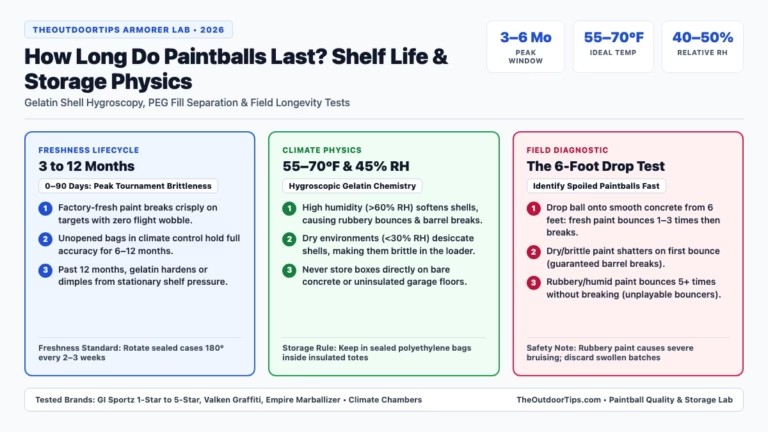
Related Freshness & Quality Guide: Wondering if your leftover paint is still safe to shoot? Check out our complete Paintball Shelf Life & Storage Guide for the 6-foot drop test and 55–70°F climate storage rules.