In our field tests and match clinics across recreational parks and NXL tournament pits, misunderstanding the paintball fps limit causes more ejections, penalties, and broken paint than any other rule. Most players assume 300 FPS is the universal green light, only to discover their local woodsball park enforces a strict 280 FPS cap—and that a marker tuned to 295 FPS in cool morning air can easily spike to 308 FPS by midday.
Field Execution at a Glance: 280 vs. 300 FPS & Joules Parity
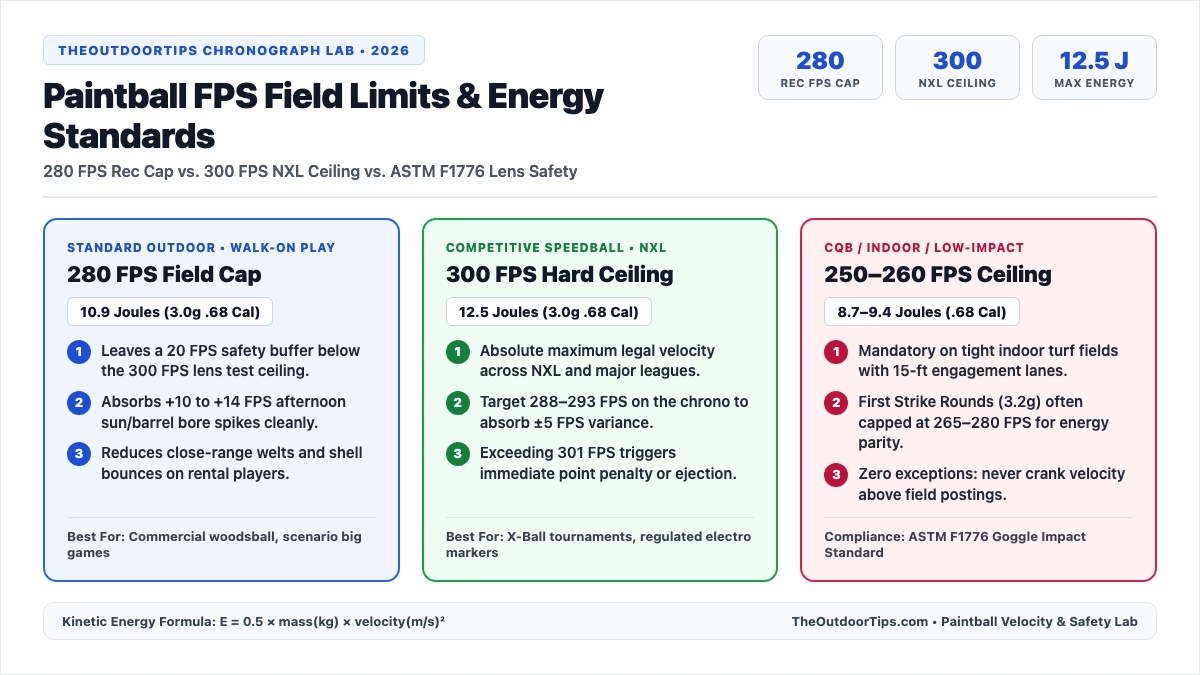
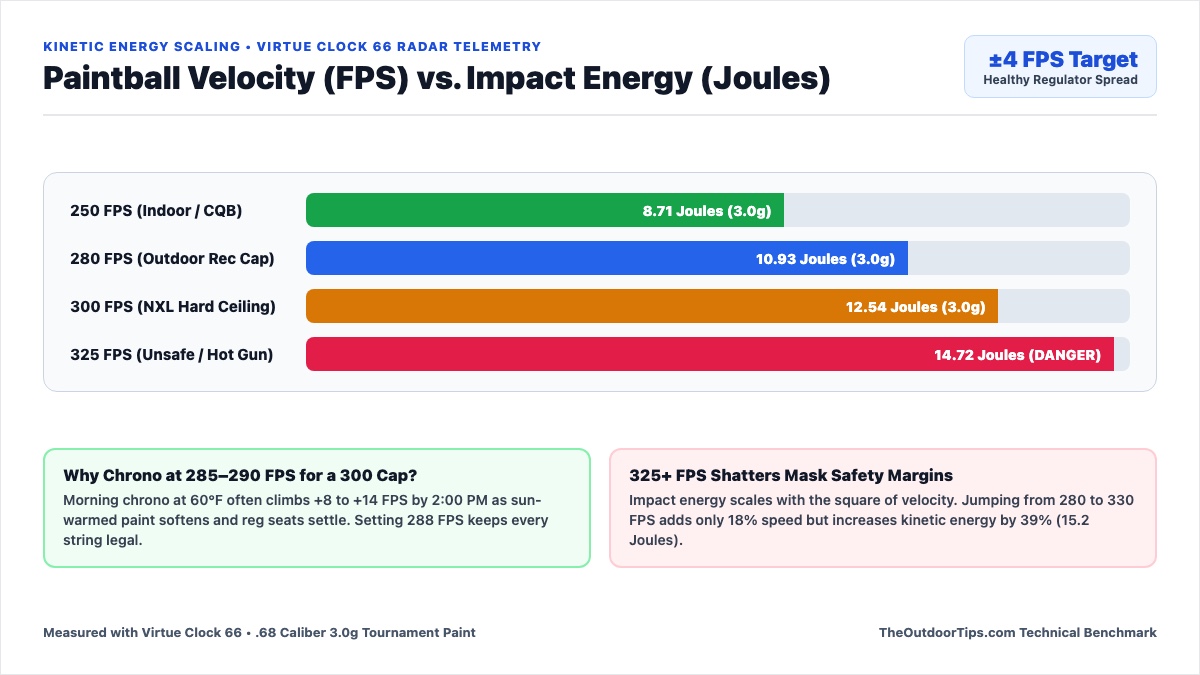
Standard outdoor recreational parks cap velocity at 280 FPS (10.9 Joules) while NXL tournaments enforce a hard 300 FPS ceiling (12.5 Joules). Always chronograph a 5-shot string after bore-matching your paint and dial your marker 10 FPS below the posted cap to absorb afternoon heat spikes and regulator variance.
Why Fields Enforce Strict FPS & Joules Limits (Impact Physics)
Every certified paintball goggle system sold in North America must pass the ASTM F1776 impact standard, which tests lenses and frames against .68-caliber paintballs traveling at 300 feet per second. Because kinetic energy increases with the square of velocity ($E = rac{1}{2}mv^2$), small FPS jumps create massive spikes in impact force:
- 250 FPS (8.7 Joules): Standard for tight indoor turf and CQB arenas where bunker engagement distances drop under 15 feet.
- 280 FPS (10.9 Joules): The commercial outdoor benchmark across US and Canadian woodsball parks, leaving a 20 FPS buffer below goggle test limits.
- 300 FPS (12.5 Joules): The absolute NXL, ICPL, and major scenario ceiling. Shooting 301 FPS or higher on an NXL field triggers an immediate major penalty and point deduction.
- 330 FPS (15.2 Joules): Unsafe “hot gun” territory—just 10% faster than 300 FPS, yet packing 21% more kinetic energy and risking lens stress fractures.
Chronograph Diagnostic & Velocity Troubleshooting Matrix
If your marker reads erratic numbers at the chrono station, diagnose the root mechanical cause before cranking your inline regulator. For markers running remote coils, verify stable tank output pressure first using our Paintball Remote Line Setup Guide.
| Chrono Symptom | Root Physics / Mechanical Cause | Armorer Fix | Recommended Tool |
|---|---|---|---|
| ±15 to ±25 FPS Swings | Severe underbore/overbore mismatch or dry inline regulator piston O-rings | Size paint with ball sizer; clean & lube HPR piston with Dow 33 | Dow 33 Grease (Amazon) |
| Shot #1 Hot (+15 FPS Creep) | Worn urethane reg seat leaking high pressure into chamber at rest | Replace regulator seat seal; cycle 3 clearing shots before chrono | O-Ring Pick Kit (Amazon) |
| Afternoon +10 FPS Spike | Warm ambient air thins gelatin shell and lowers air density drag | Re-chrono at 1:00 PM; set morning baseline 10 FPS below field limit | Virtue Clock (eBay) |
| Slow Drop Under Rapid Fire | HPA tank reg recharge lag or frozen CO2 expansion | Switch to 4500 PSI HPA tank or slow loader/trigger cadence | HK Ball Sizer (Amazon) |
Step-by-Step Field Chronograph Calibration Protocol
Follow this exact five-step referee-grade calibration sequence before every morning session and after opening a fresh case of paint. Reliable feeding also depends on a steady loader stack covered in our Bunkerkings CTRL 2 vs. Virtue Spire V comparison.
Seal Your Goggles & Bore-Match Your Paint
Never enter a chronograph station without an ASTM F1776-certified mask strapped tightly over your face—verify your mask’s seal and breathability in our Bunkerkings CMD vs. JT Proflex review. Push three paintballs from your active bag through a ball sizer and choose a barrel insert within 0.002 inches of the shell diameter.
Fire Three Clearing Shots Before Reading
Point your barrel safely into the chronograph backstop and fire three warm-up rounds to purge regulator creep and seat the bolt. Do not adjust your velocity screw based on shot #1 alone.
Run a 5-Shot Consistency String
Hold the barrel tip 2 to 4 inches from the radar sensor face (never touching the lens) and fire five consecutive shots at 1-second intervals. A healthy regulated marker should hold within a ±4 FPS spread (for example, 286, 289, 287, 290, 288 FPS).
Adjust Velocity in Quarter-Turn Increments
Insert your Allen key into the inline regulator (spool-valve and poppet markers) or rear velocity adjuster (mechanical blowbacks and First Strike T15 platforms). Turn clockwise or counter-clockwise per your manual in quarter-turn increments, fire two clearing shots, and re-test.
Lock In a 10 FPS Safety Buffer
Stop adjusting once your 5-shot average sits 8 to 12 FPS below the field limit (268–272 FPS for a 280 cap; 288–292 FPS for a 300 NXL cap). Re-check velocity if afternoon temperatures climb more than 15°F.
ASTM F1776 & NXL Hot-Gun Safety Directive
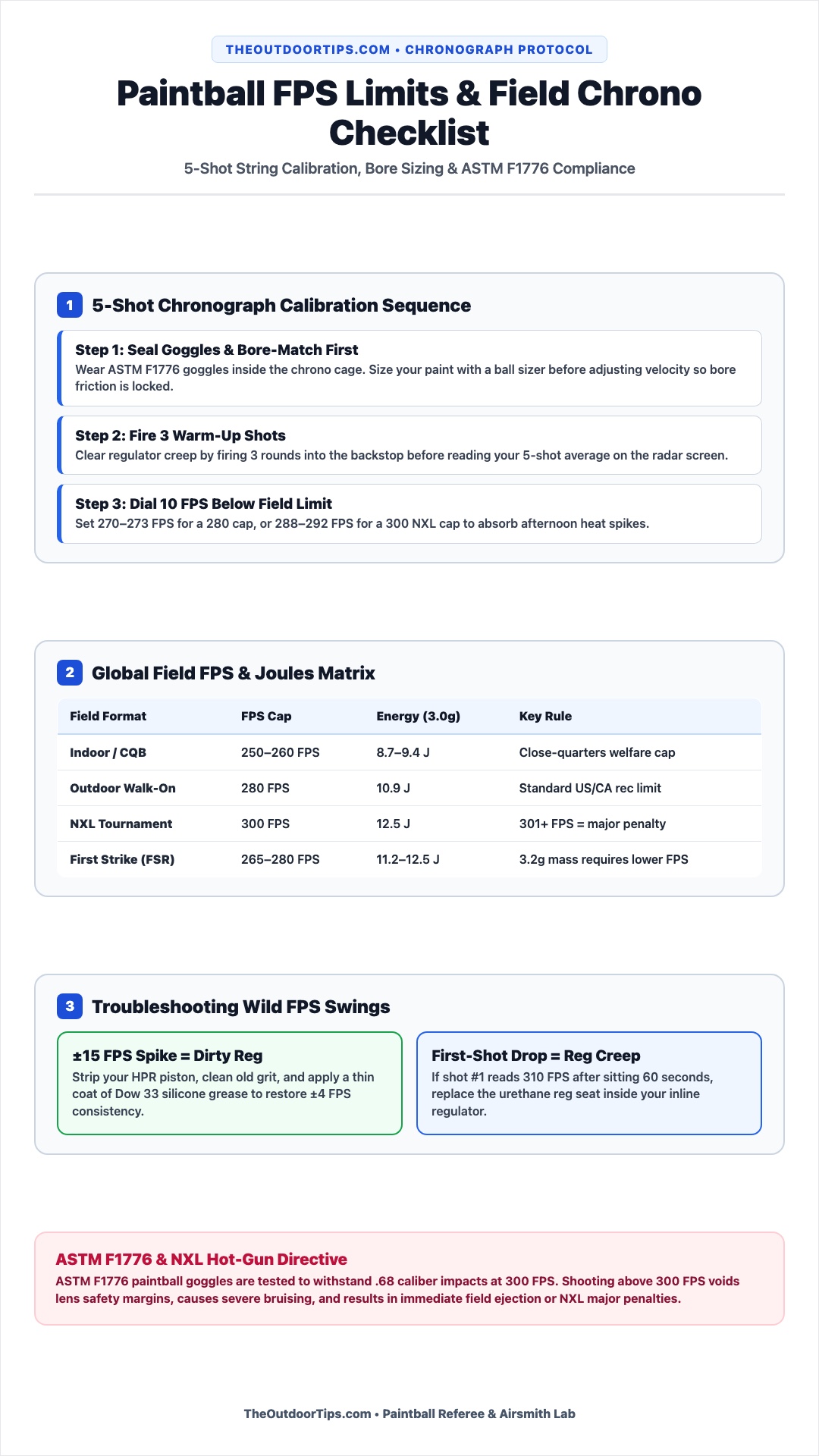
Never intentionally chrono a marker above 300 FPS. ASTM F1776 goggle testing is calibrated around 300 FPS .68-caliber impacts; exceeding that threshold compromises eye-protection safety margins and results in immediate field suspension. For First Strike Rounds (3.2g shaped projectiles), obey lower field caps (typically 265–280 FPS) to keep kinetic energy under 12.5 Joules.
Essential Chronograph & Velocity Tuning Gear
Owning a personal radar chronograph and regulator maintenance kit prevents embarrassing morning chrono delays and keeps your marker shooting tournament-legal all day. Pair this kit with a balanced mag-fed vest or tournament harness.
| Tool / Gear | Primary Role | Key Spec | Buy Direct |
|---|---|---|---|
| Virtue Clock 66 Chronograph | Pro FPS & BPS radar | Measures 150–450 FPS, shot string memory | |
| X-Radar Deluxe Handheld Chrono | Pocket field velocity check | Compact 1-button radar, 9V battery | |
| HK Army Paintball Ball Sizer | Bore-to-paint matching | Laser-etched .675–.691 bore gauges | |
| Dow 33 Regulator Grease & Pick Kit | Fix ±15 FPS reg creep | Silicone HPR lube + brass O-ring picks |
Live Field Demonstration: Using a Handheld Paintball Chronograph
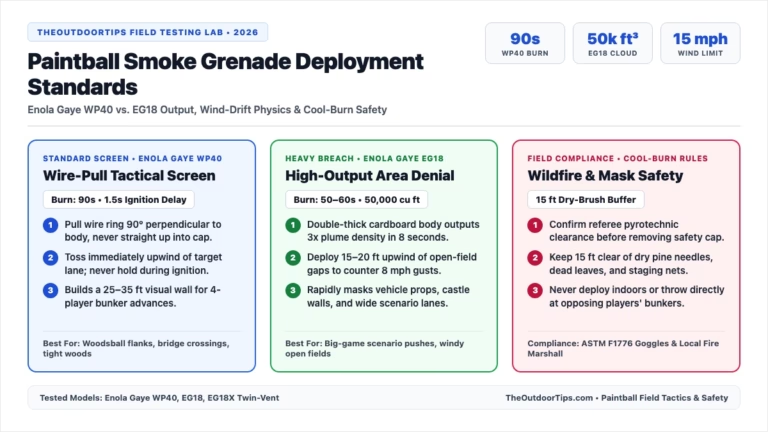
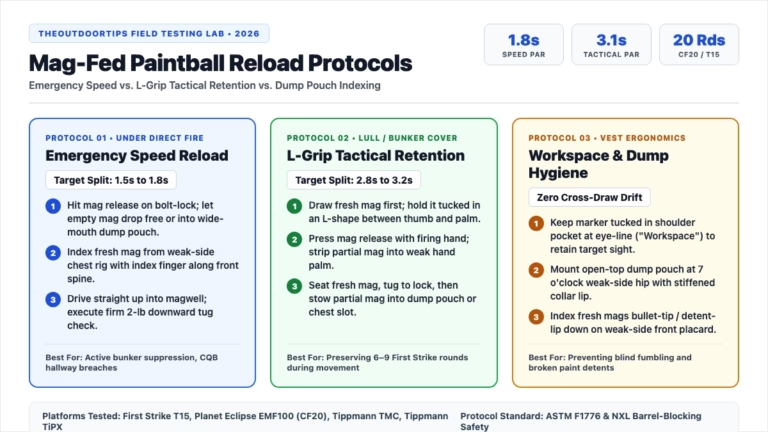
Watch how to position your barrel relative to a handheld radar unit and read 5-shot consistency strings without false echoes. After locking in your velocity, review our Paintball Bunker Names Guide, Mag-Fed Reload Drills, and Paintball Smoke Grenades Guide.
Interactive Paintball Calculators & Loadout Tools
HPA Regulator Pressure Calculator
Match tank output PSI and shim stacks to keep marker velocity consistent.
Paintball BPS & ROF Calculator
Verify NXL 10.5 BPS ramping caps alongside your 300 FPS velocity ceiling.
Paintball Weekend Cost Calculator
Estimate case consumption across recreational 280 FPS and tournament sessions.
Paintball Gun & Loadout Builder
Pair regulated spool-valve or mechanical markers with your preferred field format.
How to Stay Chrono-Legal All Day Without Losing Range
Bore-match your paint first, fire three clearing shots, and tune your 5-shot average to 270 FPS on 280-cap recreational fields or 290 FPS for 300-cap tournaments. Keep your inline regulator freshly greased with Dow 33 so your velocity spread stays inside ±4 FPS from first whistle to final point.
Frequently Asked Questions: Paintball FPS Limits
What is the standard paintball FPS limit at most fields?
Most outdoor recreational paintball fields enforce a 280 FPS limit (roughly 10.9 Joules for a 3.0g .68-caliber paintball). Competitive NXL tournaments allow up to 300 FPS, while tight indoor CQB arenas typically cap velocity at 250 to 260 FPS.
Does higher FPS make a paintball shoot much farther?
Only marginally. Because a .68-caliber sphere experiences heavy aerodynamic drag, bumping from 280 FPS to 300 FPS adds roughly 10 to 15 feet of effective flat trajectory while increasing impact energy by 15% and raising barrel-break risk on brittle paint.
Why does my paintball gun shoot hotter in the afternoon?
Rising midday temperatures warm your paintballs (making the gelatin shell rounder and slightly softer in the barrel) and warm the air inside your marker, commonly adding +8 to +14 FPS compared to an early-morning chrono check.
What happens if you shoot over 300 FPS in a tournament?
In NXL and major regional tournaments, field judges spot-chrono markers on the field. Shooting 301 to 310 FPS triggers a major penalty (pulling the player plus an active teammate), and anything above 315 FPS can result in a gross penalty and player ejection.
Why is the First Strike Round FPS limit lower at some fields?
First Strike Rounds weigh approximately 3.2 to 3.4 grams compared to 3.0 grams for standard roundball, and they retain velocity much farther downrange. Many scenario fields cap FSR at 265 to 280 FPS to keep impact energy aligned with standard roundball safety margins.
How much FPS variance is normal on a good paintball marker?
A properly maintained electronic or high-end mechanical marker with an inline regulator and bore-matched paint should hold within ±3 to ±5 FPS across a 5-shot string. Swings larger than ±12 FPS indicate dirty regulator O-rings or inconsistent paint sizing.
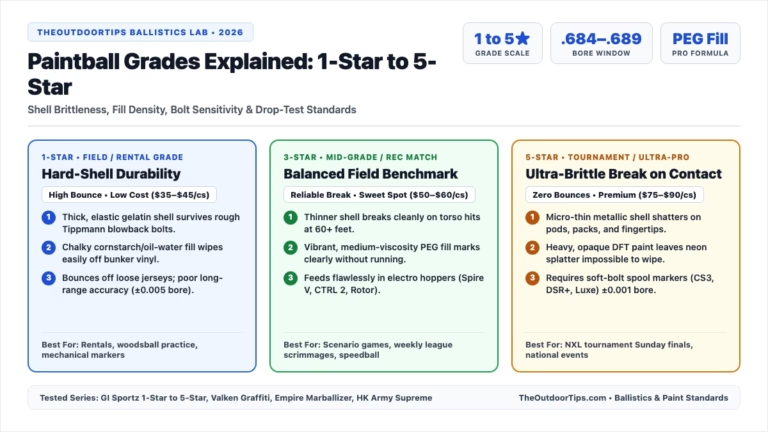
Paintball Ballistics & Ammunition: Learn what star ratings mean in our Paintball Grades Explained (1-Star to 5-Star Guide).