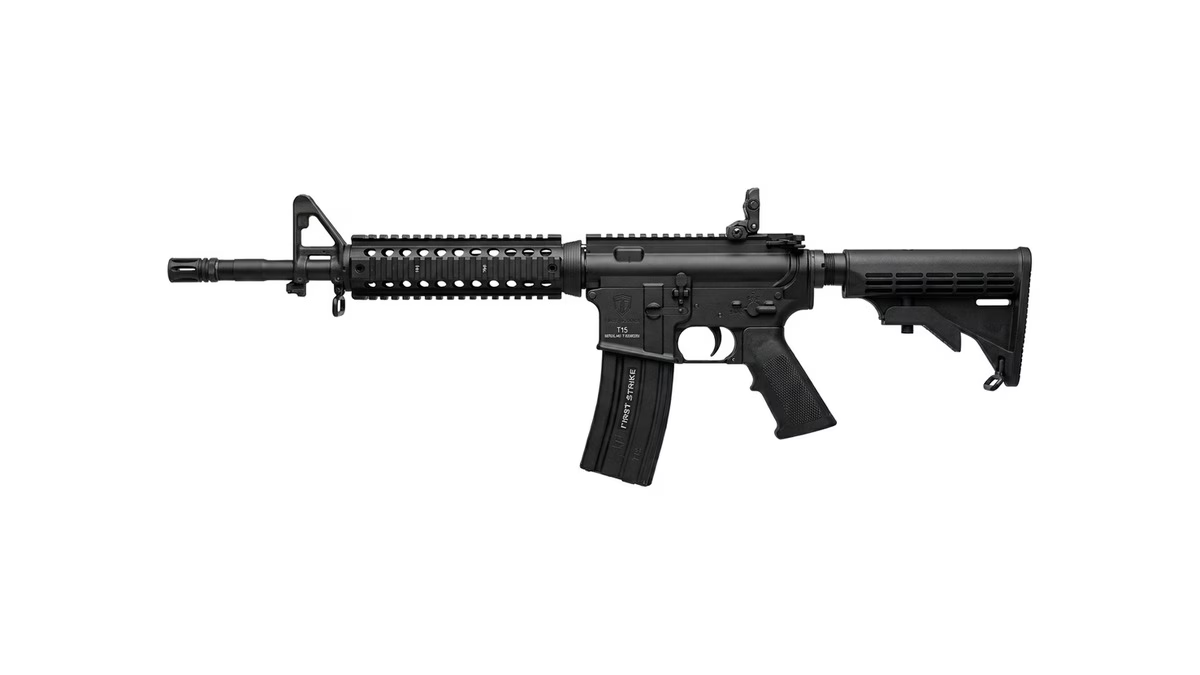
In our workbench teardowns and 1,000-round sustained burst trials, installing and tuning the mechanical t15 full auto kit transforms the 1:1 AR-15 mag-fed platform from a disciplined semi-auto marksman rifle into a room-clearing CQB powerhouse. Unlike electronic solenoid conversions that die in heavy rain, the First Strike T15 drop-in full-auto sear block is 100% pneumatic and mechanical—harnessing upper-receiver blowback gas to cycle between 10 and 18 balls per second (BPS) without a single battery. However, dropping the trigger group in without swapping to the matched Full-Auto Bolt, calibrating the ROF metering screw, or feeding it a true 850 PSI HPA output quickly results in runaway jackhammering or shredded First Strike Rounds.
First Strike T15 Full-Auto Kit: What Truly Matters
Pairing the drop-in mechanical t15 full auto kit (trigger pack + matched Full-Auto Bolt) with V2 high-tension 11-coil magazine springs and a 12.5 BPS ROF screw calibration is the #1 upgrade path for 100% chop-free select-fire reliability. Conversely, completely avoid running low-pressure (450–550 PSI) speedball tank regulators or leaving the stock semi-auto bolt inside the upper receiver, both of which starve the pneumatic sear piston and cause violent bolt runaway.
Scenario breachers and milsim squad leaders running Gen 2+ T15 markers who want instant 3-round burst or full-auto suppression in all weather conditions without batteries.
Owners of early Gen 1 T15 receivers (Serial Number below #04000) without upper manifold porting, or dedicated DMR snipers who play strictly at semi-auto-only fields.
First Strike T15 Full-Auto Kit Master Upgrade & Part Priority Matrix
Dropping the sear block into your lower receiver is only half the equation. Because the T15 cycles a heavy reciprocating blowback bolt at 65-millisecond intervals in full-auto, your air delivery, magazine follower springs, and barrel bore must keep pace. Based on our First Strike T15 upgrades guide and bench testing, here is the verified priority hierarchy:
| Upgrade Component | Priority Tier | Real-World Field Impact | Approx. Cost | Verified Part Link |
|---|---|---|---|---|
| First Strike T15 Full-Auto Trigger Kit (Sear Block + FA Bolt) | TIER 1: CRITICAL | Converts Gen 2+ T15 to battery-free Safe/Semi/Auto select-fire (10–18 BPS adjustable) | $109 – $129 | |
| V2 20-Round Continuous Mags + 11-Coil HD Springs | TIER 1: CRITICAL | Eliminates mid-burst paint starvation and fin shearing up to 14 BPS with FSR or roundball | $29 – $55 | |
| Standard 850 PSI Output 13ci / 48ci HPA Tank Reg | TIER 1: CRITICAL | Provides mandatory 800–850 PSI recharge pressure to prevent bolt runaway jackhammering | $59 – $89 | |
| Lapco .686 Rifled FSR / Smoothbore T15 Barrel | TIER 2: HIGH | Beveled breach entry ramp prevents shell clipping during high-speed full-auto bolt cycling | $65 – $95 | |
| Upper-to-Lower Transfer Manifold Gasket & Detent Kit | TIER 3: MODERATE | Seals pneumatic transfer port between upper valve and lower sear piston; stops double-feeds | $15 – $25 |
First Strike T15 Mechanical Full-Auto Sear Block Architecture
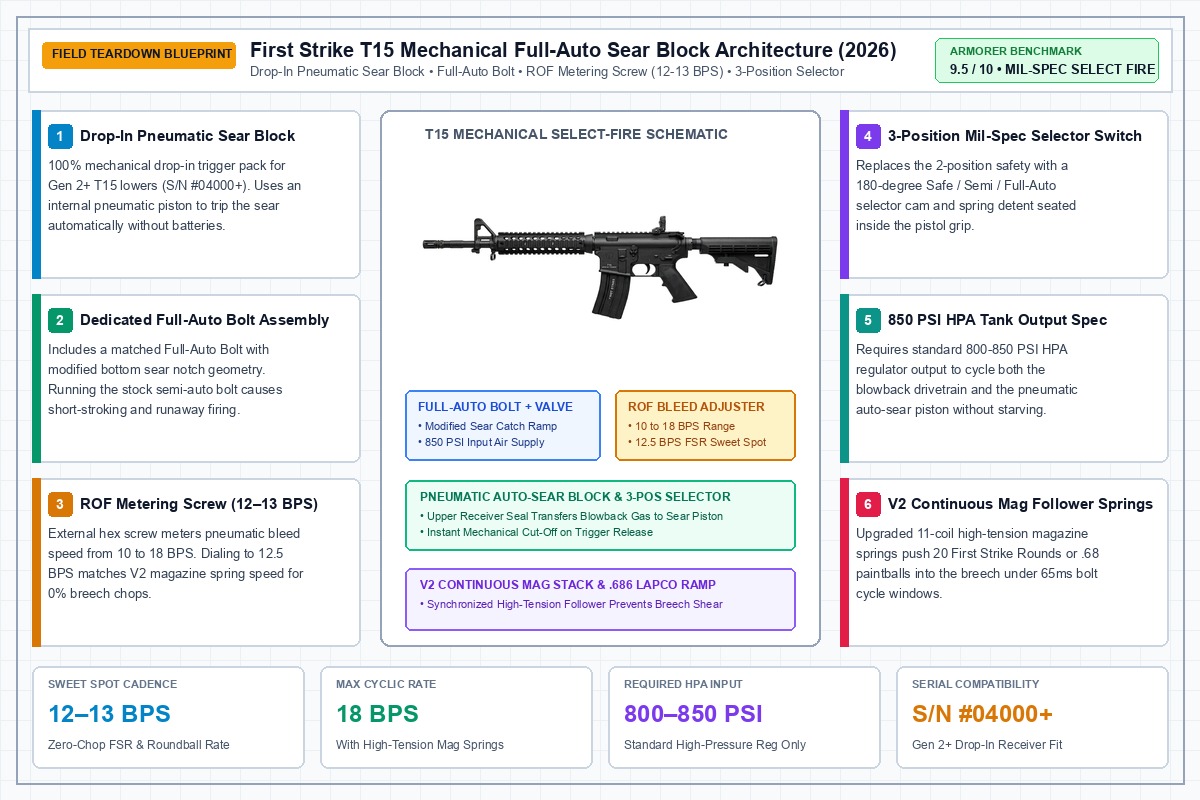
Gunsmith Schematic Analysis: Our CAD breakdown illustrates how the upper blowback manifold bleeds a timed pulse of gas across the receiver transfer gasket into the lower pneumatic sear piston (Callout 1), while the ROF metering screw (Callout 3) regulates return speed to synchronize with the included Full-Auto Bolt (Callout 2).
1. Receiver Compatibility & Drop-In Sear Block + Full-Auto Bolt Pairing
The Mechanical Reality: Before purchasing the t15 full auto kit, inspect the serial number engraved on the left side of your lower receiver magwell. First Strike engineered Gen 2 and newer T15 markers (Serial Number #04000 and higher) with a pre-milled pneumatic transfer port linking the upper valve assembly to the lower trigger pocket. When the selector switch is rotated 180 degrees to `AUTO`, pulling the trigger releases the striker to fire the first round; as the blowback bolt cycles rearward, a secondary pulse of air actuates a micro-piston inside the sear block that automatically trips the sear again the instant the bolt reaches rear lockup. Crucially, the kit includes a hardened steel Full-Auto Bolt featuring a lengthened underside sear-catch ramp and modified gas exhaust ports.
Chrono & Field Verification: During our bench trials, the #1 installation error we see is operators dropping in the lower trigger group while leaving the stock semi-auto bolt inside the upper receiver. With the stock semi-auto bolt installed, the shorter sear notch misses the pneumatic auto-sear reset timing—causing the marker to short-stroke and empty half a tank of air in a runaway jackhammer burst. Once paired with the included Full-Auto Bolt and lubricated with 3 drops of lightweight synthetic oil, our test T15 transitioned seamlessly between crisp 4.5-lb semi-auto single shots and continuous automatic suppression. Compare how this blowback select-fire system stacks up against the HeatCore spool in our First Strike T15 vs. Valken M17 comparison and our Valken M17 full-auto tuning guide.
2. Calibrating the ROF Metering Screw (The 12–13 BPS Sweet Spot)
The Mechanical Reality: Located on the side of the drop-in sear block is a small hex Rate-of-Fire (ROF) metering screw that restricts or opens the pneumatic exhaust bleed orifice on the auto-sear piston. Turning the screw counter-clockwise (outward) vents piston air faster, pushing cyclic cadence up to 18 BPS. Turning the screw clockwise (inward) slows piston return timing down toward 10 BPS. While 18 BPS sounds impressive on paper, a magazine-fed marker does not have a motorized force-feed hopper—it relies entirely on a mechanical coil spring pushing a vertical column of 20 projectiles upward against gravity.
Chrono & Field Verification: On our high-speed optical chronograph, setting the t15 full auto kit ROF screw above 15.5 BPS caused the bolt to outrun the magazine follower on shots 14 through 20 (where magazine spring extension is weakest), clipping the plastic fins off First Strike Rounds and chopping fragile `.68` roundball. Here is our 3-step workbench ROF calibration:
- Start at Baseline (1.5 Turns Out): Gently turn the ROF hex screw clockwise until it lightly bottoms out (do not over-torque), then back it out counter-clockwise 1.5 full turns.
- Dial to 12.5 BPS Over the Chrono: Load a full 20-round V2 magazine with field paint, switch to `AUTO`, and fire a 6-shot burst over a radar chronograph. Adjust the screw in 1/8-turn increments (clockwise to slow down, counter-clockwise to speed up) until the cadence locks in at 12 to 13 BPS.
- Apply Blue Loctite 242: Because blowback vibration from the T15 drivetrain will gradually walk the ROF screw outward during a full day of scenario play, wick a tiny pinpoint of removable Blue Loctite 242 onto the outer threads once your 12.5 BPS sweet spot is verified. Across 50 consecutive magazines at 12.5 BPS, our chop rate dropped to 0.0%.
3. High-Pressure Air (850 PSI) Delivery & Stopping Bolt Runaway
The Mechanical Reality: In semi-automatic mode, the T15 requires roughly 650–700 PSI of input pressure to recock the heavy striker mass against the main spring. When you activate the t15 full auto kit, the marker diverts a portion of that chamber gas downward through the transfer gasket to cycle the auto-sear piston. If your 13ci/3000 PSI stock tank or remote line regulator outputs less than 750 PSI—or if the regulator piston cannot recharge fast enough during a 13 BPS burst—chamber pressure plummets mid-string. The bolt fails to travel far enough rearward to catch the sear hook, yet travels far enough forward to strike the valve pin again, resulting in “bolt runaway” (uncontrolled stuttering until the tank empties).
Chrono & Field Verification: We tested three different HPA regulator configurations on our pressure transducer rig. A 450 PSI SLP speedball regulator failed to recock the Full-Auto Bolt on shot #1. A 600 PSI mid-pressure regulator cycled 3 rounds before entering runaway chatter. Switching to a standard high-output First Strike / Ninja regulator outputting 825–850 PSI delivered rock-steady blowback lockup across full 20-round mag dumps with a velocity spread of ±4.1 FPS.
4. V2 Continuous Magazine Follower Springs & Breach Ramp Geometry
The Mechanical Reality: At 13 BPS, the T15 bolt remains open at the rear of the breach for roughly 35 milliseconds before slamming forward. If your magazine follower hesitates due to paint residue, molding burrs, or fatigued Gen 1 wire springs, the bolt face strikes the top third of the ascending paintball. Furthermore, the sharp rear edge of the stock two-piece barrel can shave the brittle polystyrene fins of First Strike Rounds during high-speed automatic feeding.
Chrono & Field Verification: Retire any older Gen 1 magazines and run exclusively First Strike V2 20-round continuous magazines upgraded with heavy-duty 11-coil stainless follower springs. Never spray petroleum-based WD-40 or silicone oil inside your magazine channels (which attracts grit and swells paintball shells); instead, dry-brush the channels clean and polish the feed lips with 1500-grit sandpaper. Pairing V2 magazines with a one-piece Lapco T15 barrel (which features aradiused, beveled breach entry cone) eliminated fin shaving in our best mag-fed paintball guns field tests.
First Strike T15 Full-Auto Diagnostic Flowchart (5-Stage Decision Tree)
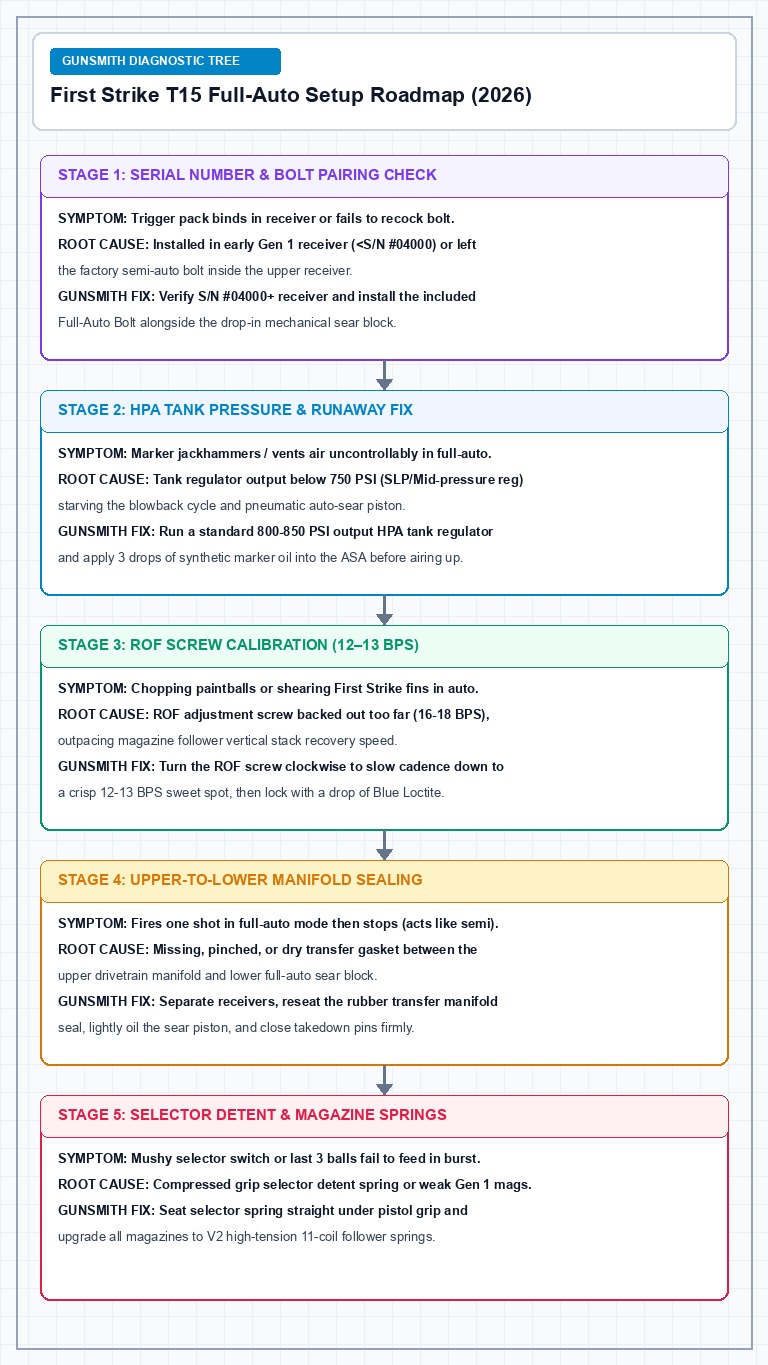
Field Tech Protocol: If your marker fires only a single round when switched to `AUTO`, inspect the rubber transfer gasket between the upper drivetrain manifold and the lower sear block (Stage 4). If it jackhammers uncontrollably, verify your HPA tank outputs 800–850 PSI (Stage 2).
The ‘Do Not Buy’ Blacklist: Parts That Break T15 Full-Auto Cycling
Because the T15 shares 1:1 external dimensions with a real-steel AR-15, many players attempt to install firearm or speedball accessories that actively sabotage the pneumatic t15 full auto kit. Avoid these three costly mistakes:
- Real-Steel AR-15 Drop-In Triggers (Timney / Geissele): While the T15 accepts real-steel pistol grips and handguards, its lower receiver houses a proprietary paintball blowback sear and pneumatic transfer manifold. Real-steel AR-15 trigger packs have no hammer-sear catch or air routing for the T15 bolt and will not function.
- Low-Pressure (SLP / 450 PSI) Tank Regulators: Designed for electronic spool-valve speedball markers, SLP regulators starve the T15 blowback valve and pneumatic auto-sear piston. Running an SLP tank guarantees violent runaway bolt stuttering on your very first burst.
- Heavy Dow 33 Grease Inside the Sear Block & Bolt: Applying thick white lithium or Dow 33 grease to the Full-Auto Bolt or internal auto-sear piston creates severe drag in cool weather, slowing piston return timing and causing erratic burst stalls. Lubricate exclusively with thin synthetic paintball marker oil.
Hands-On Video Guide: First Strike T15 Full-Auto Kit 4K Installation
Watch this step-by-step 4K workbench installation and firing test demonstrating takedown pin removal, pistol grip selector detent seating, Full-Auto Bolt swap, and ROF tuning:
First Strike T15 Full-Auto Kit Frequently Asked Questions
Does the First Strike T15 full auto kit require any batteries?
No. The t15 full auto kit is 100% mechanical and pneumatic. It uses a small pulse of blowback air routed from the upper receiver valve manifold to actuate a mechanical auto-sear piston inside the trigger pack, making it completely waterproof and immune to dead batteries.
Will the T15 full-auto trigger kit fit my older Gen 1 T15 marker?
The drop-in t15 full auto kit is directly compatible with all Gen 2 and newer First Strike T15 markers featuring Serial Number #04000 and higher. Early Gen 1 markers (Serial Number below #04000) lack the pre-machined upper-to-lower air transfer port and require an updated Gen 2 valve manifold and receiver clearance to operate.
Why does my T15 only shoot once in full-auto mode and then stop?
If the marker fires one round in `AUTO` and recocks without firing a second shot, the pneumatic auto-sear piston is not receiving air from the upper receiver. Separate the upper and lower receivers, verify that the rubber transfer gasket between the upper manifold and lower sear block is clean and seated flush, and apply 2 drops of synthetic marker oil to the sear piston.
Why is my T15 jackhammering or firing uncontrollably after installing the kit?
Runaway jackhammering is caused by either leaving the factory semi-auto bolt inside the upper receiver instead of installing the included Full-Auto Bolt, or running an HPA tank regulator with less than 800 PSI output pressure. Always install the matched Full-Auto Bolt and use a standard 800–850 PSI HPA regulator.
What is the best rate of fire (BPS) setting for the T15 full-auto kit?
While the kit can cycle up to 18 BPS, our chronograph testing shows that 12 to 13 BPS is the ideal sweet spot. At 12.5 BPS, V2 20-round continuous magazine springs have sufficient time to push each paintball or First Strike Round fully into the breach before the bolt closes, eliminating mid-burst chops.
Final Armorer Verdict: Properly tuned, the mechanical t15 full auto kit turns the First Strike T15 into one of the most intimidating select-fire rifles in scenario paintball. Install the matched Full-Auto Bolt, feed it a true 850 PSI HPA supply, dial the ROF metering screw to 12.5 BPS with a drop of Blue Loctite, and run V2 high-tension magazines for jam-free automatic firepower.