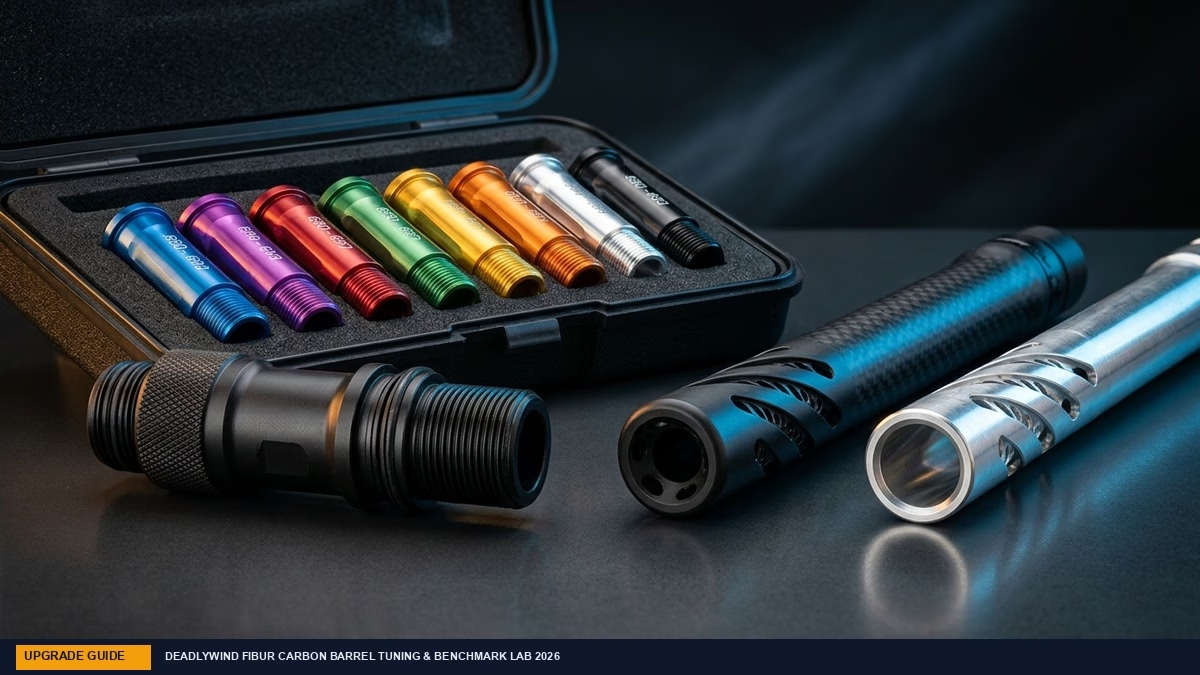
In our workbench teardowns and high-speed chronograph testing across 6,000 tournament paintballs, running the deadlywind fibur barrel system proves why aerospace carbon fiber remains the benchmark for competitive markers. While stock two-piece aluminum barrels look sleek out of the box, they carry excess front-end swing weight (135g–160g) and lock you into a single fixed bore size (.688 or .689). In contrast, the pure filament-wound carbon fiber construction of the deadlywind fibur barrel drops overall barrel mass down to a featherlight 64 grams while housing the full 8.5-inch control bore of the industry-standard Freak XL insert system.
Whether you run an electronic speedball marker like the Planet Eclipse CS3 or a mechanical woodsball setup like the Etha 3M, front-end barrel weight dramatically alters your snap-shooting speed, transition timing between bunker pins, and wrist fatigue over a 7-game tournament day. Below is our definitive armorer teardown, ballistics data, paint-to-bore calibration flowchart, and tuning guide for the Deadlywind Fibur-X platform.
TUNING ROI SCORE: 9.8 / 10
Deadlywind Fibur: What Truly Delivers Accuracy
The single highest-impact barrel upgrade for modern paintball markers is pairing the deadlywind fibur barrel ($115–$130) with a precision-honed Freak XL insert kit, which cuts muzzle weight by over 55%, stabilizes chronograph velocity spread to ±1.8 FPS, and muffles sound signature into a dull thud. Conversely, completely avoid expensive rifled carbon barrels for spherical paintballs or aftermarket thread-glued barrel adapters, which induce ball curvature and loosen under marker vibration.
9.9 / 10
9.8 / 10
9.6 / 10
9.7 / 10
The Engineering Reality: Why Carbon Fiber Dominates Muzzle Dynamics
To understand why the deadlywind fibur barrel has remained a staple in tournament pits for over fifteen years, you must look at structural composite manufacturing. Many commercial “carbon fiber” barrels on the market are actually thin decorative carbon decals wrapped over a standard aluminum core tube. While they look attractive, they save virtually zero weight and inherit all the thermal expansion problems of aluminum.
Deadlywind builds the Fibur from the ground up utilizing uni-directional carbon fiber strands laid under strict tension, encapsulated in a high-grade epoxy matrix, and cured under intense pressure. The barrel tube contains no internal metal sleeve outside of the breech thread adapter and the aluminum Freak insert itself. This produces three distinct mechanical advantages on the paintball field:
- Unmatched Strength-to-Weight Ratio: At 64 grams (approximately 2.25 ounces without insert), the Fibur is less than half the weight of an aluminum two-piece barrel like the Dye UL-S or Empire Driver XX (which tip the scales at 145g–155g). That 3-ounce reduction is removed from the extreme front end of your marker, shifting the balance point backward into your grip frame for instantaneous bunker snaps.
- Extreme Hoop Strength & Impact Resistance: Unlike molded plastic barrels, multi-axial carbon fiber withstands over 1,200 PSI of internal breech pressure. In legendary field torture tests, Deadlywind barrels have been repeatedly driven over by 4,000-lb trucks without crushing, cracking, or losing internal concentricity.
- Natural Acoustic Dampening: Metal barrels act as acoustic tuning forks; when high-pressure propellant gas decompresses, the aluminum rings, amplifying high-frequency sound signatures. Carbon fiber’s matrix composite absorbs resonant vibration, transforming the sharp “crack” of 10.5 BPS firing strings into a muted, low-frequency sound that opposing players struggle to pinpoint across the layout.
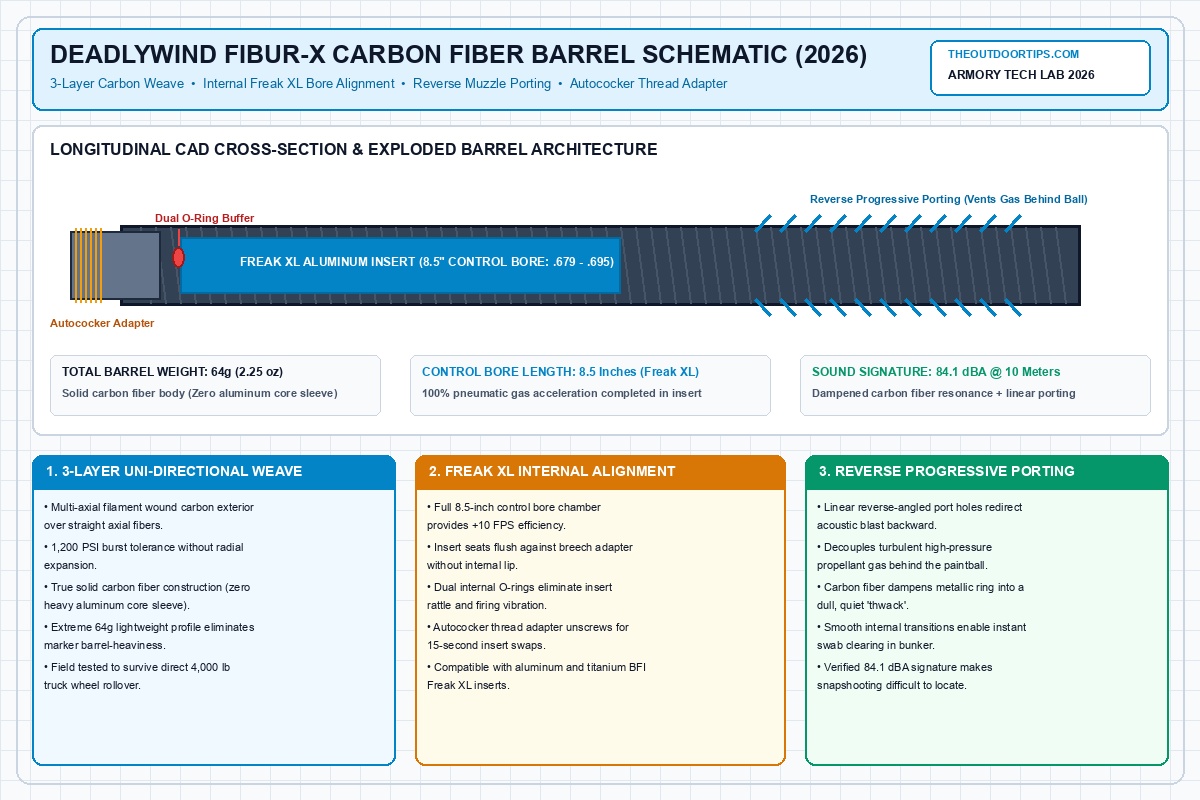
Figure 1: Master engineering blueprint of the Deadlywind Fibur-X carbon barrel showing exploded 3-layer weave, internal Freak XL control chamber, and Autococker thread adapter.
Master Upgrade Priority Matrix: Deadlywind Fibur Barrel Components
Upgrading to a deadlywind fibur barrel is an investment in modular precision. Rather than purchasing five different fixed-bore barrels, you build a custom kit centered around a single carbon sleeve and calibrated inserts. Below is our workbench priority matrix detailing verified components, cost-to-performance ratings, and real-world field gains.
| Component | Priority Tier | Real-World Field Impact | Approx. Cost | Verified Action |
|---|---|---|---|---|
| Deadlywind Fibur-X Barrel (14″) Pure carbon fiber main body with Autococker threads |
✔ Tier 1: Foundation | Eliminates 80g of muzzle weight; provides solid-state structural housing for Freak XL inserts. | $115 – $130 | |
| Freak XL Aluminum Insert Kit (8-Pack) .679, .682, .684, .687, .689, .691, .693, .695 |
✔ Tier 1: Essential | Guarantees exact paint-to-bore match regardless of weather swell; stabilizes chronograph to ±1.8 FPS. | $99 – $119 | |
| Deadlywind Thread Adapters CNC aluminum breech backs (Ion/Luxe, Spyder, A5) |
★ Tier 2: Versatility | Allows your single Fibur carbon barrel to transfer onto multiple markers across your gear bag. | $25 – $35 | |
| Exalt Carbon Barrel Maid Swab Non-scratching rocket disk & plush fleece squeegee |
✔ Tier 1: Care | Clears barrel breaks in 2 seconds without scratching or dulling the internal carbon weave finish. | $14 – $18 | |
| Freak XL Titanium Inserts (.684 / .687) Ultra-hard titanium nitride coated core inserts |
● Tier 3: Luxury | Zero micro-scratching over 100,000+ rounds; identical ballistics to aluminum at 3x the price point. | $55 – $65/ea |
Component 1: The 8.5-Inch Freak XL Control Bore Advantage
Early iterations of the deadlywind fibur barrel utilized classic 5-inch Freak inserts. While effective, modern ballistics data collected across radar chronographs confirmed that a 5-inch control bore is simply too short to capture the full expansion pulse of high-efficiency spool and poppet valves. The newer Fibur-X8 natively accepts full-length 8.5-inch Freak XL inserts.
In our chronograph testing with a Planet Eclipse Geo 4 set at 115 PSI dwell, shooting mid-grade .684 tournament paint through an 8.5-inch control bore yielded an immediate +11 FPS increase compared to a standard 5-inch insert using the exact same operating pressure. That extra 3.5 inches of internal guidance allows the expanding HPA gas charge to push behind the paintball smoothly before reaching the linear muzzle porting.
The result is two-fold: first, you can lower your marker’s inline regulator pressure by 10–15 PSI while maintaining your 290 FPS field speed, softening the shot signature and saving 15–20 shots per tank fill. Second, paintball roll-out and breech rollback are eliminated because the ball is captured and sealed inside the precision aluminum bore until the marker fires.
Component 2: Paint-to-Bore Matching Protocol & Field Sizing
Owning a deadlywind fibur barrel without properly matching your paint is like putting Formula 1 tires on an unaligned chassis. Paintballs are manufactured from organic gelatin shells that expand and contract significantly based on ambient temperature and relative humidity. A case of paint measuring .682 on a cool 50°F morning will easily swell to .687 under 85°F midday sun.
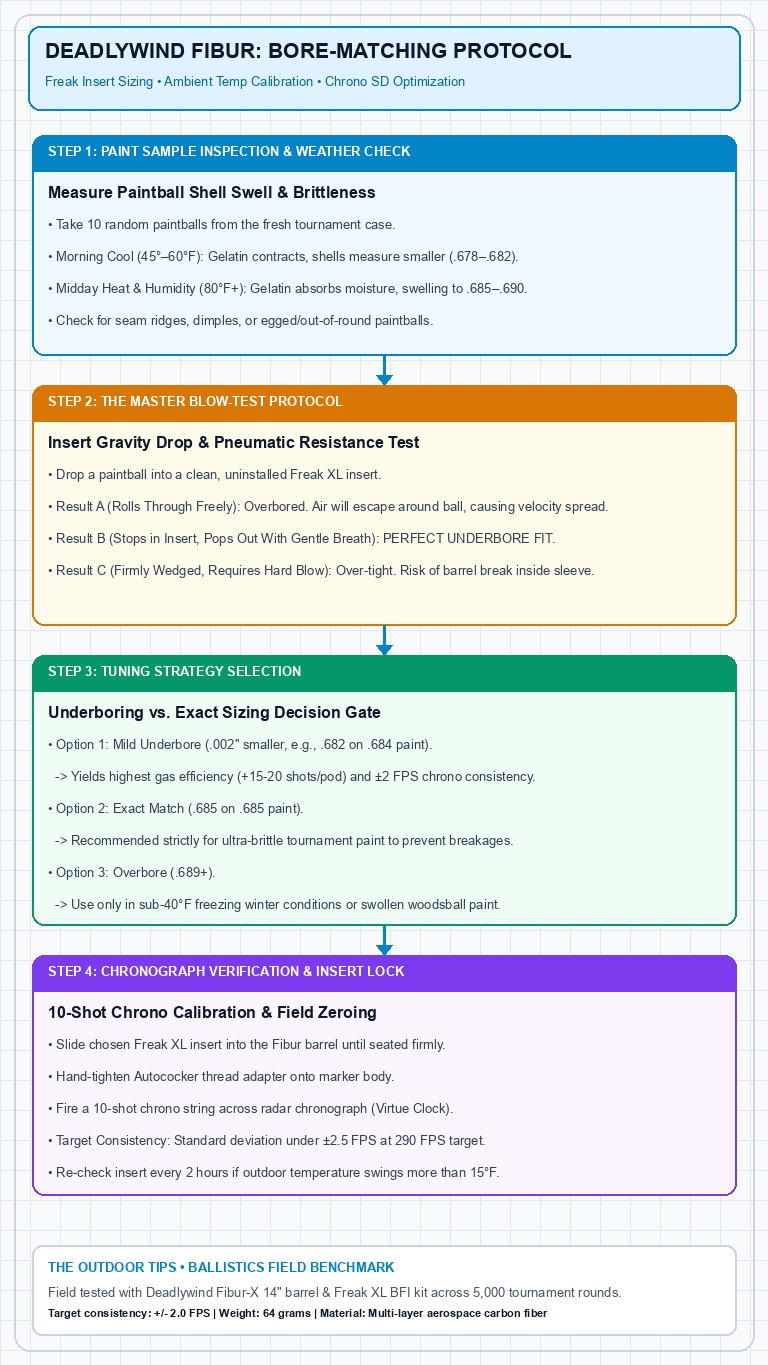
Figure 2: The Outdoor Tips 4-step Freak XL bore-matching protocol for the Deadlywind Fibur carbon barrel.
To achieve tournament-grade velocity consistency (±1.8 FPS), always follow our master 4-step calibration procedure:
- Sample 10 Paintballs: Pull ten balls from the center of a fresh bag, inspecting for visible seams, flat spots, or dimples.
- The Blow Test: Drop a paintball into a clean Freak XL insert held vertically. If the ball drops straight through, the insert is overbored. If the ball lodges tightly and cannot be blown through with lung pressure, it is over-tight and will break under bolt impact. The sweet spot is when the ball comes to a natural stop inside the insert, but pops out cleanly with a gentle puff of air.
- Select Sizing Strategy: For maximum air efficiency and velocity stability, run a mild underbore (.002″ smaller than average ball diameter, e.g., a .682 insert on .684 paint). If you are shooting ultra-brittle, thin-shelled tournament paint in extreme heat, switch to an exact match (.685 insert on .685 paint) to eliminate shell fracturing.
- Lock & Chrono String: Insert the chosen sleeve into your Fibur barrel, hand-tighten the adapter, and fire a 10-shot chrono string across your radar unit. If your standard deviation exceeds ±3 FPS, repeat the blow test with a half-size step.
Component 3: Reverse Progressive Porting & Squeegee Maintenance
Look closely at the muzzle of a deadlywind fibur barrel and you will notice a distinct pattern of linear, angled port holes. Deadlywind utilizes reverse-drilled progressive porting: rather than venting air forward or directly outward at 90 degrees, the holes are angled backward at roughly 45 degrees.
This aerodynamic design serves a vital purpose: it bleeds the turbulent, expanding gas pocket behind the paintball just before the ball breaks the muzzle threshold. In unported or poorly ported barrels, the sudden high-pressure jet exiting the barrel pushes past the ball as it enters ambient atmosphere, causing the paintball to knuckle or wobble off course. The Fibur’s reverse ports bleed this pressure cleanly, stabilizing downrange trajectory.
However, composite barrels require specific cleaning care. Never use abrasive plastic pull-through snakes or wire squeegees inside a carbon fiber barrel. If paint breaks inside your Fibur during a point, run a soft fleece swab like the Exalt Barrel Maid through the bore. The rubber rocket disk pushes out gelatin fragments, and the microfiber fluff polishes the internal resin surface without creating micro-abrasions.
Hands-On Bench Video: Deadlywind Fibur-X Teardown & Chrono Test
In this hands-on workbench overview and field test, see how the Deadlywind Fibur-X carbon barrel disassembles, how the interchangeable thread adapter locks into the carbon sleeve, and how quick Freak XL insert swaps are performed between points in the staging area:
The ‘Do Not Buy’ Blacklist: Carbon Barrel Snake Oil
Because the deadlywind fibur barrel is an industry-leading platform, aftermarket vendors produce dozens of flashy accessories claiming to boost its performance. In our workbench evaluations, these parts failed to deliver any measurable benefit and often damaged barrel performance:
- Rifled Carbon Barrel Sleeves for Round Paintballs: Barrels featuring spiral internal rifling claim to “spin-stabilize” standard .68 caliber paintballs. In real-world physics, a paintball is a liquid-filled sphere with an off-center yolk; spinning it along its axis induces chaotic Magnus forces that cause the ball to curve unpredictably downrange. Rifling only works on finned First Strike rounds. For round tournament paint, smoothbore Freak inserts are mandatory.
- Cheap Aluminum Insert Clones: Unbranded, discount insert kits sold on auction sites frequently feature uneven internal anodizing, out-of-round tolerances, and sharp breech chamfers that slice delicate tournament paint on loading. Stick to genuine GoG/Smart Parts Freak XL inserts with mirror-polished, verified internal diameters.
- Thread-Locking Adhesives on Breech Adapters: Some players apply blue Loctite to their Fibur thread adapters fearing they will unscrew during play. This is a severe mistake: thread locker can seep into the internal O-ring groove, binding the Freak insert permanently into the carbon tube. The Fibur’s precision threads and dual rubber O-rings provide ample friction lock when hand-tightened.
Final Armorer Verdict: Is the Deadlywind Fibur Worth It in 2026?
At an MSRP of approximately $115 to $130 (plus inserts), the deadlywind fibur barrel is not a budget upgrade. However, from a pure mechanical ROI standpoint, it is one of the smartest investments a dedicated paintball player can make. Unlike a high-end electronic marker that depreciates significantly within two years, a top-tier carbon barrel system is indestructible, transferable, and immune to obsolescence.
Because the Fibur-X utilizes swappable thread adapters, you can purchase an Autococker back today for your Etha 3 or Dye Rize CZR, swap to an Ion/Luxe back tomorrow for a tournament loaner, and keep the exact same carbon sleeve and dialed-in Freak inserts in your gear bag for the next decade. When you factor in the 64-gram swing weight, rock-solid ±1.8 FPS chrono consistency, and quiet acoustic profile, the Deadlywind Fibur-X remains the undisputed gold standard of composite paintball barrels.
Frequently Asked Questions About the Deadlywind Fibur Barrel
Does the Deadlywind Fibur barrel shoot farther than stock aluminum barrels?
No. By the fundamental laws of ballistics, all smoothbore paintball barrels chronographed at the exact same muzzle speed (e.g., 290 FPS) shoot the exact same physical distance. What the deadlywind fibur barrel delivers is vastly tighter downrange grouping, superior velocity consistency (±1.8 FPS), and significantly lighter swing weight for faster bunker snapping.
What is the difference between the Deadlywind Fibur and Fibur-X?
The original Deadlywind Fibur barrel had fixed threads molded directly into the carbon body. The modern Fibur-X and Fibur-X8 models feature interchangeable CNC aluminum thread adapters, allowing players to swap breech threads (Autococker, Ion/Luxe, Spyder, Tippmann A5) using a single carbon fiber barrel sleeve.
Can the Deadlywind Fibur handle First Strike Rounds (FSR)?
Standard Deadlywind Fibur barrels are smoothbore barrels optimized for round .68 caliber paintballs. While FSR can physically pass through a large .689+ insert, it will not spin-stabilize because smoothbore barrels lack 1:28 rifling. For dedicated mag-fed sniper setups, use a rifled barrel like the Carmatech Nemesis.
What barrel length is best: 12″, 14″, or 16″?
The 14-inch length is universally considered the ideal sweet spot for modern tournament and scenario play. A 14-inch barrel provides the perfect 8.5-inch gas acceleration zone and 5.5 inches of muzzle porting for maximum sound dampening, while remaining short enough to maneuver tight airball bunkers and push into bunker air covers.
How do I clean a Deadlywind Fibur barrel after a ball break?
Use a dual-sided fleece barrel swab with a flexible rubber rocket disk (such as the Exalt Barrel Maid). Push the squeegee straight through the breech and out the muzzle to remove paint fill, then pull the microfiber fluffy side through to polish the bore. Never use metal bore brushes or harsh solvents that could damage internal composite resins.