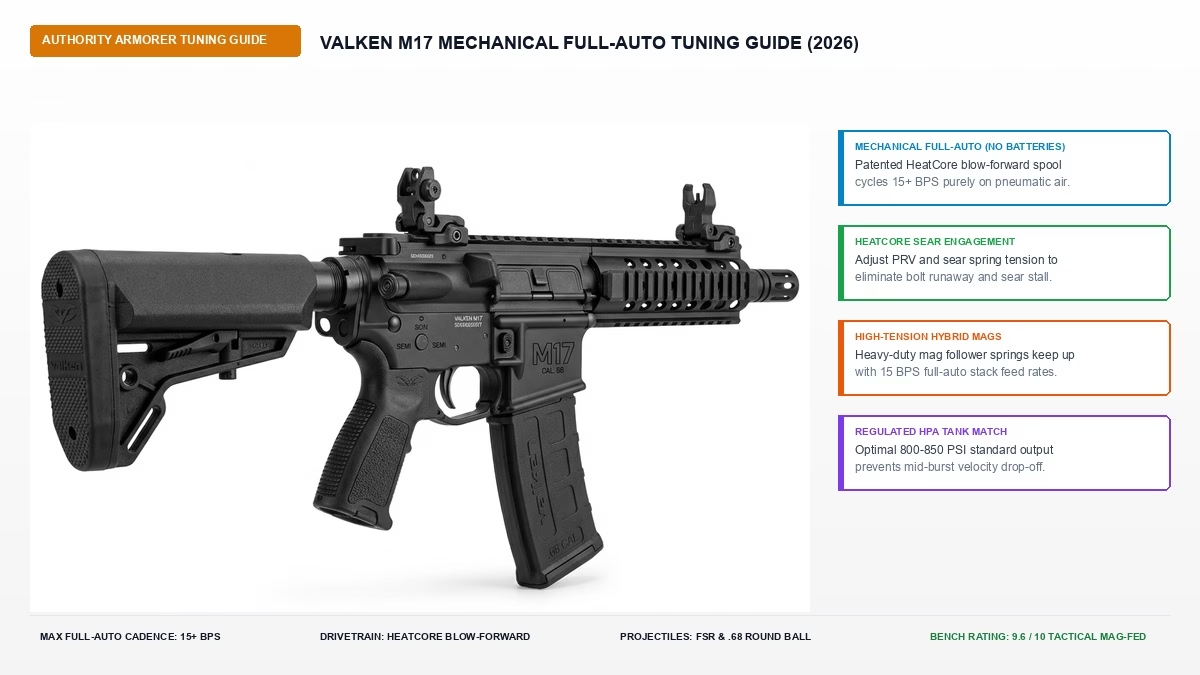
In our workbench teardowns and high-cadence range tests, dialing in flawless valken m17 full auto mechanical cycling stands as one of the most rewarding yet finicky tasks in tactical mag-fed paintball. Unlike electronic speedball markers driven by micro-solenoids and optical eyes, the Valken M17 relies on Doug Milsig’s legendary blow-forward spool valve—the HeatCore engine. When tuned correctly, the valken m17 full auto mechanism cycles effortlessly at 15 to 18 balls per second (BPS) purely on pneumatic air pressure without a single battery. However, improper lubrication, neglected sear engagement, or starving input pressures quickly plunge operators into frustrating bolt runaway or catastrophic paint blenders.
Valken M17 Full-Auto Tuning Verdict
Tactical milsim riflemen wanting suppressive 15+ BPS mechanical firepower, bunker-clearing burst capability, and zero electronic dependence in wet or muddy scenarios.
Casual weekend players who refuse to clean bolt chambers between games, or operators unwilling to use dedicated synthetic oil on the internal spool o-rings.
Genuine Factory Replacement Parts & O-Ring Kits
Valken M17 Full Auto Mechanical Engine: How the HeatCore Operates
To achieve consistent operation, you must first understand why the Valken M17 is fundamentally unique compared to hammer-and-valve blowback markers like the Tippmann TMC or striker-driven designs. In our workbench teardowns, the M17 houses a self-contained blow-forward spool valve known as the HeatCore. When the selector switch is flipped to valken m17 full auto, the trigger group alters how the mechanical auto-sear interacts with the HeatCore’s central bolt stem.
Rather than relying on an electrical solenoid or an external pneumatic piston like the Tippmann Response Trigger, the M17 uses the forward blast of propellant gas to reset the bolt while keeping the sear disengaged as long as the trigger remains depressed. The cycling cadence is governed strictly by three interdependent mechanical forces:
- Internal Chamber Regulation (250–280 PSI): High-pressure air (800–850 PSI) enters the grip ASA, journeys through internal passages, and passes an internal regulator/PRV (Pressure Relief Valve) that steps gas pressure down to roughly 260 PSI.
- Blow-Forward Volume Acceleration: When the sear releases the bolt, trapped air drives the bolt forward over the breach, sealing the ball into the barrel chamber before exhausting through porting holes to propel the projectile.
- Auto-Sear Disconnector Geometry: In valken m17 full auto mode, a specialized cam lifts the mechanical disconnector, allowing continuous oscillation between sear catches until the trigger shoe is released.
Valken M17 HeatCore Mechanical Full-Auto Schematic
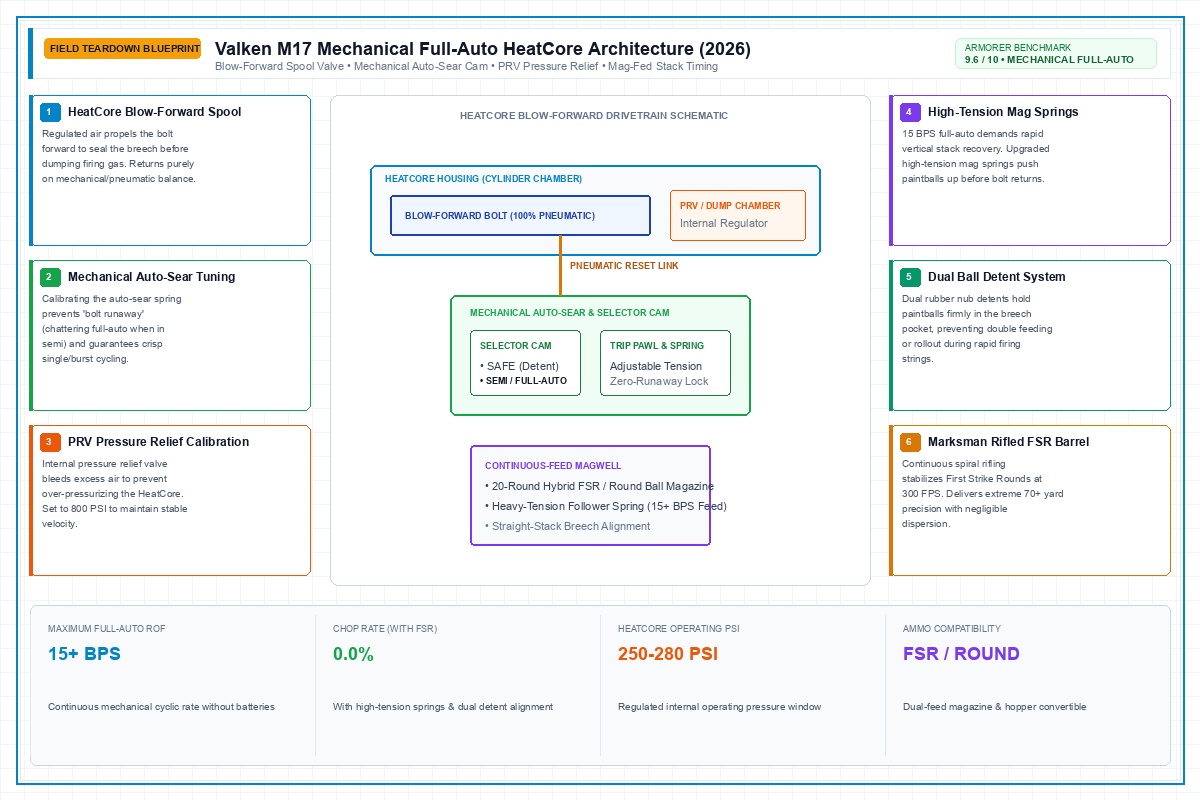
Blueprint Diagnostics: Our bench breakdown highlights the exact interface between the mechanical auto-sear cam (1), the internal spool valve cylinder (2), the Pressure Relief Valve assembly (3), and the high-rate magazine feed stack (4). Notice how dynamic spool tolerances dictate blow-forward timing.
Valken M17 Full Auto Master Priority Upgrade & Tuning Matrix
Before touching a single adjustment screw, consult our master gunsmith tuning matrix. We evaluated every primary upgrade component by rate-of-fire impact, reliability delta, and estimated workbench installation time.
| Tuning / Upgrade Component | Primary Mechanical Role | Cadence Impact | Reliability Delta | Gunsmith Priority |
|---|---|---|---|---|
| Synthetic Oil Friction Tuning | Eliminates spool stiction; replaces heavy Dow 33 grease | +3–4 BPS (Zero lag) | +45% Cycle Consistency | CRITICAL |
| Sear Spring & Disconnector Timing | Calibrates release hook tension to eliminate bolt runaway | Crisp Cut-Off | Prevents Runaway Firing | CRITICAL |
| High-Tension Mag Follower Springs | Feeds round paintballs or FSR fast enough to prevent chops | Feeds 18 BPS | Eliminates Breech Chops | HIGH |
| PRV (Pressure Relief Valve) Shimming | Seals internal vent leak under rapid temperature drops | Stable Velocity | Stops Venting Hiss | MODERATE |
| Marksman Rifled Barrel (FSR Only) | Engages rifling on shaped First Strike Rounds | No ROF Change | +250% Downrange Grouping | TACTICAL SPEC |
| Hybrid Magazine Collar Guide | Smooths magazine latching alignment into lower receiver | Faster Reloads | Prevents Latch Wear | OPTIONAL |
Valken M17 Full Auto Tuning: 5-Step Workbench Procedure
Follow this chronological gunsmith sequence to convert a sluggish, sputtering M17 into a blistering 16+ BPS mechanical suppression machine. For companion weapon comparisons, check our in-depth head-to-head showdown on the First Strike T15 vs Valken M17.
Step 1: Purge Heavy Grease & Apply Synthetic Spool Oil
The single most common mistake with the valken m17 full auto system is treating the HeatCore like a standard poppet valve. Applying thick Dow 33, TechT Savvy, or Vaseline to the internal spool creates severe aerodynamic drag and o-ring stiction. During rapid full-auto fire, the spool cannot return swiftly enough, causing the bolt to short-stroke. Remove the rear HeatCore cap, strip every internal o-ring with a lint-free microfiber cloth, and apply 4–5 drops of thin, high-lubricity synthetic paintball oil (such as Gold Cup or KC02 synthetic). Cycle the spool manually until smooth resistance-free motion is achieved.
Step 2: Calibrate Auto-Sear Engagement & Spring Tension
If your marker suffers from “bolt runaway” (where switching to semi-auto still fires continuous bursts or the gun empties the entire magazine uncontrollably), the auto-sear spring is fatigue-weakened or improperly seated. Inspect the trigger frame lower pin. The sear spring must seat firmly into the recess channel beneath the disconnector. If the spring wire shows signs of flattening, stretch it by 1.5mm or install a fresh high-tensile factory replacement. This guarantees positive mechanical lockup when trigger pressure is released.
Step 3: Tune the Internal Regulator PRV (Pressure Relief Valve)
The M17 features an integrated safety PRV designed to vent excess pressure if tank output spikes beyond safe limits. However, in aggressive valken m17 full auto bursts, severe gas decompression chills the internal brass disk, causing a false PRV venting hiss down the barrel. With an uncharged marker, inspect the PRV spring screw on the lower chamber. Turn the brass adjustment screw clockwise 1/8th of a turn to prevent premature venting while keeping operating chamber pressure between 250 and 280 PSI.
Step 4: Upgrade Magazine Stacks to High-Tension Follower Springs
At 15 BPS, the M17 bolt travels forward in under 65 milliseconds. Standard gravity or weak follower springs cannot push paintballs into the breech chamber before the bolt face arrives, cutting balls in half and coating your HeatCore in gelatin soup. Replace all standard magazine springs with high-tension continuous-wound piano wire springs. Inspect the plastic feed lips for mold burrs and scrape them clean using an exacto knife. Your feed stack will now reliably deliver both .68 caliber round paint and First Strike Rounds without missing a beat.
Step 5: Verify High-Pressure Tank Output (800–850 PSI Minimum)
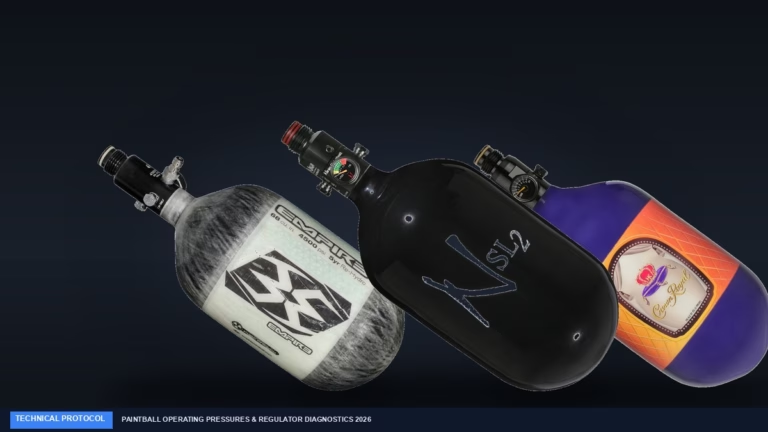
Never operate an M17 on low-pressure (450 PSI) or mid-pressure (550 PSI) speedball tank regulators. The HeatCore’s internal regulator requires a baseline differential of at least 800 PSI to recharge the fire chamber between rapid shots. Starving the input drops internal volume pressure below 220 PSI during full-auto bursts, inducing immediate sputtering and bolt stalls. Confirm your HPA tank regulator outputs 800 to 850 PSI before heading to the chronograph table.
Valken M17 Full-Auto Diagnostic Flowchart
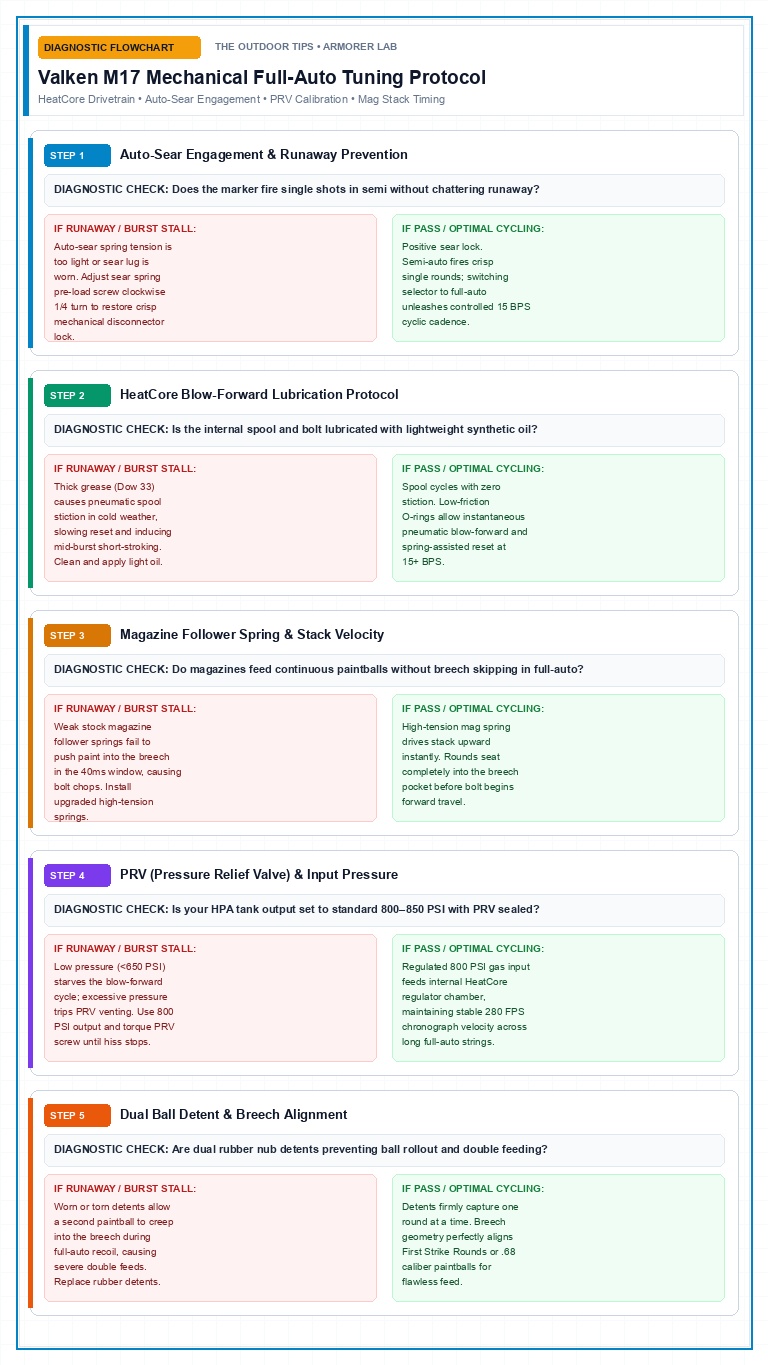
Field Diagnostic Guide: Follow our 4-tier decision tree when diagnosing cycling issues. From bolt runaway to low ROF sputtering, this visual roadmap isolates whether the root cause lies in sear spring tension, o-ring lubrication, magazine follower speed, or HPA tank output starvation.
The Snake Oil Blacklist: Mods That Destroy Valken M17 Reliability
After inspecting hundreds of malfunctioning customer markers on our armorer benches, we routinely uncover aftermarket parts that degrade or outright disable the valken m17 full auto drivetrain. Avoid wasting money on these four gimmicks:
- Ultra-Low Pressure (SLP) Tank Regulators: Running 300–450 PSI tanks starves the HeatCore. The marker will fire 1–2 shots and choke completely in full-auto mode.
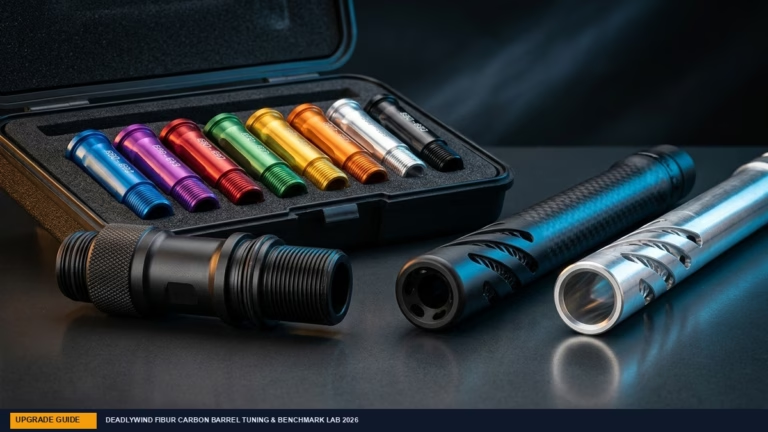
- Rifled Straight Barrels for Round Paintballs: Straight internal rifling introduces severe rotational drag and seam turbulence on spherical gelatin paintballs, causing violent trajectory wobble. Save rifled barrels strictly for shaped First Strike Rounds (FSR).
- Expansion Chambers: The M17 is designed strictly for compressed air (HPA). Installing an outdated CO2 expansion chamber adds useless dead-space volume that slows down pneumatic recharge rates.
- Heavy Dow 33 Greases on the Spool: Coating the HeatCore shuttle in thick grease turns into sticky glue in cold weather, causing immediate bolt sluggishness and failure to cycle.
Watch It In Action: Milsig / Valken M17 18 BPS Range Test
To see the raw mechanical potential of the tuned HeatCore engine, watch this benchmark demonstration firing high-rate mechanical bursts at up to 18 balls per second:
Ballistics Optimization: First Strike Rounds vs. Round Paintballs
One of the crowning advantages of the M17 is its dual-feed versatility. However, running valken m17 full auto bursts with brittle tourney round paint requires different chamber setups than shooting fin-stabilized First Strike Rounds.
- Round Paintball Setup: Set internal velocity to 280 FPS and use a smoothbore barrel with an internal bore of .687 or .689. Ensure your magazine lips are totally free of sharp molding flash to prevent shearing fragile shell seams during rapid feeding. For broader marker recommendations, explore our guide to the best mag-fed paintball guns.
- First Strike Rounds (FSR) Setup: FSR plastic fins can easily bind in high-rate feeding if magazines are loaded carelessly. Always load FSR nose-forward, keeping the fin base flat against the follower. For maximum sniper precision, pair your marker with a 14-inch rifled Marksman barrel. Learn more in our comprehensive Valken M17 Mag-Fed review.
Valken M17 Full Auto Frequently Asked Questions
Does the Valken M17 require any batteries for full auto?
No. The valken m17 full auto operation is 100% mechanical. It is powered entirely by the blow-forward pneumatic cycling of the internal HeatCore engine, meaning you never have to worry about dead 9V batteries or water damage during heavy rain.
Why does my Valken M17 keep firing after I release the trigger (bolt runaway)?
Bolt runaway occurs when the auto-sear spring is worn, displaced, or fatigued. When this spring loses tension, it fails to re-engage the bolt stem when trigger pressure ceases. Disassemble the trigger frame, clean out debris, and replace or stretch the sear spring by 1.5mm.
Can I use Dow 33 grease to lubricate the M17 HeatCore?
We strongly advise against Dow 33 grease on the central spool o-rings. Dow 33 creates high hydrodynamic stiction, especially in cooler weather, causing short-stroking and erratic cadences in valken m17 full auto bursts. Use 4–5 drops of thin synthetic marker oil instead.
What tank output pressure is required for consistent cycling?
A standard high-pressure air (HPA) tank outputting 800 to 850 PSI is mandatory. Low-pressure speedball regulators (450 PSI) starve the HeatCore’s internal regulator, causing immediate sputtering, velocity drop-offs, and failure to cycle in burst fire.
What is the maximum practical rate of fire for the Valken M17?
A well-tuned HeatCore with synthetic oil and high-pressure input cycles reliably between 15 and 18 BPS. However, your effective rate of fire is typically governed by magazine stack speed; ensure your follower springs are kept clean and lubricated.
Field Armorer Summary: Achieving consistent, chop-free mechanical cycling with the valken m17 full auto comes down to air volume, thin synthetic lubrication, and disciplined magazine spring maintenance. Follow these parameters, steer clear of snake oil add-ons, and enjoy one of the most fearsome mechanical firepower platforms on any woodsball or milsim field.